
Nonwoven Fabrics Market Size, Share & Trends Analysis Report by 2026-2035
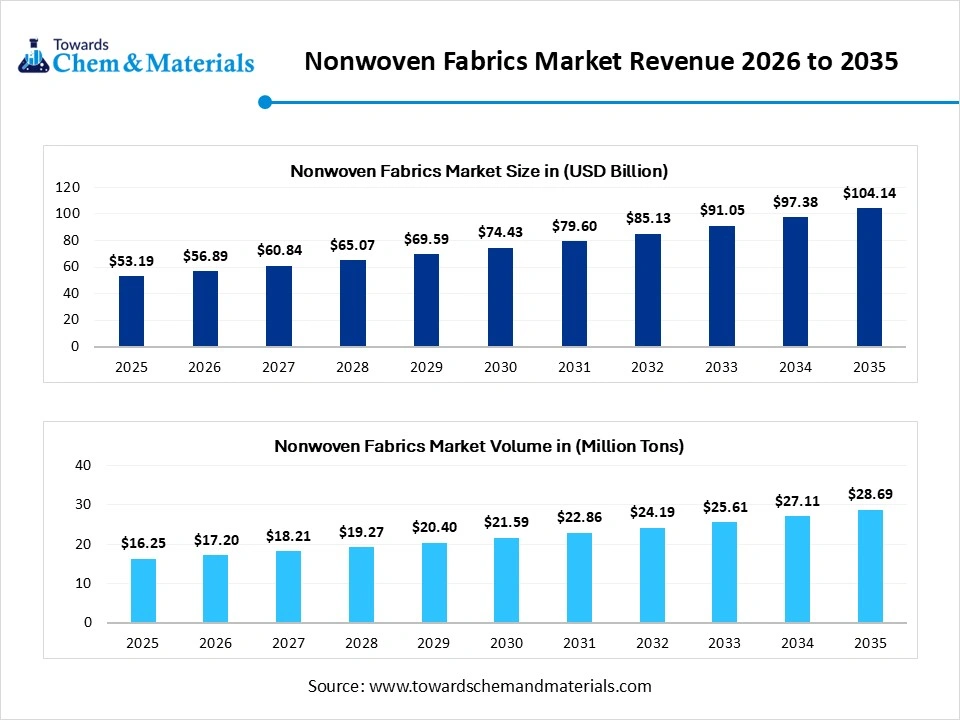
The nonwoven fabrics market is projected to grow from USD 53.19 billion in 2025 to USD 104.14 billion by 2035, expanding at a CAGR of 6.95% during the forecast period, with an estimated value of USD 56.89 billion in 2026. In volume terms, the market is anticipated to increase from 16.25 million tons in 2025 to 28.69 million tons by 2035, at a CAGR of 5.85%. The study covers detailed segmentation data, regional performance across major geographies, and extensive analysis of key companies. Additionally, it offers insights into the competitive landscape, value chain structure, trade data, and profiles of leading manufacturers and suppliers.
Content
Nonwoven Fabrics Market Growth with Logistics & Distribution Solutions
The global non-woven fabrics market was valued at USD 53.19 billion in 2025, is estimated to reach USD 56.89 billion in 2026, and is projected to reach USD 104.14 billion by 2035, growing at a CAGR of 6.95% from 2026 to 2035. In terms of volume, the nonwoven fabrics market is projected to grow from 16.25 million tons in 2025 to 28.69 million tons by 2035. growing at a CAGR of 5.85% from 2026 to 2035.
Key Takeaways
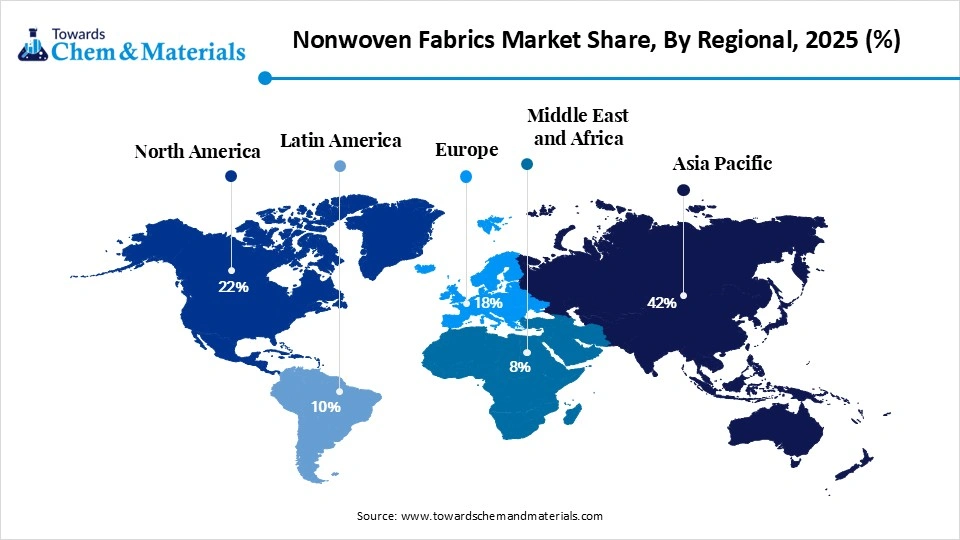
- Asia Pacific dominated the nonwoven fabrics market with the largest revenue share of 42% in 2025.
- By product, the disposables segment led the market with the largest revenue share of 65% in 2025.
- By material, the polypropylene segment led the market with the largest revenue share of 46% in 2025.
- By technology, the spun laid segment led the market with the largest revenue share of 49% in 2025.
- By application, the medical and hygiene segment led the market with the largest revenue share of 48% in 2025.
Market Size and Volume Forecast
- Market Estimated Size (2025): USD 53.19 Billion | CAGR (2026–2035):6.95%
- Market Projected Size (2035): USD 104.14 Billion
- Market Volume (2025): 16.25 Million Tons (MT) | Volume CAGR (2026–2035): 5.85%
- Market Projected Volume (2035): 28.69 Million Tons (MT)
- Market Pricing (2025):
- Average Manufacturing Price (2025): USD 2.65/kg
- Average Selling Price (2025): USD 3.45/kg
- Pricing CAGR (2025–2035): 3.11%
Market Overview
What Is The Significance Of The Nonwoven Fabrics Market?
The nonwoven fabrics market is highly significant, driven by its essential role in hygiene (diapers, wipes), medical (masks, gowns), automotive, and construction sectors. It is valued for producing lightweight, cost-effective, and breathable materials, with a strong shift toward sustainable and biodegradable products. The market is evolving with technology to create eco-friendly biodegradable alternatives, supported by high demand in emerging markets.
Nonwoven Fabrics Market Growth Trends
- Dominance of Hygiene and Medical Sectors: The market is heavily driven by demand for baby diapers, adult incontinence products, and medical-grade PPE (masks, gowns).
- Technological Advancements: Innovation in smart nonwovens, such as antimicrobial coatings and advanced filtration technologies, is increasing.
- Sustainability and Eco-Friendly Materials: A significant trend is the development of biodegradable, recyclable, and compostable nonwoven fabrics to replace traditional petroleum-based products.
Report Scope
| Report Attribute | Details |
| Market Size and Volume in 2026 | USD 56.89 Billion / 17.2 Million Metric Tons |
| Expected Size and Volume by 2035 | USD 104.14 Billion / 28.69 Million Metric Tons |
| Growth Rate from 2026 to 2035 | CAGR 6.95% |
| Forecast Period | 2026 - 2035 |
| Dominant Region | Asia Pacific |
| Segment Covered | By Product, By Material, By Technology, By Application and By Regions |
| Key companies profiled | Ahlstrom, Mitsui & Co., Ltd., Polymer Group Inc., Asahi Kasei Corporation, Fiberweb India Ltd., Avgol Industries 1953 Ltd., First Quality Enterprises, Inc., Providencia, PFNonwovens Holding s.r.o., Fibertex |
Key Technological Shifts In The Nonwoven Fabrics Market
The nonwoven fabrics market is experiencing rapid shifts toward sustainability, adopting biodegradable polymers, and utilizing recycled fibers, which fuels growth. Key technical advancements include high-performance spunbond and meltblown technologies for superior filtration and lightweighting, alongside the integration of smart textiles (sensors) and AI-driven automation for enhanced production efficiency, increasing demand, and supporting growth.
Trade Analysis of Nonwoven Fabrics Market: Import & Export Statistics
- According to Global Export Data, the world exported 314,802 Non-Woven Fabrics shipments between June 2024 and May 2025 (TTM) via 14,781 verified exporters and 14,753 buyers, representing a 46% YoY change.
- Vietnam, Indonesia, and South Korea lead as the top Non-Woven Fabrics importers, while Vietnam with 320,895 shipments, China with 268,723 shipments, and South Korea with 46,322 shipments, rank as the largest global Non-Woven Fabrics exporters.
Top-performing Global Non-Woven Fabrics Exporters by volume
- HAN YOUNG VIETNAM CO LTD: 36,826 shipments (37%)
- CONG TY TNHH HANSUNG VIET NAM CONG TY TNHH: 18,026 shipments (18%)
- COSMO VIET NAM CO LTD: 11,044 shipments (11%)
Supply Chain Analysis of Nonwoven Fabrics Market
Fabric Production & Processing
Nonwoven fabrics are produced through processes such as spunbond, meltblown, needle punching, and hydroentangling using fibers like polypropylene, polyester, and viscose for applications in hygiene, medical, and industrial sectors.
- Key players: Berry Global, Freudenberg Group, Ahlstrom, Kimberly-Clark
Quality Testing and Certification
Nonwoven fabrics must meet standards for tensile strength, absorbency, filtration efficiency, and hygiene safety compliance, depending on the application.
- Key players: International Organization for Standardization, ASTM International, U.S. Food and Drug Administration, European Chemicals Agency
Distribution to Industrial Users
Nonwoven fabrics are supplied to healthcare and hygiene product manufacturers, filtration companies, automotive industries, construction sectors, and agriculture applications.
- Key players: Berry Global, Freudenberg Group, Ahlstrom.
Nonwoven Fabrics Regulatory Landscape: Global Regulations
| Country / Region | Regulatory Body | Key Regulations | Focus Areas | Notable Notes |
| U.S. | Environmental Protection Agency (EPA); Food and Drug Administration (FDA); Occupational Safety and Health Administration (OSHA) | Toxic Substances Control Act (TSCA); FDA Medical Device & Food Contact Regulations; OSHA Safety Standards | Material safety, hygiene products compliance, and worker safety | Nonwoven fabrics used in medical, hygiene, and filtration applications must meet strict safety, sterility, and performance standards. |
| Europe | European Chemicals Agency (ECHA); European Commission | REACH Regulation; Medical Device Regulation (MDR); EU Ecolabel Standards | Chemical safety, healthcare compliance, sustainability | The EU enforces strict chemical usage and sustainability requirements, especially for nonwoven fabrics used in healthcare and personal care products. |
| China | Ministry of Industry and Information Technology (MIIT); State Administration for Market Regulation (SAMR) | Textile Industry Standards; Product Quality Law | Product quality, industrial compliance, hygiene standards | China regulates nonwoven fabric production with standards focused on quality, hygiene, and industrial safety. |
| India | Ministry of Textiles; Bureau of Indian Standards (BIS) | Textile Standards; Medical Textile Guidelines | Quality standards, hygiene compliance, product certification | India promotes nonwoven fabric production through standards and policies for hygiene and medical textile applications. |
| Japan | Ministry of Economy, Trade and Industry (METI); Ministry of Health, Labour and Welfare (MHLW) | Industrial Standards (JIS); Pharmaceutical and Medical Device Act | Product quality, healthcare applications, safety | Japan regulates nonwoven fabrics used in medical and hygiene products through strict quality and safety standards. |
| Brazil | National Health Surveillance Agency (ANVISA); Brazilian Institute of Environment and Renewable Natural Resources (IBAMA) | Health Product Regulations; Environmental Safety Laws | Medical textile safety, environmental compliance | Brazil regulates nonwoven fabrics used in healthcare and hygiene sectors with a focus on product safety and environmental standards. |
Market Dynamics
Drivers:
Rising Demand For Hygiene Products
The nonwoven fabrics market is driven by rising demand for disposable hygiene products (diapers, wipes), growing healthcare applications (masks, gowns), and adoption in automotive/construction sectors. Growth is accelerated by cost-effectiveness, lightweight properties, and a shift toward sustainable, biodegradable materials, with a strong demand spike in Asia-Pacific.
Restrains:
Growing Environmental Regulations
The market faces significant challenges from environmental regulations banning plastic-based materials. Key growth constraints include volatile raw material prices, particularly for petroleum-derived polypropylene, rising sustainability demands, and high investment costs for advanced manufacturing technologies which hinders growth.
Opportunities:
Demand For Lightweight Products
The market, is driven by rising demand for hygiene products, medical supplies (PPE), and filtration solutions, creating opportunities. Key growth opportunities lie in sustainable/biodegradable materials, automotive lightweighting (EV batteries), and advanced spunbond/meltblown technologies, particularly in the Asia Pacific and Middle East regions.
Segmental Insights
Product Insights
The Disposables Segment Dominated The Market In 2025
The disposables segment dominated the market in 2025, driven by high demand in hygiene and medical applications. Rising health awareness, an aging population, and increased healthcare spending in developing regions are key drivers, with high demand, especially in the medical sector. Improved production technologies, such as meltblown and spunbond, improve the softness and fluid management of materials, enhancing their use.
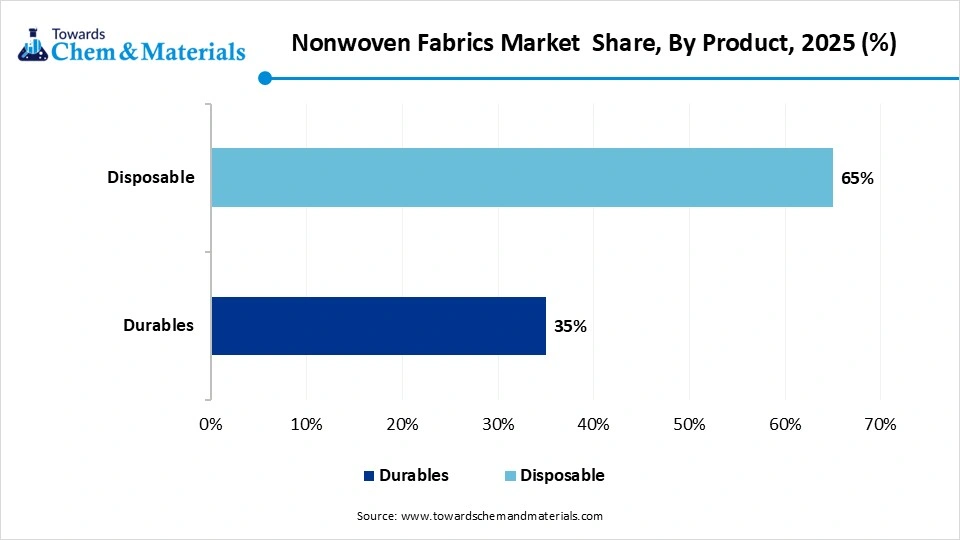
The durable segment is expected to have the fastest growth in the market during the forecast period, driven by high demand in automotive, construction, and filtration applications. The development of biodegradable, eco-friendly, durable nonwovens from materials such as PLA and natural fibers meets regulatory pressures for sustainable alternatives, driving market growth.
Material Insights
The Polypropylene Segment Dominated The Market In 2025
The polypropylene segment dominated the market in 2025, driven by rising demand in hygiene, medical, and geotechnical sectors. Cost-effectiveness, lightweight properties, and high-volume demand in spunbond applications drive the market. Manufacturers are heavily investing in sustainable, recyclable, and biodegradable PP alternatives to meet rising ecological regulations, with a shift toward green production methods.
Nonwoven Fabrics Market Share, By Material, 2025 (%)
| By Material | Revenue Share, 2025 (%) |
| Polypropylene | 46% |
| Polyethylene Terephthalate | 18% |
| Polymer | 10% |
| Rayon | 9% |
| Wood Pulp | 7% |
| BICO | 6% |
| Others | 4% |
The polyethylene terephthalate segment is expected to have the fastest growth in the market during the forecast period, driven by demand for durable, eco-friendly materials in hygiene, automotive, and construction sectors. PET nonwoven fabrics are widely utilized for their strength and versatility in applications such as geotextiles, automotive insulation, and disposable medical products. The PET Spunbond nonwoven fabric segment is experiencing significant demand for its durable, high-performance properties
Technology Insights
The Spunlaid Segment Dominated The Market Share In 2025
The spunlaid segment dominated the market in 2025, driven by high-speed production, cost-effectiveness, and rising demand in hygiene, medical, and geotextiles. The spunbond nonwoven market is poised for steady growth, specifically with the rise of durable, high-performance applications and sustainable, eco-friendly materials. The market is also seeing increased demand for customized interiors in the automotive sector.
Nonwoven Fabrics Market Share, By Technology, 2025 (%)
| By Technology | Revenue Share, 2025 (%) |
| Spunlaid | 49% |
| Drylaid | 22% |
| Wetlaid | 15% |
| Airlaid | 14% |
The airlaid segment is expected to have the fastest growth in the market during the forecast period, driven by rising demand in hygiene, healthcare, and industrial applications. This growth is propelled by its superior absorption in adult incontinence, feminine hygiene, and baby care products, alongside increasing eco-friendly, biodegradable options. Growth in biodegradable and eco-friendly airlaid materials made from natural fibers is accelerating demand.
Application Insights
The Medical And Hygiene Segment Dominated The Market In 2025
The medical and hygiene segment dominated the market in 2025, due to high demand for disposable diapers, feminine hygiene products, adult incontinence items, and medical protective gear. Growth is driven by heightened awareness of hygiene, aging populations, and increased use of sustainable/antibacterial materials. Development of biodegradable, eco-friendly nonwoven materials is a significant trend addressing environmental concerns.
Nonwoven Fabrics Market Share, By Application, 2025 (%)
| By Application | Revenue Share, 2025 (%) |
| Medical & Hygiene | 48% |
| Construction & Geotextile | 15% |
| Upholstery | 8% |
| Filtration | 11% |
| Automobile | 5% |
| Garments | 6% |
| Others | 7% |
The upholstery segment is expected to have the fastest growth in the market during the forecast period, driven by demand for durable, lightweight, and cost-effective materials in furniture and automotive interiors. The growth is driven by the demand for long-lasting, durable, and cost-effective fabrics for furniture manufacturing. The market is focusing on sustainable, eco-friendly materials, with advancements in spunbond and meltblown techniques improving fabric strength and recyclability.
Regional Insights
How did Asia Pacific Dominate the Nonwoven Fabrics Market in 2025?
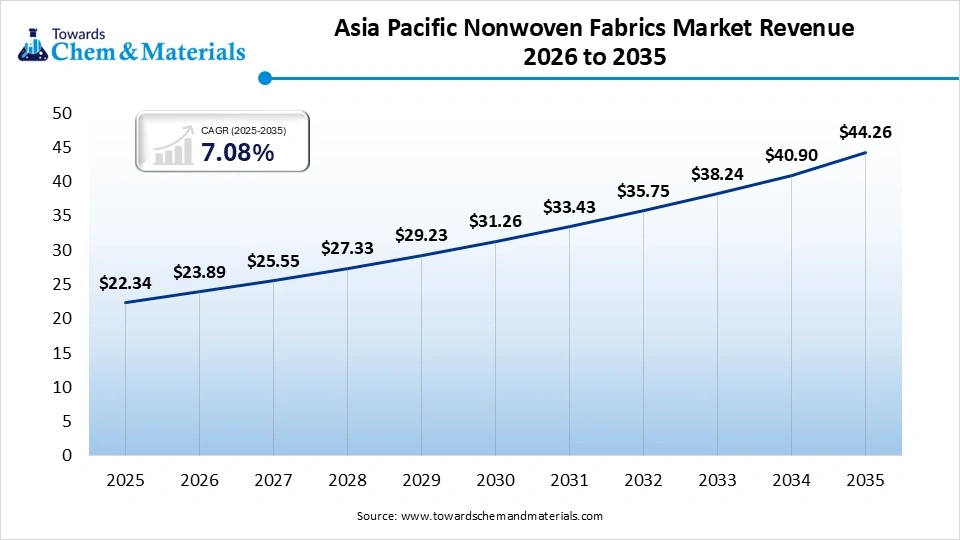
The Asia Pacific nonwoven fabrics market size was estimated at USD 22.34 billion in 2025 and is projected to reach USD 44.26 billion by 2035, growing at a CAGR of 7.08% from 2026 to 2035. China is the top manufacturer, while India and Southeast Asia show strong growth due to increasing middle-class consumption and rapid industrialization. Key players, including Magnera (formerly a division of Berry Global), Fitesa, and Freudenberg Performance Materials, are active in expanding their footprints in the Asia Pacific. The market is experiencing mergers and investments to increase capacity for specialty nonwovens
India Nonwoven Fabrics Market Growth Factor
The Indian nonwoven fabrics market is experiencing rapid expansion, driven by medical and hygiene demand. The market is expanding due to rising disposable incomes, urbanization, and increased health awareness. Spunbond technology is dominant in India, widely used for producing wipes, medical, and agricultural items. The Indian government is supporting the textile industry through incentives and investments, encouraging the growth of technical textiles, including nonwovens.
North America Nonwoven Fabrics Market Growth Factor
North America is expected to have the fastest growth in the market during the forecast period, driven by high demand for disposable hygiene and medical products. The U.S. leads the market, which is increasingly focused on sustainable, biodegradable materials and advanced filtration technologies, supported by major players like Berry Global and Kimberly-Clark. The industry is seeing a shift toward advanced technology to produce superior materials for filtration and automotive applications.
U.S. Nonwoven Fabrics Market Growth Factor
The U.S. nonwoven fabrics market, driven by high-demand sectors like hygiene (diapers, wipes), healthcare (masks, gowns), and automotive filtration, is supported by advanced manufacturing technologies, strong infrastructure, and rising adoption of eco-friendly, sustainable materials. Increased demand for geotextiles in construction and sound insulation/filters in the automotive sector boosts market growth. Shifting towards sustainable, biodegradable, and eco-friendly nonwoven products is a key trend.
Recent Developments
- In March 2026, Lenzing Group expanded its VEOCEL™ Lyocell fiber production to Asia, establishing a new production line in Prachinburi to serve the growing regional demand for sustainable nonwovens. This strategic expansion strengthens the local supply chain for biodegradable, plant-based materials and marks a shift away from fossil-based, synthetic fibers in personal care products.
- In October 2025, Elixrr introduced Elixrr NonWovens, a pulp-based nonwovens line utilizing PentaTech technology to meet growing demand for sustainable, high-absorbency materials. The new, biodegradable fabrics offer over 50% pulp content and are designed for applications in hygiene, medical, and industrial cleaning.
Top players in the Nonwoven Fabrics Market & Their Offerings:
- Berry Global Inc.: Berry Global is a leading manufacturer of nonwoven fabrics used in hygiene, healthcare, and industrial applications. The company offers spunbond and meltblown nonwovens widely used in diapers, wipes, medical gowns, and filtration systems.
- Freudenberg Group: Freudenberg produces high-performance nonwoven materials for automotive, filtration, construction, and medical applications. The company focuses on advanced technical textiles and sustainable nonwoven solutions.
- Kimberly-Clark Corporation: Kimberly-Clark uses nonwoven fabrics extensively in personal care products such as diapers, tissues, and hygiene products. The company also develops specialized nonwoven materials for healthcare applications.
- DuPont de Nemours, Inc.: DuPont produces high-performance nonwoven materials such as Tyvek®, widely used in protective apparel, construction, and industrial applications. The company focuses on durability, barrier protection, and lightweight materials.
- Toray Industries, Inc.: Toray manufactures advanced nonwoven fabrics for automotive, hygiene, and industrial applications. The company invests in innovative fiber technologies and sustainable materials.
Nonwoven Fabrics Market Top Players
- Ahlstrom
- MITSUI & CO., LTD.
- Polymer Group Incorporation
- Asahi Kasei Corporation.
- Fiberwebindia Ltd.
- Avgol Industries 1953 Ltd,
- First Quality Enterprises, Inc.
- Providencia
- PFNonwovens Holding s.r.o.
- Fibertex
Nonwoven Fabrics Market Segments Covered:
By Product
- Durables
- Disposable
By Material
- Polypropylene
- Polyethylene Terephthalate
- Polymer
- Rayon
- Wood Pulp
- BICO
- Others
By Technology
- Spunlaid
- Drylaid
- Wetlaid
- Airlaid
By Application
- Medical & Hygiene
- Construction & Geotextile
- Upholstery
- Filtration
- Automobile
- Garments
- Others
By Regions
- North America
- U.S.
- Canada
- Mexico
- U.S.
- Europe
- Germany
- UK
- France
- Italy
- Spain
- Germany
- Asia Pacific
- China
- India
- Japan
- South Korea
- China
- Latin America
- Brazil
- Argentina
- Brazil
- Middle East & Africa
- Saudi Arabia
- South Africa
- Saudi Arabia
FAQ's
Question 1 : What are the key trends shaping the nonwoven fabrics market?
Answer : Major trends include a strong shift toward sustainable, biodegradable materials and the adoption of spun-bond technology.
Question 2 : Which region holds the largest share of the nonwoven fabrics market?
Answer : Asia Pacific holds the largest share of the nonwoven fabrics market.
Question 3 : Who are the key players in the nonwoven fabrics market?
Answer : The nonwoven fabrics market is fragmented, with multiple players, including Berry Global Inc., Freudenberg Group, Ahlstrom-Munksjö, Kimberly-Clark, Fitesa S.A., PFNonwovens, DuPont, and Toray Industries, across the world.
Question 4 : What are nonwoven fabrics and why are they important?
Answer : Nonwoven fabrics are engineered materials made by bonding fibers without weaving or knitting. They are important due to their cost-effectiveness, lightweight nature, and versatility, widely used in hygiene products, medical supplies, automotive, and construction.
Question 5 : Which region dominates the nonwoven fabrics market?
Answer : Asia Pacific dominated the market in 2025 due to strong manufacturing capabilities, growing population, and rising demand for hygiene and medical products.
Meet the Team

Saurabh Bidwai
Principal Consultant
Saurabh Bidwai, a B.Tech Chemical Engineering graduate with 4+ years of experience, specializes in specialty chemicals, commodity chemicals, and engineered materials, offering valuable insights into market trends and emerging opportunities.

Aditi Shivarkar
Reviewed By
Aditi Shivarkar, with 14+ years in Chemical and Materials market research, specializes in Chemical and Materials. She ensures accurate, actionable insights, driving Towards Chemicals And Materials Analytics and Consulting excellence in industry trends and sustainability.