
Oilfield Services Market Size, Production Volume, Sales Performance, Export & Import Dynamics, Adoption Rates, Recycling Rate, Material Efficiency, Market Share Analysis, and Demand Trends
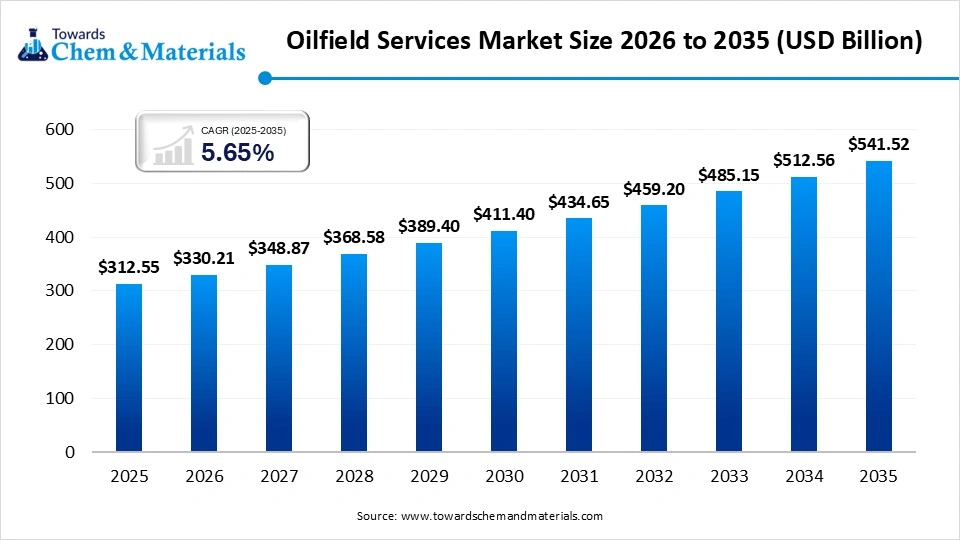
The Oilfield Services market size is estimated at USD 330.21 billion in 2026 and is expected to reach USD 541.52 billion by 2035, growing at a CAGR of 5.65%. This comprehensive report provides an in-depth value chain analysis and trade data, highlighting the Drilling Services segment's 30% dominance and the Onshore location's 62% market share. We profile global leaders such as SLB, Halliburton, and Baker Hughes, examining their competitive strategies in North America, which held a 32% share in 2025, and Asia Pacific, the fastest-growing region with a 5.9% CAGR.
Content
Oilfield Services Market Trends, Growth and Market Size Analysis
The global Oilfield Services market size was estimated at USD 312.55 billion in 2025 and is expected to be worth around USD 541.52 billion by 2035, growing at a CAGR of 5.65% from 2026 to 2035.The growth of the market is riven by rising global demand for energy, volatile oil prices influencing E&P investment, and the pursuit of operational efficiency through technology.
Market Highlights
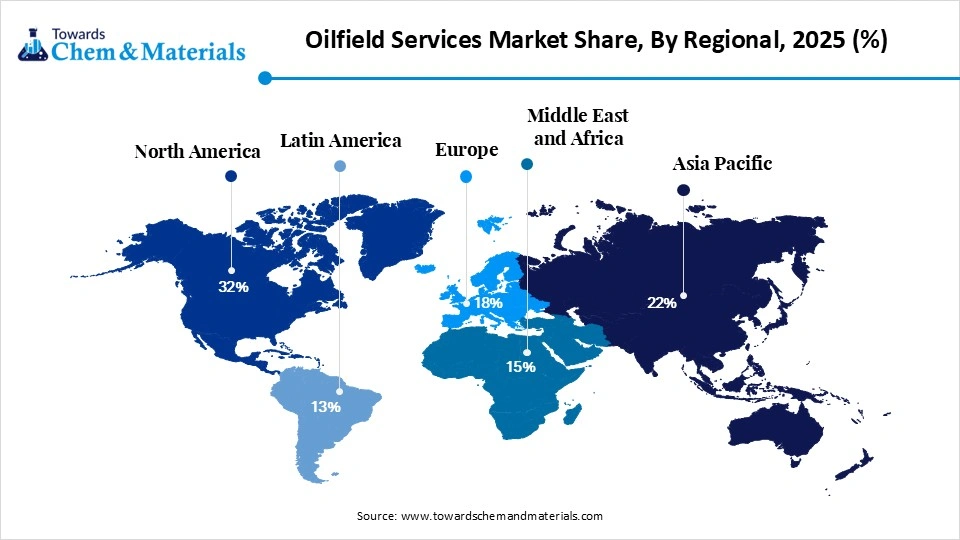
- By region, North America dominated the market with a share of 32% in 2025.
- By region, Asia Pacific held the market share of 22% in 2025 and is expects the fastest growth in the market with the CAGR of 5.9% in the forecast period.
- By service type, the drilling services segment dominated the market with 30% share in 2025.
- By service type, the completion services segment held 24% market share in 2025 and is expected to have the fastest growth with a CAGR of 6.1% in the forecast period.
- By location, the onshore segment dominated the market with 62% share in 2025.
- By location, the offshore segment held 38% market share in 2025 and is expected to have the fastest growth with a CAGR of 6.3% in the forecast period.
- By application, the production segment dominated the market with 38% share in 2025 and is expected to have the fastest growth with a CAGR of 5.9% in the forecast period.
- By equipment type, the field production machinery segment dominated the market with 27% share in 2025.
- By equipment type, the pumps and valves segment held 18% market share in 2025 and is expected to have the fastest growth with a CAGR of 5.8% in the forecast period.
Market Overview
What is the Significance of the Oilfield Services Market?
The market is projected to grow and is essential to the exploration, drilling, production, and maintenance of oil and gas assets. It is critical for maximizing resource recovery, adopting new technologies like AI for efficiency, and managing energy infrastructure, with North America leading in market share. The sector is a hub for innovation, incorporating artificial intelligence, robotics, and advanced data analytics to improve drilling efficiency, safety, and reservoir management.
Recent Growth Trends:
- Offshore and Deepwater Revival: High oil prices have revitalized offshore projects, particularly in Brazil, Guyana, and the Eastern Mediterranean, with deepwater and ultra-deepwater expected to account for a significant portion of the market.
- ESG and Decarbonization: Environmental, Social, and Governance (ESG) pressures are forcing the adoption of lower-carbon technologies, such as electric fracturing fleets (e-frac) and methane emission detection systems.
- Industry Consolidation: Companies are using mergers and acquisitions to improve operational efficiency and expand service offerings in a competitive landscape.
Report Scope
| Report Attribute | Details |
| Market Size in 2026 | USD 330.21 Billion |
| Expected Size by 2035 | USD 541.52 Billion |
| Growth Rate from 2026 to 2035 | CAGR 5.65% |
| Forecast Period | 2026 - 2035 |
| Dominant Region | North America |
| Segment Covered | By Service Type, By Location, By Application, By Equipment Type, By Regions |
| Key companies profiled | Baker Hughes Company, HALLIBURTON, SLB, Weatherford, Superior Energy Services, NOV., China Oilfield Services Limited, ARCHER OILFIELD ENGINEERS, Expro Group, TechnipFMC plc, Nabors Industries Ltd, Transocean Ltd., National Oilwell Varco, Inc., Schlumberger Limited, Saipem S.p.A. |
Key Technological Shifts In The Oilfield Services Market:
The oilfield services market is undergoing a rapid digital transformation to enhance efficiency and reduce costs, transitioning toward AI-driven analytics, automation, and real-time monitoring. Key shifts include the adoption of IoT sensors, predictive maintenance to minimize downtime, and the expansion of rigless, automated intervention techniques. The rise of "digital oilfields" utilizes IoT sensors, edge computing, and cloud computing for real-time monitoring of reservoir performance and equipment health.
Supply Chain Analysis of Oilfield Services Market:
Service Provision & Field Operations
- Oilfield services include drilling, well completion, production optimization, reservoir evaluation, and maintenance services provided using advanced equipment and technologies to support oil and gas exploration and production.
- Key players: Schlumberger, Halliburton, Baker Hughes, Weatherford
Quality Testing and Certification
- Oilfield services must comply with operational safety standards, environmental regulations, and technical performance certifications to ensure safe and efficient extraction processes.
- Key players: American Petroleum Institute, International Organization for Standardization, U.S. Environmental Protection Agency, Occupational Safety and Health Administration
Distribution to Industrial Users
- Oilfield services are provided to oil and gas exploration companies, offshore drilling operators, national oil companies, and energy producers.
- Key players: Schlumberger, Halliburton, Baker Hughes.
Oilfield Services Regulatory Landscape: Global Regulations
| Country / Region | Regulatory Body | Key Regulations | Focus Areas | Notable Notes |
| United States | Environmental Protection Agency (EPA); Bureau of Safety and Environmental Enforcement (BSEE); Occupational Safety and Health Administration (OSHA) | Clean Air Act; Outer Continental Shelf Lands Act; OSHA Safety Standards | Offshore safety, emissions control, and worker safety | The U.S. enforces strict environmental and offshore drilling safety regulations, especially for deepwater exploration and hydraulic fracturing operations. |
| European Union | European Commission; European Chemicals Agency (ECHA) | Offshore Safety Directive; REACH Regulation; Industrial Emissions Directive (IED) | Environmental protection, offshore risk management | The EU focuses heavily on offshore safety, environmental protection, and chemical compliance in oilfield operations. |
| China | Ministry of Emergency Management (MEM); Ministry of Ecology and Environment (MEE) | Work Safety Law; Environmental Protection Law | Industrial safety, emissions control | China regulates oilfield services with strict safety protocols and environmental compliance requirements, particularly for offshore and shale operations. |
| India | Directorate General of Hydrocarbons (DGH); Ministry of Environment, Forest and Climate Change (MoEFCC) | Oilfields (Regulation and Development) Act; Environment Protection Act | Exploration licensing, environmental clearance | India regulates upstream oilfield services through licensing policies and environmental approvals for exploration and production. |
| Brazil | National Agency of Petroleum, Natural Gas and Biofuels (ANP); Brazilian Institute of Environment and Renewable Natural Resources (IBAMA) | Petroleum Law; Environmental Licensing Regulations | Offshore drilling safety, environmental compliance | Brazil has strict offshore regulations due to its deepwater reserves, especially in pre-salt fields. |
| Norway | Norwegian Petroleum Directorate (NPD); Petroleum Safety Authority (PSA) | Petroleum Activities Act; Health, Safety and Environment (HSE) Regulations | Offshore safety, sustainability | Norway is known for stringent offshore safety and sustainability standards in oilfield services. |
Market Dynamics
Drivers
What are the Key Growth Drivers of the Oilfield Services Market?
The market is driven by rising global energy demand, increased exploration and production (E&P) activities, particularly in offshore/deepwater regions, and accelerating shale gas extraction via hydraulic fracturing and horizontal drilling. Key drivers also include technological advancements in digitalization (AI, IoT), mature field optimization, and significant investment in infrastructure development.
Restrains
What are the Key Growth Restraints of the Oilfield Services Market?
Key growth restraints of the oilfield services market include extreme volatility in crude oil prices, which causes unpredictable investment cycles, and the global energy transition toward renewable energy sources. Stringent environmental regulations, high operational costs, and geopolitical tensions leading to supply chain disruptions also limit market growth.
Opportunities
What are the Key Growth Opportunities of the Oilfield Services Market?
The market is driven by growing energy demand, increasing offshore/shale exploration, and digital transformation. Key growth opportunities lie in advanced drilling technologies (AI/automation), deepwater projects, digital oilfield services, and sustainable, low-emission technologies. Rapid adoption of AI to optimize drilling, enable predictive maintenance, and enhance data interpretation, which reduces costs and improves performance.
Segmental Insights
Service Type Insights
The Drilling Services Segment Dominated The Market With 30% Market Share In 2025
The drilling services segment dominated the market with 30% share in 2025, due to a surge in global energy demand driving increased upstream capital expenditure, specialized onshore shale development, and a strong rebound in offshore deepwater exploration. Increased adoption of AI, automation, and automated drilling systems enhanced operational safety and efficiency, making previously uneconomical projects viable.
The completion services segment held 24% market share in 2025 and is expected to have the fastest growth with a CAGR of 6.1% in the forecast period, driven by an estimated 46.5% market share due to increasing complexity, a surge in unconventional shale development, and high-tech, multi-stage fracturing. Key growth drivers include accelerated offshore, deepwater projects, and rising demand for efficiency-focused technologies to optimize production in mature fields.
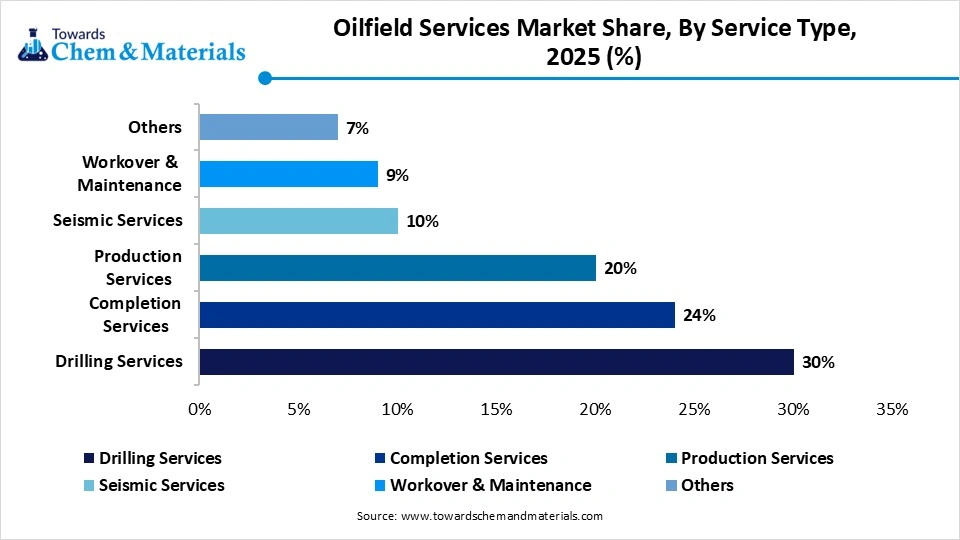
The production services segment held 20% market share in 2025, driven by a strategic industry shift toward maximizing output from existing, aging fields rather than solely drilling new wells. With a high, stable demand for oil and gas and a desire to optimize efficiency, production optimization technologies and well intervention services became critical drivers of profitability. Production services were boosted by the resurgence of offshore projects in regions like Brazil and Guyana, requiring specialized subsea production systems and maintenance.
The seismic services segment held 10% market share in 2025, driven by a global surge in offshore and deepwater exploration, increased investments in 3D/4D imaging for mature field optimization, and the integration of AI-driven data analytics. Increased global demand prompted oil and gas companies to ramp up exploration, boosting the need for seismic services to identify new, unconventional resources.
Location Insights
The Onshore Segment Dominated The Oilfield Services Market With 62% Market Share In 2025
The onshore segment dominated the market with 62% share in 2025, due to its cost-effectiveness, widespread shale development particularly in North America, and the adoption of advanced, integrated drilling technologies to maximize efficiency. The segment maintained its dominance by providing faster, more efficient production solutions compared to offshore alternatives. Enhanced Oil Recovery (EOR) techniques, digital oilfield solutions, and automation tools improved productivity.
The offshore segment held 38% market share in 2025 and is expected to have the fastest growth with a CAGR of 6.3% in the forecast period, driven by robust expansion in deep-water and ultra-deep-water exploration. Innovation in subsea technologies, robotic inspection, and autonomous underwater vehicles (AUVs) is enhancing operational efficiency and lowering costs. Drilling continues to hold a strong market share, while subsea and production services are witnessing accelerated growth.
Application Insights
The Production Segment Dominated The Market With 38% Share In 2025
The production segment dominated the market with 38% share in 2025 and is expected to have the fastest growth with a CAGR of 5.9% in the forecast period, driven by a strategic industry shift toward maximizing output from existing, mature wells using advanced technology and artificial lift systems. This growth was further fueled by rising global energy demand, increased offshore, and shale production activities.
The development segment held the 34% market share in 2025, driven by a surge in well completion services, rising demand for unconventional resource extraction, and increased, high-value, deepwater exploration. This growth was further propelled by integrated, full-field lifecycle contracts that reduced downtime. Offshore operations accelerated due to advancements in deepwater and ultra-deepwater, particularly in Brazil, the US Gulf, and Africa, where projects are expanding rapidly.
The exploration segment held 28% market share in 2025, driven by rising global energy demand, surging upstream capital expenditures, and increased investment in deepwater and unconventional resources. Key growth factors included enhanced digital technology adoption, such as AI and IoT, for efficiency, along with increased exploration in mature and frontier basins. The industry saw rapid adoption of artificial intelligence, automation, and IoT for enhanced efficiency, safety, and real-time monitoring.
Equipment Type Insights
The Field Production Machinery Segment Dominated The Market With 27% Market Share In 2025
The field production machinery segment dominated the market with 27% share in 2025, by leveraging advances in artificial lift, maturation of existing fields requiring enhanced recovery, and the adoption of IoT-enabled, high-efficiency equipment to reduce operating costs. This growth was fueled by operators prioritizing production optimization over new drilling to maximize output from existing assets.
The drilling equipment segment held 23% market share in 2025. Growth was propelled by the adoption of automated, high-pressure, and high-temperature (HPHT) rigs, particularly in deepwater projects, which demand 20,000 psi blowout preventers (BOPs) and advanced technologies to maximize efficiency in mature, complex wells. Increased adoption of Managed Pressure Drilling (MPD) and Rotary Steerable Systems (RSS) increased the need for specialized equipment.
The pumps & valves segment held 18% market share in 2025 and is expected to have the fastest growth with a CAGR of 5.8% in the forecast period, driven by a surge in shale and deepwater exploration, the rapid adoption of digitalization (IIoT) for predictive maintenance, and the need for upgrades to aging infrastructure to meet stricter environmental regulations. The expansion of pipelines and Liquefied Natural Gas (LNG) terminals has increased the demand for large-diameter valves and transmission pumps, with midstream operations accounting for a substantial market share.
The pressure control equipment segment held 17% market share in 2025, driven by increased high-pressure, unconventional, and deepwater drilling activity. Key growth factors included the adoption of IIoT-enabled automation, the rising demand for safety-critical well interventions, and a surge in onshore shale exploration in North America. Increased investment in complex reservoir projects and offshore development in regions like Guyana, Brazil, and the Middle East drove demand for high-pressure rating equipment.
Regional Insights
How did North America Dominate the Oilfield Services Market in 2025?
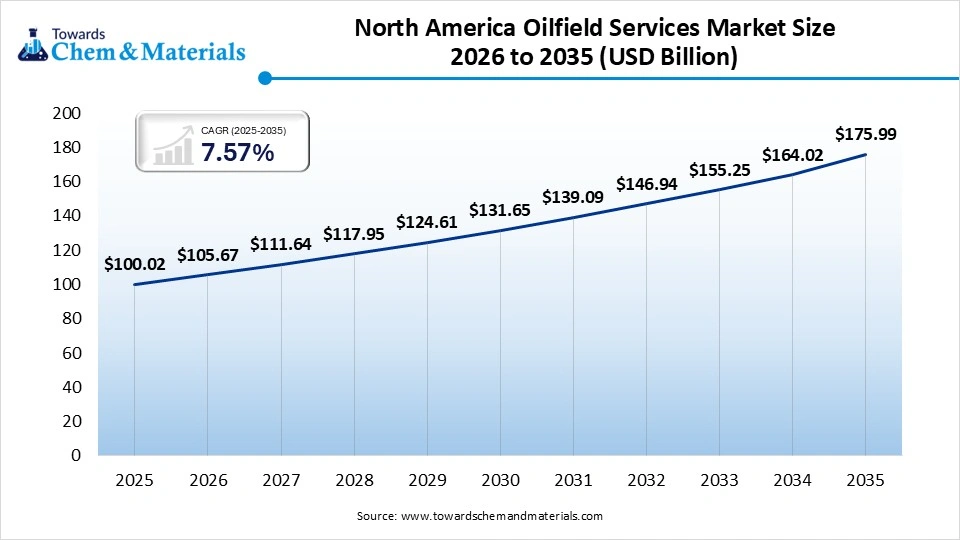
The North America Oilfield Services market size was estimated at USD 100.02 billion in 2025 and is projected to reach USD 175.99 billion by 2035, growing at a CAGR of 7.57% from 2026 to 2035. North America dominated the market with a 32% share in 2025, driven by intense shale innovation in the U.S. Permian Basin, advanced digital technology adoption, and robust infrastructure. High-efficiency drilling, including horizontal drilling, and increased offshore activity in the Gulf of Mexico reinforced this leading position. The rapid integration of AI, machine learning, and automation for operational efficiency, particularly in drilling and completion services.
U.S. Oilfield Services Market Growth Factor
The U.S. market is primarily driven by the resurgence of domestic shale production, advancements in horizontal drilling/hydraulic fracturing, and rising global energy demand. Key growth factors include increased investment in unconventional, onshore, and deepwater projects in the Permian Basin and Gulf of Mexico, alongside the rapid integration of digital, AI-driven, and automation technologies for operational efficiency.
Asia Pacific Oilfield Services Market Growth Factor
Asia Pacific held the market share of 22% in 2025 and is expects the fastest growth in the market with the CAGR of 5.9% in the forecast period, driven by rising energy consumption, increased offshore exploration (especially in Southeast Asia, Australia, and India), and significant investment in digital technologies. Governments in the region are prioritizing energy security, encouraging domestic production, and offering incentives for E&P (Exploration & Production) activities.
India Oilfield Services Market Growth Factor
The Indian oilfield services market is driven by surging energy demand, heavy government investment in offshore exploration, and efforts to reduce import dependence. Key growth factors include increased deepwater drilling in the Krishna-Godavari basin, adoption of advanced production technologies, and expansion of mature field redevelopment. Increasing adoption of digital technologies, such as real-time drilling data analytics and advanced hydraulic fracturing, is enhancing production efficiency.
Recent Developments
- In March 2026, Mullen Group Ltd. launched a dedicated website for its Grande Prairie Service Centre to streamline heavy-duty fleet maintenance access in northern Alberta. Operated by Mullen Oilfield Services L.P., this digital platform supports the broader "One Network, One Continent" strategy aimed at integrating technology like the Move-IT freight marketplace. (Source: finance.yahoo.com)
- In January 2026, Halliburton launched the HyperSteer MX, an industry-first, shankless matrix-body directional drill bit engineered for increased durability and efficiency in abrasive environments. The new technology enhances directional precision and reduces non-productive time (NPT) by facilitating longer drilling runs and decreasing the need for trips in challenging formations. (Source : www.oedigital.com)
Top players in the Oilfield Services Market & Their Offerings:
- Schlumberger Limited: SLB is the world’s largest oilfield services provider, offering integrated solutions across drilling, reservoir evaluation, production, and digital oilfield technologies. The company leads in advanced technologies such as AI-driven reservoir modeling and offshore services.
- Saipem S.p.A.: Saipem provides engineering, drilling, and construction services for offshore and onshore oil & gas projects, focusing on large-scale infrastructure.
- National Oilwell Varco, Inc.: NOV supplies equipment and components used in drilling and production operations, supporting oilfield service providers globally.
- Transocean Ltd.: Transocean specializes in offshore drilling services, particularly deepwater and ultra-deepwater exploration.
- Nabors Industries Ltd.: Nabors provides drilling and rig services along with automation technologies for onshore and offshore operations.
Other Top Players Are
- Baker Hughes Company
- HALLIBURTON
- SLB
- Weatherford
- Superior Energy Services
- NOV.
- China Oilfield Services Limited
- ARCHER OILFIELD ENGINEERS
- Expro Group
- TechnipFMC plc
Segments Covered:
By Service Type
- Drilling Services
- Directional Drilling
- Horizontal Drilling
- Managed Pressure Drilling
- Completion Services
- Hydraulic Fracturing
- Well Cementing
- Well Completion Tools
- Production Services
- Artificial Lift
- ESP (Electric Submersible Pumps)
- Gas Lift
- Well Intervention
- Enhanced Oil Recovery (EOR)
- Artificial Lift
- Seismic Services
- 2D Seismic
- 3D Seismic
- 4D Seismic
- Workover & Maintenance Services
- Well Stimulation
- Logging & Monitoring
- Others
- Consulting
- Decommissioning
By Location
- Onshore
- Offshore
- Shallow Water
- Deepwater
- Ultra-Deepwater
By Application
- Exploration
- Development
- Production
By Equipment Type
- Field Production Machinery
- Drilling Equipment
- Pumps & Valves
- Pressure Control Equipment
- Others
By Regions
- North America
- U.S.
- Canada
- Mexico
- Europe
- Germany
- UK
- France
- Italy
- Spain
- Asia Pacific
- China
- India
- Japan
- South Korea
- Latin America
- Brazil
- Argentina
- Middle East & Africa
- Saudi Arabia
- South Africa
FAQ's
Question 1 : What are the key trends shaping the oilfield services market?
Answer : Major trends include rapid adoption of AI and automation to enhance efficiency, increased ESG pressure favoring cleaner technology, and consolidation among major players to optimize costs.
Question 2 : Which region holds the largest share of the oilfield services market?
Answer : North America holds the largest share of the oilfield services market.
Question 3 : Who are the key players in the oilfield services market?
Answer : The oilfield services market is fragmented with multiple players, including SLB (formerly Schlumberger), Halliburton, Baker Hughes, Weatherford International, and TechnipFMC across the world.
Meet the Team

Saurabh Bidwai
Principal Consultant
Saurabh Bidwai, a B.Tech Chemical Engineering graduate with 4+ years of experience, specializes in specialty chemicals, commodity chemicals, and engineered materials, offering valuable insights into market trends and emerging opportunities.

Aditi Shivarkar
Reviewed By
Aditi Shivarkar, with 14+ years in Chemical and Materials market research, specializes in Chemical and Materials. She ensures accurate, actionable insights, driving Towards Chemicals And Materials Analytics and Consulting excellence in industry trends and sustainability.