
Organic Recycling of Bio-based Plastics Market Size, Sales Volume, Production Efficiency, Export & Import Metrics, Adoption Rates, Recycling Rate, Pricing Trends, Market Positioning, and Customer Experience
The organic recycling of bio-based plastics market was valued at USD 3.85 billion in 2025 and is expected to reach USD 4.38 billion in 2026, further projected to grow significantly to USD 13.84 billion by 2035, registering a CAGR of 13.65% during the forecast period. In volume terms, the market is anticipated to expand from 2.85 million tons in 2025 to 9.21 million tons by 2035, growing at a CAGR of 12.44%. The report provides detailed insights into market size, segment-wise data, regional performance, and key company analysis, along with comprehensive coverage of competitive landscape, value chain structure, trade data, and manufacturers and suppliers across the ecosystem.
Content
Organic Recycling of Bio-based Plastics Market Trends, Share, and Growth Analysis
The global organic recycling of bio-based plastics market was valued at USD 3.85 billion in 2025, is estimated to reach USD 4.38 billion in 2026, and is projected to reach USD 13.84 billion by 2035, growing at a CAGR of 13.65% from 2026 to 2035. In terms of volume, the organic recycling of bio-based plastics market is projected to grow from 2.85 million tons in 2025 to 9.21 million tons by 2035. growing at a CAGR of 12.44% from 2026 to 2035.

Key Takeaways
- By region, Europe dominated the market with the largest share of 33% in 2025. The dominance of the region can be attributed to the strong presence of advanced composite infrastructure.
- By region, Asia Pacific is expected to grow at the fastest CAGR of 15.2% over the forecast period. The growth of the region can be credited to the rapid urbanisation.
- By recycling process, the composting segment dominated the market with the largest share of 64% in 2025. The dominance of the segment can be attributed to the rapid expansion of industrial composite facilities.
- By recycling process, the anaerobic digestion segment is expected to grow at the fastest CAGR of 14.3% over the forecast period. The growth of the segment can be credited to the increasing demand for renewable energy.
- By polymer type, the Polylactic Acid (PLA) segment dominated the market with the largest share of 31% in 2025. The dominance of the segment can be linked to its high usage in packaging.
- By polymer type, the polyhydroxyalkanoates (PHA) segment is expected to grow at the fastest CAGR of 14.8% over the forecast period. The growth of the segment can be driven by increasing R&D investments.
- By end-use industry, the packaging segment dominated the market with the largest share of 38% in 2025. The dominance of the segment is due to an increase in the use of biodegradable plastics.
- By end-use industry, the consumer goods segment is expected to grow at the fastest CAGR of 13.9% during the projected period. The growth of the segment can be attributed to the increasing demand for sustainable disposable products.
- By application output, the compost production segment dominated the market with the largest share of 47% in 2025. The dominance of the segment can be linked to the high demand for organic filters.
- By application output, the biogas production segment is expected to grow at the fastest CAGR of 14.6% over the forecast period. The growth of the segment is owing to an increase in demand for renewable energy.
Market Size and Volume Forecast
- Market Estimated Size (2025): USD 3.85 Billion | CAGR (2026–2035): 13.65%
- Market Projected Size (2035): USD 13.84 Billion
- Market Volume (2025): 2.85 Million Tons (MT) | Volume CAGR (2026–2035): 12.44%
- Market Projected Volume (2035): 9.21 Million Tons (MT)
- Market Pricing (2025):
- Average Manufacturing Price: USD 1,260 per Ton
- Average Selling Price: USD 1,650 per Ton
- Pricing CAGR (2025–2035): 5.15%
What are Organic Recycling of Bio-based Plastics Market?
The market focuses on the industrial processing of compostable and biodegradable bioplastics into organic materials. It also includes aerobic composting or anaerobic digestion, converting plastics into biogas, compost, and water. The market is fuelled by sustainability initiatives and environmental regulations necessitating sustainable waste management.
Market Trends
- Ongoing technological innovations are the latest trend in the market, shaping positive market growth. The integration of smart technologies in chemical recycling is increasingly becoming prevalent by providing improved tracking and monitoring capabilities. These advanced technologies can handle an extensive range of bioplastics.
- There is a rapid transition towards customization and specialization within the market. As industries are becoming more diverse, the need for specialized bio-based solutions is rising. Also, market players are responding by providing bespoke products that are tailored to certain applications.
- Increasing infrastructure development in emerging economies is another major factor driving market growth. Rapid urbanisation, population growth, and government expenditure on adapting infrastructure, such as producing films, tea bags, and agricultural mulch films, have facilitated the substantial boost in demand for biobased plastic products.
Report Scope
| Report Attribute | Details |
| Market Volume in 2026 | USD 4.38 Billion / 3.20 Million Tons |
| Expected Volume by 2035 | USD 13.84 Billion / 9.21 Million Tons |
| Growth Rate from 2025 to 2034 | CAGR 13.65% |
| Base Year of Estimation | 2024 |
| Forecast Period | 2025 - 2035 |
| Dominant Region | Europe |
| Segment Covered | By Recycling Process,By Polymer Type, By Waste Source, By End-Use Industry, By Technology, By Application Output, By Regions |
| Key Companies Profiled | BASF, Total Corbion PLA, Braskem S.A., Danimer Scientific, Biome Bioplastics Ltd., FKuR Kunststoff GmbH, Bio-on S.p.A., Bioplastics Recycling GmbH |
How Cutting-Edge Technologies Are Revolutionizing the Organic Recycling of Bio-based Plastics Market?
Advanced technologies such as enzymatic depolymerization, synthetic biology, and AI-driven sorting are revolutionizing the market. These advancements boost biodegradation and systematically break down materials into high-grade components under mild conditions. Furthermore, research is rapidly creating high-performance microbes to improve the uptake and conversion efficiency of plastic waste.
Trade Analysis of the Organic Recycling of Bio-based Plastics Market: Import & Export Statistics
- According to data on United States Bioplastics imports (July 2024-June 2025 TTM), 159 shipments were recorded. These transactions involved 22 exporters purchased by 50 verified global buyers.
- The United States, Vietnam, and Belgium have emerged as top bioplastics importers, while China, Germany, and the Netherlands lead the market in exports.
- In 2024, China maintained its position as the global leader in plastic product exports, with an export value of approximately US$33 billion. This total accounts for 32% of the total global export market for plastic products.
Exports
- In 2025, China exported $179B of Plastics and Rubbers, being the 7th most exported product in China.
- In 2025, the prime destinations of China's Plastics and Rubbers exports were: the United States ($22B), Vietnam ($10.8B), India ($7.41B), Japan ($6.39B), and Russia ($6.11B).
Imports
- In 2025, China imported $77.1B of Plastics and Rubbers, being the 8th most imported product in China.
- In 2025, the prime origins of China's Plastics and rubber imports were: Japan ($11.3B), South Korea ($9.41B), Thailand ($8.64B), the United States ($7.21B), and Chinese Taipei ($4.74B).
- India's plastics industry is witnessing strong global demand, with total exports growing by 8% to reach USD 12.5 billion in FY 2024-25, up from USD 11.5 billion in FY 2023-24.
- Main destinations: USA, Europe, the Middle East, Africa, China, Latin America, etc.
Supply Chain Analysis of Organic Recycling of Bio-based Plastics Market
Feedstock Procurement
It refers to the strategic sourcing, collection, and processing of essential materials to create biodegradable plastics.
- Major Players: NatureWorks LLC, Novamont S.p.A
Chemical Synthesis and Processing
It emphasizes advanced end-of-life solutions for biopolymers, especially through chemical recycling. It involves breaking down bioplastics such as Polylactic Acid (PLA) and Polyhydroxyalkanoates (PHA) into their original monomers.
- Major Players: DowDuPont, Henkel (Adhesives):
Packaging and Labelling
It emphasises material derived from renewable biological sources that can be returned to the environment through composting or anaerobic digestion.
- Major Players: Braskem S.A., FKuR Kunststoff GmbH
Regulatory Compliance and Safety Monitoring
It involves stringent adherence to international standards and environmental regulations (RoHS, REACH) to ensure the safety, structural integrity, and reliability of products.
- Major Players: Futamura Chemical Co., Ltd, RWDC Industries
Organic Recycling of Bio-based Plastics Market's Regulatory Landscape: Global Regulations
| Country/Region | Key Regulations |
| European Union | From August 2026, new packaging design requirements mandate that all packaging be recyclable or reusable. By 2030, plastic parts must contain between 10% and 35% recycled content. |
| United States | In early 2026, the USDA rejected the inclusion of synthetic polymers (including some compostable plastics) in organic compost, citing concerns over potential PFAS and microplastic contamination. |
| China | Nine new national standards for recycled and recyclable plastics came into effect on 1 February 2026, requiring manufacturers to design for recyclability from the start |
Segmental Insights
Recycling Process Insights
Composting Segment Dominated the Market with 64% of Market Share in 2025
The composting segment dominated the market with the largest share of 64% in 2025. The dominance of the segment can be attributed to the rapid expansion of industrial composite facilities across the globe and government initiatives promoting compostable plastic adoption. Food waste integration fuels composite efficiency further.
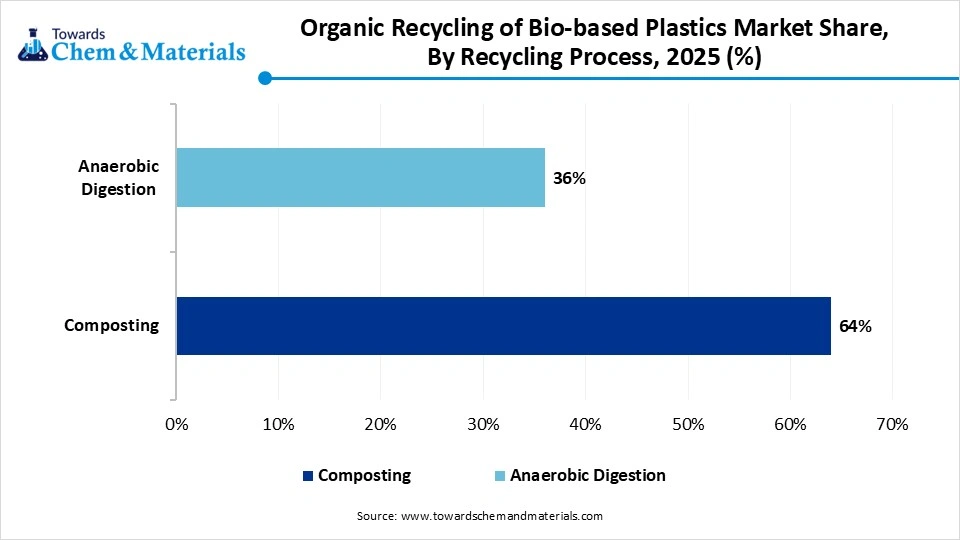
The anaerobic digestion segment held the second largest share of 36% in 2025 and is expected to grow at the fastest CAGR of 14.3% over the forecast period. The growth of the segment can be credited to the increasing demand for renewable energy for biogas generation, along with the implementation of waste-to-energy initiatives. Efficient waste conversion improves profitability.
Organic Recycling of Bio-based Plastics Market Share, By Recycling Process, 2025 (%)
| By Recycling Process | Revenue Share, 2025 (%) |
| Composting | 64% |
| Anaerobic Digestion | 36% |
Polymer Type Insights
Polylactic Acid (PLA) Segment Dominated the Market with 31% of Market Share in 2025
The Polylactic Acid (PLA) segment dominated the market with the largest share of 31% in 2025. The dominance of the segment can be linked to its high usage in packaging, coupled with the surge in bioplastic production globally. Strong composability further supports the recycling process.
The polyhydroxyalkanoates (PHA) segment held the third largest share of 18% in 2025 and is expected to grow at the fastest CAGR of 14.8% over the forecast period. The growth of the segment can be driven by increasing R&D investments and growing product demand in marine-safe applications. PHA gives superior biodegradability in various applications.
The starch blends segment held the second largest share of 21% in 2025. The growth of the segment is linked to its extensive use in disposable products and low cost with high availability. Compositing compatibility drives adoption further.
The PBS segment held 14% market share in 2025. The growth of the segment is owed to its enhanced mechanical properties, and its compatible nature aligns well with regulations. PBS is increasingly gaining traction in the agriculture and packaging sectors.
Organic Recycling of Bio-based Plastics Market Share, By Polymer Type, 2025 (%)
| By Polymer Type | Revenue Share, 2025 (%) |
| Polylactic Acid (PLA) | 31% |
| Polyhydroxyalkanoates (PHA) | 18% |
| Starch Blends | 21% |
| PBS | 14% |
| Others | 16% |
End-Use Industry Insights
Packaging Segment Dominated the Market with 38% of Market Share in 2025
The packaging segment dominated the market with the largest share of 38% in 2025. The dominance of the segment is due to an increase in the use of biodegradable plastics in packaging and food packaging. Regulatory bans on single-use plastic boost segment growth soon.
The consumer goods segment held the fourth largest share of 19% in 2025 and is expected to grow at the fastest CAGR of 13.9% during the projected period. The growth of the segment can be attributed to the increasing demand for sustainable disposable products, along with the surge in the adoption of biodegradable materials from various brands. Waste collection enhances recycling volumes.
The agriculture segment held the second largest share of 22% in 2025. The growth of the segment can be credited to the growing adoption of sustainable farming initiatives and the increase in waste output by biodegradable mulch films. Compost output also supports soil health.
The textile segment held the third largest share of 21% in 2025. The growth of the segment can be driven by the increasing popularity of biodegradable fibers in the fashion industry and the implementation of circular economy principles. There is an ongoing expansion of the recycling of textile waste.
Organic Recycling of Bio-based Plastics Market Share, By End-Use Industry, 2025 (%)
| By End-Use Industry | Revenue Share, 2025 (%) |
| Packaging | 38% |
| Agriculture | 22% |
| Consumer Goods | 19% |
| Textile | 21% |
Application Output Insights
The Compost Production Segment Dominated the Market with 47% of Market Share in 2025
The compost production segment dominated the market with the largest share of 47% in 2025. The dominance of the segment can be linked to the strong demand for organic filters and the rise in soil health initiatives. The agricultural sector uses compost extensively.
The biogas production segment held the second largest share of 33% in 2025 and is expected to grow at the fastest CAGR of 14.6% over the forecast period. The growth of the segment is owing to an increase in demand for renewable energy and government support for renewable projects. Energy recovery improves profitability.
The digestate utilization segment held the third largest share of 20% in 2025. The growth of the segment is due to its increasing use in nutrient-rich fertilizers and improved waste recovery quality. It also supports circular agricultural practices.
Organic Recycling of Bio-based Plastics Market Share, By Application Output, 2025 (%)
| By Application Output | Revenue Share, 2025 (%) |
| Compost Production | 47% |
| Biogas Production | 33% |
| Digestate Utilization | 20% |
Regional Insights
How did Europe Dominate the Organic Recycling of Bio-based Plastics Market in 2025?
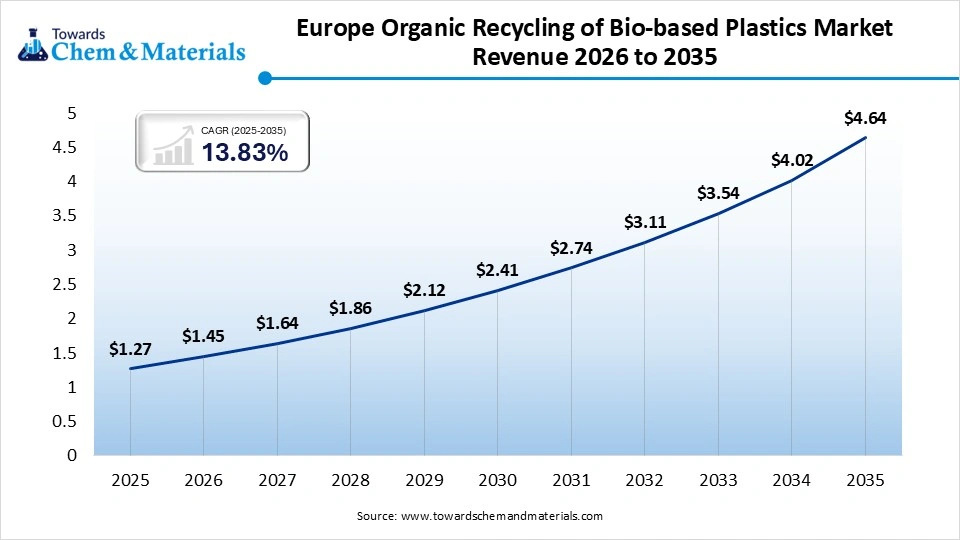
The Europe organic recycling of bio-based plastics market size was estimated at USD 1.27 billion in 2025 and is projected to reach USD 4.64 billion by 2035, growing at a CAGR of 13.83% from 2026 to 2035 The dominance of the region can be attributed to the strong presence of advanced composite infrastructure and stringent environmental regulations. Furthermore, a surge in consumer preference for sustainable products is impelling market players, especially in food and packaging, to adopt advanced composite materials, leading to market growth soon.
Germany Organic Recycling of Bio-based Plastics Market Trends
The growth of the market in the country is due to strong product demand from the automotive and packaging sectors, along with the robust cultural transition towards sustainable products. Also, the industry players and the German government are heavily investing in enzyme-based degradation methods and R&D for biodegradable polymers.
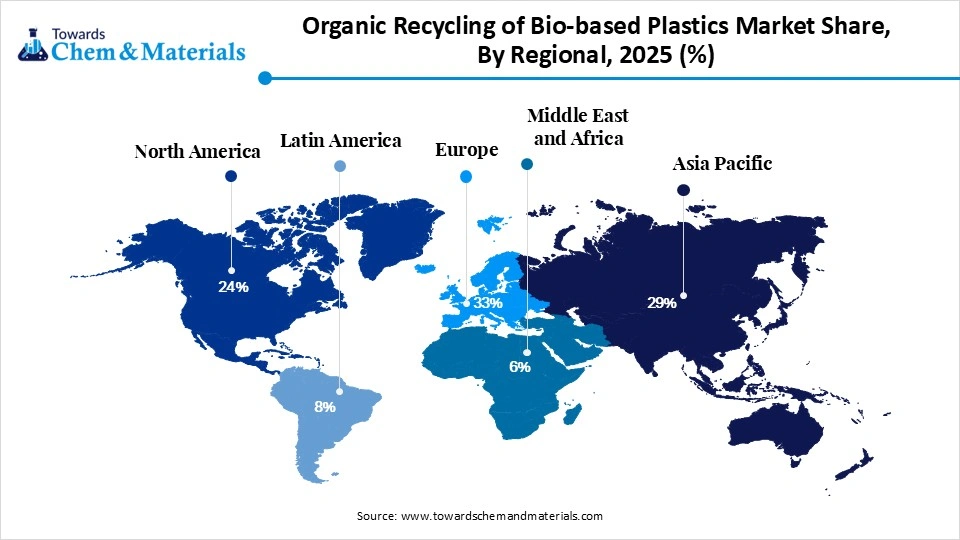
Asia Pacific held the second largest market share of 29% in 2025 and is expected to grow at the fastest CAGR of 15.2% over the forecast period. The growth of the region can be credited to the rapid urbanisation and ongoing enforcement of government initiatives supporting biobased productions. In addition, major market players are rapidly transitioning towards zero-waste manufacturing and switching to compostable materials, contributing to regional expansion further.
China Organic Recycling of Bio-based Plastics Market Trends
In the Asia Pacific, China dominated the market owing to the ongoing push towards a circular economy and growing adoption of bio-based plastics for flexible packaging. Moreover, advancements in bio-based materials and the incorporation of large-scale and advanced industrial composting facilities enhance the overall efficiency of organic recycling.
Organic Recycling of Bio-based Plastics Market Share, By Regional, 2025 (%)
| Regional | Revenue Share, 2025 (%) |
| North America | 24% |
| Europe | 33% |
| Asia-Pacific | 29% |
| Latin America | 8% |
| Middle East & Africa | 6% |
Recent Developments
- In January 2026, Aptar Pharma and Haleon launched a more sustainable version of the Otrivin® nasal spray. For the first time, Aptar's Freepod® pump is manufactured using mass balance bio-based resins, marking its global debut as a delivery system made with renewable materials.
Organic Recycling of Bio-based Plastics Market Companies
- NatureWorks LLC: NatureWorks LLC is a premier global leader in producing Ingeo™ polylactic acid (PLA) biopolymers made from plant-based sugars. A cornerstone of the organic recycling (composting) sector, they develop biodegradable, renewably sourced materials.
- Novamont S.p.A.: Novamont S.p.A., now part of Versalis (Eni), is a global leader in biodegradable and compostable bioplastics, focusing on renewable-source materials like the MATER-BI product line.
Companies in the Organic Recycling of Bio-based Plastics Market
- BASF
- Total Corbion PLA
- Braskem S.A.
- Danimer Scientific
- Biome Bioplastics Ltd.
- FKuR Kunststoff GmbH
- Bio-on S.p.A.
- Bioplastics Recycling GmbH
Organic Recycling of Bio-based Plastics Market Segments Covered in the Report
By Recycling Process
- Composting
- Industrial Composting
- Home Composting
- Anaerobic Digestion
- Wet Digestion
- Dry Digestion
By Polymer Type
- Polylactic Acid (PLA)
- Polyhydroxyalkanoates (PHA)
- Starch Blends
- PBS (Polybutylene Succinate)
- Others
- PBAT Blends
- Cellulose-based Plastics
By Waste Source
- Municipal Solid Waste
- Household Waste
- Commercial Waste
- Industrial Waste
- Food Processing Waste
- Packaging Industry Waste
- Agricultural Waste
- Mulch Films
- Crop Residue Plastics
By End-Use Industry
- Packaging
- Food Packaging
- Non-food Packaging
- Agriculture
- Mulch Films
- Plant Pots
- Consumer Goods
- Disposable Items
- Household Products
- Textile
- Fibers
- Nonwoven Fabrics
By Technology
- Aerobic Treatment Systems
- Windrow Composting
- In-vessel Composting
- Anaerobic Systems
- Biogas Plants
- Digesters
- Pre-treatment Technologies
- Mechanical Sorting
- Biological Pre-treatment
By Application Output
- Compost Production
- Soil Conditioners
- Fertilizers
- Biogas Production
- Electricity Generation
- Heat Generation
- Digestate Utilization
- Liquid Fertilizers
- Soil Enhancers
By Regions
- North America
- U.S.
- Canada
- Mexico
- Europe
- Germany
- UK
- France
- Italy
- Spain
- Asia Pacific
- China
- India
- Japan
- South Korea
- Latin America
- Brazil
- Argentina
- Middle East & Africa
- Saudi Arabia
- South Africa
FAQ's
Question 1 : What is the Organic Recycling of Bio-based Plastics Market?
Answer : The market focuses on processing biodegradable and compostable bioplastics through methods such as composting and anaerobic digestion to produce compost, biogas, and water. It is driven by sustainability goals and stricter environmental regulations.
Question 2 : What is the current size and future outlook of the market?
Answer : The market was valued at USD 3.85 billion in 2025, is expected to reach USD 4.38 billion in 2026, and is projected to grow to USD 13.84 billion by 2035, at a CAGR of 13.65%.
Question 3 : How are advanced technologies transforming the market?
Answer : Technologies such as synthetic biology, AI-based sorting, and enzyme-driven recycling are improving biodegradation efficiency, enabling higher-quality output and better waste conversion rates.
Question 4 : Which region dominates the market?
Answer : Europe led the market with a 33% share in 2025, due to strong regulatory frameworks and advanced recycling infrastructure.
Question 5 : Which region is expected to grow the fastest?
Answer : Asia Pacific is projected to grow at the fastest CAGR of 15.2%, driven by rapid urbanization and government support for sustainable materials.
Meet the Team

Saurabh Bidwai
Principal Consultant
Saurabh Bidwai, a B.Tech Chemical Engineering graduate with 4+ years of experience, specializes in specialty chemicals, commodity chemicals, and engineered materials, offering valuable insights into market trends and emerging opportunities.

Aditi Shivarkar
Reviewed By
Aditi Shivarkar, with 14+ years in Chemical and Materials market research, specializes in Chemical and Materials. She ensures accurate, actionable insights, driving Towards Chemicals And Materials Analytics and Consulting excellence in industry trends and sustainability.