
Oxidizing Agents Market Size, Share, Growth, Report 2026 to 2035
The global oxidizing agents market size is expected to grow from USD 6.29 billion in 2026 to USD 12.11 billion in 2035, growing at a CAGR of 7.55% from 2026 to 2035. The top key players in the market are BASF SE, Solvay S.A., Evonik Industries AG, AkzoNobel N.V., Carus Corporation, Arkema Group, Dow, Clariant AG, Kemira Oyj, Aditya Birla Chemicals, PeroxyChem LLC,-Global Forecast 2026 To 2035
Content
Oxidizing Agents Market Size and Forecast 2026 – 2035
The global oxidizing agents size was estimated at USD 5.85 billion in 2025 and is expected to increase from USD 6.29 billion in 2026 to USD 12.11 billion by 2035, growing at a CAGR of 7.55% from 2026 to 2035. Asia Pacific dominated the oxidizing agents with the largest revenue share of 46.00% in 2025.The growth is driven by a shift towards green oxidizing agents, sustainability, stringent regulatory infrastructure, and technological advancement in oxidation processes.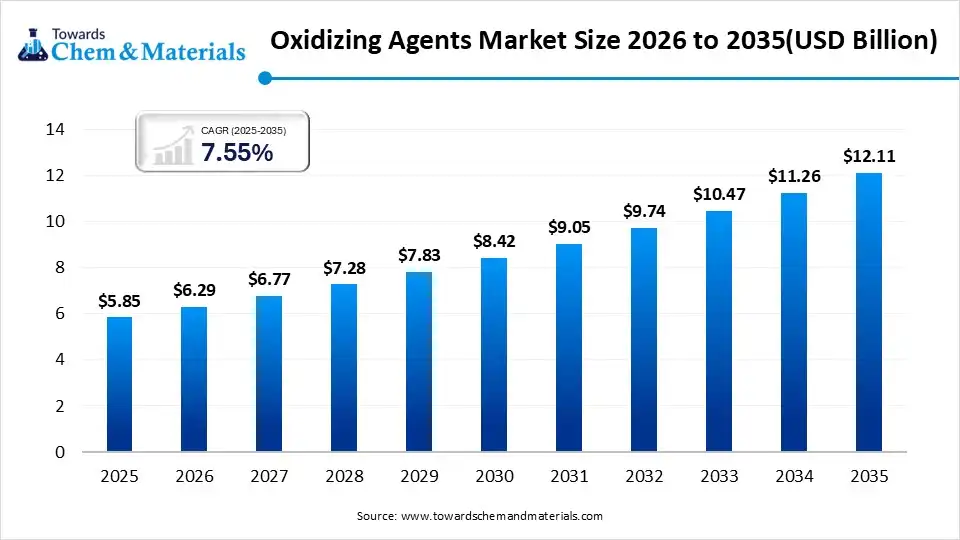
Market Highlights
- By region, Asia Pacific dominated the oxidizing agents market share 46.00% in 2025 due to its rapid urbanization and innovation in oxidative technologies supported by massive industrial infrastructure.
- By region, Europe is expected to grow at the fastest CAGR from 2026 to 2035 due to a stringent regulatory framework and sustainability in healthcare and waste management.
- By product, the hydrogen peroxide segment held the largest share in the market share 34.00% in 2025 due to its high concentration of active oxygen and its high purity, useful for bio-contamination and sterilization.
- By product, the sodium hypochlorite segment is expected to grow at the fastest CAGR during the forecast period due to its chlorine-release mechanism and bleaching properties utilized in biopharmaceutical and industrial sectors.
- By end-use, the water and wastewater segment dominated the market share 28.00% in 2025, due to rising concern in public health and demand for sustainable water management.
- By end-use, the healthcare and sterilization segment is anticipated to grow at the fastest CAGR in the market during the forecast period due to its ability to inactivate pathogens and technological innovation to meet hygiene compliance.
Market Overview
The oxidizing agents are substances that gain electrons to enable redox reactions. The agents are crucial in industry for organic degradation, pathogen inactivation, and chromophore demolition. Their segment is distributed by their chemical composition and their effectiveness in processes like AOP and HLD, with high chemical efficiency by reducing environmental impact. The recent acquisition and launch of oxidizing agent utilisation has accelerated market expansion.
As manufacturers are focused on sustainability, this is driving the innovation towards bio-based and green oxidising agents that offer oxidative potential, reactivity and decompose into non-toxic byproducts. Additionally, the rising technological adoption in the oxidation process is boosting the market expansion. The rising government support and strategic alliance fuel the market towards adoption, aligning with high-purity manufacturing standards.
Trade Analysis of the Oxidizing Agents Market: Import and Export Statistics
- Vietnam exported 3,073 shipments of oxidizing agents.
- China exported 2,533 shipments of oxidizing agents.
- South Korea exported 1,508 shipments of oxidizing agents.
- From July 2024 to June 2025, the world exported 4,957 shipments of oxidizing agents.
Report Scope
| Report Attribute | Details |
| Market Size in 2026 | USD 6.29 Billion |
| Revenue Forecast in 2035 | USD 12.11 Billion |
| Growth Rate | CAGR 7.55% |
| Forecast Period | 2026 - 2035 |
| Base Year | 2025 |
| Dominant Region | Asia Pacific |
| Segment Covered | By Product, By End-Use, By Region |
| Key companies profiled | BASF SE, Solvay S.A., Evonik Industries AG, AkzoNobel N.V., Carus Corporation, Arkema Group, Dow, Clariant AG, Kemira Oyj, Aditya Birla Chemicals, PeroxyChem LLC, |
Recent Market Trends
- Shift Towards Oxygen-Driven Chemistry: The transition towards oxygen-based alternatives, such as hydrogen peroxide and peracetic acid, as clean agents that offer harmless byproducts to meet stringent environmental mandates and zero-discharge standards.
- Increasing Implementation of Advanced Oxidation Process: The market is focused on integration of oxidizing agents with UV light, catalysts and electrolysis to create highly reactive radicals through radical-based treatments, electrochemical oxidation and sulfate radical-based processes.
- Supply Chain Integration and Collaboration: The major chemical leaders are focused on strategic partnerships, acquisitions by integrating supply with equipment solutions and specific logistics. Additionally, the collaboration enables the adoption of on-site generation models.
- Zero Liquid Discharge Standards: The standards for advanced waste water management, recovery and reuse of oxidizing agents and salts, driving these trends. Additionally, this trend reinforces manufacturers towards manufacturing waste management and circular economy goals.
Key Technological Shifts and AI in the Oxidizing Agents Market
The technological integration and AI-driven innovation are transforming the oxidizing agents market through digital precision, automation, and safety measures. Machine learning enables high-stability catalytic oxidizing agents, while the combination of the industrial Internet of Things allows real-time monitoring that offers automated precision dosing by preventing chemical waste with stable chemical kinetics.
The advanced chemical engineering and digital twin technology improve process safety and identify the risk of thermal runaway and chemical degradation. The sensor-integrated dosing system ensures accurate oxidation levels by maintaining operational efficiency. Overall, technological shift is pushing manufacturers toward intelligent, eco-friendly manufacturing by maintaining sustainability targets.
Oxidizing Agents Market: Supply Chain Analysis
- Feedstock Procurement: The stage involves the extraction, refining and processing of highly reactive raw materials such as hydrogen gas, brine, sulfur and borates to minimize early-stage transport costs.
- Key Players: Air Liquide, Rio Tinto, Linde PLC, Nutrien and Dow
- Advanced Chemical Synthesis: The producers transform raw material into specific oxidizing agents such as peracetic acid, persulfates and hydrogen peroxide by using stabilization technology and energy-intensive electrolysis to avoid volatile chemicals from decomposing
- Key Players: Solvay S.A., Evonik Industries, Arkema, Kemira and Nouryon
- Logistics and End-Use Integration: The stage dominated by distributors with specialized logistics and active management. The service providers install IoT-connected dosing pumps in water treatment, healthcare and semiconductors.
- Key Players: Ecolab, Merck KGaA, Univar Solutions, Brenntag SE, Nalco Water and Veolia
Regulatory Framework: Oxidizing Agents Market
| Region | Key regulations | Regulatory Focus |
| North America | Environmental Protection Agency and Toxic Substances Control Act (TSCA) | Focus on industrial risk evolution, GHS implementation, and the reduction of aquatic hazardous chemicals and air emissions. |
| Asia Pacific | Chemical Management Rules (CMR), Hazardous Substance Act, BIS, Law on Chemicals and Quality Control Order | Aimed at diversification and life-cycle management, Industrial standards for high-grade oxidizers used in non-commercial R&D and licensing for high-risk chemicals and GHS adoption. |
| Europe | REACH, ECHA, Classification, Labelling and Biocidal Products Regulation | Focus on the phasing out of substances of very high concern and the active substance approval of peracetic acid produced from hydrogen peroxide for biocidal uses. |
| Latin America | ABNT NBR and Brazil REACH, Environment Ministries, Decree | Aimed at biosafety regulation, the registration and alignment framework, and mandatory registration of hazardous industrial substances. |
| Middle East & Africa | GSO, African Union Strategic Framework, OPCW Africa Programme | Focus on the Global Harmonized System (GHS) integration, chemical security, and strong environmental control |
Segmental Insights
Product Insights
How did the Hydrogen Peroxide Segment hold the Largest Share in the Oxidizing Agents Market?
The hydrogen peroxide segment held the largest revenue share in the market in 2025, valued for its high concentration of active oxygen, which decomposes into water and oxygen without producing toxins. The rising focus on green alternatives to replace chlorine bleaching in papermaking and the textile industry that offer high brightness and lower degradation is fueling the segment growth. Hydrogen peroxide is vital for sterilization, wastewater treatment, and bio-contamination control through the integration of advanced oxidation processes. Additionally, its high purity grades are essential in semiconductors that combine efficiency with sustainability.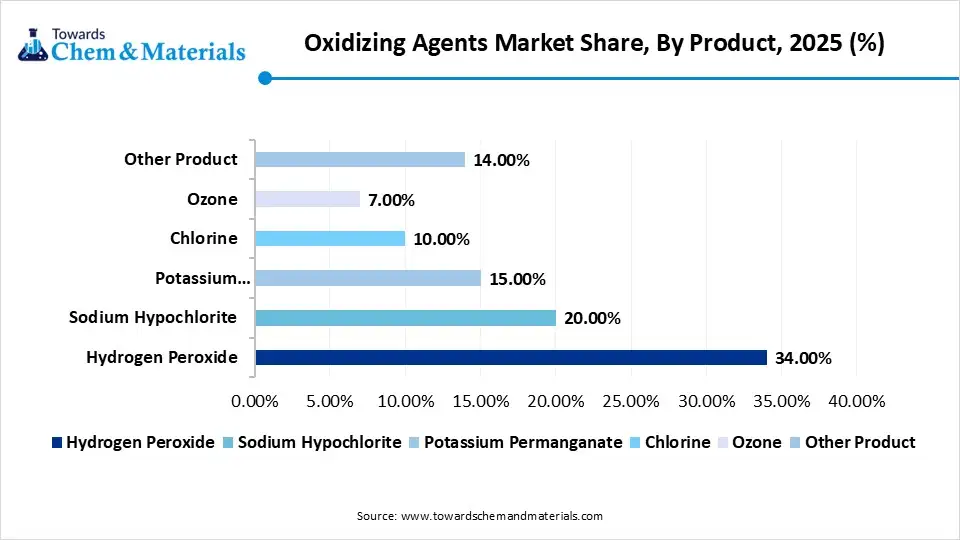
The sodium hypochlorite segment is experiencing the fastest growth in the market during the forecast period, driven by its chlorine-release mechanism that acts as a strong liquid disinfectant and antimicrobial agent used in water treatment and industrial bleaching. Its rapid action and residual disinfectant capability make it vital for sanitation in municipal water disinfection, industrial, and clinical infrastructure. Its bleaching properties utilized in the textile, pulp and paper sector, while its fluid chemical ability facilitates precise automated metering and dosing with large-scale water treatment and industrial hygiene workflow.
Oxidizing Agents Market Share, By Product, 2025 (%)
| By Product | Revenue Share, 2025 (%) |
| Hydrogen Peroxide | 34.00% |
| Sodium Hypochlorite | 20.00% |
| Potassium Permanganate | 15.00% |
| Chlorine | 10.00% |
| Ozone | 7.00% |
| Other Product | 14.00% |
- The Hydrogen Peroxide segments share of 34.00% in 2025 dominates due to its versatility in applications such as bleaching, disinfecting, and water treatment, along with growing demand in various industries.
- The Sodium Hypochlorite segments share of 20.00% in 2025 is gaining momentum due to its widespread use as a disinfectant and in water treatment, with steady demand from industrial and household sectors.
- The potassium permanganate segments share 15.00% in 2025. Not dominating but steadily growing, driven by its use in water treatment, as a disinfectant, and in chemical synthesis.
- The Chlorine segments share of 10.00% in 2025 Not dominating, though still significant in industrial processes like water purification and in the production of chemicals, albeit facing regulatory challenges.
- The Ozone segments share of 7.00% in 2025, Not dominating, with limited share but gaining momentum due to its effectiveness in water treatment and air purification, as demand for cleaner solutions rises.
- The other product's share of 14.00% is not dominating but maintaining a diverse share due to niche applications across several industries, including agriculture and food processing.
End-use Insights
Which End-Use Dominated the Oxidizing Agents Market?
The water and wastewater segment dominated the market share 28.00% in 2025. Due to a rising focus on public health and environmental safety. The segment utilized oxidants for pathogen control, organic breakdown, and contaminant removal in both municipal and industrial infrastructure. The oxidizing agent are increasing their value for their advanced oxidation processes to break down organic pollutants by offering odor control, decolorization to meet chemical oxygen demand. As water scarcity rises, its role in reclamation and reuse projects is growing, supporting sustainable water management.
The healthcare and sterilization segment is anticipated to grow fastest in the market during the forecast period. Driven by the rising need for pathogen inactivation, where oxidants like peracetic acid, sodium hypochlorite and hydrogen peroxide are essential for sterilization, eliminating a wide range of pathogens. The technological advancement in oxidizing agent enables high demand for high-level disinfection and surface contamination. The adoption of vaporized hydrogen peroxide enhances sterilization, ensuring safety and compliance in medical environments to meet regulatory hygiene standards by enhancing patient safety infrastructure.
Asia Pacific Powder Coatings Market Share, By End-use, 2025 (%)
| By End-use | Revenue Share, 2025 (%) |
| Water & Wastewater Treatment | 28.00% |
| Pulp & Paper | 14.00% |
| Textiles | 12.00% |
| Household & Institutional Cleaning | 9.00% |
| Healthcare & Sterilization | 8.00% |
| Food & Beverage | 6.00% |
| Mining & Metals | 7.00% |
| Electronics | 5.00% |
| Other End Uses | 11.00% |
- The Water & Wastewater Treatment Segments' share of 28.00% in 2025 dominates due to increasing demand for eco-friendly and efficient coatings in water purification systems, driven by environmental regulations and industrial needs.
- The Pulp & Paper Segments' share of 14.00% in 2025: Not dominating, but holding a significant share due to the need for durable coatings in paper production, though facing competition from other industrial sectors.
- The Textiles Segment's share of 12.00% in 2025 is not dominating but gaining momentum due to the demand for coatings that improve fabric durability and resistance, especially in technical textiles.
- The Household & Institutional Cleaning Segment's share of 9.00% in 2025 Not dominating, with a moderate share driven by the use of coatings in cleaning products and tools, but limited compared to larger industrial applications.
- The Healthcare & Sterilization Segment's share of 8.00% in 2025 Not dominating, but growing steadily as the healthcare industry seeks specialized coatings for sterilization and medical equipment protection.
- The Food & Beverage Segment's share of 6.00% in 2025 is not dominating, with a smaller share, but it is maintaining steady demand for coatings used in packaging and food processing equipment.
- The Mining & Metals Segment's share of 7.00%: Not dominating, though gaining momentum as powder coatings are increasingly used for corrosion protection and surface enhancement in the mining and metals industries.
- The Electronics segment's share of 5.00% in 2025 Not dominating, with limited share, but growing as demand for advanced coatings increases in the electronics sector for protection and functionality.
- The Other End Uses segment's share of 11.00% in 2025 is not dominating but contributing to the overall share with niche applications across various sectors, including automotive and construction.
Regional Insights
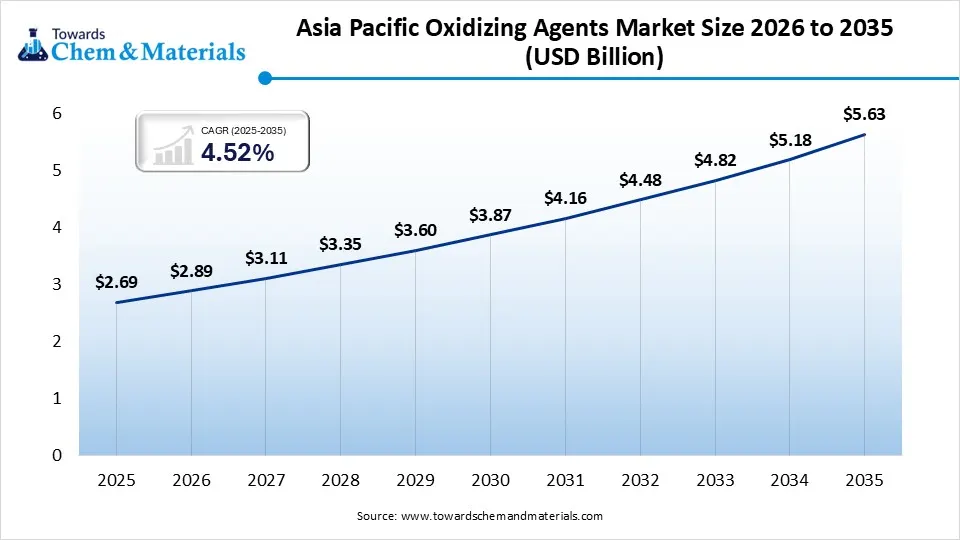
Asia Pacific oxidizing agents market size was valued at USD 2.69 billion in 2025 and is expected to be worth around USD 5.63 billion by 2035, exhibiting at a compound annual growth rate (CAGR) of 7.67% over the forecast period from 2026 to 2035.Asia Pacific dominated the market share 46.00% in 2025, known as the most dynamic market for oxidizing agents, driven by its vast industrial base and rising urbanization. The region is dominated by chemical synthesis, textiles, and electronics. The regional manufacturers enable the high demand for oxidizing agents such as hydrogen peroxide and sodium hypochlorite, especially for water treatment and healthcare, by maintaining stringent environmental compliance. The substantial investment in healthcare infrastructure and the focus on green oxidants fuel Asia Pacific growth in oxidative technologies and innovation of medical-grade sterilization agents.
China Oxidizing Agents Market Growth Trends
The China market is valued for its production and consumption of oxidizing agents for industries like chemical synthesis, textiles, and the semiconductor industry. The Domestic growth is supported by a shift towards environmentally friendly alternatives. The innovation and advances in smart manufacturing and AI integration, with a resilient supply chain that drives the domestic expansion of the region with high-efficiency industrial purification and sustainability.
Europe is expected to grow at the fastest CAGR in the market during the forecast period, driven by its strict regulations and a commitment to green chemistry. The region prefers hydrogen peroxide and peracetic acid to replace chlorine-based oxidising agents to reduce toxic byproducts. The regional stringent EU compliance fosters innovation of zero-harm formulation that integrates with AI for wastewater and sterilization. The strong governmental mandate and major market players are adopting green oxidants, positioning it as a leader in value-added oxidizing agents and sustainability utilized in healthcare and waste treatment.
Oxidizing Agents Market Share, By Regional, 2025 (%)
| Regional | Revenue Share, 2025 (%) |
| North America | 20.00% |
| Europe | 26.00% |
| Asia Pacific | 46.00% |
| Latin America | 5.00% |
| Middle East & Africa | 3.00% |
- The North America's share of 20.00% in 2025 Not dominating, with a moderate share driven by steady demand in industrial and household applications, though facing competition from other regions.
- The Europe's share of 26.00% in 2025 is gaining momentum due to strong regulatory standards, technological innovation, and a robust industrial base requiring oxidizing agents for various processes.
- The Asia Pacific share of 46.00% in 2025 Dominates due to rapid industrialization, increasing demand in manufacturing, water treatment, and chemical production across the region.
- The Latin America share of 5.00% in 2025 Not dominating, with a smaller share attributed to slower industrial growth and limited adoption of oxidizing agents in key sectors.
- The Middle East & Africa 3.00% in 2025 Not dominating, with minimal share due to niche applications and relatively lower industrial demand compared to other regions.
Germany Oxidizing Agents Market Growth Trends
Germany is a key hub for technological innovation and an industrial infrastructure with advances in low-residue oxidizing agents like hydrogen peroxide and peracetic acid. The regional growth is driven by strict environmental standards and environmental mandates for sustainability. The German manufacturer implemented automated dosing in the laboratory synthesis of oxidizing agent, which offers precision. Additionally, Germany's municipal wastewater reclamation standards and high-tech manufacturing in applications like automotive, semiconductors and healthcare are boosting the growth.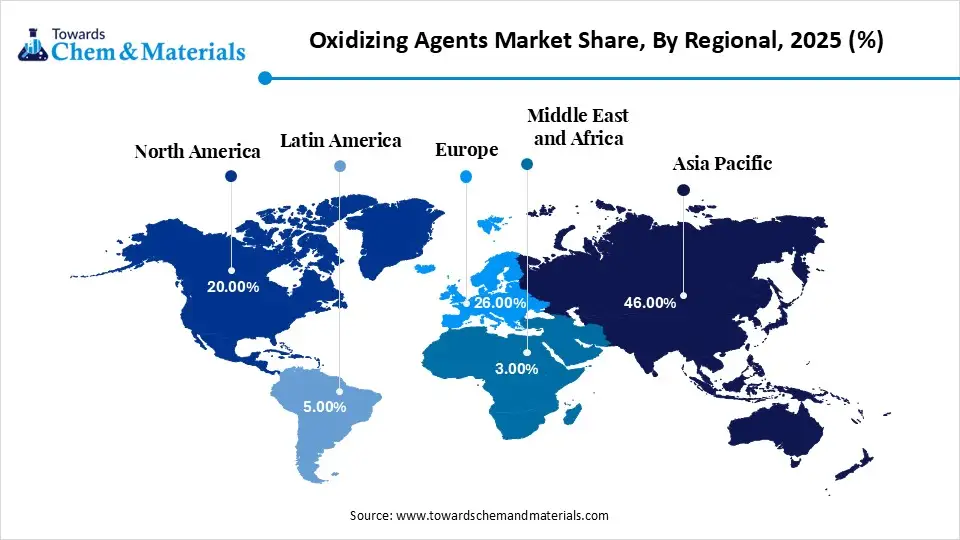
North America Oxidizing Agents Growth Trends
The North America market is focused on municipal water treatment and the shale gas sectors. The region is witnessing steady growth due to its technological upliftment and stringent regulatory framework. The region is shifting toward an eco-friendly oxidizing agent that is necessary for wastewater reclamation and chemical synthesis. North America is emphasising AI-based posing and vaporised hydrogen peroxide technology, which is boosting domestic manufacturers towards high investment in technological advancement for advanced oxidation processes. The region is focused on maintaining infectious disease control and high standards for purity and worker safety.
U.S. Oxidizing Agents Market Growth Trends
The United States leads in innovation that aligns with the advanced chemical technologies shift. The regional strong demand for hydrogen peroxide and sodium hypochlorite for diverse industries and shale gas processing is pushing them towards expansion. The rising shift away from chloride-based bleaches to green oxidants to meet stringent EPA standards enables regional growth. The U.S. dominated in the adoption of biopharmaceutical cleanrooms that integrate advanced systems for healthcare. Additionally, the R&D investment in chemical formulation sets the standard for high-purity oxidative solutions and sustainability.
Recent Developments
- In November 2025, LANXESS launched a high-performance, eco-friendly oxidizing agent designed especially for next-generation cold-wash detergents. The new Oxone monopersulfate compound allows for top-tier stain removal at low temperatures by reducing household CO2 emissions.(Source: lanxess.com)
- In June 2025, Solvay S.A. announced a strategic collaboration with BASF SE to reduce Scope 3 emissions in hydrogen peroxide production by sourcing raw materials. The strategic partnerships focus on improving environmental performance and lowering carbon footprint.(Source: www.chemanalyst.com)
Top Companies in the Oxidizing Agents Market and Their Offerings
- BASF SE: The chemical manufacturers of hydrosulfite, hydrogen peroxide and sodium metabisulfite in textile processing, high-safety cleaning and photography
- Solvay S.A.: The global leader in high-stability hydrogen peroxide, peracetic acid in water treatment, food packaging sterilization and paper bleaching.
- Evonik Industries AG: The global player that offers active oxygen with a focus on sustainability in industrial bleaching, semiconductor and food industry.
- AkzoNobel N.V.: The leading supplier of sodium chlorate, the key precursor for chlorine dioxide to supply oxidizers in real-time and environmental stewardship in paper production
- Carus Corporation: The global specialist in potassium permanganate and a specific deep-purple oxidant for neutralizing heavy metals, in municipal water treatment and air purification.
- Arkema Group
- Dow
- Clariant AG
- Kemira Oyj
- Aditya Birla Chemicals
- PeroxyChem LLC
Segment Covered in the Report
By Product
- Hydrogen Peroxide
- Sodium Hypochlorite
- Potassium Permanganate
- Chlorine
- Ozone
- Other Product
By End-Use
- Water & Wastewater Treatment
- Pulp & Paper
- Textiles
- Household & Institutional Cleaning
- Healthcare & Sterilization
- Food & Beverage
- Mining & Metals
- Electronics
- Other End Uses
By Region
- North America
- U.S.
- Canada
- Mexico
- Europe
- Germany
- UK
- France
- Italy
- Spain
- Asia Pacific
- China
- India
- Japan
- South Korea
- Latin America
- Brazil
- Argentina
- Middle East & Africa
- Saudi Arabia
- South Africa
FAQ's
Question 1 : What is the expected growth rate of the Oxidizing Agents Market from 2026 to 2035?
Answer : The Oxidizing Agents Market is expected to grow at a CAGR of 7.55% from 2026 to 2035.
Question 2 : Which region is leading the Oxidizing Agents Market and why?
Answer : Asia Pacific dominates the Oxidizing Agents Market with a 46% share in 2025, driven by rapid industrialization, urbanization, and innovation in oxidative technologies.
Question 3 : What are the key growth drivers for the Oxidizing Agents Market?
Answer : The Oxidizing Agents Market is driven by a shift towards green oxidizing agents, sustainability, stringent regulatory frameworks, and technological advancements in oxidation processes.
Question 4 : Who are the leading companies in the Oxidizing Agents Market?
Answer : Top companies in the Oxidizing Agents Market include BASF SE, Solvay S.A., Evonik Industries AG, AkzoNobel N.V., and Carus Corporation.
Meet the Team
Towards Chemical & Materials
Saurabh Bidwai, a B.Tech Chemical Engineering graduate with 4+ years of experience, specializes in specialty chemicals, commodity chemicals, and engineered materials, offering valuable insights into market trends and emerging opportunities.

Aditi Shivarkar
Reviewed By
Aditi Shivarkar, with 14+ years in Chemical and Materials market research, specializes in Chemical and Materials. She ensures accurate, actionable insights, driving Towards Chemicals And Materials Analytics and Consulting excellence in industry trends and sustainability.