
Permanent Magnet Market Manufacturers & Suppliers Company Analysis 2026-2035
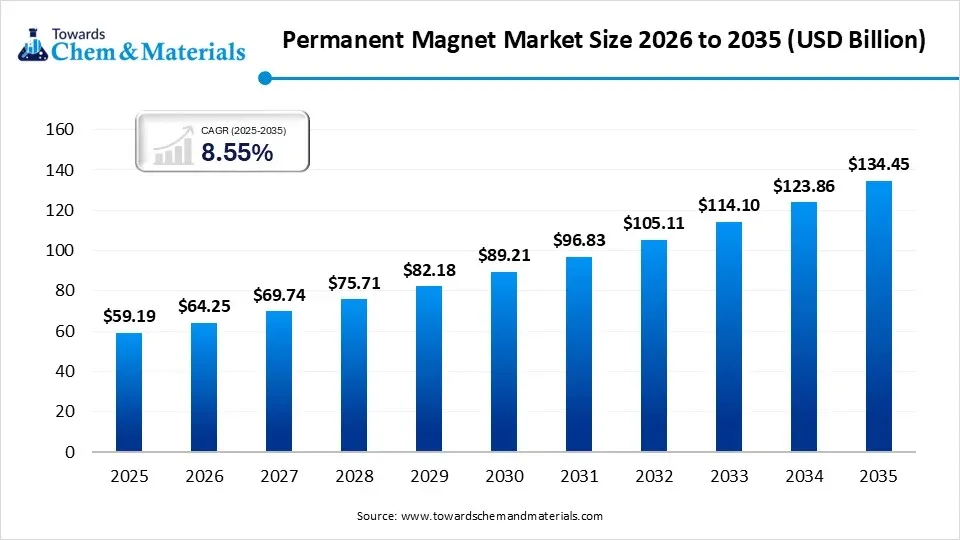
The global permanent magnet market size is expected to grow from USD 64.25 billion in 2026 to USD 134.45 billion in 2035, growing at a CAGR of 8.55% from 2026 to 2035. The top key players in the market are Adams Magnetic Products Co., Earth-Panda Advance Magnetic Material Co., Ltd., Arnold Magnetic Technologies, Daido Steel Co., Ltd., Eclipse Magnetics Ltd., Electron Energy Corp., Goudsmit Magnetics Group, Hangzhou Permanent Magnet Group, Magnequench International, LLC, Ningbo Yunsheng Co., Ltd.-Global Forecast 2026 To 2035
Content
What is the Current Permanent Magnet Market Size and Share?
The global permanent magnet market size was estimated at USD 59.19 billion in 2025 and is expected to increase from USD 64.25 billion in 2026 to USD 134.45 billion by 2035, growing at a CAGR of 8.55% from 2026 to 2035. Asia Pacific dominated the permanent magnet market with the largest revenue share of 65.00% in 2025.The growth is driven by advancements in ceramic composites, sustainable recycling, regulatory framework, decarbonization goals and shift towards electric mobility and renewable energy infrastructures.The permanent magnet functions as a strategic industrial commodity and a significant material for modern technology. It is mainly characterized by its chemical composition that sets performance standards for electric mobility and renewable energy, cost-sensitive electronics and appliances. The market is fueled by the green energy transition, with magnets playing a vital role in decarbonization, while expansion is driven by increasing demand for recycling and efficiency. Additionally, technological advancement and additive manufacturing are reshaping the market growth.
Market Highlights
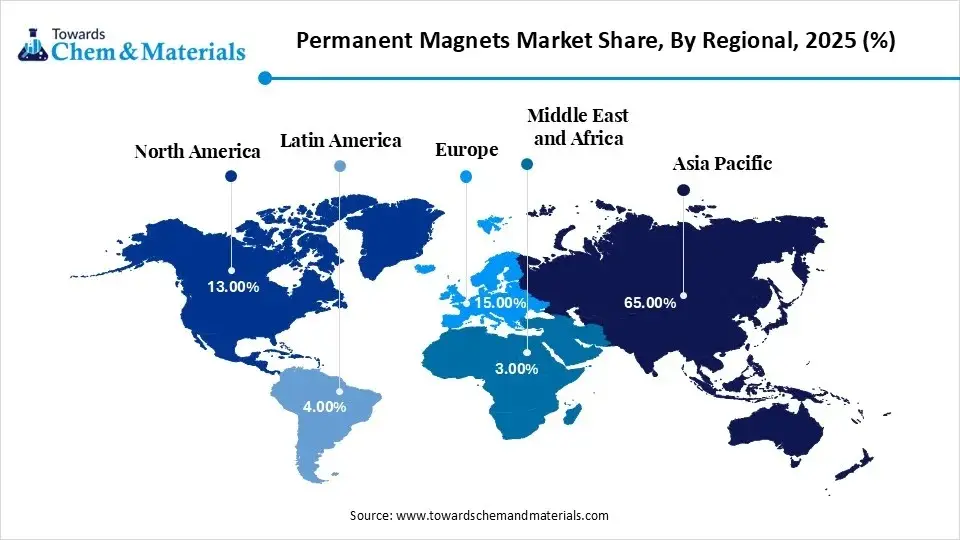
- The Asia Pacific dominated the permanent magnet market with the largest revenue share of 65.00% in 2025, due to its rare-earth supply chain and diversified industrial base.
- By material, the NdFeB segment dominated the market and accounted for the largest revenue share of 72.00% in 2025, due to its high-magnetic energy and recycling innovations.
- By application, the consumer goods segment led the market with the largest revenue share of 34.00% in 2025, due to its ultra-portable technology and demand for a high-technology lifestyle.
Trade Analysis of the Permanent Magnet Market: Import and Export Statistics
- China exported 152,751 shipments of permanent magnets.
- Vietnam exported 27,349 shipments of permanent magnets.
- India exported 19,183 shipments of permanent magnets.
- From July 2024 to June 2025, the world exported 92,324 shipments of permanent magnets.
Recent Market Trends
- Focus on Rare-Earth Free Alternatives: The manufacturers focus on commercialization of iron nitride and magnesium aluminum magnetics that offer high performance and durability in electric mobility.
- Advancement in 3D Printing: The innovation in 3D printing bonded magnets, creating graded magnets for lighter and more efficient motors in aerospace and robotics by extending battery life and performance.
- Vertical Integration and Regional Hub: The global player builds integrated magnetics groups and localized value chain from refining oxide and alloy strip-casting to final sintering and coating by inventory management.
Report Scope
| Report Attribute | Details |
| Market Size in 2026 | USD 64.25 Billion |
| Revenue Forecast in 2035 | USD 134.45 Billion |
| Growth Rate | CAGR 8.55% |
| Forecast Period | 2026 - 2035 |
| Base Year | 2025 |
| Dominant Region | Asia Pacific |
| Segment Covered | By Material, By Application, By Region |
| Key companies profiled | Adams Magnetic Products Co., Earth-Panda Advance Magnetic Material Co., Ltd., Arnold Magnetic Technologies, Daido Steel Co., Ltd., Eclipse Magnetics Ltd., Electron Energy Corp., Goudsmit Magnetics Group, Hangzhou Permanent Magnet Group, Magnequench International, LLC, Ningbo Yunsheng Co., Ltd. |
Key Technological Shifts and AI in the Permanent Magnet Market
The market is transformed by AI-driven computational metallurgy and additive manufacturing. The magnetic industry has transitioned from a product market into a high-precision technology. AI accelerates R&D by predicting rare-earth-free crystal structures and optimizing Grain Boundary Diffusion to reduce dependence on heavy elements.
The technological shift with 3D-printed creating graded magnets to improve motor efficiency and reduce weight for aerospace and robotics. These advances enable autonomous circular ecosystems that convert electronic waste into high-performance composites with minimal scrap.
Permanent Magnet Market: Supply Chain Analysis
- Feedstock Procurement: The initial stage of mining and separation of lanthanoids like samarium, neodymium and minerals like iron oxide using metallurgical refining for conversion into high-purity oxides and alloys.
- Key Players: MP Materials, Lynas Rare Earths Ltd., Iluka Resources, and Aluminum Company of China
- Magnet Engineering and Fabrication: The stage involves conversion of refined alloys into finished magnets through processes like powder metallurgy, pressing, injection molding and sintering.
- Key Players: Shin-Etsu Chemical Co., Ltd, TDK Corporation, Vaccumschmelze, Proterial, Ltd., and Arnold Magnetic Technologies
- End-User Integration: The final stage of integrating magnetic is the design of magnetic assemblies into motor manufacturing, wind turbines, medical and consumer electronics.
- Key Players: Tesla, Siemens, Samsung, Volkswagen, ABB, Vestas and BYD
Regulatory Framework: Permanent Magnet Market
| Region | Key Regulations | Regulatory Focus |
| Global | ISO/TC Standards | Standard for classification, testing and traceability of rare-earth elements globally. |
| European Union | Critical Raw Materials Act, Ecodesign for Sustainable Products | EU circular economy strategy for recycled content and mandatory product passports and labelling for magnets in electronics |
| United States | Inflation Reduction Act, Trade Expansion Act | Focuses on national security and HTS mandates for Chinese-origin permanent magnets, and on tax credits for domestic manufacturing. |
| China | Rare Earth Management Regulations, Export Control Law | Strict miming and export controls were maintained to maintain dominance and restrict the export of magnet-making technology. |
| Japan | Economic Security Promotion Act | Diversifying the supply chain through governmental support for alternative materials |
| India | Rare Earth Permanent Magnets Scheme | The focus on commercial production of domestic rare-earth magnets. |
Segmental Insights
Material Insights
How did the NdFeB Segment hold the Largest Share in the Permanent Magnet Market?
The NdFeB segment held the largest revenue share 72.00% in the market in 2025. The materials are valued for their high magnetic energy and miniaturization capabilities. This magnet is essential to modern technology by enabling reduced, lighter, and more efficient components. Their market growth aligns with decarbonization practices, supporting electric propulsion and renewable generators. The NdFeB magnets are driving recycling innovations and are pivotal in robotics, aerospace, and next-gen electronics by maintaining leadership in the modern industrial economy.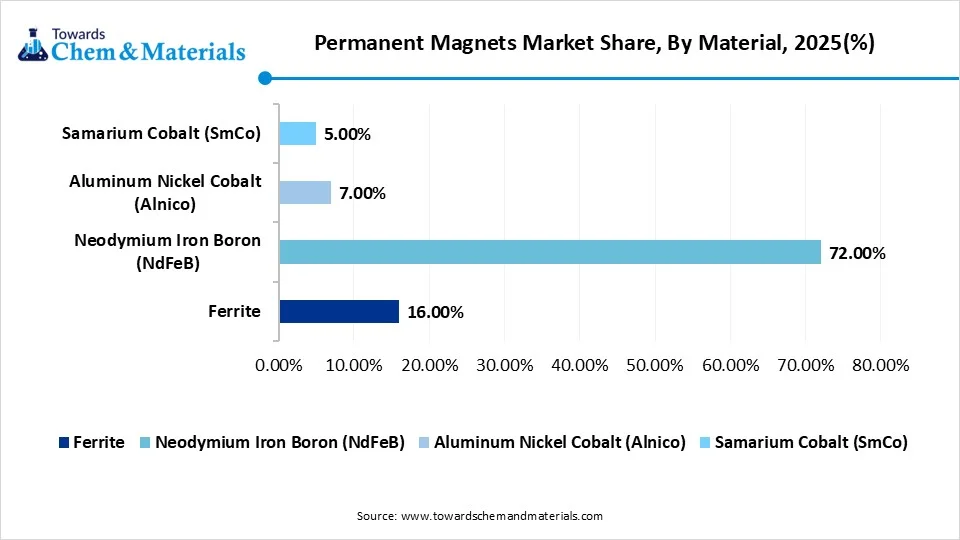
The SmCo segment is experiencing the fastest growth in the market during the forecast period, due to its thermal stability and resistance to demagnetization. The SmCo is ideal in aerospace, defense, and deep-sea exploration because they withstand high heat and corrosive conditions without oxidation. The growth driven by demand for high-speed motors and satellite technology, due to its durability, often disproves heavy protective coatings or cooling systems. Overall, SmCo remains a reliable, resilient choice for advanced engineering.
Permanent Magnets Market Share, By Material, 2025 (%)
| By Material | Revenue Share, 2025 (%) |
| Ferrite | 16.00% |
| Neodymium Iron Boron (NdFeB) | 72.00% |
| Aluminum Nickel Cobalt (Alnico) | 7.00% |
| Samarium Cobalt (SmCo) | 5.00% |
Application Insights
Which Application Dominated the Permanent Magnet Market?
The consumer goods segment dominated the market share 34.00% in 2025, due to miniaturization and ultra-portable technology. Magnets in this segment support lustrous designs in wearables, smartphones, and audio gear in precise haptic engines. Their high energy density of rare-earth materials enables thinner, lighter, more efficient devices, especially in home and personal devices. The growing ecosystem in IoT and smart home markets increases demand, fostering innovations in motor efficiency and silent operation. This segment balances compact power with reliable performance in a high-technology lifestyle.
The energy segment is predicted to grow fastest in the market during the forecast period. The segment is serving as a global energy transition, using high-power rare-earth magnets in modern wind turbines and industrial motors, by its ability to enable uptime and operational efficiency. These magnets reduce maintenance and support renewable energy development to meet industrial decarbonization commitments. As regions focus on energy independence and sustainable infrastructure, the segment emphasizes thermal resilience and material recovery to ensure a reliable, carbon-neutral future.
Permanent Magnets Market Share, By Application, 2025 (%)
| Application | Revenue Share, 2025 (%) |
| Automotive | 34.00% |
| Consumer Goods & Electronics | 28.00% |
| Industrial | 18.00% |
| Medical | 7.00% |
| Aerospace & Defense | 8.00% |
| Others | 5.00% |
Regional Insights
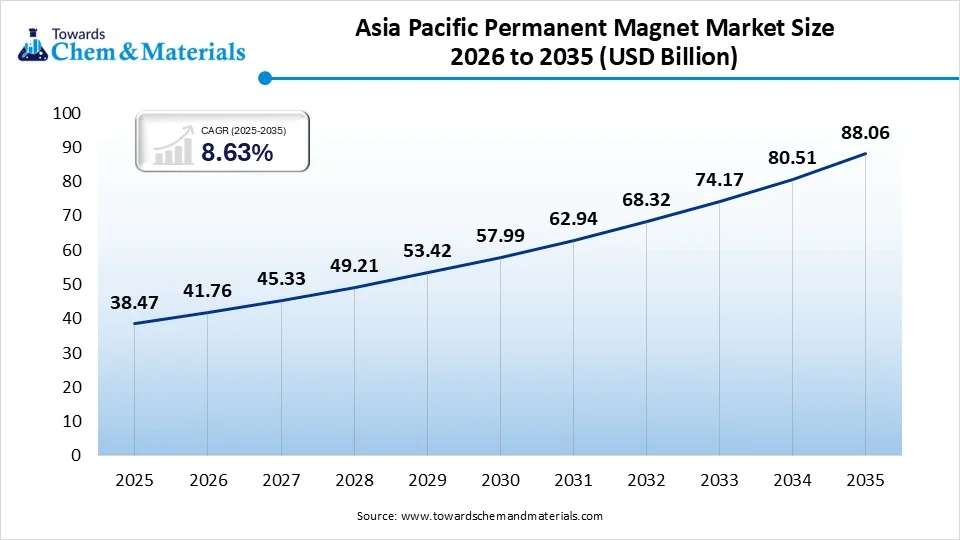
The Asia Pacific permanent magnet market size was valued at USD 38.47 billion in 2025 and is expected to be worth around USD 88.06 billion by 2035, exhibiting at a compound annual growth rate (CAGR) of 8.63% over the forecast period from 2026 to 2035.Asia Pacific dominated the market share 65.00% in 2025, acting as the top production and innovation center globally. Its leadership is due to its rare-earth supply chain and a large industrial base, from semiconductor to automotive manufacturing. The region benefits from collaborations between electronics and the growing green energy sector, especially in wind power and electric vehicles, due to a surge in high-efficiency magnets. The region is at frontfoot in the world's processing facilities that enable advantages in cost and methodological expertise. Additionally, as decarbonization accelerates, the Asia Pacific leads in magnetic material science and automated manufacturing.
China Permanent Magnet Growth Trends
China dominates the market, with a highly integrated industry that links raw rare-earth extraction to advanced magnetic component production. Its ecosystem is driven by a focus on automation, electric mobility, and renewable energy infrastructure, which boost manufacturing and economic scalability. By integrating with technical excellence, state-managed resources, and innovative science, China supplies global high-tech industries and leads innovation, that strengthening its position in the magnetic era.
North America permanent magnet market segment accounted for the major revenue share of 13.00% in 2025. North America is expected to grow at the fastest CAGR in the market during the forecast period. It is a key hub for technological advancement, emphasizing resource security and critical applications in defense, aerospace, and medicine. The region focuses on strengthening its local supply chain through projects and is part of the transition to electrification. The region is experiencing increasing demand in electric vehicles and smart energy sectors to meet industrial self-reliance. North America, combining innovative science with sustainable recycling that drives its presence in the modern magnetic industry.
U.S. Permanent Magnet Growth Trends
The U.S. market drives industrial re-shoring and strategic independence, focusing on a robust domestic supply chain for magnets used in defense and clean technology. The national investment and mine-to-magnet projects are revitalizing manufacturing and promoting recycling to reduce reliance on imports. The region's advanced science and resource security efforts align with the U.S. goals to lead in a cleaner, electrified industrial future.
Europe Permanent Magnet Growth Trends
Europe permanent magnet market segment accounted for the major revenue share of 15.00% in 2025. Europe’s magnet market focuses on high-performance engineering, emphasizing sustainability and technological shift. The regional expansion driven by offshore wind and electric mobility, Europe advances in resource-efficient, circular economy practices, especially in recycling end-of-life electronics and automotive components. Its regulatory framework is to establish resilient local supply chains by extracting and refining resources domestically, setting standards in motor efficiency and sustainable automation, aligning with material science.
Permanent Magnets Market Share, By Regional, 2025 (%)
| Regional | Revenue Share, 2025 (%) |
| North America | 13.00% |
| Europe | 15.00% |
| Asia Pacific | 65.00% |
| Latin America | 4.00% |
| Middle East & Africa | 3.00% |
Germany Permanent Magnet Growth Trends
Germany's market is the magnet engineering hub, combining automotive superiority with industry electrification. The region focuses on precision manufacturing and system efficiency, making magnets vital for next-generation electric powertrains and automotive plants. Additionally, Germany leads in innovations in recycling and magnetic alloys, and in sustainable high-tech production and green mobility.
Recent Developments
- In December 2025, USA Rare Earth, Inc. announced a subsidiary Less Common Metals (LCM) strategic supply contract with Solvay and Arnold Magnetic Technologies Corporation. The partnership focuses on providing rare earth resources for the U.S. and European Union aerospace, automotive, energy and defense sectors.(Source: in.marketscreener.com)
- In August 2025, Quantum Magnetics Private Limited signed joint venture agreements with Singapore-based Lorentic Pte Ltd. For the manufacturing and distribution of neodymium magnets. The collaboration focuses on R&D of advanced magnetic products and their domestic and global market expansion.(Source: www.autocarpro.in)
Top Players in the Permanent Magnet Market and Their Offerings
- Adams Magnetic Products Co.: The U.S. manufacturer and provider of various shape industrial magnets in specialty hardware. Provide finite element analysis and supply to aerospace, automotive, and electronics.
- Earth-Panda Advance Magnetic Material Co., Ltd.: Global leader in high-performance NdFeB and product-grade magnets. They focus on innovation and patents in rare-earth permanent magnet manufacturing.
- Arnold Magnetic Technologies: The global leader in high-temperature SmCo magnets offering thermal stability in aerospace and automotive components.
- Daido Steel Co., Ltd.
- Eclipse Magnetics Ltd.
- Electron Energy Corp.
- Goudsmit Magnetics Group
- Hangzhou Permanent Magnet Group
- Magnequench International, LLC
- Ningbo Yunsheng Co., Ltd.
Segment Covered in the Report
By Material
- Ferrite
- Neodymium Iron Boron (NdFeB)
- Aluminum Nickel Cobalt (Alnico)
- Samarium Cobalt (SmCo)
By Application
- Automotive
- Consumer Goods & Electronics
- Industrial
- Medical
- Aerospace & Defense
- Others
By Region
- North America
- U.S.
- Canada
- Mexico
- Europe
- Germany
- UK
- France
- Italy
- Spain
- Asia Pacific
- China
- India
- Japan
- South Korea
- Latin America
- Brazil
- Argentina
- Middle East & Africa
- Saudi Arabia
- South Africa
FAQ's
Question 1 : What is the current permanent magnet market size and what is the projected growth through 2035?
Answer : The global permanent magnet market was valued at USD 59.19 billion in 2025 and is projected to reach USD 134.45 billion by 2035, growing at a CAGR of 8.55% driven by rising demand from electric vehicles, renewable energy, and advanced electronics.
Question 2 : What are the key growth drivers and technology trends shaping the permanent magnet market?
Answer : The market growth is fueled by the expansion of electric mobility, renewable energy infrastructure, advancements in ceramic composites, AI-driven materials research, additive manufacturing, and increasing recycling initiatives for rare-earth materials.
Question 3 : Which region dominates the permanent magnet market and where are the strongest investment opportunities?
Answer : Asia Pacific leads the market with a 65% revenue share in 2025 due to its strong rare-earth supply chain and manufacturing base, while North America and Europe are emerging investment hubs driven by supply chain diversification and electrification initiatives.
Question 4 : Who are the leading companies operating in the permanent magnet market?
Answer : Key companies in the permanent magnet market include Adams Magnetic Products Co., Arnold Magnetic Technologies, Daido Steel Co., Ltd., Goudsmit Magnetics Group, Earth-Panda Advance Magnetic Material Co., Ltd., Ningbo Yunsheng Co., Ltd., Hangzhou Permanent Magnet Group, Electron Energy Corp., Magnequench International LLC, and Eclipse Magnetics Ltd.
Meet the Team
Towards Chemical & Materials
Saurabh Bidwai, a B.Tech Chemical Engineering graduate with 4+ years of experience, specializes in specialty chemicals, commodity chemicals, and engineered materials, offering valuable insights into market trends and emerging opportunities.

Aditi Shivarkar
Reviewed By
Aditi Shivarkar, with 14+ years in Chemical and Materials market research, specializes in Chemical and Materials. She ensures accurate, actionable insights, driving Towards Chemicals And Materials Analytics and Consulting excellence in industry trends and sustainability.