
Phosphate Fertilizers Market Size, Share, Growth, Report 2026 to 2035
The global phosphate fertilizers market report segmented By Product (Mono Ammonium Phosphate, Di Ammonium Phosphate, Single Super Phosphate, Triple Super Phosphate, Other Products), By Application (Cereals & Grains, Oilseeds & Pulses, Fruits & Vegetables, Other Applications)-Global Industry Analysis, Size, Trends, Leading Companies, Regional Outlook, and Forecast 2026 to 2035
Content
What is the Current Phosphate Fertilizers Market Size and Share?
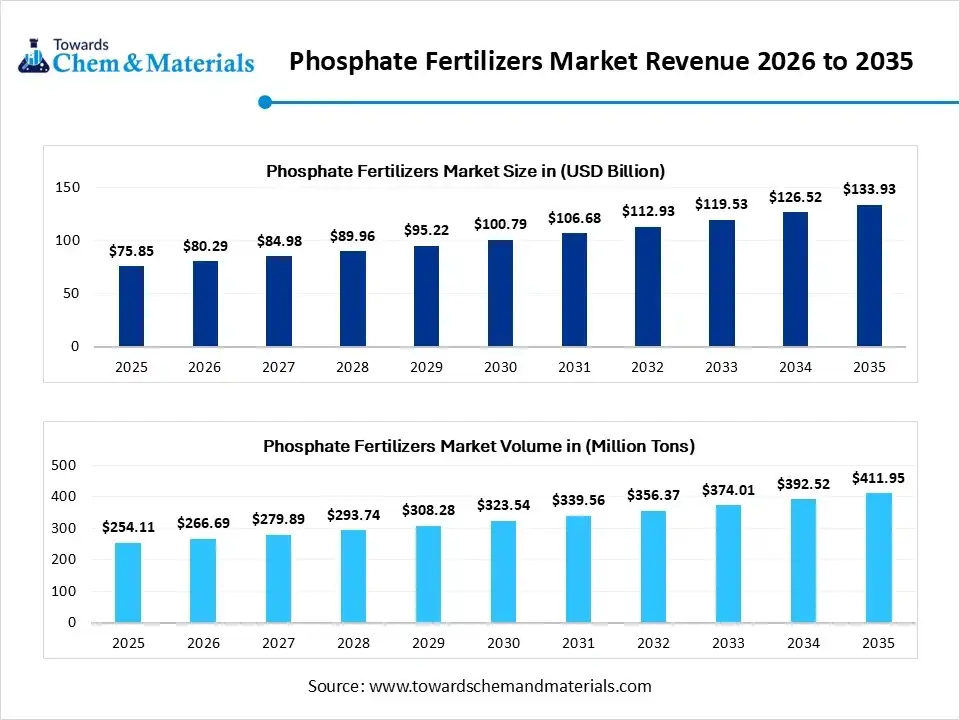
The global phosphate fertilizers market size was valued at USD 75.85 billion in 2025, is estimated to reach USD 80.29 billion in 2026, and is projected to reach USD 133.93 billion by 2035, exhibiting a compound annual growth rate (CAGR) of 5.85% over the forecast period from 2026 to 2035. Asia Pacific dominated the phosphate fertilizers market with the largest revenue share of 29% in 2025 and is expected to grow at the fastest CAGR of 5.97% during the forecast period. In terms of volume, the phosphate fertilizers industry is projected to grow from 254.11 million tons in 2025 to 411.95 million tons by 2035. growing at a CAGR of 4.95% from 2026 to 2035. The market growth is driven by rising food demands, increasing government subsidies, agricultural modernization, and rising awareness among people.
Phosphate fertilizers refer to fertilizers that contain phosphorus, which is a vital element for plant growth and development, flowering, and crop productivity. The use of these fertilizers is very common in agriculture for enhancing agricultural production and soil fertility in cereals, grains, fruits, vegetables, as well as in commercial crops. The factors responsible for market growth include the rising demand for food in the global market, scarcity of arable land, and the desire to improve agricultural production and output in a sustainable way. Subsidy programs and agricultural development are everywhere, and governments continue to promote the use of fertilizers.
Technological developments to improve nutrient use, such as the development of enhanced efficiency and controlled-release fertilizer formulations, are helping to minimize environmental impacts and improve nutrient use. Investment in precision agriculture, digital farming, and sustainable nutrient management is also further enhancing market growth. Furthermore, the increasing concern about soil health, crop quality, and the use of resources efficiently is driving the use of advanced phosphate fertilizer products in developed and emerging agricultural economies.
Market Highlights
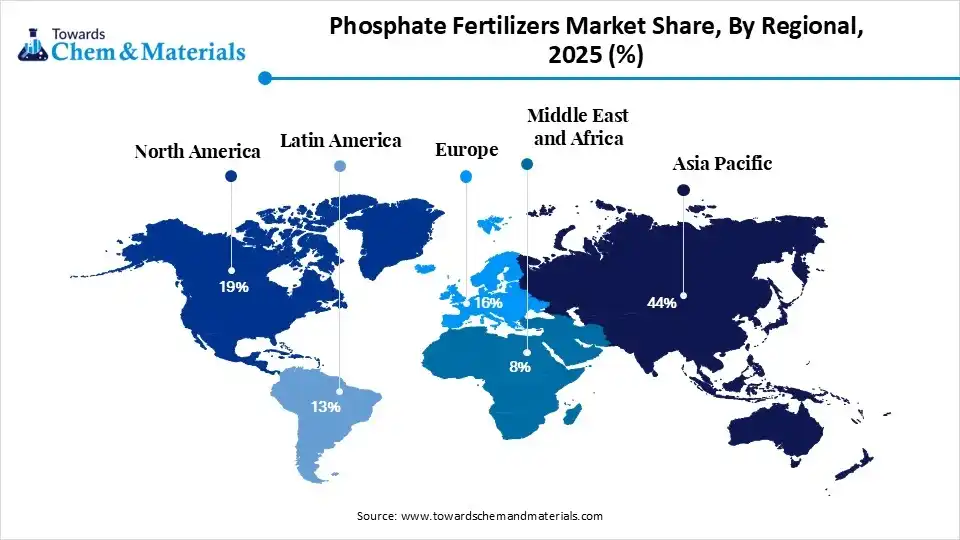
- By region, Asia Pacific dominated the phosphate fertilizers market by holding 44% share in 2025 and is expected to grow at the fastest with a CAGR of 6.5% during the forecast period, driven by intensive food production across major agricultural economies.
- By region, North America held 19% market share in 2025. The growth is driven by the increasing adaptation of the precision agriculture technology.
- By product, the Di ammonium phosphate segment dominated the market with the largest share of 39% in 2025 as governments support phosphate nutrient subsidy programs for staple crop production.
- By Product, the other products segment held 7% market share in 2025 and is expected to grow at the fastest CAGR of 6.8% over the forecast period due to liquid phosphate fertilizers gaining traction in fertigation systems and precision agriculture.
- By application, the cereals & grains segment dominated the market with the largest share of 48% in 2025, as rising global food demand sustains fertilizer usage in staple crop production.
- By application, the fruits & vegetables segment held 21% market share in 2025 and is expected to grow at the fastest CAGR of 6.7% over the forecast period, driven by high-value horticulture farming.
Quick Stats at a Glance
- Market Estimated Size (2025): USD 75.85 Billion | CAGR (2026–2035): 5.85%
- Market Projected Size (2035): USD 133.93 Billion
- Asia Pacific: largest Market Revenue Share of 44% in 2025 | USD 33.37 Billion
- Market Estimated Volume (2025): 254.11 Million Tons | Volume CAGR (2026–2035): 4.95%
- Market Projected Volume (2035): 411.95 Million Tons
- Market Pricing (2025):
- Average Manufacturing Price: USD 328/Ton
- Average Selling Price: USD 432/Ton
- Pricing CAGR (2026–2035): 3.17%
Smart Farming, Stronger Yield: The Global Momentum Behind Phosphate Fertilizers
The phosphate fertilizers market is witnessing steady growth due to its critical role in enhancing soil fertility and agricultural productivity. Phosphate fertilizers are essential for plant development, especially in root formation and energy transfer, making them vital for global food security. As the global population grows and arable land becomes limited, the need for efficient crop yields is driving demand in the current period.
Moreover, emerging economies are increasing their agricultural output through mechanization and improved farming practices, further boosting consumption in recent years. With governments supporting sustainable agriculture and food production, the market is anticipated to experience consistent expansion across both developed and developing regions in the coming years, as per the observation.
The rising global demand for greater crop yield is spearheading industry growth, which is pushing farmers to maximize crop output on limited land. Phosphorus, a core nutrient in phosphate fertilizers, plays an important role in improving crop quality and resistance to disease. This demand is further encouraged by climate change challenges and soil degradation, leading to increased dependency on nutrient-rich fertilizers. Moreover, government subsidies and support programs in countries with growing populations are encouraging large-scale fertilizer use, accelerating phosphate fertilizers market growth.
Market Trends
- Smart Fertilizers: Transforming Nutrient Efficiency:There is also a growing trend toward using controlled-release and/or enhanced-efficiency phosphate fertilizers for improved nutrient uptake and reduced nutrient loss by farmers. These sophisticated mixes boost crop yield, decrease nutrient loss, and have environmental effects. Precision agriculture technologies further assure efficient applications of fertilizers and sustainable farming results.
- DAP Maintaining Product Leadership:In recent years, Diammonium phosphate has remained the leading market share holder because of its relatively high phosphorus content and nitrogen content. Promotes good rooting and early plant growth in significant crops. It is widely adopted by farmers around the world due to its high productivity, low input requirements, and easy availability.
- Stabilizing the market through vertical integration:Top fertilizer companies are taking vertical integration routes to better guarantee phosphate rock sources and minimize sourcing risks. Investment in mining, processing, and distribution facilities offers improved control. These strategies enable businesses to control price fluctuations, enhance profitability, and boost supply chain robustness.
- The effect of regulatory policies on the demand in the market:Government subsidies are available to encourage the use of phosphate fertilizers in key agricultural economies, making it more affordable. At the same time, environmental laws are promoting the implementation of good nutrient management practices. These changing policies are pushing new sustainable fertilizer technologies and changing the way that fertilizers are bought and applied.
- Increasing interest in Bio-Based Alternatives:Environmental issues associated with phosphate mining and nutrient runoff are driving up interest in alternatives to fertilizers based on bio-systems. Sustainable solutions to phosphorus developed using renewable resources and recycled materials are underway. The products are designed to contribute to global sustainability targets and to meet the growing demand for sustainable agricultural inputs.
Market Report Scope
| Report Attributes | Details |
| Market Size and Volume in 2026 | USD 80.29 Billion/ $266.69 Million Tons |
| Revenue Forecast in 2035 | USD 133.93 Billion/ 411.95 Million Tons |
| Growth Rate from 2025 to 2035 | CAGR 5.85% |
| Base Year of Estimation | 2025 |
| Forecast Period | 2025-2035 |
| Dominant Region | Asia Pacific |
| Segment Covered | By Product, By Application, By Regions |
| Key Companies Profiled | CF Industries Holdings Inc., Israel Chemicals Ltd., Eurochem Group AG, Coromandel International Ltd., Agrium Inc., Potash Corp. of Saskatchewan Inc., PJSC PhosAgro, Yara International ASA, The Mosaic Co., S.A OCP |
Key Technological Shifts and AI in the Phosphate Fertilizers Market
The AI-powered innovations are shaping the future of the phosphate fertilizers market. AI is revolutionizing the market with precision agriculture, manufacturing optimization, and supply chain intelligence. AI systems use various data sources to provide accurate fertilizer application rates and timing. These include the ability to improve the use of nutrients and to avoid the unnecessary use of fertilizer.
AI can improve manufacturing processes by providing real-time monitoring and predictive analytics, ensuring products are consistent and material usage is optimized. Advanced algorithms also help with phosphorus recovery programs and formulation. From both ends of the chain, AI has the potential to predict demand, manage inventory, track commodity prices, and reduce the risk of disruptions, making fertilizer supply chains more resilient and efficient.
Supply Chain Analysis of the Phosphate Fertilizers Market
- Raw material Supply: Strategic sourcing of phosphate rock, sulfur, and ammonia to provide a stable supply of raw materials and cost-effective fertilizer production operations.
- Key Players: The Mosaic Company, OCP Group, PhosAgro
- Chemical Synthesis and Processing: Raw phosphate rock is chemically converted to phosphoric acid by carefully digesting, purifying, and filtering.
- Key Players: EuroChem, ICL Group
- Compound Formulation and Blending: Provides an efficient and uniform production of nutrient-rich fertilizer granules via blending of phosphoric acid and other components.
- Key Players: Coromandel International, IFFCO
- Quality Testing and Certification: Nutrient content, purity, safety, and compliance are all thoroughly tested for fertilizers before commercial distribution worldwide.
- Key Players: SGS, Cotecna, and Alfa Chemistry.
Regulatory Framework: Phosphate Fertilizers Market
| Region | Key Regulation | Regulatory Focus |
| Asia Pacific | Essential Commodities Act (ECA) | Designed to ensure the delivery of essential goods to consumers and protect them from exploitation. |
| North America | Environmental Protection Agency (EPA) | Regulates fertilizer manufacturing, facility emissions, and the use of hazardous wastes in fertilizers. |
| European Union | EU Fertilising Products Regulation (FPR) | Provides a standardized framework for the production and marketing of fertilizers across all member states |
Phosphate Fertilizers Market Dynamics
Drivers
Rising Food Demand Accelerating Fertilizer Consumption
The world is facing a great challenge due to the rapid population growth and rising food demands. With limited land resources, farmers must produce more crops, leading to higher reliance on phosphate fertilizers. Phosphate fertilizers are critical for the sustainability of farming systems and food security in the key farm economies, as phosphorus is critical for root growth, nutrient transfer, and growth.
Government Support and Strengthening Market Expansion
Government subsidies and agricultural support programs are very important factors affecting phosphate fertilizer uptake. These initiatives are designed to enhance farmer access to these products, limit global price volatility, and promote nutrient balance. In agricultural economies, strong policy support is a determinant of stable fertilizer consumption, improved crop productivity, and the development of the phosphate fertilizers market and investment in such markets.
Restraints
Concentrated Raw Material Supply Creating Market Risks
The phosphate fertilizer industry is very vulnerable to the small amount of phosphate rock held by a handful of countries. Disruptions in supplies due to geopolitical events or trade restrictions, mining restrictions, or transportation costs can have a profound impact on the availability and price of fertilizers. This concentration makes markets more vulnerable, poses procurement difficulties for producers, and raises long-term supply chain issues.
The Environmental Regulations limit the use of conventional fertilizer.
Worldwide, the regulations on fertilisers are tightening as the environment becomes more sensitive and aware of the problems phosphorus runoff brings and its consequences in terms of eutrophication of water and degradation of the soil. The use of sustainable nutrient management and precision fertilizer application is encouraged by governments and regulatory agencies. Adhering to changing environmental regulations can be costly, and puts pressure on producers to find environmentally responsible phosphate fertilizer options.
Opportunities
Enhanced-Efficiency Fertilizers Creating New Growth Avenues
A number of fertilizers with improved efficiency are being well accepted in the market, such as controlled-release and slow-release phosphate fertilizers. These products lead to enhanced nutrient availability, decreased nutrient loss, and greater crop productivity with minimal impact on the environment. The increasing demand for precision agriculture and sustainability in farming is driving significant growth potential for producers to produce innovative and high-value phosphate fertilizer products.
Bio-Phosphate Solutions Supporting Sustainable Agriculture
Bio-phosphate fertilizers & phosphate-solubilizing microorganisms are growing as promising substitutes for the conventional phosphate products. These solutions enhance nutrient availability via release of naturally bound phosphorus in soils, thereby reducing the need for using synthetic fertilizers. An enhanced awareness of environmental issues, growing organic farming adoption, and sustainability projects will drive investments and innovations in bio-based phosphate fertilizer technologies.
Segmental Insights
Product Insights
The di-ammonium phosphate segment dominated the market with the largest share of 39% in 2025, as the most nutrient-rich phosphate and is also used in most of the major crops. It contains phosphorus and nitrogen, which help to ensure good root development and early plant growth. This fertilizer is favored by farmers due to its high efficiency, ease of application, and effectiveness in improving the yield of crops under various soil and agricultural production systems.
The other products segment held the 7% market share in 2025 and is expected to grow at the fastest CAGR of 6.8% over the forecast period, as there is growing demand for specialized and crop-specific fertilizer solutions. There is growing uptake thanks to improvements in nutrient delivery technology and sustainable farming practices. New products in phosphate fertilizers are seeing good growth as the focus is shifting towards better soil health and improved nutrient use efficiency while reducing environmental impacts.
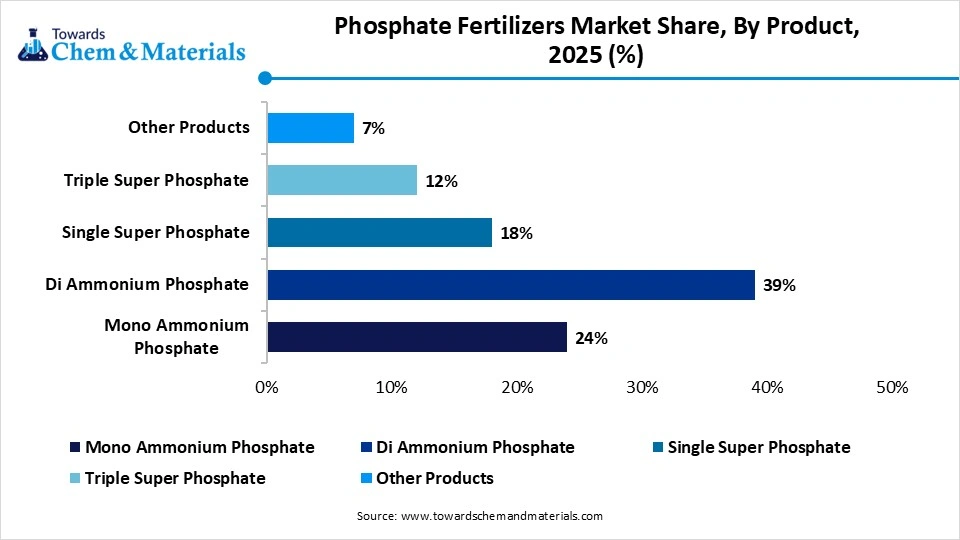
The mono ammonium phosphate segment held 24% market share in 2025, as it has a high nutrient availability and high phosphorus level. MAP is commonly used throughout early growth phases by farmers to aid root establishment and plant development. Its use in other horticultural and specialty crop production is increasing with the use of precision agriculture and water-soluble fertilizers.
The single super phosphate segment held 18% market share in 2025, because it can supply both phosphorus and sulfur nutrients. Farmers choose SSP to boost their soil fertility and balanced crop nutrition. The increasing production of pulses and oilseeds, as well as their low price, is playing a major role in the continued market uptake.
Phosphate Fertilizers Market Share, By Product, 2025 (%)
| By Product | Revenue Share, 2025 (%) |
| Mono Ammonium Phosphate | 24% |
| Di Ammonium Phosphate | 39% |
| Single Super Phosphate | 18% |
| Triple Super Phosphate | 12% |
| Other Products | 7% |
Application Insights
The cereals & grains segment dominated the market with the largest share of 48% in 2025, driven by the widespread cultivation of staple crops around the world. Phosphate fertilizers are necessary to stimulate root growth, uptake, and yield in cereal crops. Food demand is rising globally, and agricultural productivity is steadily increasing, maintaining robust demand for this application area.
The fruits & vegetables segment held the 21% market share in 2025 and is expected to grow at the fastest CAGR of 6.7% over the forecast period, fueled by rising demand for healthy, tasty fruit and vegetables. Phosphate fertilizers contribute to better crop quality, plant vigor, and the productivity of harvest. The increase in commercial horticulture activities, greenhouse production, and intensive farming is further driving up the adoption of fertilizers in this fast-growing application segment.
The oilseeds & pulses segment held 23% market share in 2025, as the demand for protein-yielding crops and edible oils increasing. Phosphorus plays a crucial role in root development and nutrient utilization. Fertilizer use is increasing in both the commercial and export-oriented planting industries in this category all over the world.
The other applications segment held 8% market share in 2025. Other applications involve turf management, forage crops, industrial plantations, and landscaping activities that require balanced nutrient management. These applications benefit from the use of healthy plants, strong roots, and productivity provided by applying phosphate fertilizers. The commercial landscaping and specialty agricultural operations continue to have steady demand as investment in them grows.
Phosphate Fertilizers Market Share, By Application, 2025 (%)
| By Application | Revenue Share, 2025 (%) |
| Cereals & Grains | 48% |
| Oilseeds & Pulses | 23% |
| Fruits & Vegetables | 21% |
| Other Applications | 8% |
Regional Insights
How did the Asia Pacific dominate the Phosphate Fertilizers Market in 2025?
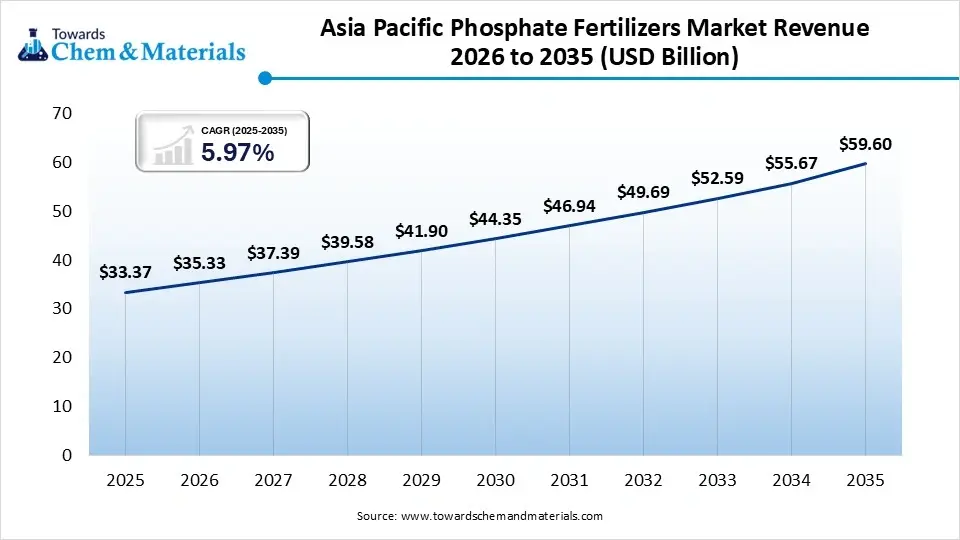
The Asia Pacific phosphate fertilizers market size was estimated at USD 33.37 billion in 2025 and is projected to reach USD 59.60 billion by 2035, growing at a CAGR of 5.97% from 2026 to 2035.Asia Pacific dominated the market by holding 44% share in 2025 and is expected to grow at the fastest with a CAGR of 6.5% during the forecast period, as the agriculture sector is vast and there is a large population, as well as a strong requirement for food production in this region. Regional demand is continuing to grow as a result of growing consumption of fertilizers, government support programs, and the widespread use of modern farming techniques. Further boosts market growth with expanded investments and increased crop productivity efforts.
China
- Annually, there is significant use of fertilizers containing phosphorus in the main agricultural provinces for large-scale grain production.
- The government's food security programs promote improved nutrient management and utilization of fertilizer.
- Precision agriculture technologies help to optimize phosphate fertilizer use and improve crop productivity.
- The nation has developed a strong capacity in domestic production of fertilizers, which enables a stable supply and contributes to the agricultural development goals.
India
- Government fertiliser subsidy programmes enhance affordability and promote the general use of phosphate fertilisers across the country.
- Greater population growth leads to greater pressure on the agriculture sector in terms of agricultural production and yield improvement.
- The cultivation of cereals, pulses, and oilseeds is increasing, thus increasing the need for phosphate nutrients.
- A greater awareness of the need for soil fertility management contributes to the growth of phosphate fertilizer consumption over the longer term.
The North America phosphate fertilizers market size was estimated at USD 14.41 billion in 2025 and is projected to reach USD 26.12 billion by 2035, growing at a CAGR of 6.13% from 2026 to 2035.North America held 19% market share in 2025 because of its advanced farming practices and high agricultural productivity standards. Precision agriculture technologies are becoming more common on farms, which use them to optimize nutrient management and enhance yields. Regional market development and modernization are continuing to be supported by sustainable farming practices, technological advancements, and increased demand for efficient fertilizer solutions.
United States
- Phosphate fertilizer is needed regularly on large commercial farms to optimise crop production.
- Adoption of precision agriculture promotes good nutrient management and ensures that unnecessary fertilizer application rates are minimized.
- Good investments in agricultural research promote the development of innovative and sustainable fertilizers.
- Continuing long term market growth is stimulated by the increased demand for high-yielding crops across the country.
Canada
- The large acreages of grains and oilseeds help to ensure a stable demand for phosphate fertilizers in the farming sections.
- Modern agricultural technologies enhance nutrient use efficiencies and encourage responsible use of fertilizer.
- Balanced nutrient management and environmental stewardship programs are promoted by government sustainability programs.
- When exports of agricultural commodities gain momentum, investments in productivity-enhancing fertilizer products and technologies increase.
The Europe phosphate fertilizers market size was estimated at USD 12.14 billion in 2025 and is projected to reach USD 22.10 billion by 2035, growing at a CAGR of 6.17% from 2026 to 2035.Europe held the 16% market share in 2025. Sustainable agriculture goals and rules are the key factors behind the phosphate fertilizers market in Europe. A trend toward smart nutrient use and precision farming is seen among farmers. The market is developing steadily across the region, with technological innovation, efforts to improve soil health, and a rising demand for environmentally responsible agricultural inputs.
 Germany
- High productivity in agriculture helps to promote precision nutrient management and fertilizer efficiency.
- Demand for environmentally friendly phosphate fertilizers is encouraged by the emphasis on sustainable farming.
- Investments in agricultural technology increase productivity but reduce nutrient loss throughout the farm.
- The use of balanced fertilizers and the practice of long-term soil health management are encouraged by regulatory frameworks.
France
- Phosphate fertilizer demand is highly consistent across crop categories, with robust demand from the large agricultural sector.
- Government support for sustainable agriculture promotes efficient use of nutrients and soil conservation.
- Precision farming technology is increasing and improving the efficiency of fertilizers and crop yield.
- The growing attention to food security ensures that investments in agricultural input solutions continue.
The Latin America phosphate fertilizers market size was estimated at USD 9.86 billion in 2025 and is projected to reach USD 18.08 billion by 2035, growing at a CAGR of 6.25% from 2026 to 2035.Latin America held 13% market share in 2025. Latin America is taking advantage of rising agricultural exports, crop acreage, and adoption rates of fertilizers. Increased investment in commercial agriculture and agricultural productivity programmes encourages market development. With the agricultural competitiveness focus being high, phosphate fertilizer demand is continuing to be high in key producing countries across the region.
Phosphate Fertilizers Market Share, By Regional, 2025 (%)
| Regional | Revenue Share, 2025 (%) |
| North America | 34% |
| Europe | 27% |
| Asia-Pacific | 29% |
| Latin America | 6% |
| Middle East & Africa | 4% |
Brazil
- Large quantities of phosphate fertilisers are used each year to grow soy beans, corn, and sugarcane.
- The growing demand for crop nutrition solutions across the country is met by national agricultural expansion programs.
- Efficient management of phosphorus is important to achieve increased productivity on large-scale commercial farming operations.
- Investment in soil fertility enhancement builds the resilience of soil fertility adoption in agricultural areas over time.
Chile
- The development of the fruit export industry drives demand for phosphate fertilizers and special crop nutrition.
- The use of innovative farming practices will enhance the management of nutrients and agricultural productivity.
- The use of balanced fertilizers and sustainable agriculture is encouraged throughout the country by programs implemented by the government.
- As there is increasing interest in export-quality production, more investments are being made in productivity-enhancing fertilizer usage throughout farms.
The Middle East & Africa phosphate fertilizers market size was estimated at USD 6.07 billion in 2025 and is projected to reach USD 11.38 billion by 2035, growing at a CAGR of 6.49% from 2026 to 2035.The Middle East & Africa held 8% market share in 2025, owing to the rising investments in agricultural modernization and food security programmes. The governments are encouraging the good use of fertilizers to boost crop production in difficult conditions. The expansion of irrigation schemes, sustainable agriculture, and development plans is still aiding regional market growth.
Saudi Arabia
- The advanced use of fertilizers for enhanced domestic agricultural production is promoted through food security programs.
- Efficient nutrient management and productivity growth are supported by modern agriculture investments by the government.
- As controlled environment farming expands, so does the demand for specialized products of phosphate fertilizers.
- In agricultural development projects, the use of fertilizer is optimized by adopting water-efficient farming practices.
South Africa
- Demand for phosphate fertilizers continues to grow on a large-scale cultivation of maize and other crops.
- Balanced nutrient application and soil management are promoted through agricultural productivity improvement programs.
- Increased investment in commercial farming supports the uptake of modern technologies of fertiliser use across the country.
- Rising attention to food security helps to maintain demand for crop nutrition solutions.
Phosphate Fertilizers Market Recent Developments
- In March 2026, the Turkmenabat chemical plant is expected to produce liquid fertilizers for greenhouse farming, specializing in phosphate fertilizers and ammonium superphosphate, while also producing technical sulfuric acid, essential for fertilizer production.(Source: business.com.tm)
- In August 2025, TWPEC launched Canada’s first low-carbon, enhanced efficiency fertilizers and phosphate fertilizer terminal. Led by V6 Agronomy and the Port of Johnstown, the project advances food security and climate-smart trade.(Source: www.worldfertilizer.com)
Top Companies List in Phosphate Fertilizers Market
- CF Industries Holdings Inc.
- Israel Chemicals Ltd.
- Eurochem Group AG
- Coromandel International Ltd.
- Agrium Inc.
- Potash Corp. of Saskatchewan Inc.
- PJSC PhosAgro
- Yara International ASA
- The Mosaic Co.
- S.A OCP
Segment Covered in the Report
By Product
- Mono Ammonium Phosphate
- Granular MAP
- Powder MAP
- Water-Soluble MAP
- Di Ammonium Phosphate
- Standard DAP
- Fortified DAP
- Water-Soluble DAP
- Single Super Phosphate
- Powder SSP
- Granulated SSP
- Zincated SSP
- Triple Super Phosphate
- Granular TSP
- Powder TSP
- Enriched TSP
- Other Products
- Ammonium Polyphosphate
- Rock Phosphate-Based Fertilizers
- Liquid Phosphate Fertilizers
By Application
- Cereals & Grains
- Wheat
- Rice
- Corn
- Barley
- Oilseeds & Pulses
- Soybean
- Groundnut
- Lentils
- Chickpeas
- Fruits & Vegetables
- Citrus Fruits
- Leafy Vegetables
- Root Vegetables
- Plantation Crops
- Other Applications
- Turf & Ornamentals
- Forage Crops
- Industrial Crops
By Region
- North America
- U.S.
- Canada
- Mexico
- Europe
- UK
- Germany
- France
- Italy
- Spain
- Sweden
- Denmark
- Norway
- Asia Pacific
- Japan
- China
- India
- Australia
- South Korea
- Thailand
- Latin America
- Brazil
- Argentina
- The Middle East and Africa
- South Africa
- Saudi Arabia
- UAE
- Kuwait
FAQ's
Question 1 : What is the phosphate fertilizers market size in 2026?
Answer : The market size is estimated to reach USD 80.29 billion in 2026, representing an upward growth trajectory from the USD 75.85 billion recorded in 2025.
Question 2 : What is the projected market value of phosphate fertilizers by 2035?
Answer : The global market value is projected to hit USD 133.93 billion by 2035, driven by a compound annual growth rate of 5.85%.
Question 3 : Which type of phosphate fertilizer is most widely used?
Answer : Diammonium Phosphate (DAP) is the most widely used type, commanding a 39% share of the overall market revenue due to its dual nitrogen and phosphorus nutrient delivery.
Question 4 : Why is the Asia-Pacific region leading the market?
Answer : Asia-Pacific leads because it contains large agricultural economies like China and India, which have massive populations, intensive food production needs, and strong government subsidy programs.
Question 5 : What are the main environmental concerns for this industry?
Answer : The primary environmental concern is phosphorus runoff from fields into local water systems, which can cause eutrophication (algal blooms that suffocate aquatic life). This is pushing the industry toward smart, controlled-release alternatives.
Meet the Team

Saurabh Bidwai
Principal Consultant
Saurabh Bidwai, a B.Tech Chemical Engineering graduate with 4+ years of experience, specializes in specialty chemicals, commodity chemicals, and engineered materials, offering valuable insights into market trends and emerging opportunities.

Aditi Shivarkar
Reviewed By
Aditi Shivarkar, with 14+ years in Chemical and Materials market research, specializes in Chemical and Materials. She ensures accurate, actionable insights, driving Towards Chemicals And Materials Analytics and Consulting excellence in industry trends and sustainability.