
Plastic Additives Size, Share, Growth, Report 2026 to 2035
The plastic additives market report segmented By Product (Plasticizers, Flame Retardants, Impact Modifiers, Antioxidants, Antimicrobials, UV Stabilizers, Others), By Plastic (Commodity Plastics, Engineering Plastics, High Performance Plastics), By End-Use (Packaging, Automotive, Consumer Goods, Construction, Others)-Global Industry Analysis, Size, Trends, Leading Companies, Regional Outlook, and Forecast 2026 to 2035
Content
What is the Current Plastic Additive Market Size Share?
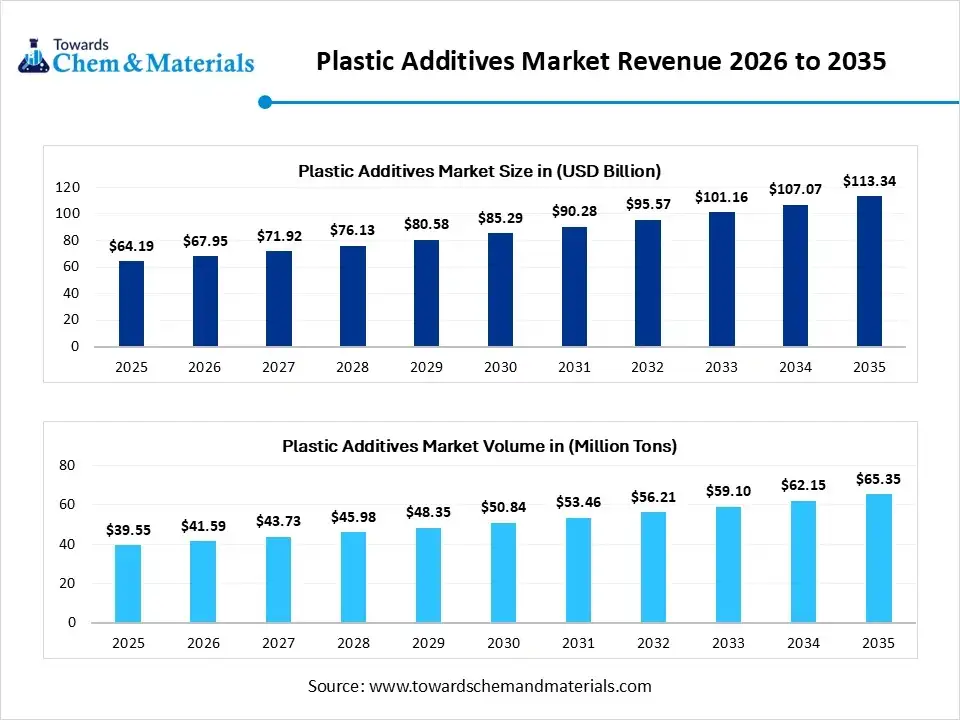
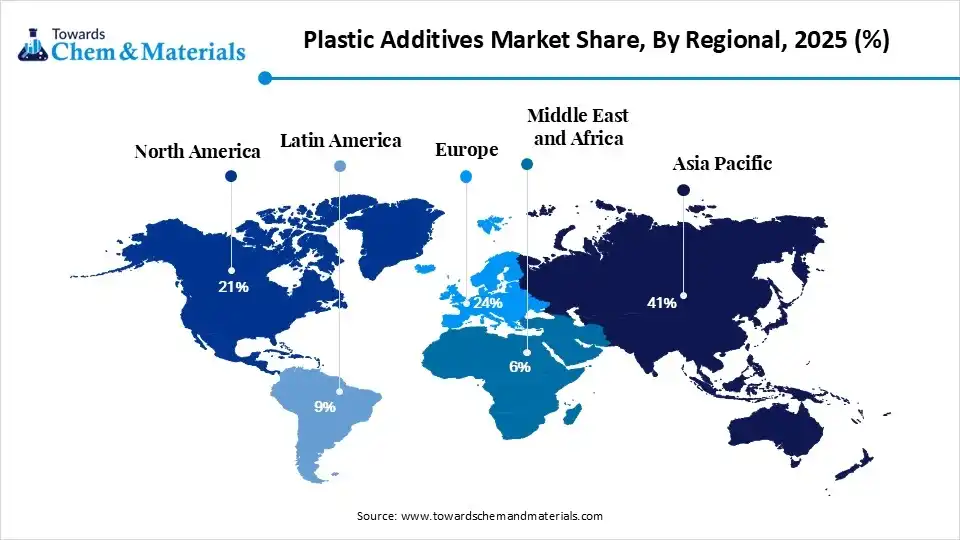
The global plastic additives market size was valued at USD 64.19 billion in 2025, is estimated to reach USD 67.95 billion in 2026, and is projected to reach USD 113.34 billion by 2035, exhibiting a compound annual growth rate (CAGR) of 5.85% over the forecast period from 2026 to 2035. Asia Pacific dominated the plastic additives market with the largest revenue share of 41% in 2025 and is expected to grow at the fastest CAGR of 5.98% during the forecast period. In terms of volume, the plastic additives industry is projected to grow from 39.55 million tons in 2025 to 65.35 million tons by 2035. growing at a CAGR of 5.15% from 2026 to 2035. The growth of the market is driven by the surging demand for polymers across the packaging, automotive, and construction industries.
The plastic additives market is a multi-billion-dollar industry that involves blending chemical compounds with polymers to enhance and modify plastic properties. Without these additives, modern plastics would be brittle, unstable, and difficult to process. They are essential for improving strength, flexibility, fire resistance, and thermal stability. Plastic additives enable polymers to resemble or even outperform traditional materials like wood, glass, and metal. Adding these substances allows manufacturers to produce lightweight, durable, and cost-effective products, fueling demand in sectors such as aerospace, automotive, and general manufacturing.
The process of transforming raw polymer powder into finished goods heavily depends on additives like lubricants, blowing agents, and processing aids, which accelerate production and reduce friction, thereby lowering costs. As environmental and chemical safety regulations tighten and consumer awareness grows, the market is shifting rapidly. Companies are increasing investments in R&D for biodegradable additives, bio-based plasticizers, & formulations that enhance recyclability.
Market Highlights
- By region, Asia Pacific dominated the market with a share of 41% in 2025 and is expected to experience the fastest growth with a CAGR of 7.00% in the forecast period. The electronics and packaging industries are rapidly increasing plastic consumption.
- By region, Europe held 24% market share in 2025. Stringent environmental regulations drive specialty additive adoption.
- By product, the plasticizers segment dominated the market with 31% share in 2025. PVC demand in construction and packaging continues to expand globally.
- By product, the antimicrobials segment held 7.00% market share in 2025 and is expected to have the fastest growth with a CAGR of 7.2% in the forecast period. Healthcare and consumer hygiene awareness accelerate additive adoption.
- By plastic, the commodity plastics segment dominated the market with 58% share in 2025. Mass packaging and consumer applications drive additive consumption.
- By plastic, the high performance plastics segment held 14% market share in 2025 and is expected to have the fastest growth with a CAGR of 7.1% in the forecast period. Aerospace and EV sectors adopt specialty polymers rapidly.
- By end-use, the packaging segment dominated the market with 36% share in 2025. Flexible packaging production increases additive requirements globally.
- By end-use, the others (e.g., pharmaceuticals, sports equipment) segment held 7% market share in 2025 and is expected to have the fastest growth with a CAGR of 6.9% in the forecast period. Medical device manufacturing requires specialty additive technologies.
Quick Stats at a Glance
- Market Estimated Size (2025): USD 64.19 Billion | CAGR (2026–2035): 5.85%
- Market Projected Size (2035): USD 113.34 Billion
- Asia Pacific: largest Market Revenue Share of 38% in 2025 | USD 26.32 Billion
- Market Estimated Volume (2025): 39.55 Million Tons | Volume CAGR (2026–2035): 5.15%
- Market Projected Volume (2035): 65.35 Million Tons
- Market Pricing (2025):
- Average Manufacturing Price (2025): USD 1,430/Ton
- Average Selling Price (2025): USD 1,896/Ton
- Pricing CAGR (2026–2035): 3.9%
The Silent Strengtheners: Exploring the Rise of Plastic Additives Worldwide
The global plastic additives market includes chemical substances added to polymer matrices to enhance performance, processability, or lifespan. These additives tailor plastic properties for specific end-uses, ranging from UV resistance, flexibility, durability, thermal stability, to color and flame resistance. They are essential in extending the versatility of plastics across industries like packaging, automotive, construction, consumer goods, and electronics. Moreover, the demand for plastic grows in emerging countries, and plastic additives are likely to gain substantial advantage in the coming years, as per the future industry observation.
Market Trends:
- The sudden shift towards eco-friendly additives is driving the market growth in recent years, as several governments have implemented sustainability regulations for major manufacturers in the past few years.
- The increased demand for antimicrobial additives is contributing to the growth of the industry in the current period. Moreover, the sectors where safety and hygiene are the priority, such as healthcare and consumer products, are driving up market growth in recent years.
Market Opportunity
- Rise of Bio-Based Additives: Driven by strict compostable-packaging laws in the EU and localized mandates in India, manufacturers are increasing bio-based masterbatch capacities.
- Stricter Chemical Regulations: Planned phase-outs of PFAS (forever chemicals) in Europe and North America are forcing suppliers to develop safer acrylic and silicone alternatives.
- EV & Automotive Lightweighting: The electric vehicle (EV) sector is demanding highly heat-stable, flame-retardant additive packages that can withstand operating temperatures exceeding 150 °C.
Market Report Scope
| Report Attributes | Details |
| Market Size and Volume in 2026 | USD 67.95 Billion/ 41.59 Million Tons |
| Revenue Forecast in 2035 | USD 113.34 Billion/ 65.35 Million Tons |
| Growth rate from 2024 to 2025 | CAGR 5.15% |
| Base Year of Estimation | 2025 |
| Forecast Period | 2025 - 2035 |
| Dominant Region | Asia Pacific |
| Segment Covered | By Product, By Plastic, By End-Use, By Regions |
| Key Companies Profiled | BASF SE, Clariant AG, Evonik Industries AG, Kaneka Corporation, Dow Inc, Albemarle Corporation, Songwon Industrial Co., Ltd., Nouryon, LANXESS AG, ExxonMobil Corporation, Mitsui Chemicals, SABIC |
Key Technological Shifts in the Plastic Additives Market through Advanced Manufacturing
Technological shifts in the plastic additives market are driven by the demand for sustainable bio-based formulations, smart Industry 4.0 production processes, and high-performance materials. Manufacturers are actively replacing traditional additives with eco-friendly alternatives to comply with strict global safety regulations. The expanding use of 3D printing in industries like aerospace and healthcare requires custom additives that improve mechanical strength, thermal stability, and surface finish during extrusion.
Plastic Additives Market Regulatory Landscape
| Country / Region | Regulatory Body | Key Regulations | Focus Areas | Notable Notes |
| United States | Environmental Protection Agency (EPA); Food and Drug Administration (FDA) | Toxic Substances Control Act (TSCA); FDA Food Contact Regulations | Chemical safety, food-grade plastics, emissions control | The U.S. regulates plastic additives for toxicity, food safety, and environmental impact, especially in packaging and consumer products. |
| European Union | European Chemicals Agency (ECHA); European Commission | REACH Regulation; RoHS Directive; EU Plastics Strategy | Hazardous substance restriction, recyclability | Europe enforces strict regulations on phthalates, heavy metals, and flame retardants used in plastic additives. |
| China | Ministry of Ecology and Environment (MEE); State Administration for Market Regulation (SAMR) | Plastic Pollution Control Policies; Chemical Registration Regulations | Sustainable plastics, environmental compliance | China is encouraging eco-friendly additives and recyclable plastics to reduce plastic pollution. |
| India | Central Pollution Control Board (CPCB); Ministry of Environment, Forest and Climate Change (MoEFCC) | Plastic Waste Management Rules; BIS Standards | Plastic recycling, sustainable additives | India is strengthening regulations related to single-use plastics and sustainable additive technologies. |
| Japan | Ministry of Economy, Trade and Industry (METI); Ministry of the Environment | Chemical Substances Control Law (CSCL) | High-performance additives, recycling efficiency | Japan emphasizes environmentally friendly and high-performance plastic additive technologies. |
Supply Chain Analysis of Plastic Additives Market
- Additive Production & Compounding:Plastic additives are produced through chemical synthesis and formulation processes to enhance polymer properties such as durability, flexibility, UV resistance, flame retardancy, and processing efficiency in plastic materials.
- Key players: BASF, Clariant, Songwon Industrial, Lanxess
- Quality Testing and Certification:Plastic additives must comply with standards for chemical safety, thermal stability, migration limits, environmental impact, and regulatory compliance before incorporation into plastic products.
- Key players: International Organization for Standardization, European Chemicals Agency, U.S. Food and Drug Administration, ASTM International
- Distribution to Industrial Users:Plastic additives are supplied to packaging manufacturers, automotive companies, construction industries, consumer goods producers, electronics manufacturers, and healthcare sectors.
- Key players: BASF, Clariant, Songwon Industrial.
Market Dynamics
| Drivers | Restrains | Opportunities |
| Rising Demand in Packaging:The e-commerce boom and a growing preference for convenience and medical-grade food packaging heavily drive the need for additives that increase shelf life, barrier protection, and durability. | Strict Environmental Regulations:Bans and heavy restrictions on harmful traditional additives such as phthalates, heavy metals, and Bisphenol A (BPA) hinder the growth of conventional products. | Bio-based and Eco-Friendly Alternatives:Driven by stringent compostability laws in the EU, California, and India, there is surging demand for bio-based plasticizers and biodegradable masterbatches. |
| Construction Expansion:Rapid urbanization in developing regions has boosted the use of plastics in piping, window profiles, and flooring, driving high demand for plasticizers and stabilizers. | High Costs of Bio-based Alternatives:Plant-oil and starch-based additives are significantly more expensive to produce than traditional petroleum-based counterparts, which limits their adoption in price-sensitive markets. | Advanced Colorants for Recycled Plastics:There is a rise in demand for advanced colorants and UV-stabilizers specifically formulated to mask impurities and maintain IR barrier performance in polymers with high recycled content. |
| Technological Advancements:Innovations such as 3D printing and the development of specialized, eco-friendly, and biodegradable additive formulations offer new avenues for market expansion. | Supply Chain and Infrastructure Gaps:A lack of established, specialized supply chains for biodegradable feedstocks makes scaling difficult and impacts product consistency during transit. | PFAS-Free Processing Aids:Increasing environmental scrutiny on traditional fluoropolymer processing aids is pushing manufacturers toward high-performing acrylic and silicone replacements. |
Segmental Insights
Product Insights
The plasticizers segment dominated the market with 31% share in 2025, due to their extensive use in improving the flexibility and durability of PVC products. Construction and infrastructure sectors rely heavily on plasticized PVC for durable piping, floor and wall coverings, roofing, and cable jacketing. Compared to other specialized polymer additives, traditional plasticizers are highly economical, making them a cost-effective solution to boost the workability and durability of plastics.
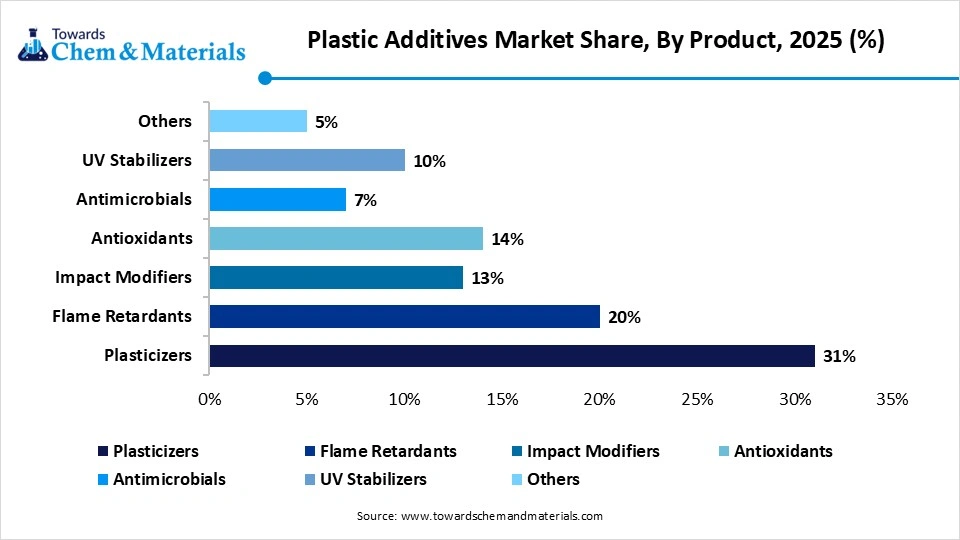 The flame retardants segment held 20% market share in 2025, driven by increasing demand for heat-resistant and fire-safe plastic materials. Governments and safety agencies worldwide continue to implement rigorous fire protection standards for materials used in construction, transportation, and consumer electronics to minimize fire-related hazards. The automotive industry’s transition to electric and hybrid vehicles has drastically boosted demand.
The antioxidants segment held 14% market share in 2025, due to expanding applications in food, pharmaceutical, and automotive packaging, which rely on them to prevent polymer degradation and extend shelf life. Antioxidants inhibit thermo-oxidative and thermo-mechanical degradation. By preventing plastics from yellowing, becoming brittle, or weakening during processing, they maintain structural integrity and visual clarity.
The antimicrobials segment held 7% market share in 2025 and is expected to have the fastest growth with a CAGR of 7.2% in the forecast period, driven by a strong focus on public hygiene, the need to prolong the shelf life of perishable goods, and stringent safety standards across critical end-use sectors like healthcare, packaging, and consumer goods. The packaging segment uses antimicrobial plastics to prevent microbial growth, thereby reducing spoilage and extending the shelf life of food, beverages, and medicines.
Plastic Additives Market Share, By Product, 2025 (%)
| By Product | Revenue Share, 2025 (%) |
| Plasticizers | 31% |
| Flame Retardants | 20% |
| Impact Modifiers | 13% |
| Antioxidants | 14% |
| Antimicrobials | 7% |
| UV Stabilizers | 10% |
| Others | 5% |
Plastic Insights
The commodity plastics segment dominated the market with 58% share in 2025, due to its massive production volume and low base cost. Additives are essential to transform these basic, inexpensive polymers into high-performance materials suitable for demanding industries. The booming e-commerce and fast-moving consumer goods (FMCG) sectors rely heavily on flexible and rigid packaging. Additives like plasticizers, anti-UV agents, and slip aids are continuously added to optimize these materials.
The engineering plastics segment held 28% market share in 2025, because these high-performance materials require specialized chemical formulations such as flame retardants, impact modifiers, and heat stabilizers to meet the extreme demands of modern, high-tech industrial applications. The boom in 3D printing technology for the aerospace and medical fields requires highly specialized, heat-resistant, and flexible engineered plastic formulations, driving a surge in tailored plastic additive manufacturing.
The high performance plastics segment held 14% market share in 2025 and is expected to have the fastest growth with a CAGR of 7.1% in the forecast period, due to rising demand for lightweight, durable materials in transportation, aerospace, and electronics. These applications require additives that enhance thermal stability, mechanical strength, and corrosion resistance under extreme conditions. Industries like medical device manufacturing, telecommunications, and advanced engineering require materials that can withstand sterilization, high voltage, and corrosive chemicals.
Plastic Additives Market Share, By Plastic, 2025 (%)
| By Plastic | Revenue Share, 2025 (%) |
| Commodity Plastics | 58% |
| Engineering Plastics | 28% |
| High Performance Plastics | 14% |
End-Use Insights
The packaging segment dominated the market with 36% share in 2025, due to the extensive use of additives in flexible films, rigid containers, and food packaging products. This surge is primarily driven by the rising demand for lightweight, flexible packaging solutions and the rapid expansion of the e-commerce sector. Online shopping requires durable, secure, and lightweight packaging to withstand transit and protect goods from moisture, light, and contamination, boosting the need for performance-enhancing additives.
The automotive segment held 24% market share in 2025 are growing rapidly owing to increasing demand for lightweight and durable plastic components. Driven by the push for vehicle lightweighting, EV manufacturing, and the need for stricter environmental compliance, automakers rely on additives to transform raw plastics into high-performance, durable, and lightweight substitutes for traditional metal components.
The consumer goods segment held 18% market share in 2025, due to rising disposable incomes, shifting consumer lifestyles, and the need to replace heavier, conventional materials with versatile, lightweight plastics. Additives are used to improve the durability, aesthetic appeal, and functionality of household items, toys, and electronics.
Manufacturers and modern consumers prefer plastic consumer goods because they are inexpensive, lightweight, and resistant to corrosion compared to metals or glass.The other (e.g., pharmaceuticals, sports equipment) segment held 7% market share in 2025 and is expected to have the fastest growth with a CAGR of 6.9% in the forecast period. Other segments include medical devices, sporting goods, and industrial equipment. The medical devices segment grew significantly within the plastic additives market due to the booming demand for biocompatible, lightweight, and cost-effective medical polymers. The sporting goods segment has experienced significant growth in the market by shifting from traditional materials to advanced, high-performance polymer composites. The industrial equipment segment of the market has grown significantly due to the rising need for high-performance, durable polymers.
Plastic Additives Market Share, By End-use, 2025 (%)
| By End-use | Revenue Share, 2025 (%) |
| Packaging | 36% |
| Automotive | 24% |
| Consumer Goods | 18% |
| Construction | 15% |
| Others (e.g., Pharmaceuticals, Sports Equipment) | 7% |
Regional Insights
How did Asia Pacific dominate the Plastic Additives Market in 2025?
The Asia Pacific plastic additives market size was estimated at USD 26.32 billion in 2025 and is projected to reach USD 47.04 billion by 2035, growing at a CAGR of 5.98% from 2026 to 2035.Asia Pacific dominated the market with a share of 41% in 2025 and is expected to sustain its position while growing with a CAGR of 7.00% in the forecast period, due to rapid industrialization, strong plastics manufacturing capacity, and increasing demand from the packaging and automotive industries. This leadership position was driven by a vast manufacturing base, surging e-commerce packaging demands, and rapidly expanding infrastructure and consumer goods sectors in economic hubs like China and India.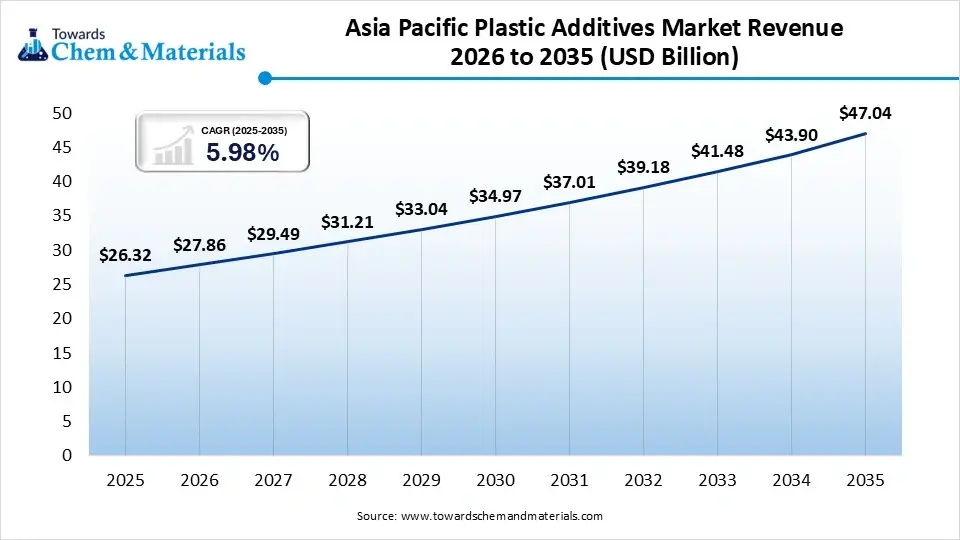
India
- Government guidelines, such as revised Plastic Waste Management Rules mandating Extended Producer
- Responsibility (EPR), require the use of specialized additives that improve recyclability, biodegradability, and eco-friendliness.
- The expansion of e-commerce and the FMCG sector is heavily driving the need for advanced stabilizers and colorants.
China
- China leads the regional market supported by massive plastic production, packaging demand, and expanding automotive and electronics manufacturing sectors.
- China remains the undisputed leader in plastic manufacturing, and its domestic packaging industry is skyrocketing due to the exponential growth of e-commerce
Japan
- Government policies mandating the reuse or recycling of plastic containers are increasing the uptake of biodegradable additives, UV stabilizers, and processing aids.
- Miniaturization in electronics and strict performance requirements in the semiconductor industry require advanced flame retardants and heat stabilizers.
Europe Plastic Additives Market Growth Factor
The Europe plastic additives market size was estimated at USD 15.41 billion in 2025 and is projected to reach USD 27.77 billion by 2035, growing at a CAGR of 6.07% from 2026 to 2035.Europe held the market share of 24% in 2025. Europe emphasizes environmentally sustainable and recyclable plastic additive technologies due to stringent environmental regulations. Europe's aggressive push toward reducing greenhouse gas emissions has forced the automotive sector to favor lightweight plastic components over heavy metals. Additives such as flame retardants, impact modifiers, and lubricants are essential to maintain safety and durability in electric vehicles (EVs).
Germany
- Germany leads in advanced engineering plastics and sustainable additive development for automotive and industrial applications.
- Stringent EU policies, including the Single-Use Plastics Directive, are pushing the German market toward sustainable solutions. There is an accelerating demand for additives that facilitate the mechanical recycling of polymers and bio-based alternatives.
Italy
- The EU Single-Use Plastics Directive and eco-conscious consumerism are forcing manufacturers to use bio-based, biodegradable, and recycling-friendly additives.
- The market is primarily fueled by the booming automotive, electrical engineering, and construction sectors, as well as strict EU sustainability mandates and the delayed national single-use plastic tax.
France
- France's aggressive environmental mandates and the broader European push for sustainability are forcing manufacturers to transition away from traditional, toxic chemicals.
- France’s strong automotive manufacturing sector, led by brands like Renault and Stellantis, continuously requires high-performance polymers. Additives are crucial to enhance the thermal stability, durability, and mechanical strength of plastics while allowing cars to be lighter
North America Plastic Additives Market Growth Factor
The North America plastic additives market size was estimated at USD 13.48 billion in 2025 and is projected to reach USD 24.37 billion by 2035, growing at a CAGR of 6.10% from 2026 to 2035.North America held the market share of 21% in 2025, driven by advanced polymer technologies and growing demand for sustainable additive solutions. State and federal government regulations targeting single-use plastics and waste are pushing manufacturers to adopt biodegradable additives. This shift is supported by increasing investments in bio-based plasticizers and innovative polymer blends.
U.S.
- The U.S. market benefits from strong innovation in specialty additives, packaging technologies, and automotive lightweighting initiatives.
- Public commitments by major brands to eliminate toxic legacy substances and meet biodegradability standards are fueling unprecedented demand for eco-friendly, bio-based additives.
Canada
- Rising pressure from the government's ban on certain single-use plastics and changing consumer preferences are driving the demand for bioplastics.
- The Canadian plastic packaging market requires specialized additives to improve barrier properties, clarity, and durability for food safety and e-commerce
Latin America Plastic Additives Market Growth Factor
The Latin America plastic additives market size was estimated at USD 5.78 billion in 2025 and is projected to reach USD 10.77 billion by 2035, growing at a CAGR of 6.42% from 2026 to 2035.Latin America held the market share of 9% in 2025, due to increasing packaging and construction activities. Key growth factors include rapid urbanization, the development of sustainable bio-based additives, and regional investments in food-safe packaging and infrastructure. Stricter environmental regulations and eco-friendly consumer trends are pushing the market toward bio-based and recyclable plastic additives.
Brazil
- Brazil is expanding plastic additive consumption, driven by growing consumer goods and food packaging industries
- Increased manufacturing in Brazil and Mexico has propelled the need for plastic additives (like plasticizers and stabilizers) to improve the durability, flexibility, and longevity of plastics in building, automotive, and retail applications.
Argentina
- The Argentina plastic additives market is primarily driven by expanding consumer goods and packaging sectors, an increased demand for high-performance plastics in the automotive industry, and the growing shift toward eco-friendly, bio-based additives to meet sustainability regulations.
- The ongoing need for lightweighting in automotive manufacturing and demand for durable piping and insulation in the construction sector push the adoption of impact modifiers, flame retardants, and heat stabilizers.
Middle East and Africa Plastic Additives Market Growth Factor
The Middle East and Africa plastic additives market size was estimated at USD 3.85 billion in 2025 and is projected to reach USD 7.37 billion by 2035, growing at a CAGR of 6.71% from 2026 to 2035.The Middle East and Africa held the market share of 6% in 2025, driven by booming infrastructure investments, urbanization, and a surging demand for high-performance plastic packaging. Growth is particularly fueled by the automotive and construction sectors in the GCC and North Africa. The region is experiencing increasing demand for plastic additives due to infrastructure development and packaging industry expansion.
Saudi Arabia
- Saudi Arabia supports market growth through expanding petrochemical production and downstream plastics manufacturing industries.
- The push toward national protein self-sufficiency and food security initiatives requires modernized livestock and aquaculture farming. There is a rapid shift toward natural and sustainable additives over artificial antibiotic growth promoters.
UAE
- The UAE’s national agenda to expand manufacturing and shift away from oil dependency is heavily boosting local industrial production.
- Government-led mandates for domestic agricultural and industrial farming are driving the need for optimized, high-quality animal nutrition.
- Increasing regional demand for "clean label," organic, and Halal-certified ingredients increases demand.
Recent Developments
- In June 2025, Clariant launched its AddWorks™ PPA product line, debuting a new generation of PFAS-free polymer processing aids designed for polyolefin extrusion applications. The launch directly addresses tightening global regulatory restrictions on per- and polyfluoroalkyl substances (PFAS) by offering a compliant, high-performance alternative to traditional fluoropolymer-based processing aids.(Source: www.clariant.com)
- In December 2025, Arkema officially announced a proposed divestment of specific segments within its plastic additives business to the Indian specialty chemicals group, Praana. The transaction allows Arkema to actively manage its portfolio and continue refocusing on strategic, higher-value-added activities within its Specialty Materials sector.(Source: www.arkema.com)
Top players in the Plastic Additives Market & Their Offerings
- BASF SE: Based in Germany, one of the largest suppliers of chemical additives, focusing heavily on bio-based and mechanically recycled additive solutions.
- Clariant AG: A Swiss specialty chemicals company offering high-performance additives, masterbatches, and sustainable biopolymer solutions.
- Evonik Industries AG: A leading German specialty chemicals company renowned for high-performance specialty additives and processing aids.
- Kaneka Corporation: A Japanese manufacturer recognized for its impact modifiers and biodegradable polymer additives.
- Dow Inc.: A United States based multinational producing a vast array of polymer modifiers, stabilizers, and functional additives.
Other Top Players Are
- Albemarle Corporation
- Songwon Industrial Co., Ltd.
- Nouryon
- LANXESS AG
- ExxonMobil Corporation
- Mitsui Chemical
- SABIC
- Songwon Industrial Co. Ltd.
Segment Covered
By Product
- Plasticizers
- Phthalate Plasticizers
- DINP
- DIDP
- DOP
- Non-phthalate Plasticizers
- Adipates
- Trimellitates
- Citrates
- Phthalate Plasticizers
- Flame Retardants
- Halogenated Flame Retardants
- Non-halogenated Flame Retardants
- Phosphorus-based
- Metal Hydroxides
- Impact Modifiers
- Acrylic Impact Modifiers
- ABS Impact Modifiers
- MBS Impact Modifiers
- Antioxidants
- Primary Antioxidants
- Secondary Antioxidants
- Antimicrobials
- Organic Antimicrobials
- Inorganic Antimicrobials
- Silver-based
- Zinc-based
- UV Stabilizers
- HALS
- UV Absorbers
- Quenchers
- Others
- Processing Aids
- Lubricants
- Colorants
- Antistatic Agents
By Plastic
- Commodity Plastics
- Polyethylene
- Polypropylene
- Polyvinyl Chloride
- Polystyrene
- Engineering Plastics
- Polycarbonate
- Polyamide
- ABS
- PBT
- High Performance Plastics
- PEEK
- PPS
- Fluoropolymers
- LCP
By End-Use
- Packaging
- Flexible Packaging
- Rigid Packaging
- Food Packaging
- Automotive
- Interior Components
- Exterior Components
- Under-the-hood Applications
- Consumer Goods
- Electronics
- Appliances
- Household Products
- Construction
- Pipes & Fittings
- Insulation
- Flooring & Roofing
- Others (e.g., Pharmaceuticals, Sports Equipment)
- Medical Devices
- Sporting Goods
- Industrial Equipment
By Region
- North America
- U.S.
- Mexico
- Canada
- Europe
- Germany
- UK
- France
- Italy
- Asia Pacific
- China
- India
- Japan
- South Korea
- Central & South America
- Brazil
- Argentina
- Middle East & Africa
- Saudi Arabia
- UAE
FAQ's
Question 1 : What is the current size of the global plastic additives market?
Answer : The global plastic additives market size is estimated at USD 67.95 billion. Industrial volume demand stands at 41.59 million tons, supported by heavy plastic consumption across packaging, retail, and automotive supply chains.
Question 2 : Which region holds the largest market share in plastic additives?
Answer : The Asia Pacific region dominates the global market, controlling a 41% revenue share. This commanding position is sustained by massive electronic component assembly lines, dense consumer packaging requirements, and strong industrial bases in China and India.
Question 3 : What is the most widely consumed type of plastic additive?
Answer : Plasticizers are the dominant product segment, accounting for 31% of total market revenue. Their massive adoption is fueled by the worldwide production of flexible PVC for infrastructure, industrial piping, and construction profiles.
Question 4 : What key factors are driving the growth of this market?
Answer : Growth is primarily driven by the expansion of the e-commerce sector requiring durable flexible packaging, rapid urbanization increasing building infrastructure, and the global automotive push for vehicle lightweighting to optimize fuel efficiency and EV battery range.
Question 5 : How are environmental regulations changing the additive industry?
Answer : Governments are actively phasing out harmful legacy additives like phthalates and PFAS compounds. This has triggered an unprecedented surge in research and development for bio-based plasticizers, biodegradable masterbatches, and processing aids that facilitate mechanical recycling.
Meet the Team

Saurabh Bidwai
Principal Consultant
Saurabh Bidwai, a B.Tech Chemical Engineering graduate with 4+ years of experience, specializes in specialty chemicals, commodity chemicals, and engineered materials, offering valuable insights into market trends and emerging opportunities.

Aditi Shivarkar
Reviewed By
Aditi Shivarkar, with 14+ years in Chemical and Materials market research, specializes in Chemical and Materials. She ensures accurate, actionable insights, driving Towards Chemicals And Materials Analytics and Consulting excellence in industry trends and sustainability.