
Plastic Films and Sheets Market Size, Share, Growth, Report 2026 to 2035
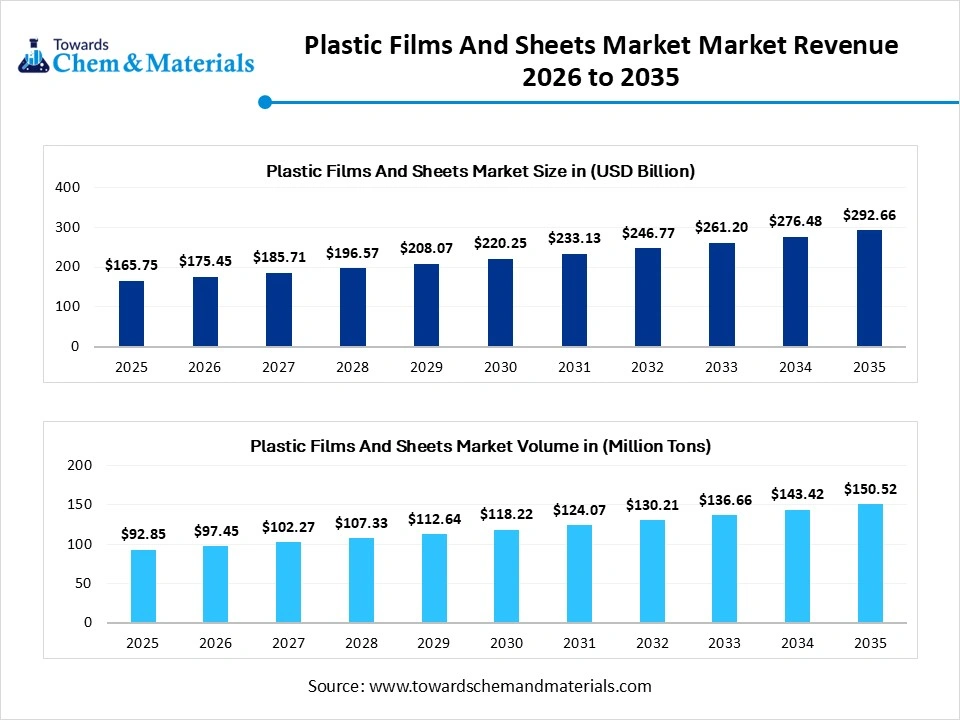
The plastic films and sheets market is expected to expand significantly from USD 175.45 billion in 2026 to USD 292.66 billion by 2035, growing at a CAGR of 5.85%. The study covers extensive market size data, segmentation analysis, and regional performance across key global markets. It further includes detailed company analysis, competitive benchmarking, value chain insights, trade statistics, and comprehensive data on key manufacturers and suppliers driving industry growth.
Content
Plastic Films and Sheets Market Analysis, Demand and Growth Rate Forecast
The global plastic films and sheets market size was estimated at USD 165.75 billion in 2025 and is expected to be worth around USD 292.66 billion by 2035, exhibiting a compound annual growth rate (CAGR) of 5.85% over the forecast period from 2026 to 2035. In terms of volume the plastic films and sheets market is projected to grow from 92.85 million tons in 2025 to 150.52 million tons by 2035. growing at a CAGR of 4.95% from 2026 to 2035. The report offers comprehensive insights into market size along with detailed segment-wise data by material type, product type, and end-use industries. It also provides in-depth regional analysis across North America, Europe, Asia-Pacific, Latin America, and the Middle East & Africa, along with company profiles, competitive landscape, value chain analysis, trade data, and detailed information on manufacturers and suppliers.
Key Takeaways
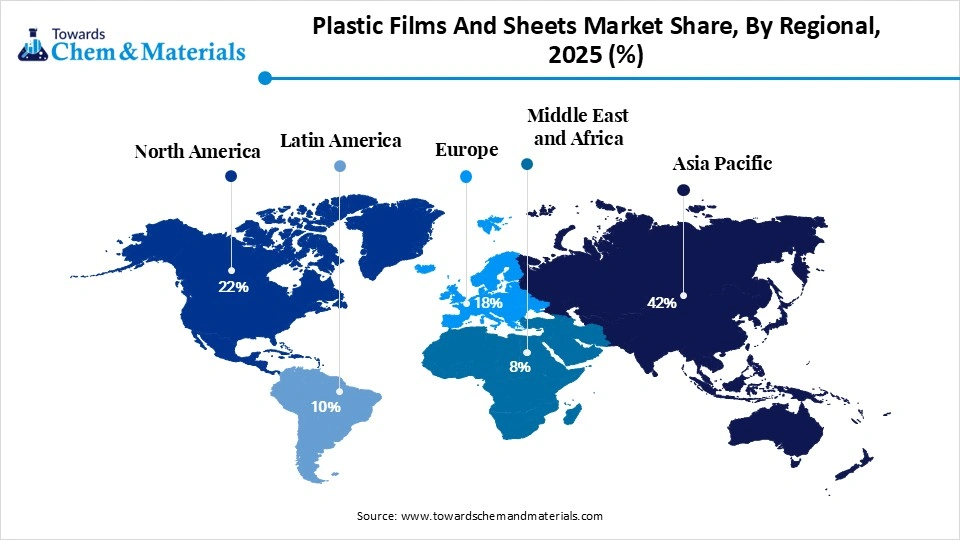
- By region, Asia Pacific dominated the plastic films and sheets market by holding a 42% share in 2025 and is expected to grow at the fastest with a CAGR of 6.8% during the forecast period due to their manufacturing and consumption hub.
- By region, North America held the second largest share of 22% in 2025 and expects notable growth in the market with 5.10% CAGR during the forecast period due to technological advancement and domestic innovation-driven infrastructure.
- By material type, the polyethylene (PE) segment dominated the market with 38% share in 2025 due to its flexibility and cost-effectiveness.
- By material type, the polypropylene (PP) segment held the second largest share of 25% in 2025 and expects the fastest growth in the market with a 6.3% CAGR during the forecast period due to its rising demand in food packaging and the expansion.
- By product type, the films segment dominated the market with 72% share in 2025, and is anticipated the fastest growth in the market with 6.0% CAGR during the forecast period due to its consumption and lightweight nature.
- By product type, the sheets segment held the second largest share of 28% in 2025 due to their superior thickness and rising demand in industrial applications.
- By process type, the extrusion segment dominated the market with 64% share in 2025 and is expected to have the fastest growth in the market with 5.9% CAGR during the forecast period due to its high-speed efficiency and mechanical performance.
- By process type, calendering segment held the second largest share of 14% in 2025 due to its precision and safety in the pharmaceutical and automotive sectors.
- By thickness, the thin films (<50 microns) segment dominated the market with 46% share in 2025 and expects the fastest growth in the market with 6.2% CAGR during the forecast period due to demand for resource efficiency and focus on lowering carbon footprint.
- By thickness, the medium thickness (50-200 microns) segment held the second largest share of 34% in 2025 due to its strength and flexibility in consumer and industrial sectors.
- By application, the packaging segment dominated the market with 52% share in 2025 and expects the fastest growth in the market with 6.4% CAGR during the forecast period, driven by growing demand for food packaging and e-commerce with cost-effectiveness.
- By application, the agriculture segment held the second largest share of 14% in 2025 due to the rising use of mulch and greenhouse films in modern farming.
- By end-use industry, the food & beverage segment dominated the market with 34% share in 2025 and expects the fastest growth in the market with 6.5% CAGR during the forecast period due to its ability to prevent food contamination and barrier technology.
- By end-use industry, the agriculture segment held the second largest share of 13% in 2025, fueled by government support and adoption of modern farming practices.
Market Size and Volume Forecast
- Market Size (2025): USD 165.75 Billion | CAGR (2026–2035): 5.85%
- Market Projected Size (2035): USD 292.66 Billion
- Market Volume (2025): 92.85 Million Tons (MT) | Volume CAGR (2026–2035): 4.95%
- Market Projected Volume (2035): 150.52 Million Tons (MT)
- Market Pricing (2025):
- Average Manufacturing Price: USD 1,477 per Ton
- Average Selling Price (ASP): USD 1,995 per Ton
- Pricing CAGR (2025–2035): 3.9%
Market Overview
The plastic films and sheets market is defined by their thin-gauge polymeric structures engineered using precision mel-processing techniques which offer barrier shielding, surface protection and structural stability. The manufacturer focuses on the development of mono-materials to enhance operational efficiency and transparency, boosting innovation in material science.
The rising focus on the circular economy accelerated the adoption of high-barrier mono-materials by maintaining safety and longevity in diversified applications like healthcare, construction, food science, and agriculture, aligning with recyclability to meet carbon-neutral targets.
Plastic Films And Sheets Market Trends
- Shift Towards Rapid Urbanization: The rising population is shaping the trend where urban hubs serving crucial materials in construction and building infrastructure enable cost-effective delivery and sustainable solutions.
- Strict Regulatory Framework: The stringent packaging compliance and extended producer responsibility initiatives enable upgradation in plastic film design and suppliers' agreements by offering chemical safety standards and certification targets
- Rising Focus on Superior-Barrier Films and Mono-Material: The manufacturer focuses on lightweight protection, transparency, and longevity of product, which is accelerating the adoption of this material, which balances shelf life with recyclability.
Key Technological Shifts and AI in the Plastic Films and Sheets Market
The technological shift in the market accelerates the integration of artificial intelligence and industrial IoT to boost autonomous manufacturing and molecular-level material science. The modern AI-driven extrusion line uses real-time closed-loop control by eliminating gauge variation and lowering scrap rates. The machine leaning accelerate the advancement of high-barrier mono-materials to maintain deoxygenation and oxygen transmission resistance with recyclability.
The emerging digital watermarking boosts the automated identification of plastic type at end-of-life, while the AI-driven defect detection offers near-perfect optical clarity and structural stability by balancing intelligent manufacturing and the circular economy.
Trade Analysis of the Plastic Films and Sheets Market: Import and Export Statistics
- Vietnam exported 175,175 shipments of plastic films and sheets.
- China exported 143,645 shipments of plastic films and sheets.
- Ukraine exported 33,882 shipments of plastic films and sheets.
- From July 2024 to June 2025, the world exported 199,391 shipments of plastic films and sheets.
Plastic Films And Sheets Market: Supply Chain Analysis
Raw Material Supply and Polymer Engineering:
The initial stage of development and sourcing of metallocene catalysts and petrochemical industries focuses on the conversion of crude oil and natural gas into high-performance resins such as PE, PVC, PP, and PET
- Key Players: Saudi Basic Industries Corporation, ExxonMobil, Dow Chemical Company, Reliance Industries Ltd., and BASF SE
Conversion & Film and Sheet Manufacturing:
The manufacturers use blown film extrusion and lamination to transform resins into finished films and sheets. The stage combines co-extrusion that offers a high-barrier shield, recyclability, and UV resistance.
- Key Players: Amcor PLC, Toray Industries Inc., Berry Global Inc., UFlex Ltd., Sealed Air Corporation, and Jindal Poly Films Ltd.
Specialized Distribution and End-Use Integration:
The stage of logistical delivery of plastic films and sheets for specific applications like food& beverages, healthcare, agriculture, building, and construction.
- Key Players: Nestle, Unilever, PolymerFilms, Construction Firms, PlasticPoint, PepsiCo, and Healthcare Providers
Regulatory Framework: Plastic Films And Sheets Market
| Region | Key Regulation | Regulatory Focus |
| European Union | Packaging and Packaging Waste Regulation | Focus on structural recyclability and material composition. It forces manufacturers to adopt mono-material films and the implementation of recyclability performance grades. |
| United States | SB 54 (Circular Economy and Plastic Pollution Act), Plastic Pollution Prevention and Packaging Producer Responsibility Act | Regulation that emphasizes collection infrastructure and material capacity. Mandates for recyclability and standardization of resins used in stretch wraps and retail bags |
| India | Plastic Waste Management Rules and EPR Framework | Mandatory recycled content and post-consumer recycled resin, thickness standards that prohibit ultra-thin films prone to littering, especially for non-food applications. |
| China | Plastic Pollution Control Action Plan | Targets that focus on banning low-quality, thin mulch films, agricultural and industrial durability mandate high-strength sheets recovery from fields to the use of specialized biodegradable films for specific crops. |
| Canada | Single-Use Plastic Prohibition, Labeling, and Recyclability Standards | Focus on transparency of consumer and waste prevention guidance to regulate environmental claims and prohibit film products. |
| United Kingdom | Plastic Packaging Tax | Utilize economic disincentives and impose a financial penalty. By taxing film and sheet to meet recycled content. The standards shift financial math for converters and brands. |
Segmental Insights
Material Type Insights
Polyethylene (PE) Segment Dominated the Plastic Films and Sheets Market with 38% of Market Share in 2025
Polyethylene (PE) segment dominated the market with 38% share in 2025, represented by its flexibility, high impact strength and moisture resistance with its cost-effectiveness. The segment is divided into LDPE, LLDPE and HDPE utilized in high-grade food packaging, agricultural films, construction liners and industrial wraps. Additionally, PE offers a superior protective barrier, recyclability, and a sustainable solution that drives innovation in PE materials.
Polypropylene (PP) segment held the second largest share of 25% in 2025 and expects the fastest growth in the market with a 6.3% CAGR during the forecast period due to its superior transparency and chemical resistance, which is utilized in BOPP and CPP, where BOPP is used for food packaging and labels, while CPP is used for medical and food wraps. The PP offers a high-gloss finish and withstands sterilised temperatures, making it ideal for premium sectors as a mono-material recyclable solution with sustainability.
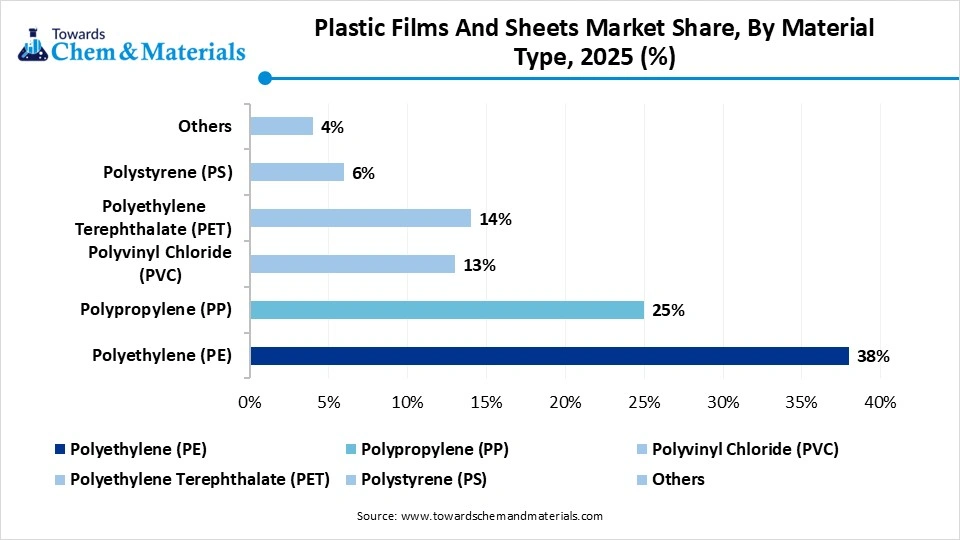
Polyethylene terephthalate (PET) segment held the third largest share of 14% in 2025 because of its offering superior tensile strength and thermal stability by maintaining clarity. The segment, divided into APET and CPET, is mostly utilized in food packaging, industrial laminates and high-end electronics by ensuring a balance of recyclability and performance.
Polyvinyl chloride (PVC)segment held the fourth largest share of 13% in 2025 characterized by their chemical resistance, flame retardancy and their transparency, which is found in rigid and flexible forms. The PVC is ideal in pharmaceutical blister packs, industrial protection and medical tubing because it is welded and printed, which makes it ideal for high-durability applications by maintaining precision and safety.
Product Type Insights
Films Segment Dominated the Plastic Films and Sheets Market with 72% Share in 2025
Films segment dominated the market with 72% share in 2025, and is anticipated the fastest growth in the market with 6.0% CAGR during the forecast period. Driven by their flexibility, superior surface area, and thin gauge essential for automated packaging. The segments are created in stretch, shrink, barrier and specialty films which offer moisture barriers, puncture resistance and aesthetic precision in various sensitive sectors. Additionally, films are coated, printed and laminated easily, positioning them as a key product for resource-efficient flexible packaging and innovative shielding wraps.
Plastic Films And Sheets Market Share, By Product Type, 2025 (%)
| By Product Type | Revenue Share, 2025 (%) |
|
Films
|
72% |
| Sheets | 28% |
Sheets segment held the second largest share of 28% in 2025, driven by their utilization in heavy-duty operations by offering higher impact resistance, structural integrity and load-bearing capacity, prominent for industrial barriers, thermoforming, and graphic arts. The sheets provide dimensional stability and superior thickness in robust applications such as automotive components, construction liners and other industrial applications.
Process Type Insights
Extrusion Segment Dominated the Plastic Films And Sheets Market with 64% of Market Share in 2025
Extrusion segment dominated the market with 64% share in 2025 and is expected to have the fastest growth in the market with 5.9% CAGR during the forecast period. The process enables high-speed efficiency, thickness and continuous production with superior mechanical reliability. The extrusion is divided into blown film and cast film, with the ability for multi-layer co-extrusion for the integration of specialized barriers. Overall, extrusion is preferred for high-performance packing and construction solutions due to its cost-efficiency
Calendering segment held the second largest share of 14% in 2025 due to its accurate thickness, superior surface finish and high-speed reliability. By processing heated polymers using a series of high-pressure rollers, it creates efficient PVC and PET materials. The calendaring is a catalyst for pharmaceutical blister packs, credit card stock and floor covering by ensuring steadiness, precision and safety.
Plastic Films And Sheets Market Share, By Process Type, 2025 (%)
| By Process Type | Revenue Share, 2025 (%) |
| Extrusion | 64% |
| Calendering | 14% |
| Injection Molding | 10% |
| Thermoforming | 12% |
Thermoforming segment held the third largest of 12% in 2025 because it transforms flat plastic sheets into precise three-dimensional products known for versatility and rapid turnaround. The segment is crucial in food trays, pharmaceutical blister packs, automotive and packaging, with the balance of structural stability and lightweight design by providing cost-effective production in diversified applications.
Injection molding segment held the fourth largest share of 10% in 2025, driven by its mechanical performance that achieves precision, complex geometries and fast repetition. The process shows injecting molten polymer into engineer-driven molds and components that offer dimensional stability and structural stability. Injection molding accelerates performance that makes them standard for medical devices, automotive parts and aesthetic perfection.
Thickness Insights
Thin Films (<50 microns) Segment Dominated the Plastic Films and Sheets Market with 46% of Market Share in 2025
Thin films (<50 microns) Segment dominated the market with 46% share in 2025 and expects the fastest growth in the market with 6.2% CAGR during the forecast period, engineered for flexibility and source reduction to achieve high-performance and resource-efficiency. The segment is utilized in automated packaging, industrial and food grades. The thin films show the ability to maintain better puncture resistance and clarity by lowering carbon footprint as cost-effective and sustainable resilient packaging solutions.
Plastic Films And Sheets Market Share, By Thickness, 2025 (%)
| By Thickness | Revenue Share, 2025 (%) |
| Thin Films (<50 microns) | 46% |
| Medium Thickness (50–200 microns) | 34% |
| Thick Sheets (>200 microns) | 20% |
Medium thickness (50-200 microns) segment held the second largest share of 34% in 2025, value for their versatility and flexibility in heavy-duty applications, agricultural mulch and protection-driven sectors. The segment improves puncture resistance, dimensional stability and mechanical strength by ensuring superior performance in consumer goods and industrial packaging.
Thick sheets (>200 microns) segment held the third largest share of 20% in 2025, characterized by their structural resilience, higher rigidity and high-impact resistance. The thick sheets utilized in thermoformed machinery components, construction barriers and protective glazing offer dimensional stability and load-bearing capacity, chemical resistance and long-term durability in high-end applications.
Application Insights
The Packaging Segment Dominated the Plastic Films and Sheets Market with 52% of Market Share in 2025
Packaging segment dominated the market with 52% share in 2025 and expects the fastest growth in the market with 6.4% CAGR during the forecast period due to its ability to extend shelf-life, product protection, and visual appeal in various applications. The plastic films and sheets offer moisture barriers, puncture strength and oxygen resistance in food-grade, non-food, consumer goods and industrial packaging. The segment is a key driver of innovation in rigid and flexible packaging with high-speed automated processing. Additionally, the packaging industry is shifting towards recyclable mono-material solutions that accelerate the market expansion.
Plastic Films And Sheets Market Share, By Application, 2025 (%)
| By Application | Revenue Share, 2025 (%) |
| Packaging | 52% |
| Agriculture | 14% |
| Construction | 11% |
| Healthcare | 8% |
| Consumer Goods | 9% |
| Automotive | 6% |
Agriculture segment held the second largest share of 14% in 2025 because these materials are crucial for improving crop yields, pest control and moisture retention, which includes mulch films, greenhouse covers offering UV stability and tear resistance in extreme conditions. The growing government support and transition towards modern and sustainable farming, which optimizes water efficiency and plant productivity, has accelerated the adoption of plastic films and sheets.
Construction segment held the third largest share of 11% in 2025, driven by rising demand vapor barrier films, flashing and protective insulation, driving the growth. The material offers superior tensile strength, durability, moisture control, and structural integrity by ensuring long-term building protection and energy efficiency in modern construction infrastructure.
Consumer goods segment held the fourth largest share of 9% in 2025 due to rising demand for luxury stationery, home decor, and high-end sports gear by ensuring a premium surface finish to meet demanding safety standards. The films offer scratch resistance and color vibrancy that are required for retail appeal, packaging by maintaining consumer transparency and versatility. Overall, the material enables high quality and long-lasting performance in modern consumer lifestyles and daily-use products.
End-Use Industry Insights
Food & Beverage Segment Dominated the Plastic Films and Sheets Market with 34% of Market Share in 2025
Food & beverage segment dominated the market with 34% share in 2025 and expects the fastest growth in the market with 6.5% CAGR during the forecast period due to its ability to provide longevity and protection from food contamination, which makes it a pillar of barrier technology. These segments are integrating high-clarity polymers with specialized coating by offering leak-proof security, ultra-low oxygen content and moisture transmission rates to preserve texture, primary flavour and nutritional value of food.
Plastic Films And Sheets Market Share, By End-Use Industry, 2025 (%)
| By End-Use Industry | Revenue Share, 2025 (%) |
| Food & Beverage | 34% |
| Pharmaceuticals | 12% |
| Agriculture | 13% |
| Construction | 11% |
| Automotive | 9% |
| Electronics | 8% |
| Retail & E-commerce | 13% |
Agriculture segment held the second largest share of 13% in 2025, driven by government subsidies for farmers and a rising population that drives the need for good security. The sector utilized mulch films, covers, and silage wraps to boost crop efficiency by lowering water loss. The plastic films and sheets protect harvests from climate change and hazardous pests by maintaining high-efficiency farming aligned with sustainable practices.
Pharmaceuticals segment held the third largest share of 12% in 2025, representing better performance and sterilized safety. The pharmaceutical sector utilised PVC, PET and laminates to create medical device bags, sealed, sterilized liquid and blister packs to avoid contamination and degradation. Additionally, the plastic films and sheets offer long-term drug stability and patient safety by preserving stringent healthcare compliance
Construction segment held the fourth largest share of 11% in 2025, due to growing urbanization and development of infrastructure, where this material is crucial for sub-slab insulation and roofing underlayment. The rising transition towards modern residential and industrial demand for insulation and film durability is boosting the market growth and making it a key pillar in the modern building framework.
Regional Insights
How Did The Asia Pacific Dominated The Plastic Films And Sheets Market In 2025?
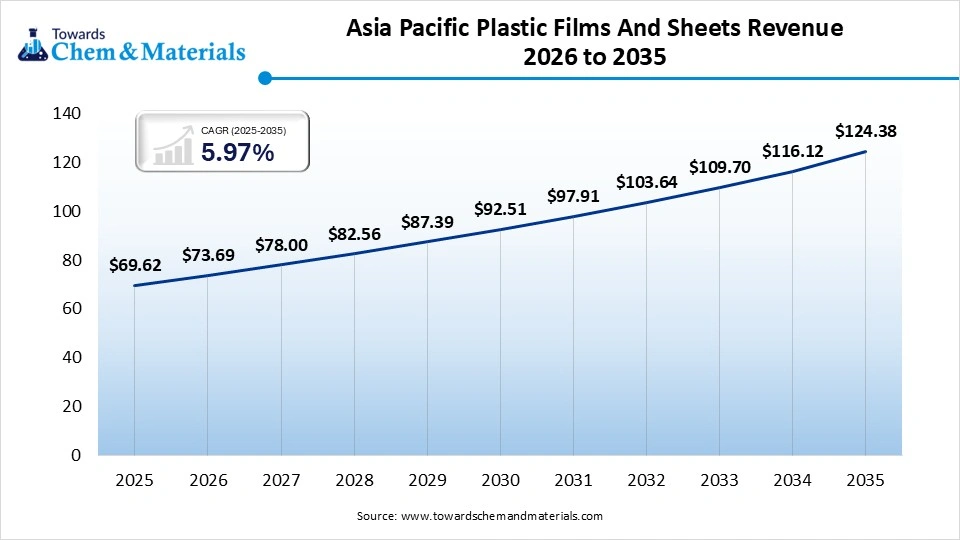
The Asia-Pacific plastic films and sheets market size was estimated at USD 69.62 billion in 2025 and is projected to reach USD 124.38 billion by 2035, growing at a CAGR of 5.97% from 2026 to 2035. Asia Pacific dominated the plastic films and sheets market by holding a 42% share in 2025 It serves as a manufacturing and consumption hub for plastic films and sheets. The region is being included towards urbanisation and industrialization with massive sourcing of upstream petrochemical capacity. Additionally, the Asia Pacific's rising expansion in e-commerce, cold-chain logistics and pharmaceutical sectors is driving the domestic growth. The stringent EPR mandates and leading innovation in material science, integrating with an AI-driven system, position the region towards leadership in the market.
China Plastic Films and Sheets Market Growth Trends
China market is a manufacturing hub for plastic films and sets the standards for supply chain dynamics and pricing. The region expansion in high-value specialty films and green manufacturing to meet white pollution mandates is driving the implementation of high-strength mulch films. The domestic players focus on innovation through strategic partnerships that prioritize biocompatible resins to meet performance and environmental standards.
North America Plastic Films and Sheets Market Growth Trends
North America held the second largest share of 22% in 2025, and is expected to experience notable growth in the market with 5.10% CAGR during the forecast period. It is representative of innovation-driven infrastructure and sets the standards for advanced material science. The region is integrating high-performance polymers across the applications sector. The regional players focus on value-add functional barriers and AI-driven extrusion by prioritizing environmental integrity and product safety for modern industrial sheeting.
United States Plastic Films and Sheets Market Growth Trends
The United States market is driven by the shift towards medical-grade compliance and high-performance industrial protection. The U.S. strongly focuses on low-waste manufacturing that aligns with technological advancement to meet U.S.-based recycled-content mandates. The region focuses on PFAS-free polymeric framework innovation that supports the domestic circular economy
Recent Developments
- In April 2026, Z-Polymers Inc. announced an investment partnership with Kureha Corporation to advance high-performance liquid crystal polymer technology. The collaboration focuses on commercialization of the next-generation high-performance finer platform.
- In January 2026, Toray Industries Inc., unveiled the development of a new type of TORAYFAN® biaxially-oriented polypropylene (BOPP) film with heat resistance by withstanding 160°C engineered to replace fluorinated films in IC substrate.
- In May 2025, Amcor completes the acquisition of Berry Global to enhance value for customers and shareholders, creating a global powerhouse in consumer and healthcare packaging. This business merger, as an $8.4 billion all-stock deal, is reshaping the packaging industry and growth opportunities.
Top Companies in the Plastic Films and Sheets Market
- Toray Industries, Inc.
- British Polythene Ltd.
- Toyobo Co., Ltd.
- Berry Global, Inc.
- SABIC
- Plastic Film Corporation of America
- Sealed Air
- Dow
- DuPont de Nemours, Inc.
- Novolex
- Amcor plc
- UFlex Ltd.
Plastic Films and Sheets Market Segment Covered in the Report
By Material Type
- Polyethylene (PE)
- Low-Density Polyethylene (LDPE)
- Linear Low-Density Polyethylene
- High-Density Polyethylene (HDPE)
- Polypropylene (PP)
- Biaxially Oriented Polypropylene (BOPP)
- Cast Polypropylene (CPP)
- Polyvinyl Chloride (PVC)
- Rigid PVC
- Flexible PVC
- Polyethylene Terephthalate (PET)
- Amorphous PET (APET)
- Crystallized PET (CPET)
- Polystyrene (PS)
- General Purpose PS
- High Impact PS
- Other
- Polyamide (PA)
- EVOH
- Bioplastics
By Product Type
- Films
- Stretch Films
- Shrink Films
- Barrier Films
- Agricultural Films
- Specialty Films
- Sheets
- Thermoforming Sheets
- Industrial Sheets
- Graphic Arts Sheets
By Process Type
- Extrusion
- Blow Film Extrusion
- Cast Film Extrusion
- Calendering
- Injection Molding
- Thermoforming
By Thickness
- Thin Films (< 50 microns)
- Medium Thickness (50-200 microns)
- Thick Sheets (>200 microns)
By Application
- Packaging
- Food Packaging
- Non-Food Packaging
- Industrial Packaging
- Agriculture
- Mulch Films
- Greenhouse Films
- Silage Films
- Construction
- Vapor Barriers
- Insulation Films
- Healthcare
- Medical Packaging
- Disposable Products
- Consumer Goods
- Automotive
By End-Use Industry
- Food & Beverage
- Pharmaceuticals
- Agriculture
- Construction
- Automotive
- Electronics
- Retail & E-commerce
By Regions
- North America:
- U.S.
- Canada
- Mexico
- Rest of North America
- Latin America:
- Brazil
- Argentina
- Rest of Latin America
- Europe:
- Western Europe
- Germany
- Italy
- France
- Netherlands
- Spain
- Portugal
- Belgium
- Ireland
- UK
- Iceland
- Switzerland
- Poland
- Rest of Western Europe
- Eastern Europe
- Austria
- Russia & Belarus
- Türkiye
- Albania
- Rest of Eastern Europe
- Asia Pacific
- China
- Taiwan
- India
- Japan
- Australia and New Zealand
- ASEAN Countries (Singapore, Malaysia)
- South Korea
- Rest of APAC
- MEA:
- GCC Countries
- Saudi Arabia
- United Arab Emirates (UAE)
- Qatar
- Kuwait
- Oman
- Bahrain
- South Africa
- Egypt
- Rest of MEA
- GCC Countries
FAQ's
Question 1 : What are the key trends shaping the plastic films and sheets market?
Answer : Major trends are the Shift towards rapid urbanization, a strict regulatory framework, rising focus on superior barrier films and mono-material
Question 2 : Which region holds the largest share of the plastic films and sheets market?
Answer : Asia Pacific holds the largest share of the plastic films and sheets market.
Question 3 : Who are the key players in the plastic films and sheets market?
Answer : The market is divided with major players including Amcor PLC, Toray Industries, Inc., Sealed Air Corporation, Jindal Polyfilms Ltd., British Polythene Ltd., Toyobo Co., Ltd., Berry Global, Inc., SABIC, Plastic Film Corporation of America, Sealed Air, Dow, DuPont de Nemours, Inc.
Question 4 : What is the leading application of plastic films and sheets?
Answer : Packaging is the largest application segment, contributing 52% of the market share in 2025, supported by increasing demand in food packaging and e-commerce.
Question 5 : Which end-use industry drives the highest demand?
Answer : The food & beverage industry leads with a 34% share, due to the need for food safety, extended shelf life, and advanced barrier technologies.
Meet the Team

Saurabh Bidwai
Principal Consultant
Saurabh Bidwai, a B.Tech Chemical Engineering graduate with 4+ years of experience, specializes in specialty chemicals, commodity chemicals, and engineered materials, offering valuable insights into market trends and emerging opportunities.

Aditi Shivarkar
Reviewed By
Aditi Shivarkar, with 14+ years in Chemical and Materials market research, specializes in Chemical and Materials. She ensures accurate, actionable insights, driving Towards Chemicals And Materials Analytics and Consulting excellence in industry trends and sustainability.