
Plastic-Free Detergent Market Size, Share & Trends Analysis Report by 2026-2035
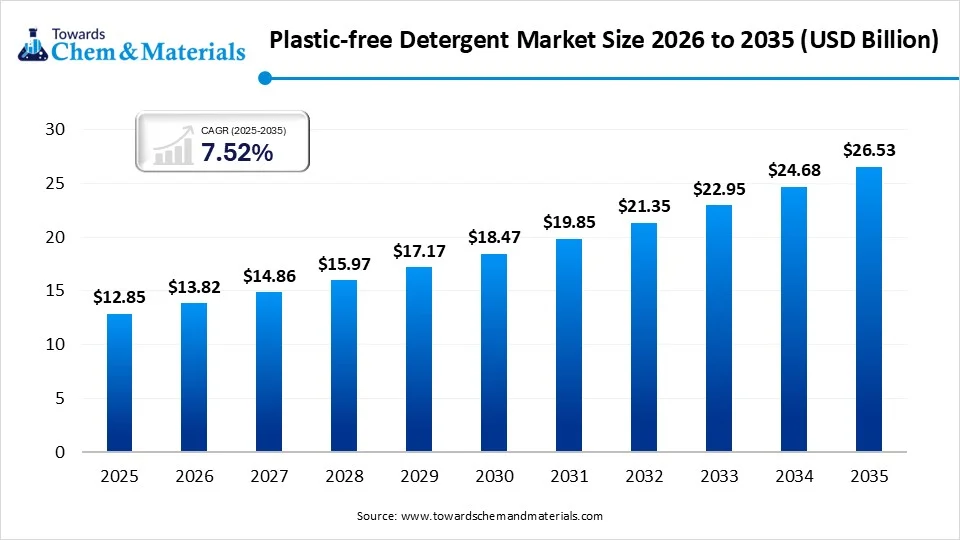
The global plastic-free detergent market size is expected to grow from USD 13.82 billion in 2026 to USD 26.53 billion in 2035, growing at a CAGR of 7.52% from 2026 to 2035. The top key players in the market are Seventh Generation, Ecover, Earth Breeze, Inc., Tru Earth, Dropps, Biokleen, Method Products, ECOS, Unilever, Procter & Gamble (P&G)-Global Forecast 2026 To 2035
Content
What is the Current Plastic-Free Detergent Market Size and Share?
The global plastic-free detergent market size was estimated at USD 12.85 billion in 2025 and is expected to increase from USD 13.82 billion in 2026 to USD 26.53 billion by 2035, growing at a CAGR of 7.52% from 2026 to 2035. Asia Pacific dominated the plastic-free detergent market with the largest revenue share of 40.00% in 2025. The greater trend towards efficient and minimal plastic usage in the manufacturing sector has fueled the market growth in recent years. A type of cleaning and laundry product that is made by eco-friendly materials by avoiding plastic waste is known as plastic-free detergent. Also, several manufacturers are avoiding plastic-free packaging by using materials like refill punches, cardboard boxes, which are primarily made of compostable materials, or metal tins. Also, the global shift towards sustainability has supported the industry's growth in recent years.
Market Highlights
- The Asia Pacific dominated plastic-free detergent market with the largest revenue share of 40.00% in 2025, due to its very large consumer population and growing awareness about environmental issues.
- By form, the liquid segment dominated the market and accounted for the largest revenue share of 57.00% in 2025, owing to its familiarity and ease for consumers to use.
- By form, the powder segment is expected to grow during the forecast period, due to it naturally requires less packaging.
- By ingredients, the plant-based surfactants segment led the market with the largest revenue share of 37.00% in 2025, owing to their offering good cleaning performance while being more environmentally friendly.
- By ingredient, the enzyme-based formulations segment is expected to grow at a rapid CAGR during the forecast period, due to its ability to clean very efficiently even in small amounts.
- By end-use, the residential segment dominated the market and accounted for the largest revenue share of 72.00% in 2025, owing to most detergents are used in households for everyday laundry
- By end-use, the commercial segment is expected to grow during the forecast period, due to businesses trying to improve their environmental reputation.
Shift Towards the Highly Concentrated Detergent Formulas
The industry has been observed to move toward highly concentrated formulas. Also, the scientists are designing detergents that clean effectively even in very small quantities. These formulas often use advanced surfactants and enzymes to remove stains without needing large volumes of liquid. Because the detergent is concentrated, companies can sell smaller products that require less packaging and transportation. This technology also allows detergents to work well in cold water, which saves energy during washing.
Trade Analysis of the Plastic-Free Detergent Market:
Import, Export, Consumption, and Production Statistics
- The detergent emerged as one of the leading exporting products with 205,862 global shipments via 19,886 buyers and 15,220 exporters between June 2024 to May 2025, as per the reports.
- Also, the world has seen a heavy import of detergent through 46,335 buyers and 14,506 exporters with 14,506 shipments in recent years, as per the latest survey.
Plastic-Free Detergent Market Trends:
- The shift from the large plastic bottles to compact formats has supported the stronger cash flows for manufacturing enterprises in recent years. Also, by having the advantages such as being easier to store and transport, the compact designs have gained industry attention while reducing the use of large-scale plastic in the past few years.
- The implementation of the sustainability standards in the manufacturing region has attracted increased capital and investment in manufacturing in the current period. Also, people are aware of the clean-labeled product, which is driving the industry scalability nowadays.
- The emergence of the smaller eco-friendly brands is seen as high margin opportunity for the manufacturers during the forecast period. Also, focusing on minimal packaging, biodegradable ingredients, and ethical production practices is likely to drive sustainable financial gains in the manufacturing sector in the upcoming period.
Report Scope
| Report Attribute | Details |
| Market Size in 2026 | USD 26.53 Billion |
| Revenue Forecast in 2035 | USD 13.82 Billion |
| Growth Rate | CAGR 7.52% |
| Forecast Period | 2026 - 2035 |
| Base Year | 2025 |
| Dominant Region | Asia Pacific |
| Segment Covered | By Form, By Ingredient, By End-Use, Region |
| Key companies profiled | Seventh Generation, Ecover, Earth Breeze, Inc., Tru Earth, Dropps, Biokleen, Method Products, ECOS, Unilever, Procter & Gamble (P&G) |
Supply Chain Analysis of the Plastic-Free Detergent Market:
Distribution to Industrial Users
- Industrial distribution of plastic-free detergents focuses on high-volume, waste-reducing solutions. Manufacturers supply industrial users through direct-to-business (B2B) channels and specialized wholesalers.
- Key formats include 60L to 1000L bulk containers, concentrated powders in 25kg sacks, and plastic-free laundry sheets that minimize transport emissions and packaging waste.
Chemical Synthesis and Processing
- Chemical synthesis of plastic-free detergents involves saponification or blending plant-based surfactants like alkyl polyglucosides. Processing focuses on spray-drying for powders or compression for solid tabs, eliminating liquid stabilizers that require plastic jugs.
- Final products are stabilized using biodegradable binders, ensuring structural integrity without synthetic polymer coatings or microplastic additives.
Regulatory Compliance and Safety Monitoring
- Regulatory compliance for plastic-free detergents involves adhering to ECHA (REACH) or EPA standards for biodegradability and chemical safety. Safety monitoring utilizes ISO 14001 and GHS-compliant labeling to track toxicological impacts.
- Regular audits ensure the absence of microplastics and restricted substances, maintaining ecological safety across the entire product lifecycle.
Plastic-Free Detergent Market Regulatory Landscape: Global Regulations
| Country Region | Regulatory Body | Key Regulations | Focus Areas |
| United States | Environmental Protection Agency (EPA) | 40 CFR Part 417: Sets Effluent Guidelines and Standards for soap and detergent manufacturing | Chemical Safety: Evaluating every intentionally added ingredient against human health and aquatic toxicity criteria. |
| European Union | ECHA | Regulation (EC) No 648/2004 (Detergents Regulation): The primary framework for detergents | Ultimate Biodegradability: All surfactants must meet strict ultimate biodegradability criteria. |
| China |
State Administration for Market Regulation (SAMR) |
GB/T 26396-2011: Technical specification for safety of soaps and detergents. | Classification by Use: Products are tiered into Class A (food/fruit cleaning) and Class B (utensils/packaging) with strict limits on 1,4-dioxane. |
Segmental Insights
Form Insights
How did the Liquid Detergents Segment Dominate the Plastic-Free Detergent Market in 2025?
The liquid detergents coatings segment dominated the market share 57.00%in 2025, due to its familiarity and ease for consumers to use. It dissolves quickly in water and works well for pre-treating stains on clothes. Many households became comfortable with liquid detergents because they are convenient and widely available. When the plastic-free detergent movement started, some brands simply changed the packaging while keeping the liquid format.
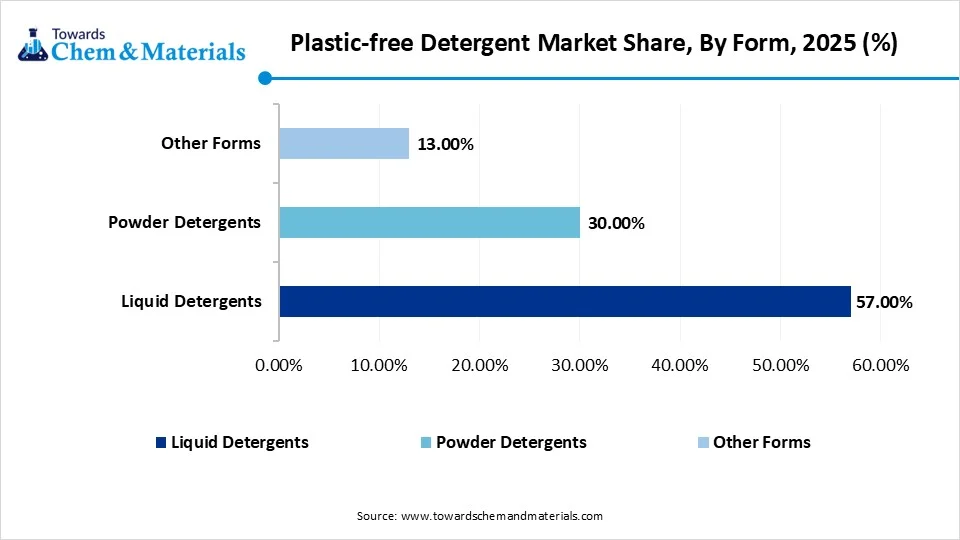
The powder detergents segment is expected to grow with a rapid CAGR, owing to it naturally requires less packaging. Also, the powders can easily be stored in cardboard boxes or paper bags, which eliminates the need for plastic bottles. Powder detergents are also lighter and easier to transport compared with liquids. Modern powder formulas have improved significantly and dissolve better than older versions. As consumers and companies focus more on reducing plastic waste, powder detergents are becoming attractive again.
Plastic-free Detergent Market Share, By Form, 2025 (%)
| By Form | Revenue Share, 2025 (%) |
| Liquid Detergents | 57.00% |
| Powder Detergents | 30.00% |
| Other Forms | 13.00% |
Ingredients Insights
How did the Plant-Based Surfactants Segment Dominate the Plastic-Free Detergent Market in 2025?
The plant-based surfactants segment dominated the market share 37.00% in 2025, due to their offering good cleaning performance while being more environmentally friendly. These surfactants are usually derived from natural sources such as coconut oil or other plant materials. They break down more easily in water and cause less environmental harm compared with some traditional petroleum-based ingredients.
The enzyme-based formulations segment is expected to grow, owing to their ability to clean very efficiently even in small amounts. Enzymes are natural proteins that break down stains such as grease, food particles, and dirt. Because enzymes works effectively, detergents can be more concentrated and require less product per wash. This supports plastic-free packaging since smaller quantities of detergent are needed.
Plastic-free Detergent Market Share, By Ingredient, 2025 (%)
| By Ingredient | Revenue Share, 2025 (%) |
| Plant-based surfactants | 37.00% |
| Enzyme-based formulations | 15.00% |
| Biodegradable formulations | 18.00% |
| Non-toxic / Natural Ingredients | 12.00% |
| Other Ingredients | 18.00% |
End Use Industry Insights
How did the Residential Segment Dominate the Plastic-Free Detergent Market in 2025?
The residential segment dominated the market share 72.00% in 2025, due to most detergents are used in households for everyday laundry. People who want to reduce plastic waste often start by changing the products they use at home. Laundry detergent is a product that is used frequently, so switching to a plastic-free option can make a noticeable difference in reducing household waste. Many eco-friendly detergent brands also first targeted individual consumers through online platforms and specialty stores.
The commercial segment is expected to grow with a rapid CAGR, owing to businesses trying to improve their environmental reputation. Moreover, the hotels, hospitals, laundromats, and restaurants use large volumes of detergents every day. If these organizations switch to plastic-free detergents, the reduction in plastic waste can be very significant. Many companies are now including sustainability goals in their operations.
Plastic-free Detergent Market Share, By End-use, 2025 (%)
| By End-use | Revenue Share, 2025 (%) |
| Residential | 72.00% |
| Commercial | 28.00% |
Regional Analysis:
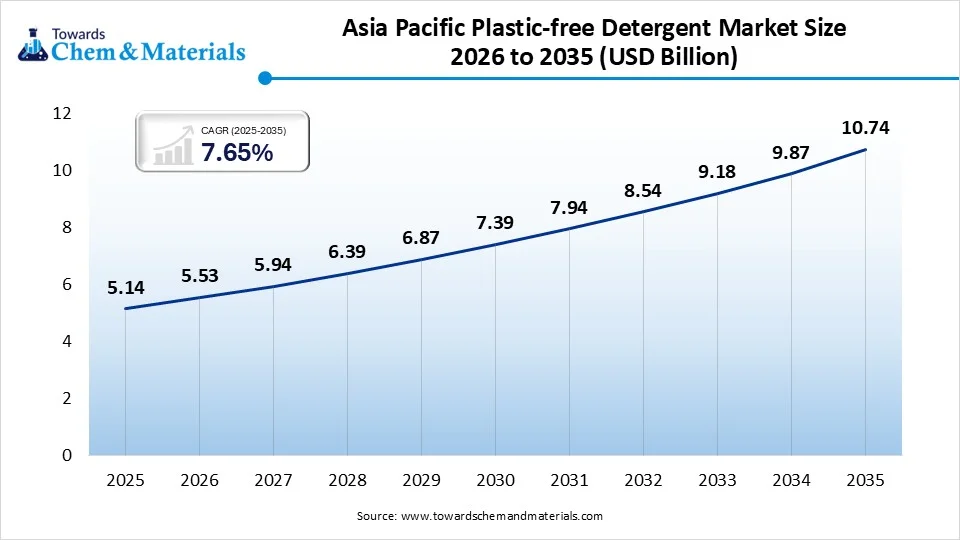
The Asia Pacific plastic-free detergent market size was valued at USD 5.14 billion in 2025 and is expected to be worth around USD 10.74 billion by 2035, exhibiting at a compound annual growth rate (CAGR) of 7.65% over the forecast period from 2026 to 2035. Asia Pacific dominated the plastic-free detergent market share 40.00% in 2025, due to its very large consumer population and growing awareness about environmental issues. Countries in this region are experiencing rapid urbanization and rising demand for household cleaning products. Governments and environmental groups are also promoting waste reduction and sustainable consumption. These efforts encourage companies to introduce eco-friendly alternatives, including plastic-free detergents.
China’s Massive Consumer Base Drives Growth
China maintained its dominance in the market, owing to it having one of the world's largest consumer bases. Environmental awareness among young consumers is increasing, and many people are interested in sustainable household products, according to recent observations. Also, the companies in China are experimenting with new detergent formats, such as sheets and concentrated powders that require less packaging. Furthermore, China has a strong manufacturing capacity, which helps produce these products at large scale.
Plastic-Free Detergent Market Evaluation in North America
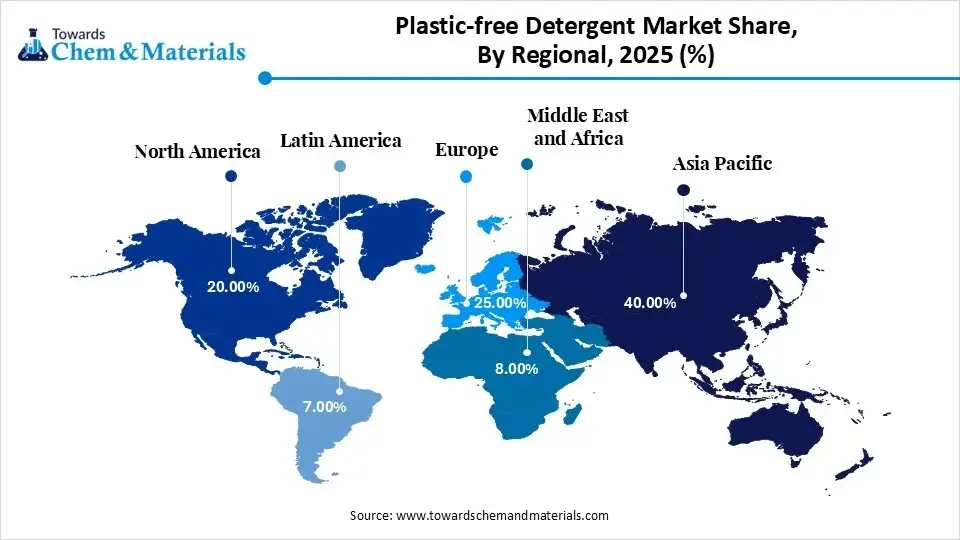
North America plastic-free detergent market segment accounted for the major revenue share of 20.00% in 2025. North America is expected to capture a major share of the plastic-free detergent market with a rapid CAGR, owing to consumers in this region strongly supporting sustainable products. Many people actively look for eco-friendly alternatives in everyday items, including cleaning products. Retailers are also expanding their selections of environmentally responsible brands. Innovation from startups is another factor driving growth, as many new detergent formats, such as strips and tablets, were first introduced in this region.
Innovation Powering the United States Plastic-Free Detergent Market
United States is expected to emerge as a prominent country for the plastic-free detergent market in the coming years, due to its strong culture of product innovation and entrepreneurship. Many startups in the united States are developing new detergent formats that reduce packaging waste. Online shopping and subscription models also help eco-friendly brands reach customers directly. Consumers in the country are becoming more interested in reducing plastic waste and supporting sustainable brands.
Europe Plastic-Free Detergent Market Examination
Europe plastic-free detergent market segment accounted for the major revenue share of 25.00% in 2025.Europe is growing in industry, owing to environmental awareness is very high among consumers. Many countries in the region promote recycling, waste reduction, and sustainable consumption. Governments and environmental organizations encourage companies to reduce plastic packaging. Retailers are also supporting eco-friendly products by giving them more visibility in stores.
Plastic-free Detergent Market Share, By Regional, 2025 (%)
| Regional | Revenue Share, 2025 (%) |
| North America | 20.00% |
| Europe | 25.00% |
| Asia Pacific | 40.00% |
| Latin America | 7.00% |
| Middle East & Africa | 8.00% |
Sustainability Shaping Germany’s Consumer Choices
Germany is expected to gain a significant industry share owing to environmental responsibility is deeply embedded in consumer culture. Moreover, many households actively try to reduce waste and choose eco-friendly products. Retail stores usually promote sustainable brands and provide recycling information to customers in the country. Germany also has strong waste management and recycling systems that support environmental goals. As a result, consumers are more open to trying new product formats such as refill detergents or packaging-free products.
Recent Developments
- In July 2025, TerraSafe created a partnership with the DisSolves. The main motive behind the strategic collaboration is to introduce plastic free product, which includes water soluble detergent, edible pod and sheets packaging, as per the company's claim.(Source: www.recyclingtoday.com)
- In February 2025, Procter & Gamble launched a waterless and plastic-free detergent called Tide Evo. Moreover, the company has invested around $97 million to develop these sustainable products as per the published report.(Source: trellis.net)
Top Vendors in the Plastic-Free Detergent Market & Their Offerings:
- Seventh Generation: Owned by Unilever, this Vermont-based pioneer focuses on plant-derived ingredients and 100% recycled packaging. Their plastic-free efforts include laundry detergent tablets and concentrated powders. They prioritize transparency through "Vocal for Local" initiatives and hold B Corp certification, focusing heavily on chemical safety and eliminating synthetic fragrances or dyes.
- Ecover: A Belgian eco-pioneer, Ecover specializes in detergents using renewable, plant-based surfactants. While famous for their "PlantPlastic," they have expanded into refill stations and plastic-free cardboard-boxed powders. Their "Long Live Labels" initiative and focus on circular economy principles aim to reduce the overall environmental footprint of industrial and domestic cleaning.
- Earth Breeze, Inc.: Earth Breeze is a leader in the detergent sheet movement, providing dehydrated laundry strips in compostable cardboard envelopes. By eliminating liquid, they remove the need for plastic jugs and significantly reduce shipping emissions. They operate on a "Buy One, Give One" model, donating millions of loads to nonprofits globally.
- Tru Earth: Based in Canada, Tru Earth popularized the ultra-concentrated laundry strip. Their plastic-free, biodegradable packaging is designed to dissolve completely or compost, addressing the global plastic crisis directly. Their focus is on space-saving logistics and paraben-free, phosphate-free formulas that are hypoallergenic and safe for sensitive skin and greywater systems.
- Dropps
- Biokleen
- Method Products
- ECOS
- Unilever
- Procter & Gamble (P&G)
Segments Covered in the Report
By Form
- Liquid Detergents
- Powder Detergents
- Other Forms
By Ingredient
- Plant-based surfactants
- Enzyme-based formulations
- Biodegradable formulations
- Non-toxic / Natural Ingredients
- Other Ingredients
By End-Use
- Residential
- Commercial
By Region
- North America
- U.S.
- Canada
- Mexico
- Europe
- Germany
- UK
- France
- Italy
- Spain
- Asia Pacific
- China
- India
- Japan
- South Korea
- Latin America
- Brazil
- Argentina
- Middle East & Africa
- Saudi Arabia
- South Africa
FAQ's
Question 1 : What is the current market size of the plastic-free detergent industry and its expected growth rate?
Answer : The plastic-free detergent market is valued at USD 12.85 billion in 2025, expected to grow at a CAGR of 7.52% to reach USD 26.53 billion by 2035.
Question 2 : What are the key drivers fueling the growth of the plastic-free detergent market?
Answer : The growing consumer awareness about sustainability, reduced plastic usage in manufacturing, and the shift towards eco-friendly products are driving the market\'s growth.
Question 3 : Which regions are leading the plastic-free detergent market, and what factors contribute to their dominance?
Answer : Asia Pacific leads the market with a 40% share in 2025, driven by its large consumer base, environmental awareness, and increasing demand for eco-friendly products.
Question 4 : Who are the top companies dominating the plastic-free detergent market?
Answer : Top companies include Seventh Generation, Ecover, Earth Breeze, Tru Earth, Dropps, Biokleen, Method Products, ECOS, Unilever, and Procter & Gamble.
Meet the Team

Saurabh Bidwai
Principal Consultant
Saurabh Bidwai, a B.Tech Chemical Engineering graduate with 4+ years of experience, specializes in specialty chemicals, commodity chemicals, and engineered materials, offering valuable insights into market trends and emerging opportunities.

Aditi Shivarkar
Reviewed By
Aditi Shivarkar, with 14+ years in Chemical and Materials market research, specializes in Chemical and Materials. She ensures accurate, actionable insights, driving Towards Chemicals And Materials Analytics and Consulting excellence in industry trends and sustainability.