
Pollution-Free Construction Market Size, Share, Growth, Report 2026 to 2035
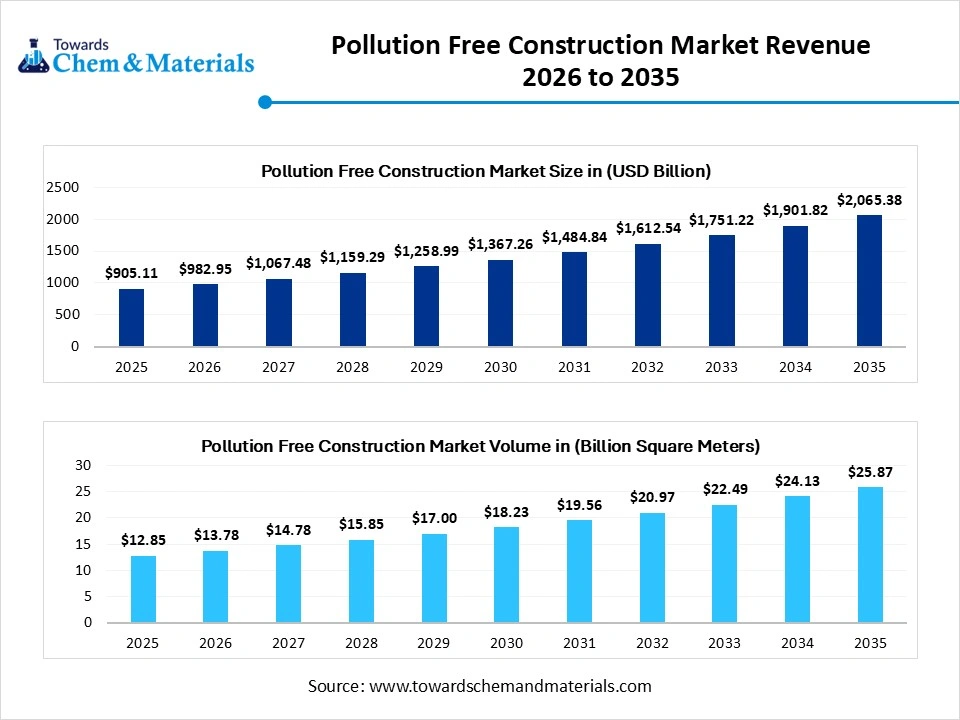
The pollution-free construction market is expected to witness strong expansion, increasing from USD 982.95 billion in 2026 to USD 2,065.38 billion by 2035, at a CAGR of 8.6%. This study covers detailed segmentation data, including eco-friendly materials, green building technologies, and application areas, alongside regional market performance and trends. It further delivers insights into leading companies, competitive positioning, value chain dynamics, global trade flows, and a detailed overview of manufacturers and suppliers, offering a complete industry perspective.
Content
Pollution-Free Construction Market Growth, Demand and Production Forecast
The global pollution-free construction market size was estimated at USD 905.11 billion in 2025 and is expected to be worth around USD 2,065.38 billion by 2035, exhibiting a compound annual growth rate (CAGR) of 8.60% over the forecast period from 2026 to 2035. In terms of volume the pollution-free construction market is projected to grow from 12.85 billion square meters in 2025 to 25.87 billion square meters by 2035. growing at a CAGR of 7.25% from 2026 to 2035. The report provides detailed segment-level data across construction types, materials, and technologies, along with regional insights covering North America, Europe, Asia-Pacific, Latin America, and the Middle East & Africa. It includes comprehensive company profiles, competitive analysis, value chain assessment, trade data, and in-depth manufacturers and suppliers analysis, highlighting key growth drivers such as urbanization and supportive government policies.
Key Takeaways
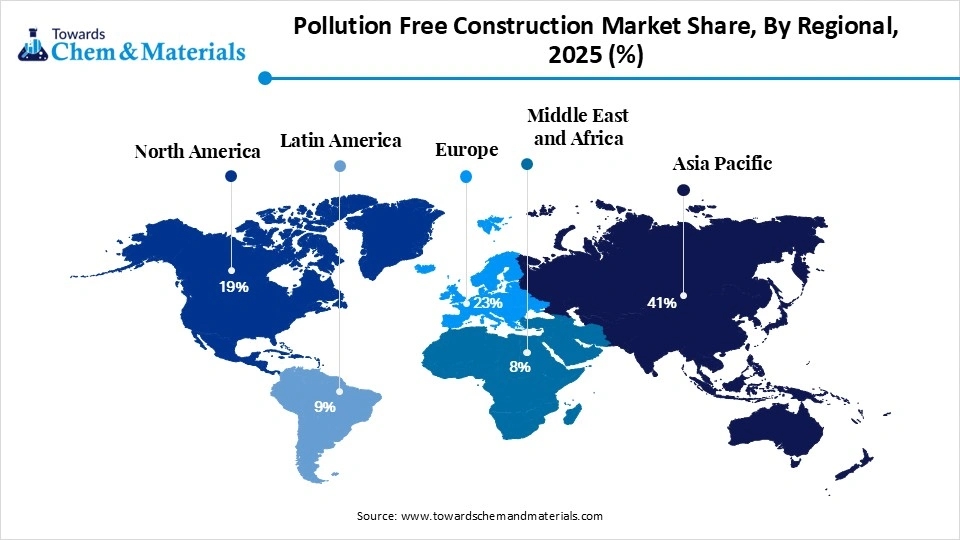
- By region, Asia Pacific dominated the market with a share of 41% in 2025 and is expected to sustain its position while growing with the fastest CAGR of 9.8% in the forecast period. Rapid urbanization drives large-scale construction demand.
- By region, Europe held the second largest share of 23% in 2025 and expects the notable growth with a CAGR of 8.40% during the forecast period. Strict environmental regulations drive sustainable construction.
- By construction approach, the green building construction segment dominated the market 46% share in 2025. Governments enforce strict sustainability codes in construction.
- By construction approach, the modular and offsite construction segment held the second largest share of 29% in 2025 and is expected to have the fastest growth with a CAGR of 9.70% in the forecast period. Offsite production reduces material waste and emissions.
- By material type, the sustainable materials segment dominated the market with 27% share in 2025. Recycling initiatives increase use of secondary materials.
- By material type, the bio-based materials segment held the fourth largest share of 23% in 2025 and is expected to have the fastest growth with a CAGR of 9.60% in the forecast period. Renewable materials reduce environmental footprint significantly.
- By technology integration, the energy optimization technologies segment dominated the market with 33% share in 2025. Smart HVAC systems reduce energy consumption effectively.
- By technology integration, the digital and smart construction segment held the second largest share of 29% in 2025 and is expected to have the fastest growth with a CAGR of 10.20% in the forecast period. IoT and AI enhance construction efficiency and monitoring.
- By end use sector, the residential segment dominated the market with 35% share in 2025. Rising housing demand increases sustainable construction adoption.
- By end use sector, the infrastructure segment held the third largest share of 19% in 2025 and is expected to have the fastest growth with a CAGR of 9.50% in the forecast period. Governments invest in sustainable infrastructure projects.
Market Size and Volume Forecast
- Market Size (2025): USD 905.11 Billion | CAGR (2026–2035): 8.60%
- Market Projected Size (2035): USD 2,065.38 Billion
- Market Volume (2025): 12.85 Billion Square Meters | Volume CAGR (2026–2035): 7.25%
- Market Projected Volume (2035): 25.87 Billion Square Meters
- Market Pricing (2025):
- Average Manufacturing Price: USD 98 per sq. meter
- Average Selling Price: USD 169 per sq. meter
- Pricing CAGR (2025–2035): 3.9%
Market Overview
What Is The Significance Of The Pollution-Free Construction Market?
Pollution-free construction is significant for mitigating severe environmental degradation, reducing substantial greenhouse gas emissions, and protecting human health from toxic dust and chemical pollutants. It directly reduces air and water pollution, protects ecosystems from runoff contamination, and lowers the industry’s massive, one-sixth share of national carbon emissions. It reduces the "toxic soup" of dust and exhaust, making cities more livable, and contributes to better long-term waste management and reduced pollution.
Pollution-Free Construction Market Growth Trends:
- Zero-Emission Zones: Cities are adopting zero-emission construction site mandates, such as in Oslo, where 98% of municipal construction sites operated without fossil fuels by 2023.
- Updated Standards (LEED v5): The introduction of new, more demanding standards like LEED v5, which prioritizes decarbonization, forces developers to adopt advanced, low-pollution materials and technologies.
- National Programs: Policies like India's National Clean Air Programme (NCAP) compel developers to implement dust-control technologies, such as anti-smog guns and green nets, to meet air quality standards.
Key Technological Shifts In The Pollution-Free Construction Market:
Key technological shifts in the pollution-free construction market are moving from voluntary, niche practices to mandatory, integrated digital and material innovations. The focus has pivoted from merely reducing operational emissions to addressing the "embodied carbon" within materials and creating zero-emission construction sites, driven by AI, modularity, and advanced materials. Construction is shifting from traditional concrete and steel to innovative, low-carbon alternatives that actively sequester carbon, transforming the site into a "carbon sink".
Trade Analysis Of Pollution-Free Construction Market: Import & Export Statistics
- According to Global Export Data, the world exported 77,658 Construction Material shipments to 347 buyers through 19 verified exporters.
- The United Kingdom, United States, and Russia emerged as the top three construction material importing countries, and India, the United States, and China were the top 3 exporting countries.
Top-performing Construction Material Exporters by volume:
- JCB India Ltd: 22,370 shipments (90%)
- Bull Machines Pvt Ltd: 2,117 shipments (9%)
- SRI JB EXPORT: 377 shipments (2%)
Pollution-Free Construction Market - Supply Chain Analysis
Sustainable Material Production & Construction Practices
Pollution-free construction involves the use of low-emission materials, green building technologies, recycled resources, and energy-efficient construction methods to minimize environmental impact.
- Key players: Holcim, Saint-Gobain, Kingspan Group, Skanska
Quality Testing and Certification
Pollution-free construction projects must comply with green building standards, emission regulations, and sustainability certifications to ensure a reduced environmental footprint.
- Key players: Leadership in Energy and Environmental Design, Building Research Establishment Environmental Assessment Method, International Organization for Standardization, U.S. Green Building Council.
Distribution to Industrial Users
Pollution-free construction solutions are adopted across residential, commercial, industrial infrastructure, smart city projects, and public sector developments.
- Key players: Holcim, Saint-Gobain, Kingspan Group.
Pollution-Free Construction Regulatory Landscape: Global Regulations
| Country / Region | Regulatory Body | Key Regulations | Focus Areas | Notable Notes |
| U.S. | Environmental Protection Agency (EPA); Occupational Safety and Health Administration (OSHA); Department of Energy (DOE) | Clean Air Act; Clean Water Act; Energy Efficiency Standards (ASHRAE guidelines) | Air and water pollution control, green building standards, and worker safety | The U.S. promotes sustainable construction through emission control laws and energy-efficient building standards such as LEED certifications. |
| Europe | European Commission; European Environment Agency (EEA) | Energy Performance of Buildings Directive (EPBD); Circular Economy Action Plan | Energy efficiency, sustainable materials, and low-emission construction | The EU enforces strict energy efficiency standards and promotes circular construction materials to reduce environmental impact. |
| China | Ministry of Housing and Urban-Rural Development (MOHURD); Ministry of Ecology and Environment (MEE) | Green Building Action Plan; Environmental Protection Law | Green construction practices, emissions reduction, and resource efficiency | China is rapidly adopting green construction standards and low-emission materials to address urban pollution challenges. |
| India | Ministry of Environment, Forest and Climate Change (MoEFCC); Bureau of Energy Efficiency (BEE) | Energy Conservation Building Code (ECBC); National Action Plan on Climate Change (NAPCC) | Energy-efficient buildings, sustainable construction materials, and emission reduction | India promotes pollution-free construction through energy-efficient building codes and green building initiatives. |
| Japan | Ministry of Land, Infrastructure, Transport and Tourism (MLIT); Ministry of the Environment | Building Energy Efficiency Act; Green Growth Strategy | Low-carbon construction, energy efficiency, sustainable infrastructure | Japan enforces strict building efficiency standards and promotes eco-friendly construction technologies. |
| Brazil | Ministry of the Environment; Brazilian Institute of Environment and Renewable Natural Resources (IBAMA) | National Environmental Policy Act; Sustainable Construction Guidelines | Environmental protection, green materials, waste management | Brazil promotes sustainable construction practices and environmental compliance in infrastructure development. |
Segmental Insights
Construction Approach Insights
The Green Building Construction Segment Dominated The Market With 46% Market Share In 2025
The green building construction segment dominated the market with 46% share in 2025. Governments enforce strict sustainability codes in construction which Developers adopt green designs to reduce emissions driving growth. Energy efficiency lowers lifecycle costs significantly. driven by rising demand for sustainable, energy-efficient infrastructure. This segment includes innovations like prefabricated, modular, and 3D-printed construction, alongside low-carbon materials, to minimize environmental impact.
The modular & offsite construction segment held the second largest share of 29% in 2025 and is expected to have the fastest growth with a CAGR of 9.70% in the forecast period driven by its pollution-free, sustainable, and rapid-delivery benefits. The growth is also fueled by high-quality, cost-efficient, and low-waste advantages in residential and commercial sectors. The primary drivers are speed, cost-effectiveness, superior quality control, and reduced site disruption compared to traditional methods.
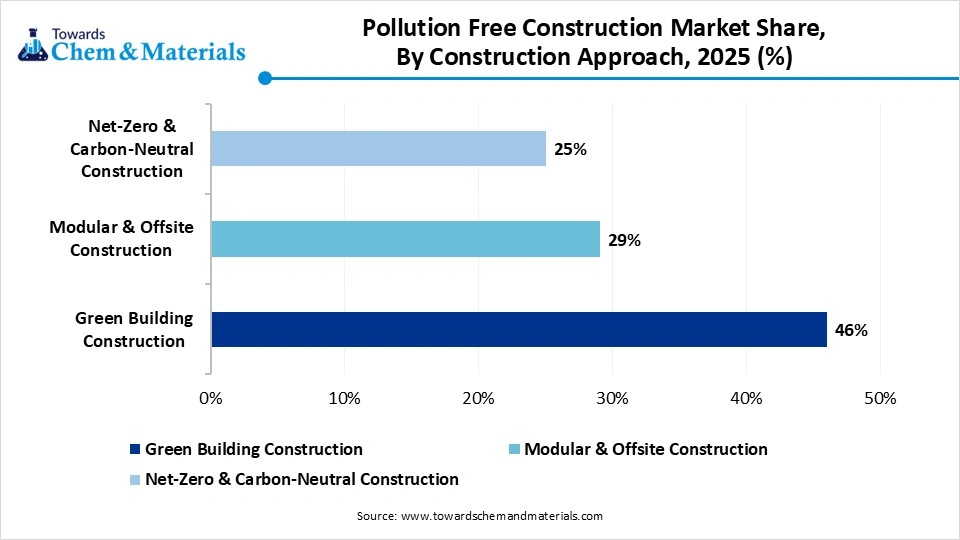
The net-zero & carbon-neutral construction segment held the third largest share of 25% in 2025, driven by urgent global climate goals, adoption of low-carbon materials, advanced green building design, and stringent environmental regulations targeting both embodied and operational emissions. The sector is shifting toward net-zero by 2030, with increasing focus on reducing embodied carbon and implementing circular economy models, particularly in commercial construction.
Pollution Free Construction Market Share, By Construction Approach, 2025 (%)
| By Construction Approach | Revenue Share, 2025 (%) |
| Green Building Construction | 46% |
| Modular & Offsite Construction | 29% |
| Net-Zero & Carbon-Neutral Construction | 25% |
Material Type Insights
Pollution Free Construction Market Share, By Material Type, 2025 (%)
| By Material Type | Revenue Share, 2025 (%) |
| Sustainable Materials | 27% |
| Bio-Based Materials | 23% |
| Low-Emission Materials | 24% |
| High-Performance Materials | 26% |
The sustainable materials segment dominated the market with 27% share in 2025. Driven by the need to minimize environmental impacts, the market is seeing a surge in demand for low-carbon, recycled, and renewable materials. Strict environmental regulations, carbon reduction targets, and corporate ESG (Environmental, Social, and Governance) goals are accelerating the use of sustainable materials.
The high-performance materials segment held the second largest share of 26% in 2025, driven by the need for sustainable, durable, and environmentally friendly building alternatives. This sector is characterized by the development of innovative materials that reduce carbon footprints, minimize waste, and improve energy efficiency. This technology is expanding rapidly as it allows for precise, low-waste manufacturing, reducing the overall environmental impact of construction.
The low emission materials segment held the third largest share of 24% in 2025. riven by rising demand for sustainable, energy-efficient building materials and strict environmental regulations. Key factors include adoption of low-VOC materials, recycled materials, and innovative low-carbon alternatives to cement and steel. Innovations like geopolymer cement and hydrogen-based steel are creating new growth avenues, as traditional cement and steel contribute significantly to global carbon emissions.
The bio-based materials segment held the fourth largest share of 23% in 2025 and is expected to have the fastest growth with a CAGR of 9.60% in the forecast period. driven by urgent sustainability targets, stricter environmental regulations, and the demand for healthier indoor environments. This shift is transforming the construction industry from a reliance on traditional high-emission materials (like conventional concrete and steel) toward renewable alternatives that act as carbon sinks, sequestering carbon during their life cycle.
Technology Integration Insights
Pollution Free Construction Market Share, By Technology Integration, 2025 (%)
| By Technology Integration | Revenue Share, 2025 (%) |
| Energy Optimization Technologies | 33% |
| Water Efficiency Technologies | 20% |
| Waste Minimization Technologies | 18% |
| Digital & Smart Construction | 29% |
The energy optimization technologies segment dominated the market with 33% share in 2025. This segment is experiencing accelerated adoption due to a push for net-zero emissions, rising energy costs, and stricter regulatory frameworks. The rapid adoption of net-zero energy buildings (NZEBs) is compelling developers to utilize renewable energy systems, advanced insulation, and smart building technologies.
The digital & smart construction segment held the second largest share of 29% in 2025 and is expected to have the fastest growth with a CAGR of 10.20% in the forecast period driven by the need for pollution-free and sustainable construction. The integration of Artificial Intelligence (AI), the Internet of Things (IoT), and Building Information Modeling (BIM) is transforming traditional, high-pollution construction sites into "cleaner" operations. This shift is fueled by the need for enhanced energy efficiency, reduced carbon footprints, and improved waste management across the construction lifecycle.
The water efficiency technologies segment held the third largest share of 20% in 2025, driven by the need to manage water scarcity, meet green building certifications (such as IGBC and LEED), and minimize environmental impact. The integration of these technologies ranging from smart sensors to advanced wastewater treatment allows construction projects to reduce water consumption by up to 77%. The adoption of IoT-enabled water meters, sensors, and AI-driven systems allows for real-time monitoring of water usage, immediate leak detection, and optimized irrigation.
The waste minimization technologies segment held the fourth largest share of 18% in 2025, experienced significant growth within the pollution-free construction market, driven by the need to reduce the environmental footprint of one of the world's largest waste-producing sectors. This segment is expanding as the construction industry shifts from traditional disposal methods to circular economy principles reducing, reusing, and recycling construction and demolition (C&D) waste.
End-Use Sector Insights
Pollution Free Construction Market Share, By End-Use, 2025 (%)
| By End-Use | Revenue Share, 2025 (%) |
| Residential | 35% |
| Commercial | 29% |
| Industrial | 17% |
| Infrastructure | 19% |
The residential segment dominated the market with 35% share in 2025. Rising housing demand increases sustainable construction adoption driving growth. Energy-efficient homes reduce utility costs which increases demand for the market. Government incentives support green housing, due to increased awareness amid rising environmental concerns which fuels the growth and expansion of the market.
The commercial segment held the second largest share of 29% in 2025. driven by rising demand for green building certifications, environmental regulations, and the need for energy efficiency. This shift is transforming the industry, with a focus on reducing carbon footprints through innovative technologies, material innovation, and waste management. sustainable, low-pollution buildings often offer lower long-term operating costs, reduced energy usage, and improved maintenance efficiency.
The infrastructure segment held the third largest share of 19% in 2025 and is expected to have the fastest growth with a CAGR of 9.50% in the forecast period. Driven by the urgent need to mitigate air pollution, manage debris, and meet stricter environmental regulations. This shift is characterized by the adoption of green technologies, dust mitigation strategies, and cleaner energy sources across major projects.
The industrial segment held the fourth largest share of 17% in 2025 driven by the need for carbon reduction, environmental regulations, and technological advancements. This transition is moving away from traditional, resource-intensive methods toward low-carbon, regenerative practices. Growth in adaptive building designs that incorporate natural ventilation and better insulation to reduce operational emissions.
Regional Insights
How did Asia Pacific Dominate the Pollution-Free Construction Market in 2025?
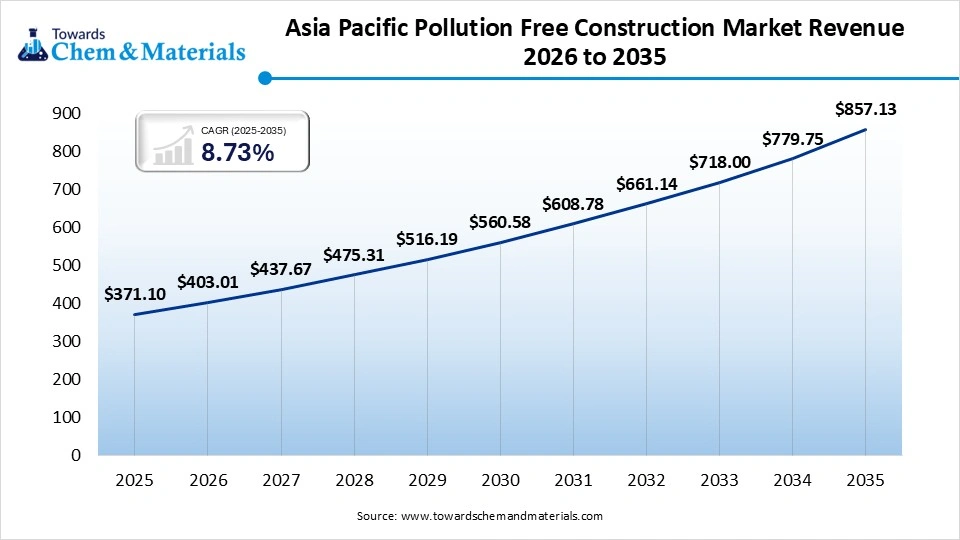
The Asia Pacific pollution-free construction market size was estimated at USD 371.10 billion in 2025 and is projected to reach USD 857.13 billion by 2035, growing at a CAGR of 8.73% from 2026 to 2035. Asia Pacific dominated the market with a share of 41% in 2025, driven by massive urbanization and stringent government sustainability mandates. Stricter environmental regulations, the pursuit of long-term cost efficiency, which 10%–20% lower operating costs, and rising demand for net-zero energy buildings drive the growth of the market in the region. Modular and prefabricated construction is surging as it reduces material waste by 30%–50% and minimizes on-site dust and emissions.
India's Pollution-Free Construction Market Growth Factor
The pollution-free construction market in India is growing rapidly, fueled by strict environmental rules and sustainable, high-growth practices. The move toward greener construction is no longer just about meeting regulations but also about standing out in the market, with builders adopting eco-friendly methods to enhance their reputation. The market's expansion is supported by the India Alliance for Clean Construction (IACC), which seeks to speed up the adoption of cleaner technologies. Organizations like the Indian Green Building Council (IGBC) are increasing demand for projects that prioritize efficiency and low pollution.
Europe Pollution-Free Construction Market Growth Factor
Europe held the second largest share of 23% in 2025 and expects the notable growth with a CAGR of 8.40% during the forecast period, experiencing rapid expansion, driven by stringent environmental regulations like the EU Green Deal and the Zero Pollution Action Plan. Initiatives such as the Energy Performance of Buildings Directive (EPBD) target a 60% reduction in building emissions by 2030. Increasing use of Building Information Modelling (BIM) and Digital Product Passports to track the environmental footprint of construction products throughout their lifecycle.
Germany's Pollution-Free Construction Market Growth Factor
The pollution-free construction market in Germany is undergoing a significant transformation, driven by the national goal of carbon neutrality by 2045. The market is shifting from conventional builds to "zero-emission" sites and high-performance green buildings. Cities like Berlin are increasingly implementing strict regulations on diesel engines in urban zones, forcing a shift toward electric construction machinery. There is a growing emphasis on using sustainable wood and mass timber (CLT) to replace carbon-intensive steel and concrete.
Recent Developments
- In February 2026, The Pune Municipal Corporation (PMC) has launched a Clean Air Portal to monitor PM10 and PM2.5 levels at construction sites over 5,000 square meters using real-time sensors. This initiative aims to increase transparency and enforce pollution standards, with violators facing stop-work notices or fines.
- In December 2025, The Assam Pollution Control Board (APCB) and iFOREST launched the "Guwahati Clean Air Plan" to tackle the city's worsening air quality. This scientific, hotspot-based roadmap focuses on reducing PM10 emissions, particularly from road dust and construction, and implements a "three-strike" enforcement rule.
Top players in the Pollution-Free Construction Market & Their Offerings:
- Holcim Group: Holcim is a global leader in sustainable construction materials, offering low-carbon cement, ECOPact green concrete, and recycled construction solutions. The company focuses on reducing COâ‚‚ emissions through alternative fuels, carbon capture, and circular construction practices.
- CEMEX S.A.B. de C.V.: CEMEX provides sustainable construction solutions, including Vertua low-carbon concrete and eco-efficient cement. The company invests in carbon-neutral technologies and digital construction platforms to reduce environmental impact.
- Heidelberg Materials AG: Heidelberg Materials focuses on carbon capture and storage (CCS) technologies and produces low-emission cement and concrete. The company aims to achieve net-zero emissions through innovation in sustainable construction materials.
- Saint-Gobain: Saint-Gobain offers energy-efficient building materials such as insulation, lightweight construction products, and sustainable glass solutions. The company supports green building practices and energy-efficient infrastructure development.
- Kingspan Group: Kingspan specializes in high-performance insulation and building envelope solutions that reduce energy consumption and carbon emissions in buildings. Its products are widely used in green construction and net-zero buildings.
Pollution-Free Construction Market Top Players
- Tata Projects
- Mace
- Skanska
- Turner Construction
- ACCIONA
- Besix
- Lendlease
- VINCI
- Bouygues
- Bechtel
- AECOM
- Larsen & Toubro
- Larsen & Toubro Limited
- China State Construction Engineering Corporation
Pollution-Free Construction Market Segments Covered
By Construction Approach
- Green Building Construction
- Passive Design Buildings
- Active Energy-Efficient Buildings
- Modular & Offsite Construction
- Volumetric Modular Construction
- Panelized Construction
- Hybrid Modular Systems
- Net-Zero & Carbon-Neutral Construction
- Net-Zero Energy Buildings
- Net-Zero Carbon Buildings
- Carbon-Negative Buildings
By Material Type
- Sustainable Materials
- Recycled Aggregates
- Recycled Steel
- Recycled Plastics
- Bio-Based Materials
- Cross Laminated Timber (CLT)
- Bamboo
- Hempcrete
- Low-Emission Materials
- Low-VOC Paints
- Eco-friendly Adhesives
- Green Cement
- High-Performance Materials
- Advanced Insulation
- Reflective Coatings
- Aerogels
By Technology Integration
- Energy Optimization Technologies
- Smart HVAC Systems
- Building Energy Management Systems (BEMS)
- Water Efficiency Technologies
- Greywater Recycling Systems
- Rainwater Harvesting Systems
- Waste Minimization Technologies
- On-site Waste Segregation
- Construction Waste Recycling Systems
- Digital & Smart Construction
- IoT-enabled Monitoring
- AI-based Project Planning
- BIM (Building Information Modeling)
By End-Use Sector
- Residential
- Single-Family Housing
- Multi-Family Housing
- Affordable Housing
- Commercial
- Office Buildings
- Retail Spaces
- Hospitality
- Industrial
- Factories
- Warehouses
- Infrastructure
- Transportation Infrastructure
- Energy Infrastructure
- Water & Waste Infrastructure
By Certification & Standards
- LEED
- Certified
- Silver
- Gold
- Platinum
- BREEAM
- WELL Building Standard
- DGNB Certification
By Project Type
- New Construction
- Renovation & Retrofit
- Energy Retrofit
- Structural Retrofit
- Public Infrastructure Projects
- Private Sector Projects
By Regions
- North America:
- U.S.
- Canada
- Mexico
- Rest of North America
- Latin America:
- Brazil
- Argentina
- Rest of Latin America
- Europe:
- Western Europe
- Germany
- Italy
- France
- Netherlands
- Spain
- Portugal
- Belgium
- Ireland
- UK
- Iceland
- Switzerland
- Poland
- Rest of Western Europe
- Eastern Europe
- Austria
- Russia & Belarus
- Türkiye
- Albania
- Rest of Eastern Europe
- Asia Pacific:
- China
- Taiwan
- India
- Japan
- Australia and New Zealand
- ASEAN Countries (Singapore, Malaysia)
- South Korea
- Rest of APAC
- MEA:
- GCC Countries
- Saudi Arabia
- United Arab Emirates (UAE)
- Qatar
- Kuwait
- Oman
- Bahrain
- South Africa
- Egypt
- Rest of MEA
- GCC Countries
FAQ's
Question 1 : What are the key trends to shape the pollution-free construction market?
Answer : Major trends include rapid urbanization, greater environmental awareness, and government incentives that encourage green housing.
Question 2 : Which region holds the largest share of the pollution-free construction market?
Answer : Asia Pacific holds the largest share of the pollution-free construction market.
Question 3 : Who are the key players in the pollution-free construction market?
Answer : The pollution-free construction market is fragmented with multiple players, including Skanska AB, VINCI Construction, Bechtel Corporation, Mace Group, and Turner Construction across the world.
Question 4 : Which end-use sector dominates the market?
Answer : The residential sector leads with a 35% market share in 2025, driven by increasing demand for energy-efficient and sustainable housing.
Question 5 : What are zero-emission construction sites?
Answer : Zero-emission construction sites eliminate fossil fuel usage by relying on electric machinery, renewable energy sources, and low-carbon materials, significantly reducing on-site pollution.
Meet the Team

Saurabh Bidwai
Principal Consultant
Saurabh Bidwai, a B.Tech Chemical Engineering graduate with 4+ years of experience, specializes in specialty chemicals, commodity chemicals, and engineered materials, offering valuable insights into market trends and emerging opportunities.

Aditi Shivarkar
Reviewed By
Aditi Shivarkar, with 14+ years in Chemical and Materials market research, specializes in Chemical and Materials. She ensures accurate, actionable insights, driving Towards Chemicals And Materials Analytics and Consulting excellence in industry trends and sustainability.