
Polyester Hot Melt Adhesives Market Trends, Cost per Unit, Sales Volume, Recycling Rate, Export & Import Metrics, Adoption Rates, Pricing Strategies, Production Volume, and Logistics Efficiency
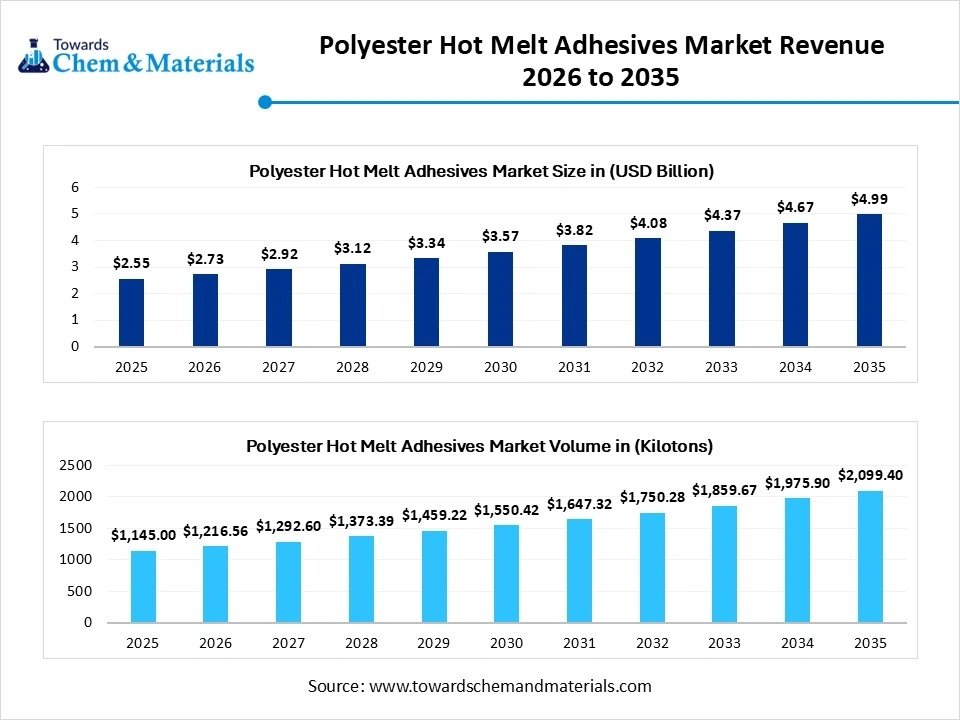
The polyester hot melt adhesives market is witnessing steady growth, with its valuation reaching USD 2.55 billion in 2025 and projected to rise to USD 4.99 billion by 2035 at a CAGR of 6.95%. The market is estimated at USD 2.73 billion in 2026. Volume-wise, it is forecast to grow from 1145 million tons to 2099.4 million tons over the same period, at a CAGR of 6.25%. The study includes detailed segment data, regional performance, competitive analysis, company profiling, value chain insights, trade statistics, and comprehensive data on manufacturers and suppliers.
Content
Polyester Hot Melt Adhesives Market Size, Share, Trends and Forecast Analysis
The global polyester hot melt adhesives market was valued at USD 2.55 billion in 2025, is estimated to reach USD 2.73 billion in 2026, and is projected to reach USD 4.99 billion by 2035, growing at a CAGR of 6.95% from 2026 to 2035. In terms of volume, the polyester hot melt adhesives market is projected to grow from 1145 kilo tons in 2025 to 2099.4 kilo tons by 2035. growing at a CAGR of 6.25% from 2026 to 2035.
Key Takeaways
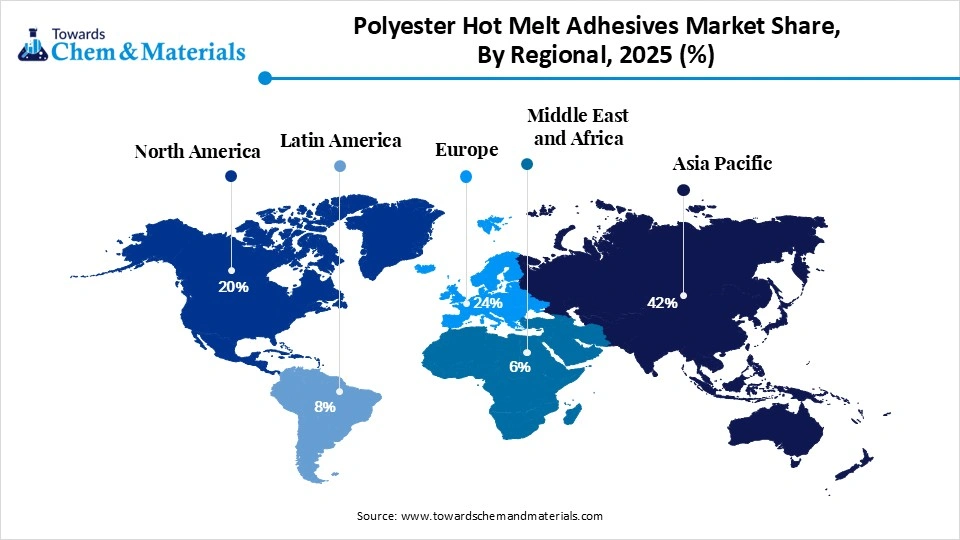
- By region, Asia Pacific dominated the market with a share of 42% in 2025 and is expected to sustain its position while growing with a CAGR of 7.8% in the forecast period.
- By region, Europe held the market share of 24% in 2025.
- By type, the linear polyester hot melt adhesives segment dominated the market with 38% share in 2025.
- By type, the reactive polyester hot melt adhesives segment held 34% market share in 2025 and is expected to have the fastest growth with a CAGR of 7.8% in the forecast period.
- By form, the granules/pellets segment dominated the market with 46% share in 2025.
- By form, the films segment held 21% market share in 2025 and is expected to have the fastest growth with a CAGR of 7.2% in the forecast period.
- By application, the packaging segment dominated the market with 32% share in 2025.
- By application, the automotive segment held 18% market share in 2025 and is expected to have the fastest growth with a CAGR of 7.5% in the forecast period.
- By distribution channel, the direct sales segment dominated the market with 48% share in 2025.
- By distribution channel, the online sales segment held 18% market share in 2025 and is expected to have the fastest growth with a CAGR of 7.9% in the forecast period.
Market Size and Volume Forecast
- Market Estimated Size (2025): USD 2.55 Billion | CAGR (2026–2035): 6.95%
- Market Projected Size (2035): USD 2.55 Billion
- Market Volume (2025): 1,145.00 Kilotons | Volume CAGR (2026–2035): 6.25%
- Market Projected Volume (2035): 2,099.40 Kilotons
- Market Pricing (2025):
- Average Manufacturing Price: USD 2.66/kg
- Average Selling Price: USD 3.86/kg
- Pricing CAGR (2025–2035): 3.45%
Market Overview
What Is the Significance of The Polyester Hot Melt Adhesives Market?
The market is vital for providing strong, flexible, and sustainable bonding solutions across the textiles, packaging, and automotive industries, often referred to as PET-based, thermoplastic, or copolyester adhesives. It is driven by the demand for eco-friendly, fast-setting materials. Used extensively for bonding interior parts, such as upholstery, door panels, and emblem attachment, aiding in weight reduction for better fuel efficiency.
Polyester Hot Melt Adhesives Market Growth Trends:
- Rapid Growth in Packaging and E-commerce: The packaging industry, particularly for food and beverage, is witnessing the fastest growth due to rising e-commerce, needing efficient and durable sealing solutions.
- Automotive Lightweighting Trend: The automotive industry is rapidly adopting polyester hot melt adhesives to replace heavy mechanical fasteners, contributing to vehicle lightweighting efforts.
- Sustainability and Eco-Friendly Focus: The industry is pivoting toward environmentally friendly solutions, with increased investment in bio-based polyester hot melt adhesives. These alternatives are designed to meet stringent environmental regulations and reduce dependence on fossil fuels.
Report Scope
| Report Attribute | Details |
| Market Size and Volume in 2026 | USD 2.73 Billion / 1216.56 Kilo Tons |
| Expected Size and Volume by 2035 | USD 4.99 Billion / 2099.4 Kilo Tons |
| Growth Rate from 2026 to 2035 | CAGR 6.95% |
| Forecast Period | 2026 - 2035 |
| Dominant Region | Asia-Pacific |
| Segment Covered | By Type, By Form, By Application, By Distribution Channel and By Regions |
| Key companies profiled | Henkel Corporation, H.B. Fuller Company, 3M Company, Arkema S.A. (Bostik), Dow Inc., Henkel Corporation, Avery Dennison Corporation, Sika India, Evonik Industries, TEX YEAR INDUSTRIES INC., Jowat SE, Paramelt, Palmetto Adhesives |
Key Technological Shifts In The Polyester Hot Melt Adhesives Market:
The market is shifting toward eco-friendly, high-performance formulations, driven by sustainability regulations and the need for superior bonding in automotive, electronics, and textile applications. Key shifts include adopting bio-based raw materials, enhancing heat/chemical resistance, and integrating smart, automated dispensing technologies for precision manufacturing.
Supply Chain Analysis of Polyester Hot Melt Adhesives Market:
Polymer Production & Adhesive Formulation
Polyester hot melt adhesives are produced through polymerization of polyester resins followed by compounding with additives to achieve desired viscosity, bonding strength, and thermal properties for industrial applications.
- Key players: Henkel, H.B. Fuller, Arkema, Jowat
Quality Testing and Certification
Polyester hot melt adhesives must meet standards for bonding strength, thermal resistance, chemical stability, and safety compliance for industrial and packaging applications.
- Key players: International Organization for Standardization, ASTM International, European Chemicals Agency, U.S. Environmental Protection Agency
Distribution to Industrial Users
Polyester hot melt adhesives are supplied to packaging manufacturers, automotive industries, textile producers, electronics assembly companies, and woodworking sectors.
- Key players: Henkel, H.B. Fuller, Arkema.
Polyester Hot Melt Adhesives Regulatory Landscape: Global Regulations
| Country / Region | Regulatory Body | Key Regulations | Focus Areas | Notable Notes |
| United States | Environmental Protection Agency (EPA); Food and Drug Administration (FDA); Occupational Safety and Health Administration (OSHA) | Toxic Substances Control Act (TSCA); FDA Food Contact Regulations (21 CFR); OSHA Hazard Communication Standard | Chemical safety, food packaging compliance, worker exposure | Polyester hot melt adhesives used in packaging and hygiene products must comply with food-contact safety and workplace exposure standards. |
| European Union | European Chemicals Agency (ECHA); European Commission | REACH Regulation; CLP Regulation; Food Contact Materials Regulation | Chemical registration, hazard classification, packaging safety | The EU enforces strict regulations for adhesives used in food packaging and promotes low-VOC and sustainable adhesive formulations. |
| China | Ministry of Ecology and Environment (MEE); State Administration for Market Regulation (SAMR) | Environmental Protection Law; Product Quality Law | Industrial emissions, product safety, chemical compliance | China regulates adhesive manufacturing and use with increasing focus on environmental protection and product quality standards. |
| India | Ministry of Environment, Forest and Climate Change (MoEFCC); Central Pollution Control Board (CPCB) | Environment Protection Act; Hazardous Chemical Rules | Emissions control, chemical handling, industrial safety | India regulates hot melt adhesives under environmental and hazardous chemical frameworks, especially for industrial and packaging applications. |
| Japan | Ministry of Economy, Trade and Industry (METI); Ministry of Health, Labour and Welfare (MHLW) | Chemical Substances Control Law (CSCL); Food Sanitation Act | Chemical safety, food-contact compliance | Japan enforces strict standards for adhesives used in packaging and electronics, focusing on safety and performance. |
| South Korea | Ministry of Environment (MoE); Ministry of Trade, Industry and Energy (MOTIE) | K-REACH; Chemicals Control Act | Chemical registration, environmental safety | South Korea regulates polyester hot melt adhesives through comprehensive chemical safety and registration systems. |
Market Dynamics
Drivers
What are the Key Growth Drivers of the Polyester Hot Melt Adhesives Market?
The market is driven by high demand in packaging, textiles, and automotive industries. Key growth drivers include rising e-commerce packaging needs, demand for eco-friendly (solvent-free) formulations, and superior bonding in textile lamination. Strong demand for moisture-resistant textiles and high-performance, durable bonds in footwear.
Restrains
What are the Key Growth Restraints of the Polyester Hot Melt Adhesives Market?
The key growth restraints of the polyester hot melt adhesives market include low thermal resistance, reduced performance in high-heat applications, high and volatile raw material costs (petrochemicals), and supply chain disruptions. Additionally, regulatory complexities regarding emissions, potential health risks from odor/fumes during application, and intense competition from superior, lower-cost alternatives limit market growth.
Opportunities
What are the Key Growth Opportunities of the Polyester Hot Melt Adhesives Market?
Key growth opportunities for the polyester hot melt adhesives market include expanding applications in high-speed packaging, lightweight automotive manufacturing, and smart textile integration. The market is driven by demand for eco-friendly, low-VOC solutions and superior bonding in electronics and furniture. Rapid industrialization in the Asia Pacific also offers significant regional expansion potential.
Segmental Insights
Type Insights
The Linear Polyester Hot Melt Adhesives Segment Dominated The Market With 38% Market Share In 2025
The linear polyester hot melt adhesives segment dominated the market with 38% share in 2025, due to their superior bonding strength, high flexibility, and excellent resistance to heat and oils. They are increasingly preferred in high-performance applications like automotive, textiles, and packaging, driven by a shift toward sustainable, fast-setting, and environmentally friendly solutions.
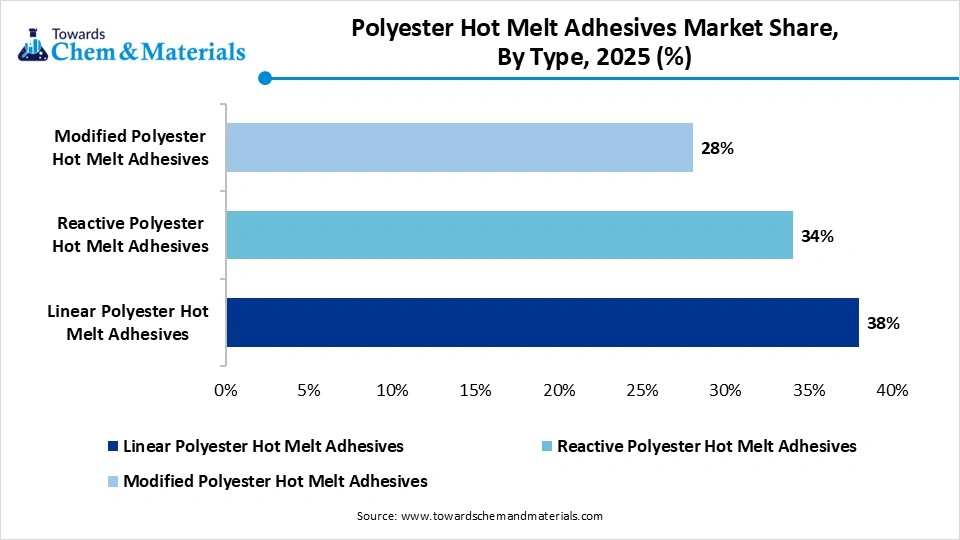
The reactive polyester hot melt adhesives segment held 34% market share in 2025 and is expected to have the fastest growth with a CAGR of 7.8% in the forecast period, due to superior performance characteristics over traditional thermoplastics, specifically high heat, moisture, and chemical resistance. Driven by demand from automotive, electronics, and construction, these adhesives crosslink to form permanent, durable, and structural bonds.
The modified polyester hot melt adhesives segment held 28% market share in 2025, due to enhanced performance characteristics such as superior thermal stability, chemical resistance, and high bonding strength on diverse substrates (PVC, PET, metal), which meet the demanding needs of automotive, textile, and electronic applications. The surge in automotive applications like interior, filtration, and high-performance packaging is pushing adoption.
Form Insights
The Granules/Pellets Segment Dominated The Market With 46% Market Share In 2025
The granules/pellets segment dominated the market with 46% share in 2025, driven by the need for faster, cleaner, and automated production in the packaging and automotive industries. Their growth is largely due to superior handling, melting consistency, and suitability for high-speed, automated application equipment. Granules and pellets are optimized for automatic feeding systems in industrial settings, allowing for consistent melt quality, reduced downtime, and higher production efficiency compared to manual methods.
The film segment held 21% market share in 2025 and is expected to have the fastest growth with a CAGR of 7.2% in the forecast period, due to rising demand for precision, uniform bonding in automotive, electronics, and textile lamination. Increasing adoption in automotive, furniture, and electronics, where films facilitate bonding lightweight materials. Films enable large-area composite fabrication, which is increasingly needed in electronics and consumer goods.
Coating Materials Market Share, By Form, 2025 (%)
| By Form | Revenue Share, 2025 (%) |
| Granules/Pellets | 46% |
| Powder | 18% |
| Film | 21% |
| Web | 15% |
The powder segment held 18% market share in 2025, driven by its high demand in textile lamination, automotive interiors, and Direct-to-Film (DTF) printing due to superior bonding, wash resistance, and suitability for flexible/sensitive materials. The form’s ability to offer precise, eco-friendly, and solvent-free applications across diverse substrates, including plastics and technical textiles, has fueled its rapid adoption.
The web segment held 15% market share in 2025, driven by its essential role in roll-to-roll textile lamination, automotive interior, and large-area composite fabrication. Polyester webs offer superior performance in bonding, wash durability for textiles, and high heat/chemical resistance, catering to the trend of functional, lightweight, and eco-friendly manufacturing. Web forms allow for continuous, automated manufacturing processes, offering better, more uniform coverage for lamination, enhancing production efficiency.
Application Insights
The Packaging Segment Dominated the Market With 32% Market Share in 2025
The packaging segment dominated the market with 32% share in 2025, driven by soaring demand for eco-friendly, fast-setting, and high-performance bonding in e-commerce, food packaging, and specialized medical applications. Polyester hot melt adhesives are favored for their ability to bond diverse, high-performance materials, providing excellent temperature resistance and fast curing times compared to alternatives.
The automotive segment held 18% market share in 2025 and is expected to have the fastest growth with a CAGR of 7.5% in the forecast period, driven primarily by the industry's shift toward lightweight, high-performance bonding solutions and electric vehicle (EV) production. These adhesives replace heavy mechanical fasteners to reduce vehicle weight, improving fuel efficiency and offering superior bonding for interior and exterior components.
Polyester Hot Melt Adhesives Market Share, By Application, 2025 (%)
| By Application | Revenue Share, 2025 (%) |
| Packaging | 32% |
| Automotive | 18% |
| Textile | 16% |
| Woodworking | 14% |
| Electronics | 12% |
| Others | 8% |
The textile segment held 16% market share in 2025, driven by high demand for superior bonding in technical textiles, apparel, and footwear. This growth is propelled by the need for durable, wash-resistant, and flexible bonding solutions in garment manufacturing, particularly for integrating electronics and specialized lamination. The shift from traditional sewing to sustainable, adhesive-based lamination technologies allows for faster production in apparel manufacturing.
The woodworking segment held 14% market share in 2025, driven by the furniture industry's demand for high-performance, heat-resistant bonding in applications like edgebanding and laminating. This growth is propelled by a shift towards solvent-free, eco-friendly, and durable adhesives that offer faster assembly times and superior strength. Advances in reactive hot melt technology have allowed for stronger bonds in woodworking, which are resistant to humidity and heat.
Distribution Channel Insights
The Direct Sales Segment Dominated The Market With 48% Market Share In 2025
The direct sales segment dominated the market with 48% share in 2025, driven by the need for customized, high-performance solutions in specialized industries like automotive and electronics. Manufacturers are bypassing distributors to offer direct technical support, tailor adhesive formulations for specific production lines, and ensure consistent quality control in rapidly advancing sectors.
Polyester Hot Melt Adhesives Market Share, By Distribution Channel, 2025 (%)
| By Distribution Channel | Revenue Share, 2025 (%) |
| Direct Sales | 48% |
| Distributors & Wholesalers | 34% |
| Online Sales | 18% |
The distributors & wholesalers segment held 34% market share in 2025, driven by the need for localized technical support, fast delivery for high-speed packaging, and expanding demand in specialized sectors like technical textiles. Distributors are enhancing their market share by offering tailored solutions, strengthening supply chain resilience to mitigate raw material volatility, and expanding into fast-growing regions such as Asia-Pacific.
The online sales segment held 18% market share in 2025 and is expected to have the fastest growth with a CAGR of 7.9% in the forecast period, due to the boom in e-commerce, which drives high demand for durable, fast-setting packaging adhesives for shipping. The shift toward online procurement offers convenience and access to a vast range of products, while industrial players increasingly adopt digital platforms to streamline sourcing.
Regional Insights
How did Asia Pacific Dominate the Polyester Hot Melt Adhesives Market in 2025?
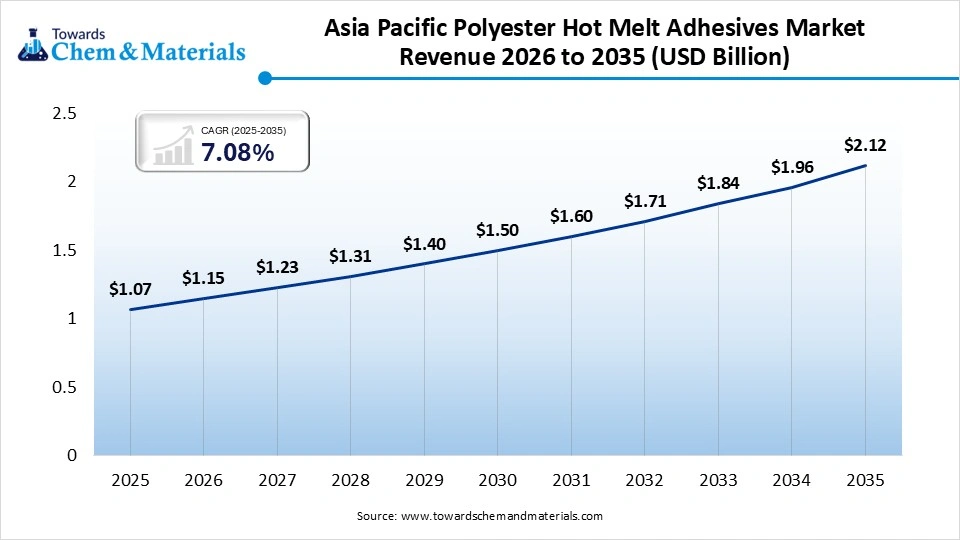
The Asia Pacific polyester hot melt adhesives market size was estimated at USD 1.07 billion in 2025 and is projected to reach USD 2.12 billion by 2035, growing at a CAGR of 7.08% from 2026 to 2035. This leadership was driven by surging demand from the textile, packaging, and automotive sectors in China, India, and Southeast Asia, fueled by rapid manufacturing industrialization and high-performance, cost-effective, and sustainable adhesive formulations. Growth in EV manufacturing in China and electronics assembly in India/Japan drove high-precision, high-volume adhesive usage.
India Polyester Hot Melt Adhesives Market Growth Factor
The Indian polyester hot melt adhesives market is driven primarily by high demand in textiles, packaging, and automotive industries. Growth is fueled by rapid industrialization, the shift towards eco-friendly, low-VOC materials, and increasing automation in manufacturing, particularly in flexible packaging and apparel production. A shift toward eco-friendly adhesives that are solvent-free and provide high performance in both high- and low-temperature settings, reducing VOC emissions.
Europe Polyester Hot Melt Adhesives Market Growth Factor
Europe held the market share of 24% in 2025, driven by rising demand for eco-friendly, solvent-free adhesives in packaging and textiles, increasing use in high-performance automotive components, and strong adoption of sustainable materials in Germany, France, and the UK. Innovation in high-performance formulations allows these adhesives to replace mechanical fasteners and solvent-based glues in industrial applications.
Germany Polyester Hot Melt Adhesives Market Growth Factor
The German polyester hot melt adhesives market growth is driven by strong demand from the automotive, packaging, and textile sectors. Strict environmental regulations in Germany are pushing manufacturers towards solvent-free, low-VOC (Volatile Organic Compounds) adhesive technologies. Focus on production efficiency, automation, and superior bonding strength in machinery and assembly applications supports the market.
Recent Development
- In May 2025, Bostik is investing $27 million to double high molecular weight (HMW) polyester production capacity and enhance infrastructure at its largest U.S. manufacturing facility in Middleton. This expansion supports increased production of BPA and halogen-free and sustainable adhesive solutions for the aerospace, automotive, and packaging markets
Top players in the Polyester Hot Melt Adhesives Market & Their Offerings:
- Henkel Corporation: Henkel is a dominant player with its Technomelt® portfolio, offering high-performance polyester-based hot melt adhesives for packaging, automotive, textiles, and electronics. The company focuses on sustainable, low-VOC, and energy-efficient adhesive solutions.
- H.B. Fuller Company: H.B. Fuller provides a wide range of hot melt adhesives, including polyester-based formulations for packaging, hygiene products, and industrial assembly. The company is expanding production capacity in Asia to meet growing demand.
- 3M Company: 3M offers specialty hot melt adhesives used in electronics, automotive, and industrial bonding applications. Its polyester-based products emphasize durability and high-performance bonding.
- Arkema S.A. (Bostik): Arkema’s Bostik division develops advanced polyester hot melt adhesives for packaging and industrial use. The company focuses on bio-based and sustainable adhesive technologies.
- Dow Inc.: Dow supplies raw materials and adhesive technologies used in polyester hot melt formulations, supporting high-performance bonding in packaging and industrial applications.
Polyester Hot Melt Adhesives Market Players
- Henkel Corporation
- Avery Dennison Corporation
- Sika India
- Evonik Industries
- TEX YEAR INDUSTRIES INC.
- Jowat SE
- Paramelt
- Palmetto Adhesives
Polyester Hot Melt Adhesives Market Segments Covered:
By Type
- Linear Polyester Hot Melt Adhesives
- Low Molecular Weight
- High Molecular Weight
- Reactive Polyester Hot Melt Adhesives (PUR-based)
- Moisture-Curing
- UV-Assisted Reactive
- Modified Polyester Hot Melt Adhesives
- Copolyester-Based
- Additive-Modified
By Form
- Granules/Pellets
- Powder
- Film
- Web
By Application
- Packaging
- Case & Carton Sealing
- Flexible Packaging
- Automotive
- Interior Assembly
- Upholstery Bonding
- Textile
- Fabric Lamination
- Seam Bonding
- Woodworking
- Edge Banding
- Profile Wrapping
- Electronics
- Component Assembly
- Insulation Bonding
- Others
By Distribution Channel
- Direct Sales
- Distributors & Wholesalers
- Online Sales
By Regions
- North America:
- U.S.
- Canada
- Mexico
- Rest of North America
- Latin America:
- Brazil
- Argentina
- Rest of Latin America
- Europe:
- Western Europe
- Germany
- Italy
- France
- Netherlands
- Spain
- Portugal
- Belgium
- Ireland
- UK
- Iceland
- Switzerland
- Poland
- Rest of Western Europe
- Eastern Europe
- Austria
- Russia & Belarus
- Türkiye
- Albania
- Rest of Eastern Europe
- Asia Pacific:
- China
- Taiwan
- India
- Japan
- Australia and New Zealand,
- ASEAN Countries (Singapore, Malaysia)
- South Korea
- Rest of APAC
- MEA:
- GCC Countries
- Saudi Arabia
- United Arab Emirates (UAE)
- Qatar
- Kuwait
- Oman
- Bahrain
- South Africa
- Egypt
- Rest of MEA
- MEA:
FAQ's
Question 1 : What is the current size of the polyester hot melt adhesives market?
Answer : The global polyester hot melt adhesives market was valued at USD 2.55 billion in 2025 and is projected to reach USD 4.99 billion by 2035, growing at a CAGR of 6.95% during the forecast period.
Question 2 : What are polyester hot melt adhesives?
Answer : Polyester hot melt adhesives are thermoplastic, solvent-free bonding materials made from polyester resins. They provide strong adhesion, flexibility, and fast setting, making them ideal for applications in packaging, textiles, automotive, and electronics.
Question 3 : Which region dominates the polyester hot melt adhesives market?
Answer : Asia Pacific leads the market with a 42% share in 2025, driven by rapid industrialization and strong demand from packaging, automotive, and textile industries in countries like China and India.
Question 4 : Which segment holds the largest market share by type?
Answer : The linear polyester hot melt adhesives segment dominates with a 38% market share in 2025, due to its superior bonding strength, flexibility, and resistance to heat and oils.
Question 5 : Which segment is expected to grow the fastest?
Answer : The reactive polyester hot melt adhesives segment is expected to grow the fastest, with a CAGR of 7.8%, owing to its enhanced durability, chemical resistance, and structural bonding capabilities.
Meet the Team

Saurabh Bidwai
Principal Consultant
Saurabh Bidwai, a B.Tech Chemical Engineering graduate with 4+ years of experience, specializes in specialty chemicals, commodity chemicals, and engineered materials, offering valuable insights into market trends and emerging opportunities.

Aditi Shivarkar
Reviewed By
Aditi Shivarkar, with 14+ years in Chemical and Materials market research, specializes in Chemical and Materials. She ensures accurate, actionable insights, driving Towards Chemicals And Materials Analytics and Consulting excellence in industry trends and sustainability.