
Polyolefin Sheets in Industrial Market Size, Share, Growth, Report 2026 to 2035
The polyolefin sheets in industrial market report segmented By Product, the market is classified into Polyethylene (PE), Polypropylene, and Others. By Application, the segmentation includes Packaging & Pellet Liners, Chemical Storage & Containment, Construction Components, Machine & Equipment Linings, and Others.-Global Industry Analysis, Size, Trends, Leading Companies, Regional Outlook, and Forecast 2026 to 2035
Content
What is the Polyolefin Sheets in Industrial Market Size and Share?
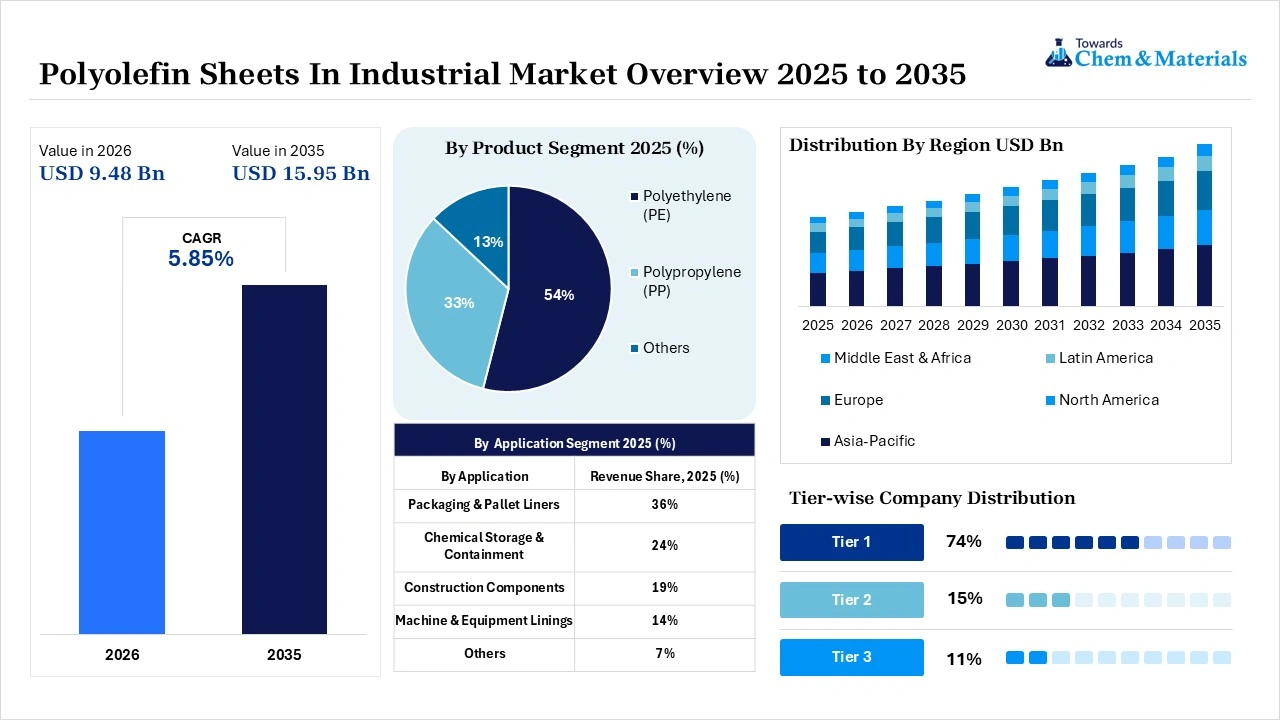
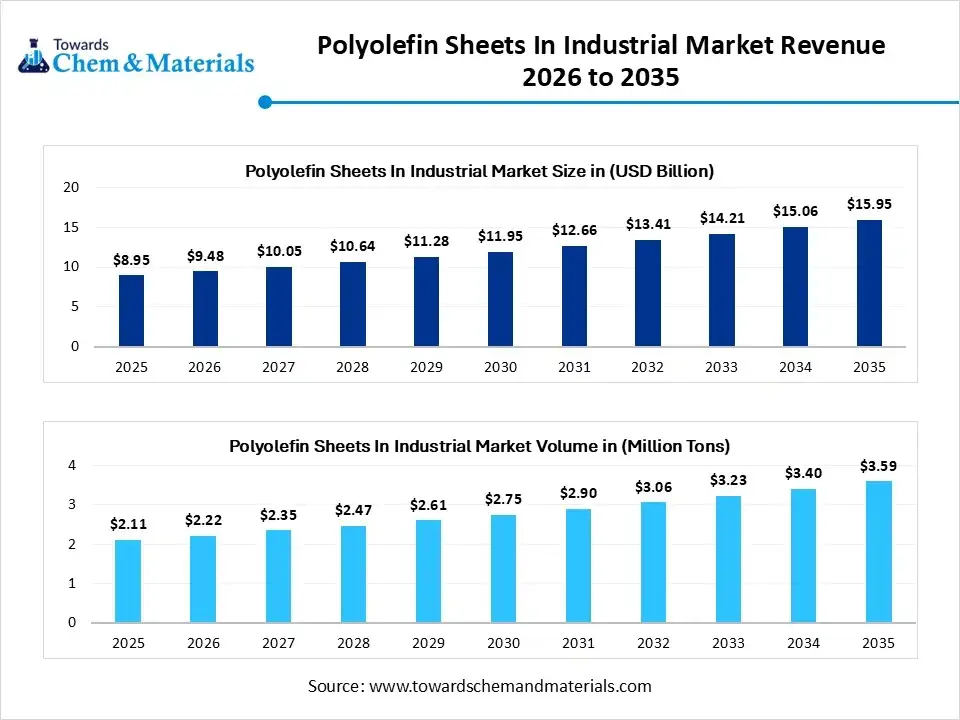
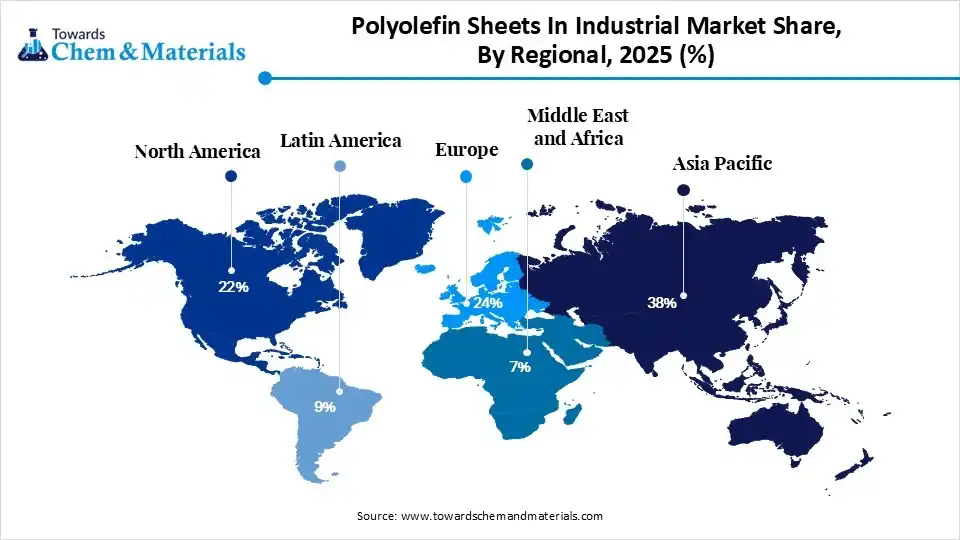
The global polyolefin sheets in industrial market size was valued at USD 8.95 billion in 2025, is estimated to reach USD 9.48 billion in 2026, and is projected to reach USD 15.95 billion by 2035, exhibiting a compound annual growth rate (CAGR) of 5.85% over the forecast period from 2026 to 2035.Asia Pacific dominated the polyolefin sheets in industrial market with the largest revenue share of 38% in 2025 and is expected to grow at the fastest CAGR of 6.09% during the forecast period. In terms of volume, the polyolefin sheets in industrial market is projected to grow from 2.11 million tons in 2025 to 3.59 million tons by 2035. growing at a CAGR of 5.45% from 2026 to 2035.The market evolution is driven by sustainability commitments, stringent regulatory compliance, and industrial automation.
Key Takeaways
- By region, Asia Pacific dominated the polyolefin sheets in industrial market by holding a 38% share in 2025 and is expected to grow at the fastest with a CAGR of 7.20% during the forecast period, driven by large-scale infrastructure projects and high-volume sheet usage.
- By region, Europe held the 24% market share in 2025 and expects notable growth in the market with 5.30% CAGR during the forecast period, fueled by demand for recyclable polyolefin materials and industrial automation.
- By product, the polyethylene (PE) segment dominated the market with the largest share of 54% in 2025 due to its superior chemical resistance and cost-effectiveness, supporting recyclability.
- By product, the polypropylene (PP) segment held 33% market share in 2025 and is expected to grow at the fastest CAGR of 6.4% over the forecast period, driven by its higher stiffness and temperature resistance.
- By application, the packaging & pellet liners segment dominated the market with the largest share of 36% in 2025, driven by demand for reusable liner solutions and protective packaging.
- By application, the construction components segment held 19% market share in 2025 and is expected to grow at the fastest CAGR of 6.7% over the forecast period, accelerated by advancements in infrastructure and lightweight construction.
The demand for polyolefin sheets in the industry is driven by the integration of advanced polymers and supply chain shifts to meet environmental compliance requirements. Polyolefin sheets are primarily composed of polyethylene, elastomers, and polypropylene, which are essential in industrial manufacturing and prized for higher strength, moisture resistance, and impact tolerance. As industrial operations grow more complex the manufacturers shift from traditionally olefin derivatives to compliant sheets through a reengineering framework. The Emerging move towards electric mobility is accelerating the demand for polyolefin sheets for battery enclosures.
The industrial focus on sustainability in polymer processing and specialty olefin formulation is pushing manufacturers to seek strategic partnerships and joint agreements for R&D and logistic infrastructure. Polyolefin sheets are used in packaging as pallet liners and warehouse wraps, and in construction, high-density polyethylene (HDPE) sheets function as vapor barriers and protective building layers, providing long-term durability. In automotive and heavy-duty logistics, industrial-grade polypropylene sheets are replacing heavy metals to support vehicle lightweighting.
The rising demand for polyolefin sheets reassures substantial investment in containment infrastructure. Polyolefins are recyclable through well-established infrastructure, driving closed-loop manufacturing solutions to decrease landfill waste and minimize carbon footprints. To phase out fossil fuels, shift the focus to bio-based polyolefins derived from renewable sources. Additionally, industries' investment in automation and extrusion technology to yield ultra-thin, high-strength polyolefin sheets for large-scale infrastructure.
Key Trends
- Focus on Recycling and Sustainability: Manufacturers focus on the circular economy by developing bio-based polyolefins and enhancing recycling tech to recover industrial scrap, reducing plastics' carbon footprint.
- Evolution to Lighter Alternatives: Industries are focusing on replacing metals and wood with advanced polyethylene and polypropylene polyolefin sheets, which offer higher strength-to-weight ratios and chemical stability, especially in electric vehicle battery enclosures and the packaging sector.
Key Technological Shifts and AI in the Polyolefin Sheets In Industrial Market
Artificial intelligence and technological innovation are revolutionizing the polyolefin sheet industry. The growing focus on industrial automation enables a shift from conventional chemistry to predictive material intelligence through the development of polyolefins. Machine learning enables the prediction of polyolefin sheet stability prior to synthesis, thereby reducing research time. Autonomous laboratories and AI-driven recycling processes enhance the sheet's performance and uniformity. Digital transformation enhances polymerization consistency and improves energy efficiency, enabling the creation of precise, high-performance materials suitable for modern sustainability targets.
Report Scope
| Report Attributes | Details |
| Market Size and Volume in 2026 | USD 9.48 Billion / 2.22 Million Tons |
| Revenue Forecast in 2035 | USD 15.95 Billion / 3.59 Million Tons |
| Growth Rate | CAGR 5.85% |
| Base Year of Estimation | 2025 |
| Forecast Period | 2025 - 2035 |
| High Impact Region | Asia Pacific |
| Segment Covered | By Product, By Application, By Region |
| Key Companies Profiled | Grafix Plastics, Mapal, Trident Plastics, Inc., Farco Plastics Supply, Duroplastic Technologies, All Foam Products, Ensinger, Inc., U.S. Packaging & Wrapping LLC, Porex, Dugar Polymers Limited, Polycan Extrusion Pvt. Ltd, Dutron |
Supply Chain Analysis of the Polyolefin Sheets In Industrial Market
- Feedstock Procurement and Polymer Synthesis: The stage of petrochemical extraction and refining of crude oil, naphtha, and natural gas for the synthesis of ethylene and propylene monomers. It includes the supply of standard polyethylene and polypropylene through high-pressure polymerization.
- Market Players: INEOS Group, PetroChina Company Limited, Chevron Phillips Chemical Company, Formosa Plastics Corporation, and Mitsubishi Chemical Group
- Extrusion and Sheet Fabrication: The specialized conversion facilities transform raw polymer pellets and molten compound into uniform, smooth, and structural semi-finished polyolefin sheets and are integrated into high-output plastic extrusion machinery.
- Market Players: Rochling Engineering Plastics, Mitsubishi Chemical Advanced Materials, Grafix Plastics, Quadrant Engineering Plastic Products, and Spartech LLC.
- Fabrication and B2B Logistics: The last stage of conversion of semi-finished plastic sheets into heavy-industry end-users with precise logistics. CNC machining, vacuum thermoforming, and welding to mold the sheets into heavy-duty networks, automotive production lines, and automated supply.
- Market Players: Piedmont Plastics, Interstate Plastics, Cope Plastics Inc., Curbell Plastics Inc., and Tier-1 industrial sub-contractors.
Regulatory Framework: Polyolefin Sheets In Industrial Market
| Region | Key Regulation | Regulatory Compliances |
| European Union | REACH Regulation, PPWR, and EU Green Claims Directive | Focus on chemical safety for raw monomer and hazardous additives during plastic extrusion. Standard for pallet liners and protective packaging. Targets verified life-cycle assessments. |
| North America | EPA TSCA, State-level Legislation, and OSHA Standards | Restrictions on VOCs and on collecting post-industrial sheet scrap. Control chemical risk in polyethylene and polypropylene. |
| Asia Pacific | National Standards, BIS Mandates, and the MHLW Positive List System. | Standards for industrial high-density polyethylene sheets and restrictions for hazardous chemical migration for specialized sheets. |
Polyolefin Sheets In Industrial Market Dynamics
Drivers
Material Development, and Industrial Value Chain Transformation
The expansion of the polyolefin sheets in industrial market is driven by a move away from traditional materials to advanced thermoplastics such as polyethylene and polypropylene. The expansion of logistics and e-commerce has spurred interest in durable packaging, moisture-resistant liners, and bulk containers, which is fueling the implementation of polyolefin sheets. The study emphasizes polyolefins' high strength-to-weight ratio, moisture barrier, and chemical resistance for maintaining structural integrity. Additionally, the manufacturers focus on innovation of developing high-performance, thinner sheets to reduce the utilization of polymer to meet safety standards by using advanced extruder solutions.
Restraint
Raw Material Volatility and Supply Chain Disruptions
Polyolefin production depends on feedstock, including crude oil and natural gas refining, which puts sheet manufacturers for higher operating cost. These fluctuations disrupt supply contracts and procurement, creating regional logistics challenges to limit polyolefin sheet market growth.
Opportunity
Embedding RFID and IoT Tracking Solution
The integration of digital tracking with industrial asset protection enables the opportunity for embedding of RFID chips, conductive ink circuits, and IoT sensors into polyolefin sheets. The market is transforming from simple barriers into active data sheets. The technological shift enables smart sheets to monitor temperature, moisture, and impact resistance in real time. Additionally, the IoT tracking technology allows distributors to track industrial machinery and chemicals during transit. Digital shift is modern, data-driven global supply chains in polyolefin sheets in the industrial market.
Segmental Insights
Product Insights
The polyethylene (PE) segment dominated the market with the largest share of 54% in 2025. Valued for its robustness, chemical resistance, and cost-efficiency. Its ability to maintain higher tensile strength and compatibility with standard plastic extrusion machinery enables recycling and co-extrusion. Polyethylene, categorized into HDPE, LDPE, UHMWPE, and LLDPE, is vital for pallet liners, vapor barriers, and chemical tank linings, with moisture resistance and impact tolerance to meet sustainability commitments.
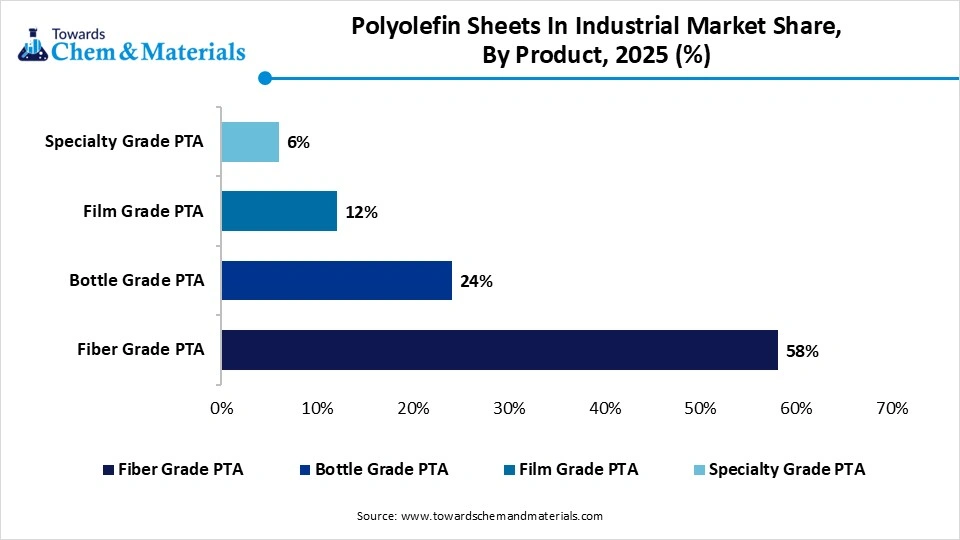
The polypropylene (PP) segment held the 33% market share in 2025 and is expected to grow at the fastest CAGR of 6.4% over the forecast period, influenced by its high toughness, heat tolerance, and surface rigidity. Polypropylene is resistant to moisture and chemicals utilized in tanks and ventilation systems. The homopolymer PP, copolymer PP, and impact-modified PP can be processed using extrusion equipment and flame-retardant additives. Additionally, its semi-crystalline structure provides rigidity aligned with recycling infrastructure, making it essential for automotive parts and battery enclosures.
The others segment held the 13% market share in 2025, including polyolefin elastomer sheet, PO, and EVA sheet blends designed for mining liners and industrial components. This product offers low friction and self-lubrication ability while its impermeability protects against abrasives and weathering. Additionally, processing and recycling requirements are driving their importance in automation and eco-friendly manufacturing.
Application Insights
The packaging & pallet liners segment dominated the market with the largest share of 36% in 2025, because it is essential stable and safer logistics. Extruded polyethylene and polypropylene are utilized in sheets for pallet separation, export packaging, and industrial packaging. The rising consumer focus on protective goods where polyolefin sheets ensure high puncture resistance and moisture proofing to support the circular economy principle and recyclability.
The construction components segment held the 19% market share in 2025 and is expected to grow at the fastest CAGR of 6.7% over the forecast period. Using heavy-gauge HDPE and PP through high-speed extrusion to maintain strength and flexibility. The builder focuses on vapor barriers, waterproofing membranes, protection against soil chemicals, and water-to-concrete protection. Polyolefin sheets are crucial for protective wall panels, supporting the building framework that enables sustainable infrastructure development to meet green-certified targets.
The chemical storage & containment segment held the 24% market share in 2025. Driven by demand for tank liners, chemical-resistant barriers that provide long-lasting, environmentally compliant solutions integrated with recycling infrastructure. The high-density polyethylene and polypropylene are essential in a secondary containment system. Polyolefin sheets resist moisture and chemicals, provide leakproof joints through hot-gas welding, and outperform concrete and steel.
The machine & equipment linings segment held 14% market share in 2025. The expansion is boosted by rising focus on enhancing material flow and self-lubricating panels, driving the use of UHMWPE and HDPE through specialized extrusion. Polyolefin sheets are important for material handling equipment liners, wear-resistant linings, & corrosion protection linings. They can be machined into customized shapes, fostering longevity of equipment in mining and agriculture.
Regional Insights
How Did the Asia Pacific Dominated the Polyolefin Sheets In Industrial Market in 2025?
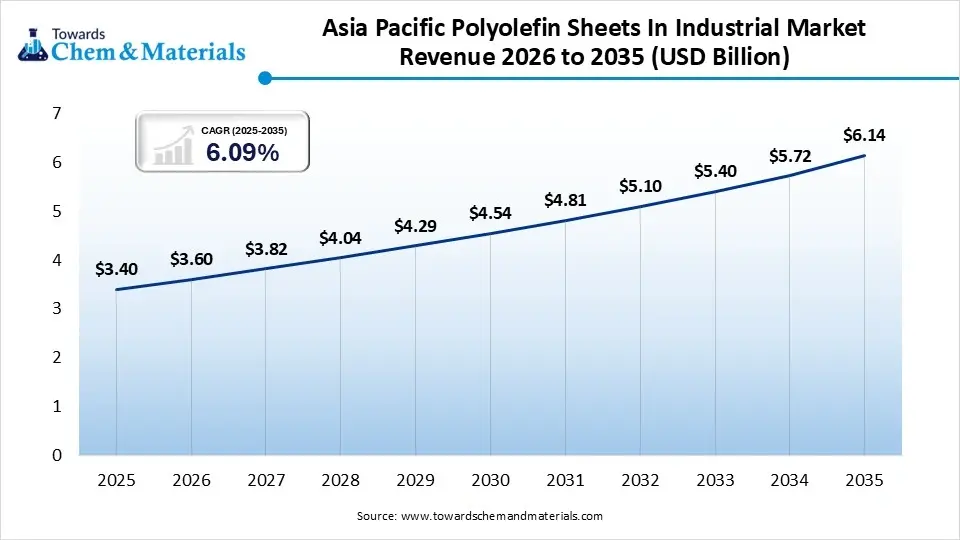
The Asia Pacific polyolefin sheets in industrial market size was estimated at USD 3.40 billion in 2025 and is projected to reach USD 6.14 billion by 2035, growing at a CAGR of 6.09% from 2026 to 2035.Asia Pacific dominated the market by holding 38% share in 2025 and is expected to grow at the fastest with a CAGR of 7.20% during the forecast period. Defined by their volume consumption and infrastructure expansion, which requires heavy-duty pallet liners for automated logistics. The region utilizes high-tech, functionalized polypropylene integrating with advanced extrusion machinery. The Asia Pacific regulatory framework for hazardous chemical migration and quality control requires strict polyolefin purity standards. Additionally, the domestic surge in EV battery production is driving demand for non-conductive sheets for battery enclosures, further strengthening their dominance.
China
- The country's rapid scaling of co-extrusion technology and high-volume demand for functionalized polypropylene sheet formulation.
- China is maintaining its dominance in electric vehicle battery production lines. Industrial players are integrating a smart e-commerce hub for pallet liners.
India
- The shift towards industrial modernization and heavily investing in chemical storage and structural fabrication through domestic manufacturing facilities.
- India growth encouraged by rising interest in on high density polyethylene sub-slab vapor barrier
The Europe polyolefin sheets in industrial market size was estimated at USD 2.15 billion in 2025 and is projected to reach USD 3.91 billion by 2035, growing at a CAGR of 6.16% from 2026 to 2035.Europe held 24% market share in 2025. The region focuses on high-value and premium sheets with specialized R&D on ultra-thin polyolefin sheets. scaling chemical recycling facilities. EU regulatory limitations on harmful stabilizers and post-consumer recycled content allow industrial manufacturers to domestically scale chemical recycling infrastructure. Europe's move towards a circular economy and decarbonization is boosting the adoption of certified bio-based polyolefins to meet lifecycle assessment requirements.
Germany
- Germany experiencing the growth by the use of advanced materials and a market shift toward certified bio-based polyolefins.
- The nation-driven regulations emphasize recycled content, and there is an industrial focus on high-performance machinery and equipment, in line with achieving net-zero goals.
Italy
- Italy is focusing on the integration of circular economy targets for industrial scrap and the expansion of high-impact transport surface wraps.
- The domestic manufacturers' rising investment in thermoforming fabrication and polyolefins for automotive components, industrial packaging, and specialized manufacturing assembly.
The North America polyolefin sheets in industrial market size was estimated at USD 1.97 billion in 2025 and is projected to reach USD 3.59 billion by 2035, growing at a CAGR of 6.18% from 2026 to 2035.North America held 22% market share in 2025, driven by automated volume growth and the rapid implementation of smart thermoplastic sheets that enhance anti-static and UV-stabilization. Stringent regulatory compliance for raw polyolefin catalysts and non-recyclable plastics. Additionally, the government supports stringent lightweighting mandates and modernization in civil engineering, with HDPE vapor barriers, which are driving steady growth in North America.
United States
- The structural environment standards reinforcement industrial manufacturing for optimizing EV driving range and automated production lines.
- The U.S. is witnessing stable growth through its focus on ultra-thin sheet by rapid scaling of shale-driven ethylene and propylene.
The Latin America polyolefin sheets in industrial market size was estimated at USD 0.81 billion in 2025 and is projected to reach USD 1.52 billion by 2035, growing at a CAGR of 6.50% from 2026 to 2035.Latin America held 9% market share in 2025, due to regional chemical standards that are gradually aligning with industrial standards. The domestic need for durable, high-impact protective packaging and the expansion of automotive supply chains are driving demand for cost-efficient polyolefin sheets. Latin America leads in export-driven infrastructure for high-strength, weather-resistant structural sheet to support industrial manufacturing.
Brazil
- The sheet-grade resins used in Brazil have been identified through a recent survey and expansion of the local petrochemical refining facility in domestic scale.
- Additionally, the country is undergoing increased demand for moisture-resistant protective polyolefin sheets, particularly in agricultural logistics and heavy-duty transportation.
Argentina
- Domestic growth is supported by extensive industrial lining and an expanded distribution network for extraction activities.
- Argentina's increasing focus on large-scale mining infrastructure and construction projects is fueling the requirement for chemical storage solutions and high-strength polyolefin sheets.
The Middle East and Africa polyolefin sheets in industrial market size was estimated at USD 0.63 billion in 2025 and is projected to reach USD 1.20 billion by 2035, growing at a CAGR of 6.66% from 2026 to 2035.Middle East & Africa held 7% market share in 2025.The domestic surge for heavy-duty, corrosion-resistant linings is especially in oil, gas, and mining infrastructure. MEA represents an infrastructure-driven expansion, with capital investment to develop domestic chemical processing and high-value polyolefin-engineered sheets. The regional environmental standards for synthetic linings in waterworks and mining are driving continuous demand for polyolefin sheets.
Saudi Arabia
- The growth is accelerated by their economic diversification for local oil and gas feedstock and mega-city infrastructure development project.
- Saudi Arabia's strict regional framework for environmental and industrial wastewater supports the regional recycling framework for industrial polyolefin waste.
Recent Developments
- In October 2025, LyondellBasell launched Pro-fax EP410C, a new polypropylene for packaging and industrial use. It offers cold durability, impact strength, & high melt strength, suitable for industrial containers, sheet, and extrusion.(Source: www.lyondellbasell.com)
- In February 2025, IPG introduced its new American® brand, Plastic Sheeting, to enhance surface protection. This product launch offers high performance, superior tear resistance, and functions as a cost-effective solution.(Source: www.marketscreener.com)
Top Companies in the Polyolefin Sheets In Industrial Market
- Grafix Plastics
- Mapal
- Trident Plastics, Inc.
- Farco Plastics Supply
- Duroplastic Technologies
- All Foam Products
- Ensinger, Inc.
- U.S. Packaging & Wrapping LLC
- Porex
- Dugar Polymers Limited
- Polycan Extrusion Pvt. Ltd
- Dutron
Segments Covered
By Product
- Polyethylene (PE)
- High-Density Polyethylene (HDPE)
- Low-Density Polyethylene (LDPE)
- Linear Low Density Polyethylene (LLDPE)
- Ultra-High Molecular Weight Polyethylene (UHMWPE)
- Polypropylene
- Homopolymer PP
- Copolymer PP
- Impact Modified PP
- Others
- Ethylene Vinyl Acetate (EVA) Sheets
- Polyolefin Elastomer (POE) Sheets
- Thermoplastic Polyolefin (TPO) Sheets
By Application
- Packaging & Pellet Liners
- Industrial Packaging Sheets
- Pallet Separation Sheets
- Export Packaging Liners
- Chemical Storage & Containment
- Tank Liners
- Secondary Containment Systems
- Chemical Resistant Barriers
- Construction Components
- Protective Wall Panels
- Temporary Site Barriers
- Moisture Protection Sheets
- Machine & Equipment Linings
- Wear Resistant Linings
- Corrosion Protection Linings
- Materials Handling Equipment Liners
- Others
- Agricultural Components
- Marine Components
- Utility Infrastructure Sheets
By Region
- North America
- U.S.
- Canada
- Europe
- Germany
- UK
- France
- Italy
- Spain
- Sweden
- Denmark
- Norway
- Asia Pacific
- China
- Japan
- India
- South Korea
- Thailand
- Latin America
- Brazil
- Mexico
- Argentina
- Middle East and Africa (MEA)
- South Africa
- UAE
- Saudi Arabia
- Kuwait
FAQ's
Question 1 : What is driving the growth of the polyolefin sheets in industrial market?
Answer : The market is primarily driven by industries replacing heavy metals and wood with lightweight plastic alternatives to improve efficiency. Additionally, the rapid rise of electric vehicle manufacturing requires non-conductive polyolefin sheets for battery enclosures, while global sustainability goals are pushing companies to adopt highly recyclable materials.
Question 2 : Why is the packaging and pellet liners segment so dominant?
Answer : This segment holds 36% of the market because safe and moisture-proof logistics are critical for global trade. Extruded polyolefin sheets provide high puncture resistance and excellent chemical barriers, making them irreplaceable for pallet separation, export packaging, and industrial bulk container liners.
Question 3 : What are the main challenges facing polyolefin sheet manufacturers?
Answer : The biggest restraint on the market is raw material price volatility. Because polyolefin production relies heavily on petrochemical feedstocks like crude oil and natural gas, unpredictable energy prices can suddenly spike manufacturing costs and disrupt long-term supply contracts.
Question 4 : How is artificial intelligence impacting the polyolefin sheets industry?
Answer : Artificial intelligence and machine learning are transforming manufacturing through predictive material intelligence. AI allows producers to test the structural stability and uniformity of a polyolefin sheet formula digitally before physical synthesis, which drastically cuts down research time and optimizes energy efficiency during extrusion.
Question 5 : Who are the top key players operating in the industrial polyolefin sheets market?
Answer : The top companies profiled in the fabrication and distribution landscape include Grafix Plastics, Mapal, Trident Plastics, Inc., Farco Plastics Supply, Duroplastic Technologies, and Ensinger, Inc. Other critical suppliers making significant moves include U.S. Packaging and Wrapping LLC, Porex, Dugar Polymers Limited, Polycan Extrusion Private Limited, and Dutron. On the raw material side, petrochemical giants like INEOS Group, PetroChina, Chevron Phillips Chemical, and Formosa Plastics supply the essential polymer pellets, while major engineering firms like Rochling Engineering Plastics, Spartech LLC, and Mitsubishi Chemical Advanced Materials handle high-output sheet extrusion.
Meet the Team

Saurabh Bidwai
Principal Consultant
Saurabh Bidwai, a B.Tech Chemical Engineering graduate with 4+ years of experience, specializes in specialty chemicals, commodity chemicals, and engineered materials, offering valuable insights into market trends and emerging opportunities.

Aditi Shivarkar
Reviewed By
Aditi Shivarkar, with 14+ years in Chemical and Materials market research, specializes in Chemical and Materials. She ensures accurate, actionable insights, driving Towards Chemicals And Materials Analytics and Consulting excellence in industry trends and sustainability.