
Polypropylene Compounds Market Size, Production Volume, Sales Performance, Export & Import Dynamics, Adoption Rates, Recycling Rate, Material Efficiency, Market Share Analysis, and Demand Trends
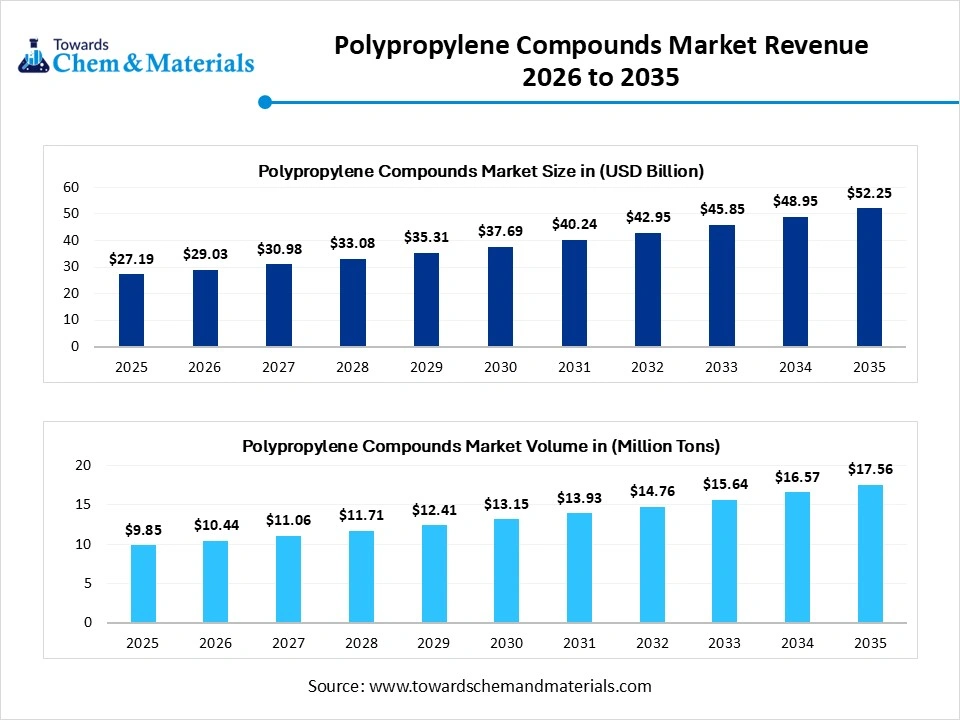
The polypropylene compounds market was valued at USD 27.19 billion in 2025 and is expected to reach USD 29.03 billion in 2026, further projected to grow to USD 52.25 billion by 2035, registering a CAGR of 6.75% from 2026 to 2035. In volume terms, the market is anticipated to expand from 9.85 million tons in 2025 to 17.56 million tons by 2035 at a CAGR of 5.95%. This report covers detailed market size, segment-wise analysis, regional trends, key company profiles, competitive landscape, value chain insights, trade data, and comprehensive information on manufacturers and suppliers.
Content
What is the Current Polypropylene Compounds Market Size and Share?
The global polypropylene compounds market was valued at USD 27.19 billion in 2025, is estimated to reach USD 29.03 billion in 2026, and is projected to reach USD 52.25 billion by 2035, growing at a CAGR of 6.75% from 2026 to 2035. In terms of volume, the polypropylene compounds market is projected to grow from 9.85 million tons in 2025 to 17.56 million tons by 2035. growing at a CAGR of 5.95% from 2026 to 2035.
Key Takeaways
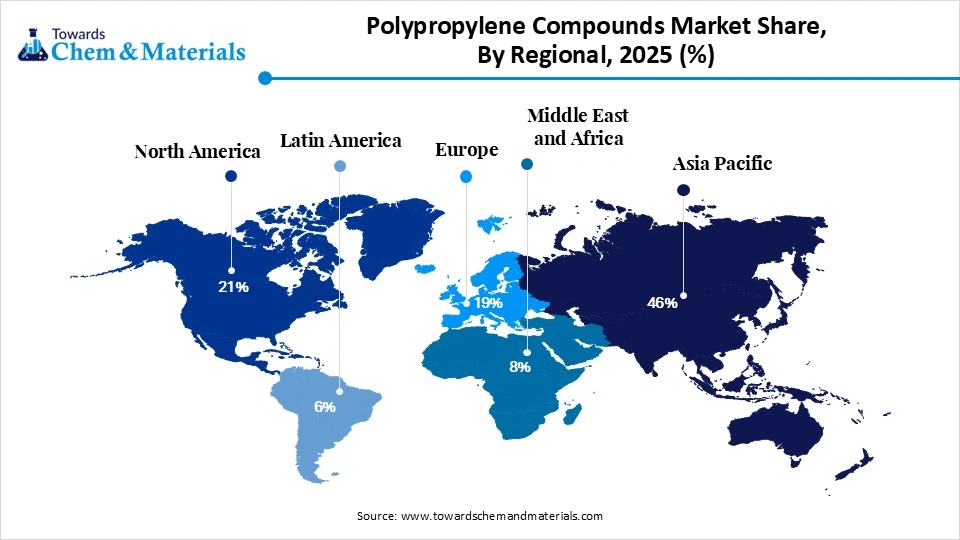
- Asia Pacific dominated the polypropylene compounds industry with the largest revenue share of 46% in 2025.
- By product type, the mineral filled PP compounds led the market with the largest revenue share of 30% in 2025.
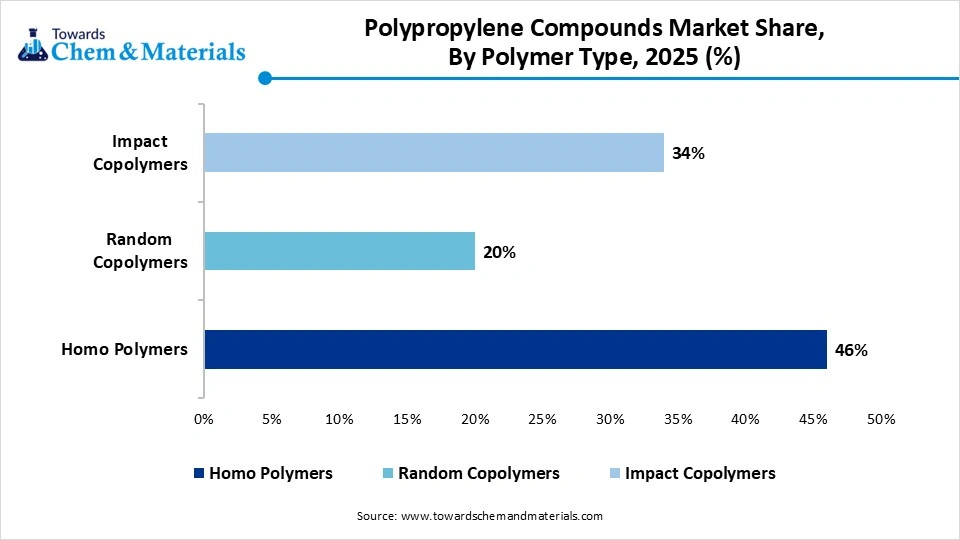
- By polymer Type, the homo polymers segment dominate the market with the largest revenue share of 46% in 2025.
- By property type, the impact resistant segment led the market with the largest revenue share of 46% in 2025.
- By process technology, the injection molding segment dominate the market with the largest revenue share of 46% in 2025.
- By End-use, the automotive segment led the market with the largest revenue share of 53% in 2025.
Market Size and Volume Forecast
- Market Estimated Size (2026): USD 29.03 Billion | CAGR (2026–2035): 6.75%
- Market Projected Size (2035): USD 52.25 Billion
- Market Volume (2025): 9.85 Million Tons (MT) | Volume CAGR (2026–2035): 5.95%
- Market Projected Volume (2035): 17.56 Million Tons (MT)
- Market Pricing (2025):
- Average Manufacturing Price (2025): USD 1,460/ton
- Average Selling Price (2025): USD 1,930/ton
- Pricing CAGR (2025–2035): 3.25%
Sustainable and High-Performance Polypropylene Compounds Gain Industry Momentum
Polypropylene (PP) compounds are extensively utilized in applications such as appliance housings, electrical connectors, and cable insulation, owing to their cost-effectiveness, strong electrical insulation capabilities, and high design versatility. These attributes make them a preferred material across a wide range of industrial and consumer applications.
A major trend shaping the polypropylene compounds market is the rapid shift toward sustainable and high-performance material solutions across key end-use industries. Manufacturers are increasingly adopting recycled polypropylene and bio-based compound variants to meet growing circular economy goals and comply with tightening environmental regulations.
In the automotive sector, particularly with the rise of electric vehicles, lightweighting remains a critical focus area. This is driving increased demand for advanced PP compounds engineered to deliver superior mechanical strength while reducing overall vehicle weight. At the same time, packaging and consumer goods industries are transitioning toward recyclable compound grades as companies work to achieve sustainability targets and reduce environmental impact.
What are Propylene Compounds, and What's the Current Market Condition?
The polypropylene compounds are known as a composite material and are made by the blends of polypropylene with resin plus fillers, and other materials like additives and plasticizers. The polypropylene industry has experienced a greater upward shift in recent years, where the automotive, appliance, and packaging industries have seen under a heavy demand for the polypropylene grades.
Polypropylene Compounds Market Outlook:
- Industry Growth Overview: Between 2025 and 2034, factors like the trend of the lightweight material usage in vehicles, electrification demands, and increased shift towards rigid packaging for the e-commerce sector have allowed key players and distributors to capitalize on growth opportunities in recent years.
- Sustainability Trends: the polypropylene manufacturers are observed in offering certified recycled blends, where the carbon footprint labels and innovative recycling formulation have sparked considerable attention from financial analysts in the past few years.
- Global Expansion: The polypropylene compounds industry is standing on a one-size-fits-all status right now. The global region, like Asia, is considering polypropylene as an ideal material for its enlarged packaging industry, while Europe is using it for the automotive and medical grades. Also, North America has been consuming polypropylene for electric grade compounds immensely in recent years, as per the survey.
Report Scope
| Report Attributes | Details |
| Market Size in 2026 | USD 27.79 Billion |
| Expected Size by 2035 | USD 54.87 Billion |
| Growth Rate from 2025 to 2035 | CAGR 7.85% |
| Base Year of Estimation | 2025 |
| Forecast Period | 2025 - 2035 |
| Dominant Region | Asia Pacific |
| Segment Covered | By Type of Polypropylene, By Application, By Property, By Process Technology, By Region |
| Key Companies Profiled | Braskem , Total Petrochemicals , Reliance Industries , Formosa Plastics Corporation , Chevron Phillips Chemical Company , BASF , LG Chem , China National Petroleum Corporation (CNPC) , DSM Engineering Plastics , Clariant , Arkema Group , Mitsui Chemicals , UBE Industries , Hanwa Chemical Corporation , PolyOne Corporation (Now Avient Corporation) , Polyplastics Co. Ltd. |
Key Technological Shifts in the Polypropylene Compounds Market:
The market has widely accepted the technology integration, where the manufacturer has seen in using the AI-enabled reactive extrusion methods in the current period. furthermore, the major brands are investing in innovative manufacturing technology for initiatives like one-pass reactive blends and others in the coming years. Also, the establishment of the localized small batch production may result in enhanced brand positioning and product offerings during the projected period.
Value Chain Analysis of the Polypropylene Compounds Market:
- Distribution to Industrial Users: The distributors are offering fine solutions to the major sectors like packaging, automotive, and electronics industries.
- Chemical Synthesis and Processing: Chemical synthesis and processing include the primary processes, such as polymerization and others, while using a catalyst like Ziegler-Natta.
- Regulatory Compliance and Safety Monitoring: The safety and regulatory process of the polypropylene compounds can be held under the national and international standards of the respective regions.
Polypropylene Compounds Market’s Regulatory Landscape: Global Regulations
| Country / Region | Regulatory Body | Key Regulations | Focus Areas | Notable Notes |
| United States | U.S. Food and Drug Administration (FDA) and Consumer Product Safety Commission (CPSC) | FDA, 21 CFR 177.1520 | Product safety and food safety | These agencies are ensuring the daily use of plastic safety in food and product usage applications. |
| European Union | European Commission (EC) and European Chemicals Agency (ECHA) | REACH (EC) No 1907/2006 | High level of chemical safety, circular economy, and sustainability | The agencies established to identify and eliminate hazardous substances in propylene compounds |
| China | National Health Commission (NHC) | GB 4806.7-2023 | Mandatory national standards and Food contact safety | These agencies are closely watching imports and exports. |
| India | Bureau of Indian Standards (BIS) and Ministry of Chemicals and Fertilizers | IS 10951:2020 | Standardized product quality | Ensures safety and provides certificates. |
Asia Pacific Polypropylene Compounds Market Size, Industry Report 2035
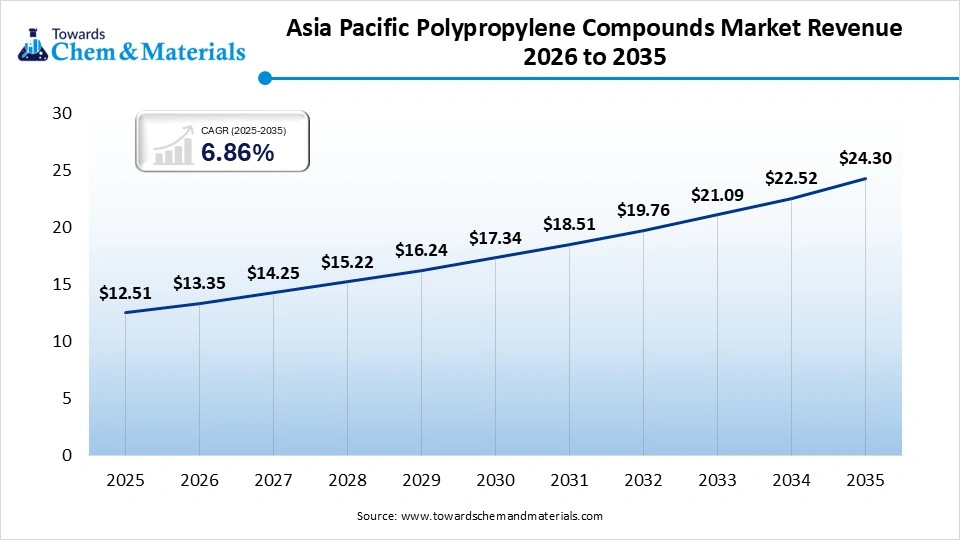
The Asia Pacific polypropylene compounds market size was estimated at USD 12.51 billion in 2025 and is projected to reach USD 24.30 billion by 2035, growing at a CAGR of 6.86% from 2026 to 2035. owing to the enlarged and advanced manufacturing infrastructure. Furthermore, the regional countries such as India and China have seen in massive end-market demand within sectors like automotive, packaging, and electronics in the current period. Also, the region has access to advanced refineries, which are contributing to the industry's growth in the current period.
What Drives China’s Supremacy in Propylene Production?
China maintained its dominance in the market, owing to the country’s massive propylene production infrastructure and domestic consumption in recent years. Also, China has seen under a heavy investment in innovative R&D activities for the processing like simplifying extrusion and polymerization in the current period.
North America Polypropylene Compounds Market Trends
North America is expected to capture a major share of the market during the forecast period, akin to the sudden shift towards specialty polypropylene and sustainability. The major sectors in the United States are actively seeking sustainable solutions as a global shift towards eco-friendliness, while the manufacturers in the United States have seen under an innovative and eco-friendly polypropylene development.
How will Europe be considered a Notable Region in the Polypropylene Compounds Market?
Europe is a notable region in the global market, primarily due to its strict environmental regulations within the EU, a high demand for lightweight materials in the automotive sector, and a strong emphasis on circular economy initiatives, especially in Germany, the UK, and France. The rapid transition towards EVs in Europe has led to an increased demand for specialty compounds used in battery housings, trays, and interior components, which necessitate high stiffness and low density. Additionally, the European construction industry is fueling the market by requiring durable, lightweight materials for insulation and piping.
Germany Polypropylene Compounds Market Trends
Germany plays a significant role within the region, driven by its robust automotive industry, which creates a demand for high-performance polypropylene (PP) compounds to replace metal parts, thereby reducing vehicle weight and enhancing fuel efficiency. This growth is also spurred by strict EU regulations concerning recyclable plastics. Germany boasts a high production capacity, with companies like LyondellBasell operating specialized compounding plants in the country.
Emergence of Latin America in the Polypropylene Compounds Market?
Latin America is emerging market within the global market, largely due to rapid industrialization, a flourishing packaging sector, and increased automotive production, particularly in Mexico and Argentina. There is a notable shift toward replacing metal parts with PP compounds to improve fuel efficiency, reduce emissions, and adapt to the rise of EVs. Governments in Latin America are implementing stringent regulations, and consumers are increasingly favoring eco-friendly products.
Brazil Polypropylene Compounds Market Trends
Brazil plays a unique role within the region, mainly because of its urbanization and infrastructure development. Braskem S.A. is the largest producer of thermoplastic resins in the Americas and operates significant facilities in Brazil, including the manufacturing of bio-based plastics. Brazil is committed to green manufacturing, highlighted by collaborations like that of Braskem and Shell, which focus on sustainable feedstock to create higher-performance, eco-friendly PP compounds.
How will the Middle East and Africa contribute to the Polypropylene Compounds Market?
The Middle East and Africa are key contributors to the global market, mainly due to their robust petrochemical base, rapid industrialization, and high demand from end-user industries such as automotive, construction, and packaging. Growing investments in chemical recycling and regulations promoting the use of recycled content in plastic products are driving innovation in sustainable, eco-friendly compounds. Ambitious construction projects in Gulf countries and housing booms in Africa are significantly boosting the demand for PP pipes, sheets, and insulation materials.
The UAE Polypropylene Compounds Market Trends
The UAE stands out as a mature market within the region, primarily stems from its advanced petrochemical infrastructure and sophisticated automated manufacturing plants, such as those operated by Borouge, which serve as distribution centers for the region. The government is heavily investing in recycling initiatives, promoting the production of high-quality, sustainable, and food-safe recycled PP compounds. The region is also a key manufacturer of specialized products, including scratch-resistant polypropylene for automotive interiors.
Polypropylene Compounds Market Share, By Regional, 2025 (%)
| Regional | Revenue Share, 2025 (%) |
| Asia-Pacific | 46% |
| North America | 21% |
| Europe | 19% |
| Middle East & Africa | 8% |
| Latin America | 6% |
- Asia-Pacific – Dominating with a 46% share, strong industrialization, large-scale manufacturing, and high demand from automotive and packaging sectors drive its leading position.
- North America – With a 21% share, advanced technologies and high-value applications support steady demand, but market maturity limits faster growth.
- Europe – Holding a 19% share, sustainability regulations and innovation drive adoption, though slower industrial expansion restricts dominance.
- Middle East & Africa – With an 8% share, growing petrochemical investments and infrastructure development are driving gradual market expansion.
- Latin America – Making up 6% of the market, improving industrial activities support growth, but economic volatility limits larger market contribution.
Country-level Investments & Funding Trends for the Polypropylene Compounds Industry:
- India: The government of India has implemented the quality control completion for the polypropylene imports in 2024.(Source: www.argusmedia.com)
- China: The polypropylene export of China has shifted towards the high-potential region, such as Africa, South Asia, and Southeast Asia, as per the published report.(Source: www.spglobal.com)
Segmental Insights
By Product Insights
Rising Demand for Reinforced Polypropylene Compounds Drives Market Expansion
The Mineral-filled polypropylene (PP) compounds continue to lead the product landscape, capturing a 30% revenue share in 2025 and projected to expand at a CAGR of 6.85% from 2026 to 2035. Their dominance is largely driven by widespread adoption in home appliances and automotive interior components such as consoles, panels, and knee bolsters. These compounds are engineered by incorporating minerals like talc, glass beads, mica, silica, and calcium, which significantly enhance heat distortion resistance and rigidity. As a result, they offer improved thermal stability and mechanical stiffness, making them highly suitable for demanding applications across automotive and electrical & electronics sectors.
In parallel, compounded thermoplastic vulcanizates (TPVs) are gaining traction, particularly in under-the-hood automotive applications where resistance to oil and high temperatures is critical. Their performance advantages are supporting increased integration in next-generation vehicle designs.
The glass fiber reinforced polypropylene segment is also witnessing strong momentum and is expected to grow at a CAGR of 6.55% during the forecast period. These compounds are valued for their exceptional strength, rigidity, and dimensional stability, along with resistance to chemicals and warpage. Notably, polypropylene reinforced with 30% chemically coupled glass fiber can achieve up to a 180% increase in tensile strength. This enhanced performance profile makes glass-reinforced PP an ideal material for structural components in furniture, appliances, and automotive applications, where durability and mechanical integrity are essential.
Polypropylene Compounds Market Share, By Product , 2025 (%)
| By Product | Revenue Share, 2025 (%) |
| Mineral filled PP compounds | 30% |
| Compounded TPO | 16% |
| Compounded TPV | 10% |
| Glass fiber reinforced | 18% |
| Talc filled | 20% |
| Others | 6% |
- Mineral Filled PP Compounds – Dominating with a 30% share, their cost-effectiveness and enhanced stiffness make them widely used in automotive and industrial applications.
- Talc Filled – With a 20% share, improved dimensional stability and rigidity support strong demand, especially in automotive components.
- Glass Fiber Reinforced – Holding an 18% share, high strength and durability drive adoption in engineering and structural applications.
- Compounded TPO – With a 16% share, growing use in automotive exterior parts due to impact resistance and flexibility is supporting steady growth.
- Compounded TPV – Holding a 10% share, excellent elasticity and heat resistance support niche applications but limit broader dominance.
- Others – Making up 6% of the market, diverse specialty compounds have limited adoption, resulting in a smaller overall contribution.
By Polymer Type Insights
How did the Homopolymer Segment Dominate the Polypropylene Compounds Market in 2025?
The Homo Polymers segment dominated the polypropylene compounds industry, accounting for the largest share of 54.3% in 2025, due to it can offer high stiffness while providing excellent dimensional stability. Moreover, the compound manufacturers are increasingly preferring the homopolymer as baseline resin to blends akin to it can give predictable mechanical behavior across batches.
The copolymer segment is expected to grow at a notable rate during the predicted timeframe, owing to the increased need for clarity, toughness, and low-temperature impact, where the homopolymer has not performed well. Moreover, the better chemical compatibility, improved impact resistance, and superior flexural performance for appliances, the copolymer likely to gain major industry attention in the coming years.
Polypropylene Compounds Market Share, By Polymer Type, 2025 (%)
| By Polymer Type | Revenue Share, 2025 (%) |
| Homo Polymers | 46% |
| Random Copolymers | 20% |
| Impact Copolymers | 34% |
- Homo Polymers – Dominating with a 46% share, its low cost, high stiffness, and extensive use in packaging and consumer goods make it the most widely adopted polymer type.
- Impact Copolymers – With a 34% share, increasing demand for high-impact strength and durability in automotive and industrial applications is driving strong growth.
- Random Copolymers – Holding a 20% share, improved clarity and flexibility support steady demand, but higher cost and niche applications limit broader dominance.
Property Type Insights
How did the Impact Resistance Segment Dominate the Polypropylene Compounds Market in 2025?
The Impact Resistant segment dominated the polypropylene compounds industry, accounting for the largest share of 51% in 2025, because industries wanted materials that don't break easily. From car bumpers to tool housings, impact resistance is very important for safety and durability. These compounds are specially designed to handle drops, crashes, and rough handling without cracking.
The UV-resistance segment is expected to grow at a significant rate during the forecast period, because more products are used outdoors and in sunlight. Normal PP can fade, crack, or become weak when exposed to the sun for a long time. UV-resistant compounds solve this by keeping color, strength, and flexibility even after years of sun exposure.
Polypropylene Compounds Market Share, By Property , 2025 (%)
| By Property | Revenue Share, 2025 (%) |
| Flame Retardant | 18% |
| Impact Resistant | 51% |
| UV Resistant | 17% |
| Antistatic | 14% |
- Impact Resistant – Dominating with a 51% share, high demand from automotive and industrial applications requiring durability and toughness drives its leading position.
- Flame Retardant – With an 18% share, increasing safety regulations in construction and electrical applications support steady demand but limit broader dominance.
- UV Resistant – Holding a 17% share, rising use in outdoor applications supports growth, though its application scope is comparatively limited.
- Antistatic – Making up 14% of the market, demand from electronics and packaging sectors supports adoption, but niche usage restricts larger market share.
Process Technology Insights
How did the Injection Molding Segment Dominate the Polypropylene Compounds Market in 2025?
The Injection Molding segment dominated the polypropylene compounds industry, accounting for the largest share of 46% in 2025, efficient, and perfect for making complex shapes. Industries like auto, electronics, and packaging prefer this process since it can produce large quantities in less time. PP compounds work very well with injection machines and can be molded into thin, strong parts.
The extrusion segment is expected to grow at a significant rate during the forecast period, because it is better for making continuous products and recyclable packaging. Unlike injection moulding, extrusion can create films, sheets, pipes, and profiles in large quantities.
Polypropylene Compounds Market Share, By Process Technology , 2025 (%)
| By Process Technology | Revenue Share, 2025 (%) |
| Extrusion | 28% |
| Injection Molding | 46% |
| Blow Molding | 16% |
| Thermoforming | 10% |
- Injection Molding – Dominating with a 46% share, its versatility, high production efficiency, and widespread use in automotive, packaging, and consumer goods drive its leading position.
- Extrusion – With a 28% share, strong demand for pipes, sheets, and profiles supports steady growth, though it remains secondary to injection molding.
- Blow Molding – Holding a 16% share, demand for hollow products like containers supports usage, but limited application scope restricts higher share.
- Thermoforming – Making up 10% of the market, its use in packaging applications supports demand, but lower versatility compared to other processes limits broader adoption.
By End-use Insights
Why does the Automotive Segment Dominate the Polypropylene Compounds Market?
The Automotive segment dominated the polypropylene compounds industry, accounting for the largest share of 53% in 2025. because cars require lightweight, affordable, and durable materials. PP compounds are used in bumpers, dashboards, door panels, and even electric vehicle parts. They help reduce vehicle weight while keeping strength and safety. Automakers also prefer PP because it is cheaper than metals and can be molded into many shapes quickly.
The consumer goods segment is expected to grow at a notable rate during the forecast period, because everyday products need variety and sustainability. Electronics, appliances, toys, and packaging require attractive finishes, scratch resistance, and recyclable materials. PP compounds can be easily customized for colors, designs, and eco-friendly features.
Polypropylene Compounds Market Share, End-use, 2025 (%)
| By End-use | Revenue Share, 2025 (%) |
| Automotive | 53% |
| Consumer Goods | 12% |
| Electrical & Electronics | 8% |
| Medical | 5% |
| Building & Construction | 7% |
| Packaging | 10% |
| Textiles | 3% |
| Others | 2% |
- Automotive – Dominating with a 53% share, high demand for lightweight, durable materials in vehicle components drives its leading position globally.
- Consumer Goods – With a 12% share, widespread use in household and daily-use products supports steady demand but limits higher dominance.
- Packaging – Holding a 10% share, strong demand for cost-effective and flexible packaging solutions drives consistent market growth.
- Electrical & Electronics – With an 8% share, increasing use in insulation and components supports growth, though niche applications restrict larger share.
- Building & Construction – Holding a 7% share, demand for durable and weather-resistant materials supports adoption but remains moderate.
- Medical – With a 5% share, rising use in healthcare products supports growth, but strict regulations limit broader expansion.
- Textiles – Making up 3% of the market, limited application scope results in a smaller contribution despite steady demand.
- Others – Accounting for 2% of the market, diverse niche applications lead to minimal overall market share.
Recent Development
- In January 2025, INEOS Olefins and Polymers Europe launched a new Recycl-IN hybrid polymer grade containing 70% recycled material which boost the sustainability of contact-sensitive cosmetics packaging without brands requiring to compromise on quality or performance. This launch deliver the strength, aesthetics, and processing ease customers expect and making it ideal for manufacturing stiff, coloured and translucent components.(Source: www.ineos.com)
Top Vendors in the Polypropylene Compounds Market & Their Offerings:
- LyondellBasell: the company is known as the leading manufacturer of polymers, while specializing in polyolefins and olefins production.
- INEOS Group: the company is focused on specialty chemical manufacturing while aiming to develop products that meet evolving needs.
- SABIC: The major producer and distributor of polyethylene, polypropylene, and polyethylene terephthalate.
- ExxonMobil Chemical: the company is a leading energy and sustainable solution provider, with enlarged ethylene, polymers, and propylene production business.
Other Key Players
- Braskem
- Total Petrochemicals
- Reliance Industries
- Formosa Plastics Corporation
- Chevron Phillips Chemical Company
- BASF
- LG Chem
- China National Petroleum Corporation (CNPC)
- DSM Engineering Plastics
- Clariant
- Arkema Group
- Mitsui Chemicals
- UBE Industries
- Hanwa Chemical Corporation
- PolyOne Corporation (Now Avient Corporation)
- Polyplastics Co. Ltd.
Segments Covered in the Report:
By Product
- Mineral filled PP compounds
- Compounded TPO
- Compounded TPV
- Glass fiber reinforced
- Talc filled
- Others
By Polymer Type
- Homo Polymers
- Random Copolymers
- Impact Copolymers
By Property
- Flame Retardant
- Impact Resistant
- UV Resistant
- Antistatic
By Process Technology
- Extrusion
- Injection Molding
- Blow Molding
- Thermoforming
By End-use
- Automotive
- Interior
- Exterior
- Under-the-Hood
- Consumer Goods
- Appliances
- Furniture
- Packaging
- Electrical & Electronics
- Insulation
- Connectors
- Cables
- Medical
- Syringes & Injectables
- Medical Containers
- Diagnostic Devices
- Construction
- Pipes & Fittings
- Flooring
- Insulation
- Packaging
- Rigid Packaging
- Flexible Packaging
- Textiles
- Nonwoven Fabrics
- Carpet Backing
- Apparel
- Others
- Agriculture Films
- Industrial Products
By Region
- North America
- U.S.
- Canada
- Europe
- Germany
- UK
- France
- Italy
- Spain
- Sweden
- Denmark
- Norway
- Asia Pacific
- China
- Japan
- India
- South Korea
- Thailand
- Latin America
- Brazil
- Mexico
- Argentina
- Middle East and Africa (MEA)
- South Africa
- UAE
- Saudi Arabia
- Kuwait
FAQ's
Question 1 : What is the market size of the Polypropylene Compounds Market ?
Answer : The global polypropylene compounds market size was valued at USD 25.77 billion in 2025 and is expected to hit around USD 54.87 billion by 2035, exhibiting at a compound annual growth rate (CAGR) of 7.85% over the forecast period from 2026 to 2035. Asia Pacific dominated the polypropylene compounds market with the largest revenue share of 41.87% in 2025
Question 2 : What are the three biggest growth drivers through 2034?
Answer : Lightweighting & design freedom in autos (interior, exterior, under-the-hood) replacing metals/engineering plastics. Packaging premiumization & e-commerce favoring rigid/flexible PP formats with performance add-ons. Electrification & appliance refresh cycles demanding heat-, impact-, and flame-managed compounds with precise flow/finish.
Question 3 : Where are the most attractive investment opportunities?
Answer : High-margin specialty grades (impact-resistant, UV-resistant, flame-retardant, antistatic) for EVs, medical, and durable consumer goods. Recycled & certified circular PP blends aligned to brand ESG targets. Localized small-batch/short-lead manufacturing near OEMs for design iterations and rapid model refreshes. AI-assisted reactive extrusion and one-pass compounding that cut energy, scrap, and changeover time.
Question 4 : Who are the leading companies operating in the Polypropylene Compounds Market?
Answer : Avient (formerly PolyOne), BASF, Braskem, Chevron Phillips Chemical, Clariant, CNPC, DSM Engineering Plastics, ExxonMobil Chemical, INEOS, LG Chem, LyondellBasell, Mitsui Chemicals, Polyplastics Co., Ltd., Reliance Industries, SABIC, TotalEnergies (Total Petrochemicals), UBE Industries, plus regional specialists.
Meet the Team

Saurabh Bidwai
Principal Consultant
Saurabh Bidwai, a B.Tech Chemical Engineering graduate with 4+ years of experience, specializes in specialty chemicals, commodity chemicals, and engineered materials, offering valuable insights into market trends and emerging opportunities.

Aditi Shivarkar
Reviewed By
Aditi Shivarkar, with 14+ years in Chemical and Materials market research, specializes in Chemical and Materials. She ensures accurate, actionable insights, driving Towards Chemicals And Materials Analytics and Consulting excellence in industry trends and sustainability.