
Proton Exchange Membrane Fuel Cell Market Size, Share, Growth, Report 2026 to 2035
The Proton Exchange Membrane Fuel Cell (PEMFC) Market Report is Segmented by Component (Membrane Electrode Assembly, Bipolar Plates, Fuel Processing System, and Balance of Plant), By Type (Air-cooled and Water-cooled), By Power Output (Below 1 kW, 1 kW-10 kW, 10 kW-100 kW, and Above 100 kW), By Application (Transportation, Stationary Power, and Portable Power), By End-Use Industry (Automotive, Energy & Utilities, Industrial, Residential, and Defense), By Hydrogen Source (Green, Blue, and Grey Hydrogen), and By Distribution Channel (Direct Sales, OEM Partnerships, and Distributors)-Global Industry Analysis, Size, Trends, Leading Companies, Regional Outlook, and Forecast 2026 to 2035.
Content
What is the Current Proton Exchange Membrane Fuel Cell Market Size and Share?
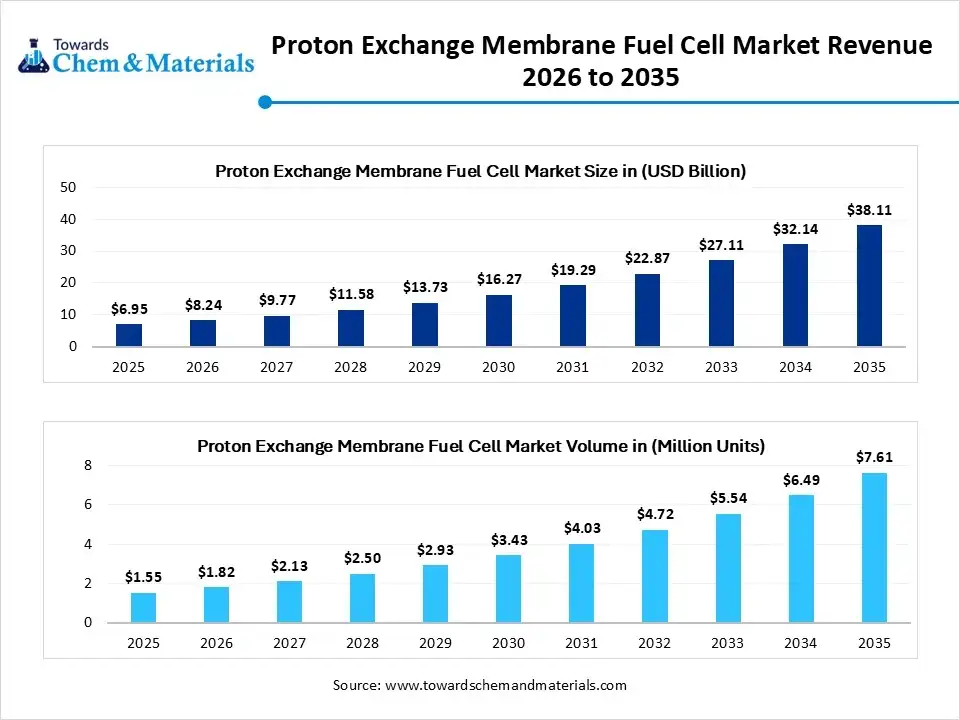
The global proton exchange membrane fuel cell market size was valued at USD 6.95 billion in 2025, is estimated to reach USD 8.24 billion in 2026, and is projected to reach USD 38.11 billion by 2035, growing at a CAGR of 18.55% from 2026 to 2035. In terms of volume, the proton exchange membrane fuel cell industry is projected to grow from 1.55 million units in 2025 to 7.61 million units by 2035, exhibiting a compound annual growth rate (CAGR) of 18.55% over the forecast period from 2026 to 2035. The rising focus on development in the hydrogen ecosystem. Implementation of a clean energy system, decarbonization commitments, and diversified industrial demand are boosting the market growth.
The proton exchange membrane fuel cell is essential for achieving high power density and low-temperature operations that facilitate hydrogen mobility and renewable energy integration. It is a vital component in the development of an integrated hydrogen ecosystem, where the proton exchange membrane functions as a key converter for green hydrogen into clean electricity. The leading player focuses on stack durability and the reduction of total cost of ownership, ensuring supply chain resilience of crucial raw materials. The increased focus on the circular economy and decarbonization makes it crucial for mission-critical transportation, personal vehicles, and transit fleets. The digital integration in proton exchange membrane fuel cells, combined with the development in solid-state hydrogen storage, drives an extension in operational lifecycle and a stable energy management system for data infrastructure.
Growing demand for proton exchange membrane fuel cells drives innovation in catalyst recycling and reduces platinum loading through advancements in thin-film membranes and bipolar plate optimization. The government supports net-zero emission targets that enable the adoption of green energy to meet stringent environmental compliance and carbon neutrality commitments. Emerging economies are concentrating on scaling automated manufacturing processes through venture capital and strategic collaborations, accelerating mass-market commercialization. The PEM fuel cell is utilized in diversified industrial infrastructure, including automotive, stationary power, energy & utilities, aerospace, defense, and residential sectors.
Market Highlights
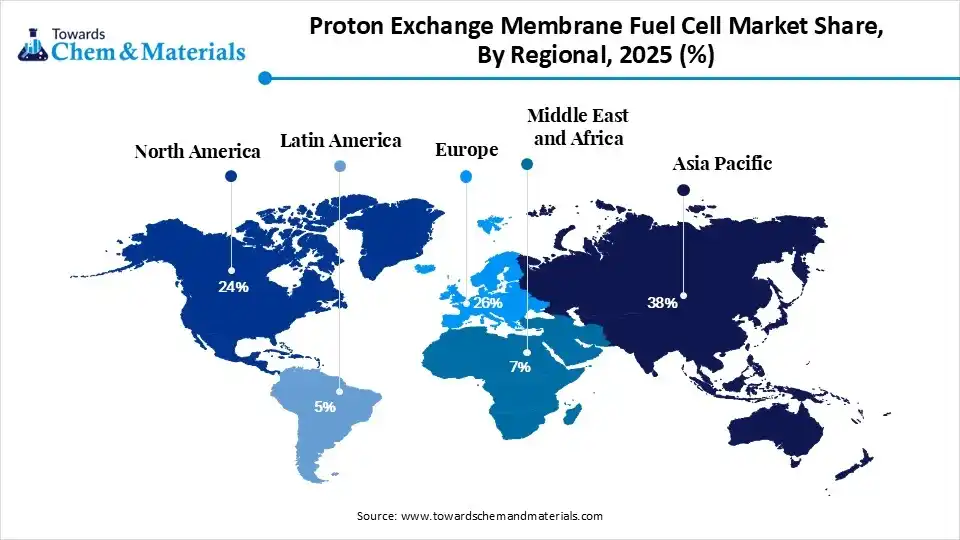
- By region, Asia Pacific dominated the proton exchange membrane fuel cell market by holding a 38% share in 2025 and is expected to grow the fastest with a CAGR of 20.8% during the forecast period due to its strong manufacturing base and government incentives.
- By region, Europe held the 26% market share in 2025 and expects notable growth in the market with 18.20% CAGR during the forecast period, driven by stringent emission standards and deployment of hydrogen strategies.
- By component, the membrane electrode assembly (MEA) segment dominated the market with the largest share of 41% in 2025 and is expected to grow at the fastest CAGR of 19.5% over the forecast period, driven by its improvement in efficiency and advancement in catalyst materials.
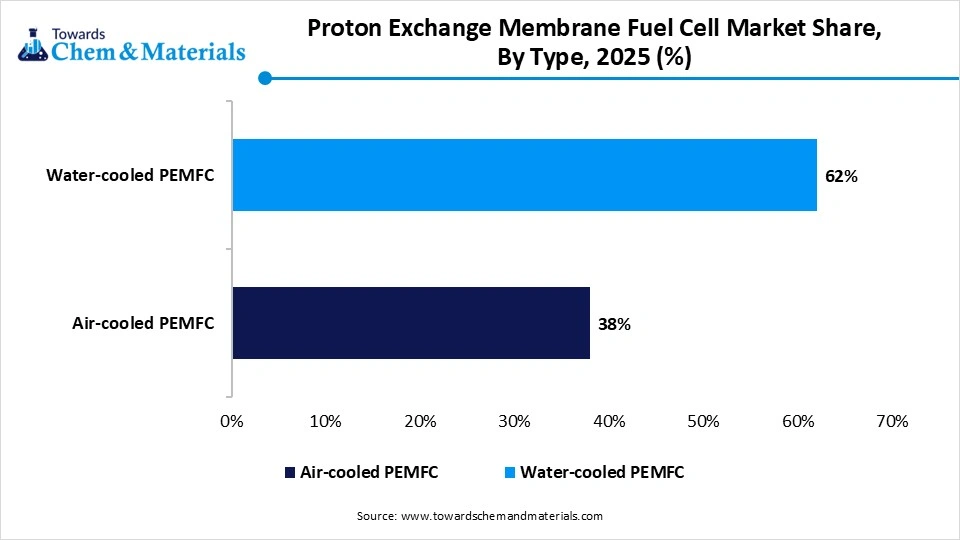
- By type, the water-cooled PEMFC segment dominated the market with the largest share of 62% in 2025 and is expected to grow at the fastest CAGR of 19.3% over the forecast period, driven by its higher thermal management and demand in heavy-duty applications.
- By power output, the above 100kW segment dominated the market with the largest share of 39% in 2025 and is expected to grow at the fastest CAGR of 20.4% over the forecast period, driven by infrastructure investment in hydrogen mobility and large-scale vehicle deployment.
- By application, the transportation segment dominated the market with the largest share of 47% in 2025 and is expected to grow at the fastest CAGR of 21.2% over the forecast period due to the shift towards zero-emission mobility and OEM investment in the hydrogen ecosystem.
- By end-use industry, the automotive segment dominated the market with the largest share of 45% in 2025 and is expected to grow at the fastest CAGR of 21.5% over the forecast period due to OEM partnerships and investment for fuel cell vehicle adoption.
- By hydrogen source, the grey hydrogen segment dominated the market with the largest share of 52% in 2025, driven by its lower production cost and its demand in industrial infrastructure
- By hydrogen source, the green hydrogen segment held 20% market share in 2025 and is expected to grow at the fastest CAGR of 26.3% over the forecast period due to rising integration of renewable energy and the government policies for sustainability.
- By distribution channel, the direct sales segment dominated the market with the largest share of 49% in 2025 due to large-scale projects and customization for long-term stability.
- By distribution channel, the OEM partnership segment held 34% market share in 2025 and is expected to grow at the fastest CAGR of 20.1% over the forecast period, driven by collaboration with OEMs and researchers through integration into vehicle innovation.
Market Size and Volume Forecast
- Market Estimated Size (2025): USD 6.95 Billion | CAGR (2026–2035): 18.55%
- Market Projected Size (2035): USD 38.11 Billion
- Market Volume (2025): 1.55 Million Units | Volume CAGR (2026–2035): 17.25%
- Market Projected Volume (2035): 7.61 Million Units
- Market Pricing (2025):
- Average Manufacturing Price: USD 2,860 per kW
- Average Selling Price: USD 3,760 per kW
- Pricing CAGR (2025–2035): 3.95%
Recent Market Trends
- Rising Fuel Cell Vehicle Development: Growing use of hydrogen-powered vehicles is driving PEM fuel cell demand, which facilitates the adoption of improved membrane and catalyst efficiency, enhancing performance.
- Government Support for Green Hydrogen Projects: Increasing green hydrogen investments are supporting PEM fuel cell market growth. Government subsidies and hydrogen policies are accelerating fuel cell adoption.
Key Technological Shifts and AI in the Proton Exchange Membrane Fuel Cell Market
The integration of AI and advanced systems transformed proton exchange membrane fuel cells into a commercially viable and operationally reliable solution. The technological innovation, boosting material discovery, and the longevity of the manufacturing process are driving the expansion. Machine learning virtually simulates catalyst performance to develop low-platinum membranes.
Advances in carbon capture and storage technology improve the efficiency of proton exchange membrane fuel cell production and improve the viability of this technology. An AI-driven water management and detection system enables peak efficiency and prevents stack degradation. Overall, technological shift lowers production costs, and automated manufacturing results in reduced carbon emissions with upgraded operational efficiency.
Report Scope
| Report Attribute | Details |
| Market Size and Volume in 2026 | USD 8.24 Billion/ 1.82 Million Units |
| Revenue Forecast in 2035 | USD 38.11 Billion/ 7.61 Million Units |
| Growth Rate | CAGR 18.55% |
| Forecast Period | 2026 - 2035 |
| Base Year | 2025 |
| Dominant Region | Asia Pacific |
| Segment Covered | By Component, By Type, By Power Output, By Application, By End-Use Industry, By Hydrogen Source, by distribution channel, and by Regions |
| Key companies profiled | Altergy, AVL, Ballard Power Systems, Cummins Inc., Horizon Fuel Cell Technologies, Intelligent Energy Limited, ITM Power PLC, Nedstack Fuel Cell Technology BV, Plug Power Inc., and PowerCell Sweden AB. |
Supply Chain Analysis of the Proton Exchange Membrane Fuel Cell Market
- Feedstock Procurement and Pre-manufacturing: The key stages of sourcing of platinum-group metals for catalysts and fabrication of specialized membrane components through R&D practices and chemical engineering.
- Key Players: 3M Company, Toray Industries, Chemours, and Johnson Matthey
- System Incorporation and Fuel Cell Stack: The stage of cell transformation into stacks and integration into the membrane electrode assembly and balance of plant components that focus on enhancement of thermal stability, power density, and operation reliability.
- Key Players: SFC Energy, Ballard Power Systems, Horizon Fuel Cell Technology, and Plug Power
- End-Use and Maintenance: The stage of integration of the PEM fuel cell system into the stationary power, transportation, and portable power electronics sector through the hydrogen refueling economy and service sales, maintenance, and technical support.
- Key Players: Doosan Fuel Cell, Toyota, Hyundai Motor, and Cummins
Regulatory Framework: Proton Exchange Membrane Fuel Cell Market
| Region | Key Regulation | Regulatory Focus |
| Asia Pacific | Hydrogen Energy Development Plan, National Green Hydrogen Mission, and H2 Economy Act | Incentives for domestic electrolyser manufacturing, standardizing fuel cell vehicle clusters, and subsidizing refueling infrastructure. Standard for residential mCHP units’ safety |
| North America | Inflation Reduction Act | Lucrative production tax credits and investment credits for hydrogen fuel cells. |
| European Union | European Green Deal and RED III Directive | Strict carbon-pricing and mandatory green hydrogen targets for heavy industry and logistics. |
Proton Exchange Membrane Fuel Cell Market Dynamics
Driver
Focus on Hydrogen Infrastructure Expansion
The market for proton exchange membrane fuel cells is being driven by the government's strong support for decarbonization initiatives, the growing use of hydrogen-powered vehicles, and the growing demand for clean energy solutions. The expansion of hydrogen infrastructure and improvements in fuel cell efficiency are driving market growth. Growing investments in fuel cell-powered trucks, buses, and stationary power systems are also aiding in the market's growth. The transportation and industrial sectors' increasing emphasis on cutting greenhouse gas emissions is driving a steady demand for PEM fuel cell technologies.
Restraints
Complexity and Cost in the Production Process
The platinum catalysts and advanced membrane materials are expensive to produce; the market is constrained. Widespread adoption is also hampered by a lack of infrastructure for hydrogen refueling, as well as difficulties with transportation and storage. Commercialization is further hampered by high initial investment requirements and the absence of standardized hydrogen supply networks in developing nations. Additionally, complicated system integration and durability issues continue to be major obstacles for manufacturers.
Opportunity
Rising Consumer Demand Aligns with Substantial Investment
Significant growth opportunities are created by rising investments in the production of green hydrogen and the growing use of PEM fuel cells in industrial applications, backup power, and renewable energy integration. Market potential will be strengthened by increasing research efforts to lower system costs. It is anticipated that government support for hydrogen economy initiatives and the expansion of hydrogen refueling stations will generate new business prospects. Future market expansion is also being supported by the growing use of clean energy technologies in data centers, marine, and aerospace applications.
Segmental Insights
Component Insights
Proton Exchange Membrane Fuel Cell Market Share, By Component, 2025 (%)
| By Component | Revenue Share, 2025 (%) |
| Membrane Electrode Assembly (MEA) | 41% |
| Bipolar Plates | 24% |
| Fuel Processing System | 15% |
| Balance of Plant (BoP) | 20% |
The Membrane Electrode Assembly (MEA) Segment Dominated the Proton Exchange Membrane Fuel Cell Market with 41% of Market Share in 2025
The membrane electrode assembly (MEA) segment dominated the market with the largest share of 41% in 2025 and is expected to grow at the fastest CAGR of 19.5% over the forecast period, a key component for their electrochemical reliability and stack density. The expansion is facilitated by a shift towards ultra-thin membranes, gas diffusion layers, and nanostructured catalysts with tri-interface optimization by offering operational efficiency. The MEA segment growth is boosted by continuous manufacturing techniques for heavy-duty commercial applications.
The bipolar plates segment held the 24% market share in 2025 and functions as a key manifold system and structural framework of the fuel cell stack for fluid distribution and electrical connectivity. The industry focuses on surface engineering that uses physical vapor deposition and carbon-based coatings due to their superior electrical conductivity and ability to avoid oxidation. Bipolar plates segment transition towards automated leak testing and high-speed precision stamping that drives global stack costs.
The balance of plant (BoP) segment held the 20% market share in 2025. It is a crucial functional ecosystem that provides optimized flows of hydrogen, air, and coolant. The BoP expansion on integrated power modules and smart thermal regulators in automotive-grade reliability and miniaturization is It enhances cost-competitiveness and system-level efficiency by utilizing oil-free compression and high-frequency power electronics in the hydrogen powertrain.
The fuel processing system segment held a 15% market share in 2025, key for alternative fuel integration, balancing the gas conditioning pathway, and hydrogen feedstock to meet strict ISO purity compliances. The fuel processing system utilizes advanced reformers and shift reactors, where PEM fuel cell reformulates that drives endothermic reactions by providing round-trip efficiency. Additionally, the shift towards sulfur-free catalysts and a high-precision filtration module offering operational longevity of the PEM in off-grid and heavy-duty applications
Type Insights
Proton Exchange Membrane Fuel Cell Market Share, By Type, 2025 (%)
| By Type | Revenue Share, 2025 (%) |
| Air-cooled PEMFC | 38% |
| Water-cooled PEMFC | 62% |
Water-Cooled PEMFC Segment Dominated the Proton Exchange Membrane Fuel Cell Market with 62% of Market Share in 2025
The water-cooled PEMFC segment dominated the market with the largest share of 62% in 2025 and is expected to grow at the fastest CAGR of 19.3% over the forecast period. It is a high-performance driven segment that offers thermal resilience and rejection efficiency for maritime propulsion and heavy-duty transit. Water-cooled PEMFC utilizes liquid circuits across large-scale stacks by preventing structural degradation of the membrane. The rising focus on decarbonization enables the evolution of water-cooled types through non-conductive thermal fluids and advanced pump technologies to maximize power density and long-term stack durability.
The air-cooled PEMFC segment held the 38% market share in 2025. It functions as a key lightweight solution for small-scale power and portable systems by discarding a heavy liquid cooling system. The industry focuses on thermal regulation and open-cathode frameworks that are key enablers for UAV propulsion and backup power. The air-cooling PEMFC is advancing in optimized fin geometries and high-flow ventilation to improve heat dissipation, boosting its surge in off-grid energy and micro-mobility.
Power Output Insights
Proton Exchange Membrane Fuel Cell Market Share, By Power Output, 2025 (%)
| By Power Output | Revenue Share, 2025 (%) |
| Below 1 kW | 14% |
| 1 kW – 10 kW | 21% |
| 10 kW – 100 kW | 26% |
| Above 100 kW | 39% |
The Above 100 kW Segment Dominated the Proton Exchange Membrane Fuel Cell Market with 39% of Market Share in 2025
The above 100 kW segment dominated the market with the largest share of 39% in 2025 and is expected to grow at the fastest CAGR of 20.4% over the forecast period, driven by its demand in heavy-duty mobility, especially in maritime shipping, rail transport, and long-haul trucking. This power output offers superior current density and thermal stability by integrating a high-voltage stack. The substantial investment in the hydrogen ecosystem and system modularity makes it key for megawatt-scale applications by maintaining refueling and extension in operational life cycles for transportation & utility scale.
The 10 kW-100 kW segment held a 26% market share in 2025, functioning as a key power output for light-duty logistics and urban transportation. This range is essential for electrifying delivery fleets, passenger SUVs, and transit vans. The rising focus on mass-production scalability enables the utilization of integrated power electronics and standardized stack modules for the commercial fleet to meet zero-emission targets. Additionally, this segment is ensuring reliable and long-range supply to the battery system.
The 1 kW-10 kW segment held the 21% market share in 2025, due to its superior energy density and rapid uptime in residential cogeneration, telecommunication backup, and material handling infrastructure. This segment expansion is boosted by air-cooled simplicity and modular integration to lower the total cost of ownership for residential CHP systems and warehouse fleets. The surge for decentralized energy makes 1 kW-10 kW a zero-emission solution for a consistent power supply and long-distance delivery.
The below 1 kW segment held a 14% market share in 2025, driven by its ability to maintain minimal mass and high specific energy for ultra-portable power applications, especially in man-portable military equipment, extended-stability UAVs, and remote IoT sensors. Below 1 kW offer higher energy-to-weight ratios and fast refueling, which makes them key for resilient and long-lasting power infrastructure. The innovation focuses on integrated cartridge-based hydrogen storage, and automated field operations drive its adoption among non-technical consumers.
Application Insights
Proton Exchange Membrane Fuel Cell Market Share, By Application, 2025 (%)
| By Application | Revenue Share, 2025 (%) |
| Transportation | 47% |
| Stationary Power | 38% |
| Portable Power | 15% |
Transportation Segment Dominated the Proton Exchange Membrane Fuel Cell Market with 47% of Market Share in 2025
The transportation segment dominated the market with the largest share of 47% in 2025 and is expected to grow at the fastest CAGR of 21.2% over the forecast period. The PEM fuel cell is key for long-haul and heavy-duty transportation driven by hydrogen infrastructure. The significant investment in fuel cell electric vehicles and high energy density for marine vessels, passenger vehicles, public transit buses, and material handling trucks is driving the growth. The transportation sector focuses on zero-emission targets and focuses on achieving the total cost of ownership, enabling mass-scale commercialization of PEM fuel cells.
The stationary power segment held the 38% market share in 2025 due to rising focus on reliable electricity and clean alternatives in power infrastructure. The stationary power application focuses on sustainable backup energy solutions and a hydrogen ecosystem to offer operational reliability during grid failures to meet decarbonization targets. As the urban population demands zero-onsite emission and efficient alternatives in the residential and commercial sectors.
The portable power segment held the 15% market share in 2025, functioning as an ultra-compact, grid-independent energy solution for tactical military gear, remote research expeditions, and emergency first responders. The portable power segment focuses on fast recharging and vibration-free technology through innovation in material science to improve ruggedization and miniaturization in military and consumer electronics.
End-Use Industry Insights
Proton Exchange Membrane Fuel Cell Market Share, By End-Use Industry, 2025 (%)
| By End-Use Industry | Revenue Share, 2025 (%) |
| Automotive | 45% |
| Energy & Utilities | 22% |
| Industrial | 14% |
| Residential | 11% |
| Defense | 8% |
The Automotive Segment Dominated the Proton Exchange Membrane Fuel Cell Market with 45% of Market Share in 2025
The automotive segment dominated the market with the largest share of 45% in 2025 and is expected to grow at the fastest CAGR of 21.5% over the forecast period. The PEM fuel cell offers higher payload efficiency and expedited refueling in heavy-duty logistics. The automotive OEM is increasingly investing in platinum catalysts and bipolar plates for mass-production assembly. The automotive shift towards hydrogen-based fleets and decarbonized public transit networks makes PEM fuel cells a commercially viable alternative to meet environmental compliance.
The energy & utilities segment held the 22% market share in 2025, driven by a shift towards decentralized smart grids, where PEM fuel cells offer high-efficiency load balancing and long-term storage. The energy sector focuses on renewable hydrogen and utilities' demand for infrastructure reliability and consistent supply, driving the adoption of PEM fuel cells. The energy & utilities industry is integrating a carbon-neutrality mandate for grid reliability, ensuring green energy output.
The industrial segment held the 14% market share in 2025, due to the industrial demand for PEM fuel cells for hydrogen-powered forklifts and warehouse machinery to achieve higher uptime by preventing lengthy charging cycles. The industrial operation focuses on zero emissions and enhancement in indoor air quality, especially for large-scale distribution and manufacturing facilities. The integration of sustainable energy supports stable supply chains.
The residential segment held 11% market share in 2025, driven by demand for decentralized power through a micro-CHP system. The residential sector focuses on zero emissions, where the PEM fuel cell offers simultaneous heat and electricity and superior thermal efficiency. Additionally, government support for green subsidies and reduction of carbon footprint make PEM fuel cells as key for modern living spaces.
Hydrogen Source Insights
Proton Exchange Membrane Fuel Cell Market Share, By Hydrogen Source, 2025 (%)
| By Hydrogen Source | Revenue Share, 2025 (%) |
| Grey Hydrogen | 52% |
| Blue Hydrogen | 28% |
| Green Hydrogen | 20% |
The Grey Hydrogen Segment Dominated the Proton Exchange Membrane Fuel Cell Market with 52% of Market Share in 2025
The grey hydrogen segment dominated the market with the largest share of 52% in 2025, fueled by its cost-effectiveness for initial infrastructure, which is manufactured through steam methane reforming that ensures high-volume versatility in logistics and industrial sectors. The fuel cell technology integrated with renewable sources makes it key for supply chain resilience and testing system reliability. The grey hydrogen growth accelerated by the shift towards zero-emission and low-carbon hydrogen pathways.
The green hydrogen segment held the 20% market share in 2025 and is expected to grow at the fastest CAGR of 26.3% over the forecast period. This hydrogen source offer purely carbon-neutral energy cycle by utilizing electrolysis to remove reliance on fossil fuels to meet stringent environmental compliance. With the increasing requirement for long-haul shipping and decarbonizing heavy industries, green hydrogen acts as a premium alternative for clean energy transition, supported by policy incentives.
The blue hydrogen segment held the 28% market share in 2025. It serves as a combination of large-scale manufacturing with carbon capture technology by maintain decarbonization profile. Blue hydrogen is a low-carbon feedstock that offers cost-effectiveness by utilizing existing energy infrastructure to boost green capacity expansion and economic viability. This segment growth is supported by demand for scalable transition fuel in heavy-duty fleets.
Distribution Channel Insights
Proton Exchange Membrane Fuel Cell Market Share, By Distribution Channel, 2025 (%)
| By Distribution Channel | Revenue Share, 2025 (%) |
| Direct Sales | 49% |
| OEM Partnerships | 34% |
| Distributors | 17% |
Direct Sales Segment Dominated the Proton Exchange Membrane Fuel Cell Market with 49% of Market Share in 2025
The direct sales segment dominated the market with the largest share of 49% in 2025. This distribution channel is key for manufacturers and large-scale industrial clients that offer tailored maintenance packages, custom-engineered solution and technical support. The direct sales strengthen brand loyalty and allow collaborative innovation crucial for high-stakes sectors, and allows manufacturer to refine fuel-cell technology.
The OEM partnerships segment held the 34% market share in 2025 and is expected to grow at the fastest CAGR of 20.1% over the forecast period. The growth is driven by increasing focus on the standardization of hydrogen power and experimental technology in road-ready applications. The OEM is embedding fuel cell stacks into the vehicle assembly line to achieve scalability through strategic partnerships. The OEM partnership enables cost reduction and leveraging brand authority across logistics and industrial infrastructure.
The distributors segment held the 17% market share in 2025, providing geographic reach and on-the-ground support. The distributors maintain domestic inventory and technical support in smaller enterprises and remote operations. By ensuring regional compliance and after-sales maintenance, we allow manufacturers to build a reliable and optimized energy ecosystem.
Regional Insights
How Did the Asia Pacific Dominated the Proton Exchange Membrane Fuel Cell Market in 2025?
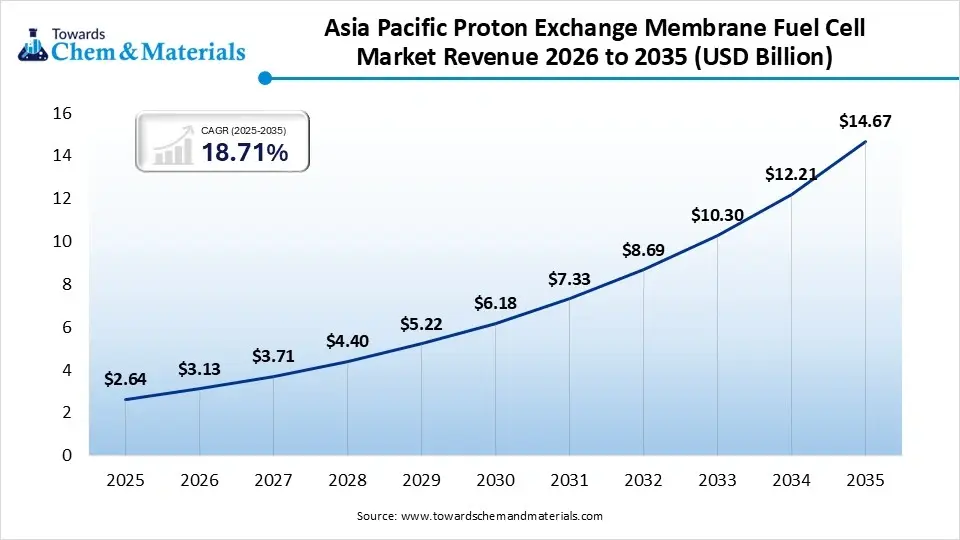
The Asia Pacific proton exchange membrane fuel cell market size was estimated at USD 2.64 billion in 2025 and is projected to reach USD 14.67 billion by 2035, growing at a CAGR of 18.71% from 2026 to 2035. Asia Pacific dominated the market by holding 38% share in 2025 and is expected to grow at the fastest with a CAGR of 20.8% during the forecast period. The regional growth is accelerated by substantial investment and massive industrial infrastructure. Asia Pacific dominates in commercializing hydrogen mobility and high-volume manufacturing. The region is integrating fuel cells into utility-scale storage and transit for PEM fuel cell durability. Asia Pacific shift towards self-sufficiency and ecosystem development to meet decarbonization commitments.
India Proton Exchange Membrane Fuel Cell Market Growth Trends
India is an emerging market for proton exchange fuel cell that, driven by the domestic green hydrogen mission. The country prefers decarbonization in heavy-duty transportation, that make them key export hub for fuel cell technology and green fuel. India gains momentum through public-private partnership for hydrogen refueling infrastructure and low-cost renewable energy that strengthen region leadership.
Europe held the 26% market share in 2025 and expects notable growth in the market with 18.20% CAGR during the forecast period. The regional expansion is accelerated by their stringent regulatory compliance and strict carbon-pricing mechanisms. Europe focuses on decarbonization in long-haul trucking, heavy-duty rail, and maritime shipping. The deployment of industrial-scale electrolyzers and an integrated energy hub make Europe a resilient, zero-emission hydrogen pillar in the market.
Germany Proton Exchange Membrane Fuel Cell Market Growth Trends
Germany witnessed significant growth in the market due to its transition towards a hydrogen-based economy and the country's focus on decarbonization of heavy-duty transit. The advancement of large-scale stationary power through a national hydrogen strategy makes Germany a key region for innovation-driven energy solutions and zero-emission technology.
Proton Exchange Membrane Fuel Cell Market Share, By Regional, 2025 (%)
| Regional | Revenue Share, 2025 (%) |
| North America | 24% |
| Europe | 26% |
| Asia-Pacific | 38% |
| Latin America | 5% |
| Middle East & Africa | 7% |
Recent Developments
- In May 2026, Ballard Power Systems announced partnerships with Solaris for the integration of Ballard's FCmove® SC hydrogen fuel cell engine to power its next-generation hydrogen bus platform. FCmove® SC engine offers high efficiency, extended durability, and reduce total cost of ownership for transit operators.(Source: www.prnewswire.com)
- In November 2025, SAMSUNG E&A and Nel hydrogen launched Compass H2-P, that offer high-pressure and ultra-pure hydrogen. It is the first 100MW PEM-based green hydrogen solution that decrease plant footprint by innovative architecture.(Source: www.samsungena.com)
Top Companies in the Market
- Altergy
- AVL
- Ballard Power Systems
- Cummins Inc.
- Horizon Fuel Cell Technologies
- Intelligent Energy Limited
- ITM Power PLC
- Nedstack Fuel Cell Technology BV
- Plug Power Inc.
- PowerCell Sweden AB
Segment Covered in the Report
By Component
- Membrane Electrode Assembly (MEA)
- Proton Exchange Membrane
- Catalyst Layer
- Gas Diffusion Layer
- Bipolar Plates
- Graphite Plates
- Metal Plates
- Fuel Processing System
- Reformer Units
- Hydrogen Purification Systems
- Balance of Plant (BoP)
- Pumps & Compressors
- Humidifiers
- Cooling Systems
By Type
- Air-cooled PEMFC
- Water-cooled PEMFC
By Power Output
- Below 1 kW
- Portable Power Systems
- 1 kW-10 kW
- Residential CHP Systems
- 10 kW-100 kW
- Commercial Systems
- Above 100 kW
- Transportation & Utility Scale
By Application
- Transportation
- Passenger Vehicles
- Commercial Vehicles
- Buses
- Material Handling Vehicles
- Stationary Power
- Residential CHP
- Commercial CHP
- Backup Power
- Portable Power
- Military Applications
- Consumer Electronics
By End-Use Industry
- Automotive
- Energy & Utilities
- Industrial
- Residential
- Defense
By Hydrogen Source
- Green Hydrogen
- Blue Hydrogen
- Grey Hydrogen
By Distribution Channel
- Direct Sales
- OEM Partnerships
- Distributors
By Regions
- North America
- U.S.
- Canada
- Mexico
- Europe
- Germany
- UK
- France
- Italy
- Spain
- Asia Pacific
- China
- India
- Japan
- South Korea
- Latin America
- Brazil
- Argentina
- Middle East & Africa
- Saudi Arabia
- South Africa
FAQ's
Question 1 : What exactly does a PEM fuel cell do?
Answer : It is a device that converts the chemical energy of hydrogen directly into electricity. It uses a special solid polymer membrane as an electrolyte. Its main advantage is that it operates at relatively low temperatures and can start up very quickly.
Question 2 : Is the hydrogen used in these fuel cells green?
Answer : Currently, about 52% of the market uses \"grey\" hydrogen (made from natural gas), but green hydrogen—made using renewable energy is the fastest-growing segment. It is expected to grow at a CAGR of 26.3% as we build more wind and solar farms.
Question 3 : Why are PEM fuel cells better for trucks than batteries?
Answer : Batteries for a semi-truck are incredibly heavy and take hours to charge. A PEM fuel cell system is much lighter, allowing for more cargo, and can be refueled in minutes, just like a diesel truck.
Question 4 : Who are the biggest players in this market?
Answer : Top companies include Ballard Power Systems, Plug Power, Cummins, and Toyota. These companies are focusing on making the stacks more durable and reducing the amount of expensive platinum needed in the catalysts.
Question 5 : Are PEM fuel cells used for anything besides cars?
Answer : Yes! They are used for stationary power (like backup generators for hospitals or data centers) and portable power for military equipment or remote research stations where the power grid doesn\'t reach.
Meet the Team

Saurabh Bidwai
Principal Consultant
Saurabh Bidwai, a B.Tech Chemical Engineering graduate with 4+ years of experience, specializes in specialty chemicals, commodity chemicals, and engineered materials, offering valuable insights into market trends and emerging opportunities.

Aditi Shivarkar
Reviewed By
Aditi Shivarkar, with 14+ years in Chemical and Materials market research, specializes in Chemical and Materials. She ensures accurate, actionable insights, driving Towards Chemicals And Materials Analytics and Consulting excellence in industry trends and sustainability.