
Shape Memory Materials Market Size, Share, Growth, Report 2026 to 2035
The global shape memory materials market report Segmented By Alloy Type (Nitinol, Copper-based Alloys, Nickel-based Alloys, Niobium, Stainless Steel, Other Alloy Types), By Polymer Type (Polyethylene Terephthalate, Polyurethane Films, Polyethylene, Nylon, Polypropylene, Other Polymer Types), By Application (Actuators, Stent, Transducers, Surgical Fixation and Other Medical Applications, Clothing, Valves, Other Applications), By End-User Industry (Healthcare & Medical, Aerospace & Defense, Automotive, Electronics & Semiconductor, Industrial Manufacturing, Others)-Global Industry Analysis, Size, Trends, Leading Companies, Regional Outlook, and Forecast 2026 to 2035
Content
What is the current Shape Memory Materials Market Size and Share?
The global shape memory materials market size was valued at USD 18.85 billion in 2025, is estimated to reach USD 21.22 billion in 2026, and is projected to reach USD 61.48 billion by 2035, exhibiting a compound annual growth rate (CAGR) of 12.55% over the forecast period from 2026 to 2035. North America dominated the shape memory materials market with the largest revenue share of 34% in 2025 and is expected to grow at the fastest CAGR of 12.71% during the forecast period. In terms of volume, the shape memory materials industry is projected to grow from 429.25 thousand tons in 2025 to 1,228.74 thousand tons by 2035. growing at a CAGR of 11.09% from 2026 to 2035.Increasing demand for minimally invasive surgeries is the key factor driving market growth. Also, ongoing innovations in aerospace and defence, coupled with the surge in consumer electronics integration, can fuel market growth further.
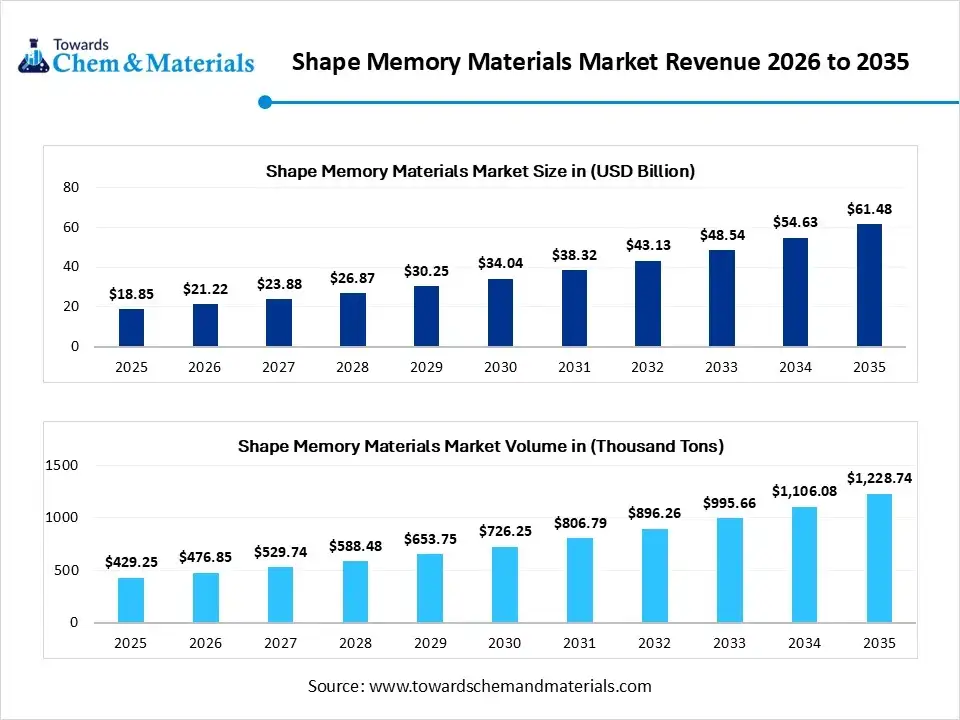
The market includes the global sector surrounding innovative, stimulus-responsive materials that can be deformed and later revert to their pre-programmed and original shape when triggered by an external stimulus such as light, heat, or a magnetic field. The market includes intermediate components such as sheets, wires, and tubes, raw materials, and specialized end-use applications.
The transition toward eco-friendly alternatives is accelerating the advancement of biodegradable shape memory polymers, creating new opportunities for industrial growth. As many sectors investigate the capabilities of these materials, the market is well-positioned for expansion. Continuous research and development are anticipated to produce novel applications and enhanced material characteristics. Hence, the market is on a steady growth trajectory, driven by innovation and a strong emphasis on sustainability.
Market Highlights
- By region, North America dominated the market with the largest share of 34.00% in 2025. The dominance of the region can be attributed to the aerospace innovations boosting smart implant adoption.
- By region, Asia Pacific is expected to grow at the fastest CAGR of 14.42% over the forecast period. The growth of the region can be credited to the rapid urbanisation and increasing investments in smart manufacturing.
- By alloy type, the nitinol segment dominated the market with the largest share of 46.00% in 2025. The dominance of the segment can be attributed to the increasing use of superelastic materials.
- By alloy type, the niobium segment is expected to grow at the fastest CAGR of 13.46% over the forecast period. The growth of the segment can be credited to the ongoing research in advanced biomedical fields.
- By polymer type, the polyurethane films segment dominated the market with the largest share of 31.00% in 2025. The dominance of the segment is owing to the increasing demand for adaptive films.
- By polymer type, the other polymer types segment is expected to grow at the fastest CAGR of 13.88% over the forecast period. The growth of the segment is due to the increase in research funding supporting innovation.
- By application, the stent segment dominated the market with the largest share of 26.00% in 2025. The dominance of the segment can be driven by the growing prevalence of cardiovascular diseases.
- By application, the other applications segment is expected to grow at the fastest CAGR of 14.06% during the forecast period. The growth of the segment is owing to the increasing adoption of adaptive smart materials.
- By end-use industry, the healthcare & medical segment dominated the market with the largest share of 38.00% in 2025. The dominance of the segment can be credited to healthcare innovation supporting the adoption of biocompatible smart materials.
- By end-use industry, the electronics & semiconductor segment is expected to grow at the fastest CAGR of 13.18% during the projected period. The growth of the segment can be linked to semiconductor innovations.
Market Trends
- The growing product adoption in the healthcare sector is the latest trend in the market, shaping positive market growth. This sector is rapidly using shape memory materials for applications like surgical tools and stents. These materials give unique properties that improve patient outcomes.
- The growing emphasis on sustainability and energy efficiency is likely to create new avenues in the market. These materials provide unique properties that can contribute to energy-saving solutions in different applications, such as energy harvesting devices and HVAC systems.
- The growing need for consumer electronics is another major factor driving market expansion. Shape memory materials, particularly nickel-titanium, are crucial for miniaturized devices because of their capability to change shape in response to temperature or electrical signals.
Report Scope
| Report Attribute | Details |
| Market Size and Volume in 2026 | USD 21.22 Billion/ 476.85 Thousand Tons |
| Revenue Forecast in 2035 | USD 61.48 Billion/ 1,228.74 Thousand Tons |
| Growth Rate | CAGR 12.55% |
| Forecast Period | 2026 - 2035 |
| Base Year | 2025 |
| Dominant Region | Asia Pacific |
| Segment Covered | By Alloy Type, By Polymer Type, By Application, By End-User Industry, By Regions |
| Key companies profiled | Furukawa Electric Co., Ltd., Johnson Matthey, Nippon Seisen Co., Ltd., Nippon Steel Corporation, SAES Getters, Seabird Metal Material Co., Ltd., Sumitomo Metal Mining Co., Ltd., Allegheny Technologies Incorporated, Fort Wayne Metals |
How Cutting-Edge AI Technologies Are Revolutionizing the Shape Memory Materials Market?
Artificial Intelligence (AI) is revolutionizing the market by propelling new alloy discovery, facilitating manufacturing, and mastering complicated nonlinear material modeling. Furthermore, major research facilities such as CSIRO use AI-guided fabrication for shape memory alloy foils. AI monitors the manufacturing process, reduces flaws, and minimizes overall material waste, leading to market growth soon.
Supply Chain Analysis of the Shape Memory Materials Market
- Feedstock Procurement:It refers to the sourcing and purchasing of the essential raw materials, such as titanium, copper, and polymers, needed to manufacture shape memory materials.
- Major Players: Johnson Matthey, SAES Getters S.p.A.
- Chemical Synthesis and Processing:It includes the formulation, compounding, and production of raw shape memory materials (SMAs) and shape memory polymers (SMPs). It also encompasses precise molecular engineering and thermo-mechanical treatments.
- Major Players: Mitsubishi Chemical Corporation, Johnson Matthey
- Packaging and Labeling:It includes and analyzes how these materials are handled, stored, branded, and delivered to end-use sectors like healthcare, aerospace, and electronics.
- Major Players: SAES Getters, Covestro AG
- Regulatory Compliance and Safety Monitoring:It ensures smart materials such as polymers and Nitinol meet stringent aerospace, health, and industrial standards. It also involves rigorous testing for biocompatibility, fatigue life, and thermal-response limits to prevent structural failures or medical complications.
- Major Players: Covestro, BASF SE
Shape Memory Materials Market's Regulatory Landscape: Global Regulations
| Country/Region | Key Regulations |
| United States | Aerospace & Defense (FAA & DoD): Materials used in aircraft actuation or morphing structures must achieve certification from the Federal Aviation Administration (FAA). Military-grade SMM application falls under ITAR (International Traffic in Arms Regulations) controls, limiting the export of high-performance alloy technology. |
| European Union | Medical Devices (EU MDR 2017/745): The Medical Device Regulation (MDR) classifies any implantable SMM device tightly. Under the MDR, materials containing hazardous or restricted substances over a 0.1% weight-by-weight threshold face heavy justification hurdles. |
| China | The National Medical Products Administration (NMPA) requires all localized or imported SMM medical devices to go through rigorous registration pathways. SMM implants face mandatory clinical trials within China unless comprehensive, equivalent predicate data can be legally proven. |
Market Dynamics
Driver
Surge in Vehicle Production
Increasing vehicle production across the globe is a major factor driving the growth of the market. Shape memory materials, particularly nickel-titanium, give exceptional properties such as high flexibility, strength, and corrosion resistance, which make them crucial for automotive applications. These materials can be used in components like sensors, actuators, and adaptive systems, enhancing vehicle safety and performance. The escalating demand for electric and autonomous vehicles is driving a corresponding surge in the requirement for advanced materials, particularly shape memory materials.
Restraint
Manufacturing Difficulties
Materials such as Nitinol are difficult to machine due to high super elasticity, extreme hardness, and a robust tendency to work-harden during manufacturing, which is the major factor hindering market growth. These results in frequent tool degradation & high material wastage. Moreover, minute deviations in the compositional ratio during fabrication radically shift the material's actuation temperature, hence creating key challenges in achieving consistent multi-lot quality.
Opportunity
Increasing Inclination Towards Robotics and Automation
The market is benefiting from the growing interest in automation and robotics technologies, generating lucrative opportunities in the market. These materials are being used in robotic components and actuators, offering key benefits like lightweight construction and the capability to return to a predetermined shape. Increased manufacturing initiatives aimed at enhancing robotic system efficacy and performance are expected to drive the adoption of shape memory materials, rapidly driving the growth of this market sector.
Segmental Insights
Alloy Type Insights
The nitinol segment dominated the market with the largest share of 46.00% in 2025. The dominance of the segment can be attributed to the increasing use of superelastic materials by medical device manufacturers and the growing adoption of minimally invasive surgical procedures. Also, aerospace firms are extensively deploying lightweight adaptive materials.
The niobium segment held a market share of 8.00% in 2025 and is expected to grow at the fastest CAGR of 13.46% over the forecast period. The growth of the segment can be credited to ongoing research in advanced biomedical fields, boosting niobium material development across the globe. Moreover, high corrosion resistance supports crucial industrial applications.
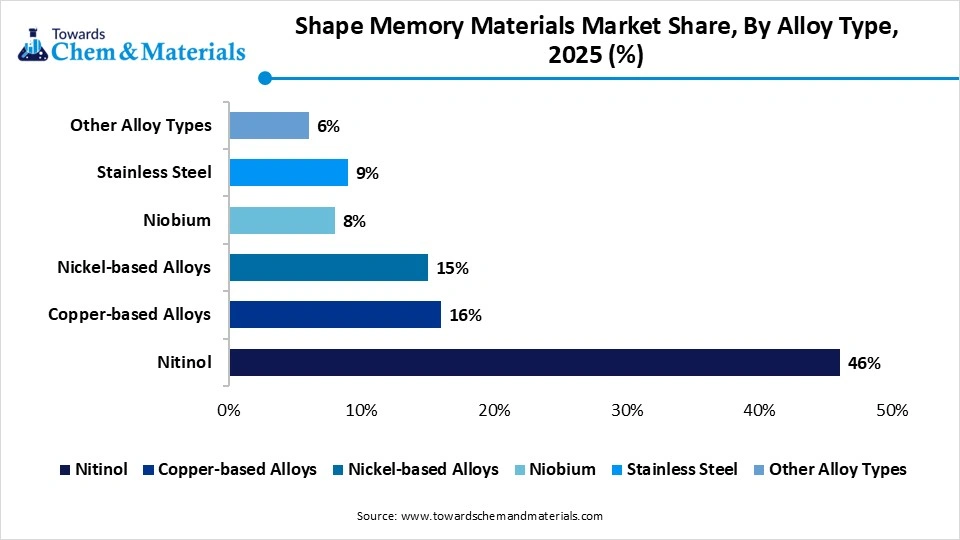
The copper-based alloys segment held a market share of 16.00% in 2025. The growth of the segment is attributed due to the industrial automation systems utilizing affordable memory alloys, along with the manufacturing industries preferring low-cost & durable adaptive materials. Electrical applications support extensive copper alloy integration globally.The nickel-based alloys segment held a market share of 15.00% in 2025. The growth of the segment can be driven by growing demand for nickel-based materials in high-temperature applications and the rapid development of smart actuators. The defense and aerospace sectors are heavily adopting advanced adaptive alloys.
Shape Memory Materials Market Share, By Alloy Type, 2025 (%)
| By Alloy Type | Revenue Share, 2025 (%) |
| Nitinol | 46% |
| Copper-based Alloys | 16% |
| Nickel-based Alloys | 15% |
| Niobium | 8% |
| Stainless Steel | 9% |
| Other Alloy Types | 6% |
Polymer Type Insights
The polyurethane films segment dominated the market with the largest share of 31.00% in 2025. The dominance of the segment is owing to the increasing demand for adaptive films in wearable electronics and the growing polyurethane integration globally. Biomedical applications boost the use of thermally responsive polymers.
The other polymer types segment held a market share of 8.00% in 2025 and is expected to grow at the fastest CAGR of 13.88% over the forecast period. The growth of the segment is due to an increase in research funding supporting innovation in composite memory materials and hybrid smart materials, improving overall multifunctional properties.
The polyethylene terephthalate segment held a market share of 24.00% in 2025.
The growth of the segment can be attributed to growing material demand from packaging and wearable applications, coupled with the surge in PET films adoption. Smart textiles market players are increasingly integrating responsive PET fibers.The polyethylene segment held a market share of 14.00% in 2025. The growth of the segment can be credited to the industrial packaging sector adopting responsive polyethylene solutions and cost-effective processing, encouraging the adoption of commercial polymers. Consumer goods applications are increasing the utilization of adaptive plastics.
Shape Memory Materials Market Share, By Polymer Type, 2025 (%)
| By Polymer Type | Revenue Share, 2025 (%) |
| Polyethylene Terephthalate | 24% |
| Polyurethane Films | 31% |
| Polyethylene | 14% |
| Nylon | 13% |
| Polypropylene | 10% |
| Other Polymer Types | 8% |
Application Insights
The stent segment dominated the market with the largest share of 26.00% in 2025. The growth of the segment is attributed due to the rising prevalence of cardiovascular diseases, accelerating demand for advanced stents around the world, and a significant surge in interventional medical procedures. Nitinol stents enhanced the effectiveness of minimally invasive treatments.
The other applications segment held a market share of 7.00% in 2025 and is expected to grow at the fastest CAGR of 14.06% during the forecast period. The segment’s growth is attributed due to the implementation of adaptive smart materials & developing technologies encouraging latest commercial application advancements. It also combines responsive components into compact devices.
The actuators segment held a market share of 22.00% in 2025. The growth of the segment is due to automation systems increasingly needing adaptive motion control materials, along with the aerospace and automotive sectors deploying compact smart actuators. Energy-efficient actuation technologies are supporting commercial growth.
The surgical fixation and other medical applications segment held a market share of 18.00% in 2025. The growth of the segment can be attributed to the increasing demand for minimally invasive surgical devices and medical innovation, boosting the adoption of smart biomaterials globally.
Shape Memory Materials Market Share, By Application, 2025 (%)
| By Application | Revenue Share, 2025 (%) |
| Actuators | 22% |
| Stent | 26% |
| Transducers | 11% |
| Surgical Fixation and Other Medical Applications | 18% |
| Clothing | 7% |
| Valves | 9% |
| Other Applications | 7% |
End-User Industry Insights
The healthcare & medical segment dominated the market with the largest share of 38.00% in 2025. The dominance of the segment can be credited to healthcare innovation supporting the adoption of biocompatible smart materials and a surge in advanced alloy utilization rates. Medical implants and stents drive material demand across the globe.
The electronics & semiconductor segment held a market share of 12.00% in 2025 and is expected to grow at the fastest CAGR of 13.18% during the projected period. The growth of the segment can be linked to semiconductor innovations supporting advanced material integration across the globe and miniaturized components increasingly requiring flexible, responsive components.
The aerospace & defense segment held a market share of 19.00% in 2025. The growth of the segment can be driven by ongoing defense modernization programs, expanding smart materials integration, and space applications requiring high-performance responsive a material. Aircraft systems are adopting lightweight components.The automotive segment held a market share of 15.00% in 2025.
The growth of the segment is owing to the growing demand for adaptive smart systems and automotive manufacturers focusing on improving efficiency using lightweight materials. Emission control technologies use responsive alloy mechanisms.
Shape Memory Materials Market Share, By End-User Industry, 2025 (%)
| By End-User Industry | Revenue Share, 2025 (%) |
| Healthcare & Medical | 38% |
| Aerospace & Defense | 19% |
| Automotive | 15% |
| Electronics & Semiconductor | 12% |
| Industrial Manufacturing | 11% |
| Others | 5% |
Regional Insights
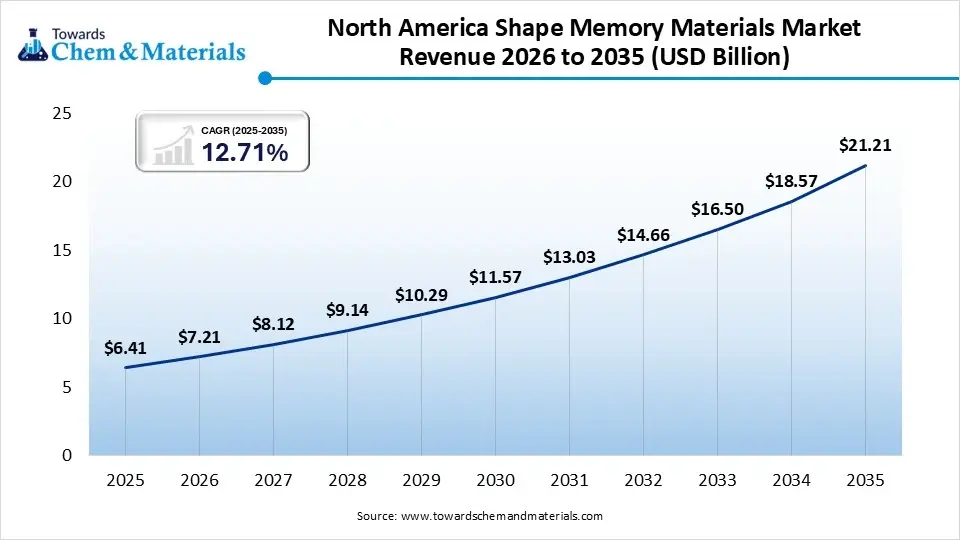
The North America shape memory materials market size was estimated at USD 6.41 billion in 2025 and is projected to reach USD 21.21 billion by 2035, growing at a CAGR of 12.71% from 2026 to 2035.North America dominated the market with the largest share of 34.00% in 2025. The dominance of the region can be attributed to aerospace innovations boosting smart implant adoption and government-funded initiatives supporting advanced alloy development. In addition, major material science companies and FDA-regulated medical device developers are commercialising advanced shape memory polymers and materials.
United States
- SMMs are rapidly being used in the U.S. automotive sector to design lightweight, flexible components that minimize overall vehicle emissions.
- The aging population fuels inelastic and sustained demand for Nitinol and shape memory polymers in minimally invasive procedures.
Canada
- Canada’s strong aerospace sector depends on smart actuators and lightweight structural components that shape memory materials offer.
- There is an increasing demand for responsive, compact materials in advanced robotics and consumer electronics, where shape memory polymers are replacing mechanical and heavier metal alternatives.
The Asia Pacific shape memory materials market size was estimated at USD 5.47 billion in 2025 and is projected to reach USD 18.14 billion by 2035, growing at a CAGR of 12.74% from 2026 to 2035.Asia Pacific held a market share of 29.00% in 2025 and is expected to grow at the fastest CAGR of 14.42% over the forecast period. The growth is attributed due to the rising urbanisation, investments in smart manufacturing, and increasing adoption from the semiconductor & automotive industries. Furthermore, aggressive infrastructure investments, notably within China and India, are driving substantial demand for advanced, resilient smart materials utilized in structural retrofitting and modern construction projects.
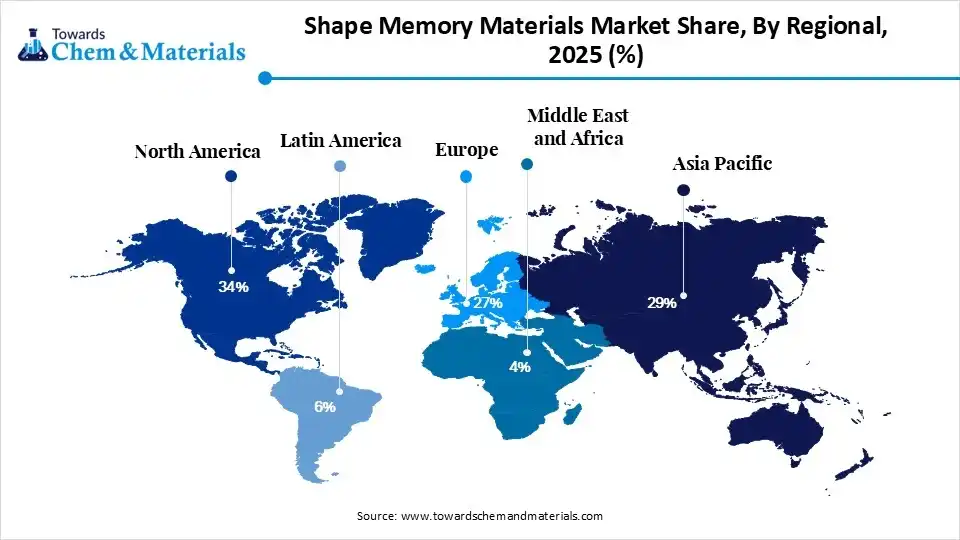
Shape Memory Materials Market Share, By Regional, 2025 (%)
| Regional | Revenue Share, 2025 (%) |
| North America | 34% |
| Europe | 27% |
| Asia-Pacific | 29% |
| Latin America | 6% |
| Middle East & Africa | 4% |
China
- The ongoing aging of the population and technological transfers are fuelling the demand for minimally invasive surgical tools in the country.
- China's aggressive transition toward electric vehicles (EVs) and smart vehicles drives the demand for lightweight, energy-efficient shape memory actuators and smart components.
India
- An expanding healthcare sector, aging population, and rising incidence of cardiac diseases require extensive use of shape memory wires, stents, and tubes.
- An expansion of smart materials in aerospace structures & engine components, due to their high strength and temperature resistance, is driving the market growth.
The Europe shape memory materials market size was estimated at USD 5.09 billion in 2025 and is projected to reach USD 16.91 billion by 2035, growing at a CAGR of 12.76% from 2026 to 2035. The growth of the region can be linked to sustainable initiatives encouraging the adoption of lightweight industrial solutions and a growing need for automotive engineering leadership. Also, the rapid push towards fuel efficiency, lightweight design, and structural durability impels the adoption of SMAs in different structural systems.
Germany
- The healthcare industry is the largest consumer of shape memory materials (like Nitinol) and polymers in Germany.The transition toward lightweight vehicle components and energy efficiency drives the use of shape memory materials.
The Latin America shape memory materials market size was estimated at USD 1.13 billion in 2025 and is projected to reach USD 4.00 billion by 2035, growing at a CAGR of 13.47% from 2026 to 2035.Latin America held a market share of 6.00% in 2025. The growth of the region can be driven by increasing advanced material demand in healthcare infrastructure development, along with government investment encouraging production sector modernization. Moreover, local aerospace firms and production plants are adopting shape memory materials for vibration dampers and actuators to improve system performance.
Brazil
- The demand for high-strength, temperature-adaptive parts in aircraft and electronic manufacturing continues to rise, driving market growth soon.
- Rising use of biocompatible shape memory materials (like Nitinol) in cardiovascular stents, guidewires, and orthodontic wires is leading to further market growth.
Argentina
- Argentina’s aerospace industry depends on shape memory materials for lightweight, long-lasting aircraft components, vibration dampers, and smart structural elements.
The Middle East & Africa shape memory materials market size was estimated at USD 0.75 billion in 2025 and is projected to reach USD 2.77 billion by 2035, growing at a CAGR of 13.96% from 2026 to 2035.The Middle East & Africa held a market share of 4.00% in 2025. The growth of the region is owing to the growing demand for medical devices due to a surge in regional healthcare investments, coupled with infrastructure modernization supporting industrial automation growth. Furthermore, a rise in construction demand and the need for structural reinforcements are fuelling interest in SMMs.
Saudi Arabia
- The Saudi government is heavily reducing its dependence on traditional oil and gas. This has led to massive financial injections into domestic manufacturing.
- The development of localized defense production and rising aerospace capabilities requires lightweight, high-performance smart materials.
UAE
- The UAE’s push to become a regional medical hub is fuelling heavy demand for biocompatible shape memory materials(such as Nitinol) and polymers.
- The increasing adoption of consumer tech and a rising domestic automotive sector is driving the demand for responsive components.
Recent Developments
- In March 2026, the Mondottica Group formally announced the launch of ReForm Eyewear, a proprietary memory optical brand. Engineered with advanced materials, the collection features highly flexible frames designed to revert to their original shape after bending or twisting and is protected by more than 100 global patents. (Source: www.aop.org.uk )
- In February 2026, Porcher Industries (Eclose-Badinières, France) introduced a new suite of multilayer hybrid textiles. Designed for rapid consolidation and complex 3D geometry, this advanced portfolio of high-performance thermoplastic composites (TPC) caters to demanding applications across the automotive, medical, sports, and leisure sectors.(Source: www.compositesworld.com)
Shape Memory Materials Market Companies
- Furukawa Electric Co., Ltd.
- Johnson Matthey
- Nippon Seisen Co., Ltd.
- Nippon Steel Corporation
- SAES Getters
- Seabird Metal Material Co., Ltd.
- Sumitomo Metal Mining Co., Ltd.
- Allegheny Technologies Incorporated
- Fort Wayne Metals
Segments Covered in the Report
By Alloy Type
- Nitinol
- Medical Grade Nitinol
- Industrial Grade Nitinol
- Copper-based Alloys
- Copper-Aluminum-Nickel
- Copper-Zinc-Aluminum
- Nickel-based Alloys
- Nickel-Titanium-Hafnium
- Nickel-Manganese-Gallium
- Niobium
- Niobium-Titanium
- Niobium-Based Superelastic Materials
- Stainless Steel
- Austenitic Stainless Steel
- Precipitation Hardened Stainless Steel
- Other Alloy Types
- Iron-based Shape Memory Alloys
- Hybrid Shape Memory Composites
By Polymer Type
- Polyethylene Terephthalate
- Smart PET Fibers
- PET Films
- Polyurethane Films
- Thermally Responsive Polyurethane
- Biomedical Polyurethane Films
- Polyethylene
- High-density Polyethylene
- Low-density Polyethylene
- Nylon
- Nylon 6
- Nylon 66
- Polypropylene
- Medical Grade Polypropylene
- Industrial Polypropylene
- Other Polymer Types
- Polylactic Acid
- Epoxy-based Shape Memory Polymers
By Application
- Actuators
- Aerospace Actuators
- Automotive Actuators
- Stent
- Cardiovascular Stents
- Neurovascular Stents
- Transducers
- Pressure Transducers
- Thermal Transducers
- Surgical Fixation and Other Medical Applications
- Orthopedic Implants
- Surgical Instruments
- Clothing
- Smart Textiles
- Sportswear Applications
- Valves
- Fluid Control Valves
- Aerospace Valves
- Other Applications
- Robotics
- Consumer Electronics
By End-User Industry
- Healthcare & Medical
- Implants
- Surgical Devices
- Drug Delivery Systems
- Aerospace & Defense
- Aircraft Systems
- Space Applications
- Automotive
- Adaptive Components
- Emission Control Systems
- Electronics & Semiconductor
- Sensors
- MEMS Devices
- Industrial Manufacturing
- Automation Equipment
- Smart Machinery
- Others
- Energy
- Consumer Goods
By Regional
- North America
- U.S.
- Canada
- Mexico
- Europe
- UK
- Germany
- France
- Italy
- Spain
- Sweden
- Denmark
- Norway
- Asia Pacific
- Japan
- China
- India
- Australia
- South Korea
- Thailand
- Latin America
- Brazil
- Argentina
- The Middle East and Africa
- South Africa
- Saudi Arabia
- UAE
- Kuwait
FAQ's
Question 1 : What is the current size of the Shape Memory Materials market?
Answer : The Shape Memory Materials market was valued at USD 18.85 billion in 2025 and is projected to reach USD 61.48 billion by 2035.
Question 2 : What is the CAGR of the Shape Memory Materials market?
Answer : The market is expected to grow at a CAGR of 12.55% from 2026 to 2035.
Question 3 : How is AI influencing the Shape Memory Materials industry?
Answer : AI is improving alloy discovery, reducing manufacturing defects, and optimizing material performance for industrial and medical applications.
Question 4 : What are the major applications of Shape Memory Materials?
Answer : Major applications include stents, actuators, surgical devices, transducers, valves, and smart textiles.
Question 5 : Which region dominates the Shape Memory Materials market?
Answer : North America dominated the market in 2025 with a 34% revenue share.
Meet the Team

Saurabh Bidwai
Principal Consultant
Saurabh Bidwai, a B.Tech Chemical Engineering graduate with 4+ years of experience, specializes in specialty chemicals, commodity chemicals, and engineered materials, offering valuable insights into market trends and emerging opportunities.

Aditi Shivarkar
Reviewed By
Aditi Shivarkar, with 14+ years in Chemical and Materials market research, specializes in Chemical and Materials. She ensures accurate, actionable insights, driving Towards Chemicals And Materials Analytics and Consulting excellence in industry trends and sustainability.