
Silicon Carbide Fibers Market Size, Share & Trends Analysis Report by 2026-2035
The global silicon carbide fibers market size is expected to grow from USD 2.34 billion in 2026 to USD 19.46 billion in 2035, growing at a CAGR of 26.53% from 2026 to 2035. The top key players in the market are NGS Advanced Fiber, Ube Industries, BJS Ceramic GmbH, SGL Carbon, Toyobo Co., Ltd., U.S. Specialty Materials (USSM), CeramTec, 3M, H.C. Starck, Nippon Carbon Co., Ltd., GE Aviation, Dow Chemical (Dow Inc.), Applied Materials-Global Forecast 2026 To 2035
Content
Silicon Carbide Fibers Market Size and Forecast 2026 - 2035
The global silicon carbide fibers market size was estimated at USD 1.85 billion in 2025 and is expected to increase from USD 2.34 billion in 2026 to USD 19.46 billion by 2035, growing at a CAGR of 26.53% from 2026 to 2035. Asia Pacific dominated the silicon carbide fibers market with the largest revenue share of 54.00% in 2025.The expansion is fueled by technological advancement, government initiatives, automotive electrification and industrial applications. Silicon Carbide (SiC) fibers represents advanced ceramics known for their ability to retain mechanical strength and oxidative stability at high temperatures, essential for modern propulsion systems and hypersonic vehicles. Market growth is driven by efforts to improve thermal efficiency and sustainability, and by the replacement of heavy alloys with lightweight SiC to enable cleaner combustion. Its excellent chemical inertness and radiation tolerance are suitable for the nuclear and semiconductor sectors. Additionally, investment and innovation needs for high- purity structures are driving the expansion of the market.

Market Highlights
- The North America dominated silicon carbide fibers market with the largest revenue share of 54.00% in 2025, due to its technological innovation, collaboration and strong government support.
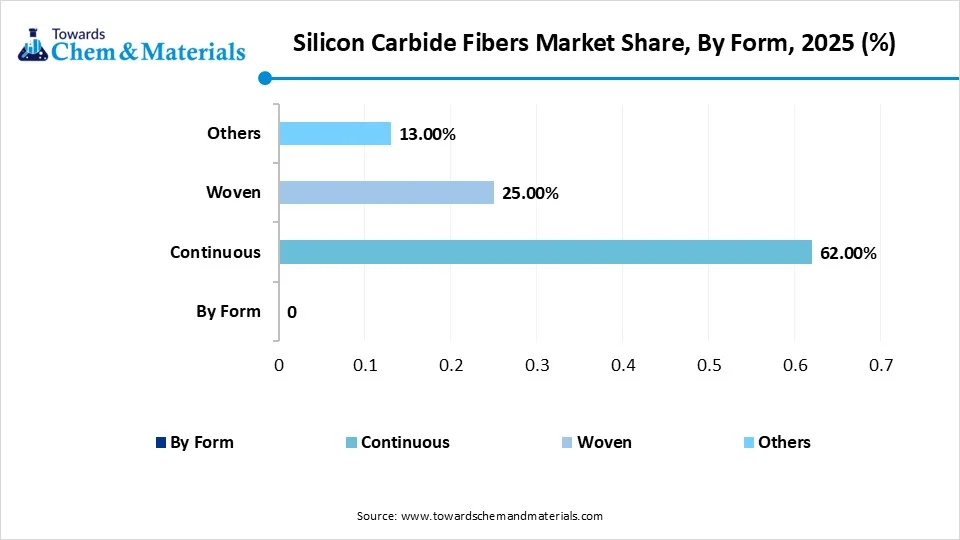
- By form, the continuous segment dominated the market and accounted for the largest revenue share of 62.00% in 2025, due to its reinforcement architecture and its oxidative resistance.
- By form, the woven segment is expected to grow at the fastest CAGR during the forecast period due to its multidirectional strength and demand for near-net-shape manufacturing.
- By usage, the composite segment led the market with the largest revenue share of 79.00% in 2025, driven by its improved fracture durability and its applicational demand.
- By end-use, the aerospace and defense segment dominated the market and accounted for the largest revenue share of 46.00% in 2025, due to a rapid shift towards propulsion efficiency and thermal stability in advanced combat systems.
- By end-use, the defense thermal protection systems (TPS) segment is anticipated to grow at the fastest CAGR in the market during the forecast period due to its ability in heat shields and refractory endurance.
Key Technological Shifts and AI in the Silicon Carbide Fibers Market
- Technological development and AI are transforming the market from traditional to a digital ecosystem with precision. The revolution is defined by machine learning, which optimizes polymer pyrolysis, precursor chemistry, and microstructure integrity.
- AI-powered modelling offers stress simulation and real-time defection by reducing R&D time for third-generation crystalline fibers. The integration of automated sensors and neural networks improves consistency in batches and yields, meeting safety standards for advanced propulsion and modern reactors.
Trade Analysis of the Silicon Carbide Fibers Market: Import and Export Statistics
- Japan exported 562 shipments of silicon carbide fibers.
- China exported 216 shipments of silicon carbide fibers.
- The United States exported 46 shipments of silicon carbide fibers.
- From July 2024 to June 2025, the world exported 387 shipments of silicon carbide fibers.
Market Trends
- Focus on Eco-Friendly Coatings: The surge in integrated fiber and coating solutions that focus on the development of environmental barrier coatings to protect SiC fibers from water vapor, ensuring long-term industrial reliability.
- Stringent Aviation Regulatory Framework: The tightened global aviation standards are pushing the adoption of SiC reinforced ceramic matrix composites to achieve weight reduction in air mobility.
- Decarbonization and Innovation: The rising use of heat exchangers and gas turbines to improve fuel efficiency in chemical synthesis and green energy infrastructure is driving the trend and fostering innovation in accident-tolerant fuel cladding for nuclear reactors.
Report Scope
| Report Attribute | Details |
| Market Size in 2026 | USD 2.34 Billion |
| Revenue Forecast in 2035 | USD 19.46 Billion |
| Growth Rate | CAGR 26.53% |
| Forecast Period | 2026 - 2035 |
| Base Year | 2025 |
| Dominant Region | Asia Pacific |
| Segment Covered | By Form, By Usage, By End Use, By Region |
| Key companies profiled | NGS Advanced Fiber, Ube Industries, BJS Ceramic GmbH, SGL Carbon, Toyobo Co., Ltd., U.S. Specialty Materials (USSM), CeramTec, 3M, H.C. Starck, Nippon Carbon Co., Ltd., GE Aviation, Dow Chemical (Dow Inc.), Applied Materials |
Silicon Carbide Fibers Market: Supply Chain Analysis
- Chemical Precursor Synthesis: The initial stage of synthesis of organometallic polymers and polycarbosilane using pyrolysis without compromising structural integrity and purity.
- Key Players: Ube Industries, Tisics, Shin-Etsu Chemical and Starfire Systems.
- SiC Fiber Processing and Manufacturing: The stage where the chemical precursor is transformed into a solid ceramic filament using melt spinning, electron-beam curing and thermal treatment at high temperature to form the final SiC fiber that defines the generation of fiber.
- Key Players: NGS Advanced Fiber, BJS Ceramics, GE Aerospace, Ube Industries and Free Form Fibers
- CMC Fabrication and Industrial Integration: The last stage SiC fibers into a ceramic matrix to create ceramic matrix composites using chemical vapor infiltration to form the final rigid component.
- Key Players: Rolls-Royce, Safran Group, Lockheed Martin & Raytheon, Kratos Defense and Westinghouse Electric Company
Regulatory Framework: Silicon Carbide Fibers Market
| Region | Key Regulation | Regulatory Focus |
| Global | Wassenaar Arrangement, OSHA/ECHA/NIOSH | Global limits of high-modulus, high-tensile SiC fibers that focus on preventing the transfer of Gen III fibers to restrict the development of advanced missile and nuclear technology. |
| North America | ITAR (International Traffic in Arms) and EAR, NRC (Nuclear Regulatory Commission) | Strict controls fibers used in military engine components and airframes. Regulations focus on end-user verification and the safety of SiC fibers used in accident-tolerant fuel. |
| European Union | REACH Regulation (ECHA) | Standard for chemical and polycarbosilane precursor safety, focusing on the environmental impact of VOCs during manufacturing. |
| Asia Pacific | METI (Foreign Exchange and Foreign Trade Act), Export Control Law | Strict regulations for the restriction of the export of specialized spinnerets and CVD equipment, and resource and supply chain security, especially for raw silicon-carbon feedstock. |
Segmental Insights
Form Insights
Why the Continuous Segment Dominates the Silicon Carbide Fibers Market?
The continuous segment dominated the market share 62.00% in 2025, crucial for high-performance ceramic matrix composites (CMCs), acting as reinforcement that can be woven textiles for strength and damage tolerance in hot-section components. The segment expansion is driven by ultra-high-temperature gas turbines and hypersonic platforms, where fibers offer low creep and oxidative resistance. The growth is fueled by advancements in precursor chemistry and spinning techniques to reduce processing costs and provide structural consistency in masterbatches.
The woven segment is the fastest-growing in the market during the forecast period. because it creates a textile framework that connects raw materials to value-added structural parts, providing multidirectional strength and fracture toughness for parts exposed to mechanical vibrations and thermal gradients. It demands technical precision in coating and infiltration. The segment focus is on near-net-shape manufacturing to minimise waste and machining time, making it indispensable for impact- resistant and reliable hypersonic airframes and advanced turbines driven by the transition towards automated manufacturing.
Silicon Carbide Fibers Market Share, By Form, 2025 (%)
| By Form | Revenue Share, 2025 (%) |
| Continuous | 62.00% |
| Woven | 25.00% |
| Others | 13.00% |
- Continuous – Dominating with a 62.00% share, superior strength, high thermal resistance, and extensive use in aerospace and defense applications drive strong market preference.
- Woven – With a 25.00% share, enhanced flexibility and suitability for composite structures support steady demand across industrial applications.
- Others – Holding a 13.00% share, niche forms contribute to specialized applications, but limited scalability restricts broader market dominance.
Usage Insights
How did the Composite Segment hold the Largest Share in the Silicon Carbide Fibers Market?
The composite segment held the largest revenue share in the market share 79.00% in 2025. It embeds silicon carbide fibers in a matrix to create high-performance ceramic matrix composites that offer improved fracture durability through crack- bridging. These composites enable weight reduction and higher push- to- weight ratios in aerospace propulsion and hypersonic systems, enabling stability and resistance at high temperatures. Additionally, it utilized in accident-tolerant fuels and hot-section components, interfacial coatings and densification.
The non-composites segment is experiencing the fastest growth in the market during the forecast period. known for their elemental properties, such as refractory insulation and chemical resistance. They are essential in filtration, especially for molten metals and corrosive gases. The non-composites show radiation tolerance and high-purity, ensuring their demand in semiconductor shielding, thermal blankets and kiln furniture. This segment focuses on fibers as heat- stable barriers that provide stability and dielectric strength without degradation.
Silicon Carbide Fibers Market Share, By Usage, 2025 (%)
| By Usage | Revenue Share, 2025 (%) |
| Composite | 79.00% |
| Non-composites | 21.00% |
- Composite – Dominating with a 79.00% share, extensive use in high-performance aerospace, defense, and energy applications due to superior strength-to-weight ratio and thermal resistance drives overwhelming demand.
- Non-composites – With a 21.00% share, niche applications in specialized industrial uses support moderate demand, but limited versatility and lower adoption restrict market dominance.
End Use Insights
Which Application Dominated the Silicon Carbide Fibers Market?
The aerospace and defense segment dominated the market share 46.00% in 2025, driven by a shift of propulsion efficiency and thermal stability, is leveraging fibers’ specific strength and refractory stability for ceramic matrix composites in high- pressure turbines and hypersonic airframes. This material has the ability to enable hotter engine operation, improving efficiency and sustainability while supporting stealth and impact toughness for advanced combat systems and defense assets.
The defense thermal protection systems (TPS) segment is anticipated to grow fastest in the market during the forecast period. It uses silicon carbide fibers for heat shields and aero- structural components in harsh flight regimes. They ensure shape stability and refractory endurance for hypersonic missiles and glide vehicles, offering precision, reusable protection, and a non-ablative surface that withstands thermal shock and plasma environments. Overall, the segment boosts payload productivity, lightweight survivability and manoeuvrability in this application.
Silicon Carbide Fibers Market Share, By End Use, 2025 (%)
| End Use | Revenue Share, 2025 (%) |
| Aerospace & Defense | 46.00% |
| Defense Thermal Protection Systems (TPS) | 20.00% |
| Energy & Power | 14.00% |
| Industrial | 9.00% |
| Others | 11.00% |
- Aerospace & Defense – Dominating with a 46.00% share, high demand for lightweight, high-strength, and heat-resistant materials in aircraft and defense systems drives strong market leadership.
- Defense Thermal Protection Systems (TPS) – With a 20.00% share, critical use in hypersonic vehicles and advanced defense applications supports steady growth, though limited program scale restricts higher share.
- Energy & Power – Holding a 14.00% share, increasing adoption in high-temperature energy systems and next-generation power generation supports moderate expansion.
- Others – With a 11.00% share, diverse niche applications contribute limited demand due to fragmented usage.
- Industrial – With a 9.00% share, specialized high-performance applications support steady but smaller-scale consumption compared to aerospace-driven demand.
Regional Insights
The North America silicon carbide fibers market size was valued at USD 1.00 billion in 2025 and is expected to be worth around USD 10.61 billion by 2035, exhibiting at a compound annual growth rate (CAGR) of 26.64% over the forecast period from 2026 to 2035. North America dominated the market in 2025. It is global hub for technological innovation, driven by the aerospace and defense infrastructure. The region defined by its public-private corporations and government initiatives to secure supply chains, which focuses on focus-oriented commercial jet engines and hypersonic platforms with emphasis on fuel efficiency and thermal management. The region also dominates in nuclear energy and space exploration, which fuels advancement in matrix technology and high-purity fiber manufacturing.
U.S. Silicon Carbide Fibers Market Growth Trends
U.S. silicon carbide fibers market size was valued at USD 1.00 billion in 2025 and is expected to be worth around USD 10.61 billion by 2035, exhibiting at a compound annual growth rate (CAGR) of 26.64% over the forecast period from 2026 to 2035.The United States maintain its dominance in the market due to its innovation and adoption of the material in a highly integrated aerospace and defense ecosystem. The region prioritises domestic production for propulsion and hypersonic projects, especially in ceramic matrix composites, with significant investment. Additionally, government support for research in nuclear energy makes it a key region for high-purity crystalline fiber manufacturing.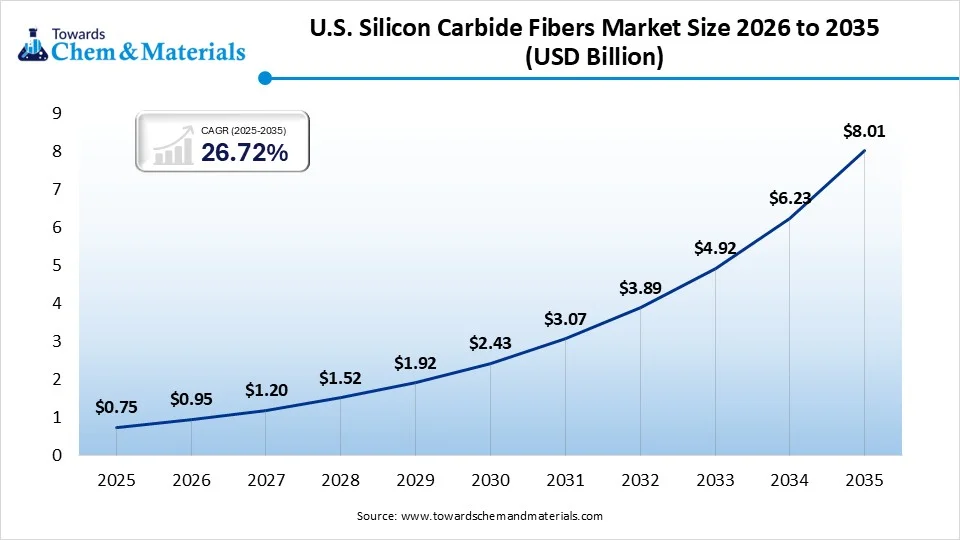
Asia Pacific silicon carbide fibers marketmarket segment accounted for the major revenue share of 14.00% in 2025. Asia Pacific is expected to grow at the fastest CAGR in the market during the forecast period. It is a key manufacturing and consumption hub, known for precursor chemistry and fiber spinning. The region is surging for supply chain independence and expanding in nuclear energy and defence, scaling the domestic production of third-generation crystalline fibers. The Asia Pacific is moving from raw material exports to integrating CMCs into engines and hypersonic technology, which is promoted by modernization programmes and local refiners.
China Silicon Carbide Fibers Market Growth Trends
China's market is represented as the industrial and technological backbone of the market. The regional mandates with strong government support for refractory materials enable the substantial investment in polymer pyrolysis and precursor synthesis. Additionally, the market is shifting towards indigenous high-bypass turbofans and hypersonic surfaces, focusing on domestic CMCs and crystalline fibre scaling the region for nuclear applications and large-scale thermostructural ceramics production.

Europe Silicon Carbide Fibers Market Growth Trends
Europe silicon carbide fibers market segment accounted for the major revenue share of 22.00% in 2025.Europe market shows notable growth due to its value-added engineering and materials science. The region is committed to the circular economy and advanced propulsion efficiency. It integrates CMCs in aircraft to lower carbon footprint, while the region emphasises innovation in nuclear fusion and small modular reactors for future energy accelerate the expansion. The local manufacturers network for textile preforming and aerospace, with a focus on matrix infiltration and sustainability model making the region towards continuous growth.
Germany Silicon Carbide Fibers Market Growth Trends
Germany's market drives Europe's industrial and innovation efforts. The region emphasising decarbonization and energy efficiency through CMCs in turbines and stationary power plants. The growth is supported by experimental facilities and R&D collaborations on crystalline fibers for sustainable propulsion and nuclear fuels. Additionally, Germany's well-established technological shift makes it a key pillar for refractory ceramic commercialization.
Silicon Carbide Fibers Market Share, By Regional, 2025 (%)
| Regional | Revenue Share, 2025 (%) |
| North America | 54.00% |
| Europe | 22.00% |
| Asia Pacific | 14.00% |
| Latin America | 6.00% |
| Middle East & Africa | 4.00% |
- North America – Dominating with a 54.00% share, strong aerospace & defense programs, advanced R&D capabilities, and high adoption of high-performance materials drive market leadership.
- Europe – With a 22.00% share, established aerospace manufacturing base and increasing focus on advanced composites support steady demand growth.
- Asia Pacific – Holding a 14.00% share, expanding aerospace and industrial sectors are driving gradual adoption, though limited production capacity restricts higher share.
- Latin America – With a 6.00% share, early-stage industrial development and limited advanced materials adoption result in modest market contribution.
- Middle East & Africa – Making up 4.00% of the market, relatively low aerospace manufacturing activity and limited technological penetration keep demand minimal.
Recent Developments
- In August 2025, Toshiba Electronic Devices & Storage Corporation signed a Memorandum of Understanding (MOU) with SICC Co., Ltd to explore enhancing the quality and supply of SiC power semiconductor wafers for high-reliability applications, including automotive and industrial power supplies.(Source: toshiba.semicon-storage.com)
- In January 2025, SNAM Abrasives Pvt. Ltd launched high-purity silicon carbide (HP SiC), with up to 4N SiC purity (99.99%) that offers superior mechanical strength, thermal stability and electrical performance to meet the growing demands of modern industries.(Source:www.business-standard.com)
Top Companies in the Market and Their Offerings
- NGS Advanced Fiber: The global manufacturers of SiC fibers that are used as reinforcement in ceramic matrix composites that offer superior thermal stability and oxidative resistance in industrial applications.
- Ube Industries: The global leader that offers continuous inorganic fiber that is incorporated into the SiC structure. Offers various grades for high temperature filters, stoichiometric fibre, and utilized in nuclear fusion research and advanced gas turbine
- BJS Ceramic GmbH: The major player that offers SiC ceramic matrix and fibers in generation 2 and generation 3 grades and specialized fibers with excellent mechanical strength and low observability for space re-entry vehicles.
- SGL Carbon
- Toyobo Co., Ltd.
- U.S. Specialty Materials (USSM)
- CeramTec
- 3M
- H.C. Starck
- Nippon Carbon Co., Ltd.
- GE Aviation
- Dow Chemical (Dow Inc.)
- Applied Materials
Segment Covered in the Report
By Form
- Continuous
- Woven
- Others
By Usage
- Composite
- Non-composites
By End Use
- Aerospace & Defense
- Hypersonic missiles
- Hypersonic vehicles / glide bodies
- Space & launch vehicles
- Aircraft engines & high-temperature components
- Others
- Defense Thermal Protection Systems (TPS)
- Energy & Power
- Industrial
- Others
By Region
- North America
- U.S.
- Canada
- Mexico
- Europe
- Germany
- UK
- France
- Italy
- Spain
- Asia Pacific
- China
- India
- Japan
- South Korea
- Latin America
- Brazil
- Argentina
- Middle East & Africa
- Saudi Arabia
- South Africa
FAQ's
Question 1 : What is the current size and growth forecast of the global silicon carbide fibers market?
Answer : The global silicon carbide fibers market was valued at USD 1.85 billion in 2025 and is expected to grow to USD 19.46 billion by 2035, at a CAGR of 26.53%.
Question 2 : What are the key drivers of growth in the silicon carbide fibers market?
Answer : The market growth is driven by technological advancements, government initiatives, the rise of automotive electrification, and increasing demand in industrial applications like aerospace and defense.
Question 3 : How are technological advancements and AI influencing the silicon carbide fibers market?
Answer : AI-powered modeling, machine learning, and advanced manufacturing techniques are optimizing polymer pyrolysis and precursor chemistry, improving fiber consistency and reducing R&D time.
Question 4 : Who are the leading companies in the silicon carbide fibers market, and what are their contributions?
Answer : Leading companies like NGS Advanced Fiber, Ube Industries, and SGL Carbon are driving market innovation with high-performance SiC fibers used in aerospace, defense, and energy applications.
Meet the Team

Saurabh Bidwai
Principal Consultant
Saurabh Bidwai, a B.Tech Chemical Engineering graduate with 4+ years of experience, specializes in specialty chemicals, commodity chemicals, and engineered materials, offering valuable insights into market trends and emerging opportunities.

Aditi Shivarkar
Reviewed By
Aditi Shivarkar, with 14+ years in Chemical and Materials market research, specializes in Chemical and Materials. She ensures accurate, actionable insights, driving Towards Chemicals And Materials Analytics and Consulting excellence in industry trends and sustainability.