
Steel Pipes And Tubes Market Size, Share, Growth, Report 2026 to 2035
The global steel pipes and tubes market segmented By Product Type (Seamless Steel Pipes, Welded Steel Pipes, Steel Tubes), By Material Type (Carbon Steel, Alloy Steel, Stainless Steel), By Diameter (Small Diameter Pipes & Tubes (<6 inches), Medium Diameter Pipes & Tubes (6–24 inches), Large Diameter Pipes & Tubes (>24 inches)), By Manufacturing Process (Seamless Manufacturing, Electric Resistance Welding (ERW), Submerged Arc Welding (SAW), Cold Drawing & Finishing), By End-use Industry (Oil & Gas, Construction & Infrastructure, Water & Wastewater, Automotive, Mechanical & Industrial Engineering, Power Generation), By Distribution Channel (Direct Sales, Distributors & Traders, EPC Contractors, Online & Digital Procurement Platforms)- Global Industry Analysis, Size, Trends, Leading Companies, Regional Outlook, and Forecast 2026 to 2035
Content
What is Steel Pipes And Tubes Market Size and Share?
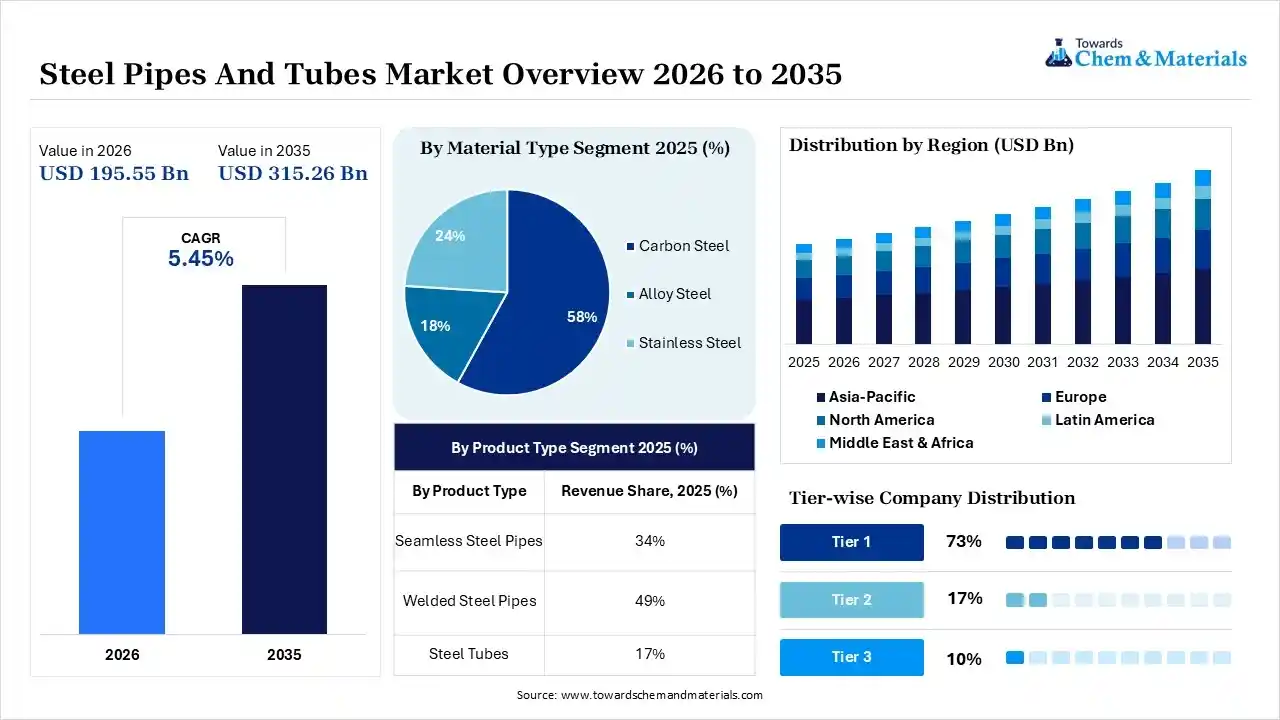
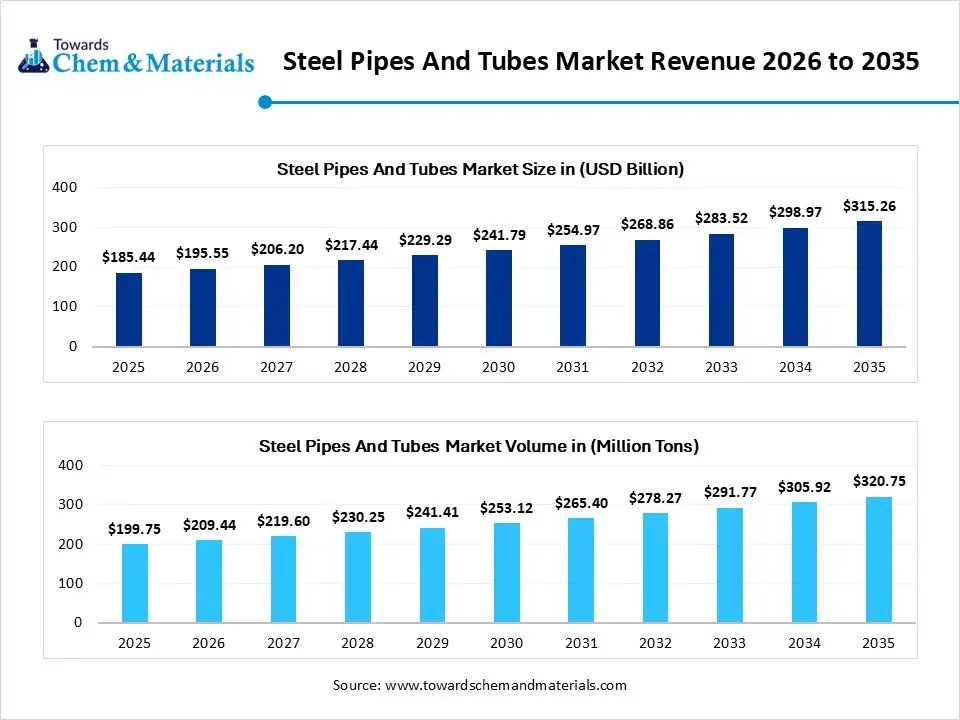
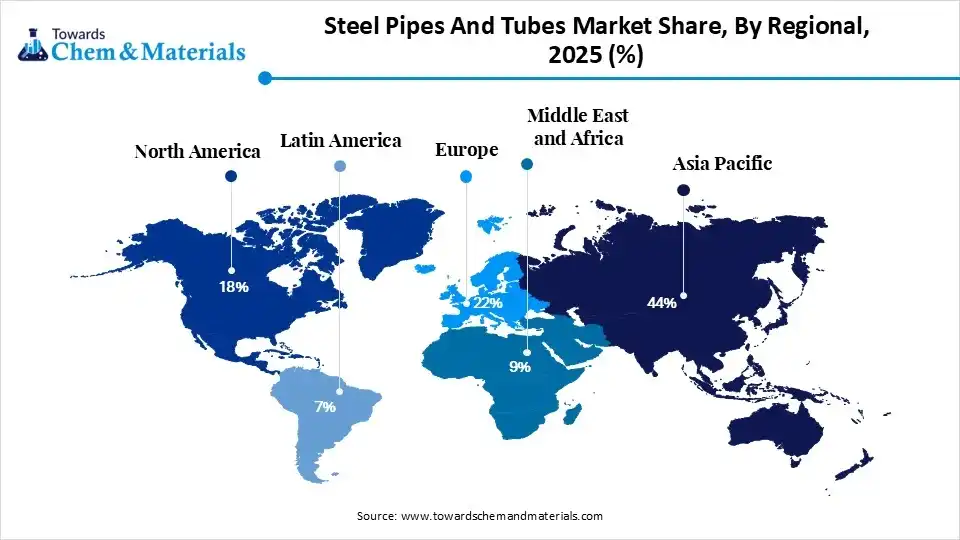
The global steel pipes and tubes market size was valued at USD 185.44 billion in 2025, is estimated to reach USD 195.55 billion in 2026, and is projected to reach USD 315.26 billion by 2035, exhibiting a compound annual growth rate (CAGR) of 5.45% over the forecast period from 2026 to 2035.Asia Pacific dominated the steel pipes and tubes market with the largest revenue share of 44% in 2025 and is expected to grow at the fastest CAGR of 5.57% during the forecast period. In terms of volume, the steel pipes and tubes market is projected to grow from 199.75 million tons in 2025 to 320.75 million tons by 2035. growing at a CAGR of 4.85% from 2026 to 2035. Demand for steel pipes and tubes is high as a result of the more rapid urbanization, investments in infrastructure, and growth in the energy, automotive, and manufacturing industries. Technological improvement and sustainable production processes continue to improve product quality, efficiency, and market development.
 Market Highlights
- By region, Asia Pacific dominated the steel pipes and tubes market by holding 44% share in 2025, as manufacturing expansion increases consumption.
- By region, North America held 18% market share in 2025 and is expected to grow at the fastest with a CAGR of 6.5% during the forecast period.
- By product type, the welded steel pipes segment dominated the market with the largest share of 49% in 2025 as cost-effective production supports widespread use.
- By product type, the steel tubes segment held 17% market share in 2025 and is expected to grow at the fastest CAGR of 6.1% over the forecast period due to the expanded usage in the automotive and mechanical engineering sectors.
- By material type, the carbon steel segment dominated the market with the largest share of 58% in 2025, as construction and infrastructure projects consume large volumes.
- By material type, the stainless steel segment held 24% market share in 2025 and is expected to grow at the fastest CAGR of 6.4% over the forecast period, driven by expanded consumption by food processing and water systems.
- By diameter, the small diameter pipes & tubes (<6 inches) segment dominated the market with the largest share of 39% in 2025, as mechanical tubing usage remains strong.
- By diameter, the large diameter pipes & tubes (>24 inches) segment held 25% market share in 2025 and is expected to grow at the fastest CAGR of 6% over the forecast period due to major pipeline projects boosting installation volumes.
- By manufacturing process, the electric resistance welding (ERW) segment dominated the market with the largest share of 37% in 2025, as production scalability enhances growth.
- By manufacturing process, the cold drawing & finishing segment held 10% market share in 2025 and is expected to grow at the fastest CAGR of 6.3% over the forecast period as precision engineering applications require tighter tolerances.
- By end-use industry, the oil & gas segment dominated the market with the largest share of 32% in 2025 as energy security investments support growth.
- By end-use industry, the power generation segment held 9% market share in 2025 and is expected to grow at the fastest CAGR of 6.5% over the forecast period due to power infrastructure investments.
- By distribution channel, the direct sales segment dominated the market with the largest share of 46% in 2025, as large projects prefer direct procurement.
- By distribution channel, the online & digital procurement platforms segment held 5% market share in 2025 and is expected to grow at the fastest CAGR of 8.2% over the forecast period due to digitalization streamlining sourcing activities.
Quick Stats at a Glance
- Market in Size 2025: USD 185.44 Billion | CAGR (2026–2035): 5.45%
- Market Estimated Size in 2026: USD 195.55 Billion
- Market Projected Size by 2035: USD 315.26 Billion
- Asia Pacific: largest Regional Market Revenue Share of 44% in 2025 | USD 81.59 Billion
- North America: Fastest-growing Regional Market Revenue Share of 18% in 2025 | USD 33.38 Billion
- By country: The China held the largest Market share of 49% in 2025
- Market Volume in 2025: 199.75 Million Tons | Volume CAGR (2026–2035): 4.85%
- Market Estimated Volume in 2026: 209.44 Million Tons
- Market Projected Volume by 2035: 320.75 Million Tons
- Market Pricing (2025):
- Average Manufacturing Price: USD 770/Ton
- Average Selling Price: USD 998/Ton
- Pricing CAGR (2026–2035): 2.25%
 Increased investment in energy and industrial projects, rapid urbanization, and infrastructure development are at the forefront of the global steel pipes and tubes market. The strength, durability, and versatility of steel pipes and tubes make them popular products for a variety of applications, including oil and gas transportation, construction, water and gas supply systems, automotive manufacturing, and power generation. The oil and gas industry continues to be the largest end-user with growing pipeline and LNG infrastructure projects.
The production efficiency and product quality are being improved by technological developments such as electric resistance welding (ERW), automation, and smart manufacturing. Furthermore, there is a strong focus on sustainable steel production and a rise in demand for renewable energy applications, including hydrogen transportation and geothermal projects, driving new market growth opportunities.
- For instance, JSW One Platforms launched One Helix Pipes & Tubes, a private brand of good quality and BIS-certified steel pipes and tubes for MSMEs in the manufacturing and construction sector in India.(Source: theprint.in)
Global Investment Movement for Steel Pipes And Tubes Market
The growing demand for steel pipes from the infrastructure, energy, automotive, and industrial industries around the world is driving the manufacturing expansion of steel pipe companies and the building of new manufacturing plants.
Firms are investing in backward integration, distribution networks, and capacities for sourcing raw materials to bolster supply security, operational resilience, and cost competitiveness.
- In November 2025, APL Apollo unveiled the largest 1000 x 1000 mm steel tube section in Southeast Asia, contributing to its leadership in innovation and providing steel tube and structural solutions.
(Source: tubepipeindia)
Market participants are investing in cutting-edge manufacturing technologies, automation, precision engineering, and low-carbon production methods to increase efficiency and fulfil the changing sustainability demands.
Market Trends
- Increase in energy infrastructure investments:The demand for steel pipes and tubes is high, backed by increasing investments in oil and gas pipelines, offshore drilling activities, and LNG terminal projects. Seamless and welded pipes still play a very important role in the supply of crude oil, natural gas, and refined products in the flow of the global energy network.
- Adoption of Smart Manufacturing and Precision Engineering:Manufacturers are increasingly adopting automation, digital monitoring, and innovative manufacturing technologies to improve the quality of their products and their production processes. Technological innovations are also continuing to be driven by the rising demand for precision steel tubes in automobiles, hydraulic systems, and electric vehicles.
Report Scope
| Report Attributes | Details |
| Market Size and Volume in 2026 | USD 195.55 Billion / 209.44 Million Tons |
| Revenue Forecast in 2035 | USD 315.26 Billion / 320.75 Million Tons |
| Growth Rate | CAGR 5.45% |
| Base Year of Estimation | 2025 |
| Forecast Period | 2025 - 2035 |
| High Impact Region | Asia Pacific |
| Segment Covered | By Product Type, By Material Type, By Diameter, By Manufacturing Process, By End-use Industry, By Distribution Channel, By Regions |
| Key Companies Profiled | ArcelorMittal, Nippon Steel Corporation, Rama Steel Tubes Limited, Tenaris, United States Steel Corporation, EVRAZ plc, Hyundai Steel, JFE Steel Corporation, ThyssenKrupp AG, Baosteel Group, Jindal Steel Ltd., Steel Authority of India Limited (SAIL), Tata Steel, Vallourec |
Key Technological Shifts and AI in the Steel Pipes And Tubes Market
The most significant technological advancements and the role of AI in the steel pipes and tubes sector. The steel pipes and tubes industry is going fast into automation, robotics, and digital technologies, to push productivity and quality, so it kinda keeps moving. Robotics is more and more used for cutting, welding, and material handling, and this boosts precision, along with worker safety at the same time.
Digital procurement platforms let buyers compare prices and track down certified products more smoothly, while IoT-enabled sensors give live monitoring of wall thickness, temperature, and how consistently dimensions stay in spec. AI-powered computer vision setups can spot defects and also foresee likely production troubles before they even start, which lowers material wastage.
Supply Chain Analysis of the Steel Pipes And Tubes Market
- Procurement of Feedstock: It is the process of selecting the raw materials, such as iron ore, metallurgical coal, and recycled scrap steel, which can be used for the production of steel pipes, under strict quality and cost conditions.
- Key players: Tata Steel, ArcelorMittal, JSW Steel
- Chemical Synthesis and Processing: Raw materials are subjected to smelting, BOF, and EAF processes to convert them into molten steel, and the cast molten steel is shaped into a preliminary tubular form.
- Key players: BASF, Dow, Sinopec
- Compound Formulation and Blending: Molten steel is mixed with certain ingredients to obtain the required properties and then rolled, formed, and welded to create the finished pipes and tubes.
- Key players: Nippon Steel Corporation, Jindal Steel & Power
Regulatory Framework: Steel Pipes And Tubes Market
| Region | Key Regulation | Regulatory Focus |
| Asia Pacific | Bureau of Indian Standards (BIS) / JIS Standards | Establishes quality, safety, and performance standards for steel pipes and tubes used in construction, infrastructure, and industrial applications. |
| North America | American Petroleum Institute (API) Standards | Regulates specifications for steel pipes used in oil and gas exploration, transportation, and high-pressure industrial applications. |
| European Union | Construction Products Regulation (CPR) | Provides a harmonized framework for the safety, performance, and marketing of steel tubes and structural steel products across EU member states. |
Steel Pipes And Tubes Market Dynamics
Drivers
Rising Oil and Gas Investments
Oil and gas exploration, oil and gas refining, and transnational pipelines are all driving up the demand for steel pipes and tubes. The durable, corrosion-resistant, and high-strength pipes are essential for large-scale LNG development and new transmission infrastructure – they must be strong enough and resist corrosion in extreme pressure and environmental conditions.
Restraints
Fluctuations in Raw Material Prices
Iron ore and coking coal prices and hot-rolled coils prices fluctuations cause uncertainty in the production cost and profit margin. The volatility in prices makes procurement planning, inventory management, and long-term contract negotiations difficult, and it can be challenging for manufacturers to keep competitive prices and efficiency.
Opportunities
Growing Renewable Energy Infrastructure Opportunities
As the world transitions to clean energy, there will be a growing market for hydrogen transport, geothermal, and carbon capture steel pipes and tubes. They demand high-performance alloys and technologically advanced materials that are corrosion-resistant, creating scope for growth for technologically advanced manufacturers.
Segmental Insights
Product Type Insights
The welded steel pipes segment dominated the market with the largest share of 49% in 2025. The cost-effectiveness and efficient manufacturing processes make Welded Steel Pipes a major share of the market. They can be made in a variety of diameters and thicknesses, making them ideal for use in a wide variety of construction, energy, automotive, and industrial applications. They are still widely adopted around the world due to their easy scaling and reduced production costs.
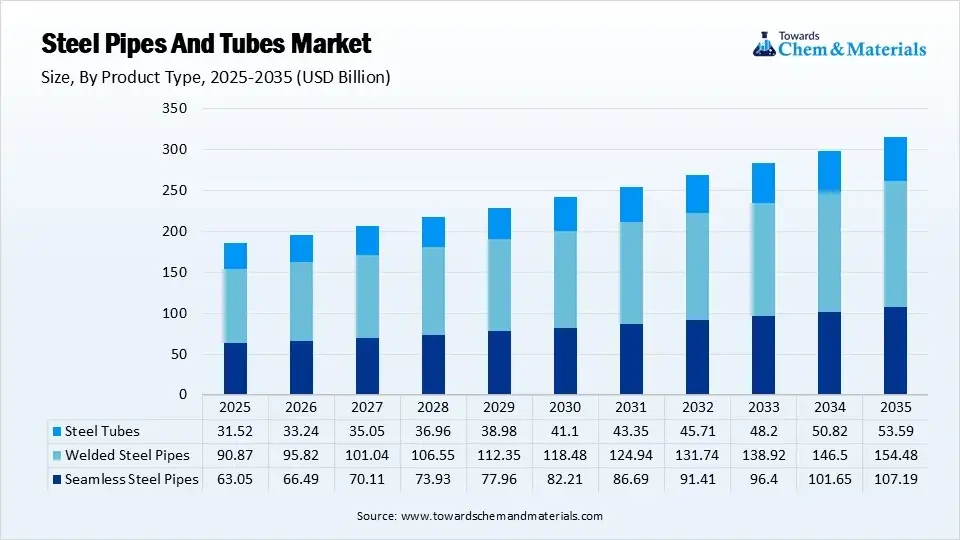 The steel tubes segment held the 17% market share in 2025 and is expected to grow at the fastest CAGR of 6.1% over the forecast period, due to increasing demand for precision-engineered and high-performance products. They are commonly employed in automotive parts, mechanical components, and infrastructure construction for their excellent strength and precision. The increasing specialized tubing solution requirements are further driving segment growth, as are the rising performance industrialisation needs.
Steel Pipes And Tubes Market Share,By Product Type, 2025 (%)
| By Product Type | Revenue Share, 2025 (%) |
| Seamless Steel Pipes | 34% |
| Welded Steel Pipes | 49% |
| Steel Tubes | 17% |
Material Type Insights
The carbon steel segment dominated the market with the largest share of 58% in 2025, owing to its low costs, durability, and good mechanical properties. It is highly demanded in the construction industry, industrial machinery, and oil and gas transportation systems for its strength and reliability in piping. It is widely available and affordable, and is still in demand globally.
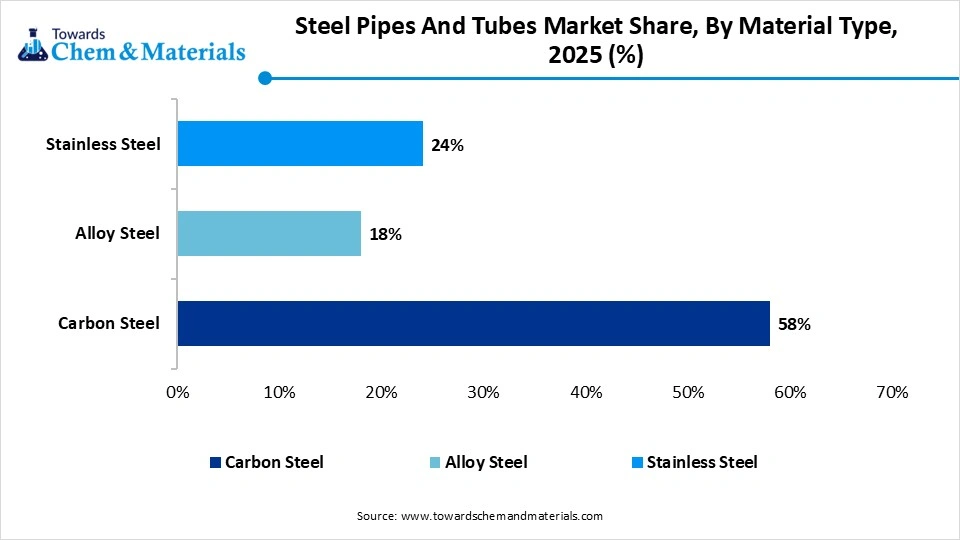 The stainless steel segment held the 24% market share in 2025 and is expected to grow at the fastest CAGR of 6.4% over the forecast period, because of its outstanding corrosion resistance and lifespan. The material is being used more and more in the field of renewable energy, chemical processing, and industrial environments where durability and low maintenance are critical. It is an application that is rapidly expanding, with growing investments in high-performance applications.
Steel Pipes And Tubes Market Share,By Material Type, 2025 (%)
| By Material Type | Revenue Share, 2025 (%) |
| Carbon Steel | 58% |
| Alloy Steel | 18% |
| Stainless Steel | 24% |
Diameter Insights
The small diameter pipes & tubes (<6 inches) segment dominated the market with the largest share of 39% in 2025, due to their applications being considerable in the plumbing, construction, automotive, and industrial applications. They are easy to install, versatile, and can be used in applications that demand compact and flexible piping. These have remained in high demand due to their wide usage in various end-use industries.
The large diameter pipes & tubes (>24 inches) segment held the 25% market share in 2025 and is expected to grow at the fastest CAGR of 6% over the forecast period, due to increasing investments in water transmission systems and energy infrastructure projects. Such pipes play a vital role in efficiently moving huge amounts of water, oil, and gas over long distances. The segment is growing due to rising infrastructure modernization projects.
Steel Pipes And Tubes Market Share,By Diameter, 2025 (%)
| By Diameter | Revenue Share, 2025 (%) |
| Small Diameter Pipes & Tubes (<6 inches) | 39% |
| Medium Diameter Pipes & Tubes (6–24 inches) | 36% |
| Large Diameter Pipes & Tubes (>24 inches) | 25% |
Manufacturing Process Insights
The electric resistance welding (ERW) segment dominated the market with the largest share of 37% in 2025, as it is characterized by high production efficiency and cost. The process allows the manufacturer to ensure pipes of consistent dimensional accuracy, quality, and scale. It has become one of the most adopted production methods around the world due to its use in the construction, automotive, and industrial sectors.
The cold drawing & finishing segment held the 10% market share in 2025 and is expected to grow at the fastest CAGR of 6.3% over the forecast period, as it is desired to have high-precision tubes with superior mechanical properties. The process offers excellent surface finish, dimensional accuracy, and improved strength properties. The benefits of this make it very desirable for use as top-quality tubing in advanced engineering, automotive, and hydraulic applications.
Steel Pipes And Tubes Market Share,By Manufacturing Process, 2025 (%)
| By Manufacturing Process | Revenue Share, 2025 (%) |
| Seamless Manufacturing | 31% |
| Electric Resistance Welding (ERW) | 37% |
| Submerged Arc Welding (SAW) | 22% |
| Cold Drawing & Finishing | 10% |
End-use Industry Insights
The oil & gas segment dominated the market with the largest share of 32% in 2025, which is attributed to its huge demand for exploration, production, and transportation infrastructure. High-strength steel pipes are crucial for use in the transportation of hydrocarbons under extreme pressure and conditions. Strong demand stemming from this sector has been maintained with continued investments in pipelines and LNG.
The power generation segment held the 9% market share in 2025 and is expected to grow at the fastest CAGR of 6.5% over the forecast period, as investments are increasing in thermal, renewable, and nuclear power initiatives across the globe. Steel pipes and tubes are vital for various purposes such as steam generation, coolers, and fluid transportation. The energy sector is seeing accelerated uptake due to rising electricity demand and energy infrastructure development.
Steel Pipes And Tubes Market Share,By End-use Industry, 2025 (%)
| By End-use Industry | Revenue Share, 2025 (%) |
| Oil & Gas | 32% |
| Construction & Infrastructure | 26% |
| Water & Wastewater | 11% |
| Automotive | 9% |
| Mechanical & Industrial Engineering | 13% |
| Power Generation | 9% |
Distribution Channel Insights
The direct sales segment dominated the market with the largest share of 46% in 2025, which is preferred by manufacturers since they prefer to have direct access to the project developers and large industrial buyers. This channel allows for tailored solutions, long-term contracts, and smooth supply chain management. It also helps to improve responsiveness to project requirements and to improve customer retention across key end-use industries.
The online & digital procurement platforms segment held the 5% market share in 2025 and is expected to grow at the fastest CAGR of 8.2% over the forecast period, driven by their ability to provide increased transparency, accelerated sourcing cycles, and enhanced supplier visibility. Such sites allow buyers to see up-to-the-minute pricing and specs. The digitisation of industrial procurement processes is gaining pace around the world.
Steel Pipes And Tubes Market Share,By Distribution Channel, 2025 (%)
| By Distribution Channel | Revenue Share, 2025 (%) |
| Direct Sales | 46% |
| Distributors & Traders | 31% |
| EPC Contractors | 18% |
| Online & Digital Procurement Platforms | 5% |
Regional Insights
How did the Asia Pacific dominate the Steel Pipes And Tubes Market in 2025?
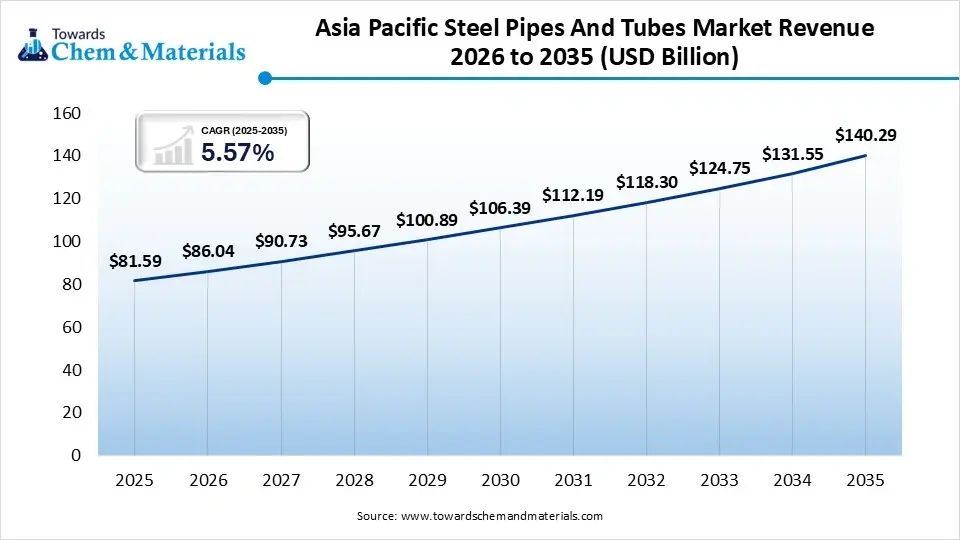
The Asia Pacific steel pipes and tubes market size was estimated at USD 81.59 billion in 2025 and is projected to reach USD 140.29 billion by 2035, growing at a CAGR of 5.57% from 2026 to 2035.Asia Pacific dominated the market by 44% share in 2025, with regard to the high rate of industrialization, urbanization, and huge investment in infrastructure and energy projects. The area has a strong base for steel manufacturing, cost-competitive production, and a growing construction industry. The region's market leadership continues to grow, driven by the increasing demand from transportation, water infrastructure projects, automotive manufacturing, and oil and gas pipeline industries.
 China
China
- Transportation infrastructure, such as railways, bridges, and urban development projects, remains a significant source of demand for structural steel pipes and tubes, with many projects being heavily reliant on these materials.
- The country has a well-established manufacturing value chain and integrated steel supply chain, which provides the opportunity to produce large quantities, benefit from cost efficiencies, and have considerable export potential.
- These projects are fueling steady demand for high-performance steel piping solutions, whether they are oil and gas transmission lines, industrial, or renewable energy projects.
India
- The demand for steel pipes and tubes has been rising enormously from government projects on smart cities, highways, industrial corridors, and housing projects.
- The demand for water supply systems, sewage networks, and steel products used in construction is increasing due to rapid urbanization and industrial expansion.
- Long-term market growth is being driven by increasing investments in oil and gas pipelines, renewable energy facilities, and manufacturing industries.
The North America steel pipes and tubes market size was estimated at USD 33.38 billion in 2025 and is projected to reach USD 58.32 billion by 2035, growing at a CAGR of 5.74% from 2026 to 2035.North America held 18% market share in 2025 and is expected to grow at the fastest rate, with a CAGR of 6.5% during the forecast period. It will witness strong growth in the coming years, as the modernization of infrastructure is intensified and energy project investments are boosted. Pipeline replacement programmes, industrial growth, and the increased use of sophisticated manufacturing technologies are supporting the demand. The area is seeing a rising demand for high-quality steel pipes and tubes for renewable energy and utility infrastructure projects, as well.
United States
- Strong demand for steel pipe products is driven by the federal government's infrastructure investments for transportation systems, bridges, water, and utility modernization.
- The growth of shale gas production, LNG facilities, and pipeline replacement projects is creating a demand for high-strength and corrosion-resistant pipes.
Canada
- The higher demand for durable steel pipes for energy transportation infrastructure stems from oil sands development and natural gas projects.
- Regular consumption of steel tubes has been supported by investments in the municipal infrastructure sector, such as water treatment and transportation systems, particularly by the government.
The Europe steel pipes and tubes market size was estimated at USD 40.80 billion in 2025 and is projected to reach USD 70.93 billion by 2035, growing at a CAGR of 5.69% from 2026 to 2035.Europe held the 22% market share in 2025. Investments in sustainable infrastructure and industrial modernization are expected to be significant in Europe. Low-carbon steel manufacturing and cutting-edge production technologies are being driven by the region's strict environmental policies. High market demand from the renewable energy, automotive, and industrial industries is also driving the demand for high-quality steel pipes and tubes.
Germany
- Demand for precision steel tubes for high-tech manufacturing applications is driven by the country's significant automotive and engineering industries.
- Technology-driven steel products are being encouraged because of investments made in automation and energy-efficient production processes.
- As the industry continues to grow with renewable energy installation and hydrogen projects, the need for specialized, high-performance steel piping solutions is rising.
France
- Modernization of infrastructure and urban development projects is presenting enormous opportunities for construction and industrial steel pipe manufacturers.
- Demand for corrosion-resistant and durable steel tubing products is growing due to greater investments in renewable energy and energy transition projects.
- The government's policy support for sustainable industrial practices is promoting the use of low-carbon production technologies and advanced steel production techniques.
The Middle East and Africa steel pipes and tubes market size was estimated at USD 16.69 billion in 2025 and is projected to reach USD 29.95 billion by 2035, growing at a CAGR of 6.02% from 2026 to 2035.The Middle East & Africa held 9% market share in 2025. Large investments in energy infrastructure, industrial diversification, and urban development projects are fueling the Middle East and Africa market. Water management systems, pipeline networks, and construction activities are among the factors that are driving market growth. The state's economic transformation initiatives are also providing further impetus for manufacturing and infrastructure investments.
 Saudi Arabia
- The demand for steel pipes, especially for construction and industrial uses, is high, particularly for large-scale infrastructure and megaprojects.
- High-performance steel pipes are still demanded for the significant investments being made in oil and gas production, refining, and pipeline expansion projects.
- Economic diversification programs are encouraging expansion of manufacturing, adding investments in transportation, utilities, and industrial infrastructure projects.
South Africa
- The demand for high-strength steel pipes and special steel tubing is steady as mining and industrial operations ramp up.
- Long-term investments in transportation systems, water resources, and the modernization of utilities are driving market development opportunities.
- The increasing industrial activities and development of manufacturing industries are fueling the need for precision-engineered steel pipes in various end-use industries.
The Latin America steel pipes and tubes market size was estimated at USD 12.98 billion in 2025 and is projected to reach USD 23.64 billion by 2035, growing at a CAGR of 6.18% from 2026 to 2035.Latin America held 7% market share in 2025, owing to rising investments in the infrastructure, mining, and energy sectors. Governments of the region have focused investment in transportation networks, water infrastructure, and industrial development projects. Demand for cost-effective, long-lasting steel pipes and tubes is increasing as urbanization and modernization of utility systems continue.
Brazil
- A significant demand for structural steel pipes and tubes is expected due to the major investments in transportation infrastructure and industrial development projects.
- The growing development of offshore oil and gas resources is driving the need for pipeline development and energy transportation infrastructure.
- Urbanisation and public works investments are helping to develop water supply and sanitation infrastructure across the country.
Chile
- The demand for industrial steel pipes that can withstand harsh environments is high in the country because of the country's growing mining industry.
- A rise in the investment in renewable energy, especially in solar and wind, is generating opportunities for the specialized steel tube application.
- The demand for long-lasting piping systems and utility networks is emerging due to infrastructure development and water management projects.
Recent Developments
- In March 2026, in Tay Ninh Province, Hoa Phat Long An Steel Products officially inaugurated the modern steel pipe production enterprise in the district with a production capacity of 410,000 tons/year, further boosting the company's production capabilities and distribution network in both the domestic and international markets.
(Source: www.steelradar.com) - In August 2025, Vibhor Steel Tubes Limited started manufacturing of ERW pipes and GI pipes from its new factory in Odisha, further increasing its production capacity and bringing in high-value pipes into its portfolio, such as crash barriers and transmission towers.
(Source: scanx.trade) - In August 2025, Rhinox opened its new S/S pipe manufacturing plant in Karnal, Haryana in August 2025. The high-tech plant was to enhance precision, hygiene, and durability requirements and to vastly extend the company's manufacturing capabilities. (Source: infra.economictimes.indiatimes.com)
Competitive Analysis
The steel pipes and tubes market is highly competitive, with leading players focusing on capacity expansion, technological innovation, vertical integration, and sustainable manufacturing practices to strengthen their market positions. As additional ESG criteria come into effect, companies are increasingly looking to invest in low-carbon steelmaking technologies and optimization of the supply chain to boost cost competitiveness.
- One such case is the strategic move by Jindal Steel to become the first coal gasification-based Direct Reduced Iron (DRI) plant of its kind in India, using syngas for producing steel. The company also launched syngas applications for galvanizing, color coating, and blast furnace processes, thus avoiding the import of fuels and minimising carbon emissions.(Source: jindalsteel.in)
Top Players in the Steel Pipes and Tubes Market & Their Offerings
| Company | Company Type/Position | Major Headquarters | Geographic Presence | Steel Pipes and Tubes Offerings | Key Offering/Strength |
| ArcelorMittal | Leading Global Steel Producer | Luxembourg City, Luxembourg | Europe, North America, South America, Asia, Africa | Seamless and welded steel pipes, line pipes, structural tubes | Extensive global manufacturing footprint and integrated steel production capabilities |
| Nippon Steel Corporation | Leading Integrated Steel Manufacturer | Tokyo, Japan | Asia, North America, Europe, the Middle East | High-grade seamless pipes, welded tubes, specialty steel tubing | Advanced metallurgy expertise and high-performance specialty steel products |
| Rama Steel Tubes Limited | Major Indian Steel Tube Manufacturer | New Delhi, India | India, the Middle East, Africa, and Europe | ERW steel tubes, galvanized pipes, and structural hollow sections | Diverse product portfolio and strong distribution network across emerging markets |
| Tenaris | Global Manufacturer of Steel Pipes for Energy Applications | Luxembourg City, Luxembourg | North America, South America, Europe, the Middle East, and Asia | Seamless pipes, OCTG products, line pipes, premium connections | Strong presence in oil and gas applications and premium tubular technology solutions |
Other Key Players
- United States Steel Corporation
- EVRAZ plc
- Hyundai Steel
- JFE Steel Corporation
- ThyssenKrupp AG
- Baosteel Group
- Jindal Steel Ltd.
- Steel Authority of India Limited (SAIL)
- Tata Steel
- Vallourec
Segment Covered in the Report
By Product Type
- Seamless Steel Pipes
- Hot-Finished Seamless Pipes
- Cold-Drawn Seamless Pipes
- Welded Steel Pipes
- Electric Resistance Welded (ERW) Pipes
- Longitudinal Submerged Arc Welded (LSAW) Pipes
- Spiral Submerged Arc Welded (SSAW) Pipes
- Steel Tubes
- Structural Tubes
- Mechanical Tubes
- Precision Tubes
By Material Type
- Carbon Steel
- Low Carbon Steel
- Medium Carbon Steel
- High Carbon Steel
- Alloy Steel
- Chromium Alloy Steel
- Nickel Alloy Steel
- Molybdenum Alloy Steel
- Stainless Steel
- Austenitic Stainless Steel
- Ferritic Stainless Steel
- Duplex Stainless Steel
By Diameter
- Small Diameter Pipes & Tubes (<6 inches)
- Medium Diameter Pipes & Tubes (6–24 inches)
- Large Diameter Pipes & Tubes (>24 inches)
By Manufacturing Process
- Seamless Manufacturing
- Electric Resistance Welding (ERW)
- Submerged Arc Welding (SAW)
- Cold Drawing & Finishing
By End-use Industry
- Oil & Gas
- Upstream
- Midstream
- Downstream
- Construction & Infrastructure
- Residential Construction
- Commercial Construction
- Infrastructure Projects
- Water & Wastewater
- Municipal Water Systems
- Industrial Water Systems
- Automotive
- Passenger Vehicles
- Commercial Vehicles
- Mechanical & Industrial Engineering
- Machinery Manufacturing
- Process Industries
- Power Generation
- Thermal Power
- Nuclear Power
- Renewable Energy Facilities
By Distribution Channel
- Direct Sales
- Distributors & Traders
- EPC Contractors
- Online & Digital Procurement Platforms
By Regions
- North America
- U.S.
- Canada
- Europe
- Germany
- UK
- France
- Italy
- Spain
- Sweden
- Denmark
- Norway
- Asia Pacific
- China
- Japan
- India
- South Korea
- Thailand
- Latin America
- Brazil
- Mexico
- Argentina
- Middle East and Africa (MEA)
- South Africa
- UAE
- Saudi Arabia
- Kuwait
FAQ'
Question 1 : What is the current size of the global steel pipes and tubes market?
Answer : The global steel pipes and tubes market size is valued at an estimated USD 195.55 billion in 2026. Backed by steady industrial demand, it is projected to grow to USD 315.26 billion by the year 2035.
Question 2 : What are the main uses of industrial steel pipes and tubes?
Answer : Industrial steel pipes and tubes are primarily used to transport fluids and gases in the oil, gas, water, and wastewater industries. They are also heavily utilized as structural supports in commercial buildings, structural components in automotive engineering, and fluid conduits in power generation plants.
Question 3 : Which region dominates the global steel pipes and tubes market?
Answer : The Asia Pacific region completely dominates the global landscape, holding a 44% share of total market revenue. This dominant position is driven by high manufacturing outputs and massive infrastructure development in countries like China and India.
Question 4 : What are the top key players in the steel pipes and tubes market?
Answer : The top key players leading the global market include ArcelorMittal, Nippon Steel Corporation, Tenaris, Rama Steel Tubes Limited, United States Steel Corporation, EVRAZ plc, Hyundai Steel, JFE Steel Corporation, ThyssenKrupp AG, Baosteel Group, Jindal Steel Ltd, Steel Authority of India Limited (SAIL), Tata Steel, and Vallourec.
Question 5 : What is the difference between welded and seamless steel pipes in market share?
Answer : Welded steel pipes are the market leader with a 49% share because they are highly cost-effective and easy to scale during manufacturing. Seamless steel pipes hold a 34% share and are typically preferred for high-pressure environments like deep-sea oil drilling.
Question 6 : What challenges does the steel pipes manufacturing industry face?
Answer : The biggest challenge facing manufacturers is the constant fluctuation of raw material prices, specifically iron ore and coking coal. These unpredictable shifts make it very difficult for companies to plan long-term inventories and maintain steady profit margins.
Meet the Team

Saurabh Bidwai
Principal Consultant
Saurabh Bidwai, a B.Tech Chemical Engineering graduate with 4+ years of experience, specializes in specialty chemicals, commodity chemicals, and engineered materials, offering valuable insights into market trends and emerging opportunities.

Aditi Shivarkar
Reviewed By
Aditi Shivarkar, with 14+ years in Chemical and Materials market research, specializes in Chemical and Materials. She ensures accurate, actionable insights, driving Towards Chemicals And Materials Analytics and Consulting excellence in industry trends and sustainability.