
Steel Plate Market Size, Share, Growth, Report 2026 to 2035
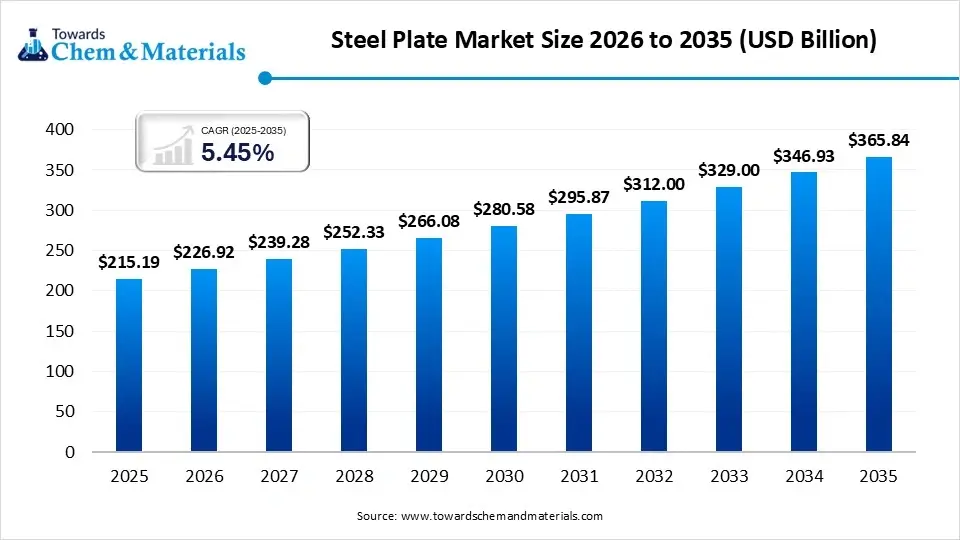
The global steel plate market size is expected to grow from USD 226.92 billion in 2026 to USD 365.84 billion in 2035, growing at a CAGR of 5.45% from 2026 to 2035. The top key players in the market are Nucor Corporation, POSCO Holdings, ArcelorMittal, JSW Steel Ltd., Nippon Steel Corporation, Tata Steel, Baowu Steel Group, JFE Steel Corporation, EVRAZ, HBIS Group, Thyssenkrupp AG, Jianlong Group Global Forecast 2026 To 2035
Content
What is the Current Size of the Steel Plate Market and Its Projected Growth?
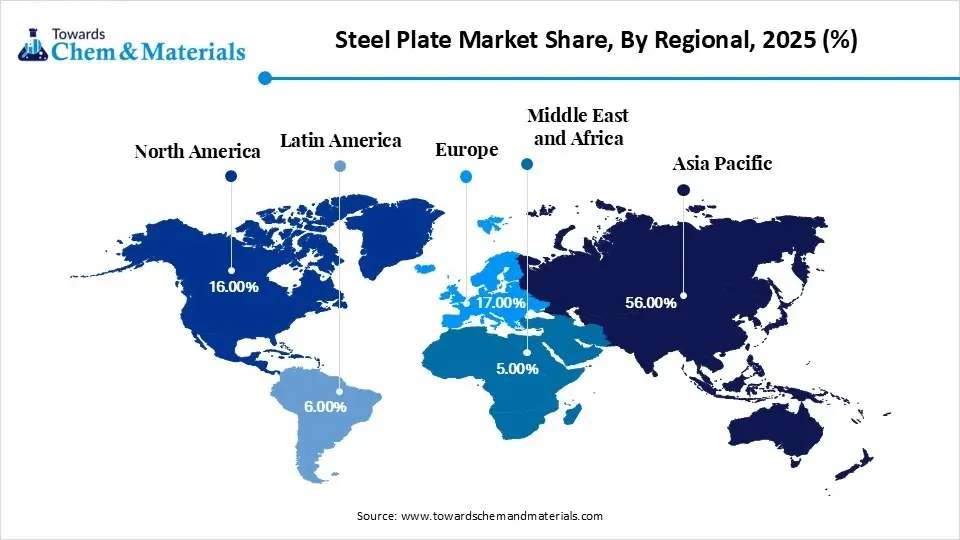
The global steel plate size was estimated at USD 215.19 billion in 2025 and is expected to increase from USD 226.92 billion in 2026 to USD 365.84 billion by 2035, growing at a CAGR of 5.45% from 2026 to 2035. Asia Pacific dominated the steel plate with the largest revenue share of 56% in 2025.The increased need for stronger and lightweight construction materials has accelerated the industry's growth in recent years.
Market Highlights
- By region, Asia Pacific dominated the steel plate market with the largest share 56% in 2025, due to the region having very large construction activity, heavy manufacturing, transport equipment production, shipbuilding, and infrastructure expansion happening at the same time.
- By region, North America is anticipated to capture a greater portion of the market with a significant CAGR in the future due to many old bridges, industrial buildings, pipelines, and transport systems to be replaced or strengthened using heavy steel materials.
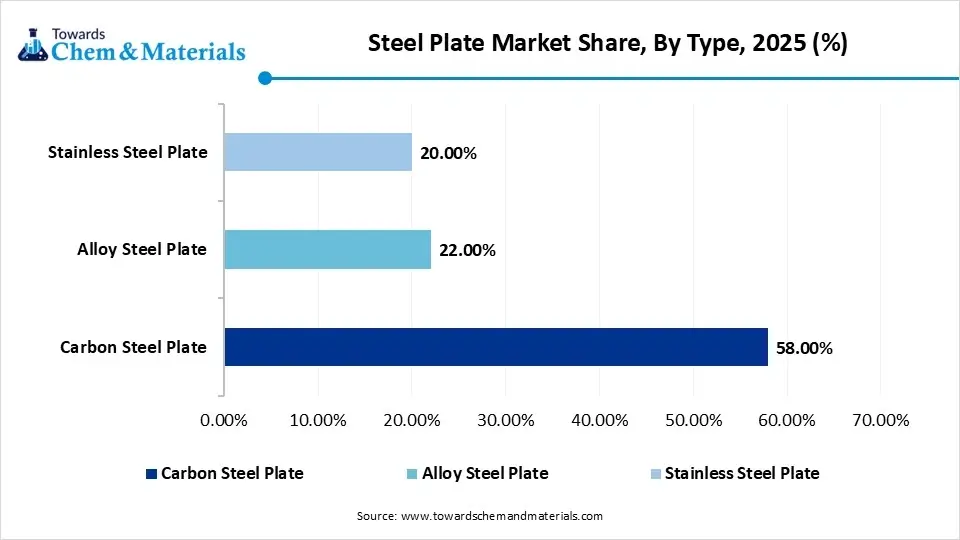
- By product type, the carbon steel plates segment dominated the market with the largest industry share 58.00% in 2025, owing to its strong mechanical performance at a practical cost for many industries.
- By product type, the stainless steel plates segment is expected to grow during the forecast period, due to future industries increasingly needing materials that resist corrosion and stay durable for longer periods.
- By application, the construction segment dominated the market with the largest market share 40.00% in 2025, owing to steel plates are widely used in bridges, structural frames, heavy supports, industrial buildings, and large infrastructure systems.
- By application, the oil and gas segment is expected to grow during the forecast period, due to pipelines, storage tanks, drilling systems, and pressure equipment requiring highly reliable steel plates.
- By manufacturing process, the hot rolled steel plate segment dominated the market and accounted for the largest revenue share of 62.00% in 2025.
- By end-user industry, the construction & infrastructure segment led the market with the largest revenue share of 42.00% in 2025.
- By thickness, medium plate (6–25 mm) led the market with the largest revenue share of 46.00% in 2025.
Built Strong: The Rise of Steel Plates
The thick, flat piece of steel, which is primarily made by rolling metal into a wide sheet form that has better thickness than ordinary steel sheets, is known as the steel plate. Moreover, providing higher durability, greater strength, and load-bearing ability, the steel plates have gained major industry attention in recent years. Also, the major sectors such as industrial manufacturing and heavy construction have seen greater steel plate needs in the current period.
Steel Plate Market Trends:
- The heavy demand for the stronger plates, which have minimum weight and higher strength, has increased return on investment for manufacturers in recent years. These plates have heavy demand in major sectors due to their lightweight and durability, which reduces transportation costs effortlessly.
- The increased demand for ready-to-use custom-sized plates has supported stronger cash flows for manufacturing enterprises in the current period. Moreover, the industries are actively preferring exact sizes of plates to reduce labor and material waste in recent years.
- The smooth surface steel plates are expected to elevate earning potential for producers during the forecast period, as several manufacturers are not only preferring strength and lightweight, but also preferring smooth surfaces, which is a perfect choice for the visible structures, advanced industrial equipment, and precise fabrication.
Report Scope
| Report Attribute | Details |
| Market Size in 2026 | USD 226.92 Billion |
| Revenue Forecast in 2035 | USD 365.84 Billion |
| Growth Rate | CAGR 5.45% |
| Forecast Period | 2026 - 2035 |
| Base Year | 2025 |
| Dominant Region | Asia Pacific |
| Segment Covered | By Product Type, By Application, By Type, By Thickness, By Manufacturing Process, By End-User Industry |
| Key companies profiled | Nucor Corporation, POSCO Holdings, ArcelorMittal, JSW Steel Ltd., Nippon Steel Corporation, Tata Steel, Baowu Steel Group, JFE Steel Corporation, EVRAZ, HBIS Group, Thyssenkrupp AG, Jianlong Group |
Advanced Rolling Improves Steel Plate Quality
The industry is actively shifting towards better control during rolling and cooling stages. Earlier, many plates mainly focused on thickness targets. Moreover, now producers carefully control temperature and cooling speed to improve strength, fitness, and internal consistency. Also, steel is now made more precisely, so each plate performs more predictably during use. This matters because modern industries expect uniform material quality across large production volumes. Better process control helps steel plates meet stricter technical demands. Also, in construction, machinery, energy systems, and transport manufacturing, reliable material behavior is increasingly important.
Trade Analysis of the Steel Plate Market:
Import, Export, Consumption, and Production Statistics
- The world has been observed a sophisticated export of steel plate between July 2024 and June 2025 via 7,187 exporters and 8,671 buyers with 112,208 shipments, as per the published report.
- Also, the import of steel plates has increased in recent years, with 7,342 shipments through 8,994 buyers and 7,342 exporters reported between June 2024 to May 2025 as per the published report.
Supply Chain Analysis of the Steel Plate Market:
Distribution to Industrial Users
Steel plate distribution to industrial users is a multi-tiered supply chain where mills sell high volumes directly to large-scale manufacturers. Distributors and service centers act as "material middlemen," stockpiling bulk inventory to provide faster delivery, specialized grades, and custom cutting for medium-sized sectors like construction, shipbuilding, and automotive.
Chemical Synthesis and Processing
Steel plate production begins with smelting iron ore in blast furnaces, followed by Basic Oxygen Steelmaking to refine chemical composition. Secondary metallurgy adjusts carbon and alloying elements (like manganese or chromium) for strength. The molten steel is continuously cast into slabs, then hot-rolled and heat-treated to achieve precise thickness and mechanical properties.
Regulatory Compliance and Safety Monitoring
Steel plate production adheres to strict ASTM or ISO standards, ensuring structural integrity through chemical and mechanical testing. Compliance involves mill test reports (MTRs) for traceability. Safety monitoring employs non-destructive testing (NDT), like ultrasonic or X-ray inspections, to detect internal flaws, guaranteeing reliability in high-pressure or load-bearing industrial applications.
Steel Plate Market Regulatory Landscape: Global Regulations
| Country Region | Regulatory Body | Key Regulations | Focus Areas |
| United States | Environmental Protection Agency (EPA) | Clean Air Act (CAA): Regulates emissions of particulate matter and sulfur dioxide from steel mills | Emission control, workplace hazard reduction, and structural integrity for construction and infrastructure |
| European Union | European Commission | Regulation (EU) No 305/2011 (CPR): Mandates the CE marking for all structural steel plates, ensuring they meet harmonized European standards like EN 10025. | Sustainability, free movement of goods via CE certification, and trade protection through anti-dumping duties on imported plates |
| China | Standardization Administration of China (SAC) | GB (Guobiao) Standards: Mandatory national standards. For example, GB 700 covers carbon structural steels and GB 713 specifies plates for boilers and pressure vessels. |
High-end production shifts, intelligent manufacturing, and meeting global export quality benchmarks. |
Segmental Insights
By Type Insights
The Carbon Steel Plates Segment Led the Steel Plate Market in 2025 with the Largest Share
The carbon steel plates dominated the market with the largest market share in 2025, due to their strong mechanical performance at a practical cost for many industries. Also, builders, machine makers, shipyards, and infrastructure projects use carbon steel because it handles heavy loads well and remains easy to process. Moreover, it is widely available in many thickness levels, which supports flexible use across projects. Also, carbon steel became dominant because it works well for many common heavy applications without high material cost.
The stainless steel plates segment is expected to grow with a rapid CAGR, owing to future industries increasingly needing materials that resist corrosion and stay durable for longer periods. Also, these plates are especially useful where moisture, chemicals, or difficult environments affect material life. Furthermore, buyers increasingly prefer plates that require less maintenance over time. As long-term durability becomes more valuable, stainless steel demand may increase strongly in technical and industrial sectors.
Steel Plate Market Share, By Type, 2025 (%)
| By Type | Revenue Share, 2025 (%) |
| Carbon Steel Plate | 58.00% |
| Alloy Steel Plate | 22.00% |
| Stainless Steel Plate | 20.00% |
- Carbon steel plate accounts for 58.00% of the steel plate market in 2025, making it the dominant segment, as it is widely used across construction, shipbuilding, and heavy machinery due to its cost-effectiveness, strength, and versatility.
- Alloy steel plate holds a 22.00% share, supported by its enhanced mechanical properties, including higher strength, durability, and resistance to wear, making it suitable for demanding industrial and engineering applications.
- Stainless steel plate represents 20.00% of the market and is the fastest growing segment, driven by increasing demand in sectors such as food processing, chemical, and infrastructure, where corrosion resistance and hygiene standards are critical.
By Thickness
The steel plate market by thickness is segmented based on application requirements across diverse industries such as construction, automotive, shipbuilding, and heavy machinery. Thin plates (up to 6 mm) are widely used in automotive manufacturing, appliances, and light structural applications due to their ease of fabrication, flexibility, and cost efficiency. These plates are essential in sectors where weight reduction and formability are key considerations. Medium plates (6–25 mm) serve a broad range of applications, including general construction, bridges, and industrial equipment, offering a balance between strength and workability.
They are commonly preferred for structural components that require moderate load-bearing capacity. Meanwhile, thick plates (above 25 mm) are primarily utilized in heavy-duty applications such as shipbuilding, offshore structures, pressure vessels, and defense equipment, where high strength and durability are critical. The demand across all thickness segments is driven by infrastructure development, industrial expansion, and increasing investments in energy and transportation projects globally.
Steel Plate Market Share, By Thickness, 2025 (%)
| By Thickness | Revenue Share, 2025 (%) |
| Thin Plate (Up to 6 mm) | 28.00% |
| Medium Plate (6–25 mm) | 46.00% |
| Thick Plate (Above 25 mm) | 26.00% |
- Medium plate (6–25 mm) accounts for 46.00% of the steel plate market in 2025, making it the dominant segment, as it is widely used across construction, automotive, and industrial applications due to its balanced strength, flexibility, and cost efficiency.
- Thin plate (up to 6 mm) holds a 28.00% share, supported by increasing demand in automotive, appliances, and lightweight structural applications where ease of fabrication and reduced weight are key factors.
- Thick plate (above 25 mm) represents 26.00% of the market and is the fastest growing segment, driven by rising investments in heavy infrastructure, shipbuilding, and energy projects that require high strength and durability.
By Manufacturing Process
The steel plate market by manufacturing process is characterized by different production techniques tailored to specific performance and application requirements. Hot rolled steel plates are the most widely used, produced at high temperatures to achieve good ductility and cost efficiency, making them suitable for construction, shipbuilding, and general structural applications. In contrast, cold rolled steel plates undergo additional processing at room temperature, resulting in improved surface finish, tighter tolerances, and higher strength, which are ideal for automotive components and precision equipment.
Quenched and tempered plates are engineered through heat treatment processes to enhance hardness, toughness, and wear resistance, making them essential in demanding sectors such as mining, defense, and heavy machinery. Meanwhile, TMCP (Thermo-Mechanically Controlled Process) plates combine controlled rolling and cooling techniques to deliver superior strength and weldability without compromising toughness. These diverse manufacturing processes enable steel plates to meet evolving industrial standards and performance expectations across global markets.
Steel Plate Market Share, By Manufacturing Process, 2025 (%)
| By Manufacturing Process | Revenue Share, 2025 (%) |
| Hot Rolled Steel Plate | 62.00% |
| Cold Rolled Steel Plate | 16.00% |
| Quenched & Tempered Plate | 12.00% |
| TMCP Plate | 10.00% |
- Hot rolled steel plate accounts for 62.00% of the steel plate market in 2025, making it the dominant segment, as it is widely used in construction, infrastructure, and heavy industries due to its cost-effectiveness and suitability for large-scale structural applications.
- Cold rolled steel plate holds a 16.00% share, supported by its superior surface finish, dimensional accuracy, and increasing use in automotive and appliance manufacturing.
- Quenched & tempered plate represents 12.00% of the market, driven by demand for high-strength and wear-resistant materials in mining, defense, and heavy equipment sectors.
- TMCP (Thermo-Mechanically Controlled Process) plate captures 10.00% share and is the fastest growing segment, owing to its enhanced strength, toughness, and weldability, making it increasingly preferred in advanced infrastructure and offshore applications.
Application Insights
The Construction Segment Led the Steel Plate Market in 2025 with the Largest Share
The construction segment dominated the market with the largest industry share in 2025, due to steel plates being widely used in bridges, structural frames, heavy supports, industrial buildings, and large infrastructure systems. Moreover, these projects need materials that can carry heavy loads safely over long periods. Also, many construction designs require thick plates for foundation support and structural reinforcement. Moreover, the large building work consumes steel plates regularly because strong flat metal is needed in many hidden structural areas.
The oil and gas segment is expected to grow with a rapid CAGR, owing to pipelines, storage tanks, drilling systems, and pressure equipment that require highly reliable steel plates. Also, these projects often demand materials that perform under pressure, heat, and difficult environments. Moreover, energy systems increasingly need stronger steel in technical equipment. As energy infrastructure expands, steel plate use in this sector may rise faster.
Steel Plate Market Share, By Application, 2025 (%)
| By Application | Revenue Share, 2025 (%) |
| Construction | 40.00% |
| Automotive | 18.00% |
| Shipbuilding & Marine | 12.00% |
| Energy & Power | 14.00% |
| Industrial Machinery | 10.00% |
| Others | 6.00% |
- Construction accounts for 40.00% of the steel plate market in 2025, making it the dominant segment, driven by extensive use in infrastructure projects, residential buildings, and commercial developments worldwide.
- Automotive holds a 18.00% share, supported by rising vehicle production and increasing demand for durable and high-strength materials in structural and safety components.
- Energy & power contributes 14.00% of the market, fueled by growing investments in power plants, renewable energy projects, and oil & gas infrastructure.
- Shipbuilding & marine represents 12.00% share, driven by demand for robust and corrosion-resistant steel plates used in vessels, offshore structures, and maritime equipment.
- Industrial machinery accounts for 10.00% of the market, supported by the need for heavy-duty equipment across manufacturing and processing industries.
- Others make up 6.00% share, covering niche applications, while energy & power is the fastest growing segment due to expanding global energy demand and infrastructure modernization.
By End-User Industry
The steel plate market by end-user industry is driven by widespread demand across key sectors that rely on strength, durability, and structural integrity. The construction and infrastructure segment represents a major area of application, as steel plates are extensively used in buildings, bridges, and large-scale public projects due to their load-bearing capabilities and long service life. In the automotive and transportation sector, steel plates are essential for manufacturing vehicle frames, rail components, and commercial transport equipment, where safety and performance are critical. The energy and power industry also relies heavily on steel plates for applications such as pipelines, wind towers, and power generation equipment, supported by growing investments in both conventional and renewable energy projects. Industrial manufacturing uses steel plates in machinery, equipment, and fabrication processes, while the shipbuilding sector depends on them for hull structures and offshore vessels. Other industries contribute steadily, reflecting the material’s versatility across diverse applications.
Steel Plate Market Share, By End-User Industry, 2025 (%)
| By End-User Industry | Revenue Share, 2025 (%) |
| Construction & Infrastructure | 42.00% |
| Automotive & Transportation | 16.00% |
| Energy & Power | 15.00% |
| Industrial Manufacturing | 14.00% |
| Shipbuilding | 9.00% |
| Others | 4.00% |
- Construction & infrastructure accounts for 42.00% of the steel plate market in 2025, making it the dominant segment, driven by extensive usage in bridges, buildings, highways, and large-scale urban development projects.
- Automotive & transportation holds a 16.00% share, supported by increasing vehicle production and demand for high-strength materials in structural and safety components.
- Energy & power contributes 15.00% of the market and is the fastest growing segment, fueled by rising investments in renewable energy, power plants, and oil & gas infrastructure.
- Industrial manufacturing represents 14.00% share, driven by the need for durable materials in heavy machinery, equipment, and processing industries.
- Shipbuilding accounts for 9.00% of the market, supported by demand for robust steel plates used in marine vessels and offshore structures.
- Others make up 4.00% share, covering niche and specialized applications across various industries.
Regional Insights
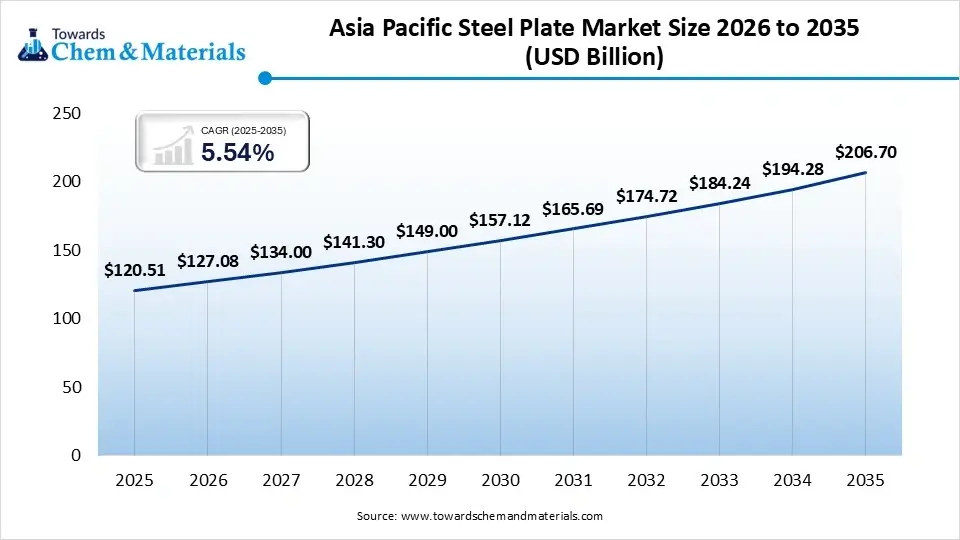
The Asia Pacific steel plate market size was valued at USD 120.51 billion in 2025 and is expected to be worth around USD 206.70 billion by 2035, exhibiting at a compound annual growth rate (CAGR) of 5.54% over the forecast period from 2026 to 2035. Asia Pacific dominated the steel plate market with the largest market share 56% in 2025, due to the region having very large construction activity, heavy manufacturing, transport equipment production, shipbuilding, and infrastructure expansion happening at the same time. Moreover, steel plates are required in bridges, factories, industrial buildings, railway systems, ports, and heavy machines, so demand remains continuously high. Also, the regional countries have strong local steel production, which supports easy material availability. Also, steel plates are used daily in many industries across this region without interruption.
Massive Demand Driving China’s Steel Industry
China maintained its dominance in the market, owing to its combination of very large steel production capacity with extremely high internal steel consumption. Moreover, the large volumes of steel plates are used in industrial machinery, commercial construction, transport equipment, shipbuilding, and energy projects. Moreover, many factories buy steel plates directly for manufacturing finished products, creating constant industrial demand.
Steel Plate Market Evaluation in North America
North America is expected to capture a major share of the steel plate market with a rapid CAGR, owing to many old bridges, industrial buildings, pipelines, and transport systems to be replaced or strengthened using heavy steel materials. Also, steel plates are important in these projects because they provide strong structural support and long service life. Furthermore, industrial investment is increasing in energy systems, logistics buildings, and technical manufacturing facilities.
Steel Plates Supporting United States Infrastructure Expansion
The United States is expected to emerge as a prominent country for the steel plate market in the coming years, due to many heavy industries there that use steel plates in industrial plants, transport equipment, pressure systems, energy facilities, and large commercial structures. Also, many infrastructure projects require steel in bridges, public transport systems, and utility construction. Moreover, the steel plates remain important because many sectors still depend on thick structural metal for safe operation. Future growth is likely to come from industrial modernization, where old metal systems are replaced with stronger new materials in the country.
Europe Steel Plate Market Examination
Europe is notably growing in industry, owing to steel plates increasingly used in technical manufacturing, energy systems, transport equipment, and specialized industrial construction. Moreover, many projects now require steel materials that offer reliable strength and stable performance over long service periods. Also, the advanced engineering sectors often prefer carefully processed steel plates for exact fabrication work. Moreover, steel plates are important because many industries need controlled material quality for precision production.
Steel Plate Market Share, By Regional, 2025 (%)
| Regional | Revenue Share, 2025 (%) |
| Asia-Pacific | 56.00% |
| Europe | 17.00% |
| North America | 16.00% |
| Latin America | 6.00% |
| Middle East & Africa | 5.00% |
Germany Strengthens Steel Plate Market Growth
Germany is expected to gain a significant industry share owing to many engineering industries there that use steel plates for machine frames, industrial equipment, transport systems, and heavy technical structures. Also, the manufacturing quality standards are high, so buyers often need steel plates with reliable dimensions and predictable performance. Moreover, the steel plate demand stays strong because industrial production requires strong and consistent material every day in the country.
Recent Developments
- In March 2026, ArcelorMittal created a partnership with Nippon Steel India. The partnership aims to develop a new steel plant in Andhra Pradesh, India, which has an annual capacity of 8.2 million tons and will also start operating at the beginning of 2029, as per the published report.(Source: www.yieh.com)
- In October 2025, Jindal Steel established its stainless steel fabrication unit in Washivali, Mumbai, India. Also, the newly launched plant has the capacity of fabrication up to 18000 tons annually, which is expected in FY26-27 as per the company's claim.(Source: www.jindalstainless.com )
Top Vendors in the Steel Plate Market & Their Offerings:
- Nucor Corporation: Based in the United States, Nucor is a pioneer in sustainable steelmaking, utilizing electric arc furnaces (EAF) to recycle scrap metal. As North America’s largest steel producer, it provides diverse products, including high-quality steel plates, while maintaining a highly decentralized, efficient management structure and a strong focus on innovation.
- POSCO Holdings: South Korea’s POSCO is a global steel powerhouse known for technical excellence and premium automotive and shipbuilding plates. Beyond its massive steel production facilities in Pohang and Gwangyang, the holding company is aggressively diversifying into eco-friendly materials, lithium, and battery components to lead the transition toward a green energy economy.
- ArcelorMittal: Headquartered in Luxembourg, ArcelorMittal is one of the world’s leading integrated steel and mining companies. Operating in over 60 countries, it supplies critical steel plates for global infrastructure and energy projects. The company is currently spearheading "XCarb" initiatives to achieve carbon neutrality through hydrogen-based steelmaking and carbon capture.
- JSW Steel Ltd.: Part of the O.P. Jindal Group, JSW Steel is India's leading private sector steel producer. With a massive integrated facility at Vijayanagar, it specializes in high-grade steel plates for the construction and automotive sectors. The company is rapidly expanding its capacity to meet India’s growing domestic infrastructure demands.
- Nippon Steel Corporation
- Tata Steel
- Baowu Steel Group
- JFE Steel Corporation
- EVRAZ
- HBIS Group
- Thyssenkrupp AG
- Jianlong Group
Segments Covered in the Report
By Type
- Carbon Steel Plate
- Low Carbon Steel Plate
- Medium Carbon Steel Plate
- High Carbon Steel Plate
- Alloy Steel Plate
- Low Alloy Steel Plate
- High Alloy Steel Plate
- Stainless Steel Plate
- Austenitic Stainless Steel
- Ferritic Stainless Steel
- Martensitic Stainless Steel
- Duplex Stainless Steel
By Thickness
Thin Plate (Up to 6 mm)
Medium Plate (6–25 mm)
Thick Plate (Above 25 mm)
By Manufacturing Process
- Hot Rolled Steel Plate
- Cold Rolled Steel Plate
- Quenched & Tempered Steel Plate
- Thermo-Mechanically Controlled Processed (TMCP) Plate
By Application
- Construction
- Residential Buildings
- Commercial Buildings
- Infrastructure Projects
- Automotive
- Passenger Vehicles
- Commercial Vehicles
- Shipbuilding & Marine
- Cargo Ships
- Naval Vessels
- Offshore Structures
- Energy & Power
- Oil & Gas
- Renewable Energy (Wind Towers)
- Power Plants
- Industrial Machinery
- Heavy Equipment
- Mining Machinery
- Others
- Defense
- Railways
By End-User Industry
- Construction & Infrastructure
- Automotive & Transportation
- Energy & Power
- Industrial Manufacturing
- Shipbuilding
- Others
By Region
- North America
- U.S.
- Canada
- Mexico
- Europe
- Germany
- UK
- France
- Italy
- Spain
- Asia Pacific
- China
- India
- Japan
- South Korea
- Latin America
- Brazil
- Argentina
- Middle East & Africa
- Saudi Arabia
- South Africa
FAQ's
Question 1 : What are the key growth drivers for the steel plate market?
Answer : The growing demand for stronger, lightweight materials in construction, automotive, and energy sectors, alongside infrastructure expansion, is driving the growth of the steel plate market.
Question 2 : How is the steel plate market expected to evolve by 2035?
Answer : The steel plate market is projected to grow at a CAGR of 5.45%, reaching USD 365.84 billion by 2035, driven by increased demand from construction, automotive, and energy sectors.
Question 3 : What are the technological advancements shaping the steel plate market?
Answer : Advanced rolling techniques, precision manufacturing, and the shift toward high-quality, custom-sized steel plates are improving performance, durability, and cost-efficiency in the steel plate market.
Question 4 : Who are the leading companies operating in the steel plate market?
Answer : Leading companies in the steel plate market include Nucor Corporation, POSCO Holdings, ArcelorMittal, JSW Steel, Nippon Steel, Tata Steel, and Baowu Steel Group, known for their diverse product offerings and global reach.
Meet the Team

Saurabh Bidwai
Principal Consultant
Saurabh Bidwai, a B.Tech Chemical Engineering graduate with 4+ years of experience, specializes in specialty chemicals, commodity chemicals, and engineered materials, offering valuable insights into market trends and emerging opportunities.

Aditi Shivarkar
Reviewed By
Aditi Shivarkar, with 14+ years in Chemical and Materials market research, specializes in Chemical and Materials. She ensures accurate, actionable insights, driving Towards Chemicals And Materials Analytics and Consulting excellence in industry trends and sustainability.