
Supplementary Cementitious Materials Market Size, Share, Growth, Report 2026 to 2035
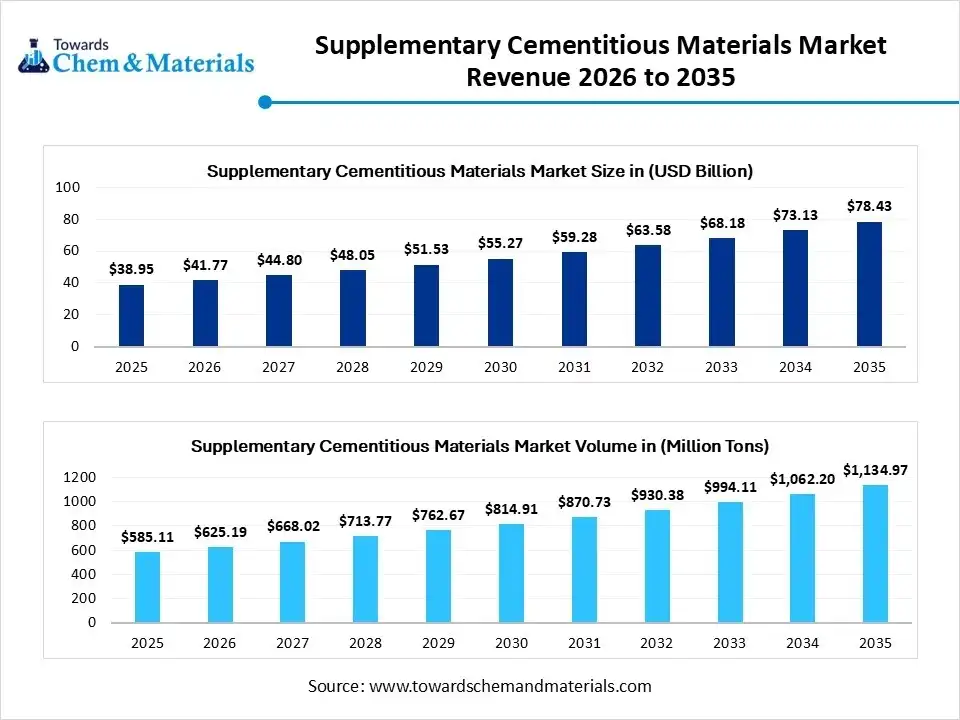
The global supplementary cementitious materials market size is expected to grow from USD 41.77 billion in 2026 to USD 78.43 billion in 2035, growing at a CAGR of 7.25% from 2026 to 2035. The top key players in the market are Holcim Group (formerly LafargeHolcim), Heidelberg Materials, CEMEX S.A.B. de C.V., CRH plc, Boral Limited, Sika AG, Tata Steel Ltd., ArcelorMittal SA
Content
What is the Current Size of the Supplementary Cementitious Materials Market and Its Projected Growth?
The global supplementary cementitious materials market size was estimated at USD 38.95 billion in 2025 and is expected to increase from USD 41.77 billion in 2026 to USD 78.43 billion by 2035, growing at a CAGR of 7.25% from 2026 to 2035. Asia Pacific dominated the supplementary cementitious materials market with the largest revenue share of 44% in 2025.In terms of volume, the market is projected to grow from 585.11 million tons in 2025 to 1,134.97 million tons by 2035. growing at a CAGR of 6.85% from 2026 to 2035.The greater shift towards sustainable construction activity has accelerated the industry's growth in recent years.
Market Highlights
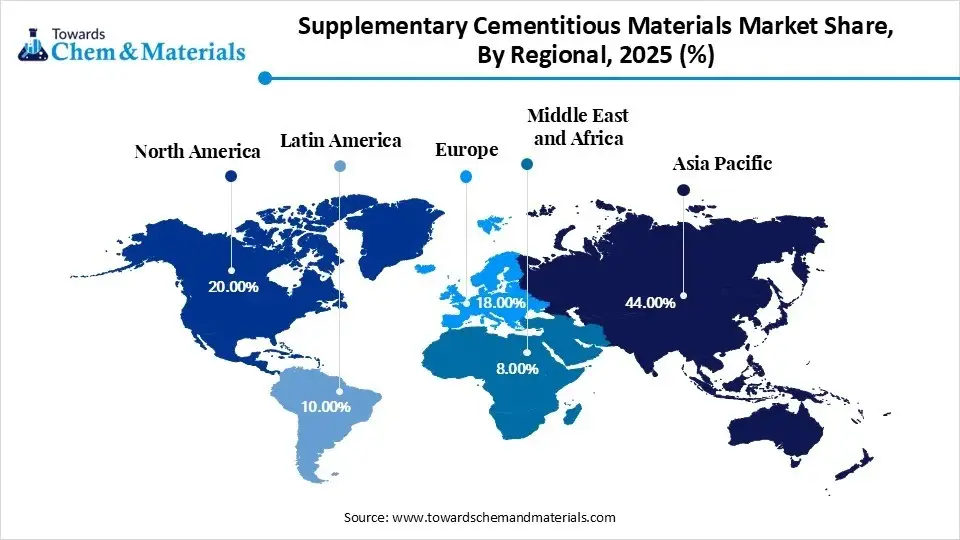
- By region, Asia Pacific dominated the supplementary cementitious materials market in 2025, with 44% industry share expected to sustain its position while growing with a CAGR of 8.60% in the forecast period, due to the massive and continuous construction activity here.
- By region, North America held the second largest share of 20% in 2025 and expects the notable growth with a CAGR of 7.10% during the forecast period, due to the region's focus on building longer-lasting and more sustainable structures.
- By type, the fly ash segment dominated the market with 38% share in 2025, owing to its being easily available, having a very low cost, and already being trusted by engineers.
- By type, the GGBFS segment expects the fastest growth in the market with 8.40% CAGR during the forecast period, as the market is shifting toward higher performance, not just low cost.
- By application, the concrete production segment dominated the market with 46% share in 2025, owing to SCMs are mostly used directly in concrete mixing.
- By application, the infrastructure segment expects the fastest growth in the market with 8.60% CAGR during the forecast period, due to the demand for future projects, long life, and high durability.
- By end-use industry, the construction segment dominated the market with 52% share in 2025, owing to its being the main user of concrete and cement.
- By end-use industry, the infrastructure development segment expects the fastest growth in the market with 8.70% CAGR during the forecast period, due to governments investing heavily in long-term public assets.
- By source, the coal-based power plants segment dominated the market with 41% share in 2025, owing to their production of fly ash in huge quantities as a byproduct. This made SCM supply easy and cheap
- By source, the steel industry segment expects the fastest growth in the market with 8.50% CAGR during the forecast period due to it producing slag, which can be processed into high-quality SCM like GGBFS.
Market Size and Volume Forecast
- Market Size (2025): USD 38.95 Billion | CAGR (2026–2035): 7.25%
- Market Projected Size (2035): USD 78.43 Billion
- Market Volume (2025): 585.11 Million Tons (MT) | Volume CAGR (2026–2035): 6.85%
- Market Projected Volume (2035): 1,134.97 Million Tons (MT)
- Market Pricing (2025):
- Average Manufacturing Price: USD 69/Ton
- Average Selling Price: USD 111/Ton
- Pricing CAGR (2026–2035): 3.24%
Smarter Materials for Stronger, Sustainable Concrete
The materials that are primarily added to cement for the improvement of concrete performance while reducing cement usage are known as the supplementary cementitious materials. Also, resisting damage while making concrete last longer and lower environmental harm, the supplementary cementitious materials have received greater attention from modern developers and the construction sector, as per the recent observation.
Recent Market Trends:
- The greater shift from waste to designed materials has driven the strategic transformation and sectoral scalability in recent years. Moreover, in earlier periods, the SCM was treated as waste material, but the major companies have been designing SCMs intentionally in recent years.
- The establishment of the localized manufacturing plants has positioned the industry for long-term expansion in recent years. By avoiding the longer distance transportation and meeting the availability of materials near construction sites, the localization of manufacturing plants has gained industry attention in the current period.
- The greater focus on performance-based material manufacturing is expected to allow stakeholders to capitalize on growth opportunities in the coming years. Moreover, the major manufacturers have been seen investing in research and development programs nowadays.
Report Scope
| Report Attribute | Details |
| Market Size in 2026 | USD 41.77 Billion / 625.19 Million Tons |
| Revenue Forecast in 2035 | USD 78.43 Billion / 1,134.97 Million Tons |
| Growth Rate | CAGR 5.95% |
| Forecast Period | 2026 - 2035 |
| Base Year | 2025 |
| Dominant Region | Asia Pacific |
| Segment Covered | By Type, By Application, By End Use Industry, By Source, By Form, By Distribution, By Region |
| Key companies profiled | Holcim Group (formerly LafargeHolcim), Heidelberg Materials, CEMEX S.A.B. de C.V., CRH plc, Boral Limited, Sika AG, Tata Steel Ltd., ArcelorMittal SA |
Engineered Reactivity for Better Construction Performance
The industry is moving toward controlled reactivity. Earlier, SCMs reacted slowly and unpredictably. Moreover, the technologies are traditionally used to take control of material speed and reaction. Also, this includes improving particle size, heat treatment, and chemical activation. The goal is to make SCMs behave more like engineered products rather than natural or waste materials. This shift is important because it reduces risk in construction projects.
Supply Chain Analysis of the Supplementary Cementitious Materials Market:
Distribution to Industrial Users
- Industrial distribution of Supplementary Cementitious Materials (SCMs) like fly ash, slag, and silica fume typically utilizes specialized bulk logistics. Materials are pneumatically conveyed into storage silos and transported via bulk tanker trucks, rail cars, or barges to ready-mix concrete plants.
- This just-in-time supply chain ensures efficient, low-carbon delivery for large-scale infrastructure and industrial construction.
Chemical Synthesis and Processing
- Chemical synthesis and processing of SCMs involve transforming industrial by-products into reactive binders. Slag undergoes water-quenching for vitrification, while fly ash is precipitated from flue gas.
- Advanced SCMs are synthesized via calcination of clays or vapor-phase oxidation for silica fume, optimizing particle fineness and chemical reactivity for concrete durability.
Regulatory Compliance and Safety Monitoring
- Regulatory compliance for SCMs involves adhering to ASTM or EN standards to ensure chemical stability. Safety monitoring focuses on OSHA-mandated silica exposure limits and heavy metal leaching tests.
- Continuous industrial oversight, including material safety data sheets (MSDS) and air quality sensors, mitigates respiratory risks during bulk handling and pneumatic processing.
Supplementary Cementitious Materials Market Regulatory Landscape: Regulations
| Country Region | Regulatory Body | Key Regulations | Focus Areas |
| United States | ASTM International & EPA | ASTM C618 (Coal Fly Ash/Pozzolans); ASTM C1240 (Silica Fume); ASTM C989 (Slag Cement) | Classification (Class F vs. C), chemical composition (sum of oxides 70% for Class F), and fineness. |
| Europe | CEN (European Committee for Standardization) |
EN 197-1 (Common Cement Types); EN 450-1 (Fly Ash for Concrete) | Harmonised performance across the Single Market, durability in severe environments, and clinker reduction. |
| China | SAC (Standardization Administration of China) | GB/T 1596 (Fly Ash for Cement/Concrete); GB/T 18046 (Ground Granulated Slag). |
Technical requirements for activity index, loss on ignition (LOI), and insoluble matter. |
Segmental Insights
Type Insights
The Fly Ash Segment Dominated the Supplementary Cementitious Materials Market with 38% Market Share in 2025
The fly ash segment dominated the market with 38% share in 2025, owing to its being easily available, very low cost, and already trusted by engineers. For many years, coal power plants produced huge amounts of fly ash, so supply was never a problem. It also blends well with cement without requiring major process changes. Contractors like materials that are familiar and safe, and fly ash fits that perfectly.
The GGBFS segment is expected to be the fastest growing in the market with 8.40% CAGR during the forecast period, as the market is shifting toward higher performance, not just low cost. Unlike fly ash, GGBFS gives better durability, especially in harsh environments like coastal or industrial areas. As construction quality standards increase, builders prefer materials that give long life, not just savings.
The silica fume segment held the third largest share of 14% in 2025. It gives very high strength and excellent durability, but it is not needed for normal construction. It is mainly used in special projects like bridges, high-rise buildings, or heavy-load structures. Because of its fine particles, it also needs careful handling and skilled usage.
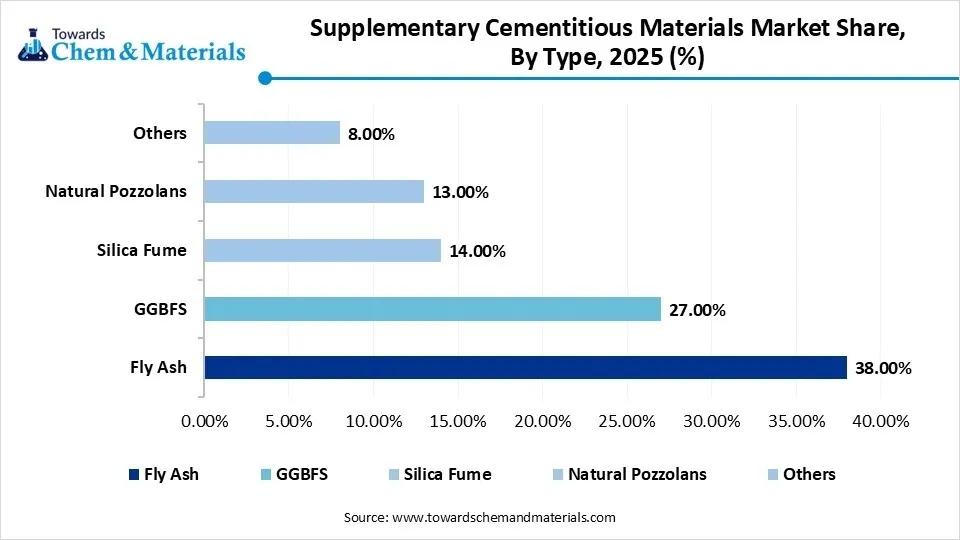
The natural pozzolans segment held the fourth largest share of 13% in 2025, owing to the world's move toward eco-friendly and locally available materials. These materials reduce dependence on industrial waste and support sustainable construction. Many regions are now exploring their own natural resources, which creates new opportunities. Governments and researchers are also promoting their use to reduce carbon emissions.
Supplementary Cementitious Materials Market Share, By Type, 2025 (%)
| By Type | Revenue Share, 2025 (%) |
| Fly Ash | 38.00% |
| GGBFS | 27.00% |
| Silica Fume | 14.00% |
| Natural Pozzolans | 13.00% |
| Others | 8.00% |
- Fly Ash leads the market with a share of 38.00%. Its widespread use in the construction industry is driven by its availability, cost-effectiveness, and ability to enhance the durability of concrete.
- GGBFS (Ground Granulated Blast-Furnace Slag) accounts for 27.00% of the market. Known for improving the strength and workability of concrete, it is widely used in infrastructure projects and high-performance concrete.
- Silica Fume holds 14.00% of the market. Its high reactivity enhances the strength and durability of concrete, making it a key material in advanced concrete applications.
- Natural Pozzolans make up 13.00% of the market. These materials are increasingly used for their environmental benefits and ability to reduce the carbon footprint of cement-based products.
- Others account for 8.00% of the market. This category includes various supplementary materials used in specialized applications within the construction and infrastructure sectors
Application Insights
The Concrete Production Segment Dominated the Market with 46% Market Share in 2025
The concrete production segment dominated the market with 46% share in 2025, owing to SCMs are mostly used directly in concrete mixing. Every construction project needs concrete, so this application naturally becomes the largest. SCMs improve concrete properties like strength, durability, and workability, making them highly valuable here. Also, ready-mix concrete plants can easily adjust mixes to include SCMs without major changes.
The cement manufacturing segment held the second largest share of 28% in 2025 due to SCMs being used as partial clinker replacement during production. This helps reduce cost and carbon emissions. However, not all cement plants can easily adjust their processes to include high levels of SCMs. There are technical limits and quality standards that restrict usage.
The infrastructure segment is expected to be the fastest-growing in the market with 8.60% CAGR during the forecast period due to the demand for future projects, long life, and high durability. Roads, bridges, metro systems, and dams must last decades with minimal repair. SCMs help achieve this by improving resistance to water, chemicals, and weather. Governments are also focusing on sustainable construction, which increases SCM use.
The oil & gas well cementing segment held the fourth largest share of 6% in 2025, owing to its requirement for very reliable and durable cementing solutions. SCMs help improve performance under extreme conditions like high pressure and temperature. As energy demand continues, new exploration and drilling activities are happening in deeper and more challenging locations. This increases the need for better materials.
Supplementary Cementitious Materials Market Share, By Application, 2025 (%)
| By Application | Revenue Share, 2025 (%) |
| Concrete Production | 46.00% |
| Cement Manufacturing | 28.00% |
| Infrastructure | 16.00% |
| Oil & Gas Well Cementing | 6.00% |
| Others | 4.00% |
- Concrete Production holds the largest share of the market with 46.00%. Supplementary cementitious materials are primarily used to enhance the properties of concrete, improving its strength, durability, and sustainability.
- Cement Manufacturing accounts for 28.00% of the market. These materials are added to cement to improve its quality and reduce the environmental impact of cement production.
Infrastructure makes up 16.00% of the market. Supplementary cementitious materials are used in infrastructure projects like roads, bridges, and tunnels to increase the longevity and strength of concrete structures. - Oil & Gas Well Cementing holds 6.00% of the market. These materials are used in oil and gas well cementing to enhance the performance of cement in challenging underground environments.
- Others account for 4.00% of the market. This category includes niche applications in sectors such as agriculture, mining, and waste management, where supplementary cementitious materials offer specialized benefits.
End Use Industry Insights
The Construction Segment Dominated the Supplementary Cementitious Materials Market with 52% Market Share in 2025
The construction segment dominated the market with 52% share in 2025, owing to its being the main user of concrete and cement. Every building, road, and structure depends on these materials. SCMs naturally become part of this industry because they improve performance and reduce cost. Also, construction is growing rapidly in developing countries, increasing demand.
The infrastructure development segment is expected to be the fastest growing in the market with 8.70% CAGR during the forecast period due to governments investing heavily in long-term public assets. These projects require materials that last longer and need less maintenance. SCMs help achieve both goals.
The oil and gas segment held the third-largest share of 9% in 2025, owing to its focus on safety, durability, and long-term performance. SCMs help improve cement quality used in pipelines, wells, and structural supports. As projects become more complex, the need for advanced materials increases.
The marine segment held the fourth largest share of 8% in 2025 due to coastal development and offshore projects increasing. Ports, harbors, offshore wind farms, and coastal protection structures require materials that can resist saltwater and corrosion. SCMs are very useful here because they improve durability in harsh environments.
Supplementary Cementitious Materials Market Share, By End-Use Industry 2025 (%)
| By End-Use Industrty | Revenue Share, 2025 (%) |
| Construction | 52.00% |
| Infrastructure Development | 24.00% |
| Oil & Gas | 9.00% |
| Marine | 8.00% |
| Others | 7.00% |
- Construction dominates the market with a share of 52.00%. The construction industry's demand for durable and high-performance concrete makes it the largest end-user of supplementary cementitious materials.
- Infrastructure Development accounts for 24.00% of the market. These materials are essential in enhancing the longevity and strength of infrastructure projects, including roads, bridges, and buildings.
- Oil & Gas holds 9.00% of the market. Supplementary cementitious materials are used in the oil and gas industry for concrete production in challenging environments, such as offshore platforms and drilling sites.
- Marine makes up 8.00% of the market. The marine industry utilizes these materials to improve the durability of structures exposed to harsh sea conditions, such as ports, piers, and ships.
- Others account for 7.00% of the market. This category includes various niche applications in sectors like agriculture, mining, and waste management where supplementary cementitious materials offer specialized benefits.
Source Insights
The Coal-Based Power Plants Segment Dominated the Market with 41% Market Share in 2025
The coal-based power plants segment dominated the market with 41% share in 2025, owing to their production of fly ash in huge quantities as a byproduct. This made SCM supply easy and cheap. Since disposal of fly ash is a problem, using it in construction became a practical solution. This created a strong link between power plants and the construction industry.
The steel industry segment is expected to be the fastest growing in the market with 8.50% CAGR during the forecast period due to it producing slag, which can be processed into high-quality SCM like GGBFS. As construction demands stronger and more durable materials, slag-based SCMs become more valuable. Also, steel production is expected to remain stable or grow, ensuring supply.
The natural sources segment held the third largest share of 13% in 2025, owing to the construction industry's exploration of more sustainable and region-based materials. These sources reduce environmental impact and support local economies. As transportation costs increase, using nearby materials becomes more attractive. Research and technology are also improving how these materials are processed and used.
The silicon & ferrosilicon industry segment held the fourth largest share of 12% in 2025, because it produces silica fume, which is highly valuable in modern construction. As demand for high-performance concrete increases, the importance of silica fume also rises. Industries are also improving production efficiency, which increases availability.
Supplementary Cementitious Materials Market Share, By Source 2025 (%)
| By Source | Revenue Share, 2025 (%) |
| Coal-Based Power Plants | 41.00% |
| Steel Industry | 26.00% |
| Silicon & Ferrosilicon Industry | 12.00% |
| Natural Sources | 13.00% |
| Agricultural Waste | 8.00% |
- Coal-Based Power Plants lead the market with a share of 41.00%. The byproducts from coal-based power plants, such as fly ash, are widely used in the production of supplementary cementitious materials due to their availability and cost-effectiveness.
- Steel Industry accounts for 26.00% of the market. Byproducts from the steel industry, such as slag, are used in the production of supplementary materials that improve the strength and durability of concrete.
- Silicon & Ferrosilicon Industry holds 12.00% of the market. Waste products from these industries, like silica fume, contribute significantly to the high-performance characteristics of cementitious materials.
- Natural Sources make up 13.00% of the market. Materials sourced from natural deposits, like volcanic ash and pozzolans, are increasingly used for their sustainability and environmental benefits in concrete production.
- Agricultural Waste accounts for 8.00% of the market. Agricultural byproducts, such as rice husk ash, are being utilized as supplementary materials, contributing to the growing trend of sustainable construction practices.
By Form
The segmented by form, includes Powder, Granular, and Slurry. The Powder form dominates the market, accounting for 58.00% of the total demand in 2025. Its widespread adoption is driven by its compatibility with various manufacturing processes, offering superior stability and ease of handling. Powdered solvents are preferred in industries that require precise control over solvent quantities, such as in battery manufacturing. On the other hand, the Granular form is expected to grow at a rapid pace, as it offers advantages in terms of ease of transport and improved handling characteristics. This form is increasingly being used in applications where bulk processing and cost efficiency are key considerations.
The Slurry form, while the smallest segment, continues to serve specialized applications that require liquid consistency for easy mixing and uniform distribution in the production of lithium-ion batteries, especially in the energy storage and automotive sectors. As demand for more efficient manufacturing grows, these forms will continue to evolve.
Supplementary Cementitious Materials Market Share, By Form 2025 (%)
| By Form | Revenue Share, 2025 (%) |
| Powder | 58.00% |
| Granular | 24.00% |
| Slurry | 18.00% |
- Dip Coating leads the market with a share of 30.00%. This technology is widely used due to its simplicity and effectiveness in providing uniform coatings on large surfaces, especially in the medical and automotive industries.
- Spray Coating accounts for 22.00% of the market. It is favored for its flexibility and ability to coat complex and large surfaces, making it ideal for applications in electronics and automotive sectors.
- Spin Coating holds 14.00% of the market. This technology is used for creating thin, uniform coatings, especially in the electronics and semiconductor industries, due to its precision and efficiency.
- Chemical Vapor Deposition (CVD) represents 18.00% of the market. CVD is widely used for high-performance coatings in industries such as aerospace and electronics, providing enhanced material properties and durability.
- Physical Vapor Deposition (PVD) makes up 16.00% of the market. PVD is commonly used to deposit thin, durable films in applications like optics and electronics, where precision and surface quality are critical.
By Distribution Channel
The Supplementary Cementitious Materials (SCMs) Market, segmented by distribution channel, includes Direct Sales, Distributors & Dealers, and Online Sales. Direct Sales is the dominant channel, accounting for 49.00% of the market share in 2025. This channel is favored by large construction companies and manufacturers, as it ensures direct access to bulk materials, often at more competitive prices, and allows for personalized customer service.
The Distributors & Dealers segment is witnessing steady growth, driven by its ability to offer widespread availability and localized distribution, making it ideal for smaller-scale contractors and regional projects. The fastest-growing segment, however, is Online Sales. With the increasing digitalization of the construction and materials industry, the convenience of ordering SCMs online is gaining significant traction. This segment benefits from the ability to reach a global customer base and streamline ordering processes, catering to both small contractors and large-scale construction firms looking for easy access to materials and enhanced logistics.
Supplementary Cementitious Materials Market Share, By Distribution Channel 2025 (%)
| By Distribution Channel | Revenue Share, 2025 (%) |
| Direct Sales | 49.00% |
| Distributors & Dealers | 36.00% |
| Online Sales | 15.00% |
- Direct Sales hold the largest share of the market with 49.00%. This channel is preferred by manufacturers for direct engagement with large-scale clients, ensuring efficient delivery and tailored solutions.
- Distributors & Dealers account for 36.00% of the market. They play a crucial role in reaching a broader customer base, providing access to supplementary cementitious materials across various regions.
- Online Sales make up 15.00% of the market. The growing trend of e-commerce and digital transactions has made it easier for smaller buyers to access these materials, contributing to this segment's share.
Regional Insights
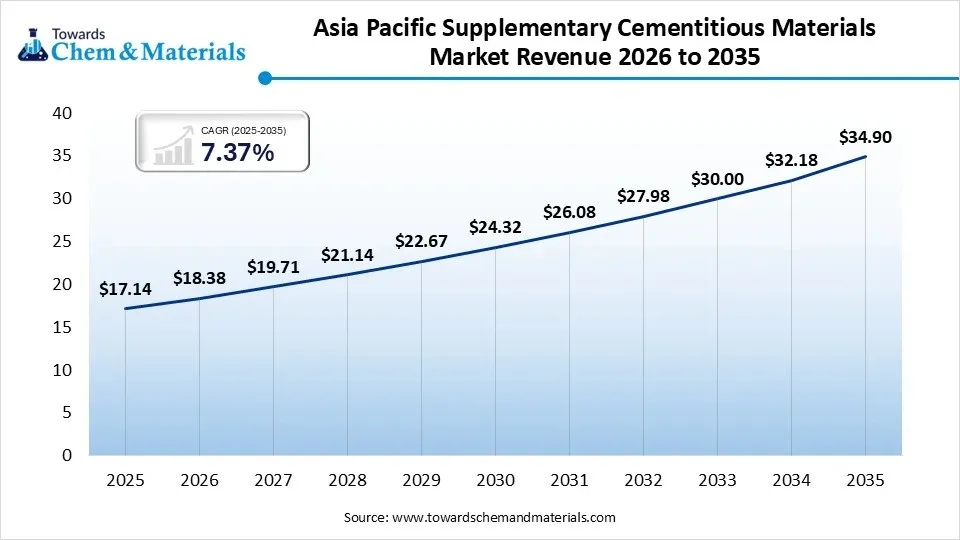
The Asia Pacific supplementary cementitious materials market size was valued at USD 17.14 billion in 2025 and is expected to be worth around USD 34.90 billion by 2035, exhibiting at a compound annual growth rate (CAGR) of 7.37% over the forecast period from 2026 to 2035.Asia Pacific dominated the market with a share of 44% in 2025 and is expected to sustain its position while growing with a CAGR of 8.60% in the forecast period, due to the massive and continuous construction activity here. Countries in this region are building cities, roads, metros, and industries at a very fast rate. This creates huge demand for concrete, and naturally, SCMs are used more. Also, the cost sensitivity, builders prefer materials that reduce cement cost, and SCMs help in that.
China Leading with Strong Construction Growth
China maintained its dominance in the market, owing to the country's focus on infrastructure like highways, railways, and smart cities. This creates continuous demand for concrete and SCMs. China also has strong industrial output, which means a steady supply of materials like slag and fly ash. Moreover, the government supports sustainable construction, encouraging the use of alternative materials.
Supplementary Cementitious Materials Market Evaluation in North America
North America held the second largest share of 20% in 2025 and expects the notable growth with a CAGR of 7.10% during the forecast period, owing to the region's focus on building longer-lasting and more sustainable structures. This increases the use of high-performance SCMs. Strict environmental regulations are also pushing companies to reduce cement usage and adopt greener materials. Also, the innovation, new technologies, and advanced mix designs are being developed here.
United States Leading Next Construction Evolution
The United States is expected to emerge as a prominent country for the supplementary cementitious materials market in the coming years, due to its focus on upgrading old infrastructure, along with new construction. Bridges, roads, and buildings need repair and strengthening, which increases demand for durable materials like SCMs. The country also invests heavily in research and technology, improving how SCMs are used.
Supplementary Cementitious Materials Market Share, By Regional, 2025 (%)
| Regional | Revenue Share, 2025 (%) |
| Asia-Pacific | 44.00% |
| North America | 20.00% |
| Europe | 18.00% |
| Latin America | 10.00% |
| Middle East & Africa | 8.00% |
- Asia-Pacific leads the market with a significant 44.00% share, driven by the rapid urbanization and construction activities in countries like China and India, where the demand for sustainable building materials is high.
- North America holds a 20.00% share of the market, with growing awareness of environmental impact and a strong construction industry focused on reducing carbon emissions.
- Europe represents 18.00% of the market, where strict environmental regulations and a commitment to green building practices drive the adoption of supplementary cementitious materials.
- Latin America accounts for 10.00% of the market, supported by increasing infrastructure projects and a rising interest in environmentally friendly construction alternatives.
- Middle East & Africa contributes 8.00% of the market share, reflecting ongoing construction developments and a gradual shift towards sustainable building materials, despite the region's traditionally smaller market size.
Recent Development
- In July 2025, the CRH completed the acquisition of Eco Material Technologies with a total consideration of $2.1 billion. Also, the main motive behind this acquisition is to meet the increasing need for cementitious products in the current period and support North American infrastructure modernization, as per the published report.
(Source: www.crh.com)
Top Vendors in the Supplementary Cementitious Materials Market & Their Offerings:
- Holcim Group (formerly LafargeHolcim): Headquartered in Switzerland, Holcim is the world's largest cement producer, formed by the 2015 merger of Lafarge and Holcim. It operates in over 70 countries, focusing on sustainable building solutions like low-carbon concrete. The group recently spun off its North American operations as Amrize in June 2025.
- Heidelberg Materials: This German multinational rebranded from HeidelbergCement in 2022 to reflect its broader focus on circularity. A global leader in aggregates and cement, it operates in 50 countries with 51,000 employees. It recently pioneered the world’s first industrial-scale carbon capture facility at its Brevik plant in Norway.
- CEMEX S.A.B. de C.V.: Based in Mexico, CEMEX is a top-tier global producer of cement, ready-mix concrete, and aggregates with a presence in over 50 countries. It is recognized for its digital transformation and "Future in Action" program, aiming for carbon neutrality. A significant portion of its revenue comes from the U.S. and Mexican markets.
- CRH plc: Headquartered in Ireland, CRH is the largest building materials company in North America and Europe. It follows an acquisition-led growth strategy, recently acquiring Eco Material Technologies for $2.1 billion in late 2025. In 2023, it moved its primary stock listing to the New York Stock Exchange to better reflect its heavy U.S. presence.
- Boral Limited
- Sika AG
- Tata Steel Ltd.
- ArcelorMittal SA
Segments Covered in the Report
By Type
- Fly Ash
- Class F Fly Ash
- Class C Fly Ash
- Ground Granulated Blast Furnace Slag (GGBFS)
- Grade 80
- Grade 100
- Grade 120
- Silica Fume
- Undensified Silica Fume
- Densified Silica Fume
- Natural Pozzolans
- Volcanic Ash
- Calcined Clay
- Diatomaceous Earth
- Others
- Rice Husk Ash
- Metakaolin
By Application
- Concrete Production
- Ready-Mix Concrete
- Precast Concrete
- High-Performance Concrete
- Cement Manufacturing
- Blended Cement
- Portland Pozzolana Cement (PPC)
- Infrastructure
- Roads & Highways
- Bridges & Dams
- Tunnels
- Oil & Gas Well Cementing
- Others
- Mining Backfill
- Waste Stabilization
By End Use Industry
- Construction
- Residential
- Commercial
- Industrial
- Infrastructure Development
- Transportation Infrastructure
- Energy Infrastructure
- Oil & Gas
- Marine
- Others
- Waste Management
- Agriculture
By Source
- Coal-Based Power Plants
- Steel Industry
- Silicon & Ferrosilicon Industry
- Natural Sources
- Agricultural Waste
By Form
- Powder
- Granular
- Slurry
By Distribution
- Direct Sales
- Distributors & Dealers
- Online Sales
By Region
- North America
- U.S.
- Canada
- Mexico
- Europe
- Germany
- UK
- France
- Italy
- Spain
- Asia Pacific
- China
- India
- Japan
- South Korea
- Latin America
- Brazil
- Argentina
- Middle East & Africa
- Saudi Arabia
- South Africa
FAQ's
Question 1 : What is the current size and projected growth of the global supplementary cementitious materials market?
Answer : The global supplementary cementitious materials market size is estimated at USD 38.95 billion in 2025 and is expected to grow to USD 78.43 billion by 2035, with a CAGR of 7.25% from 2026 to 2035.
Question 2 : Which regions are leading the supplementary cementitious materials market and why?
Answer : Asia Pacific dominates the market with a 44% share in 2025, driven by massive construction activity, while North America is expected to see notable growth with a 7.10% CAGR due to a focus on sustainable and long-lasting structures.
Question 3 : What are the key types and applications driving growth in the supplementary cementitious materials market?
Answer : Fly ash leads the market with a 38% share in 2025, followed by GGBFS at 27%. The concrete production segment dominates, with SCMs improving strength, durability, and workability in construction.
Question 4 : How are sources like coal-based power plants and the steel industry impacting the supplementary cementitious materials market?
Answer : Coal-based power plants dominate the market with a 41% share, providing a steady supply of fly ash, while the steel industry is expected to grow at the fastest rate, contributing slag for GGBFS production at an 8.50% CAGR.
Meet the Team

Saurabh Bidwai
Principal Consultant
Saurabh Bidwai, a B.Tech Chemical Engineering graduate with 4+ years of experience, specializes in specialty chemicals, commodity chemicals, and engineered materials, offering valuable insights into market trends and emerging opportunities.

Aditi Shivarkar
Reviewed By
Aditi Shivarkar, with 14+ years in Chemical and Materials market research, specializes in Chemical and Materials. She ensures accurate, actionable insights, driving Towards Chemicals And Materials Analytics and Consulting excellence in industry trends and sustainability.