
Sustainable Adhesive Market Size, Share, Growth, Report 2026 to 2035
The Global Sustainable Adhesive Market report segmented By Type (Recyclable Adhesives, Renewable Adhesives, Repulpable Adhesives, Biodegradable Adhesives, Other Types), By Raw Material (Water-based, Plant-based, EVA-based, Acrylic-based, Other Types), By End-Use Industry (Automotive, Packaging, Medical, Woodworking, Consumer Goods, Construction, other)—Global Industry Analysis, Size, Trends, Leading Companies, Regional Outlook, and Forecast 2026 to 2035
Content
What is the current Sustainable Adhesive Market Size and Share?
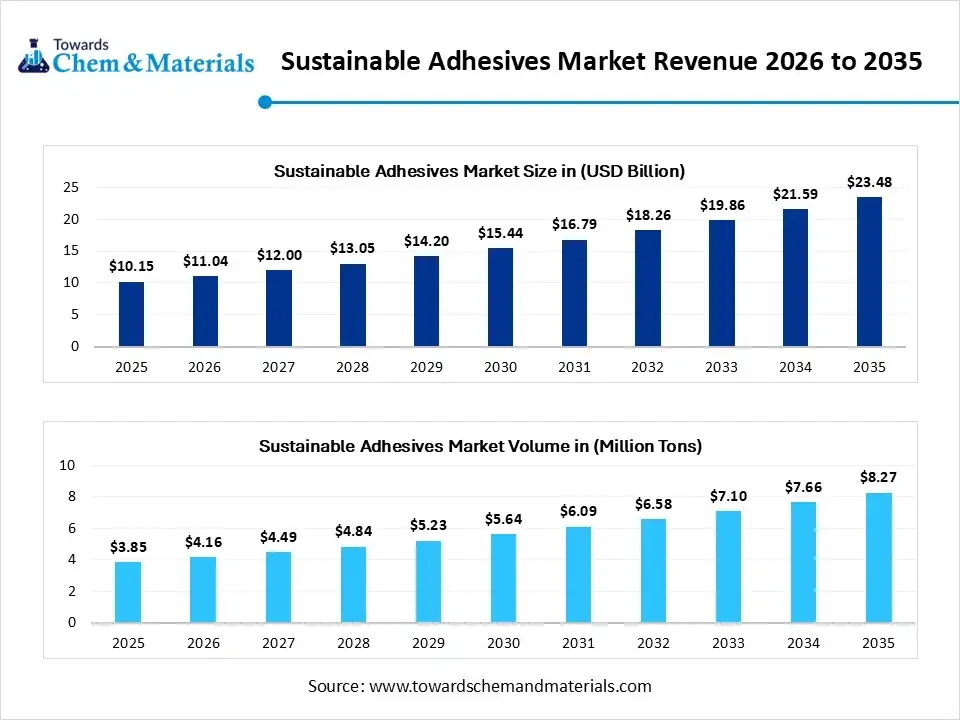
The global sustainable adhesive market size was valued at USD 10.15 billion in 2025, is estimated to reach USD 11.04 billion in 2026, and is projected to reach USD 23.48 billion by 2035, exhibiting a compound annual growth rate (CAGR) of 8.75% over the forecast period from 2026 to 2035. Asia Pacific dominated the sustainable adhesive market with the largest revenue share of 33% in 2025 and is expected to grow at the fastest CAGR of 8.92% during the forecast period. In terms of volume, the sustainable adhesive industry is projected to grow from 3.85 million tons in 2025 to 8.27 million tons by 2035. growing at a CAGR of 7.95% from 2026 to 2035. Innovations in bio-based adhesive formulas are the key factor in driving market growth. Also, strict environmental regulations coupled with the expanding sustainable packaging sector can fuel market growth further.
The market includes the industry that manufactures and supplies sustainable bonding agents. These adhesives are produced to reduce toxic emissions and decrease environmental effects by utilizing recyclable or biodegradable materials with high-performance bonding strength. The market mainly emphasizes replacing conventional, petroleum-based chemical adhesives with eco-friendly chemistries.
With the growing focus on sustainability, enterprises are increasingly innovating to develop bio-based, non-toxic formulations that accommodate the expanding market for environmentally conscious solutions. Also, global regulatory frameworks are intensifying, as governments implement more stringent directives concerning the application of hazardous chemical compounds in adhesive manufacturing.
Market Highlights
- By region, Asia Pacific dominated the market with the largest share of 33.00% in 2025 and is expected to grow at the fastest CAGR of 9.6% over the forecast period. The dominance and growth of the region can be attributed to the growing consumer inclination for biodegradable and recyclable packaging.
- By region, Europe held a market share of 31.00% in 2025. The growth of the region can be credited to the increasing demand for low-emission and lightweight materials in the construction and automotive sectors.
- By type, the recyclable adhesives segment dominated the market with the largest share of 29.00% in 2025. The dominance of the segment can be attributed to the increasing demand for recycled adhesive technologies.
- By type, the biodegradable adhesives segment is expected to grow at the fastest CAGR of 10.2% over the forecast period. The growth of the segment can be credited to the growing demand for compostable packaging.
- By raw material, the water-based segment dominated the market with the largest share of 36.00% in 2025. The growth of the segment is due to the ongoing growth in sustainable packaging.
- By raw material, the plant-based segment is expected to grow at the fastest CAGR of 9.7% over the forecast period. The growth of the segment is due to rapid innovations in green chemistry.
- By end-use industry, the packaging segment dominated the market with the largest share of 31.00% in 2025. The dominance of the segment can be linked to the increasing e-commerce demand.
- By end-use industry, the automotive segment is expected to grow at the fastest CAGR of 8.90% during the projected period. The growth of the segment can be driven by rising adoption of bio-based adhesives.
The Shift to Eco-Friendly Adhesives and Bio-Based Polymers
The sustainable adhesives market has experienced fast-paced growth in recent years. The growing consumer base for eco-friendly products, sustainability favorable rules and regulations, and enhancements of bio-based materials are major growth factors for the industry in the current period. The industry's shifting toward greener alternatives can replace traditional adhesives that contain volatile organic compounds and petroleum-based chemicals soon.
- For Instance, In 2024, Bostik introduced bio-based adhesives which are instant engineering adhesives. The name of the adhesive is Born2BondTM Ultra K85. This adhesive is made up of 60% eco-friendly raw materials.
The increasing need for biobased polymers is anticipated to drive market growth during the forecast period. the manufacturers are actively looking for reducing carbon footprint in recent period. Thus, the biobased polymer is expected to emerge as a key solution for industries such as construction, packaging, consumer goods, and automotive during the next decade
Recent Trends:
- The emergence of circular economy practices is the latest trend in the market, shaping positive market growth. Major market players are rapidly adopting circular economy models to reduce waste and maximize overall resource efficiency. This shift is also beneficial for the environment and new business avenues.
- The expansion of the automotive and construction sectors is a key market driver. As these sectors grow, the need for adhesives that fulfill the stringent performance and environmental standards is rising. In construction, sustainable adhesives are used for insulation, flooring, and other applications.
- Technological innovations in adhesive production are another major factor in fueling market growth. Advancements in production processes, like the development of bio-based adhesives, are improving overall performance while minimizing adverse environmental impacts.
Report Scope
| Report Attribute | Details |
| Market Size and Volume in 2026 | USD 11.04 Billion / 4.16 Million Tons |
| Revenue Forecast in 2035 | USD 23.48 Billion / 8.27 Million Tons |
| Growth Rate | CAGR 8.75% |
| Forecast Period | 2026 - 2035 |
| Base Year | 2025 |
| Dominant Region | Asia Pacific |
| Segment Covered | By Type, By Raw Material, By End-Use Industry, By Regions |
| Key companies profiled | BASF, Henkel AG & Co. KGaA, H.B. Fuller Company, Jowat Se, Dow, Dupont, Arkema, Avery Dennison Corporation, Paramelt B.V., Synthos |
How Are Cutting-Edge AI Technologies Revolutionizing the Sustainable Adhesives Market?
AI is extensively revolutionizing the market by boosting sustainable R&D, facilitating materials usage, and improving circularity. By reducing lengthy trial and error processes. Furthermore, cutting-edge digital modeling simulates the heat, stress, and physical performance of bonded materials to ensure proper structural durability.
Supply Chain Analysis of the Sustainable Adhesives Market
Feedstock Procurement
- It refers to the sourcing of raw materials, like natural polymers, bio-based resins, and recycled synthetic materials used to produce sustainable adhesives.
- Major Players: Henkel AG & Co. KGaA, Arkema/Bostik
Chemical Synthesis and Processing
- It includes the core scientific techniques used to design sustainable bonding agents from renewable, low-toxicity, or recyclable raw materials.
- Major Players: 3M Company, Avery Dennison Corporation
Packaging and Labeling
- It refers to the use of sustainable bonding agents to seal cartons and attach labels and packaging without harming the environment.
- Major Players: 3M, Arkema
Regulatory Compliance and Safety Monitoring
- It ensures products contain minimal toxic emissions (VOCs), lack of hazardous chemicals, and fulfill strict environmental frameworks.
- Major Players: Arkema Group, Pidilite Industries
Sustainable Adhesives Market's Regulatory Landscape: Global Regulations
| Country/Region | Key Regulations |
| European Union | Packaging and Packaging Waste Regulation (PPWR): Enforces strict design-for-recycling metrics, creating immediate demand for water-soluble or easily removable adhesives that don't contaminate the plastic and paper recycling streams. |
| United States | The U.S. Environmental Protection Agency (EPA) regulates chemical compliance under the Toxic Substances Control Act (TSCA), restricting specific per- and polyfluoroalkyl substances (PFAS) and conventional solvents. |
| China | China utilizes strict national standards (such as GB 30981-2020 and GB 33372-2020) to strictly limit harmful substances and limit volatile organic compounds in adhesives |
Market Dynamics
Driver
Growing Demand from the Automotive Sector
The growing product demand from the automotive industries is the major factor driving the growth of the market. The industry is emphasizing minimizing the weight of its vehicles to achieve superior fuel economy and abide by stringent environmental regulations. The sustainable adhesives include bio-based epoxies, necessary for heavy-weighting solutions in different materials such as plastics and composites. In addition, sustainable adhesives, notable for their minimal volatile organic compound (VOC) emissions and renewable origins, are increasingly adopted across diverse applications.
Restraint
Higher Manufacturing Cost
The high formulation and production cost of sustainable adhesives is the major factor hindering the growth of the market. Sustainable adhesives are more costly than traditional, petroleum-based adhesives. Moreover, the ongoing research and development (R&D) necessary to enhance the performance and durability of these adhesives inherently raises their overall cost, hampering market expansion soon.
Opportunity
Increasing Consumer Awareness
Growing consumer awareness and demand for sustainability are the key factors creating lucrative opportunities in the market. As consumers are becoming more informed regarding environmental issues, their inclinations are transitioning towards products that are sustainable. Furthermore, the industry is undergoing a significant transformation, with enterprises dedicating resources to research and development to satisfy this escalating demand. This transition not only yields environmental benefits but also cultivates stronger brand loyalty among consumers who prioritize sustainability.
Segmental Insights
Type Insights
The recyclable adhesives segment dominated the market with the largest share of 29.00% in 2025. The dominance of the segment can be attributed to the increasing demand for recycled adhesive technologies due to circular economy initiatives and a surge in emphasis on easy material separation. Regulatory pressure on sustainable packaging supports market growth soon.
The biodegradable adhesives segment held the market share of 24.00% in 2025 and is expected to grow at the fastest CAGR of 10.2% over the forecast period. The growth of the segment can be credited to the growing demand for compostable packaging and ongoing regulations on single-use plastics fueling sustainable bonding solutions. The food packaging sector needs biodegradable material compatibility.
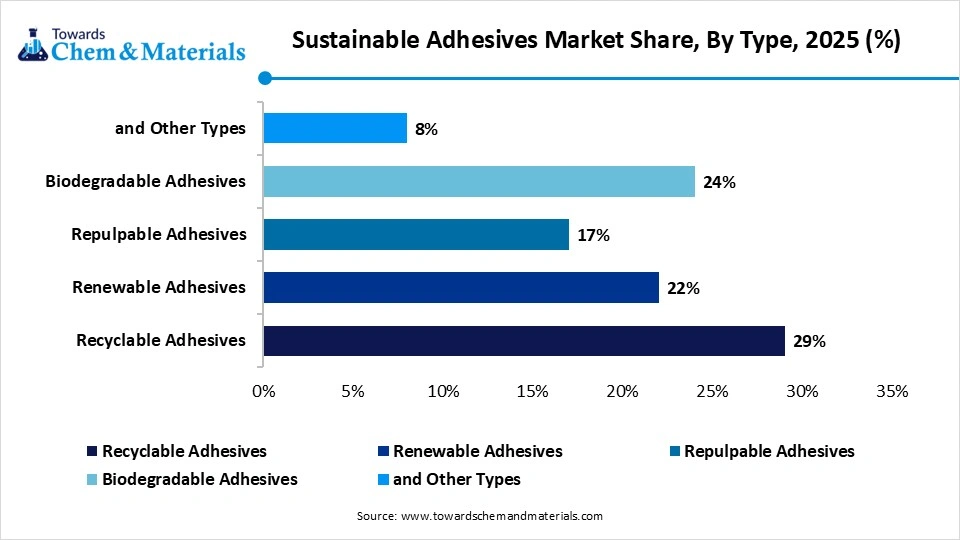
The renewable adhesives segment held a market share of 22.00% in 2025. The growth of the segment can be linked to the ongoing implementation of strict environmental regulations and growing demand from e-commerce packaging. Major market players are committing to stringent social and governance (ESG) criteria. The repulpable adhesives segment held a market share of 17.00% in 2025. The growth of the segment can be driven by an increase in e-commerce packaging and bans on single-use plastic, necessitating paper and board materials, which can be recycled without contaminating the mill's pulping process.
Sustainable Adhesives Market Share, By Type, 2025 (%)
| By Type | Revenue Share, 2025 (%) |
| Recyclable Adhesives | 29% |
| Renewable Adhesives | 22% |
| Repulpable Adhesives | 17% |
| Biodegradable Adhesives | 24% |
| and Other Types | 8% |
Raw Material Insights
The water-based segment dominated the market with the largest share of 36.00% in 2025. The growth of the segment is due to the ongoing growth in sustainable packaging and strict global VOC regulations. Ongoing advancements in adhesive formulations have widely enhanced the overall performance of water-based adhesives. The plant-based segment held the market share of 21.00% in 2025 and is expected to grow at the fastest CAGR of 9.7% over the forecast period. The growth of the segment is due to rapid innovations in green chemistry and expanding sustainable packaging sectors. Brands across woodworking and consumer goods are adopting renewable raw materials.
The EVA-based segment held a market share of 18.00% in 2025. The growth of the segment can be attributed to the growing need for biodegradable packaging along with the surge in adoption of green furniture production across developing markets. PVA adhesives emit minimal VOCs and are water-based. The acrylic-based segment held a market share of 17.00% in 2025. The growth of the segment can be credited to the rise in the demand for durable and specialized packaging materials coupled with the ongoing adoption of electric vehicles. High-performance needs across the automotive and packaging sectors will lead to segment growth soon.
Sustainable Adhesives Market Share, By Raw Material, 2025 (%)
| By Raw Material | Revenue Share, 2025 (%) |
| Water-based | 36% |
| Plant-based | 21% |
| EVA-based | 18% |
| Acrylic-based | 17% |
| and Other Types | 8% |
End-Use Industry Insights
The packaging segment dominated the market with the largest share of 31.00% in 2025. The dominance of the segment can be linked to the increasing e-commerce demand and ongoing enforcement of corporate circular economy goals. Major market players are committing to net-zero carbon footprints.
The automotive segment held the market share of 17.00% in 2025 and is expected to grow at the fastest CAGR of 8.90% during the projected period due to the rising adoption of water-based and bio-based sustainable adhesives with the push towards circular economy production in the expected future.
The woodworking segment held a market share of 14.00% in 2025. The growth of the segment is owing to the increasing consumer demand for low-VOC green furniture and the growing global utilization of engineered wood-based panels. Advancements in bio-based polyurethanes enable sustainable adhesives.
The construction segment held a market share of 12.00% in 2025. The growth of the segment is due to the growing need for high-performance and lightweight bonding solutions and the increase in modular construction. Major players are shifting their product portfolios toward circular economy principles.
Sustainable Adhesives Market Share, By End-use Industry, 2025 (%)
| By End-use Industry | Revenue Share, 2025 (%) |
| Automotive | 17% |
| Packaging | 31% |
| Medical | 11% |
| Woodworking | 14% |
| Consumer Goods | 10% |
| Construction | 12% |
| Other | 5% |
Regional Insights
How did Asia Pacific Dominate the Sustainable Adhesives Market in 2025?
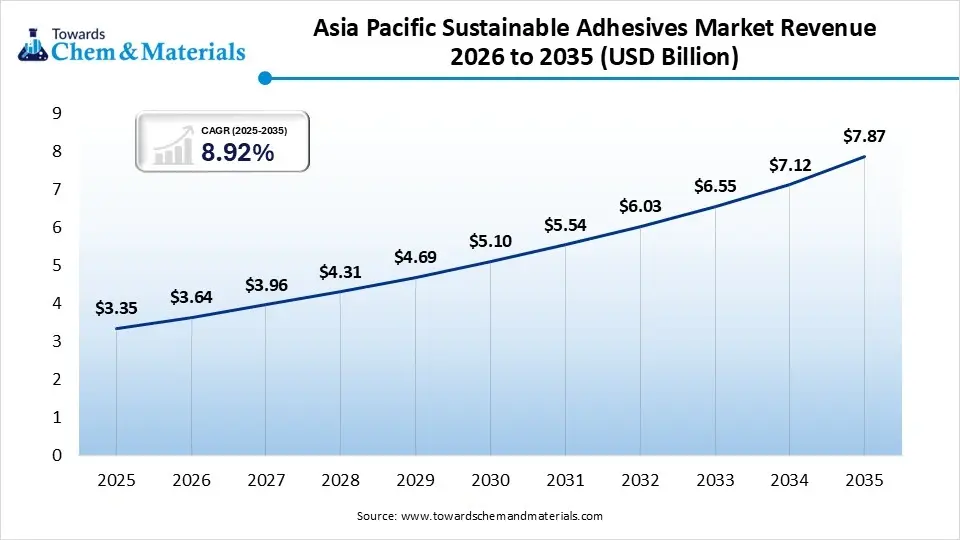
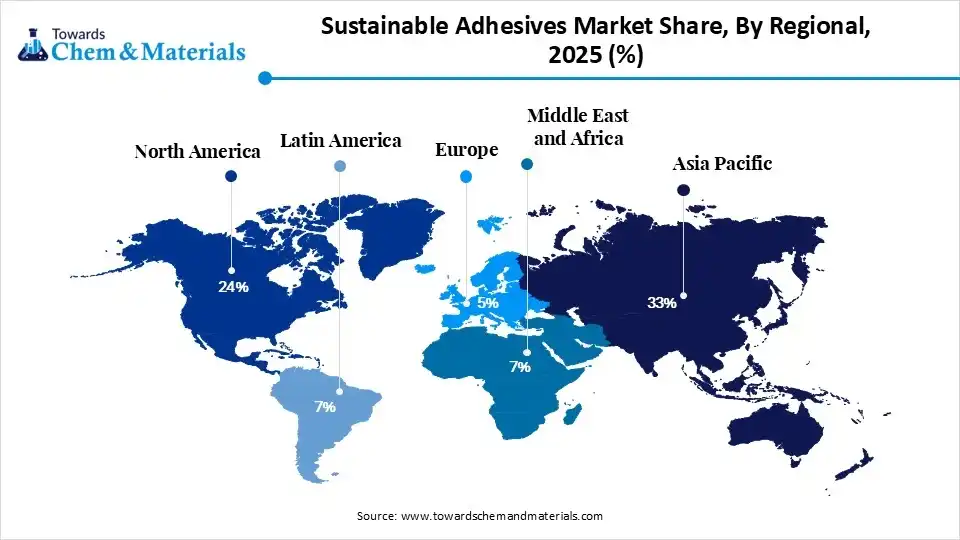
The Asia Pacific sustainable adhesives market size was estimated at USD 3.35 billion in 2025 and is projected to reach USD 7.87 billion by 2035, growing at a CAGR of 8.92% from 2026 to 2035. Asia Pacific dominated the market with the largest share of 33.00% in 2025 and is expected to grow at the fastest CAGR of 9.6% over the forecast period. The dominance and growth of the region can be attributed to the growing consumer inclination for biodegradable and recyclable packaging. In addition, growth in EV production fuels the adoption of sustainable bonding, and government sustainability policies further support market development.
China
- The Chinese government has implemented stringent pollution control bans and targets on hazardous chemicals.
- The expanding Chinese EV production sector needs lightweight, advanced materials.
India
- Urban infrastructure projects and affordable housing schemes are fueling the growth of the woodworking and construction sectors.
- Major MNCs are rapidly expanding their sustainable portfolios and local manufacturing capacity, impacting positive market growth.
The European sustainable adhesives market size was estimated at USD 3.15 billion in 2025 and is projected to reach USD 7.40 billion by 2035, growing at a CAGR of 8.92% from 2026 to 2035. Europe held a market share of 31.00% in 2025. The growth of the region can be credited to the increasing demand for low-emission and lightweight materials in the construction and automotive sectors along with the boom in the e-commerce industry. Furthermore, circular economy initiatives boost recyclable adhesive demand. Also, stringent environmental regulations fuel sustainable additive adoption.
Germany
- The country's strong automotive industry needs lightweight materials. Polymer adhesives can allow for the vehicle weight reduction without sacrificing thermal resistance.
- Major market players in the hubs such as Munich, Berlin, and Frankfurt are setting robust corporate sustainability goals, driving market growth further.
The North America sustainable adhesives market size was estimated at USD 2.44 billion in 2025 and is projected to reach USD 5.75 billion by 2035, growing at a CAGR of 8.95% from 2026 to 2035. North America held a market share of 24.00% in 2025. The growth of the region can be linked to the ongoing green construction projects and growing adhesive demand from the automotive manufacturing sector. Moreover, major market players in the region are heavily investing in research to ensure bio-based adhesives match the bonding strength and high performance.
United States
- The extensive boom in e-commerce needs recyclable, sustainable, and biodegradable packaging adhesives, impelling market players to innovate.
- The EPA heavily enforcing stringent limitations on VOCs, which makes water based, low emission adhesive crucial for complacence.
Canada
- The abundance of natural resources boosts R&D in soy-based and plant-based adhesives, which are used in the country's prominent woodworking sector.
- Country's robust packaging waste reduction goals compel the packaging industry towards biodegradable, composable and water-based adhesives.
The Latin America sustainable adhesives market size was estimated at USD 0.71 billion in 2025 and is projected to reach USD 1.76 billion by 2035, growing at a CAGR of 9.50% from 2026 to 2035.Latin America held a market share of 7.00% in 2025. The growth of the region can be driven by a surge in sustainable adhesive integration and growing material adoption to boost industrial modernization. Major production hubs in developed countries need green adhesives and high-performance technologies, leading to market expansion further.
Sustainable Adhesives Market Share, By Regional, 2025 (%)
| Regional | Revenue Share, 2025 (%) |
| North America | 24% |
| Europe | 31% |
| Asia-Pacific | 33% |
| Latin America | 7% |
| Middle East & Africa | 5% |
Brazil
- Increasing need for sustainable consumer goods and a push towards recyclable and compostable packaging are boosting the shift away from conventional adhesives.
- The country serves as a major industrial hub; leading end-use sectors, especially construction and automotive, are adopting lightweight and high-performance bonding solutions.
Argentina
- Stringent national and regional environmental standards are forcing manufacturers to minimize Volatile Organic Compound (VOC) emissions.
- Argentina's strong agricultural and forestry sectors present localized opportunities to harness plant-based raw materials.
The Middle East & Africa sustainable adhesives market size was estimated at USD 0.51 billion in 2025 and is projected to reach USD 1.29 billion by 2035, growing at a CAGR of 9.72% from 2026 to 2035.The Middle East & Africa held a market share of 5.00% in 2025. The growth of the region can be attributed to the rigorous legislative controls on volatile organic compound (VOC) emissions, rapid expansion in the regional construction sector, and escalating consumer demand for ecologically responsible packaging.
Saudi Arabia
- Advancements in bio-based and water-based adhesives ensure that sustainable solutions perform just as well as traditional alternatives.
- Sustainable adhesives are heavily adopted in residential and corporate construction, as well as in eco-friendly energy infrastructure.
UAE
- Massive urban and residential innovations in metropolitan hubs like Dubai and Abu Dhabi are fueling the need for high-performance adhesives.
- The UAE's food, beverage, and consumer goods sectors are rapidly adopting biodegradable and compostable adhesives.
Recent Developments
- In February 2026, the Saica Group introduced an innovative recycled paper adhesive tape, a development that strengthens its position in the sustainable packaging market. Jointly engineered by Saica Flex and Saica Paper, this product is manufactured entirely from 100% recycled fibers.(Source: www.saica.com)
- In October 2025, Henkel officially inaugurated its Packaging RecycLab in Shanghai, China. This facility is strategically designed to rigorously evaluate adhesive technologies and their capacity to enhance packaging recyclability. Ultimately, the laboratory endeavors to boost technological innovation and expedite the industry's transition toward a circular economy.(Source: www.packaginginsights.com)
Top Market Companies
- BASF: BASF is a leading global supplier of raw materials for the adhesives and sealants industry, driving the shift toward eco-efficient technologies. Their portfolio prioritizes water-based, UV-curable, and biomass-balanced systems designed to reduce carbon footprints and minimize volatile organic compounds (VOCs).
- Henkel AG & Co. KGaA: Henkel AG & Co. KGaA is the global market leader in adhesives, sealants, and functional coatings. Driving the broader sustainable adhesives market, Henkel’s Adhesive Technologies division emphasizes science-based decarbonization, circular economy support, and supply chain transparency.
Other Companies in the Market
- H.B. Fuller Company
- Jowat Se
- Dow
- Dupont
- Arkema
- Avery Dennison Corporation
- Paramelt B.V.
- Synthos
Segments Covered In The Report
By Type
- Recyclable Adhesives
- Pressure Sensitive Recyclable Adhesives
- Hot Melt Recyclable Adhesives
- Water-Dispersible Recyclable Adhesives
- Renewable Adhesives
- Starch-Based Adhesives
- Soy-Based Adhesives
- Lignin-Based Adhesives
- Repulpable Adhesives
- Paper Packaging Repulpable Adhesives
- Label Repulpable Adhesives
- Carton Sealing Repulpable Adhesives
- Biodegradable Adhesives
- Compostable Adhesives
- Protein-Based Adhesives
- Natural Resin Adhesives
- Other Types
- Low-VOC Adhesives
- Solvent-Free Adhesives
- Hybrid Sustainable Adhesives
By Raw Material
- Water-based
- PVA Emulsions
- Waterborne Polyurethane
- Latex-Based Adhesives
- Plant-based
- Corn Starch
- Soy Protein
- Cellulose Derivatives
- EVA-based
- Standard EVA
- Bio-EVA
- EVA Hot Melt
- Acrylic-based
- Waterborne Acrylics
- UV-Curable Acrylics
- Pressure-Sensitive Acrylics
- Other Types
- Polyurethane-Based
- Silicone-Based
- Epoxy-Based Sustainable Adhesives
By End-Use Industry
- Automotive
- Interior Assembly
- Battery Systems
- Lightweight Bonding
- Packaging
- Flexible Packaging
- Corrugated Packaging
- Food & Beverage Packaging
- Medical
- Surgical Tapes
- Wearable Devices
- Medical Packaging
- Woodworking
- Furniture Assembly
- Flooring
- Cabinetry
- Consumer Goods
- Footwear
- Appliances
- Personal Care Products
- Construction
- Flooring Installation
- Insulation Bonding
- Panel Lamination
- Other
- Textile
- Electronics
- Aerospace
By Regional
- North America
- U.S.
- Canada
- Mexico
- Europe
- UK
- Germany
- France
- Italy
- Spain
- Sweden
- Denmark
- Norway
- Asia Pacific
- Japan
- China
- India
- Australia
- South Korea
- Thailand
- Latin America
- Brazil
- Argentina
- The Middle East and Africa
- South Africa
- Saudi Arabia
- UAE
- Kuwait
FAQ's
Question 1 : What is the current size of the Sustainable Adhesives market?
Answer : The Sustainable Adhesives market was valued at USD 10.15 billion in 2025 and is projected to reach USD 23.48 billion by 2035.
Question 2 : What is the CAGR of the Sustainable Adhesives market?
Answer : The market is expected to grow at a CAGR of 8.75% from 2026 to 2035.
Question 3 : Which region dominates the Sustainable Adhesives market?
Answer : Asia Pacific dominated the market with a 33% revenue share in 2025.
Question 4 : Which type segment leads the Sustainable Adhesives market?
Answer : Recyclable adhesives led the market with a 29% share in 2025.
Question 5 : Why is packaging the largest end use industry?
Answer : Packaging companies are increasingly using biodegradable and recyclable adhesives to support sustainability goals and reduce waste.
Meet the Team
Towards Chemical & Materials
Saurabh Bidwai, a B.Tech Chemical Engineering graduate with 4+ years of experience, specializes in specialty chemicals, commodity chemicals, and engineered materials, offering valuable insights into market trends and emerging opportunities.

Aditi Shivarkar
Reviewed By
Aditi Shivarkar, with 14+ years in Chemical and Materials market research, specializes in Chemical and Materials. She ensures accurate, actionable insights, driving Towards Chemicals And Materials Analytics and Consulting excellence in industry trends and sustainability.