
Sustainable Biopolymers Market Size, Production & Manufacturing Efficiency, Sales Volume, Export & Import Dependency, Adoption Rates, Cost Structure, Recycling Rate, and Supply Chain Metrics
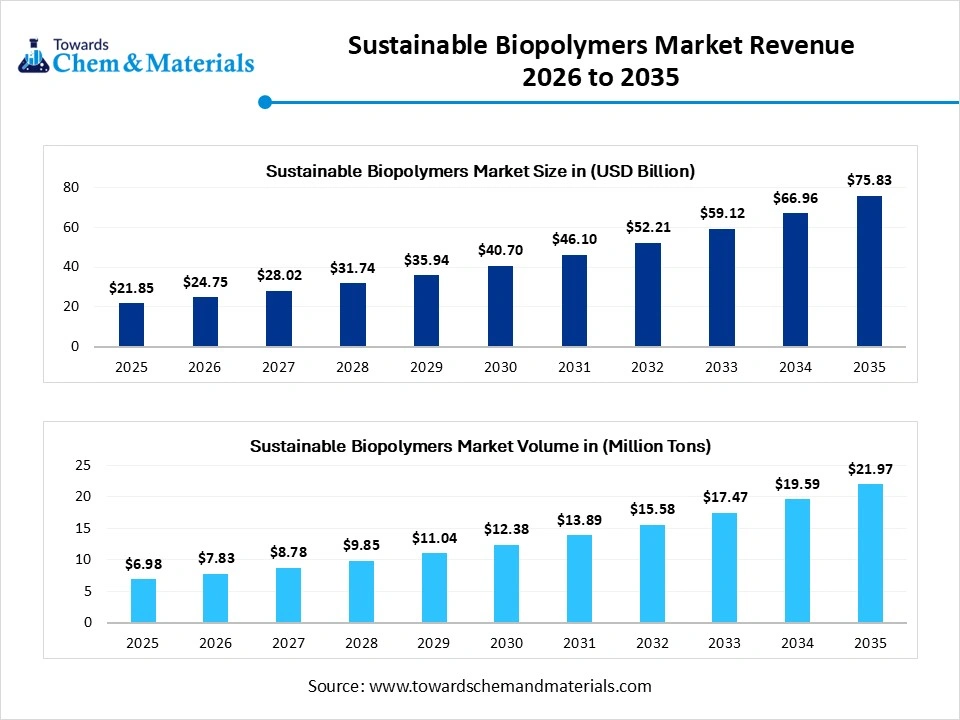
The sustainable biopolymers market is experiencing strong growth, increasing from USD 21.85 billion in 2025 to USD 24.75 billion in 2026 and projected to reach USD 75.83 billion by 2035 at a CAGR of 13.25%. The market volume is anticipated to grow from 6.98 million tons to 21.97 million tons, at a CAGR of 12.15%. The study includes in-depth segmentation analysis, regional breakdown, company analysis, competitive landscape, value chain insights, trade statistics, and detailed manufacturer and supplier data.
Content
Sustainable Biopolymers Market Size and Volume Forecast
- Market Estimated Size (2025): USD 21.85 Billion | CAGR (2026–2035): 13.25%
- Market Projected Size (2035): USD 75.83 Billion
- Market Volume (2025): 6.98 Million Tons | Volume CAGR (2026–2035): 12.15%
- Market Projected Volume (2035): 21.97 Million Tons
- Market Pricing (2025):
- Average Manufacturing Price: USD 2,957/Ton
- Average Selling Price: USD 3,785/Ton
- Pricing CAGR (2026–2035): 4.8%
The global sustainable biopolymers market was valued at USD 21.85 billion in 2025, is estimated to reach USD 24.75 billion in 2026, and is projected to reach USD 75.83 billion by 2035, growing at a CAGR of 13.25% from 2026 to 2035. In terms of volume, the sustainable biopolymers market is projected to grow from 6.98 million tons in 2025 to 21.97 million tons by 2035. growing at a CAGR of 12.15% from 2026 to 2035. The sustainable biopolymers market is vital for reducing reliance on fossil fuels, lowering carbon emissions, and addressing plastic waste through renewable, biodegradable materials. It drives innovation in eco-friendly packaging and agriculture, driven by corporate sustainability goals and government regulations. Major brands are adopting bio-based materials to improve sustainability metrics. The market is rapidly evolving, with a growing emphasis on high-performance materials like Polyhydroxyalkanoates (PHA) and advanced, non-food feedstocks.
Key Takeaways
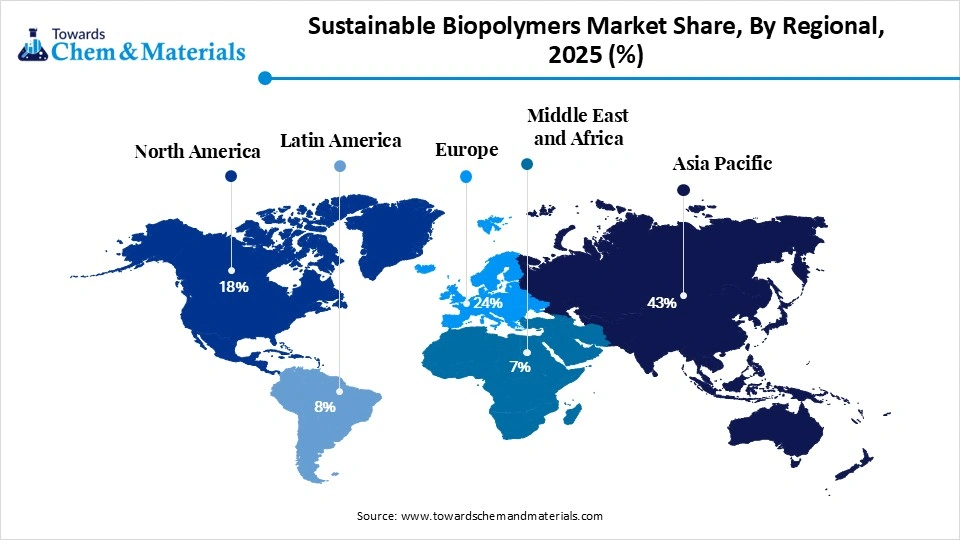
- By region, Asia Pacific dominated the market with 43% share in 2025.
- By region, the Middle East and Africa held the market share of 7% in 2025 and is expected to sustain its position while growing with a CAGR of 14.30% in the forecast period.
- By type, the polylactic acid (PLA) segment dominated the market with 32% share in 2025.
By type, the polyhydroxyalkanoates (PHA) segment held 14% market share in 2025 and is expected to have the fastest growth with a CAGR of 15.80% in the forecast period. - By source, the renewable biomass segment dominated the market with 49% share in 2025.
By source, the microbial production segment held 21% market share in 2025 and is expected to have the fastest growth with a CAGR of 14.90% in the forecast period. - By degradability, the biodegradable polymers segment dominated the market with 68% share in 2025 and is expected to have the fastest growth with a CAGR of 13.8% in the forecast period.
- By application, the packaging segment dominated the market with 41% share in 2025.
By application, the healthcare segment held 12% market share in 2025 and is expected to have the fastest growth with a CAGR of 14.60% in the forecast period.
Sustainable Biopolymers Market Growth Trends:
- Material Innovation (PHA & PLA): Increased focus on Polyhydroxyalkanoates (PHA) due to its superior
- biodegradability in marine and soil environments. Advancements in PLA (polylactic acid) are improving heat resistance and expanding its use in hot-fill applications.
- Expansion in Agriculture & Automotive: Biodegradable mulch films in agriculture and lightweight materials for automotive interiors are key growing sectors beyond packaging.
- Regulatory & Consumer Pressure: Mandatory single-use plastic bans and rising consumer awareness regarding carbon footprints are forcing brands to switch from fossil-based to bio-based, compostable alternatives.
Report Scope
| Report Attribute | Details |
| Market Size and Volume in 2026 | USD 24.75 Billion / 7.83 Million Tons |
| Expected Size and Volume by 2035 | USD 75.83 Billion / 21.97 Million Tons |
| Growth Rate from 2026 to 2035 | CAGR 13.25% |
| Forecast Period | 2026 - 2035 |
| Dominant Region | Asia-Pacific |
| Segment Covered | By Type, By Source, By Degradability, By Application and By Regions |
| Key companies profiled | ADM, Arkema, Biotec Biologische Naturverpackungen GmbH & Co. KG, Biome Technologies Ltd., Eni S.P.A., Futerro, Mitsubishi Chemical Group Corp., Rodenburg Biopolymers, RYAM, United Biopolymers SA, Toray Industries Inc. |
Key Technological Shifts in the Sustainable Biopolymers Market:
The sustainable biopolymers market is experiencing rapid technological evolution, driven by the need to match the performance of conventional plastics while ensuring environmental sustainability. Key shifts include advancements in feedstock utilization, precision fermentation, chemical recycling, and the integration of AI for material design. A major shift is moving away from food-competitive feedstock toward agricultural waste, industrial residues, and lignocellulosic biomass.
Supply Chain Analysis of Sustainable Biopolymers Market:
Biopolymer Production & Processing
Sustainable biopolymers are produced from renewable feedstocks such as corn starch, sugarcane, cellulose, and algae through fermentation and polymerization processes, followed by compounding and processing into biodegradable materials.
- Key players: NatureWorks, TotalEnergies Corbion, BASF, Novamont
Quality Testing and Certification
Sustainable biopolymers must meet standards for biodegradability, compostability, environmental impact, and material performance across applications.
- Key players: International Organization for Standardization, ASTM International, European Chemicals Agency, TÜV Austria.
Distribution to Industrial Users
Sustainable biopolymers are supplied to packaging manufacturers, the agriculture sector, consumer goods companies, textile industries, and automotive manufacturers for eco-friendly material solutions.
- Key players: NatureWorks, TotalEnergies Corbion, Novamont.
Sustainable Biopolymers Regulatory Landscape: Global Regulations
| Country / Region | Regulatory Body | Key Regulations | Focus Areas | Notable Notes |
| United States | Environmental Protection Agency (EPA); United States Department of Agriculture (USDA); Food and Drug Administration (FDA) | Toxic Substances Control Act (TSCA); USDA BioPreferred Program; FDA Food Contact Regulations | Biobased certification, environmental safety, food-contact compliance | The U.S. promotes sustainable biopolymers through bio-based labeling programs and regulations supporting biodegradable alternatives and reduced plastic waste. |
| European Union | European Commission; European Chemicals Agency (ECHA) | Single-Use Plastics Directive; REACH Regulation; Circular Economy Action Plan | Biodegradability standards, plastic reduction, circular economy | The EU is a global leader in regulating sustainable polymers, enforcing strict rules on recyclability, compostability, and lifecycle sustainability. |
| China | National Development and Reform Commission (NDRC); Ministry of Ecology and Environment (MEE) | Plastic Pollution Control Policies; Circular Economy Promotion Law | Biodegradable plastics adoption, industrial sustainability | China is actively promoting bio-based and biodegradable polymers to curb plastic pollution and support green manufacturing. |
| India | Ministry of Environment, Forest and Climate Change (MoEFCC); Central Pollution Control Board (CPCB) | Plastic Waste Management Rules; EPR Guidelines | Bioplastics regulation, waste management, and recycling compliance | India is strengthening regulations around biodegradable plastics while encouraging domestic production to reduce reliance on imports. |
| Japan | Ministry of Economy, Trade and Industry (METI); Ministry of the Environment | Plastic Resource Circulation Act; Green Procurement Policies | Sustainable materials adoption, recycling | Japan promotes bio-based polymers through circular economy initiatives and green procurement policies. |
| Germany | Federal Environment Agency (UBA); Federal Ministry for the Environment | Packaging Act (VerpackG); Circular Economy Act | Recycling, biodegradable materials certification | Germany is at the forefront of sustainable polymer adoption, with strict recycling and packaging regulations driving biopolymer usage. |
Market Dynamics
Drivers
What are the Key Growth Drivers of the Sustainable Biopolymers Market?
The key growth drivers of the sustainable biopolymers market include, but are not limited to, stringent government regulations banning single-use plastics, rising consumer demand for eco-friendly products, and a strategic shift towards a circular economy. Significant adoption in packaging, agriculture, and automotive sectors, combined with advancements in production technology reducing costs, further propels market expansion.
Restrains
What are the Key Growth Restraints of the Sustainable Biopolymers Market?
The sustainable biopolymers market is experiencing strong growth, but its expansion is hindered by significant challenges related to cost, performance, and infrastructure. While demand for eco-friendly alternatives is high, the market is heavily restrained by the high cost of production and limited scalability, making it difficult to compete with inexpensive, well-established petroleum-based plastics.
Opportunities
What are the Key Growth Opportunities of the Sustainable Biopolymers Market?
Key growth opportunities for the sustainable biopolymers market include rapid adoption in packaging driven by regulations, specialized medical applications (sutures, drug delivery), and high-performance automotive components. The market is shifting toward 2nd/3rd generation feedstocks (waste-based) and technological advancements in biodegradable PLA, creating a high-margin landscape.
Segmental Insights
Type Insights
The Polylactic Acid Segment Dominated The Market With 32% Market Share In 2025
The polylactic acid (PLA) segment dominated the market with 32% share in 2025, driven by its strong adoption in packaging, compostability, and role as a cost-effective, bio-based alternative to petroleum plastics. PLA is heavily used for eco-friendly food packaging, such as rigid thermoforms, bottles, and food service items like cups and trays, accounting for a significant portion of the market. Increased consumer awareness regarding plastic pollution is pushing brands to adopt PLA for consumer goods and packaging to improve their environmental footprint.
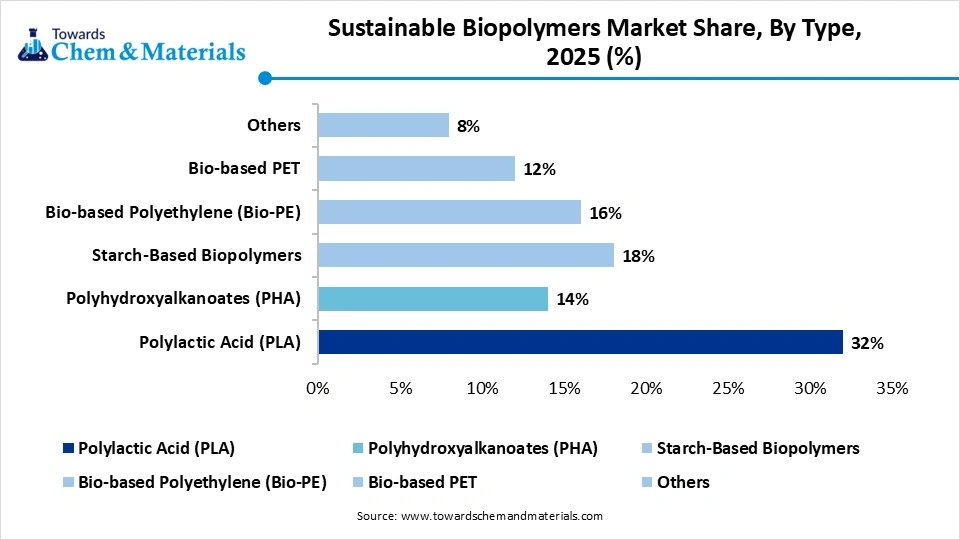
The starch-based biopolymers segment held 18% market share in 2025, due to their cost-effectiveness, abundance, and excellent biodegradability. Driven by regulatory support and consumer demand for plastic alternatives, this sector is expanding through innovations in blending with other biopolymers to improve performance in packaging, agriculture, and disposable items. Stricter government policies regarding plastic waste reduction are accelerating the adoption.
The bio-based polyethylene (Bio-PE) segment held 16% market share in 2025, driven by its role as a "drop-in" solution, allowing existing, high-volume, and durable, High-Density Polyethylene (HDPE) manufacturing infrastructure to switch from fossil fuels to renewable, sugar-based feedstocks while reducing carbon footprints. Public awareness regarding plastic pollution and climate change is forcing a shift toward renewable resources.
The Polyhydroxyalkanoates (PHA) segment held 14% market share in 2025 and is expected to have the fastest growth with a CAGR of 15.80% in the forecast period, primarily fueled by the urgent global need for truly biodegradable and marine-degradable plastic alternatives, replacing conventional plastics in high-volume industries like packaging. Increasing global bans on single-use plastics are forcing industries to adopt compliant alternatives, with PHA being a primary solution for flexible packaging, food containers, and disposable utensils.
Source Insights
The Renewable Biomass Segment Dominated The Market With 49% Market Share In 2025
The renewable biomass segment dominated the market with 49% share in 2025, driven by the urgent need for fossil-fuel alternatives, strict environmental regulations against single-use plastics, and the high scalability of plant-based feedstocks like sugarcane, corn, and cassava. Innovations in fermentation and enzymatic processes are making the conversion of agricultural feedstock into high-performance polymers more cost-effective and efficient.
Sustainable Biopolymers Market Share, By Source, 2025 (%)
| By Source | Revenue Share, 2025 (%) |
| Renewable Biomass | 49% |
| Microbial Production | 21% |
| Waste-Based Feedstock | 30% |
The waste-based feedstock segment held 30% market share in 2025, projected to expand rapidly as companies move away from food-competitive raw materials toward using agricultural, industrial, and municipal organic waste. This sector thrives on the principles of the circular economy, transforming environmental liabilities into high-value biopolymers such as Polyhydroxyalkanoates (PHA) and cellulose derivatives.
The microbial production segment held 21% market share in 2025 and is expected to have the fastest growth with a CAGR of 14.90% in the forecast period, due to its ability to produce high-purity, biodegradable materials such as Polyhydroxyalkanoates (PHAs) and bacterial cellulose using waste feedstocks and advanced fermentation techniques. This segment offers superior structural diversity and sustainability compared to synthetic plastics, with the market for microbial cellulose alone projected to be driven by Acetobacter genus advancements.
Degradability Insights
The Biodegradable Polymers Segment Dominated The Market With 68% Market Share In 2025
The biodegradable polymers segment dominated the market with 68% share in 2025 and is expected to have the fastest growth with a CAGR of 13.8% in the forecast period, due to intensifying environmental regulations, a strong shift towards sustainable packaging, and rising demand for reduced carbon footprints. Driven by high adoption in packaging, industries are favoring PLA and PHA for their compostable nature over traditional plastics. The market is maturing from niche applications to widespread adoption, driven by the need to combat environmental pollution and meet corporate sustainability goals.
Sustainable Biopolymers Market Share, By Degradability, 2025 (%)
| By Degradability | Revenue Share, 2025 (%) |
| Biodegradable Polymers | 68% |
| Non-Biodegradable Bio-based Polymers | 32% |
The non-biodegradable bio-based polymers segment held 32% market share in 2025, by offering "drop-in" solutions that are technically identical to petroleum-based plastics. Their growth is driven by high demand for sustainable alternatives in automotive, packaging, and consumer goods sectors that require durability, as they reduce carbon footprints without changing existing manufacturing infrastructure.
Application Insights
The Packaging Segment Dominated The Market With 41% Market Share In 2025
The packaging segment dominated the market with 41% share in 2025, driven by stringent regulatory bans on single-use plastics, surging consumer demand for eco-friendly alternatives, and corporate sustainability commitments. Biopolymers such as PLA, PHA, and starch blends are increasingly replacing conventional plastics in food, cosmetic, and pharmaceutical packaging due to their biodegradability and lower carbon footprint.
The agriculture segment held 15% market share in 2025, driven by demand for biodegradable mulch films, plant pots, and seed coatings that reduce plastic waste and improve soil health. These are gaining high popularity because they can be ploughed back into the soil, reducing waste and labor costs associated with removing traditional plastic films. Government initiatives promoting eco-friendly agricultural inputs in North America and Europe are fostering market adoption.
Sustainable Biopolymers Market Share, By Application, 2025 (%)
| By Application | Revenue Share, 2025 (%) |
| Packaging | 41% |
| Agriculture | 15% |
| Textile | 11% |
| Consumer Goods | 13% |
| Automotive | 8% |
| Healthcare | 12% |
The consumer goods segment held 13% market share in 2025, driven by rising demand for eco-friendly packaging in household products, electronics, and personal care. This surge is fueled by strict regulations on single-use plastics, corporate sustainability goals, and increasing consumer preference for biodegradable alternatives. Technological advancements have improved the cost-efficiency and functionality of biopolymers, making them viable replacements for conventional, oil-based plastics in durable consumer goods.
The healthcare segment held 12% market share in 2025 and is expected to have the fastest growth with a CAGR of 14.60% in the forecast period, driven by the need for biocompatible, biodegradable, and non-toxic materials that can improve patient outcomes while reducing environmental impact. Continuous innovations are increasing the mechanical strength and barrier properties of biopolymers, making them suitable for more demanding medical applications.
Regional Insights
How did Asia Pacific dominate the Sustainable Biopolymers Market in 2025?
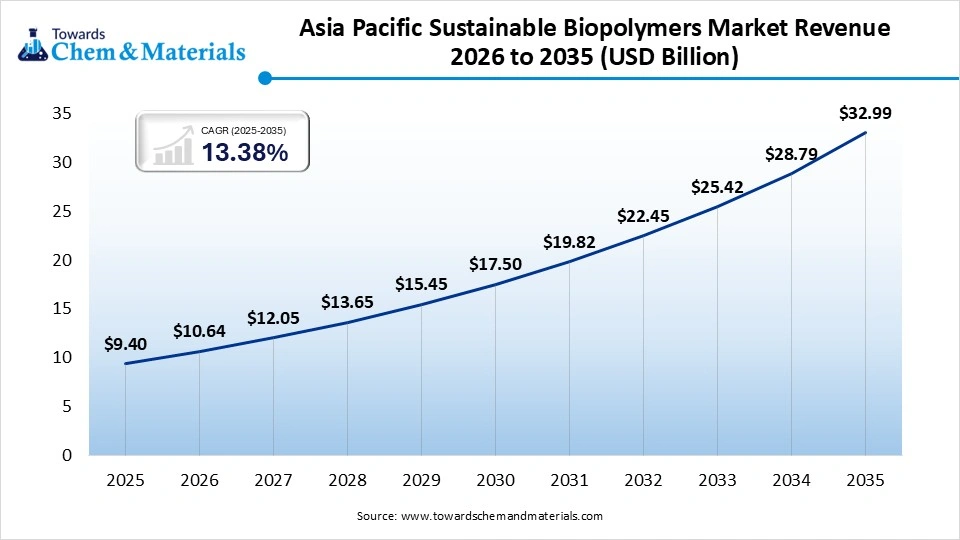
The Asia Pacific sustainable biopolymers market size was estimated at USD 9.40 billion in 2025 and is projected to reach USD 32.99 billion by 2035, growing at a CAGR of 13.38% from 2026 to 2035. Rapid industrialization and government initiatives promoting biodegradable plastics further support growth. Rising consumer awareness regarding environmental degradation, corporate sustainability commitments, and government policies supporting biodegradable materials.
China Sustainable Biopolymers Market Growth Factor
The sustainable biopolymers market in China is experiencing rapid growth, driven by "dual carbon" goals and bans on single-use plastics. Demand is high for PLA, PHA, and starch-based materials, especially in packaging and agriculture. China is a major producer and consumer, driven by strict plastic bans and investments in biodegradable polymer production. The Chinese government is supporting bio-based technologies to meet carbon neutrality targets, driving the adoption of sustainable materials.
Middle East and Africa Sustainable Biopolymers Market Growth Factor
The Middle East and Africa held the market share of 7% in 2025, and is expected to sustain its position while growing with a CAGR of 14.30% in the forecast period, driven by rising environmental concerns, increasing bans on single-use plastics, and the adoption of eco-friendly packaging in the GCC region. The Middle East is seeing increased adoption, notably within the Gulf Cooperation Council (GCC), which has a strong chemicals sector. Rising consumer awareness, government regulations against plastic waste, and the need for eco-friendly materials in packaging and agriculture drive the market.
Saudi Arabia Sustainable Biopolymers Market Growth Factor
The Saudi Arabia sustainable biopolymers market is rapidly expanding, driven by Vision 2030 sustainability goals and strict regulations against single-use plastics. Growth is fueled by government initiatives, such as the Saudi Investment Recycling Company (SIRC), aiming to divert 94% of waste from landfills, and a 30% reduction goal in plastic waste, encouraging the shift to biodegradable alternatives. The Saudi Standards, Metrology and Quality Organization (SASO) has implemented regulations requiring strict compliance for degradable plastic products, accelerating the adoption of sustainable materials
Recent Developments
- In February 2026, Bengaluru-based biotech startup BacAlt Biosciences raised ₹18 crore in a funding round led by Avaana Capital to scale its circular bio-manufacturing platform. The capital will be used to establish a pre-pilot facility and enhance R&D for converting agro-industrial waste into high-performance biopolymers for the FMCG, pharmaceutical, and agrochemical sectors.
- In October 2025, Siemens launched SIRIUS 3RQ1 coupling relays featuring housings made from a mass-balanced biopolymer derived from waste cooking oil, reducing the carbon footprint by approximately 27%. The Sirius 3RQ4 couplings meet Siemens EcoTech standards, ensuring sustainability from development to disposal.
- In November 2025, Emirates Biotech launched Embio, a new line of locally produced, plant-based PolyLactic Acid biopolymers designed for packaging, fibers, and specialty applications. This initiative aims to facilitate the transition to renewable materials for regional converters, packaging manufacturers, and brand owners.
Top players in the Sustainable Biopolymers Market & Their Offerings:
- NatureWorks LLC: NatureWorks is a global leader in PLA (polylactic acid) biopolymers under the Ingeo™ brand. The company focuses on compostable, bio-based polymers used in packaging, textiles, and hygiene products, with a strong emphasis on reducing carbon footprint.
- Braskem S.A.: Braskem produces bio-based polyethylene derived from sugarcane ethanol. Its “I’m green™” portfolio is widely used in packaging, automotive, and consumer goods, offering a renewable alternative to conventional plastics.
- BASF SE: BASF offers biodegradable polymers such as ecovio® and ecoflex®, used in compostable packaging, agricultural films, and consumer goods. The company focuses on circular economy solutions and sustainable material innovation.
- Novamont S.p.A.: Novamont manufactures starch-based biodegradable polymers under the Mater-Bi® brand, widely used in packaging, agriculture, and compostable products.
- Kuraray Co., Ltd.: Kuraray produces bio-based polymers and specialty materials used in packaging, textiles, and industrial applications, focusing on innovation and sustainability.
Sustainable Biopolymers Market Top Players Are
- Adm
- Arkema
- Biotec Biologische Naturverpackungen GmbH & Co. KG
- Biome Technologies Ltd.
- Eni S.P.A.
- Futerro
- Mitsubishi Chemical Group Corp.
- Rodenburg Biopolymers
- Ryam
- United Biopolymers SA
- Toray Industries Inc.
Sustainable Biopolymers Market Segments Covered:
By Type
- Polylactic Acid (PLA)
- Injection Grade PLA
- Film Grade PLA
- Fiber Grade PLA
- Polyhydroxyalkanoates (PHA)
- Short Chain Length PHA
- Medium Chain Length PHA
- Starch-Based Biopolymers
- Thermoplastic Starch (TPS)
- Starch Blends
- Bio-based Polyethylene (Bio-PE)
- High-Density Bio-PE (HDPE)
- Low-Density Bio-PE (LDPE)
- Bio-based Polyethylene Terephthalate (Bio-PET)
- Partially Bio-based PET
- Fully Bio-based PET
- Others
-
- Polybutylene Succinate (PBS)
- Polycaprolactone (PCL)
- Cellulose-based Polymers
By Source
- Renewable Biomass
-
- Corn
- Sugarcane
- Cassava
- Vegetable Oils
- Microbial Production
- Bacterial Fermentation
- Algal-Based Production
- Waste-Based Feedstock
- Agricultural Waste
- Food Waste
- Industrial Organic Waste
By Degradability
- Biodegradable Polymers
- Compostable
- Marine Degradable
- Soil Degradable
- Non-Biodegradable Bio-based Polymers
- Bio-PE
- Bio-PET
By Application
- Packaging
- Flexible Packaging
- Rigid Packaging
- Food Service Ware
- Agriculture
- Mulch Films
- Plant Pots
- Controlled Release Systems
- Textile
- Fibers
- Nonwoven Fabrics
- Consumer Goods
-
- Disposable Products
- Durable Goods
- Automotive
- Healthcare
- Medical Implants
- Drug Delivery Systems
By Regions
- North America:
- U.S.
- Canada
- Mexico
- Rest of North America
- Latin America:
- Brazil
- Argentina
- Rest of Latin America
- Europe:
- Western Europe
- Germany
- Italy
- France
- Netherlands
- Spain
- Portugal
- Belgium
- Ireland
- UK
- Iceland
- Switzerland
- Poland
- Rest of Western Europe
- Eastern Europe
- Austria
- Russia & Belarus
- Türkiye
- Albania
- Rest of Eastern Europe
- Asia Pacific:
- China
- Taiwan
- India
- Japan
- Australia and New Zealand,
- ASEAN Countries (Singapore, Malaysia)
- South Korea
- Rest of APAC
- MEA:
- GCC Countries
- Saudi Arabia
- United Arab Emirates (UAE)
- Qatar
- Kuwait
- Oman
- Bahrain
- South Africa
- Egypt
- Rest of MEA
- MEA:
FAQ's
Question 1 : What is the current size of the sustainable biopolymers market?
Answer : The global sustainable biopolymers market was valued at USD 21.85 billion in 2025 and is estimated to reach USD 24.75 billion in 2026.
Question 2 : What is the projected growth rate of the sustainable biopolymers market?
Answer : The market is expected to grow at a CAGR of 13.25% from 2026 to 2035.
Question 3 : What will be the market size of sustainable biopolymers by 2035?
Answer : The market is projected to reach USD 75.83 billion by 2035.
Question 4 : Which region dominates the sustainable biopolymers market?
Answer : Asia Pacific dominated the market with a 43% share in 2025, driven by industrial growth and regulatory support.
Question 5 : Which type segment leads the sustainable biopolymers market?
Answer : The Polylactic Acid (PLA) segment dominated with a 32% market share in 2025.
Meet the Team

Saurabh Bidwai
Principal Consultant
Saurabh Bidwai, a B.Tech Chemical Engineering graduate with 4+ years of experience, specializes in specialty chemicals, commodity chemicals, and engineered materials, offering valuable insights into market trends and emerging opportunities.

Aditi Shivarkar
Reviewed By
Aditi Shivarkar, with 14+ years in Chemical and Materials market research, specializes in Chemical and Materials. She ensures accurate, actionable insights, driving Towards Chemicals And Materials Analytics and Consulting excellence in industry trends and sustainability.