
Sustainable Construction Material Market Size, Share, Growth, Report 2026 to 2035
The sustainable construction material market report Segmented By Material Type (Bamboo, Cork, Hempcrete, Mycelium, Precast Concrete, Others), By Application (Exterior, Interior, Structural), By End Use (Residential, Commercial, Industrial), By Distribution Channel (Direct, Indirect)-,-Global Industry Analysis, Size, Trends, Leading Companies, Regional Outlook, and Forecast 2026 to 2035
Content
What is the current Sustainable Construction Material Market Size and Share?
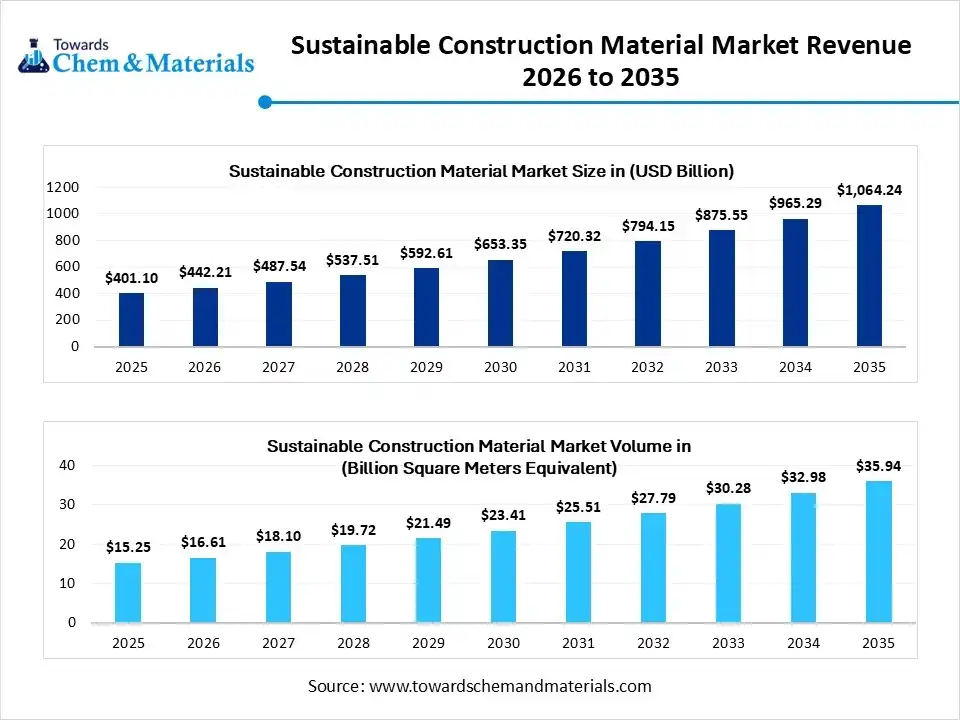
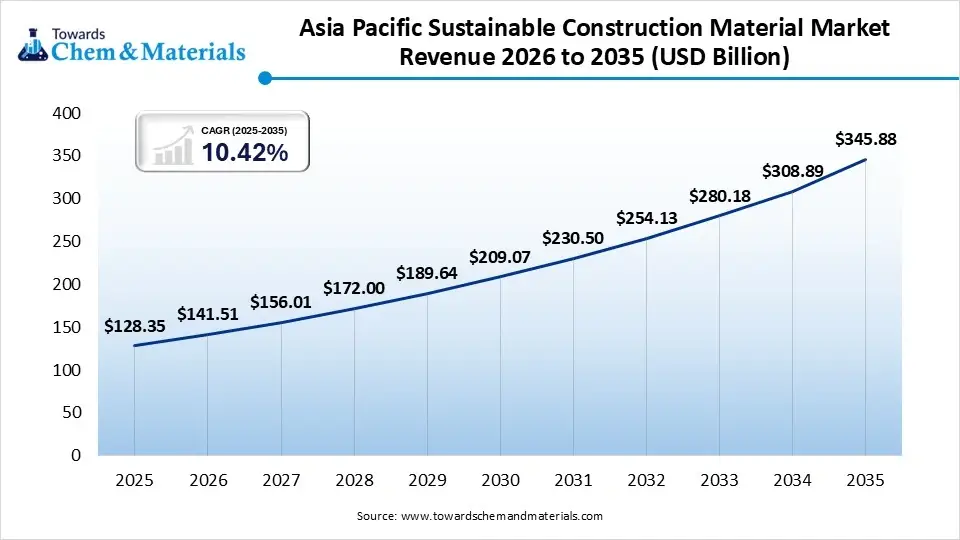
The global sustainable construction material market size was valued at USD 401.10 billion in 2025, is estimated to reach USD 442.21 billion in 2026, and is projected to reach USD 1,064.24 billion by 2035, exhibiting a compound annual growth rate (CAGR) of 10.25% over the forecast period from 2026 to 2035. Asia Pacific dominated the sustainable construction material market with the largest revenue share of 32% in 2025 and is expected to grow at the fastest CAGR of 10.42% during the forecast period. In terms of volume, the sustainable construction material industry is projected to grow from 15.25 billion square meters equivalent in 2025 to 35.94 billion square meters equivalent by 2035, growing at a CAGR of 8.95% from 2026 to 2035. The growth of the market is driven by the strict environmental regulations, corporate ESG (Environmental, Social, and Governance) commitments, and a surge in consumer demand for energy-efficient living spaces.
Market Highlights
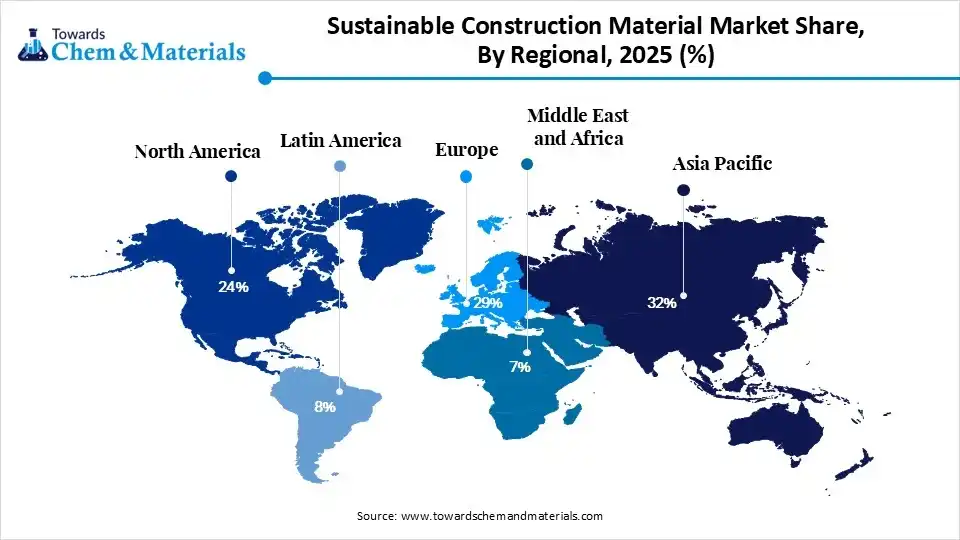
- By region, Asia Pacific dominated the market with a share of 32% in 2025 and is expected to experience the fastest growth with a CAGR of 11.4% in the forecast period. Rapid urbanization and smart city projects significantly increase sustainable construction demand.
- By region, Europe held 29% market share in 2025. The growth is driven by the rapid development and sustainability initiatives.
- By material type, the precast concrete segment dominated the market with 28% share in 2025. Infrastructure modernization projects increase demand for sustainable precast.
- By material type, the hempcrete segment held 16% market share in 2025 and is expected to have the fastest growth with a CAGR of 11.7% in the forecast period. Biodegradable construction solutions increase mycelium material adoption.
- By application, the exterior segment dominated the market with 36% share in 2025. Sustainable facades and roofing systems gain traction in green building projects.
- By application, the structural segment held 31% market share in 2025 and is expected to have the fastest growth with a CAGR of 11.1% in the forecast period. Carbon-neutral construction initiatives increase structural sustainable material adoption.
- By end use, the residential segment dominated the market with 46% share in 2025 and is expected to have the fastest growth with a CAGR of 10.7% in the forecast period. Rising green housing developments significantly increase sustainable material demand.
Market Overview
What Is the Significance of the Sustainable Construction Material Market?
The market for sustainable construction materials is vital for minimizing the massive carbon footprint of the built environment. By substituting traditional resources with eco-friendly, low-carbon alternatives, the industry helps prevent resource depletion, enhances healthier living spaces, and achieves long-term cost savings. As urbanization accelerates and government regulations tighten, this market is growing quickly to support greener, more energy-efficient infrastructure.
Construction traditionally accounts for up to 50% of global natural resource extraction. Sustainable materials encourage a circular economy by reusing existing resources. Unlike conventional materials, which can emit VOCs and other toxic chemicals that degrade indoor air quality, green materials are generally non-toxic and low-emission, leading to safer indoor environments. Although sustainable options may involve higher initial costs, they yield significant savings through decreased energy use, lower maintenance, and increased durability. Using eco-friendly materials helps developers meet strict green building standards like LEED and GRIHA, substantially increasing property values in both commercial and residential sectors.
Market Growth Trends
- Embodied Carbon Focus: The industry is moving beyond just operational energy (heating/cooling). Developers and Architects are prioritizing materials with low-to-negative embodied carbon, like biochar-based claddings and mass timber.
- Material Innovations: High-performance bio-composites, hempcrete, recycled structural steel, and bamboo are seeing increased commercial viability, supplementing traditional raw materials.
- Circular Economy: There is a heavy focus on upcycled waste products, such as incorporating fly ash and recycled industrial plastics into concrete and insulation forms.
Market Scope
| Report Coverage | Details |
| Market Size in 2026 | USD 442.21 Billion/ 16.61 Billion Square Meters Equivalent |
| Expected Market Size in 2035 | USD 1,064.24 Billion/ 35.94 Billion Square Meters Equivalent |
| Projected CAGR 2025 to 2035 | CAGR 10.25% |
| Dominant Region | Asia Pacific |
| Base Year | 2025 |
| Segments covered | By Material Type , By Application, By End Use, By Distribution Channel, By Regions |
| Key companies profiled | BASF SE, Holcim, Kingspan Group, Owens Corning, DuPont, Amvik, Bauder, Cemex, Heidelberg, Ramco, Saint-Gobain, Siga, Sika, Steico, Titan, Vulcan |
Key Technological Shifts in the Sustainable Construction Material Market with the Integration of Advanced Technology
Technological shifts in the sustainable construction market focus heavily on embodied carbon reduction, circular economy principles, and precision manufacturing. Key innovations like science-backed low-carbon concrete and bio-composite insulation are transforming how materials are sourced, processed, and tracked across their lifecycles. Techniques like 3D concrete printing reduce material waste by depositing concrete exactly where it is needed, requiring significantly less formwork and lowering supply chain complexity.
Sustainable Construction Material Market Regulatory Landscape
| Country / Region | Regulatory Body | Key Regulations | Focus Areas | Notable Notes |
| United States | Environmental Protection Agency (EPA); U.S. Green Building Council (USGBC); Department of Energy (DOE) | LEED Certification Standards; ENERGY STAR Programs; Clean Air Act | Low-carbon construction, energy efficiency, sustainable infrastructure | The U.S. promotes sustainable construction materials through green building certification systems and carbon reduction initiatives. |
| European Union | European Commission; European Chemicals Agency (ECHA) | EU Green Deal; Energy Performance of Buildings Directive (EPBD); Construction Products Regulation (CPR) | Circular construction, low-emission materials | Europe strongly supports sustainable construction through stringent environmental regulations and carbon neutrality goals. |
| China | Ministry of Housing and Urban-Rural Development (MOHURD); Ministry of Ecology and Environment (MEE) | Green Building Action Plan; Carbon Neutrality Targets | Green infrastructure, eco-friendly construction | China is investing heavily in low-carbon building materials and sustainable urban infrastructure development. |
| India | Bureau of Energy Efficiency (BEE); Ministry of Environment, Forest and Climate Change (MoEFCC) | Energy Conservation Building Code (ECBC); Green Building Guidelines | Energy-efficient buildings, sustainable urbanization | India promotes sustainable construction materials through smart city projects and green infrastructure policies. |
| Japan |
Ministry of Land, Infrastructure, Transport and Tourism (MLIT) Dubai Municipality; Emirates Green Building Council |
Building Energy Efficiency Act; CASBEE Standards Dubai Green Building Regulations; Estidama Rating System |
Earthquake-resistant sustainable materials, energy conservation Sustainable architecture, low-energy infrastructure |
Japan emphasizes sustainable and resilient construction materials for advanced infrastructure projects. The UAE is increasing adoption of sustainable materials in smart city and large-scale infrastructure developments. |
Supply Chain Analysis of Sustainable Construction Material Market
- Chemical Synthesis and Processing:The chemical synthesis and processing of sustainable construction materials focus on transforming industrial byproducts, natural fibers, and waste into low-carbon alternatives to conventional concrete and steel.
- Key players: Kingspan Group, Holcim Group, BASF SE, and Saint-Gobain
- Quality Testing and Certification:Quality testing and certification for sustainable construction materials ensure they meet strict performance and ecological standards. These verified materials support green building credits for systems like the Indian Green Building Council (IGBC).
- Key players:the Forest Stewardship Council (FSC), National Test House, Bureau of Indian Standards
- Distribution to Industrial Users:Sustainable construction materials like green concrete, recycled steel, and timber are primarily distributed to EPC contractors, private real estate developers, and large industrial facility operators.
- Key players: UltraTech Cement, JSW Cement, and Magnus Ventures
Sustainable Construction Material Market Dynamics
| Drivers | Restrains | Opportunities |
| Stringent Government Regulations & Policies: | Economic & Financial Barriers: | Energy-Efficiency Retrofits: |
| Strong government support and enforcing stringent energy performance standards support the growth. | Sustainable and recycled materials often require a higher upfront investment compared to traditional options. While they offer long-term operational savings, the steeper initial cost deters cost-sensitive developers and residential builders. | Upgrading and retrofitting aging infrastructure to meet strict energy codes and net-zero carbon directives presents massive, long-term demand. |
| Corporate ESG Goals & Climate Commitments: | Supply Chain & Availability: | Bio-Based & Recycled Materials: |
| With the construction industry being a major contributor to global carbon dioxide emissions, companies are actively striving to hit net-zero targets. | Unlike traditional building materials (e.g., standard concrete or virgin steel), green materials often rely on localized, specialized distributors. This can lead to unreliable lead times and logistical bottlenecks. | The development of alternatives to traditional concrete and steel (e.g., carbon-free cement, cross-laminated timber, and reclaimed wood) is capturing market share. |
| Technological Innovation & Product Availability: | Knowledge & Technical Gaps: | Circular Economy Adoption: |
| Continuous research and development have led to the commercialization of highly effective alternatives to conventional materials, such as mass timber, 3D printed concrete, and engineered cementitious composites. | The proper handling, installation, and maintenance of sustainable materials often require specialized skills. The construction industry currently faces a deficit of laborers and engineers trained in green building practices. | Integrating closed-loop manufacturing processes into supply chains, such as recycled aggregates, plastics, and recycled metals reduces waste and attracts green funding. |
Segmental Insights
Material Type Insights
The precast concrete segment dominated the market with 28% share in 2025, driving off-site efficiency, reducing on-site waste, and optimizing resource use. In urban centers like Thane, Maharashtra, it has become crucial to rapidly scale affordable housing and public infrastructure while minimizing local pollution. Precast panels and structural components are designed to be disassembled, rearranged, or downcycled into new aggregates. This aligns seamlessly with green-certified real estate frameworks by minimizing lifecycle carbon emissions.
The bamboo segment held 24% market share in 2025 by providing a rapidly renewable, carbon-sequestering, and highly durable alternative to concrete, steel, and timber. It redefined green building standards by offering superior structural strength, accelerated growth cycles, and low global warming potential. Engineered bamboo possesses a tensile strength that rivals steel and a compressive strength greater than concrete. This allows it to act as a direct structural substitute in framing and reinforcement.
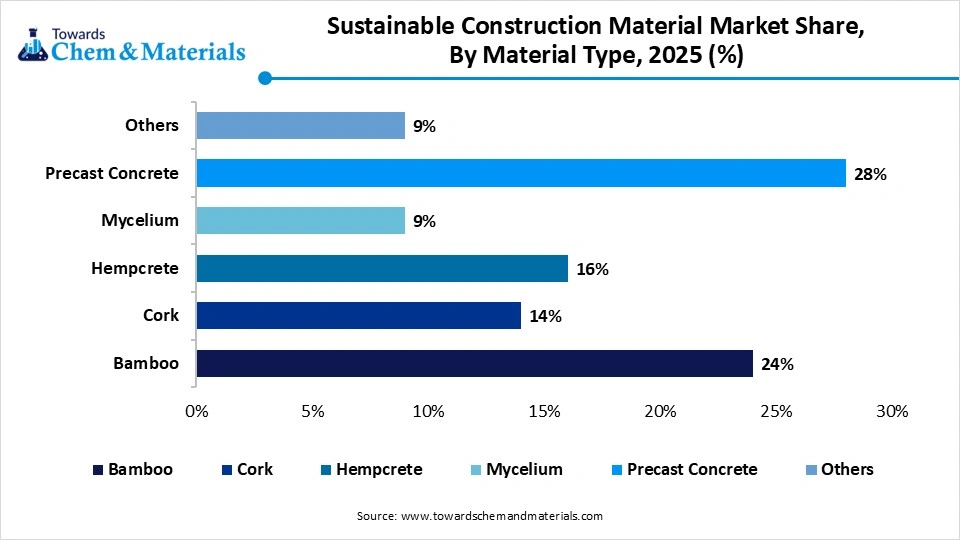
The hempcrete segment held 16% market share in 2025 and is expected to have the fastest growth with a CAGR of 11.7% in the forecast period by offering a high-performance, carbon-negative bio-composite. Made from hemp shiv, lime, and water, its market integration is largely driven by its thermal properties, regulatory shifts toward green buildings, and rising consumer demand for circular, eco-friendly materials.
The cork segment held 14% market share in 2025 by providing a rapidly renewable, carbon-negative, and highly versatile bio-based alternative to synthetic products. Its superior thermal and acoustic performance has made it a premier choice for achieving strict green building certifications. Cork's biodegradability, natural pest resistance, and moisture control allow it to easily secure points for sustainability frameworks like LEED and BREEAM certifications.
Sustainable Construction Material Market Share, By Material Type, 2025 (%)
| By Material Type | Revenue Share, 2025 (%) |
| Bamboo | 24% |
| Cork | 14% |
| Hempcrete | 16% |
| Mycelium | 9% |
| Precast Concrete | 28% |
| Others | 9% |
Application Insights
The exterior segment dominated the market with 36% share in 2025 and is expanding due to strict energy efficiency codes, consumer demand for eco-friendly structures, and a push for green certifications. Driven by the need for thermal insulation and reduced environmental footprints, builders are increasingly shifting to reclaimed wood, recycled metal cladding, and cool roofing materials.
The interior segment held 33% market share in 2025, driving a significant revenue share, fueled by the push for healthier indoor environments and energy efficiency. Growth is localized, with emerging demand concentrated in the booming residential sectors of urban regions like Thane and Mumbai. Post-pandemic awareness has spurred consumers and commercial developers to seek low-emission interior fixtures that do not off-gas toxic chemicals into enclosed living and working spaces.
The structural segment held 31% market share in 2025 and is expected to have the fastest growth with a CAGR of 11.1% in the forecast period. It has driven massive industry growth due to strict building regulations, the global push for net-zero emissions, and the need for lower embodied carbon in heavy infrastructure. Rising in popularity, these materials provide steel-like load-bearing strength while actively sequestering carbon, making them highly desirable for eco-friendly high-rise projects.
Sustainable Construction Material Market Share, By Application, 2025 (%)
| By Application | Revenue Share, 2025 (%) |
| Exterior | 36% |
| Interior | 33% |
| Structural | 31% |
End Use Insights
The residential segment dominated the market with 46% share in 2025 and is expected to have the fastest growth with a CAGR of 10.7% in the forecast period. Driven by stricter energy regulations and consumer demand for eco-friendly homes, homeowners and builders are heavily prioritizing recycled steel, engineered wood, and non-toxic, low-VOC materials. For structural integrity, materials such as bamboo, engineered timber, and recycled steel are replacing traditional carbon-heavy materials.
The commercial segment held 37% market share in 2025, has rapidly evolved due to corporate ESG mandates, stringent green building certifications, and the need to lower long-term operational costs. Recycled steel and aluminum are heavily used in structural frameworks and roofing due to their cost-efficiency and infinite recyclability. Commercial builders are widely adopting low-carbon concrete and carbon-capture (CCS) concrete tech to significantly reduce their carbon footprint.
The industrial segment held 17% market share in 2025 by prioritizing heavy-duty, low-carbon materials like recycled steel and green concrete. Driving the circular economy, manufacturing and warehousing developments require materials that balance massive structural load requirements with strict ESG mandates and corporate sustainability targets. The demand is heavily divided. Structural needs require high durability and reduced carbon footprint, while non-structural elements prioritize thermal efficiency to lower operational energy costs.
Sustainable Construction Material Market Share, By End Use, 2025 (%)
| By End Use | Revenue Share, 2025 (%) |
| Residential | 46% |
| Commercial | 37% |
| Industrial | 17% |
Regional Analysis
How did Asia Pacific Dominate the Sustainable Construction Material Market in 2025?
The Asia Pacific sustainable construction material market size was estimated at USD 128.35 billion in 2025 and is projected to reach USD 345.88 billion by 2035, growing at a CAGR of 10.42% from 2026 to 2035.Asia Pacific dominated the market with a share of 32% in 2025 and is expected to sustain its position while growing with a CAGR of 11.4% in the forecast period. This regional leadership is driven by government infrastructure mandates, rapid urbanization, and a localized shift toward industrialized building systems. National initiatives and stringent net-zero building codes in countries like China, India, Japan, and Singapore spurred the adoption of eco-friendly materials. China's vast infrastructure projects such as the Belt and Road Initiative and India's rapid infrastructure growth acted as primary catalysts.
India
- A surge in registrations with the Indian Green Building Council (IGBC) is compelling developers to use low-VOC paints, sustainable flooring, and fly ash bricks to achieve prestigious sustainability ratings.
- Government-backed initiatives and the GRIHA Council rating systems actively incentivize the use of local, recycled, and low-embodied-energy materials.
China
- The growth of China’s sustainable construction material market is primarily driven by strict government "Dual Carbon" policies, rapid urbanization, rising environmental awareness, and expanding green financing.
- Continuous research and development (R&D) in construction technology have made sustainable materials more durable, cost-effective, and scalable.
Japan
- Japan’s goal to achieve net-zero greenhouse gas emissions by 2050 is the primary macro-driver. Stricter building energy codes require contractors to incorporate eco-friendly materials and energy-efficient systems to reduce lifecycle carbon footprints.
- Mandatory compliance with the Act on the Rationalization of Energy Use forces the industry to heavily utilize high-performance insulation, solar roofing, and smart glass.
Europe Sustainable Construction Material Market Growth Factor
The Europe sustainable construction material market size was estimated at USD 116.32 billion in 2025 and is projected to reach USD 313.95 billion by 2035, growing at a CAGR of 10.44% from 2026 to 2035.Europe held the market share of 29% in 2025, driven by strict EU climate regulations, circular economy policies, and rising energy costs. These factors compel the construction of highly energy-efficient buildings using renewable, low-emission materials like green concrete, recycled steel, and sustainable timber. The European Union's push for the European Green Deal and Nearly Zero-Energy Buildings mandates compels the adoption of eco-friendly materials.
Germany
- Germany’s building laws are among the strictest globally. The country aims for climate neutrality by 2045, forcing developers to adhere to tough energy-efficiency standards and zero-emission building codes.
- The German government, through agencies like the KfW, offers substantial grants and low-interest loans to incentivize climate-neutral building renovations and eco-friendly new builds.
Italy
- Italy is committed to the EU’s overarching goal of severely reducing carbon emissions, establishing a major push for zero-emission buildings and retrofitting.
- The Italian government stimulates market demand through generous tax deductions like the Superbonus and Ecobonus which can cover a large percentage of expenses for energy-efficient renovations.
France
- France's ambitious roadmap to achieving carbon neutrality by 2050 directly targets the construction sector, pushing for decarbonized concrete, bio-based materials like hempcrete, wood, and recycled aggregates.
- To encourage compliance and early adoption, the French government provides billions in state subsidies and tax credits for green retrofitting and eco-friendly new builds.
North America Sustainable Construction Material Market Growth Factor
The North America sustainable construction material market size was estimated at USD 96.26 billion in 2025 and is projected to reach USD 260.74 billion by 2035, growing at a CAGR of 10.48% from 2026 to 2035.North America held the market share of 24% in 2025, the growth is driven by strict government emission policies, rising demand for energy-efficient buildings, and tax incentives. These factors propel a market that dominates the global green building sector, with market research projecting significant revenue growth. Aggressive carbon reduction targets, such as net-zero building codes and updated energy conservation codes, require builders to use low-carbon and eco-friendly alternatives.
U.S.
- Federal and state regulations are setting procurement standards that require low-carbon and recycled-content materials in publicly funded infrastructure, effectively subsidizing the green materials industry.
- Real estate developers and commercial tenants are voluntarily demanding eco-friendly, energy-efficient building materials to meet strict Environmental, Social, and Governance (ESG) targets and attract sustainability-conscious investors.
Canada
- Canada’s commitment to net-zero emissions forces the construction industry to transition toward low-carbon and eco-friendly materials.
- Provinces are adopting higher tiers of the National Energy Code of Canada for Buildings (NECB), mandating higher thermal performance and lower embodied carbon.
Latin America Sustainable Construction Material Market Growth Factor
The Latin America sustainable construction material market size was estimated at USD 32.09 billion in 2025 and is projected to reach USD 90.46 billion by 2035, growing at a CAGR of 8.18% from 2026 to 2035.Latin America held the market share of 8% in 2025 the growth is driven by rapid urbanization, strict ESG compliance, and localized green building certifications. Key factors include government sustainability mandates, rising demand for energy-efficient insulation, and a major regional focus on lowering carbon footprints in public infrastructure. With Latin America's population becoming heavily urbanized, the pressure on the commercial and residential sectors has forced governments to invest in sustainable mass transit and smart city initiatives.
Brazil
- The federal government has committed hundreds of billions of dollars to infrastructure and industrial construction, creating a massive push for sustainable civil works, climate-resilient designs, and green pavements.
- Large corporations and institutional facilities are heavily prioritizing LEED and BREEAM certifications to meet strict ESG and carbon cap requirements.
Argentina
- The adoption of rating systems such as LEED, BREEAM, and software like EDGE in the commercial and tourism sectors is pressuring the market to supply third-party-verified, low-carbon materials.
- Market growth is supported by government action plans designed to foster green jobs and inclusive sustainability within the construction sector
Middle East and Africa Sustainable Construction Material Market Growth Factor
The Middle East and Africa sustainable construction material market size was estimated at USD 28.08 billion in 2025 and is projected to reach USD 79.82 billion by 2035, growing at a CAGR of 11.01% from 2026 to 2035.The Middle East and Africa held the market share of 7% in 2025 growth is driven by aggressive government net-zero targets, rapid urbanization, and surging investments in smart cities. Rising demand for materials that provide natural thermal insulation and reduce energy consumption (like rammed earth and fiber cement) is fueled by the region's intense heat and water scarcity. Massive capital inflows into mega-projects like NEOM in Saudi Arabia require large-scale sustainable material procurement to meet international ESG standards.
Saudi Arabia
- National initiatives such as Saudi Arabia’s Vision 2030, UAE's Estidama rating system, and similar green housing programs across Africab force the adoption of low-carbon materials.
- Mega-infrastructure projects such as NEOM, Qiddiya, and ROSHN are being built from the ground up with strict sustainability criteria. These developments act as living laboratories, prioritizing the use of advanced green cement, geopolymer concrete, cross-laminated timber, and recycled steel over traditional materials
UAE
- The UAE’s commitment to achieving a significant reduction in carbon emissions and the UAE Net Zero 2050 strategic initiative requires developers to adopt sustainable building codes and LEED or Estidama certification standards.
- Government incentives prioritizing the use of locally sourced and regionally manufactured sustainable products help reduce the carbon footprint of transportation while lowering overall project costs.
Recent Developments
- In October 2025, leading global green building and certification organizations including BRE, Green Building Council of Australia, mindful MATERIALS, International Living Future Institute, International WELL Building Institute, and U.S. Green Building Council formed a landmark global partnership to standardize the definition and measurement of sustainable building materials across major certification systems such as BREEAM, LEED, WELL, Living Building Challenge, and Green Star.(Source: www.usgbc.org)
- In May 2026, a specific green construction project launched in Morocco aims to eliminate hazardous chemical substances from the construction supply chain. Co-organized by Morocco's Ministry of Energy Transition and Sustainable Development and the United Nations Industrial Development Organization (UNIDO), the initiative marks a critical shift toward safer, low-impact infrastructure.(Source: en.yabiladi.com)
Top players in the Sustainable Construction Material Market & Their Offerings:
- BASF SE: A powerhouse in chemical solutions, providing environment-friendly binders and advanced insulation products designed to significantly reduce the carbon footprints of buildings.
- Holcim: Leading the low-carbon cement and concrete sector, focusing on circular construction, recycled aggregates, and sustainable building solutions.
- Kingspan Group: Specializes in high-performance insulation boards and building envelope solutions to advance energy efficiency.
- DuPont: Known for high-durability weather barriers, insulation, and building envelope systems that optimize energy use.
- Owens Corning: A major manufacturer of fiberglass insulation and composite materials that improve thermal efficiency
Other Top Players Are
- Amvik
- Bauder
- Cemex
- DuPont
- Heidelberg
- Holcim
- Kingspan
- Owens
- Ramco
- Saint-Gobain
- Siga
- Sika
- Steico
- Titan
- Vulcan
Segments Covered in the report
By Material Type
- Bamboo
- Bamboo Flooring
- Bamboo Panels
- Bamboo Structural Components
- Cork
- Cork Insulation
- Cork Flooring
- Cork Wall Panels
- Hempcrete
- Precast Hempcrete Blocks
- Spray-Applied Hempcrete
- Cast-in-Place Hempcrete
- Mycelium
- Mycelium Insulation Panels
- Mycelium Bricks
- Mycelium Acoustic Materials
- Precast Concrete
- Green Cement Precast
- Recycled Aggregate Precast
- Carbon-Cured Precast
- Others
- Recycled Steel
- Reclaimed Wood
- Bio-Based Composites
By Application
- Exterior
- Facades
- Roofing
- Cladding
- Insulation Systems
- Interior
- Flooring
- Wall Systems
- Ceiling Systems
- Decorative Components
- Structural
- Load-Bearing Walls
- Beams & Columns
- Foundation Systems
- Modular Structural Units
By End Use
- Residential
- Single Family Housing
- Multi-Family Housing
- Affordable Housing
- Commercial
- Offices
- Retail Spaces
- Hospitality Buildings
- Educational Institutions
- Industrial
- Warehouses
- Manufacturing Facilities
- Logistics Infrastructure
By Distribution Channel
- Direct
- Manufacturer-to-Contractor
- Project-Based Supply Agreements
- Institutional Procurement
- Indirect
- Distributors
- Building Material Retailers
- E-Commerce Platforms
By Geography
- North America
- Asia Pacific
- Europe
- Latin America
- Middle East & Africa
FAQ's
Question 1 : What is the current size of the Sustainable Construction Material market?
Answer : The Sustainable Construction Material market was valued at USD 401.10 billion in 2025 and is projected to reach USD 1,064.24 billion by 2035.
Question 2 : What is the CAGR of the Sustainable Construction Material market?
Answer : The market is expected to grow at a CAGR of 10.25% from 2026 to 2035.
Question 3 : Which region dominates the Sustainable Construction Material market?
Answer : Asia Pacific dominated the market with a 32% revenue share in 2025.
Question 4 : Which material type leads the Sustainable Construction Material market?
Answer : Precast concrete led the market with a 28% share in 2025.
Question 5 : What are Sustainable Construction Materials used for?
Answer : These materials are used for exterior systems, structural applications, insulation, roofing, flooring, facades, and energy efficient buildings.
Meet the Team
Towards Chemical & Materials
Saurabh Bidwai, a B.Tech Chemical Engineering graduate with 4+ years of experience, specializes in specialty chemicals, commodity chemicals, and engineered materials, offering valuable insights into market trends and emerging opportunities.

Aditi Shivarkar
Reviewed By
Aditi Shivarkar, with 14+ years in Chemical and Materials market research, specializes in Chemical and Materials. She ensures accurate, actionable insights, driving Towards Chemicals And Materials Analytics and Consulting excellence in industry trends and sustainability.