
Synthetic Lubricants Market Size, Share, Growth, Report 2026 to 2035
The synthetic lubricants market report is Segmented By Base Oil Type (Polyalphaolefins (PAO), Esters, Polyalkylene Glycols (PAG), Group III (Hydrocracked Synthetic Oils), Others), By Product Type (Engine Oils, Transmission Fluids, Hydraulic Fluids, Compressor Oils, Gear Oils, Metalworking Fluids, Others), By Application (Automotive, Industrial, Aerospace, Marine), By End-Use Industry (Automotive Industry, Industrial Manufacturing, Energy & Power, Aerospace & Defense, Marine Industry), By Distribution Channel (OEM Supply, Aftermarket, Online Sales) - Global Industry Analysis, Size, Trends, Leading Companies, Regional Outlook, and Forecast 2026 to 2035.
Content
What is the Current Synthetic Lubricants Market Size and Share?
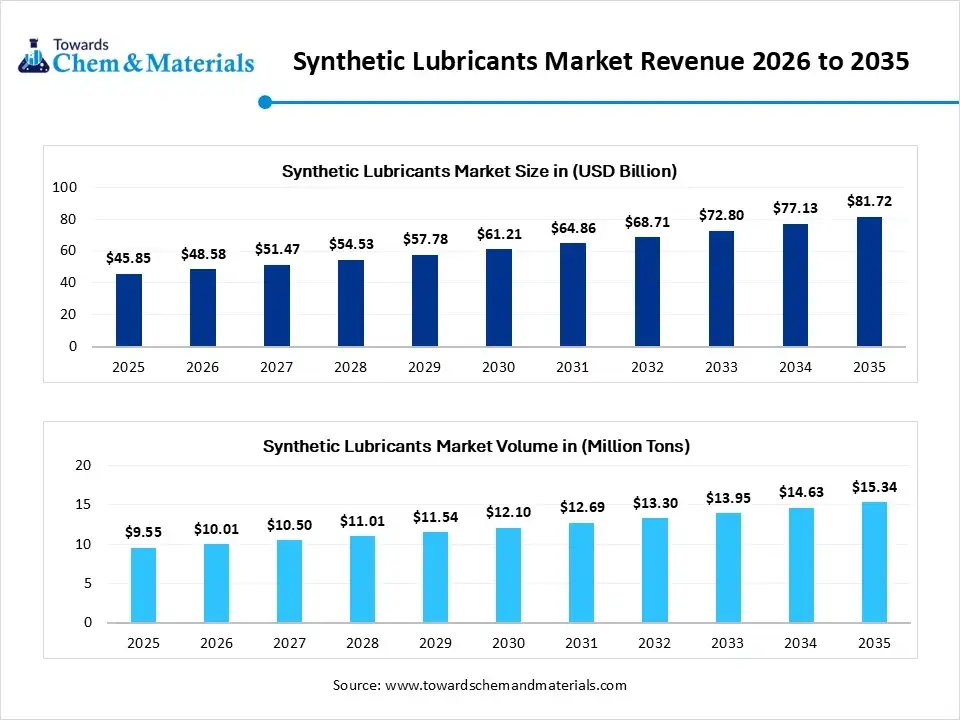
The synthetic lubricants market size was valued at USD 45.85 billion in 2025, is estimated to reach USD 48.58 billion in 2026, and is projected to reach USD 81.72 billion by 2035, exhibiting a compound annual growth rate (CAGR) of 5.95% over the forecast period from 2026 to 2035. In terms of volume, the synthetic lubricants industry is projected to grow from 9.55 million tons in 2025 to 15.34 million tons by 2035. growing at a CAGR of 4.85% from 2026 to 2035. The market expands because of three main factors, which include the increasing need for high-performance automotive and industrial machinery, the growing adoption of electric vehicles, the implementation of stricter environmental regulations, and the development of advanced synthetic lubricant products.
Market Highlights
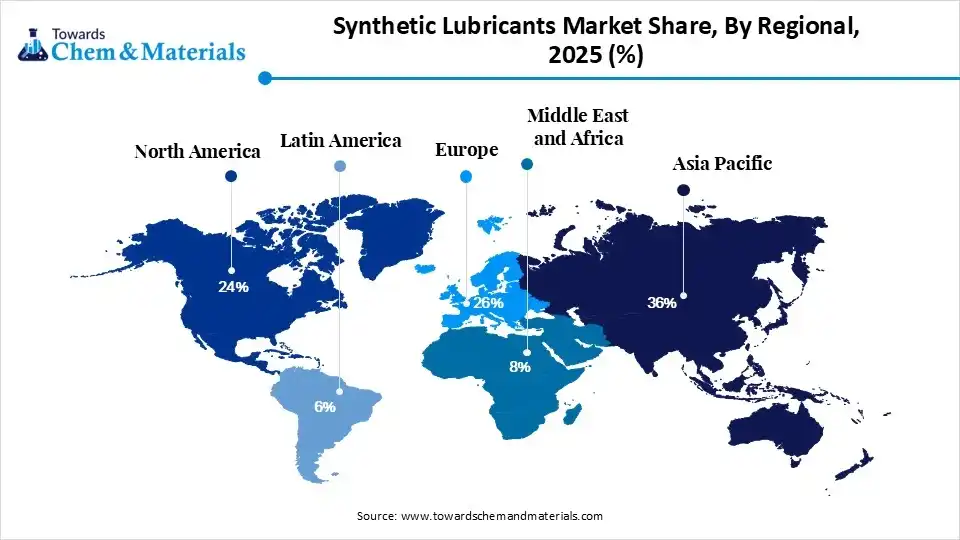
- By region, Asia Pacific dominated the market by holding 36% share in 2025 and is expected to grow at the fastest with a CAGR of 6.4% during the forecast period due to rapid industrialization and vehicle growth.
- By region, Europe held the 26% market share in 2025 and expects notable growth in the market with 5.5% CAGR during the forecast period, driven by stringent regulatory standards.
- By base oil type, the polyalphaolefins (PAO) segment dominated the market with the largest share of 39% in 2025, driven by high thermal stability, which boosts widespread use in automotive lubricants.
- By base oil type, the esters segment held the 21% market share in 2025 and is expected to grow at the fastest CAGR of 6.8% over the forecast period due to biodegradability and high lubricity, which drive demand in eco-sensitive applications.
- By product type, the engine oils segment dominated the market with the largest share of 34% in 2025, driven by its longer drain intervals, which enhance efficiency.
- By product type, the transmission fluids segment held the 16% market share in 2025 and is expected to grow at the fastest CAGR of 5.90% over the forecast period due to its advanced transmission systems requiring high-performance fluids.
- By application, the automotive segment dominated the market with the largest share of 52% in 2025.
- By application, the industrial segment held the 34% market share in 2025, and is expected to grow at the fastest CAGR of 5.8% over the forecast period, driven by increased consumption of lubricants by automation and industrial expansion.
- By end-use industry, the automotive industry segment dominated the market with the largest share of 49% in 2025 due to synthetic adoption for performance improvement.
- By end-use industry, the industrial manufacturing segment held the 28% market share in 2025, and is expected to grow at the fastest CAGR of 5.9% over the forecast period due to demand for lubricants caused by manufacturing expansion.
- By distribution channel, the aftermarket segment dominated the market with the largest share of 47% in 2025, and is expected to grow at the fastest CAGR of 5.8% over the forecast period, driven by a large installed base of vehicles and machinery.
Market Size and Volume Forecast
- Market Estimated Size (2025): USD 45.85 Billion | CAGR (2026–2035): 5.95%
- Market Projected Size (2035): USD 81.72 Billion
- Asia Pacific: largest Market Revenue Share of 36% in 2025.
- Market Estimated Volume (2025): 9.55 Million Tons | Volume CAGR (2026–2035): 4.85%
- Market Projected Volume (2035): 15.34 Million Tons
- Market Pricing (2025):
- Average Manufacturing Price: USD 4,160 per ton
- Average Selling Price: USD 5,430 per ton
- Pricing CAGR (2025–2035): 2.65%
Market Overview
- The synthetic lubricants market is experiencing rapid expansion because various sectors, including automotive, industrial, aerospace, and marine markets, require high-quality lubricants that deliver energy efficiency and environmental safety. Synthetic lubricants represent chemically created oils that deliver better thermal stability, oxidation protection, viscosity management, and extended usage periods than standard mineral oils.
- The increasing use of electric vehicles, together with turbocharged engines and advanced industrial equipment, is creating a demand for specialized lubricants that can withstand extreme temperature and pressure conditions. The market growth receives additional support through increasing environmental regulations, which demand reduced emissions and biodegradable product solutions.
- Product development and operational efficiency improvements receive benefits from technological progress, which includes PAO- and ester-based formulations, nano-additives, smart lubricant monitoring systems, and AI-driven predictive maintenance solutions. The combination of Industry 4.0 with IoT-based oil condition monitoring and data-driven manufacturing optimization allows lubricant manufacturers to achieve better product performance, decreased downtime, and improved global supply chain efficiency.
Recent Market Trends
- Automotive Industry Demand :The synthetic oils from the advanced generation are designed to provide increased thermal stability, anti-oxidation properties, and LSPI protection for the engine to ensure long life and improved overall performance in Turbocharged and high-efficiency engines around the world. Passenger vehicles, commercial vehicles, and high-performance automotive applications are driving the market.
- Environmental & Sustainability Focus :Synthetic lubricants offer a clear advantage in many respects with their lower volatility, longer drain cycles, enhanced fuel economy, and lower emissions, which are aiding in meeting the compliance requirements of increasingly stringent environmental regulations and corporate sustainability initiatives around the world.
- Transition Toward Synthetic Lubrication:The automotive industry is moving away from traditional mineral oils toward synthetic lubricants, which provide better thermal performance, oxidation protection, fuel efficiency, and dependable operation in high-stress situations because both regulations and market demand for advanced vehicles have increased.
- Increasing Preference for PAO-Based Lubricants:Polyalphaolefins are experiencing strong market demand because they provide outstanding performance at both low and high temperatures, maintain their viscosity, and protect equipment for extended periods. The automotive, industrial, and aerospace sectors are driving the adoption of these advanced synthetic lubricant solutions through their increasing use of these products.
- Expanding Demand for Transmission Fluids:Modern automatic transmission systems and hybrid transmission systems require synthetic transmission fluids because these fluids provide essential lubrication needed to achieve better gear shifting, thermal control, and longer equipment life. The complex technological features of automobiles create a need for new high-performance transmission lubrication solutions, which drive both advancements in transmission technology and increased demand for advanced transmission lubrication products.
- Innovation in Electric Vehicle Lubricants:The increasing electric vehicle market creates a demand for specialized lubricants that provide battery cooling, thermal control, and electrical insulation functions. Manufacturers are increasing research investments to create advanced EV-compatible lubrication solutions that support efficiency and safety, and next-generation mobility technologies.
Report Scope
| Report Attribute | Details |
| Market Size and Volume in 2026 | USD 48.58 Billion/ 10.01 Million Tons |
| Revenue Forecast in 2035 | USD 81.72 Billion/ 15.34 Million Tons |
| Growth Rate | CAGR 5.95% |
| Forecast Period | 2026 - 2035 |
| Base Year | 2025 |
| Dominant Region | Asia Pacific |
| Segment Covered | By Base Oil Type, By Product Type, By Application, By End-Use Industry, By Distribution Channel, By Region |
| Key companies profiled | Motosel, IRMCO, Nye Lubricants, Inc., BP Plc, JAX Inc., Nylok Corp., International Products Corporation, Engineered Custom Lubricants and JXTG Nippon Oil & Energy Corporation. |
Key Technological Shifts and AI in the Synthetic Lubricants Market
The synthetic lubricants market is evolving rapidly because of product formulation innovations, sustainability initiatives, and the implementation of artificial intelligence technologies. The development of EV-specific lubricants requires research into thermal management systems, battery cooling methods, and gearbox efficiency improvements, which will enable future electric mobility systems. The PAO- and ester-based lubricants deliver superior oxidation resistance together with high-temperature stability, which results in better operational performance across automotive and industrial applications in extreme conditions.
The need for environmentally friendly products drives industries to adopt biodegradable and eco-friendly lubricants. The application of nanotechnology helps to enhance lubricant performance through reduced friction and decreased wear, which results in longer equipment lifespan. The IoT-enabled smart lubricants with embedded sensors offers real-time oil condition monitoring, which helps to meet predictive maintenance and enhnace operational efficiency.
The market undergoes transformation through artificial intelligence, which accelerates lubricant formulation processes and achieves optimal additive combinations while enhancing product consistency and predicting lubricant degradation. AI-powered analytics enhance supply chain management, together with inventory optimization and the creation of tailored lubricant solutions that serve both automotive and industrial markets.
Supply Chain Analysis of the Synthetic Lubricants Market
- Feedstock Procurement: Strategic sourcing and transportation of petrochemical, natural gas, and bio-based feedstocks for the synthetic lubricant base oil production.
- Key Players: ExxonMobil, Shell, BP, Chevron
- Chemical synthesis and processing are used to produce chemically synthesized high-purity, high-stability base oils using advanced refining, polymerization, and gas-to-liquid technologies and feedstocks.
- Key Players: Shell, Chevron Phillips Chemical, INEOS
- Quality Testing and Certification: Rigorous laboratory testing and certification ensure lubricant longevity, regulatory compliance, reliability, and adherence to industry standards across the globe.
- Key Players: SGS, Intertek, Bureau Veritas
Regulatory Framework: Synthetic Lubricants Market
| Region | Key Regulation | Regulatory Focus |
| Asia Pacific | China VI Emission Standards and Bharat Stage VI (BS-VI) Norms | Emission regulations for vehicles create greater needs for synthetic engine oils that have low viscosity and deliver high performance while enhancing fuel efficiency and decreasing emissions. |
| North America | U.S. EPA Fuel Economy and Emission Standards | Reduced emissions and improved fuel efficiency drive the use of advanced synthetic lubricants, which offer superior thermal stability and lower volatility. |
| European Union | EU Ecolabel for Lubricants | The program promotes the use of biodegradable lubricants that are safe for the environment, while the program develops sustainable synthetic lubricant products for commercial use. |
Synthetic Lubricants Market Dynamics
Drivers:
Superior Performance & Durability
Excellent performance properties are gaining popularity and leading the industry towards the use of synthetic lubricants over traditional mineral-based lubricants. They have excellent oxidation resistance, thermal stability, viscosity control, and wear protection properties under extreme operating conditions. These lubricants can also help to extend the time between oil changes, minimize equipment downtime, and optimize fuel efficiency in automotive and industrial machinery applications. As machinery, such as high-performance engines, heavy industrial equipment, and advanced machinery systems become more prevalent, the demand for high-performance, long-lasting synthetic lubricants is growing.
Expanding Automotive Production Supporting Synthetic Oil Demand
The demand for synthetic engine oils is rising because vehicle production worldwide is increasing, and people prefer to use fuel-efficient engines that deliver high performance. Automakers are increasingly adopting lower viscosity lubricant grades and extended drain interval technologies to improve engine efficiency and reduce emissions while increasing engine durability. The worldwide demand for advanced synthetic lubricants is growing because of this trend, which affects passenger vehicles, commercial fleets, and hybrid automotive applications.
Restraints
High Cost:
The most significant limitation on market growth is the increased production cost of the synthetic lubricants, particularly in the price-sensitive industry and in developing economies. The use of advanced chemical processing technologies and top-of-the-line additive packages for the manufacture of synthetic base oils results in higher-priced products than conventional mineral lubricants. Although a synthetic product may be cheaper, it may not be preferred by the small-scale industries or cost-conscious consumers due to its performance over a longer period of time. Moreover, the cost of raw materials and formulation issues also play a part in determining profitability and limiting mass market use in product applications where cost, not performance or extending equipment protection, is a key factor.
Electric Vehicle Transition Reshaping Lubricant Demand
Electric vehicles are becoming more popular, which causes a major impact on the synthetic lubricants market because it decreases the need for traditional engine oils that protect internal combustion engines. The industry now needs specialized EV fluids that provide battery cooling and thermal management, electrical insulation, and drivetrain efficiency. The lubricant industry needs to create new EV-compatible formulations that will help it meet the demands of future automotive technologies and changing transportation needs.
Opportunities
Advanced Formulation Developments:
The synthetic lubricants market is witnessing significant growth opportunities owing to continuous developments in lubricant chemistry and formulation technologies. Manufacturers have been working on research and development to create new lubricants, which are advanced ester-based, bio-based, and nano-enhanced, that will provide wear resistance, biodegradability, and thermal stability. Innovation activities all over the world are stimulated by the need for EV-specific fluids, environmentally friendly lubricants, and highly efficient industrial oils.
Growing Focus on Bio-based Synthetic Lubricants
Research develops bio-based synthetic lubricants because environmental problems and new sustainability laws create research needs. Countries across the world support green product development through their environmental regulations, financial incentives, and carbon reduction programs. The lubricants provide automotive, industrial, marine, and aerospace industries with sustainable high-performance lubrication solutions because they offer biodegradability, reduced emissions, and enhanced environmental sustainability.
Segmental Insights
Base Oil Type Insights
The Polyalphaolefins (PAO) Segment Dominated the Synthetic Lubricants Market with 39% of Market Share in 2025
The polyalphaolefins (PAO) segment dominated the market with the largest share of 39% in 2025. The fuel economy and the low toxicity of the synthetic lubricants are significant advantages. They perform better in extreme conditions and pressures, which helps extend equipment life. The rising demand for high-performance lubricants and OEM approval for them still keeps global adoption moving forward.
The esters segment held the 21% market share in 2025 and is expected to grow at the fastest CAGR of 6.8% over the forecast period, due to demand for industrial and aerospace applications as biodegradable and environmentally friendly lubricants. They have superb lubricity and thermal stability, making them suitable for high-performance machines. The market is poised to grow rapidly around the world, driven by increasing regulations and the use of advanced mobility solutions.
The group III (Hydrocracked Oils) segment held the 18% market share in 2025 because of its ability to provide a balance of performance and affordability. Refining technologies have been improved, which has led to high-quality products and made them available to use in wider applications such as automotive lubricants and industrial applications. The market demand for synthetic lubricants is strong, as they are becoming increasingly preferred by consumers because they are efficient and economical.
Synthetic Lubricants Market Share, By Base Oil Type, 2025 (%)
| By Base Oil Type | Revenue Share, 2025 (%) |
| Polyalphaolefins (PAO) | 39% |
| Esters | 21% |
| Polyalkylene Glycols (PAG) | 16% |
| Group III (Hydrocracked Oils) | 18% |
| Others | 6% |
Product Type Insights
The Engine Oils Segment Dominated the Synthetic Lubricants Market with 34% of Market Share in 2025
The engine oils segment dominated the market with the largest share of 34% in 2025, because of the surge in global vehicle production and the demand for high-performance automotive lubricant. Longer drain periods, better protection for engines, more efficient in operation, and less maintenance. The world shows continued growth in demand for advanced engines and higher fuel economy standards.
The transmission fluids segment held the 16% market share in 2025 and is expected to grow at the fastest CAGR of 5.90% over the forecast period, as advanced vehicles with advanced transmission systems are increasing. Adoption is picking up due to the need for smooth gear performance, improved durability, and thermal stability. The increasing number of electric vehicles on the road is also spurring innovation in new transmission lubrication solutions worldwide.
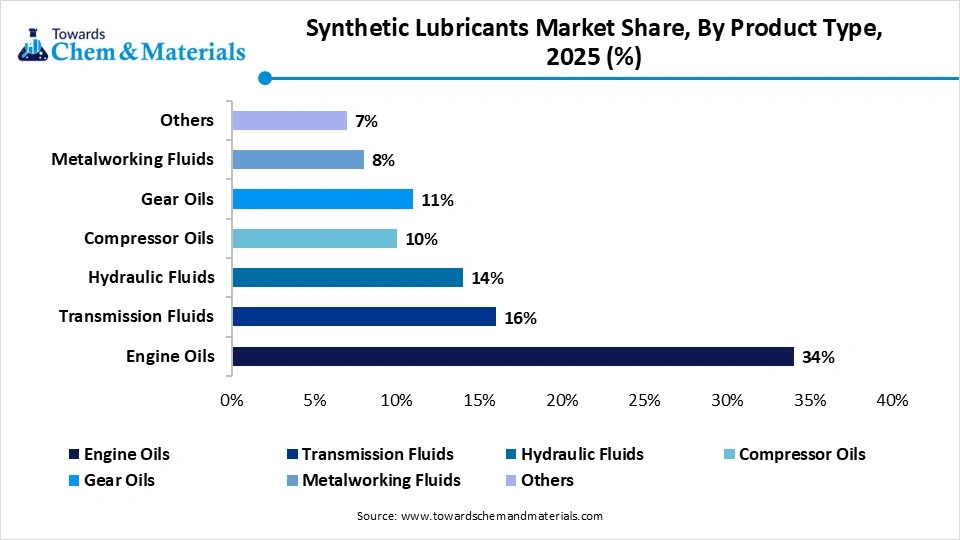
The hydraulic fluids segment held the 14% market share in 2025, by virtue of the increasing industrial automation and growth in manufacturing activities in different parts of the world. These fluids help in enhancing the effectiveness of the equipment, minimizing operational wear, and assisting in the smooth functioning of industrial machinery at peak performance. Advanced hydraulic lubrication solutions continue to see a high demand from investments in infrastructure, construction, and heavy industries.
Synthetic Lubricants Market Share, By Product Type, 2025 (%)
| By Product Type | Revenue Share, 2025 (%) |
| Engine Oils | 34% |
| Transmission Fluids | 16% |
| Hydraulic Fluids | 14% |
| Compressor Oils | 10% |
| Gear Oils | 11% |
| Metalworking Fluids | 8% |
| Others | 7% |
Application Insights
The Automotive Segment Dominated the Synthetic Lubricants Market with 52% of Market Share in 2025
The automotive segment dominated the market with the largest share of 52% in 2025, due to the growing number of automobiles and a growing demand for powertrain protection. Synthetic lubricants help to increase fuel efficiency, lower emissions, and aid in the development of advanced engine technologies. As more and more vehicles are going electric and hybrid, there is an increasing incentive to innovate lubricants in other parts of the world.
The industrial segment held the 34% market share in 2025 and is expected to grow at the fastest CAGR of 5.8% over the forecast period, as it is characterized by a high level of automation, manufacturing growth, and emphasis on operational efficiency. The synthetic lubricants provide assistance in reducing equipment downtime, provide increased energy efficiency, and increase the life of the equipment. Demand for sophisticated lubrication solutions in various manufacturing industries continues to grow as a result of stronger industrialisation in emerging economies all over the world.
The aerospace segment held the 8% market share in 2025, with increased demand for high-performance lubricants that can withstand extreme conditions. Lubricants are used worldwide to support aviation activities and the production of aircraft. Specialized synthetic lubrication solutions are being developed as a result of strict safety requirements and ongoing technological improvements.
Synthetic Lubricants Market Share, By Application, 2025 (%)
| By Application | Revenue Share, 2025 (%) |
| Automotive | 52% |
| Industrial | 34% |
| Aerospace | 8% |
| Marine | 6% |
End-Use Industry Insights
The Automotive Industry Segment Dominated the Synthetic Lubricants Market with 49% of Market Share in 2025
The automotive industry segment dominated the market with the largest share of 49% in 2025, because of rising vehicle sales and rising demand for high-performance automotive lubricants. Synthetic lubricants, in addition to improving engine efficiency, prolonging vehicle life, and enabling cutting-edge automotive technologies, are widely used in the automotive industry. The automotive industry relies on synthetic lubricants, which also help to improve engine efficiency, extend vehicle life, and enable advanced automotive technologies. The global adoption of premium synthetic lubricant products is being driven even more by the increasing OEM specifications and fuel economy standards.
The industrial manufacturing segment held the 28% market share in 2025, and is expected to grow at the fastest CAGR of 5.9% over the forecast period. The growing production activities and rapid industrial automation across the globe are the key factors driving the segment. Synthetic lubricants increase machinery efficiency, reduce the costs of maintenance, and minimize downtime while operating. Market growth is boosted across industrial sectors by the continued growth of industrialization in emerging markets and growth in investments in smart manufacturing technologies.
The energy & power segment held the 10% market share in 2025, the growth of the segment attributed due to the rising demand for authentic lubrication as the power generation systems. Synthetic lubricants help to ensure equipment durability, operational efficiency, and the optimization of maintenance. The market is growing due to the rise in renewable energy installations and the expansion of energy infrastructure projects.
Synthetic Lubricants Market Share, By End-Use Industry, 2025 (%)
| By End-Use Industry | Revenue Share, 2025 (%) |
| Automotive Industry | 49% |
| Industrial Manufacturing | 28% |
| Energy & Power | 10% |
| Aerospace & Defense | 7% |
| Marine Industry | 6% |
Distribution Channel Insights
The aftermarket Segment Dominated the Synthetic Lubricants Market with 47% of Market Share in 2025
The aftermarket segment dominated the market with the largest share of 47% in 2025, and is expected to grow at the fastest CAGR of 5.8% over the forecast period, because of the massive installed base of vehicles and industrial machinery that need maintenance and replacement of lubricants. Growing networks and consumer awareness help to sustain demand. Aftermarket lubricant usage is continuing to grow as the equipment becomes more used and the maintenance activities become more frequent around the world.
The OEM Supply segment held the 41% market share in 2025, due to OEM's preference to use approved high-performance lubes for factory fill and warranties. Lubricant manufacturers have long-term agreements with car manufacturers to guarantee demand. Product reliability, engine efficiency, and performance requirements continue to be increasingly emphasized, which further helps justify the use of OEM lubricants globally.
Synthetic Lubricants Market Share, By Distribution Channel, 2025 (%)
| By Distribution Channel | Revenue Share, 2025 (%) |
| OEM Supply | 41% |
| Aftermarket | 47% |
| Online Sales | 12% |
Regional Insights
How did the Asia Pacific dominate the Synthetic Lubricants Market in 2025?
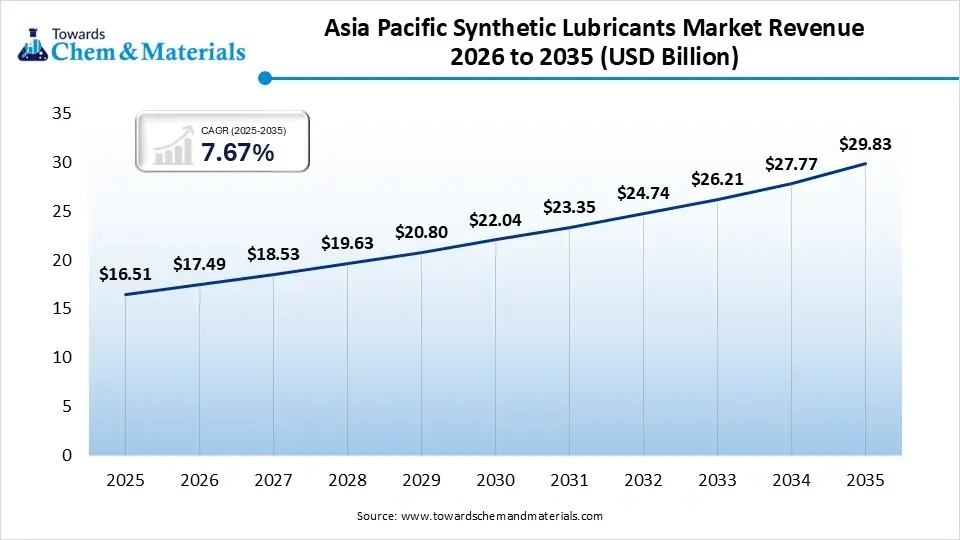
Asia Pacific synthetic lubricants market size was estimated at USD 16.51 billion in 2025 and is projected to reach USD 29.83 billion by 2035, growing at a CAGR of 7.67% from 2026 to 2035. Asia Pacific dominated the market by holding 36% share in 2025 and is expected to grow at the fastest with a CAGR of 6.4% during the forecast period, because the region experienced both rapid industrial growth and increased automotive production and various manufacturing operations, which emerged in developing nations. The market showed increased lubricant demand because more people started owning vehicles, infrastructure projects progressed, and industrial facilities required better performance machinery. The regional market maintained its leading position through advanced automotive technology adoption, government support programs, and increased funding for industrial automation projects.
India Synthetic Lubricants Market Growth Trends
The market in India shows strong expansion because of the rising automotive industry, rapid industrial development, and increasing infrastructure construction activities. The demand for fuel-efficient vehicles, industrial automation, and high-performance machinery drives the growth of synthetic lubricants in the market. The market across multiple industrial sectors maintains its growth because government programs support manufacturing expansion, electric vehicle adoption increases, equipment efficiency knowledge grows, and longer equipment drain intervals become known.
Europe Synthetic Lubricants Market Growth Trends
Europe held the 26% market share in 2025 and expects notable growth in the market with 5.5% CAGR during the forecast period, because the region possesses an advanced automotive industry, has established strict environmental standards, and is developing sustainable practices. The market experiences growth because consumers demand vehicles that use less fuel and because businesses seek environmentally friendly industrial solutions. The region experiences increased demand for premium synthetic lubrication products because of technological advancements in lubricant formulations, the growing use of electric vehicles, and the worldwide effort to reduce carbon emissions.
Germany Synthetic Lubricants Market Growth Trends
The European synthetic lubricants market relies on Germany because the country possesses both automotive manufacturing strengths and industrial engineering expertise. The market experiences growth because consumers demand premium automotive lubricants, advanced industrial machinery, and energy-efficient technologies. The market for high-performance synthetic lubricants in automotive and industrial applications continues to grow because of increased investments in electric mobility, Industry 4.0 automation, and sustainable manufacturing practices.
Synthetic Lubricants Market Share, By Regional, 2025 (%)
| Regional | Revenue Share, 2025 (%) |
| North America | 24% |
| Europe | 26% |
| Asia-Pacific | 36% |
| Latin America | 6% |
| Middle East & Africa | 8% |
Recent Developments
- In December 2025, Gulf Oil Lubricants India Ltd introduced Gulf Syntrac, a fully synthetic motorcycle engine oil, targeting the premium two-wheeler market. API SP compliant features advanced ester technology and includes 11 SKUs in various viscosity grades for optimal performance.(Source: auto.economictimes.indiatimes.com)
- In September 2025, Veedol Corporation launched two new fully synthetic engine oils, 'SwiftPower' and 'SynthGlide,' in the Indian market on September 24, 2025. Utilizing EstoBioLides Technology, these products reflect Veedol's commitment to innovation, aiming to boost performance and efficiency while providing enhanced protection and longevity for vehicle engines.(Source: scanx.trade)
Top Companies in the Market
- Motosel
- IRMCO
- Nye Lubricants, Inc.
- BP Plc
- JAX Inc.
- Nylok Corp.
- International Products Corporation
- Engineered Custom Lubricants
- JXTG Nippon Oil & Energy Corporation
Segment Covered in the Report
By Base Oil Type
- Polyalphaolefins (PAO)
- Low Viscosity PAO
- High Viscosity PAO
- Esters
- Diesters
- Polyol Esters
- Polyalkylene Glycols (PAG)
- Water-Soluble PAG
- Water-Insoluble PAG
- Group III (Hydrocracked Synthetic Oils)
- Highly Refined Mineral-Based Synthetics
- Others
- Silicone Oils
- Phosphate Esters
By Product Type
- Engine Oils
- Passenger Car Motor Oil (PCMO)
- Heavy Duty Engine Oil (HDEO)
- Transmission Fluids
- Automatic Transmission Fluids (ATF)
- Manual Transmission Fluids (MTF)
- Hydraulic Fluids
- Industrial Hydraulic Fluids
- Mobile Hydraulic Fluids
- Compressor Oils
- Refrigeration Compressor Oils
- Air Compressor Oils
- Gear Oils
- Automotive Gear Oils
- Industrial Gear Oils
- Metalworking Fluids
- Cutting Fluids
- Forming Fluids
- Others
- Turbine Oils
- Heat Transfer Fluids
By Application
- Automotive
- Passenger Vehicles
- Commercial Vehicles
- Electric Vehicles
- Industrial
- Manufacturing Equipment
- Power Generation
- Construction Equipment
- Aerospace
- Aviation Engines
- Hydraulic Systems
- Marine
- Ship Engines
- Offshore Equipment
By End-Use Industry
- Automotive Industry
- Industrial Manufacturing
- Energy & Power
- Aerospace & Defense
- Marine Industry
By Distribution Channel
- OEM Supply
- Aftermarket
- Online Sales
By Regions
- North America
- U.S.
- Canada
- Mexico
- Europe
- Germany
- UK
- France
- Italy
- Spain
- Asia Pacific
- China
- India
- Japan
- South Korea
- Latin America
- Brazil
- Argentina
- Middle East & Africa
- Saudi Arabia
- South Africa
FAQ's
Question 1 : What is the projected market size for synthetic lubricants by 2035?
Answer : The market is expected to grow to USD 81.72 billion by 2035, supported by a 5.95% annual growth rate.
Question 2 : Why is synthetic oil better than traditional mineral oil?
Answer : Synthetic oil is chemically engineered to have more uniform molecules. This results in better protection at extreme temperatures, longer periods between oil changes (drain intervals), and improved fuel efficiency.
Question 3 : Does the rise of Electric Vehicles (EVs) hurt the lubricant market?
Answer : While EVs don\'t need traditional engine oil, they actually create a new demand for high-tech synthetic fluids. EVs require specialized lubricants for battery cooling, thermal management, and high-speed gearboxes.
Question 4 : Which industry uses the most synthetic lubricants?
Answer : The Automotive Industry is the largest consumer, accounting for 49% of the market in 2025. It’s followed by industrial manufacturing and the energy sector.
Question 5 : What are PAOs and why are they important?
Answer : PAOs (Polyalphaolefins) are a type of synthetic base oil. They are the most popular choice in the market because they provide excellent performance in both freezing cold and blistering heat.
Meet the Team

Saurabh Bidwai
Principal Consultant
Saurabh Bidwai, a B.Tech Chemical Engineering graduate with 4+ years of experience, specializes in specialty chemicals, commodity chemicals, and engineered materials, offering valuable insights into market trends and emerging opportunities.

Aditi Shivarkar
Reviewed By
Aditi Shivarkar, with 14+ years in Chemical and Materials market research, specializes in Chemical and Materials. She ensures accurate, actionable insights, driving Towards Chemicals And Materials Analytics and Consulting excellence in industry trends and sustainability.