
Tertiary Water & Wastewater Treatment Equipment Market Size, Production & Manufacturing Efficiency, Sales Volume, Export & Import Dependency, Adoption Rates, Cost Structure, Recycling Rate, and Supply Chain Metrics
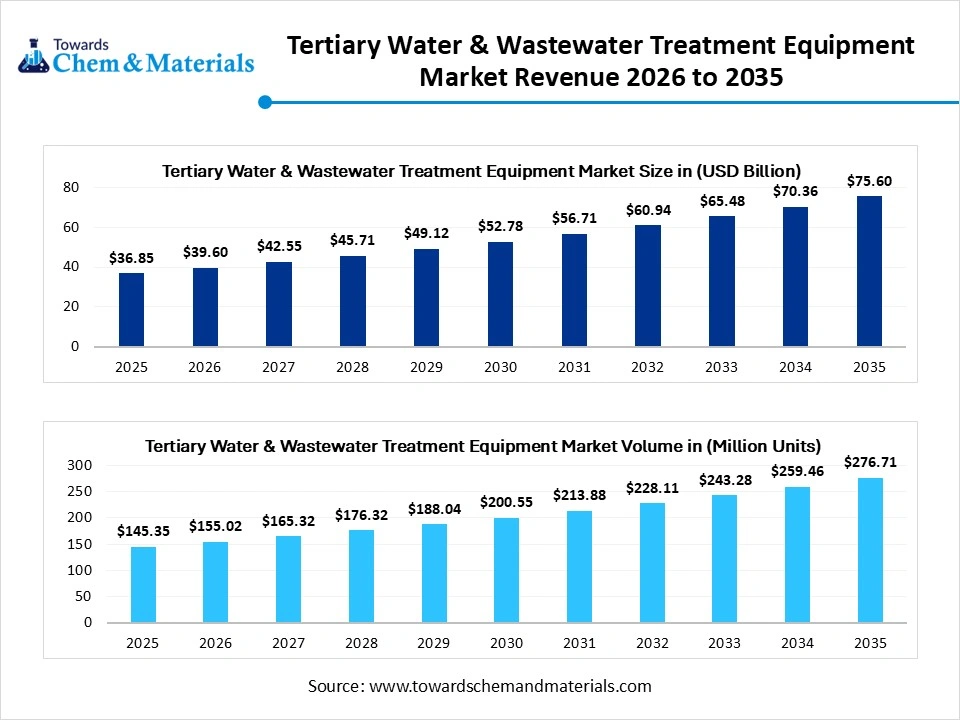
The tertiary water & wastewater treatment equipment market is experiencing strong growth, driven by increasing demand for advanced water purification solutions. The market size is projected to grow from USD 36.85 billion in 2025 to USD 75.6 billion by 2035, with a 7.45% CAGR, while volume demand is set to nearly double from 145.35 million tons to 276.71 million tons, growing at 6.6% CAGR. The study includes detailed segmentation analysis, regional performance evaluation, competitive benchmarking, value chain insights, trade flow analysis, and comprehensive data on manufacturers and suppliers, ensuring complete market understanding.
Content
Tertiary Water & Wastewater Treatment Equipment Market Size and Growth Forecast
The global tertiary water & wastewater treatment equipment market was valued at USD 36.85 billion in 2025, is estimated to reach USD 39.6 billion in 2026, and is projected to reach USD 75.6 billion by 2035, growing at a CAGR of 7.45% from 2026 to 2035. In terms of volume, the tertiary water & wastewater treatment equipment market is projected to grow from 145.35 million tons in 2025 to 276.71 million tons by 2035. growing at a CAGR of 6.6% from 2026 to 2035.
Key Takeaways
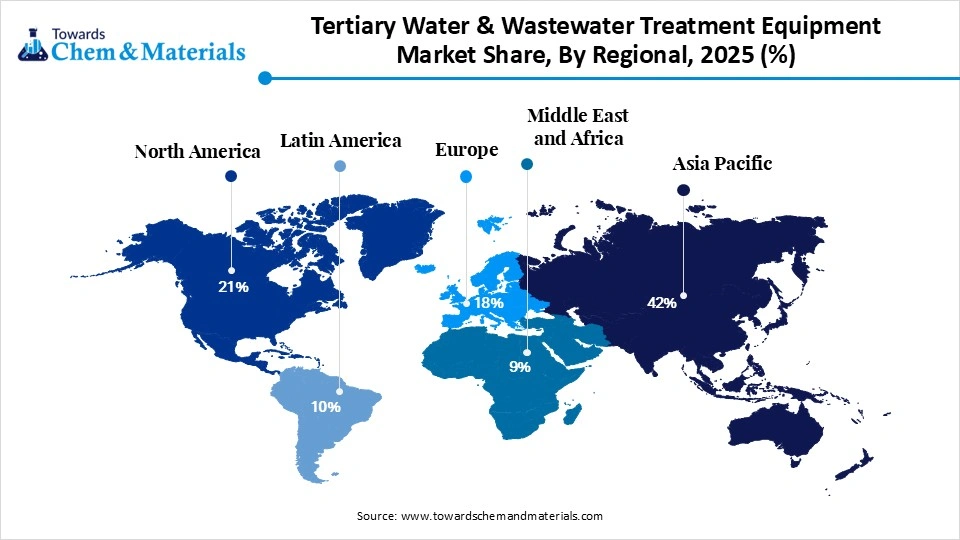
- By region, Asia Pacific dominated the tertiary water & wastewater treatment equipment market in 2025, with 42% share, and is expected to be the fastest-growing in the market, with a CAGR of 8.0% in the forecast period.
- By region, North America is notably growing with 21% market share in 2025.By equipment type, the filtration systems segment dominated the market with 38% share in 2025 and is expected to be the fastest-growing in the market, with a CAGR of 7.8% in the forecast period.
- By technology, the membrane-based treatment segment held 41% share in 2025 and is expected to be the fastest-growing in the market, with a CAGR of 8.1% in the forecast period.
- By application, the municipal water treatment segment dominated the market with 46% share in 2025.
- By application, the industrial wastewater treatment segment held 34% share in 2025 and is expected to be the fastest-growing in the market, with a CAGR of 7.6% in the forecast period.
- By end-use industry, the municipal segment dominated the market with 48% share in 2025.
- By end-use industry, the industrial segment held 32% share in 2025 and is expected to be the fastest-growing in the market, with a CAGR of 7.7% in the forecast period.
- By system type, the fixed systems segment dominated the market with 54% share in 2025.
- By system type, the modular system segment held 31% share in 2025 and is expected to be the fastest-growing in the market, with a CAGR of 8.2% in the forecast period.
High End Water Treatment Systems Growing
The advanced systems, which include advanced systems primarily used in the final stage of water cleaning is known as the tertiary wastewater and wastewater treatment equipment. Also, with the advancements in water cleaning technologies, the developed regions have been seen creating lucrative opportunities for manufacturers in the current period.
Market Size and Volume Forecast
- Market Estimated Size (2025): USD 36.85 Billion | CAGR (2026–2035): 7.45%
- Market Projected Size (2035): USD 75.60 Billion
- Market Volume (2025): 145.35 Million Units (equipment & systems) | Volume CAGR (2026–2035): 6.65%
- Market Projected Volume (2035): 276.71 Million Units (equipment & systems)
- Market Pricing (2025):
- Average Manufacturing Price: USD 18,560/unit
- Average Selling Price: USD 26,090/unit
- Pricing CAGR (2025–2035): 3.95%
- Average Manufacturing Price: USD 18,560/unit
Recent Market Trends
- The demand for ultra-clean water has contributed to the stronger cash flows for manufacturing enterprises in recent years. Also, the increased expectations for the production of water, which is almost equal to the world's fresh water, have elevated the earning potential for producers in the past few years.
- The shift towards flexible treatment systems has translated into favorable financial prospects for producers in the current period. Also, the plants are designed to adapt to changing water qualities and seasonal variations as per the survey.
- The integration of artificial intelligence and robotics is seen as a high-margin opportunity for manufacturers in the coming years. Also, these advanced systems are seen as working more efficiently than manual labor nowadays.
Report Scope
| Report Attribute | Details |
| Market Size and Volume in 2026 | USD 39.6 Billion / 145.35 Million Metric Tons |
| Expected Size and Volume by 2035 | USD 75.6 Billion / 75.6 Million Metric Tons |
| Growth Rate from 2026 to 2035 | CAGR 7.45% |
| Forecast Period | 2026 - 2035 |
| Dominant Region | Asia Pacific |
| Segment Covered | By Equipment Type, By Technology, By Application, By End-Use Industry, By System Type and By Regions |
| Key companies profiled | Xylem Inc., Veolia Environnement S.A., Suez S.A., DuPont Water Solutions, Evoqua Water Technologies, Pentair plc, Ecolab Inc., Kemira Oyj, Danaher Corporation, 3M Company |
From Isolated Steps to Smart Flow
The industry is actively shifting towards the isolated processes to connected treatment flows. Also, earlier, each step, like filtration or disinfection, worked separately, with limited coordination. Now, systems are designed so each stage supports the next, creating a smooth and optimized process. This improves overall performance and reduces waste in the coming years.
Supply Chain Analysis of the Tertiary Water & Wastewater Treatment Equipment Market
Distribution to Industrial Users
- Industrial distribution of tertiary treatment equipment is concentrated in water-intensive sectors like oil and gas, pharmaceuticals, food and beverage, and power generation.
- These users adopt advanced filtration and disinfection to meet strict discharge regulations and enable water reuse, essential for operational efficiency and sustainability.
Chemical Synthesis and Processing
- In chemical synthesis and processing, tertiary treatment equipment is vital for refining effluent to ultra-pure standards. Systems like advanced oxidation and ion exchange neutralize complex synthetic compounds and residual toxins.
- This ensures high-quality water recovery, allowing facilities to maintain precise chemical reactions while adhering to stringent environmental safety protocols.
Regulatory Compliance and Safety Monitoring
- Strict regulatory frameworks mandate that tertiary treatment systems achieve precise decontamination levels before discharge or reuse. Integrated safety monitoring tools, such as real-time sensors and automated shut-offs, ensure continuous compliance with environmental standards.
- These technologies mitigate risks by detecting pollutant spikes, protecting local ecosystems, and ensuring facility legal adherence.
Tertiary Water & Wastewater Treatment Equipment Market Regulatory Landscape: Regulations
| Country Region | Regulatory Body | Key Regulations | Focus Areas |
| United States | Environmental Protection Agency (EPA), | Clean Water Act (CWA) Section 402: Establishes the National Pollutant Discharge Elimination System (NPDES), which issues permits to all wastewater treatment facilities. These permits often mandate tertiary processes for discharges into "impaired waters". | Removal of PFAS (updated in 2024), nutrient reduction (nitrogen and phosphorus), and protection of sensitive aquatic environments |
| Europe | European Commission - Environment | Revised Urban Wastewater Treatment Directive (UWWTD): Entered into force January 1, 2025. It mandates tertiary treatment (nutrient removal) for plants with a capacity of 150,000 p.e. (population equivalents) by 2039. | Nutrient removal to stop eutrophication, micropollutant removal (pharmaceuticals and cosmetics), and achieving energy neutrality in treatment plants by 2045. |
| China | Ministry of Ecology and Environment (MEE) | GB 18918-2002: The "Discharge Standard of Pollutants for Municipal Wastewater Treatment Plants." It defines the Grade 1-A standard, which often requires tertiary treatment (filtration and disinfection). | Effluent reuse for landscaping and irrigation in water-scarce megacities, and industrial water recovery in manufacturing zones along major rivers like the Yangtze. |
Market Dynamics
Drivers
Reuse Pressure Reshaping the Water Industry
The rising pressure to reuse water instead of wasting it has driven the industry's growth in recent years. Also, water is no longer easily available, especially in growing cities and industrial zones. Governments, industries, and even real estate developers are being forced to treat water to higher levels and reuse it.
Restraints
Expensive Systems Limit Wide Market Adoption
The high cost and complexity of advanced treatment systems are likely to create growth barriers in the market. Many small industries and local authorities struggle to invest in tertiary treatment because it requires skilled operation, regular maintenance, and a high upfront cost.
Opportunity
From Treatment Cost to Profit Opportunity
Turning wastewater treatment into a profit-generating activity is likely to create sophisticated opportunities for manufacturers during the forecast period. Also, instead of just treating water, companies can recover valuable resources like reusable water, energy, and nutrients.
Segmental Insights
Equipment Type Insights
The Filtration Systems Segment Dominated the Tertiary Water & Wastewater Treatment Equipment Market With 38% Market Share in 2025
The filtration systems segment dominated the market with 38% share in 2025 and is expected to be the fastest-growing in the market, with a CAGR of 7.8% in the forecast period, owing to they are the most reliable and widely understood method of removing physical impurities. They act as the backbone of almost every treatment plant, whether simple or advanced. Without proper filtration, other processes cannot work effectively.
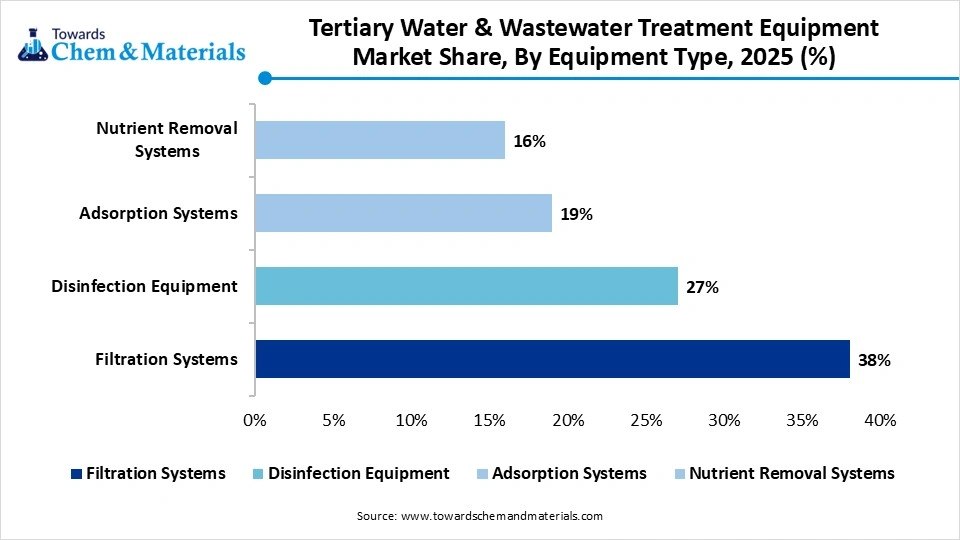
The disinfection equipment segment held 27% market share in 2025, as the focus is shifting toward eliminating invisible biological risks. Earlier, removing visible impurities was enough, but now bacteria, viruses, and pathogens are a major concern. Public health awareness has increased, especially after global health events.
The adsorption systems segment held the 19% market share in 2025 due to they can remove contaminants that other methods struggle with. These include chemicals, odors, colors, and micro-pollutants. As water pollution becomes more complex, traditional systems are not enough. Adsorption provides an extra layer of purification.
Technology Insights
The Membrane-based Treatment Segment Dominated the Market with 41% Market Share in 2025
The membrane-based treatment segment dominated the market with 41% share in 2025 and is expected to be the fastest-growing in the market, with a CAGR of 8.1% in the forecast period, owing to it offers high precision and consistent output quality. It can remove extremely small particles, making it suitable for reuse applications. Industries prefer membranes because they reduce uncertainty and provide predictable results.
Tertiary Water & Wastewater Treatment Equipment Market Share, By Technology, 2025 (%)
| By Technology | Revenue Share, 2025 (%) |
| Membrane-based Treatment | 41% |
| Chemical Treatment | 26% |
| Biological Treatment | 21% |
| Advanced Oxidation Processes | 12% |
The chemical treatment segment held the 26% market share in 2025, owing to its effectiveness in handling sudden changes in water quality. Unlike some systems that require stable conditions, chemical processes can quickly adjust to different contaminants. This makes them useful in industries where wastewater composition changes frequently.
The biological treatment segment held the 21% market share in 2025 due to its being seen as a more natural and sustainable approach. It uses microorganisms to break down organic waste, reducing the need for chemicals. This makes it environmentally friendly and cost-efficient in the long run.
Application Insights
The Municipal Water Treatment Segment Dominated the Tertiary Water & Wastewater Treatment Equipment Market with 46% Market Share in 2025
The municipal water treatment segment dominated the market with 46% share in 2025, owing to cities generating the largest volume of wastewater. Urban populations are growing rapidly, increasing the demand for large-scale treatment systems. Governments also prioritize public health and sanitation, which leads to continuous investment in municipal infrastructure.
Tertiary Water & Wastewater Treatment Equipment Market Share, By Application, 2025 (%)
| By Application | Revenue Share, 2025 (%) |
| Municipal Water Treatment | 46% |
| Industrial Wastewater Treatment | 34% |
| Water Reuse & Recycling | 20% |
The industrial wastewater treatment segment held 34% industry share in 2025 and is expected to be the fastest-growing in the market, with a CAGR of 7.6% in the forecast period, as industries are under increasing pressure to manage their own water. Regulations are becoming stricter, and companies are being held responsible for their discharge. At the same time, industries want to reduce water costs by recycling internally.
The water rescue and recycling segment held the 20% market share in 2025 because it directly solves the problem of water shortage. Instead of finding new water sources, treated water is reused multiple times. This reduces dependency on natural resources. Industries, agriculture, and even residential sectors are adopting reuse systems.
End-Use Industry Insights
The Municipal Segment Dominated the Market with 48% Market Share in 2025
The municipal segment dominated the market with 48% share in 2025 because governments are responsible for managing public water systems. They invest heavily in infrastructure to ensure a safe water supply and wastewater treatment. This creates steady demand for equipment and services.
The industrial segment held the 32% market share in 2025 and is expected to be the fastest-growing in the market, with a CAGR of 7.7% in the forecast period, owing to companies shifting toward self-sufficiency. Instead of depending on municipal systems, industries are building their own treatment and recycling units. This is driven by cost, regulation, and sustainability goals.
The commercial segment held the 12% market share in 2025, as increasing awareness and regulatory pressure on buildings like malls, hotels, and offices. These spaces consume large amounts of water and generate wastewater daily. Installing treatment systems helps reduce costs and improve the sustainability image.
System Type Insights
The Fixed Systems Segment Dominated the Market with 54% Market Share in 2025
The fixed systems segment dominated the market with 54% share in 2025 because they are designed for long-term, large-scale operations. They offer stability, high capacity, and consistent performance. Municipal plants and large industries prefer fixed systems because they can handle continuous flow without interruption.
Tertiary Water & Wastewater Treatment Equipment Market Share, By System Type, 2025 (%)
| By System Type | Revenue Share, 2025 (%) |
| Fixed Systems | 54% |
| Modular Systems | 31% |
| Portable Systems | 15% |
The modular systems segment held the 31% market share in 2025 and is expected to be the fastest-growing in the market, with a CAGR of 8.2% in the forecast period, owing to they offer flexibility and scalability. Users can start small and expand as needed. This reduces initial investment and risk. Modular systems are also faster to install and easier to upgrade.
The portable systems segment held the 15% market share in 2025, as they provide quick and temporary solutions. They are useful in emergencies, remote locations, and construction sites. These systems are easy to transport and install. Also, their use in pilot testing before permanent installation is driving growth.
Regional Insights
How will Asia Pacific Dominate the Tertiary Water & Wastewater Treatment Equipment Market in 2025?
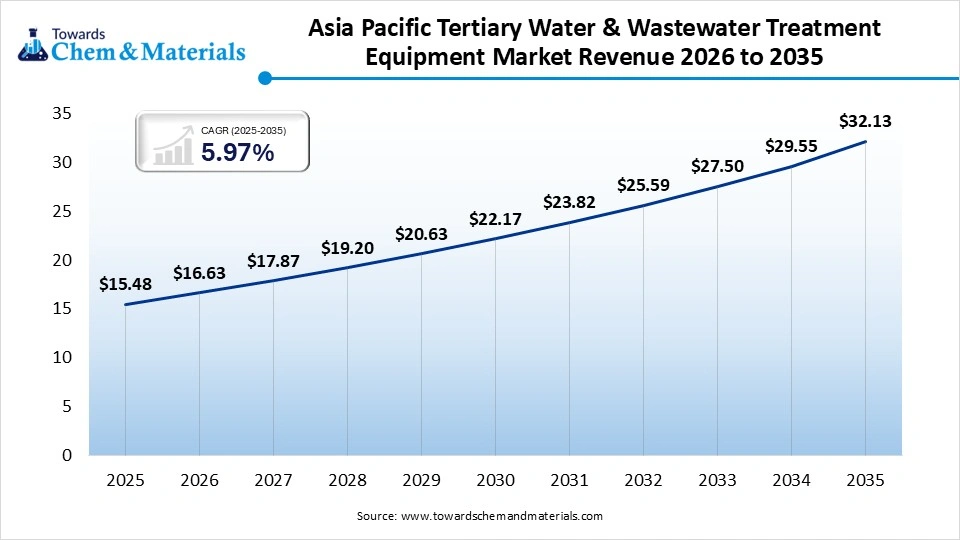
The Asia Pacific tertiary water & wastewater treatment equipment market size was estimated at USD 15.48 billion in 2025 and is projected to reach USD 32.13 billion by 2035, growing at a CAGR of 5.97% from 2026 to 2035 Countries in this region are facing serious water challenges due to population increase and pollution. Governments are investing heavily in water infrastructure. Also, the awareness about water reuse. Moreover, the region dominates because demand is extremely high and growing fast, making it the largest market for water treatment solutions.
Strong Policies Power China Market Dominance
China maintained its dominance in the market, owing to its large industrial base and strict environmental policies. The government is actively promoting wastewater treatment and reuse. Many industries are required to install advanced systems. Furthermore, the urban expansion, which increases municipal demand in the country.
Tertiary Water & Wastewater Treatment Equipment Market Evaluation in North America
North America is growing notably with 21% market share in 2025, owing to technological advancement and focus on water reuse. The region is investing in upgrading old infrastructure with modern systems. Also, innovation in treatment technologies is leading industry growth. Moreover, the future dominance comes from strong technology adoption and continuous improvement of existing systems.
 Strong R&D Drives United States Market Growth
The United States is expected to emerge as a prominent country for the tertiary water & wastewater treatment equipment market in the coming years, due to its advanced infrastructure and strict regulations. Also, many plants are being upgraded to handle new contaminants. Water reuse is also becoming more common. Moreover, the strong research and development.
Recent Development
- In January 2026, Sulzer established its latest global water treatment Centre of Excellence. Also, the newly introduced centre is a global platform that includes deep process knowledge, state-of-the-art engineering, and updated technologies, as per the company's claim.
Top Vendors in the Tertiary Water & Wastewater Treatment Equipment Market & Their Offerings:
- Xylem Inc.: Xylem is a global leader in water technology, specializing in the "Smart Water" segment. They provide advanced tertiary solutions, including UV disinfection, ozone treatments, and membrane filtration through brands like Wedeco and Leopold. Their focus centers on optimizing the water cycle through digital integration and energy-efficient equipment for resource recovery.
- Veolia Environnement S.A.: A French powerhouse, Veolia provides comprehensive water, waste, and energy management. In the tertiary market, they offer cutting-edge technologies like Actiflo for high-speed clarification and Hydrotech discfilters. Veolia leads in large-scale desalination and wastewater recycling projects, emphasizing circular economy practices to transform waste into valuable secondary raw materials.
- Suez S.A.: Suez focuses on innovative circular solutions for water and waste management across five continents. Their tertiary expertise includes advanced ultrafiltration membranes and specialized chemical treatments designed to remove persistent micropollutants. Following its acquisition by a consortium of investors, Suez has reinforced its commitment to sustainable infrastructure and industrial water reuse.
Tertiary Water & Wastewater Treatment Equipment Market Key Players
- DuPont Water Solutions
- Evoqua Water Technologies
- Pentair plc
- Ecolab Inc.
- Kemira Oyj
- Danaher Corporation
- 3M Company
Tertiary Water & Wastewater Treatment Equipment Market Segments Covered in the Report
By Equipment Type
- Filtration Systems
- Sand Filters
- Membrane Filtration
- Ultrafiltration (UF)
- Nanofiltration (NF)
- Reverse Osmosis (RO)
- Disinfection Equipment
- UV Disinfection
- Chlorination Systems
- Ozonation Systems
- Adsorption Systems
- Activated Carbon Filters
- Ion Exchange Systems
- Nutrient Removal Systems
- Biological Nutrient Removal (BNR)
- Chemical Precipitation Systems
By Technology
- Membrane-based Treatment
- RO Systems
- UF Systems
- NF Systems
- Chemical Treatment
- Coagulation & Flocculation
- Oxidation Processes
- Biological Treatment
- Aerobic Systems
- Anaerobic Systems
- Advanced Oxidation Processes (AOPs)
By Application
- Municipal Water Treatment
- Drinking Water Plants
- Sewage Treatment Plants
- Industrial Wastewater Treatment
- Power Generation
- Oil & Gas
- Chemicals
- Food & Beverage
- Water Reuse & Recycling
- Industrial Reuse
- Urban Reuse
By End-Use Industry
- Municipal
- Industrial
- Commercial
- Residential
By System Type
- Fixed Systems
- Modular Systems
- Portable Systems
By Regions
- North America
- U.S.
- Canada
- Mexico
- U.S.
- Europe
- Germany
- UK
- France
- Italy
- Spain
- Germany
- Asia Pacific
- China
- India
- Japan
- South Korea
- China
- Latin America
- Brazil
- Argentina
- Brazil
- Middle East & Africa
- Saudi Arabia
- South Africa
- Saudi Arabia
FAQ's
Question 1 : What are the key trends shaping the tertiary water & wastewater treatment equipment market?
Answer : The greater shift towards sustainable manufacturing and clean water demand is the current industry trend.
Question 2 : Who are the key players in the tertiary water & wastewater treatment equipment market?
Answer : DuPont Water Solutions, Evoqua Water Technologies, and Pentair plc are major players in the tertiary water & wastewater treatment equipment market.
Question 3 : How is the market expected to grow in terms of volume?
Answer : The market volume is projected to increase from 145.35 million units in 2025 to 276.71 million units by 2035, at a CAGR of 6.6%.
Question 4 : Which region dominates the tertiary water treatment equipment market?
Answer : Asia Pacific dominates the market with a 42% share in 2025 and is also the fastest-growing region.
Question 5 : Which region is expected to witness significant growth?
Answer : North America, with a 21% market share in 2025, is expected to grow steadily due to technological advancements and infrastructure upgrades.
Meet the Team

Saurabh Bidwai
Principal Consultant
Saurabh Bidwai, a B.Tech Chemical Engineering graduate with 4+ years of experience, specializes in specialty chemicals, commodity chemicals, and engineered materials, offering valuable insights into market trends and emerging opportunities.

Aditi Shivarkar
Reviewed By
Aditi Shivarkar, with 14+ years in Chemical and Materials market research, specializes in Chemical and Materials. She ensures accurate, actionable insights, driving Towards Chemicals And Materials Analytics and Consulting excellence in industry trends and sustainability.