
Textile Chemicals Market Size, Share, Growth, Report 2026 to 2035
The textile chemicals market segmented By Product (Coating & Sizing Chemicals, Colorants & Auxiliaries, Finishing Agents, Surfactants, Desizing Agents, Bleaching Agents, Scouring Agents, and Yarn Lubricants), the market highlights the diverse formulations essential for textile manufacturing. Based on material compatibility, the market is segmented By Fiber Type (Natural Fiber and Synthetic Fiber), mapping the adoption across organic and man-made raw materials. In terms of chemical application stages, the industry is evaluated By Process (Pretreatment, Coating, and Treatment Of Finished Products), reflecting its integration into different processing phases. Furthermore, the commercial footprint and demand dynamics are scrutinized By Application (Apparel, Home Furnishing, Technical Textiles, and Other Applications)-Global Industry Analysis, Size, Trends, Leading Companies, Regional Outlook, and Forecast 2026 to 2035
Content
What is Textile Chemicals Market Size?
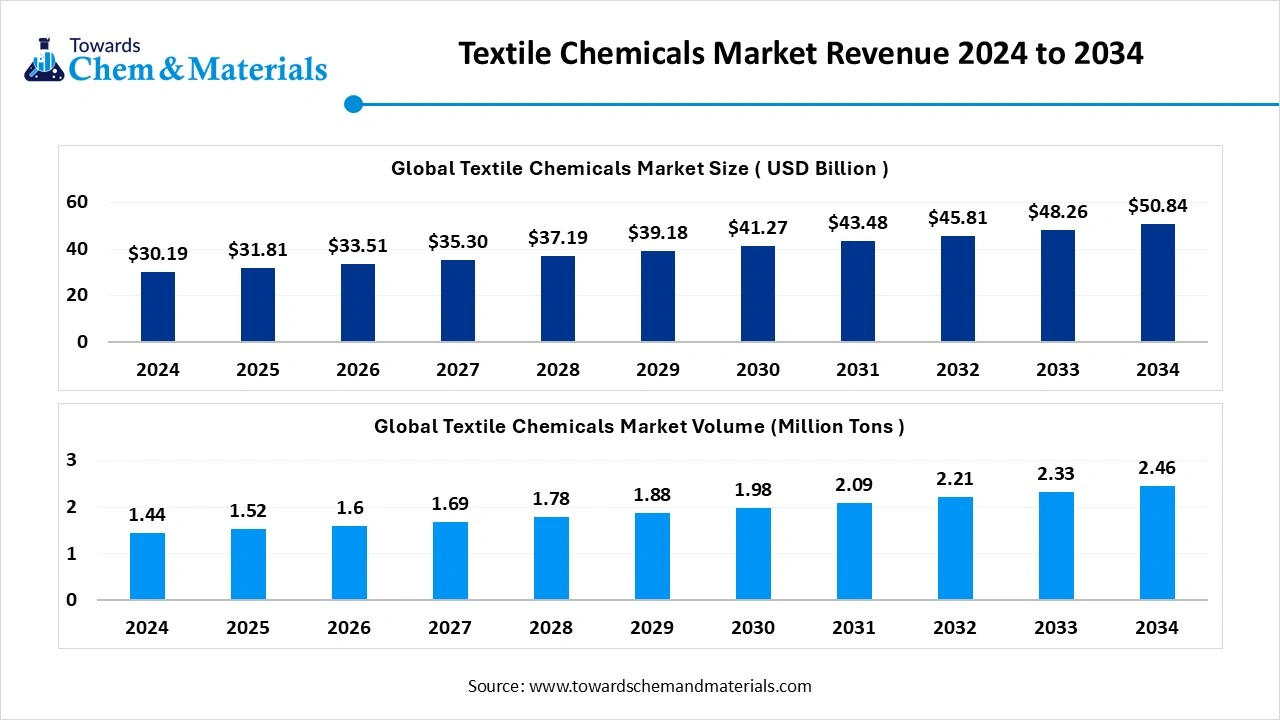
The textile chemicals market size was valued at USD 33.55 billion in 2025, is estimated to reach USD 35.55 billion in 2026, and is projected to reach USD 59.80 billion by 2035, exhibiting a compound annual growth rate (CAGR) of 5.95% over the forecast period from 2026 to 2035. In terms of volume, the textile chemicals market is projected to grow from 18.95 million tons in 2025 to 30.43 million tons by 2035. growing at a CAGR of 4.85% from 2026 to 2035.The global shift towards durable and eco-friendly textiles is accelerating the industry's potential.
Market Highlights
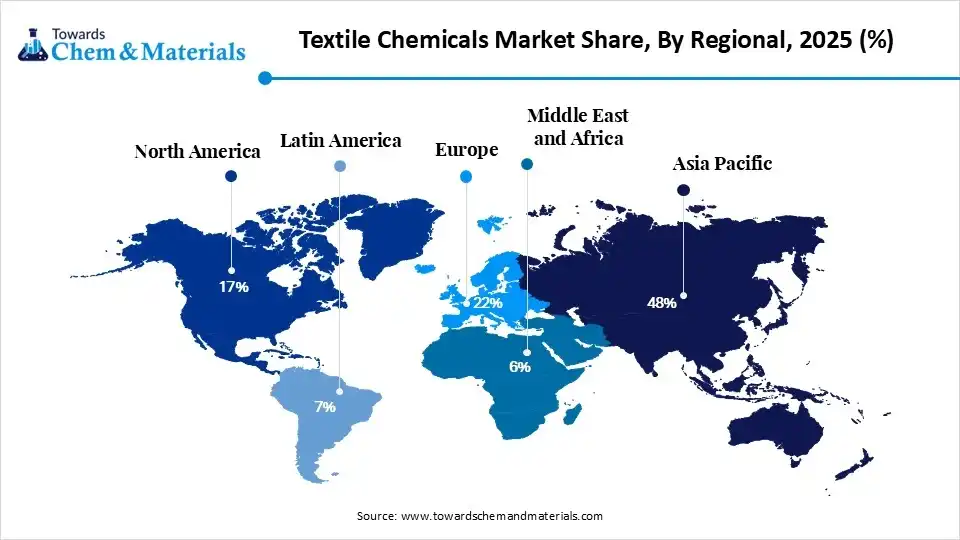
- By region, Asia Pacific dominated the market with a share of 48% in 2025 and is expected to be the fastest-growing region in the market, with a CAGR of 7.10% in the forecast period, due to the region having become the global center for textile manufacturing and exports.
- By region, Europe is notably growing with 22% market share in 2025, owing to the region is increasingly focusing on technical textiles, smart fabrics, and sustainable textile manufacturing technologies.
- By product, the coating & sizing chemicals segment dominated the market with 18% share in 2025, as these chemicals are widely used to improve yarn strength, fabric durability, and surface protection during textile manufacturing.
- By product, the finishing agents segment held the 16% market share in 2025 and is expected to be the fastest-growing in the market, with a CAGR of 6.8% in the forecast period, owing to consumers increasingly demanding advanced fabrics with improved comfort, softness, antibacterial protection, wrinkle resistance, and water repellency.
- By fiber type, the synthetic fiber segment dominated the market with 58% share in 2025 and is expected to be the fastest-growing in the market, with a CAGR of 6.40% in the forecast period, owing to industries that are increasingly demanding durable, lightweight, flexible, and cost-effective textile materials.
- By process, the pretreatment segment dominated the market with 39% share in 2025, as fabric preparation is one of the most important stages in textile manufacturing.
- By process, the treatment of finished product segment held the 34% market share in 2025 and is expected to be the fastest-growing segment in the market, with a CAGR of 6.70% in the forecast period, due to consumers increasingly demanding textiles with advanced functional properties.
- By application, the apparel segment dominated the market with 46% share in 2025, as the fashion and clothing industry remains the largest consumer of textile products globally.
- By application, technical textiles segment held the 25% market share in 2025 and is expected to be the fastest-growing segment in the market, with a CAGR of 7.30% in the forecast period, due to industries are increasingly using high-performance fabrics in healthcare, automotive, aerospace, construction, agriculture, and defense sectors
Better Fabrics with Chemistry
The specialized chemicals, which are primarily used during the processing and manufacturing of fabrics, garments, and yarns while improving their appearance, quality, and strength, are known as the textile chemicals. Furthermore, by supporting textile manufacturers to produce comfortable, long-lasting, and durable fabrics, textile chemicals have created their own presence in the industry nowadays. Moreover, regions like the Asia Pacific have seen under the greater expansion of textile chemicals and their textile export in recent years.
Also, the industry is witnessing stable growth because of the rising demand for fashionable clothing, technical textiles, and sustainable fabric solutions across global markets. Moreover, textile manufacturers are increasingly focusing on improving production efficiency while reducing water consumption and chemical waste. The demand for eco-friendly and bio-based textile chemicals has also increased in recent years as governments and consumers are becoming more aware about environmental protection.
Furthermore, modern technologies and smart textile production methods are helping manufacturers develop advanced chemicals that improve fabric performance while supporting sustainable manufacturing practices.
Textile Chemicals Market Trends
- The heavy demand for sustainable textile chemicals has created profitable pathways for manufacturers in recent years. Also, the manufacturers have been seen reducing water usage and pollution in the past few years.
- The greater shift towards performance and function fabrics has supported stronger cash flows for manufacturing enterprises in the current period. Also, the industries such as healthcare, sportswear, and automotive have been seen in supporting these initiatives nowadays.
- The greater adoption of digital textile printing is expected to attract increased capital and investment in manufacturing during the forecast period. Also, manufacturers are seeking greater design flexibility, faster production, and lower chemical and water consumption, which create advantages for digital textile printing.
Report Scope
| Report Attributes | Details |
| Market Size in 2026 | USD 35.55 Billion/ 19.87 Million Tons |
| Expected Size by 2035 | USD 59.80 Billion/ 30.43 Million Tons |
| Growth Rate from 2025 to 2035 | CAGR 5.95% |
| Base Year of Estimation | 2025 |
| Forecast Period | 2025 - 2035 |
| Dominant Region | Asia Pacific |
| Segment Covered | By Product, By Fiber Type, By Process, By Application, By Regions |
| Key Companies Profiled | Archroma, BASF SE, The Dow Chemical Company, Kiri Industries Ltd., Huntsman Corporation, Wacker Chemie AG, Dorf Ketal, Rudolf GmbH, Tanatex Chemicals, CHT Group, Solvay SA, Lubrizol Corporation, Croda International |
AI and Automation Advancing Modern Textile Chemical Operations
The industry is actively shifting towards sustainable and high-efficiency processing technologies, as per our recent experts' observations. Also, the Manufacturers are increasingly using digital textile printing, low-water dyeing technologies, enzyme-based processing, and smart chemical formulations to improve production efficiency and reduce environmental impact. Moreover, advanced automation and AI-based monitoring systems are helping textile companies control chemical usage more effectively during production.
Supply Chain Analysis of the Textile Chemicals Market:
- Distribution to Industrial Users: Industrial distribution of textile chemicals relies on bulk supply networks delivering specialized agents directly to manufacturers. Distributors manage the complex logistics of transporting dyes, finishing agents, and processing auxiliaries. They bridge the gap between chemical producers and textile mills, ensuring consistent inventory, safety compliance, and tailored technical support.
- Key Players: Archroma
- Chemical Synthesis and Processing :Chemical synthesis of textile chemicals involves manufacturing functional agents, including surfactants, colorants, and polymers, through controlled molecular reactions.
Wet processing then applies these synthesised auxiliaries across vital stages such as desizing, scouring, bleaching, dyeing, and finishing to transform raw fibres into durable, high-performance, and aesthetically enhanced commercial fabric surfaces.
- Key Players: Archroma and The Dow Chemical Company
- Regulatory Compliance and Safety Monitoring :Regulatory compliance and safety monitoring mandate strict evaluation of chemicals used in textile manufacturing to protect human health and ecosystems.
Through rigorous risk assessments, chemical testing, and wastewater audits, tracking systems enforce strict limits on hazardous substances, heavy metals, and toxic dyes to eliminate pollution and ensure workplace safety.
- Key Agencies: ECHA, EPA, and US CPSC
Textile Chemicals Market Regulatory Landscape: Regulations
| Country Region | Regulatory Body | Key Regulations | Focus Areas |
| United States | Environmental Protection Agency (EPA) | TSCA (Toxic Substances Control Act): Section 5: Significant New Use Rules (SNURs) for textile finishes |
Restricting PFAS ("forever chemicals") in stain-resistant fabrics. Screening new dye/pigment formulations before manufacturing. |
| Europe | ECHA (European Chemicals Agency) |
REACH Regulation (EC No 1907/2006): Annex XVII (Entries 43, 72): Bans azo dyes releasing carcinogenic amines, formaldehyde, and heavy metals in consumer clothing. SVHC Candidate List: Controls tracking of Substances of Very High Concern (>0.1% w/w). |
Banning carcinogenic aromatic amines from synthetic fabric dyes. Strict threshold enforcement on formaldehyde and plasticisers. Complete phase-out of fluorinated finishing agents (PFAS). |
| China | Ministry of Emergency Management (MEM) | GB 18401-2010 (National General Safety Technical Code for Textile Products): Section 4.1: Categorises products into Category A (Infants), Category B (Direct skin contact), and Category C (Indirect skin contact) with differing chemical allowances. |
Controlling chemical transfer to skin based on product categories. Elimination of toxic 22 aromatic amines and control of residual formaldehydes. |
Textile Chemicals Market Dynamics
Driver
Consumer Fabric Preferences Supporting Industry Growth
The rising global demand for clothing, home furnishing products, and industrial textiles is elevating earning potential for producers. In the current period, textile manufacturers are increasing production capacities to meet the growing demand from fashion, sportswear, automotive, and healthcare industries. Moreover, consumers are demanding better fabric quality, softness, durability, and attractive colors, which is increasing the use of textile chemicals during textile processing.
Restraint
Sustainability Rules Reshaping Textiles Processing Operations
The strict environmental regulations related to chemical usage and wastewater discharge are expected to hinder the industry's growth during the forecast period. Textile processing activities consume large amounts of water and chemicals, which can create pollution if not managed properly. In recent years, governments across many countries have introduced strict rules regarding hazardous chemicals used in textile manufacturing.
Opportunity
Green Textiles Chemicals Gaining Major Attention
The demand for sustainable and technical textiles is anticipated to create lucrative opportunities for manufacturers during the projected period. Also, industries such as healthcare, automotive, sportswear, construction, and defense are increasingly using advanced textile materials with special performance features. Moreover, the rising popularity of recycled fabrics, organic textiles, and bio-based fibers is increasing the demand for eco-friendly textile chemicals.
Segmental Insights
Product Insights
The coating & sizing chemicals segment dominated the market with 18% share in 2025, as these chemicals are widely used to improve yarn strength, fabric durability, and surface protection during textile manufacturing. In recent years, textile manufacturers have increasingly focused on producing high-quality fabrics with better resistance to wear, moisture, and mechanical stress. Moreover, coating and sizing chemicals help improve weaving efficiency and reduce yarn breakage during processing activities.
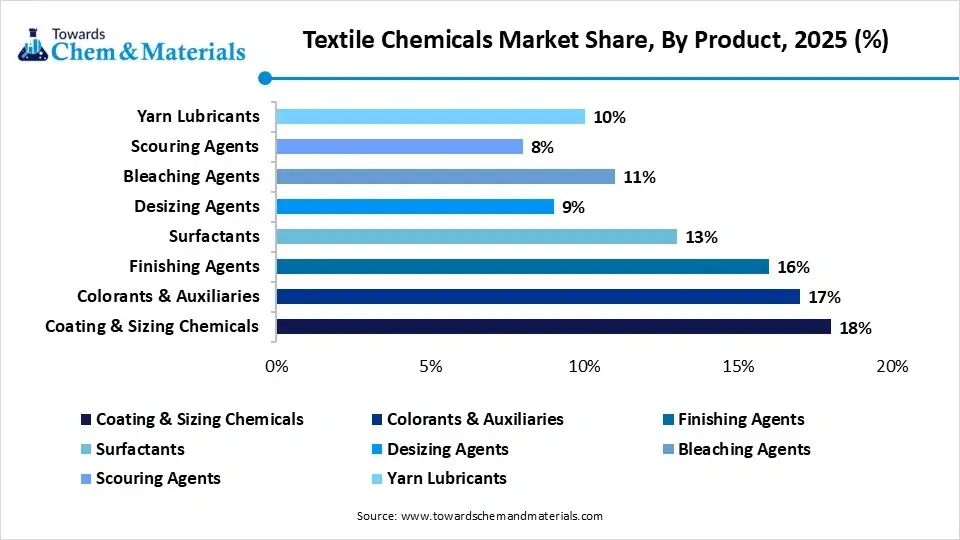
The finishing agents segment held the 16% market share in 2025 and is expected to be the fastest-growing in the market, with a CAGR of 6.8% in the forecast period, owing to consumers increasingly demanding advanced fabrics with improved comfort, softness, antibacterial protection, wrinkle resistance, and water repellency. In the current period, textile manufacturers are investing heavily in specialty finishing chemicals to create value-added textile products. Moreover, the growing popularity of sportswear, medical textiles, and smart fabrics is increasing the need for high-performance finishing technologies.
The colorants & auxiliaries segment held the 17% market share in 2025, owing to textile manufacturers are increasingly focusing on producing attractive, colorful, and high-quality fabrics. Colorants help provide bright and long-lasting shades to textile materials, while auxiliaries improve dyeing efficiency, color absorption, and fabric finishing performance.
The surfactants segment held the 13% market share in 2025, akin to these chemicals play an important role during fabric cleaning, dyeing, bleaching, and finishing processes. Surfactants help improve the spreading, wetting, and penetration of chemicals on textile materials, which increases processing efficiency and fabric quality. In the current period, textile manufacturers are increasingly using advanced surfactants to improve dye absorption while reducing water and chemical consumption.
Fiber Type Insights
The synthetic fiber segment dominated the market with 58% share in 2025 and is expected to be the fastest-growing in the market, with a CAGR of 6.40% in the forecast period, owing to industries that are increasingly demanding durable, lightweight, flexible, and cost-effective textile materials. Fibers such as polyester, nylon, and acrylic are becoming highly popular in sportswear, automotive textiles, industrial fabrics, and technical textile applications.
The natural fiber segment held the 42% market share in 2025, as cotton, wool, silk, and other natural fibers are widely used in global textile manufacturing. In recent years, consumers have shown a strong preference for comfortable, breathable, and environmentally friendly fabrics made from natural materials. Moreover, natural fibers are heavily used in clothing, home furnishing, and traditional textile products across many countries.
Process Insights
The pretreatment segment dominated the market with 39% share in 2025, as fabric preparation is one of the most important stages in textile manufacturing. Pre-treatment processes such as desizing, scouring, bleaching, and cleaning help remove impurities from fabrics before dyeing and finishing operations. Moreover, proper pre-treatment improves fabric absorbency, color quality, and overall processing efficiency. In recent years, textile manufacturers have increasingly focused on improving production quality while reducing defects during textile processing.
The treatment of finished product segment held the 34% market share in 2025 and is expected to be the fastest-growing segment in the market, with a CAGR of 6.70% in the forecast period, due to consumers increasingly demanding textiles with advanced functional properties. Manufacturers are using specialized textile chemicals to provide stain resistance, antimicrobial protection, flame retardancy, odor control, and UV resistance in finished fabrics. Moreover, industries such as healthcare, defense, automotive, and sportswear are creating strong demand for treated technical textiles with improved performance.
The coating segment held the 27% market share in 2025, owing to textile manufacturers are increasingly focusing on producing fabrics with advanced protective and performance properties. Textile coatings help improve water resistance, flame resistance, UV protection, durability, and stain resistance in fabrics. Moreover, the coatings have gained major attention in the modern fabrics industry, where innovative cloths are being developed using coatings.
Application Insights
The apparel segment dominated the market with 46% share in 2025, as the fashion and clothing industry remains the largest consumer of textile products globally. In recent years, rising population, changing fashion trends, and increasing disposable incomes have significantly increased clothing demand across developed and developing countries. Moreover, textile chemicals are heavily used in apparel manufacturing for dyeing, printing, finishing, and fabric softening applications.
The technical textiles segment held the 25% market share in 2025 and is expected to be the fastest-growing segment in the market, with a CAGR of 7.30% in the forecast period, due to industries are increasingly using high-performance fabrics in healthcare, automotive, aerospace, construction, agriculture, and defense sectors. Technical textiles require specialized chemicals to improve strength, heat resistance, water resistance, and antibacterial performance. Moreover, governments and industries are investing heavily in advanced textile technologies for industrial and protective applications.
The home furnishing segment held the 21% market share in 2025, akin to consumers are increasingly spending on comfortable, decorative, and premium-quality home textile products. Products such as curtains, carpets, bedsheets, upholstery fabrics, cushions, and towels require textile chemicals for better softness, color quality, durability, and stain resistance.
The other applications segment held the 8% market share in 2025, akin to textile materials are increasingly being used in several non-traditional industries beyond apparel and home furnishing. Industries such as healthcare, agriculture, automotive, packaging, construction, and defense are creating strong demand for specialized textile products with advanced performance features.
Regional Analysis:
How will Asia Pacific Dominate the Textile Chemicals Market in 2025?
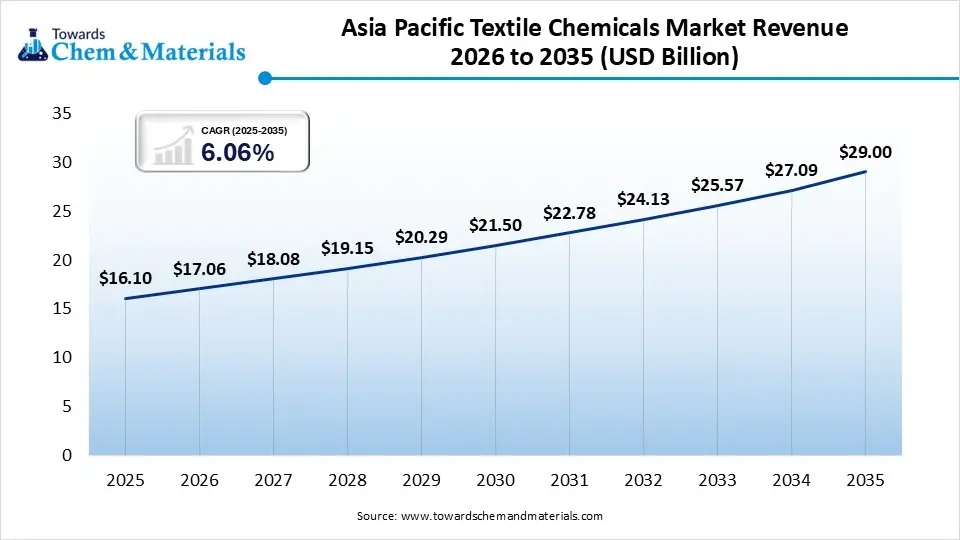
The Asia Pacific textile chemicals market size was estimated at USD 16.10 billion in 2025 and is projected to reach USD 29.00 billion by 2035, growing at a CAGR of 6.06% from 2026 to 2035.Asia Pacific dominated the market with a share of 48% in 2025 and is expected to be the fastest-growing region in the market, with a CAGR of 7.10% in the forecast period, due to the region having become the global center for textile manufacturing and exports. Countries like China, India, Bangladesh, and Vietnam have large textile production capacities supported by low manufacturing costs and strong labor availability. Moreover, rising domestic clothing demand and increasing exports have encouraged investments in textile processing industries across the region.
China
- Manufacturers in China have focused on high-quality textile exports, technical textiles, and sustainable production methods.
- Also, government regulations regarding pollution control are encouraging companies to use eco-friendly textile chemicals.
Japan
- Companies in Japan are investing in smart fabrics, antibacterial textiles, and advanced textile finishing technologies.
- Also, Research and development activities in nanotechnology and functional fabrics are also supporting market growth.
India
- Increasing investments in garment production, technical textiles, and textile parks have supported industry growth.
- The rising demand for sustainable textiles and organic cotton fabrics is increasing the use of eco-friendly textile chemicals in India.
Textile Chemicals Market Evaluation in Europe
The Europe textile chemicals market size was estimated at USD 7.38 billion in 2025 and is projected to reach USD 13.46 billion by 2035, growing at a CAGR of 6.19% from 2026 to 2035.Europe is notably growing with 22% market share in 2025, owing to the region is increasingly focusing on technical textiles, smart fabrics, and sustainable textile manufacturing technologies. Industries such as healthcare, defense, automotive, and sportswear are driving strong demand for advanced textile materials. Moreover, manufacturers are investing heavily in research and development activities related to high-performance textile chemicals and environmentally friendly processing technologies.
Germany
- The companies are investing in digital textile manufacturing and energy-efficient processing technologies to reduce environmental impact.
- The strong industrial base and advanced technology capabilities continue to support the growth of the textile chemicals market.
Italy
- The fashion industry is driving strong demand for innovative textile processing chemicals that improve fabric appearance and comfort.
- Also, the country is focusing on recycling textile waste and reducing environmental impact in textile production.
North America Textile Chemicals Industry Conditions
The Textile Chemicals market size was estimated at USD 5.70 billion in 2025 and is projected to reach USD 10.47 billion by 2035, growing at a CAGR of 6.27% from 2026 to 2035.North America held the 17% market share in 2025 owing to the region is strongly focused on sustainable textile manufacturing and high-quality fabric production. North American textile companies are increasingly investing in eco-friendly chemicals, recycling technologies, and low-carbon manufacturing systems. Moreover, strict environmental regulations are encouraging manufacturers to adopt cleaner production processes and safer chemical formulations.
United States
- The industries such as healthcare, military, sportswear, and automotive are increasingly demanding advanced textile materials with specialized chemical treatments.
- Furthermore, automation and AI-driven textile manufacturing systems are improving production efficiency.
Canada
- The textile manufacturers have shown rising interest in eco-friendly textile processing technologies and low-emission chemical solutions.
- Also, research institutions and manufacturers are working together to develop smart textile materials and recyclable fabric technologies.
Textile Chemicals Market Survey in Latin America
The Latin America Textile Chemicals market size was estimated at USD 2.35 billion in 2025 and is projected to reach USD 4.49 billion by 2035, growing at a CAGR of 6.69% from 2026 to 2035.Latin America held the 7% market share in 2025 due to growing domestic demand for clothing and rising urbanization, which are supporting textile industry growth. Furthermore, textile manufacturers are increasingly adopting modern dyeing and finishing technologies to improve fabric quality and production efficiency. The growing awareness regarding sustainable textile production is also increasing demand for environmentally friendly textile chemicals.
Brazil
- The country has expanded production of apparel, home textiles, and industrial fabrics for domestic and export markets.
- Also, Brazil is also focusing on improving textile manufacturing efficiency through automation and digital production technologies.
Argentina
- The local textile manufacturers are modernizing production facilities and improving fabric quality standards.
- Sustainable textile production practices are gaining attention as companies aim to reduce environmental impact in the country nowadays.
Middle East & Africa’s Textile Chemicals Sector Observation
The Middle East and Africa market size was estimated at USD 2.01 billion in 2025 and is projected to reach USD 3.89 billion by 2035, growing at a CAGR of 6.83% from 2026 to 2035.The Middle East and Africa held the 6% market share in 2025, akin textile manufacturing and industrial development activities are gradually increasing across the region. In recent years, governments have invested heavily in industrial diversification and manufacturing infrastructure development. Moreover, rising population and growing clothing demand are supporting textile production activities in several countries.
Saudi Arabia
- The government initiatives supporting non-oil industries are encouraging investments in textile and industrial fabric production.
- Companies are adopting modern textile processing technologies to improve manufacturing efficiency and product quality.
UAE
- The country is becoming an important trade and textile business hub in the Middle East region.
- Also, rising tourism and hospitality industries are increasing demand for high-quality home textiles and furnishing fabrics.
Recent Developments
- In September 2025, Archroma introduced its latest textile softener, which is known for durability. Also, the newly launched product is branded as a SILIGEN® D2W LIQ C and is able to provide a high level of fabric softness and elasticity, as per the published report.(Source: www.archroma.com)
- In January 2026, HeiQ and Archroma created a strategic collaboration. The main motive behind the collaboration is to focus on and release solutions for antimicrobial and odor control textiles in a sustainable way, as per the company's claim. (Source: www.indianchemicalnews.com)
Top Vendors in the Textile Chemicals Market & Their Offerings:
- Archroma: Archroma operates as a Swiss-based global pioneer in sustainable color and specialty performance chemicals. The enterprise designs eco-conscious dye formulations, optical brighteners, and surface-modifying polymers.
- BASF SE: BASF SE delivers specialized raw materials and polymer solutions foundational to the worldwide textile manufacturing supply chain. The German chemical giant produces high-performance chemical auxiliaries used extensively in fiber extrusion, pre-treatment, and finishing.
- The Dow Chemical Company: The Dow Chemical Company leverages innovative silicone chemistry and material science to transform fabric finishing processes. Based in the United States, this corporation provides advanced coating materials, durable softeners, and polyurethanes.
- Kiri Industries Ltd.: Kiri Industries Ltd. is a leading Indian manufacturer specializing in high-grade synthetic organic dyes and chemical intermediates. The company exports massive volumes of reactive, acid, and direct dyestuffs globally.
Other Key Players
- Evonik Industries AG
- Huntsman Corporation
- Wacker Chemie AG
- Dorf Ketal
- Rudolf GmbH
- Tanatex Chemicals
- CHT Group
- Solvay SA
- Lubrizol Corporation
- Croda International
Segments Covered in the Report
By Product
- Coating & Sizing Chemicals
- Acrylic Sizing Chemicals
- Polyvinyl Alcohol (PVA) Sizing
- Starch-Based Sizing Agents
- Wax & Resin-Based Coatings
- Water-Repellent Coatings
- Colorants & Auxiliaries
- Reactive Dyes
- Disperse Dyes
- Pigments
- Dye Fixing Agents
- Wetting Agents
- Leveling Agents
- Finishing Agents
- Softening Agents
- Wrinkle-Free Finishes
- Flame Retardant Finishes
- Antimicrobial Finishes
- Water & Oil Repellent Finishes
- Surfactants
- Non-Ionic Surfactants
- Anionic Surfactants
- Cationic Surfactants
- Amphoteric Surfactants
- Desizing Agents
- Enzymatic Desizing Agents
- Oxidative Desizing Agents
- Acid Desizing Chemicals
- Bleaching Agents
- Hydrogen Peroxide Bleaches
- Chlorine-Based Bleaches
- Optical Brightening Agents
- Scouring Agents
- Alkali-Based Scouring Agents
- Enzymatic Scouring Agents
- Detergent-Based Scouring Chemicals
- Yarn Lubricants
- Spin Finishes
- Knitting Oils
- Cone Oils
- Antistatic Lubricants
By Fiber Type
- Natural Fiber
- Cotton
- Wool
- Silk
- Linen
- Jute
- Synthetic Fiber
- Polyester
- Nylon
- Acrylic
- Polypropylene
- Viscose & Rayon
By Process
- Pretreatment
- Desizing
- Scouring
- Bleaching
- Mercerization
- Coating
- Functional Coating
- Protective Coating
- Decorative Coating
- Barrier Coating
- Treatment Of Finished Products
- Antimicrobial Treatment
- Flame Retardant Treatment
- Water Repellent Treatment
- UV Protection Treatment
- Anti-Static Treatment
By Application
- Apparel
- Sportswear
- Casual Wear
- Formal Wear
- Denim
- Innerwear
- Home Furnishing
- Upholstery
- Curtains
- Carpets & Rugs
- Bedding & Linen
- Technical Textiles
- Automotive Textiles
- Medical Textiles
- Industrial Textiles
- Protective Textiles
- Geotextiles
- Other Applications
- Footwear Textiles
- Packaging Textiles
- Agricultural Textiles
By Region
- North America
- U.S.
- Canada
- Mexico
- Europe
- Germany
- UK
- France
- Italy
- Spain
- Asia Pacific
- China
- India
- Japan
- South Korea
- Latin America
- Brazil
- Argentina
- Middle East & Africa
- Saudi Arabia
- South Africa
FAQ's
Question 1 : What is the current size of the textile chemicals market?
Answer : The global textile chemicals market size was valued at USD 33.55 billion in 2025 and is estimated to reach USD 35.55 billion in 2026. It is projected to reach USD 59.80 billion by 2035, growing at a compound annual growth rate of 5.95%.
Question 2 : Which region holds the largest share in the textile chemicals market?
Answer : The Asia-Pacific region holds the largest share, capturing 48% of the global market in 2025. It is also expected to experience the fastest growth with a CAGR of 7.10% because it serves as the global epicenter for garment manufacturing and exports.
Question 3 : Who are the top key players in the textile chemicals market?
Answer : The leading global companies in this market include Archroma, BASF SE, The Dow Chemical Company, Kiri Industries Ltd., Huntsman Corporation, and Wacker Chemie AG. Other notable players are Evonik Industries, Dorf Ketal, Rudolf GmbH, and Tanatex Chemicals.
Question 4 : What is the textile chemicals market used for?
Answer : Textile chemicals are specialized agents used during the processing and manufacturing of fabrics, garments, and yarns. They are applied across multiple processing stages to improve fabric appearance, colors, structural strength, softness, and advanced properties like water repellency or antimicrobial protection.
Question 5 : What is driving the growth of sustainable textile chemicals?
Answer : The growth is driven by strict government regulations on hazardous wastewater discharges and rising consumer demand for eco-friendly clothing. Brands are increasingly investing in bio-based chemicals, enzyme processing, and low-water dyeing technologies to meet strict environmental protection requirements.
Meet the Team

Saurabh Bidwai
Principal Consultant
Saurabh Bidwai, a B.Tech Chemical Engineering graduate with 4+ years of experience, specializes in specialty chemicals, commodity chemicals, and engineered materials, offering valuable insights into market trends and emerging opportunities.

Aditi Shivarkar
Reviewed By
Aditi Shivarkar, with 14+ years in Chemical and Materials market research, specializes in Chemical and Materials. She ensures accurate, actionable insights, driving Towards Chemicals And Materials Analytics and Consulting excellence in industry trends and sustainability.