
Transformer Oil Market Size, Share, Growth, Report 2026 to 2035
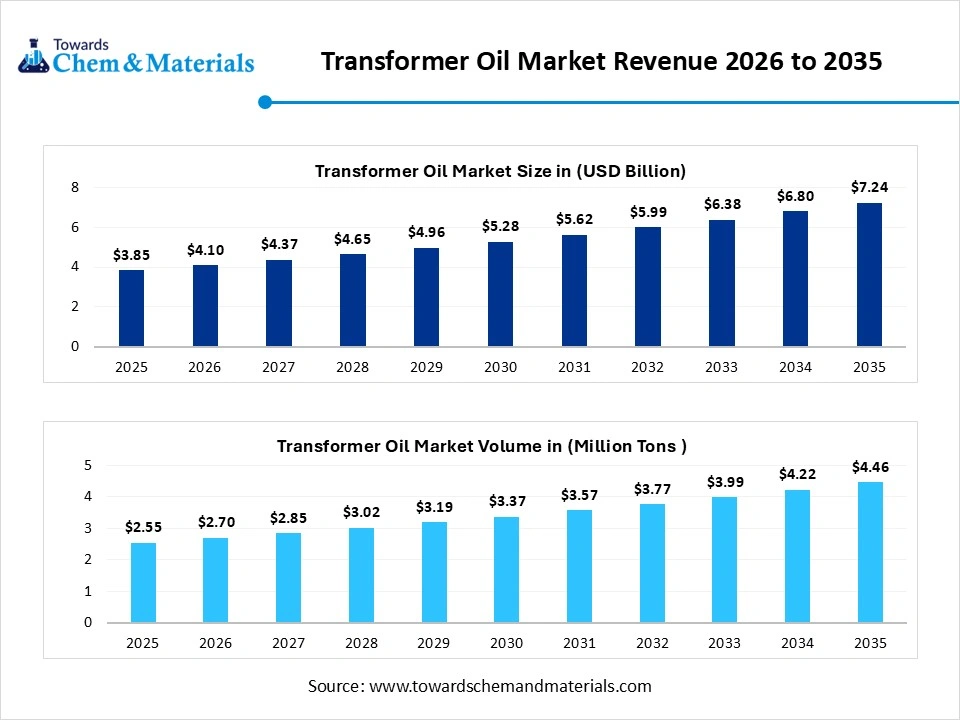
The transformer oil market is expected to witness steady growth, expanding from USD 4.1 billion in 2026 to USD 7.24 billion by 2035 at a CAGR of 6.52%. The report covers complete market size evaluation along with segmentation data by product type, function, and application areas. It further highlights regional performance across major geographies and provides deep insights into leading companies, manufacturers, and suppliers. The study also includes competitive analysis, value chain assessment, and trade data to offer a holistic view of the industry.
Content
Transformer Oil Market Trends, Growth and Market Size Analysis
The global transformer oil market size was estimated at USD 3.85 billion in 2025 and is expected to be worth around USD 7.24 billion by 2035, exhibiting a compound annual growth rate (CAGR) of 6.52% over the forecast period from 2026 to 2035. In terms of volume the transformer oil market is projected to grow from 2.55 million tons in 2025 to 4.46 million tons by 2035. growing at a CAGR of 5.75% from 2026 to 2035.This report provides comprehensive insights into market size along with detailed segment-wise data by type, application, and end-use industries. It also offers in-depth regional analysis across North America, Europe, Asia-Pacific, Latin America, and the Middle East & Africa. Additionally, the study includes extensive company profiles, competitive landscape, value chain analysis, trade data, and detailed information on key manufacturers and suppliers shaping the market.
Key Takeaways
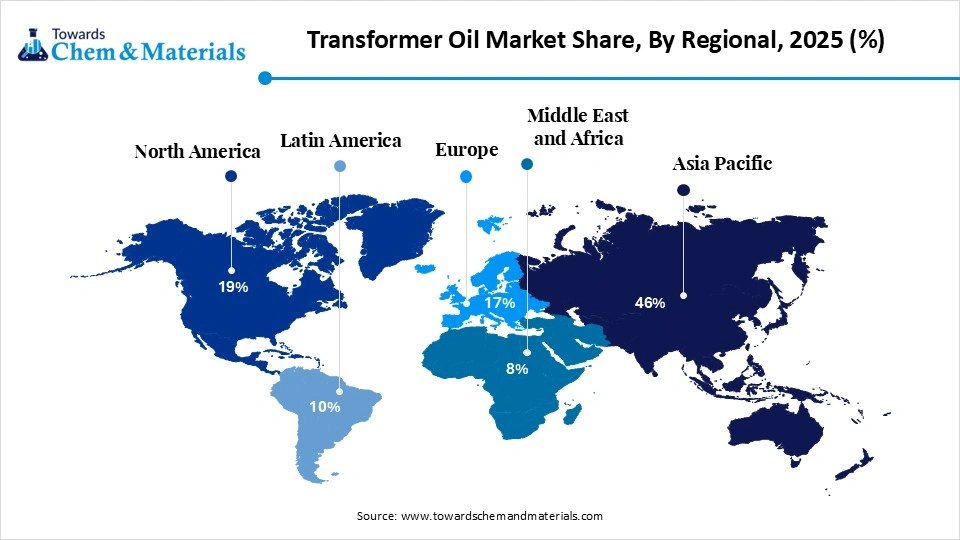
- By region, Asia Pacific dominated the transformer oil market in 2025, with 46% share expected to sustain its position with the fastest CAGR of 7.2% in the forecast period, due to the region growing fast in terms of population, cities, and industries.
- By region, North America held the second largest share of 19% in 2025 and expects notable CAGR of 5.80% during the forecast period, due the improvement of its old power systems.
- By type, the mineral oil-based segment dominated the market with 62% share in 2025, owing to its simplicity, affordability, and being already trusted by everyone in the industry.
- By type, the bio-based segment expects the fastest growth in the market with 7.5% CAGR during the forecast period, owing to people now caring more about safety and the environment.
- By application, the transformer segment dominated the market with 71% share in 2025 and is expected to sustain its position with the fastest CAGR of 6.5% in the forecast period owing to they are everywhere in the power system.
- By end user, the transmission and distribution utilities segment dominated the market with 38% share in 2025 and is expected to sustain its position with the fastest CAGR of 6.9% during the forecast period, owing to electricity is now reaching more people and places, so transmission and distribution systems are growing fast.
- By voltage rating, the medium voltage segment dominated the market with 44% share in 2025 and is expected to sustain its position with the fastest CAGR of 6.6% in the forecast period, owing to medium voltage systems are used in many places like cities, industries, and commercial areas.
Market Size and Volume Forecast
- Market Size (2025): USD 3.85 Billion | CAGR (2026–2035): 6.52%
- Market Projected Size (2035): USD 7.24 Billion
- Market Volume (2025): 2.55 Million Tons (MT) | Volume CAGR (2026–2035): 5.75%
- Market Projected Volume (2035): 4.46 Million Tons (MT)
- Market Pricing (2025):
- Average Manufacturing Price: USD 1,260 per Ton
- Average Selling Price (ASP): USD 1,790 per Ton
- Pricing CAGR (2025–2035): 3.11%
The Silent Guardian of Electrical Systems
The special oil, which is primarily used inside the transformers to keep them working efficiently and safely, is known as the transformer oil. Moreover, by acting as a barrier where electricity does not cause damage or leak, the transformer oil has gained major attention in heavy companies. Furthermore, these oils have greater stability in high temperatures, leading to the demand in recent years.
Transformer Oil Market Trends:
- The increased demand for safer and greener oil has strengthened the foundation for future sector growth in recent years. Also, the major companies are seen in moving from normal mineral oil to more natural options nowadays.
- The growing usage of electricity in every sector is actively enhancing market readiness and future industry capabilities in the current period. Also, the transformers are heavily installed all over the region, which is leading the demand for oil these days.
- The shift towards the development of longer-life transformer oil while having lower maintenance is expected to drive strategic transformation and sectoral scalability in the coming years. Also, work will continue without breaking down the transformer.
Smarter Oils for Modern Power Systems
The industry is actively moving toward smarter oil usage. Earlier, oil was only used and checked manually after some time. Now, sensors and monitoring systems are used to check oil condition continuously. Also, this helps detect problems early, like overheating or moisture. New types of oils are also designed to handle heavy loads and complex systems. Some oils even support modern smart grids.
Trade Analysis of the Transformer Oil Market
Import, Export, Consumption, and Production Statistics
- The world has seen a heavy export of transformer oil between June 2024 to May 2025 with 4,790 shipments. Also, in this trade, 1,343 buyers and 858 exporters were included.
- India has emerged as the leading exporter of transformer oil with 7,998 shipments, while the United States (1,483 shipments) and Russia (1,039 shipments) are following.
- Vietnam has been seen a greater import of transformer oil with 2,188 shipments, while Bangladesh (1,465 shipments) and the United States (1,245 shipments) are actively following Vietnam in imports.
Supply Chain Analysis of the Transformer Oil Market
Distribution to Industrial Users
- Industrial users, such as utility companies and transformer manufacturers, receive transformer oil through specialized chemical distributors and direct refinery contracts.
- Logistics involve dedicated stainless steel tankers, flexitanks, or sealed drums to prevent moisture contamination. Distribution networks emphasize "just-in-time" delivery and often include on-site filtration services to maintain dielectric purity.
Chemical Synthesis and Processing
- Transformer oil is produced via the fractional distillation and vacuum distillation of crude oil. The resulting base oil undergoes hydrocracking or solvent extraction to remove impurities like sulfur and aromatics.
- Final processing includes clay filtration and dehydration to achieve high dielectric strength, often followed by adding antioxidant inhibitors.
Regulatory Compliance and Safety Monitoring
- Transformer oil must comply with ASTM D3487 or IEC 60296 standards for dielectric strength and oxidation stability. Safety monitoring involves regular Dissolved Gas Analysis (DGA) and PCB testing to prevent catastrophic failures and environmental contamination. Regulations also mandate strict spill containment and hazardous waste disposal protocols.
Transformer Oil Market Regulatory Landscape: Regulations
| Country Region | Regulatory Body | Key Regulations | Focus Areas |
| United States | Environmental Protection Agency (EPA), | TSCA Section 6(h) (Toxic Substances Control Act): Regulates the management and disposal of persistent, bioaccumulative, and toxic chemicals. | PCB elimination (threshold <50 ppm), dielectric breakdown voltage, moisture content, and the transition toward biodegradable ester fluids to meet EPA sustainability guidelines |
| Europe | European Chemicals Agency (ECHA) | REACH (EC 1907/2006): Governs the registration and restriction of chemical substances to protect human health and the environment. | Focus Areas: Circular economy (recycling of oils), fire safety in urban areas, and strict limits on aromatic content and polycyclic aromatic hydrocarbons (PAHs) |
| China | State Administration for Market Regulation (SAMR) | GB 2536: Mandatory standard for "Fluids for electrotechnical applications Unused mineral insulating oils for transformers and switchgear." | UHV (Ultra-High Voltage) project compatibility, low-temperature performance (pour point), and strict quality supervision of in-service oils to prevent grid failure |
Segmental Insights
Type Insights
The Mineral Oil-Based Segment Dominated the Transformer Oil Market with 62% Market Share in 2025
The mineral oil-based segment dominated the market with 62% share in 2025, owing to its simplicity, affordability, and being already trusted by everyone in the industry. Most transformers are designed to work with this oil, so companies don’t feel the need to change. It does its basic job well, cooling and insulation, without creating complications. Also, people already know how to handle and maintain it, which saves time and effort.
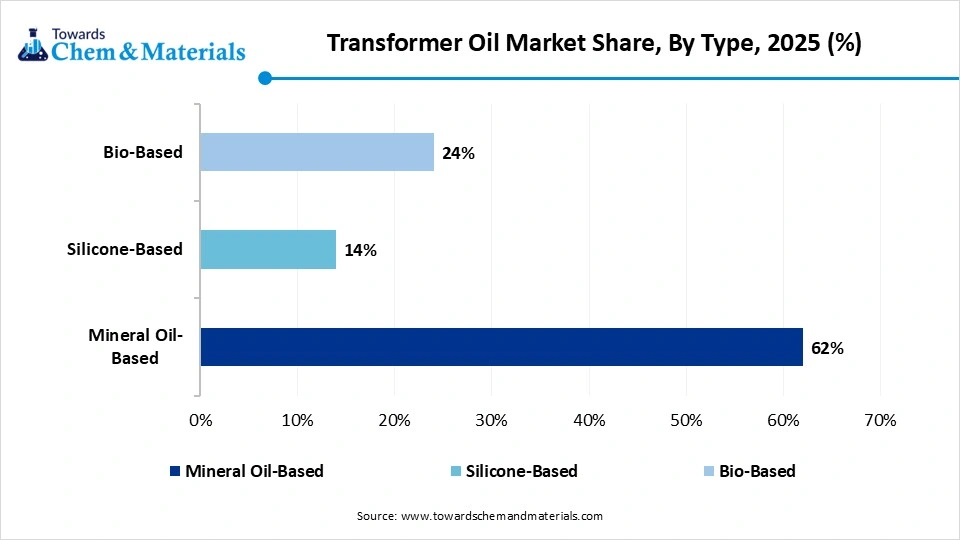
The biobased segment is expected to be the fastest-growing in the market, with 7.5% CAGR during the forecast period due to people now caring more about safety and the environment. This oil comes from natural sources, so it is less harmful if it spills. It also has better fire safety, which makes it useful in cities and crowded areas. Many companies are starting to think long-term, and this oil supports that thinking.
The silicon-based segment held the third largest share of 14% in 2025 due to it is very valuable. It can handle very high temperatures and does not catch fire easily. This makes it perfect for places where safety is very important, like inside buildings or sensitive areas. It also stays stable for a long time, so it does not need frequent replacement.
Application Insights
The Transformer Segment Dominated the Market with 71% Market Share in 2025
The transformer segment dominated the market with 71% share in 2025 and is expected to sustain its position with the fastest CAGR of 6.5% in the forecast period, owing to they are everywhere in the power system. From power plants to your local area, transformers are needed to control electricity flow. Every transformer needs oil for cooling and insulation. As electricity demand increases, more transformers are installed, which increases oil use. Also, old transformers need oil replacement or maintenance.
The switchgear segment held the second largest share of 11% in 2025, due to it becoming more common as power systems become more advanced. These systems need proper insulation to work safely, and oil helps in that. As more buildings, industries, and infrastructure projects are built, switchgear use increases. This creates a steady demand for transformer oil.
Transformer Oil Market Share, By Application, 2025 (%)
| By Application | Revenue Share, 2025 (%) |
| Transformer | 71% |
| Switchgear | 11% |
| Circuit Breakers | 10% |
| Others | 8% |
The circuit breakers segment held the third largest share of 10% in 2025 due to they are used to stop electricity during faults to prevent damage. In some types, oil helps control the heat and sparks created during this process. As power systems expand, circuit breakers are used more often, which increases oil use. Even though newer technologies are coming, many systems still use oil-based designs because they are reliable and well understood.
The other segment held the fourth largest share of 8% in 2025, as transformer oil is used apart from major equipment. These uses may not be very large individually, but together they create a steady demand. Some special machines and testing setups also need this oil. Each use may require slightly different oil properties. This makes the category diverse and useful.
End User Insights
The Transmission & Distribution Utilities Segment Dominated the Transformer Oil Market with 38% Market Share in 2025
Transmission & distribution utilities dominated the market with 38% share in 2025 is expected to sustain its position with the fastest CAGR of 6.9% during the forecast period, due to electricity is now reaching more people and places, so transmission and distribution systems are growing fast. New substations and lines are being built, which need transformers and oil. Also, old systems are being improved to work better. This increases demand for oil.
The power generation segment held the second largest share of 26% share in 2025, owing to power plants needing a lot of transformers to manage electricity. Since these plants run continuously, they need good cooling and insulation, which increases oil use. Whether it is coal, water, wind, or solar power, all systems need transformers. Regular operation and maintenance also increase oil demand.
Transformer Oil Market Share, By End-User, 2025 (%)
| By End-User | Revenue Share, 2025 (%) |
| Power Generation | 26% |
| Transmission & Distribution Utilities | 38% |
| Industrial | 24% |
| Railways & Metro | 12% |
The industrial segment held the third largest share of 24% in 2025 due to industries' need for strong and continuous electricity to run machines. They use transformers and other equipment that require oil for safe operation. These systems often work under heavy load, so good oil is very important. As industries grow and expand, more such equipment is installed.
The railways & metro segment held the fourth largest share of 12% in 2025, owing to the need for railways and metro systems to use electricity to run trains and manage stations. They use transformers in many places. As cities build more metro lines and improve railways, the need for such systems increases. This creates demand for transformer oil. Electrification of rail routes is also adding to this growth.
Voltage Rating Insights
The Medium Voltage (1-36kV) Segment Dominated the Market with 44% Market Share in 2025
The medium voltage (1-36kV) segment dominated the market with 44% share in 2025 and is expected to sustain its position with the fastest CAGR of 6.6% in the forecast period, owing to medium voltage systems are used in many places like cities, industries, and commercial areas. They are practical and balance cost and performance well. Because they are used widely, many transformers fall in this range. This increases oil demand.
Transformer Oil Market Share, By Voltage Rating, 2025 (%)
| By Voltage Rating | Revenue Share, 2025 (%) |
| Oil-Cooled | 79.00% |
| Air-Cooled | 13.00% |
| Water-Cooled | 8.00% |
The high voltage (>36kV) segment held the second largest share of 38% in 2025, due to high voltage systems are used to send electricity over long distances. They need strong insulation and good cooling, so oil quality is very important here. Even though there are fewer such systems, each one uses more oil. They are very important for connecting different regions and keeping the electricity flow stable.
Low voltage (<1kV) segment held the third largest share of 18% in 2025, owing to low voltage systems are used in homes and small businesses. They need smaller transformers, so oil use is less per unit. But there are many such systems, which create a steady demand.
Regional Insights
How will Asia Pacific Dominate the Transformer Oil Market in 2025?
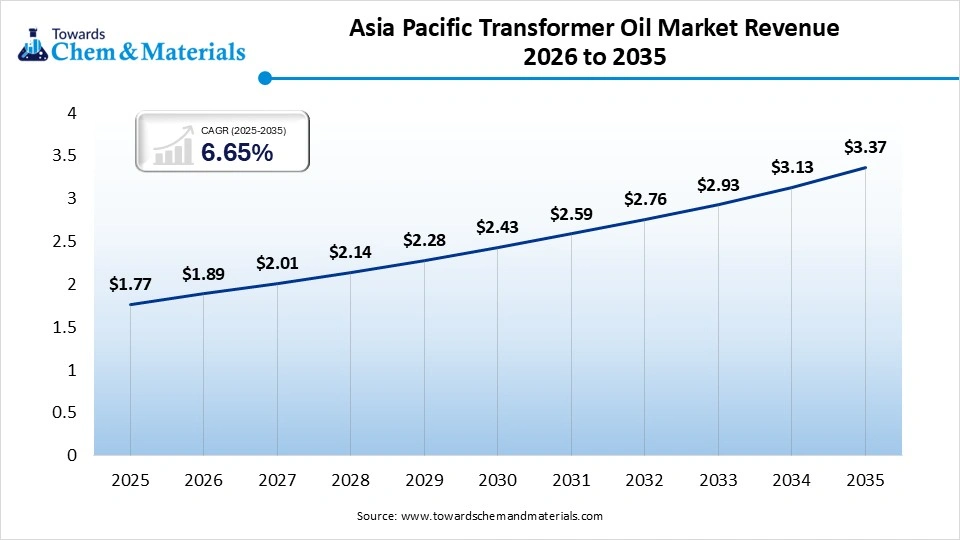
The Asia-Pacific transformer oil market size was estimated at USD 1.77 billion in 2025 and is projected to reach USD 3.37 billion by 2035, growing at a CAGR of 6.65% from 2026 to 2035. Asia Pacific dominated the market with a share of 46% in 2025. owing to the region growing fast in terms of population, cities, and industries. This increases electricity demand, which increases transformer use. Many countries are building new power systems and improving old ones. Governments are investing heavily in electricity infrastructure.
China Driving Strong Transformer Oil Demand
China maintained its dominance in the market, owing to the country uses a huge amount of electricity, so it needs many transformers. It is also building new power systems and renewable energy projects. Local production is strong, which helps in easy supply. Maintenance and upgrades also increase oil demand. Also, because of its size and fast development, China plays a very big role in the market.
Transformer Oil Market Evaluation in North America
North America held the second largest share of 19% in 2025 and expects notable CAGR of 5.80% during the forecast period, owing to the improvement of its old power systems. Moreover, many transformers are being repaired or replaced. This increases oil demand. The region also focuses on better technology and safety. Renewable energy projects are also growing. All these factors help the market grow steadily in this region as per the recent observation.
Modernizing Driving United States Industry Expansion
United States is expected to emerge as a prominent country for the transformer oil market in the coming years, due to country has a large power system that needs regular upgrades. Many transformers are old and need maintenance. The country is also using new technologies like smart grids. Renewable energy is also increasing. All this creates demand for better quality oil. Also, the continuous improvement and investment is actively driving the industry growth in the United States nowadays.
Recent Developments
- In November 2025, Shell Indonesia unveiled its latest product line of transformer fluids. Also, the newly introduced fluid is known as the Shell MIDEL, which is primarily designed for transformers in the power sector. Moreover, this fluid can achieve higher performance while maintaining safety and improving fire resistance as per the published report.
Top Vendors in the Transformer Oil Market & Their Offerings:
- Nynas AB: A Swedish specialist in naphthenic oils, Nynas is a global leader in the transformer oil market. Their NYTRO® range is renowned for high oxidation stability and superior low-temperature performance. The company focuses on sustainable solutions, recently introducing bio-based and circular (re-refined) transformer fluids to reduce the carbon footprint of power grids.
- Ergon, Inc.: Based in the United States, Ergon is one of the world’s largest producers of naphthenic insulating oils. Their HyVolt line is a primary choice for North American utilities due to its excellent dielectric properties and cooling efficiency. Ergon operates a robust global supply chain, ensuring high-purity oil delivery for both new and retrofilled transformers.
- PetroChina Company Limited: As a subsidiary of CNPC, PetroChina is a dominant player in the Asian energy sector. It supplies vast quantities of mineral-based transformer oils specifically formulated to meet GB standards for China’s massive Ultra-High Voltage (UHV) grid projects. Their oils are critical for maintaining large-scale infrastructure reliability across the Asia Pacific region.
- Sinopec Corporation: Sinopec is a global refining giant and a key supplier of high-grade insulating oils under its LUBRICANT division. The company focuses on R&D for extreme-environment oils, including those with low pour points for cold climates and high-flash-point fluids for fire safety. They provide comprehensive lubrication solutions for power generation and distribution worldwide.
Transformer Oil Market Key Players
- Shell plc
- ExxonMobil Corporation
- Apar Industries Ltd.
- Savita Oil Technologies Ltd.
- Gandhar Oil Refinery (India) Ltd.
Transformer Oil Market Segments Covered in the Report
By Type
- Mineral Oil-Based
- Naphthenic Oil
- Paraffinic Oil
- Silicone-Based
- Bio-Based
- Natural Ester
- Synthetic Ester
By Application
- Transformer
- Power Transformers
- Distribution Transformers
- Instrument Transformers
- Switchgear
- Circuit Breakers
- Others
By End User
- Power Generation
- Thermal
- Hydropower
- Renewable (Solar, Wind)
- Transmission & Distribution Utilities
- Industrial
- Manufacturing
- Oil & Gas
- Mining
- Railways & Metro
By Voltage Rating
- Low Voltage (<1 kV)
- Medium Voltage (1–36 kV)
- High Voltage (>36 kV)
By Cooling Method
- Oil-Cooled
- ONAN (Oil Natural Air Natural)
- ONAF (Oil Natural Air Forced)
- OFAF (Oil Forced Air Forced)
- Air-Cooled
- Water-Cooled
By Region
- North America:
- U.S.
- Canada
- Mexico
- Rest of North America
- Latin America:
- Brazil
- Argentina
- Rest of Latin America
- Europe:
- Western Europe
- Germany
- Italy
- France
- Netherlands
- Spain
- Portugal
- Belgium
- Ireland
- UK
- Iceland
- Switzerland
- Poland
- Rest of Western Europe
- Eastern Europe
- Austria
- Russia & Belarus
- Türkiye
- Albania
- Rest of Eastern Europe
- Asia Pacific:
- China
- Taiwan
- India
- Japan
- Australia and New Zealand
- ASEAN Countries (Singapore, Malaysia)
- South Korea
- Rest of APAC
- MEA:
- GCC Countries
- Saudi Arabia
- United Arab Emirates (UAE)
- Qatar
- Kuwait
- Oman
- Bahrain
- South Africa
- Egypt
- Rest of MEA
- GCC Countries
FAQ's
Question 1 : What are the key trends shaping the transformer oil market?
Answer : The greater shift towards sustainability is the current industry trend.
Question 2 : Who are the key players in the transformer oil market?
Answer : Shell plc, ExxonMobil Corporation, and Apar Industries Ltd. are major players in the transformer oil market.
Question 3 : Which application segment holds the largest market share?
Answer : The transformer application segment leads the market with a 71% share in 2025, as transformers are essential components across all power systems.
Question 4 : Which region dominates the transformer oil market?
Answer : Asia Pacific dominates the global market with a 46% share (2025) and is expected to maintain the fastest growth rate due to rapid industrialization, urbanization, and infrastructure expansion.
Meet the Team

Saurabh Bidwai
Principal Consultant
Saurabh Bidwai, a B.Tech Chemical Engineering graduate with 4+ years of experience, specializes in specialty chemicals, commodity chemicals, and engineered materials, offering valuable insights into market trends and emerging opportunities.

Aditi Shivarkar
Reviewed By
Aditi Shivarkar, with 14+ years in Chemical and Materials market research, specializes in Chemical and Materials. She ensures accurate, actionable insights, driving Towards Chemicals And Materials Analytics and Consulting excellence in industry trends and sustainability.