
Ultrafiltration Market Size, Production & Manufacturing Efficiency, Sales Volume, Export & Import Dependency, Adoption Rates, Cost Structure, Recycling Rate, and Supply Chain Metrics
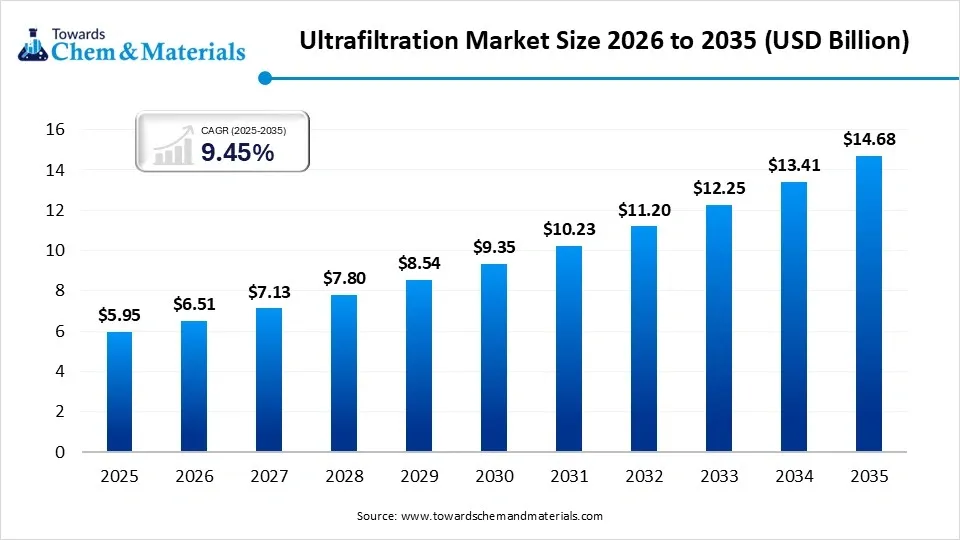
The global Ultrafiltration market, valued at USD 6.51 billion in 2026, is projected to reach USD 14.68 billion by 2035, growing at a CAGR of 9.45%. The market growth is driven by increased demand for advanced filtration systems, particularly for wastewater treatment, water reuse, and industrial applications. Asia Pacific dominates with a 34% market share in 2025 and is expected to grow at a CAGR of 10.80%. Key technologies include polymeric membranes, particularly in water and wastewater treatment. Ceramic membranes and hollow fiber modules are seeing strong growth. The market is also boosted by the rising need for sustainable industrial filtration systems and water management solutions.
Content
Ultrafiltration Market Size, Share, Growth, Report 2026 to 2035
The global ultrafiltration market size was estimated at USD 5.95 billion in 2025 and is predicted to increase from USD 6.51 billion in 2026 to approximately USD 14.68 billion by 2035, expanding at a CAGR of 9.45% from 2026 to 2035. The greater shift towards industrial wastewater management has fueled the industry's growth in recent years.
Key Takeaways
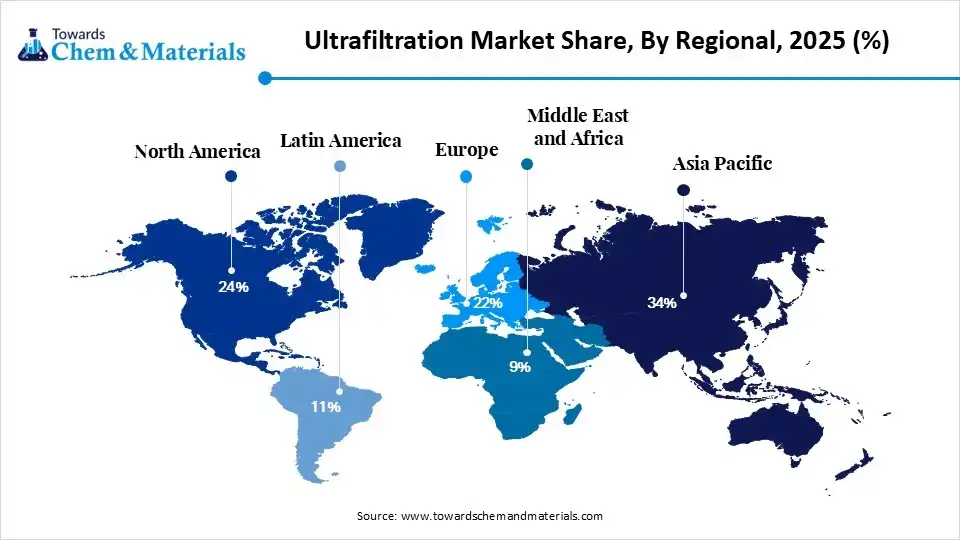
- By region, Asia Pacific dominated the market with a share of 34% in 2025 and is expected to be the fastest-growing region in the market, with a CAGR of 10.80% in the forecast period.
- By region, North America is notably growing with 24% market share in 2025.
- By membrane type, the polymeric membranes segment dominated the market with 78% share in 2025.
- By membrane type, the ceramic membranes segment held the 22% market share in 2025 and is expected to be the fastest-growing in the market, with a CAGR of 10.60% in the forecast period.
- By module type, the hollow fiber segment dominated the market with 46% share in 2025.
- By module type, tubular segment held the 14% market share in 2025 and is expected to be the fastest-growing in the market, with a CAGR of 10.20% in the forecast period.
- By application, the water and wastewater treatment segment dominated the market with 52% share in 2025.
- By application, the pharmaceutical and biotechnology segment held the 14% market share in 2025 and is expected to be the fastest-growing in the market, with a CAGR of 10.80% in the forecast period.
- By end-user, the municipal segment dominated the market with 44% share in 2025.
- By end-user, the residential segment held the 15% market share in 2025 and is expected to be the fastest-growing in the market, with a CAGR of 10.50% in the forecast period.
- By system type, the integrated system segment dominated the market with 61% share in 2025 and is expected to be the fastest-growing in the market, with a CAGR of 10.10% in the forecast period.
Precision Filtration Enabling Industrial Excellence
The method that is used to clean or separate liquid while using a very fine filter is known as the ultrafilter. Also, the demand for this advanced filtration is increasing in various industries such as medical applications, food processing, and water purification, which is actively driving the strategic transformation and sectoral scalability in recent years.
Recent Market Trends:
- The greater need for safer and cleaner water has enhanced the industry readiness and future industry capabilities. Major water suppliers have been installing ultrafiltration systems to get rid of bacteria and harmful particles in recent years.
- The heavy demand from the food industries is actively positioning the industry for long-term expansion in the current period. Also, the food companies are using ultrafiltration to extend the shelf life and quality of food products.
- The trend towards pollution-free industrial manufacturing, which includes wastewater treatment, is allowing stakeholders to capitalize on growth opportunities. Also, several governments are imposing stricter rules for industrial water filtration, where the ultrafiltration system is likely to gain greater industry attention in the coming years.
Report Scope
| Report Attribute | Details |
| Market Size in 2026 | USD 6.51 Billion |
| Revenue Size Forecast in 2035 | USD 14.68 Billion |
| Growth Rate | CAGR 9.45% |
| Forecast Period | 2026 - 2035 |
| Base Year | 2025 |
| Dominant Region | Asia Pacific |
| Segment Covered | By Membrane Type, By Module Type, By Application, By End-User, By System Type, By Region |
| Key companies profiled | DuPont de Nemours, Inc., Toray Industries, Inc, Veolia Environnement S.A, Pentair plc, Asahi Kasei Corporation, Kovalus Separation Solutions, Merck KGaA, 3M Company, ani Hydranautics |
Advanced Filtration Technology Boosts Efficiency
The development of smarter and more advanced membranes is a new technology instance that can lead to industry growth in the coming years. New membranes are stronger, last longer, and can filter more efficiently than older ones. Some modern systems also use automation and sensors to monitor performance and reduce maintenance. This means less manual work and better results. Companies are also focusing on energy-saving designs to reduce costs.
Supply Chain Analysis of the Ultrafiltration Market:
Distribution to Industrial Users
- Distribution of ultrafiltration technologies to industrial users relies on specialized engineering firms and direct regional sales channels. These networks provide essential technical integration, ensuring membrane modules meet specific filtration flux and chemical resistance requirements.
- By offering localized maintenance and pilot testing, distributors help manufacturers optimize water treatment and process separation cycles.
Chemical Synthesis and Processing
- The fabrication of ultrafiltration membranes involves advanced phase inversion or interfacial polymerization techniques to create precise asymmetric structures.
- Processing focuses on controlling pore size distribution and surface hydrophilicity through specialized polymer blending. These engineered methods ensure high permeability and robust mechanical strength for demanding industrial separation and purification tasks.
Regulatory Compliance and Safety Monitoring
- Ultrafiltration compliance centers on meeting stringent international standards like NSF/ANSI for water safety and ISO for manufacturing quality. Safety monitoring prioritizes membrane integrity testing and pressure regulation to prevent hazardous leaks or contamination.
- Robust documentation ensures filtration systems consistently adhere to environmental discharge limits and industrial health protocols during operation.
Ultrafiltration Market Regulatory Landscape: Regulations
| Country Region | Regulatory Body | Key Regulations | Focus Areas |
| United States | Environmental Protection Agency (EPA) | Safe Drinking Water Act (SDWA): Mandates standards for public water systems to remove pathogens. | Removal of emerging contaminants (e.g., microplastics), pathogen control, and ensuring the safety of food-contact materials |
| Europe | European Chemicals Agency (ECHA) |
Drinking Water Directive (EU 2020/2184): Sets strict microbiological and chemical quality standards for human consumption. | Sustainable water management, high-purity biopharmaceutical processing, and the adoption of circular economy models for water reuse |
| China | State Administration for Market Regulation (SAMR). | GB Standards for Membranes: Specific national standards (e.g., GB/T 30294-2013) provide testing methods and specifications for hollow fiber ultrafiltration modules. | Large-scale municipal water infrastructure upgrades, strictly controlled industrial wastewater discharge, and expanding water reuse projects in water-scarce regions |
Market Dynamics
Driver
Pollution Concerns Boost Filtration Demand
The need for clean and safe water has created profitable pathways for the industry's growth in recent years. Pollution is increasing, and natural water sources are becoming dirty, so better filtration systems are needed. Governments are also making strict rules to control water pollution, which pushes industries to use ultrafiltration.
Restraint
Expensive Systems Slow Industry Adoption
The high initial cost of setting up the system is likely to create growth barriers for the manufacturers in the coming years. Small businesses or rural areas may find it expensive to install and maintain. Also, the membrane fouling, where dirt and particles block the filter over time, reduces efficiency.
Opportunity
Investment Potential Rising in Water Treatment
In developing countries, where clean water systems are still limited is expected to create lucrative opportunities for the manufacturers during the forecast period. Governments and private companies can invest in these regions. Another opportunity is water reuse and recycling, which is becoming important due to water shortages.
Segmental Insights
Membrane Type Insights
The Polymeric Membranes Segment Dominated The Ultrafiltration Market With 78% Market Share In 2025
The polymeric membranes segment dominated the market with 78% share in 2025, as they are affordable and easy to use. They are made from plastic-based materials, which makes them cheaper compared to other types. These membranes are flexible and can be used in many applications, such as water treatment and food processing.
The ceramic membranes segment held the 22% market share in 2025 and is expected to be the fastest-growing in the market, with a CAGR of 10.60% in the forecast period, owing to they are stronger and more durable. Unlike polymeric membranes, they can handle very high temperatures, pressure, and harsh chemicals. This makes them ideal for tough industrial applications. They also last longer and require less frequent replacement, which saves money in the long run.
Module Type Insights
The Hollow Fiber Segment Dominated the Market with 46% Market Share in 2025.
The hollow fiber segment dominated the market with 46% share in 2025, as they provide a large surface area in a compact size. This means they can filter more water in less space, making them very efficient. They are also cost-effective and widely used in water and wastewater treatment plants. These systems are easy to install and operate, which makes them popular among users.
The flat sheet segment held the 21% market share in 2025 due to its simplicity and easy to maintain. These membranes are designed in flat layers, which makes cleaning and replacement easier compared to other types. They are especially useful in systems where regular cleaning is needed. Many industries prefer them because they can handle higher levels of dirt and are less likely to get clogged quickly.
The tubular segment held the 14% market share in 2025 and is expected to be the fastest-growing in the market, with a CAGR of 10.20% in the forecast period, due to they are very strong and can handle highly polluted water. Their design allows thick and dirty liquids to pass through without clogging easily. This makes them perfect for industries like chemicals, textiles, and food processing.
Application Insights
The Water and Wastewater Treatment Segment Dominated the Ultrafiltration Market with 52% Market Share in 2025
The water and wastewater treatment segment dominated the market with 52% share in 2025, as clean water is a basic need everywhere. Cities, industries, and communities all require safe water for daily use. Ultrafiltration helps remove bacteria, dirt, and harmful particles effectively. Governments are investing heavily in water treatment systems to ensure public health. It is also used to treat wastewater before releasing it into the environment.
The food and beverage processing segment held the 15% market share in 2025 due to the companies' need to maintain high quality and safety standards. Ultrafiltration helps remove unwanted particles while keeping important nutrients in products like milk, juices, and beverages. It also improves taste and shelf life. As consumers become more health-conscious, companies are focusing on cleaner production methods.
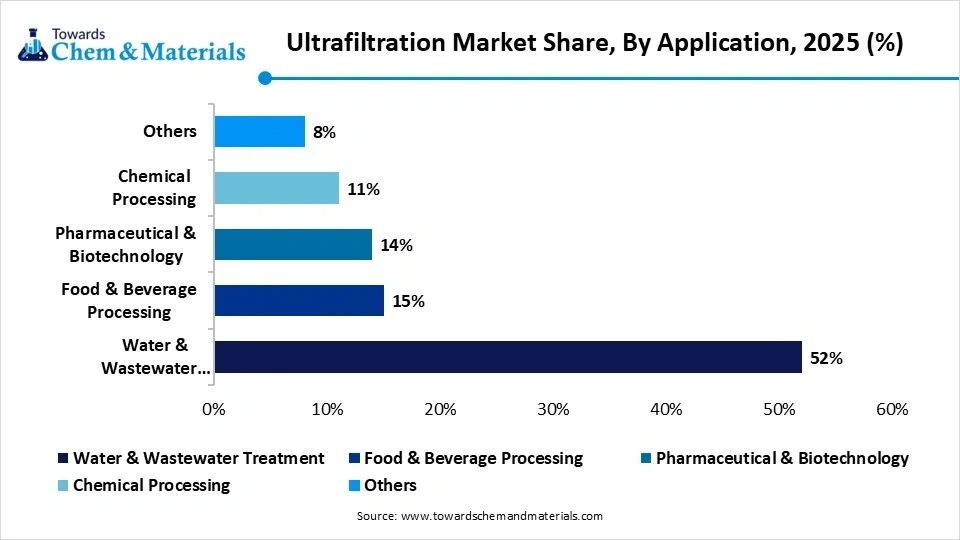
The pharmaceutical and biotechnology segment held the 14% market share in 2025 and is expected to be the fastest-growing in the market, with a CAGR of 10.80% in the forecast period, owing to the it requires very high purity levels. Ultrafiltration is used to separate proteins, remove bacteria, and ensure the safe production of medicines. As the healthcare industry grows, the demand for advanced filtration systems also increases.
End-User Insights
The Municipal Segment Dominated the Market with 44% Market Share in 2025
The municipal segment dominated the market with 44% share in 2025, owing to cities' need for large-scale water treatment systems. Governments are responsible for providing clean drinking water and proper sewage treatment. Ultrafiltration is widely used in municipal plants because it is effective and reliable. It helps remove harmful particles and ensures a safe water supply for millions of people.
The industrial segment held the 41% market share in 2025, owing to the industries are under pressure to treat their wastewater. Factories produce polluted water that must be cleaned before disposal. Ultrafiltration helps industries meet environmental regulations. It also allows water reuse, which reduces costs and saves resources.
The residential segment held the 15% market share in 2025 and is expected to be the fastest-growing in the market, with a CAGR of 10.50% in the forecast period in 2025, owing to more people wanting clean water at home. Rising health awareness and water pollution are major reasons. Many households are installing filtration systems for safe drinking water. Ultrafiltration systems are becoming smaller, more affordable, and easier to use, which makes them suitable for home use.
System Type Insights
The Integrated System Segment Dominated the Market with 61% Market Share in 2025
The integrated system segment dominated the market with 61% share in 2025 and is expected to be the fastest-growing in the market, with a CAGR of 10.10% in the forecast period, owing to they combine multiple filtration processes into one unit. This makes them more efficient and convenient. Users do not need to install separate systems for different purposes. These systems save space, reduce operational complexity, and provide better performance.
The standalone systems segment held the 39% market share in 2025 because they are simple and flexible. These systems perform a single function and are easy to install and operate. They are ideal for small-scale users or specific applications. Many small businesses and households prefer standalone systems because they are affordable. They can also be easily upgraded or replaced when needed.
Regional Insights:
How will Asia Pacific Dominate the Ultrafiltration Market in 2025?
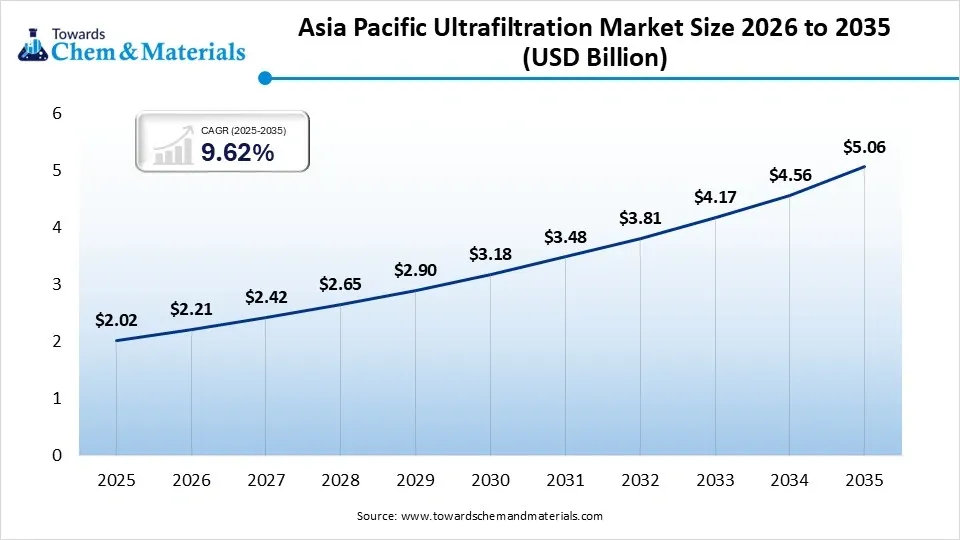
Asia Pacific dominated the market with a share of 34% in 2025 and is expected to be the fastest-growing region in the market, with a CAGR of 10.80% in the forecast period, due to its large population and growing water needs. Many countries in this region face water pollution and scarcity issues. Governments are investing in water treatment infrastructure to solve these problems. Rapid industrialization also increases demand for wastewater treatment. Countries like China and India are major contributors to this growth.
Water Challenges Boost Filtration Adoption
China maintained its dominance in the market, owing to its large industrial base and population. The country faces serious water pollution challenges, which increase demand for advanced filtration systems. The government is actively investing in water treatment projects and enforcing strict environmental regulations. Many industries in China are adopting ultrafiltration to meet these rules.
Ultrafiltration Market Evaluation in North America
North America is notably growing with 24% market share in 2025, owing to the advanced technology and strong regulations. The region focuses heavily on water quality and environmental protection. Companies invest in modern and efficient filtration systems. There is also high adoption of smart and automated technologies.
Advanced Infrastructure Boosts Ultrafiltration Market Demand in the United States
The United States is expected to emerge as a prominent country for the ultrafiltration market in the coming years, due to its advanced infrastructure and strict water quality standards. The government enforces strong environmental laws, which require industries to treat wastewater properly. Many companies are investing in modern filtration technologies.
Recent Development
In April 2026, DuPont unveiled the ultrafiltration modules. Also, the newly launched modules have already integrated with pre-filter called the Inge™. Also, this module is likely to reduce plant footprints and operation costs in the coming years, as per the company's claim.(Source: www.prnewswire.com)
Top Vendors in the Ultrafiltration Market & Their Offerings:
- DuPont de Nemours, Inc.: DuPont is a global innovation leader in specialty materials, particularly within its Healthcare & Water Technologies segment. Through brands like IntegraTec and Inge, it provides high-performance PVDF and PES ultrafiltration membranes. These solutions are vital for municipal drinking water, industrial wastewater reuse, and as a critical pretreatment for reverse osmosis systems worldwide.
- Toray Industries, Inc.: Headquartered in Japan, Toray is a premier manufacturer of advanced membrane technologies, including hollow-fiber ultrafiltration modules. Its membranes are renowned for high mechanical strength and chemical resistance, serving diverse applications from seawater desalination pretreatment to biopharmaceutical purification. The company is currently expanding its global footprint with new production facilities and research centers in India.
- Veolia Environnement S.A.: Veolia is the world’s leading provider of environmental services, managing the complete water cycle for cities and industries. Its specialized division, Veolia Water Technologies, offers the ZeeWeed ultrafiltration line one of the most widely deployed technologies for wastewater recycling and drinking water production. The company excels in providing mobile water services and turnkey skid-mounted systems for rapid deployment.
Other Key Players
- Pentair plc
- Asahi Kasei Corporation
- Kovalus Separation Solutions
- Merck KGaA
- 3M Company
- Hydranautics
Segments Covered in the Report
By Membrane Type
- Polymeric Membranes
- Polysulfone (PS)
- Polyethersulfone (PES)
- Polyvinylidene Fluoride (PVDF)
- Others
- Ceramic Membranes
- Alumina-based
- Zirconia-based
- Titania-based
By Module Type
- Hollow Fiber
- Flat Sheet
- Tubular
- Spiral Wound
By Application
- Water & Wastewater Treatment
- Municipal Treatment
- Industrial Effluent Treatment
- Water Reuse
- Food & Beverage Processing
- Dairy Processing
- Beverage Clarification
- Pharmaceutical & Biotechnology
- Protein Separation
- Vaccine Processing
- Chemical Processing
- Others
By End-User
- Municipal
- Industrial
- Power Generation
- Chemical
- Oil & Gas
- Food & Beverage
- Pharmaceuticals
- Residential
By System Type
- Standalone Systems
- Integrated Systems
- UF + RO
- UF + NF
- Hybrid Membrane Systems
By Region
- North America
- U.S.
- Canada
- Mexico
- Europe
- Germany
- UK
- France
- Italy
- Spain
- Asia Pacific
- China
- India
- Japan
- South Korea
- Latin America
- Brazil
- Argentina
- Middle East & Africa
- Saudi Arabia
- South Africa
FAQ's
Question 1 : What are the key trends shaping the ultrafiltration market?
Answer : The greater demand for clean water is the current industry trend.
Question 2 : Who are the key players in the ultrafiltration market?
Answer : Pentair plc, Asahi Kasei Corporation, and Kovalus Separation Solutions are major players in the ultrafiltration market.
Question 3 : What exactly is ultrafiltration?
Answer : Ultrafiltration is a pressure-driven process that uses a very fine membrane to separate bacteria, viruses, and silt from water. Think of it as a microscopic sieve that lets water through but blocks even the tiniest harmful particles.
Question 4 : Why are pharmaceutical companies using ultrafiltration more often?
Answer : The pharmaceutical and biotech sector is the fastest-growing application area (10.80% CAGR) because it requires extreme purity. Ultrafiltration is used here to separate proteins, process vaccines, and ensure that medicines are free from any bacterial contamination.
Question 5 : Can ultrafiltration help with the microplastics problem?
Answer : Yes. Modern ultrafiltration systems are specifically being targeted by regulators like the EPA to help remove emerging contaminants, including microplastics and other synthetic fibers, from public water supplies.
Meet the Team

Saurabh Bidwai
Principal Consultant
Saurabh Bidwai, a B.Tech Chemical Engineering graduate with 4+ years of experience, specializes in specialty chemicals, commodity chemicals, and engineered materials, offering valuable insights into market trends and emerging opportunities.

Aditi Shivarkar
Reviewed By
Aditi Shivarkar, with 14+ years in Chemical and Materials market research, specializes in Chemical and Materials. She ensures accurate, actionable insights, driving Towards Chemicals And Materials Analytics and Consulting excellence in industry trends and sustainability.