
Urea Market Size, Production Volume, Sales Performance, Export & Import Dynamics, Adoption Rates, Recycling Rate, Material Efficiency, Market Share Analysis, and Demand Trends
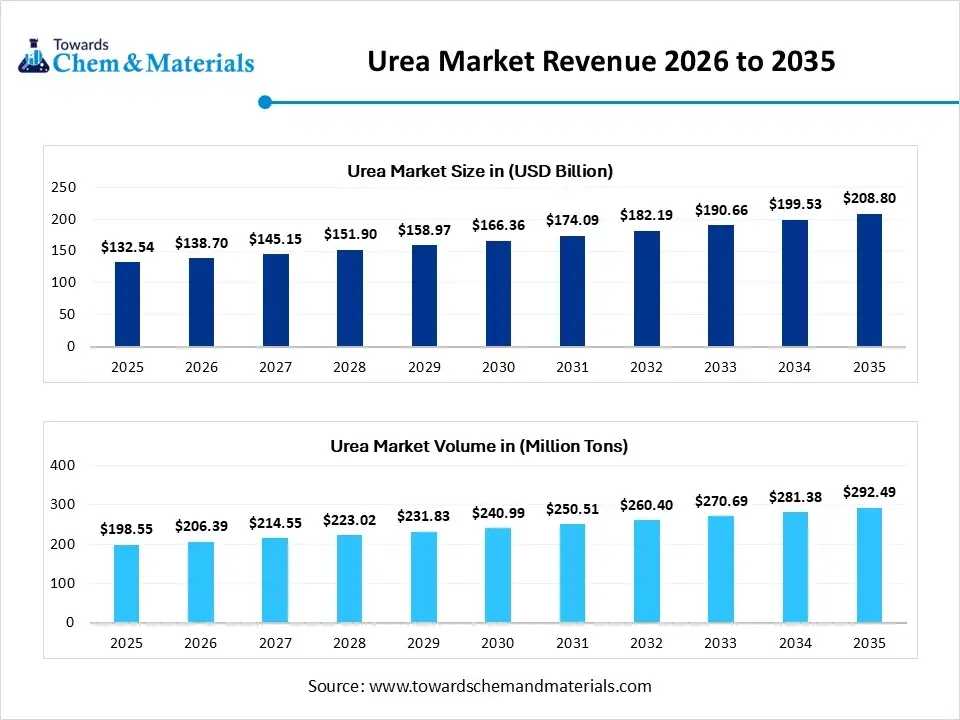
The global urea market is a vital pillar of food security, valued at USD 138.70 billion in 2026. Expanding at a 4.65% CAGR, the industry is projected to hit USD 208.80 billion by 2035.Asia Pacific leads with a 53% market share, driven by high demand for nitrogen fertilizers in India and China. While agriculture remains the primary end-user, the automotive segment is the fastest-growing due to mandatory Diesel Exhaust Fluid (DEF) regulations. Key trends include the shift toward granular urea, green production processes, and nanotechnology-based liquid solutions.
Content
Urea Market Size, Volume, Share, Growth, Report 2026 to 2035
The global urea market size was estimated at USD 132.54 billion in 2025 and is expected to be worth around USD 208.80 billion by 2035, growing at a CAGR of 4.65% from 2026 to 2035. In terms of volume, the urea industry is projected to grow from 198.55 million tons in 2025 to 292.49 million tons by 2035, exhibiting a compound annual growth rate (CAGR) of 3.95% over the forecast period from 2026 to 2035. The growth of the market is driven by the rising demand for high-nitrogen fertilizers to support agriculture, with over 70% of usage in farming.
Market Highlights
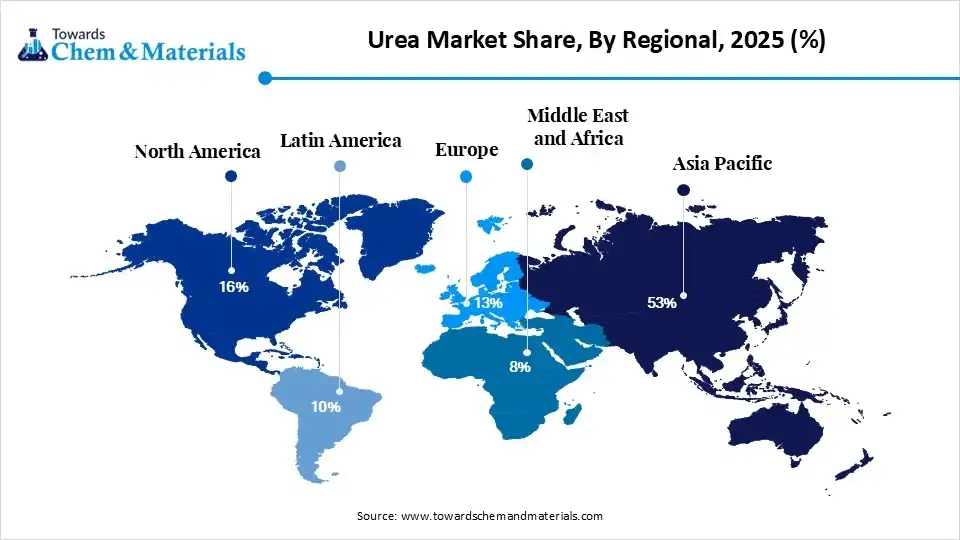
- By region, Asia Pacific dominated the market with a share of 53% in 2025 and is expected to sustain its position while growing with a CAGR of 5.0% in the forecast period.
- By region, North America held the market share of 16% in 2025.
- By product type, the granular urea segment dominated the market with 54% share in 2025 and is expected to have the fastest growth with a CAGR of 4.8% in the forecast period
- By application, the fertilizers segment dominated the market with 72% share in 2025.
- By application, the automotive segment held 6% market share in 2025 and is expected to have the fastest growth with a CAGR of 5.2% in the forecast period.
- By end-use industry, the agriculture segment dominated the market with 74% share in 2025.
- By end-use industry, the automotive industry segment held 7% market share in 2025 and is expected to have the fastest growth with a CAGR of 5.1% in the forecast period.
- By form, the solid segment dominated the market with 81% share in 2025.
- By form, the liquid segment held 19% market share in 2025 and is expected to have the fastest growth with a CAGR of 4.9% in the forecast period.
- By distribution channel, the direct sales segment dominated the market with 46% share in 2025.
- By distribution channel, the online sales segment held 10% market share in 2025 and is expected to have the fastest growth with a CAGR of 5.6% in the forecast period.
- By production process, the natural gas based segment dominated the market with 68% share in 2025.
- By production process, the biomass based segment held 5% market share in 2025 and is expected to have the fastest growth with a CAGR of 5.8% in the forecast period.
Market Size and Volume Forecast
- Market Estimated Size (2025): USD 132.54 Billion | CAGR (2026–2035): 4.65%
- Market Projected Size (2035): USD 208.80 Billion
- Market Volume (2025): 198.55 Million Tons | Volume CAGR (2026–2035):3.95%
- Market Projected Volume (2035): 292.49 Million Tons
- Market Pricing (2025):
- Average Manufacturing Price: USD 220 per ton
- Average Selling Price: USD 330 per ton
- Pricing CAGR (2025–2035): 2.85%
Market Overview
What Is The Significance Of The Urea Market?
The urea market is critical for global food security, acting as the primary nitrogen based fertilizer (46% nitrogen), driving high-yield agricultural production. It supports global agriculture by enhancing soil fertility, while industrial applications include diesel exhaust fluid for emissions reduction and chemical manufacturing. As the most concentrated nitrogen fertilizer, it is essential for enhancing crop yield for crops like rice, wheat, and corn to support the increasing global population.
Recent Growth Trends:
- Rising Industrial Demand: Beyond farming, urea is seeing increased utilization in industrial sectors, particularly for DEF (urea solution) in the automotive industry to meet emission regulations.
- Production & Investment: High-capacity urea production plants are introducing in regions with cheap natural gas (Ethiopia, Nigeria, Russia).
- Rising Fertilizer Innovation: Growth is driven by specialty products like controlled-release and water-soluble fertilizers, offering higher efficiency than conventional urea.
Report Scope
| Report Attribute | Details |
| Market Size and Volume in 2026 | USD 138.70 Billion / 206.39 Million Tons |
| Revenue Size and Volume Forecast in 2035 | USD 208.80 Billion / 292.49 Million Tons |
| Growth Rate | CAGR 4.65% |
| Forecast Period | 2026 - 2035 |
| Base Year | 2025 |
| Dominant Region | Asia Pacific |
| Segment Covered | By Product Type, By Application, By End-Use Industry, By Form, By Distribution Channel, By Regions |
| Key companies profiled | CF Industries Holdings, Inc, Indian Farmers Fertiliser Cooperative Limited (IFFCO), Saudi Arabian Fertilizer Company (SAFCO), EuroChem Group AG, Sinofert Holdings Limited, SABIC (Saudi Arabia), Qatar Fertilizer Company (Qatar), Yara International ASA (Norway), Nutrien AG (Canada), OCI N.V. (Netherlands), Acron Group (Russia), CF Industries Holdings (U.S.), HUBEI YIHUA CHEMICAL INDUSTRY CO., LTD. (China), China National Petroleum Corporation (CNPC) (China), Koch Fertilizer, LLC (U.S.), Coromandel International Limited (India). |
Key Technological Shifts in the Urea Market:
The urea market is experiencing a significant transformation, driven by the need for sustainability, efficiency, and reduced carbon emissions. The key technological shifts are moving away from traditional, energy-intensive production toward "green" and "blue" urea, enhanced efficiency formulations, and digitalized, localized manufacturing. These shifts are heavily supported by government initiatives to improve agricultural sustainability, particularly in the Asia-Pacific region, which dominates global urea production and consumption.
Supply Chain Analysis of the Urea Market:
Chemical Production & Processing
- Urea is produced through the reaction of ammonia and carbon dioxide under high pressure and temperature, followed by granulation or prilling for use in fertilizers, resins, and industrial applications.
- Key players: Yara International, Nutrien, CF Industries, and Indian Farmers Fertiliser Cooperative.
Quality Testing and Certification
- Urea must meet standards for nitrogen content, purity, moisture levels, and environmental compliance for agricultural and industrial use.
- Key players: Food and Agriculture Organization, International Organization for Standardization, Bureau of Indian Standards, European Chemicals Agency.
Distribution to Industrial Users
- Urea is supplied to agricultural sectors for fertilizers, resin manufacturers, animal feed producers, automotive industries (for DEF), and chemical processing industries.
- Key players: Yara International, Nutrien, Indian Farmers Fertiliser Cooperative.
Urea Regulatory Landscape: Global Regulations
| Country / Region | Regulatory Body | Key Regulations | Focus Areas | Notable Notes |
| United States | Environmental Protection Agency (EPA); Department of Agriculture (USDA); Occupational Safety and Health Administration (OSHA) | Clean Air Act; Toxic Substances Control Act (TSCA); Fertilizer Regulations | Fertilizer safety, emissions control, and worker exposure | Urea is regulated for agricultural use and industrial emissions, particularly in diesel exhaust fluid (DEF) applications to reduce NOx emissions. |
| European Union | European Commission; European Chemicals Agency (ECHA) | REACH Regulation; Fertilising Products Regulation (EU 2019/1009); Nitrates Directive | Nutrient management, environmental protection | The EU enforces strict nitrogen application limits and promotes sustainable fertilizer usage to reduce environmental impact. |
| China | Ministry of Agriculture and Rural Affairs (MARA); Ministry of Ecology and Environment (MEE) | Fertilizer Registration Regulations; Environmental Protection Law | Fertilizer efficiency, pollution control | China regulates urea production and application with a focus on improving fertilizer efficiency and reducing agricultural pollution. |
| India | Ministry of Chemicals and Fertilizers; Department of Fertilizers | Fertilizer Control Order (FCO); Subsidy Policies | Price control, fertilizer distribution, and agricultural productivity | India heavily subsidizes urea to support farmers, making it one of the largest consumers and importers globally. |
| Brazil | Ministry of Agriculture, Livestock and Food Supply (MAPA); Brazilian Institute of Environment and Renewable Natural Resources (IBAMA) | National Fertilizer Plan; Environmental Regulations | Agricultural productivity, sustainable fertilizer use | Brazil promotes fertilizer efficiency and imports significant volumes of urea to support its large agricultural sector. |
| Saudi Arabia | Ministry of Industry and Mineral Resources; Saudi Standards, Metrology and Quality Organization (SASO) | Industrial Chemical Regulations; Export Standards | Production standards, export compliance | Saudi Arabia is a major exporter of urea, with regulations focused on production quality and international trade compliance. |
Market Dynamics
Drivers
What are the key growth drivers of the urea market?
Key growth drivers for the urea market include rising demand for high-nitrogen fertilizers due to a growing global population and increased food demand, especially in the Asia-Pacific. Other drivers include government agricultural subsidies, rising demand for industrial applications like AdBlue (automotive) and melamine, and the adoption of specialized, controlled-release urea to boost efficiency. Many governments offer incentives and subsidies to farmers to increase fertilizer accessibility and enhance food security, especially in developing regions. The adoption of controlled-release fertilizers, coated urea, and enhanced-efficiency fertilizers reduces nitrogen runoff and improves uptake efficiency, driving premium, sustainable product demand.
Restrains
What are the key growth restraints of the Urea Market?
Key growth restraints of the urea market primarily stem from severe price volatility due to natural gas feedstock dependency, strict environmental regulations regarding emissions and nitrogen runoff, and the rising shift toward organic farming practices. These factors increase operational costs and reduce demand in certain segments. The adoption of controlled-release fertilizers and liquid urea solutions slows down the growth of conventional urea in premium agricultural markets. While specialty fertilizers are a growth area, their high production costs can act as a barrier to market expansion.
Opportunities
What are the key growth opportunities of the urea market?
Key growth opportunities in the urea market are driven by increasing demand for high-efficiency coated fertilizers and expanded industrial use of diesel exhaust fluid to meet strict emission regulations. Other growth areas include rising agricultural needs in emerging APAC/African markets, technological advances in green ammonia production, and the manufacturing of urea-formaldehyde resins. Shifting production methods toward utilizing green ammonia and low-carbon technologies aligns with global decarbonization goals, providing long-term competitive advantages. Growing food demand in developing regions is boosting the need for fertilizer, creating untapped market potential.
Segmental Insights
Product Type Insights
The granular urea segment dominated the market with a 54% share in 2025 and is expected to have the fastest growth with a CAGR of 4.8% in the forecast period due to its superior efficiency in precision agriculture, high nitrogen concentration, and better suitability for bulk blending and machine application compared to prilled urea. Granular urea allows for precise, variable-rate application with pneumatic spreaders, reducing over-application by up to 18%. It is less prone to caking and allows for deeper soil incorporation, improving nutrient uptake.
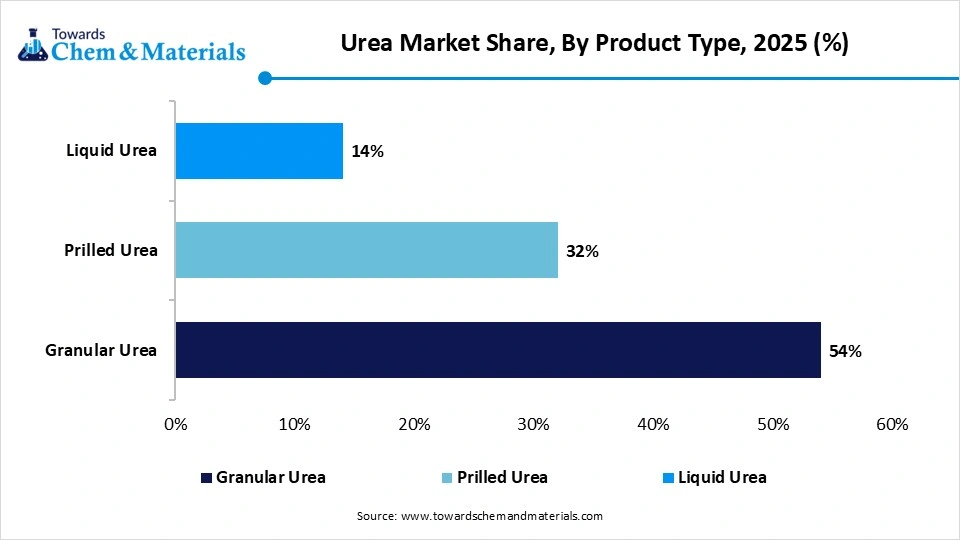
The prilled urea segment held 32% market share in 2025, due to its high nitrogen content, ease of application in agricultural spreading, and rapid dissolution, making it a preferred, cost-effective fertilizer for accelerating crop yields to meet global food demand. Its growth is further accelerated by its role in producing diesel exhaust fluid to comply with emissions regulations and its use in industrial applications.
The liquid urea segment held a 14% market share in 2025, due to its superior efficiency, ease of application via spraying, and lower environmental impact compared to granular alternatives. It is highly suitable for foliar spray and fertigation, allowing farmers to apply nutrients precisely when needed, reducing labor costs. Liquid urea offers enhanced nutrient use efficiency, reducing fertilizer losses compared to conventional granules, making it a preferred choice for sustainable agriculture.
Urea Market Share, By Product Type, 2025 (%)
| By Product Type | Revenue Share, 2025 (%) |
| Granular Urea | 54% |
| Prilled Urea | 32% |
| Liquid Urea | 14% |
Application Insights
The fertilizers segment dominated the market with 72% share in 2025, driven by escalating global demand for food, necessitating higher crop yields and increased nitrogen-based fertilization. Its high nitrogen content, cost-effectiveness, and widespread adoption in emerging markets accelerated market penetration. The development of slow-release urea and specialized nitrogen-efficient fertilizers has broadened the application of urea in sustainable farming.
The industrial segment held a 14% market share in 2025, due to surging demand for diesel exhaust fluid to meet strict emission regulations, along with increased usage in manufacturing resins, plastics, and animal feed. Rapid industrialization in the Asia-Pacific and rising demand for pollution control (NOx reduction) have driven this non-agricultural demand, which is growing faster than traditional fertilizer applications.
The automotive segment held 6% market share in 2025 and is expected to have the fastest growth with a CAGR of 5.2% in the forecast period, driven by the mandatory adoption of urea-based diesel exhaust fluid to meet stringent global emission standards. Growing commercial vehicle fleets, including heavy-duty trucks, buses, and off-road agricultural/construction machinery, are the largest consumers of DEF.
End-Use Industry Insights
The agriculture segment dominated the market with a 74% share in 2025, due to rising global food demand for a growing population, which requires higher crop yields. As a highly efficient nitrogen source, urea is the preferred fertilizer, with demand further boosted by government subsidies, increased use of coated/slow-release fertilizers, and expanded agricultural production in developing regions.
The chemical industry segment held 14% market share in 2025, driven by rapid industrialization, stringent environmental regulations requiring emissions control, and widespread use in manufacturing adhesives and resins. Industrial applications are growing to represent a significant share of the total urea market, particularly as demand for diesel exhaust fluid for heavy-duty vehicles increases.
The automotive industry segment held 7% market share in 2025 and is expected to have the fastest growth with a CAGR of 5.1% in the forecast period due to the mandatory adoption of selective catalytic reduction technology in diesel vehicles to comply with increasingly stringent global emission regulations, such as Euro VI and Bharat Stage VI (BS VI). This technology requires a high-purity urea-water solution, commonly known as diesel exhaust fluid, to break down harmful nitrogen oxides (NOx) into harmless nitrogen and water.
Form Insights
The solid segment dominated the market with 81% share in 2025, driven by its superior storage stability, cost-effectiveness, and suitability for large-scale, mechanized agricultural deployment. Its growth is primarily anchored by high demand in Asia-Pacific and Africa for intensive food production, while advanced coated solid formulations offer better nutrient efficiency. Solid urea is the preferred fertilizer for large-scale farming because it can be applied manually or mechanically. It is crucial for staple crops such as rice, wheat, and corn, especially in emerging economies seeking to increase yield per hectare.
The liquid segment held a 19% market share in 2025 and is expected to have the fastest growth with a CAGR of 4.9% in the forecast period, due to its superior nutrient efficiency, ease of application, and alignment with precision agriculture, alongside massive government promotion in developing economies. Governments, particularly in India, are promoting liquid nano urea to reduce the high subsidy burden associated with imported granular urea. For instance, IFFCO in India inaugurated the world's first nano urea plant, significantly boosting local production.
Distribution Channel Insights
The direct sales segment dominated the market with 46% share in 2025, driven by the need for supply chain optimization, digitalization, and increased demand from large-scale buyers such as cooperatives, agro-industrial enterprises, and government procurement agencies. This growth is part of a broader shift in the fertilizer industry toward lowering logistical costs, securing price stability, and enhancing customization for end-users.
The distributors segment held 44% market share in 2025 due to the rising need for last-mile delivery in developing regions, the explosion of e-commerce in agricultural inputs, and the necessity of managing logistical complexities, particularly in the Asia-Pacific and Africa. Distributors serve as a critical bridge between large-scale producers and fragmented end-users, ensuring timely availability during peak seasons and navigating complex regulatory environments.
The online sales segment held a 10% market share in 2025 and is expected to have the fastest growth with a CAGR of 5.6% in the forecast period, due to accelerated digital adoption in agriculture, improved last-mile delivery, and the need for greater price transparency. Post-pandemic, e-commerce platforms have become a convenient alternative for farmers, allowing them to purchase bulk fertilizers directly from manufacturers or authorized distributors.
Production Process Insights
The natural gas-based segment dominated the market with a 68% market share in 2025.
The natural gas-based segment dominated the market with a 68% share in 2025, due to its superior cost-effectiveness, higher production efficiency, and lower environmental impact compared to coal-based alternatives. Increased demand for high-efficiency fertilizers to support a growing global population, coupled with government subsidies, robust infrastructure, and cleaner, cheaper feedstock, has solidified its market dominance. The shift to natural gas has become a dominant trend, with the gas-based urea market value projected to grow steadily as agricultural sectors prioritize efficiency and sustainable practices.
The coal-based segment held a 27% market share in 2025, due to its superior cost-effectiveness, higher production efficiency, and lower environmental impact compared to coal-based alternatives. Increased demand for high-efficiency fertilizers to support a growing global population, coupled with government subsidies, robust infrastructure, and cleaner, cheaper feedstock, has solidified its market dominance.
The biomass-based segment held a 5% market share in 2025 and is expected to have the fastest growth with a CAGR of 5.8% in the forecast period, primarily as a low-carbon alternative to traditional natural gas-based production, driven by strict environmental regulations, the need for sustainable agricultural practices, and technological advancements that allow for greener ammonia synthesis. Governments are offering incentives for eco-friendly fertilizers, pushing agricultural sectors toward bio-based products to improve soil health.
Regional Insights
How did Asia Pacific dominate the urea market in 2025?
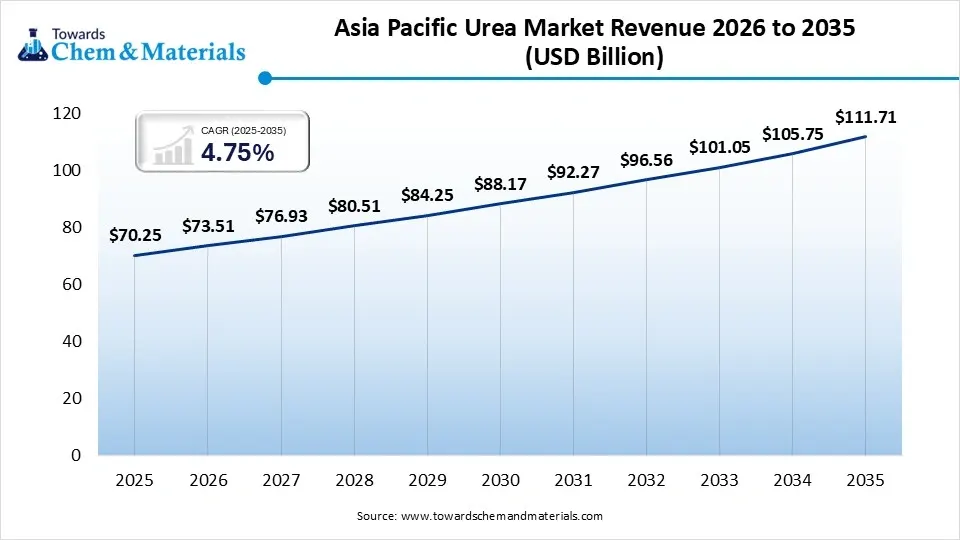
The Asia Pacific Urea market size was estimated at USD 70.25 billion in 2025 and is projected to reach USD 111.71 billion by 2035, growing at a CAGR of 4.75% from 2026 to 2035. Asia Pacific dominated the market with a share of 53% in 2025 and is expected to sustain its position while growing with a CAGR of 5.0% in the forecast period, driven by intense agricultural demand, heavy government fertilizer subsidies, and massive production capacity, particularly in China and India, which ensure high consumption for crop yields and industrial use. Significant government support (subsidies) in nations like India makes urea affordable and encourages adoption by farmers. The region's large agricultural base and population density necessitate high fertilizer use for food security, making China and India the largest producers and consumers.
India Urea Market Growth Factor
The Indian urea market is projected to grow significantly, driven by high agricultural demand, government subsidies, and rising adoption of nanotechnology. Policies like the Nutrient-Based Subsidy (NBS) and the New Investment Policy (NIP) promote domestic production, aimed at reducing reliance on imports. Key growth factors include rising food production needs, increased cultivation of wheat and rice, and the adoption of efficiency-boosting products like urea-based fertilizers.
North America Urea Market Growth Factor
North America held the market share of 16% in 2025, driven by high demand for fertilizers in intensive agriculture. Growth is fueled by widespread use of granular urea, increasing industrial applications, and rising demand for diesel exhaust fluid. Competitive, stable natural gas supplies support strong domestic production. North America's access to abundant, low-cost shale gas allows for competitive, domestic urea production, reducing reliance on imports.
U.S. Urea Market Growth Factor
The U.S. urea market is experiencing growth driven by high agricultural demand, increasing diesel exhaust fluid consumption, and cost-efficient domestic production using shale gas. Increasing use of urea in manufacturing urea-formaldehyde resins, adhesives, and coatings adds to market demand. The expansion of fertilizer production facilities in the US contributes to meeting both domestic and export needs.
Recent Developments
- In May 2026, Platts announced that it is set to launch a new daily FOB Nigeria granular urea assessment, effective on June 1, 2026, targeting spot transactions for 30,000–50,000 mt cargoes from major terminals like Lekki and Onne. This new benchmark aims to provide transparency for the growing West African export market and help participants manage price risk from the emerging nitrogen hub.(Source: www.spglobal.com)
- In October 2025, Zambia launched its first-ever urea manufacturing plant, a US$641 million investment by United Capital Fertilizer designed to boost food security and eliminate import reliance. The facility aims to increase maize yields significantly, with a planned Phase 2 expansion to double production capacity for regional export(Source: www.chemanalyst.com)
Top players in the Urea Market & Their Offerings:
- CF Industries Holdings, Inc.: CF Industries specializes in nitrogen fertilizers, including urea and ammonia. The company focuses on large-scale production and is investing in low-carbon ammonia and clean energy initiatives.
- Indian Farmers Fertiliser Cooperative Limited (IFFCO): IFFCO is one of India’s largest fertilizer producers, supplying urea for agricultural use and supporting domestic food security.
- Saudi Arabian Fertilizer Company (SAFCO): SAFCO is a major producer of urea and ammonia, benefiting from low-cost feedstock and large-scale production facilities.
- EuroChem Group AG: EuroChem produces nitrogen fertilizers, including urea, focusing on vertical integration and global distribution.
- Sinofert Holdings Limited: Sinofert is a key supplier of urea and other fertilizers in China, supporting the country’s large agricultural sector.
Other Top Players Are
- SABIC (Saudi Arabia)
- Qatar Fertilizer Company (Qatar)
- Yara International ASA (Norway)
- Nutrien AG (Canada)
- OCI N.V. (Netherlands)
- Acron Group (Russia)
- CF Industries Holdings (U.S.)
- HUBEI YIHUA CHEMICAL INDUSTRY CO., LTD. (China)
- China National Petroleum Corporation (CNPC) (China)
- Koch Fertilizer, LLC (U.S.)
- Coromandel International Limited (India)
Segments Covered:
By Product Type
- Granular Urea
- Standard Granular
- Coated Granular
- Prilled Urea
- Standard Prill
- Low Biuret Prill
- Liquid Urea
- Urea Ammonium Nitrate (UAN)
- DEF (Diesel Exhaust Fluid Grade)
By Application
- Fertilizers
- Nitrogen Fertilizers
- Blended Fertilizers
- Industrial
- Resins Production
- Urea Formaldehyde Resins
- Melamine Production
- Chemical Intermediates
- Resins Production
- Automotive
- Diesel Exhaust Fluid (DEF)
- Animal Feed
- Feed Additives
- Pharmaceuticals & Cosmetics
- Dermatological Products
- Personal Care Products
By End-Use Industry
- Agriculture
- Chemical Industry
- Automotive Industry
- Healthcare Industry
By Form
- Solid
- Granules
- Prills
- Liquid
- Solutions
- Blends
By Distribution Channel
- Direct Sales
- Distributors
- Agricultural Cooperatives
- Retail Dealers
- Online Sales
By Production Process
- Natural Gas Based
- Coal Based
- Biomass Based
By Regions
- North America
- U.S.
- Canada
- Mexico
- Europe
- Germany
- UK
- France
- Italy
- Spain
- Asia Pacific
- China
- India
- Japan
- South Korea
- Latin America
- Brazil
- Argentina
- Middle East & Africa
- Saudi Arabia
- South Africa
FAQ's
Question 1 : What is urea mainly used for?
Answer : Urea is mainly used as a nitrogen fertilizer in agriculture. It is also used in diesel exhaust fluid, resins, adhesives, animal feed, and industrial chemical manufacturing.
Question 2 : Why is urea important in agriculture?
Answer : Urea contains a high concentration of nitrogen, which helps improve soil fertility and increase crop yields for major food crops like wheat, rice, and corn.
Question 3 : Which region dominates the global urea market?
Answer : Asia Pacific dominates the urea market because of strong agricultural activity, government subsidies, and high fertilizer demand from countries like China and India.
Question 4 : What is granular urea?
Answer : Granular urea is a solid nitrogen fertilizer with larger particles that improve storage, transportation, and machine application efficiency in modern farming.
Question 5 : How is urea used in the automotive industry?
Answer : The automotive industry uses urea-based diesel exhaust fluid (DEF) in selective catalytic reduction systems to reduce harmful vehicle emissions.
Meet the Team

Saurabh Bidwai
Principal Consultant
Saurabh Bidwai, a B.Tech Chemical Engineering graduate with 4+ years of experience, specializes in specialty chemicals, commodity chemicals, and engineered materials, offering valuable insights into market trends and emerging opportunities.

Aditi Shivarkar
Reviewed By
Aditi Shivarkar, with 14+ years in Chemical and Materials market research, specializes in Chemical and Materials. She ensures accurate, actionable insights, driving Towards Chemicals And Materials Analytics and Consulting excellence in industry trends and sustainability.