
U.S. Green Chemicals Market Size, Share, Growth, Report 2026 to 2035
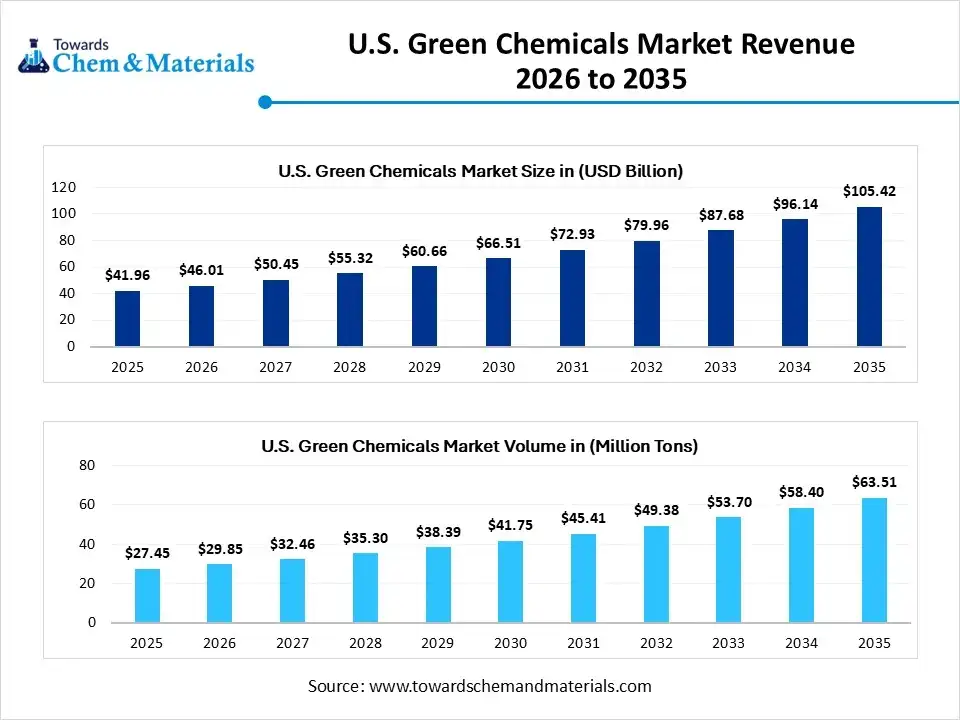
The U.S. green chemicals market is experiencing a significant transformation, with its valuation projected to reach USD 46.01 billion in 2026. Expanding at a CAGR of 9.65%, the market is expected to hit USD 105.42 billion by 2035. This growth is underpinned by a transition toward a circular economy, where agricultural waste and plant-based oils are increasingly replacing traditional petroleum feedstocks.While bio-based solvents currently dominate the market share due to high demand in the coatings and cleaning industries, bio-based polymers and bioplastics are the fastest-growing product segment. This surge is primarily driven by the packaging and automotive sectors, which are under intense regulatory and consumer pressure to reduce carbon footprints.
Content
U.S. Green Chemicals Market Size, Share, Trends and Forecasts 2035
The U.S. green chemicals market size was valued at USD 41.96 billion in 2025, is estimated to reach USD 46.01 billion in 2026, and is projected to reach USD 105.42 billion by 2035, exhibiting a compound annual growth rate (CAGR) of 9.65% over the forecast period from 2026 to 2035. In terms of volume, the U.S. green chemicals market is projected to grow from 27.45 million tons in 2025 to 63.51 million tons by 2035. growing at a CAGR of 8.75% from 2026 to 2035.The market demand is driven by increasing consumer demand for sustainable products backe d by strong federal regulatory incentives.
Key Takeaways
- By product type, the bio-based polymers & bioplastics segment held approximately 28% share in the market in 2025
- By product type, the Bio-based Solvents segment is expected to grow at the fastest CAGR in the market during the forecast period.
- By feedstock, the plant oils & fats segment held approximately 34% share in the market in 2025.
- By feedstock, the lignocellulosic biomass segment is expected to grow at the fastest CAGR in the market during the forecast period.
- By application, the packaging & plastics segment held approximately 29% share in the market in 2025.
- By application, the automotive & transportation segment is expected to grow at the fastest CAGR in the market during the forecast period.
Market Size and Volume Forecast
- Market Estimated Size (2025): USD 41.96 Billion | CAGR (2026–2035): 9.65%
- Market Projected Size (2035): USD 105.42 Billion
- Market Volume (2025): 27.45 Million Tons| Volume CAGR (2026–2035): 8.75%
- Market Projected Volume (2035): 63.51 Million Tons
- Pricing Data (2025):
- Average Manufacturing Price (2025): USD 1,990/Ton
- Average Selling Price (2025): USD 2,550/Ton
- Pricing CAGR (2026–2035): 3.45%
What Do You Mean by the U.S. Green Chemicals Market?
U.S. green chemicals market growth is driven by improvements in bio-based feedstocks and renewable processing technologies, increased consumer demand for sustainable products, and tighter environmental regulations. Two important market segments are bio-alcohols and bio-organic acids. Growth is further fueled by widespread adoption in sectors like packaging, automotive, construction, and specialty chemicals.
- In June 2025, New Iridium announced it had raised seed funding. The Colorado-based green chemicals startup is planning a pilot facility to produce bio-based acetic acid and ethyl acetate using renewable feedstocks and captured CO2(Source: www.industryintel.com)
Market Outlook
- Industry Growth Overview: The U.S. green chemicals market is steadily growing as industries increasingly adopt eco-friendly alternatives to traditional chemicals. Demand is rising across sectors like agriculture, automotive, packaging, and construction, driving companies to invest in innovative, sustainable production methods.
- Sustainability Trends: Sustainability is a top priority, and the market is being shaped by renewable feedstocks, circular economy principles, and regulatory compliance. Businesses are focusing on plant-based materials recycling and cleaner processes in an effort to lessen their impact on the environment.
- Startup Ecosystem: The U. S. has a thriving green chemicals startup ecosystem with an emphasis on sustainable production, recycling technologies, and bio-based materials. To scale technologies and swiftly introduce novel solutions to the market, many startups partner with well-established businesses.
Emerging Trends in the U.S. Green Chemicals Market
Circular Economy and Waste-to-Chemicals Solutions
Emerging trends include converting industrial by-products, agricultural residues, and post-consumer waste into value-added chemicals. This supports circular economy principles by reducing landfill usage, cutting emissions, and creating sustainable feedstock pipelines for chemical production.
Growth of Specialty Bio-Chemicals
Bio-lubricants, bio-solvents, and natural surfactants are examples of specialty chemicals made from renewable resources that are becoming increasingly well-liked. Compared to bulk green chemicals, their uses in personal care, pharmaceutical, and cosmetic products are growing and offer greater value opportunities.
Value Chain Analysis
- Feedstock Procurement: Finding sustainable raw materials such as plant oils, sugars, algae, agricultural waste, and other renewable biomass is known as feedstock procurement. To guarantee that these feedstocks satisfy quality requirements for chemical synthesis, they are gathered, cleaned, and pre-processed.
- Chemical Synthesis and Processing: Through processes like enzymatic reactions, fermentation, catalysis, separation, purification, and drying, chemical synthesis and processing transform the feedstocks into green chemicals. For increased efficiency and less environmental impact, the processes may also use continuous flow systems, modular reactors, or bioreactors.
- Quality Testing and Certification: Quality testing evaluates parameters such as purity, density, viscosity, pH, melting point, and biodegradability, depending on the chemical type. Certifications like USDA BioPreferred, ISCC Plus, or other eco-labels ensure compliance with U.S. regulatory standards and global sustainability benchmarks.
Report Scope
| Report Attributes | Details |
| Market Size in 2026 | USD 46.01 Billion |
| Expected Size by 2035 | USD 105.42 Billion |
| Growth Rate from 2025 to 2034 | CAGR 9.65% |
| Base Year of Estimation | 2025 |
| Forecast Period | 2025 - 2035 |
| Segment Covered | By Product Type / Chemical Class, By Feedstock / Raw Material, By Application / End-Use Industry |
| Key Companies Profiled | Corbion, Evonik Industries (U.S. operations), Genomatica, Inc., Novozymes, Inc., Solvay S.A. (U.S. operations), BioAmber (renewable succinic acid), Amyris, Inc., Green Biologics Ltd.LanzaTech (carbon-to-chemicals technology) |
Market Opportunity
Waste-to-Chemicals and Circular Economy Solutions
The production of chemicals from waste materials offers a significant opportunity for expansion. Businesses can lower their environmental impact, lower the cost of raw materials, and produce innovative goods from agricultural or industrial waste by incorporating the principles of the circular economy.
Market Challenge
High Production Costs
Green chemicals often rely on renewable feedstocks or advanced bio-based processes, which are more expensive than conventional petrochemical routes. This makes price competitiveness a major hurdle. Companies must balance sustainability with profitability, often requiring subsidies or incentives to remain viable. High upfront capital investment for green production facilities further limits rapid expansion.
Segmental Insights
Product Type Insights
Why Bio-Based Solvents Segment Dominate the U.S. Green Chemicals Market?
The bio-based solvents segment dominated the market with approximately 35% share in 2025, motivated by the growing use of these environmentally friendly substitutes for solvents derived from petroleum in paints, coatings, adhesives, and cleaning products. The dominance of bio-based solvents in a variety of industries was further reinforced by growing consumer demand for safer, nontoxic products and regulatory pressure to reduce volatile organic compounds.
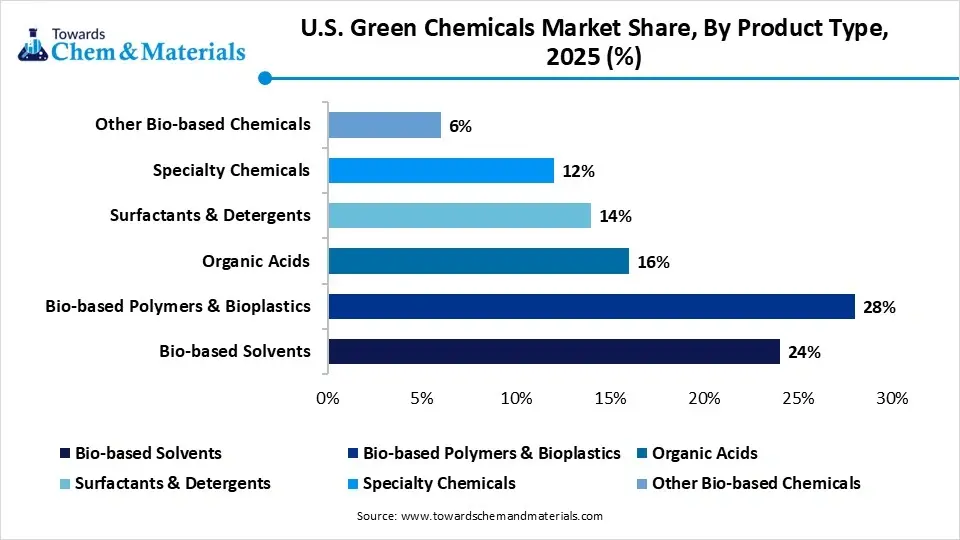
The bio-based polymers & bioplastics fastest growing in the market during the forecast period, owing to rising demand from packaging, consumer goods, and automotive sectors looking to replace conventional plastics with sustainable materials. Government initiatives supporting biodegradable packaging and corporate commitments toward carbon neutrality are accelerating adoption, making this segment a key driver of future market expansion.
U.S. Green Chemicals Market Share, By Product Type, 2025 (%)
| By Product Type | Revenue Share, 2025 (%) |
| Bio-based Solvents | 24% |
| Bio-based Polymers & Bioplastics | 28% |
| Organic Acids | 16% |
| Surfactants & Detergents | 14% |
| Specialty Chemicals | 12% |
| Other Bio-based Chemicals | 6% |
- Bio-based polymers and bioplastics hold the leading revenue share of 28% as industries pivot toward sustainable alternatives to traditional petroleum-based plastics.
- Bio-based solvents account for a significant revenue share of 24% because they offer a safer, low-toxicity alternative for paints, coatings, and industrial cleaning applications.
- Organic acids represent a revenue share of 16% as they are essential building blocks for the production of bio-polymers, preservatives, and pharmaceutical intermediates.
- Surfactants and detergents hold a revenue share of 14% due to the rapid consumer shift toward plant-derived and biodegradable household cleaning products.
- Specialty chemicals maintain a revenue share of 12% because they provide high-performance, tailored solutions for niche applications in the agricultural and electronic sectors.
- Other bio-based chemicals account for a revenue share of 6% as they encompass various emerging green additives, lubricants, and specialized bio-oils.
Feedstock Insights
How the Plant Oils & Fats Segment Held the Largest Share in the U.S. Green Chemicals Market?
The plant oils & fats segment held the largest revenue share of approximately 40% in the market in 2025, motivated by their broad availability and numerous uses in bio-based lubricants, surfactants, solvents, and bioplastics. Their cost-effectiveness, renewable nature, and ease of integration into current chemical processes make them a popular option for manufacturers
The lignocellulosic biomass segment is experiencing the fastest growth in the market during the forecast period due to its capacity to produce high-value chemicals from forestry waste, non-food crops, and agricultural residues. Due to its scalability and ability to avoid competition with the food supply, this feedstock is becoming more appealing to produce advanced green chemicals and second-generation biofuels.
U.S. Green Chemicals Market Share, By Feedstock / Raw Material, 2025 (%)
| By Feedstock / Raw Material | Revenue Share, 2025 (%) |
| Plant Oils & Fats | 34% |
| Carbohydrates / Starches / Sugars | 27% |
| Agricultural & Food Waste | 16% |
| Lignocellulosic Biomass | 14% |
| Algae / Microbial Feedstocks | 9% |
- Plant oils and fats hold the leading revenue share of 34% because they are the primary raw materials used for producing bio-based lubricants and surfactants
- Carbohydrates, starches, and sugars account for a revenue share of 27% as they serve as the essential foundation for fermentation-based production of bio-ethanol and organic acids.
- Agricultural and food waste represent a revenue share of 16% because the industry is increasingly adopting circular economy models to convert harvest residues into value-added chemicals.
- Lignocellulosic biomass maintains a revenue share of 14% due to its potential to produce high-value aromatic compounds and biofuels from wood, straw, and husks.
- Algae and microbial feedstocks hold a revenue share of 9% as they provide a highly sustainable source for specialized pigments, oils, and high-purity chemical intermediates.
Application Insights
Which Application Segments Dominated the U.S. Green Chemicals Market?
The packaging & plastics segment dominated the market with approximately 30% share in 2025 due to strong demand for environmentally friendly packaging solutions from consumers and regulations. Corporate sustainability commitments, single-use plastic bags, and growing e-commerce have all contributed to the rapid expansion of bio-based polymers and biodegradable plastics in packaging.
The automotive & transportation segment is the fastest growing in the market during the forecast period, owing to the rising use of bio-based polymers, lubricants, and composites to reduce carbon emissions and improve fuel efficiency. Increasing EV adoption and regulatory pressure on automakers to adopt sustainable materials are accelerating demand for green chemicals in this sector.
U.S. Green Chemicals Market Share, By Application, 2025 (%)
| By Application | Revenue Share, 2025 (%) |
| Packaging & Plastics | 29% |
| Automotive & Transportation | 15% |
| Personal Care & Cosmetics | 16% |
| Pharmaceuticals & Nutraceuticals | 12% |
| Agriculture & Crop Protection | 11% |
| Coatings, Adhesives, Sealants | 7% |
| Industrial & Specialty Applications | 10% |
- Packaging and plastics hold a revenue share of 29% because of intense regulatory pressure and the implementation of state-level Extended Producer Responsibility (EPR) laws.
- Personal care and cosmetics account for a revenue share of 16% due to a massive consumer shift toward "clean beauty" and non-toxic, bio-based surfactants.
- Automotive and transportation represent a revenue share of 15% as manufacturers integrate bio-based composites and lightweight bioplastics to improve fuel efficiency.
- Pharmaceuticals and nutraceuticals maintain a revenue share of 12% because of the increasing use of bio-based solvents and intermediates in drug synthesis to reduce hazardous waste.
- Agriculture and crop protection command a revenue share of 11% driven by the rising demand for biopesticides and bio-fertilizers that reduce soil toxicity.
- Industrial and specialty applications take a revenue share of 10% because of the specialized use of bio-catalysts and green surfactants in industrial cleaning and heavy manufacturing.
- Coatings, adhesives, and sealants hold a revenue share of 7% as the construction and manufacturing sectors adopt bio-resins to minimize indoor air pollutants.
Country Insights
The United States stands as one of the largest and most progressive markets for green chemicals in 2025, fueled by the growing demand for environmentally friendly products, stringent regulations, and developments in bio-based technologies. Bioplastics are expanding at the fastest rate, while bio-based solvents dominate the market. Feedstocks are mostly composed of plant oils and fats, while lignocellulosic biomass is rapidly increasing.
The United States Export Of Organic / Chemical Products
| Metric | Value / Details |
| U.S. Exports of organic chemicals in 2024 | USD 51.88 billion |
| Share of U.S. total merchandise exports (2023) represented by organic chemicals (HS commodity group 29) | ≈ 2.56% |
| Top export destinations for U.S. organic chemicals (2023) | Mexico (~USD 6.82 billion), China (~USD 4.20 billion), Belgium, Canada, Italy, Japan, Germany, Netherlands, UK, Brazil |
Recent Developments
- In May 2025, HH Chemical introduced BIODEX®, a fully integrated bio-based materials brand offering a comprehensive solution across the entire value chain from renewable raw materials to finished consumer products. This platform establishes a closed-loop ecosystem, enabling seamless integration from green sourcing to end-use applications.(Source: www.prnewswire.com)
- In June 2024, Trillium Renewable Chemicals announced the selection of INEOS Nitriles’ Green Lake facility in Port Lavaca, Texas, to establish the world’s first demonstration plant for converting plant-based glycerol into acrylonitrile. The demonstration plant, named “Project Falcon,” is set to commence operations in early 2025 and run through early 2026.(Source: www.trilliumchemicals.com)
Top Companies in the U.S. Green Chemicals Market
- DuPont: A chemical company providing technology-based materials and solutions.
- Dow Inc.: A materials science company producing plastics, coatings, and performance materials.
- BASF Corporation: The North American subsidiary of a global chemical producer.
- ADM: A food processing and commodities trading company focused on agricultural products.
- Cargill: A global agribusiness and food company providing diverse products and services.
- NatureWorks LLC: A manufacturer of bioplastics made from renewable plant resources.
Other Top Companies
- Corbion
- Evonik Industries (U.S. operations)
- Genomatica, Inc.
- Novozymes, Inc.
- Solvay S.A. (U.S. operations)
- BioAmber (renewable succinic acid)
- Amyris, Inc.
- Green Biologics Ltd.LanzaTech (carbon-to-chemicals technology)
Segments Covered
By Product Type / Chemical Class
- Bio-based Solvents (ethanol, acetone, methyl soyate)
- Bio-based Polymers & Bioplastics (PLA, PHA, PBS)
- Organic Acids (citric acid, lactic acid, succinic acid)
- Surfactants & Detergents
- Specialty Chemicals (bio-lubricants, bio-additives, bio-based coatings)
- Other Bio-based Chemicals
By Feedstock / Raw Material
- Plant Oils & Fats (soybean, canola, palm, sunflower)
- Carbohydrates / Starches / Sugars
- Agricultural & Food Waste
- Lignocellulosic Biomass
- Algae / Microbial Feedstocks
By Application / End-Use Industry
- Packaging & Plastics
- Automotive & Transportation
- Personal Care & Cosmetics
- Pharmaceuticals & Nutraceuticals
- Agriculture & Crop Protection
- Coatings, Adhesives, Sealants
- Industrial & Specialty Applications
FAQ's
Question 1 : What exactly are green chemicals?
Answer : They are chemical products made from renewable biological sources—like agricultural waste, algae, or plants—instead of traditional petroleum or fossil fuels.
Question 2 : Why are bio-based solvents so popular right now?
Answer : They are much safer to use than traditional solvents because they produce fewer toxic fumes (low VOCs) and are highly effective in products like paints, adhesives, and cleaning supplies.
Question 3 : Is it more expensive to produce green chemicals?
Answer : Currently, yes. High production costs are a major challenge. However, as technology improves and we reach economies of scale, prices are expected to drop, helped along by government tax incentives.
Question 4 : What is the Waste-to-Chemicals trend?
Answer : It’s a process where industrial or agricultural waste is converted into high-value chemicals. This reduces landfill use and creates a sustainable loop for manufacturing.
Question 5 : Who are the major players in the U.S. market?
Answer : Industry giants like Dow Inc., DuPont, and Cargill are leading the way, alongside innovative startups like NatureWorks and LanzaTech.
Question 6 : How does the government support this market?
Answer : The U.S. government provides R&D grants and \"preferential purchasing\" programs, which require federal agencies to choose bio-based products over traditional ones whenever possible.
Meet the Team

Saurabh Bidwai
Principal Consultant
Saurabh Bidwai, a B.Tech Chemical Engineering graduate with 4+ years of experience, specializes in specialty chemicals, commodity chemicals, and engineered materials, offering valuable insights into market trends and emerging opportunities.

Aditi Shivarkar
Reviewed By
Aditi Shivarkar, with 14+ years in Chemical and Materials market research, specializes in Chemical and Materials. She ensures accurate, actionable insights, driving Towards Chemicals And Materials Analytics and Consulting excellence in industry trends and sustainability.