
U.S. Industrial Lubricants Market Manufacturers & Suppliers Company Analysis 2026-2035
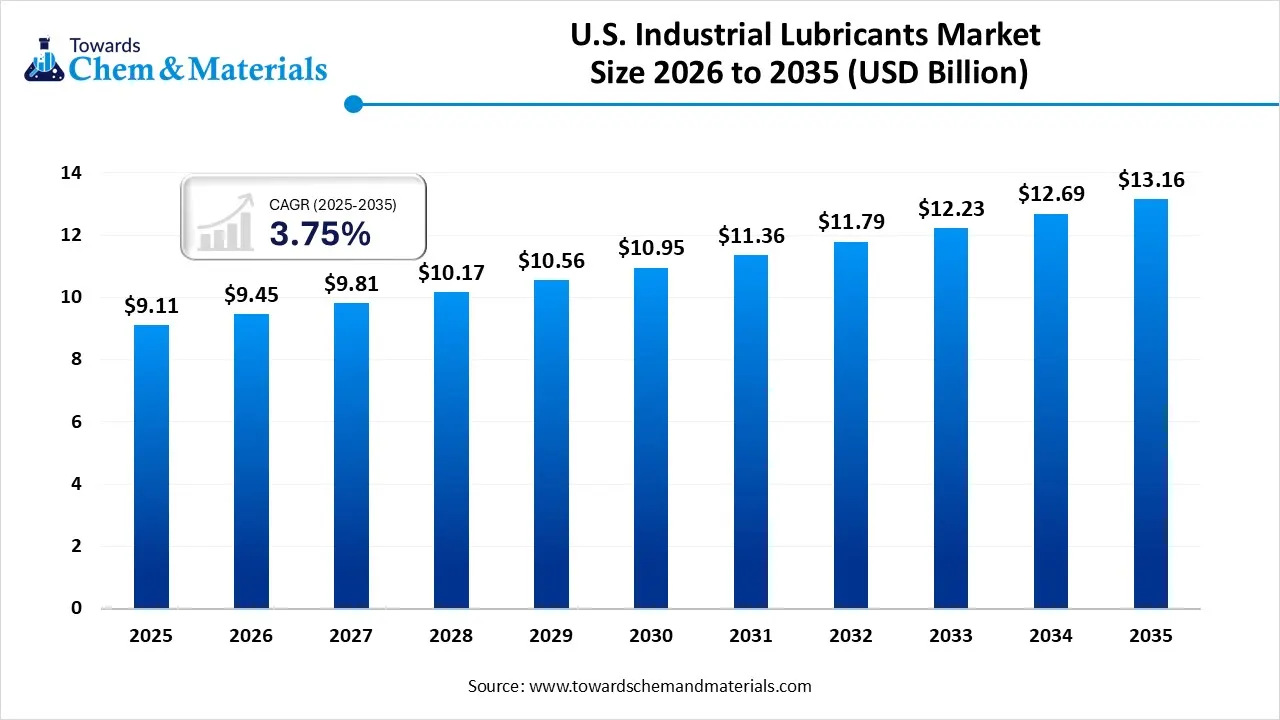
The u.s. industrial lubricants market size is expected to grow from USD 9.45 billion in 2026 to USD 13.16 billion in 2035, growing at a CAGR of 3.75% from 2026 to 2035. The top key players in the market are ExxonMobil Corporation, Chevron Corporation, BP p.l.c. (Castrol), Shell plc, TotalEnergies SE, Fuchs SE, Phillips 66, Valvoline Global Operations, Quaker Houghton (Quaker Chemical), The Lubrizol Corporation, AMSOIL INC., Kluber Lubrication (Freudenberg Group), BASF SE, Idemitsu Kosan Co., Ltd., CITGO Petroleum Corporation-Global Forecast 2026 To 2035
Content
What is the Current U.S. Industrial Lubricants Market Size and Share?
The U.S. industrial lubricants market size was estimated at USD 9.11 billion in 2025 and is expected to increase from USD 9.45 billion in 2026 to USD 13.16 billion by 2035, growing at a CAGR of 3.75% from 2026 to 2035. The market is driven by rising domestic demand in energy and industrial infrastructure, technological innovation, and stringent environmental regulations. The U.S. industrial lubricants market is shifting from high-volume commodities to high-scale and technology-based specialty fluids, driven by rising domestic manufacturing and autonomous systems requiring robust lubricants. The market is moving toward synthetic and bio- based formulation aligned with decarbonization and environmental mandates that boosting the innovation in the market. The integration of smart lubricant for monitoring and predictive analytics allows operators to extend lubricant life through precise, condition- based maintenance. Overall, the rising focus on operational efficiency, infrastructure growth, and advanced thermal management fluids is driving the expansion.
Market Highlights
- By product type, the process oils segment held the largest, approximately 35% share in the market in 2025 due to its massive manufacturing use in tires and rubber.
- By base oil, the mineral oil segment dominated with approximately 60% share in the market, driven by its cost-effectiveness and compatibility.
- By end-use, the manufacturing segment dominated with a held approximately 38% share in the market due to its diversified industrial and manufacturing infrastructure.
- By end-use, the energy & power segment is anticipated to grow at the fastest CAGR 3.19% in the market during the forecast period due to demand for renewable energy and wind turbines.
Key Technological Shifts and AI in the U.S. Industrial Lubricants Market
The U.S. industrial lubricants market is transforming into a digital solution. The integration of AI and IoT is turning lubricants into liquid sensors, providing real-time diagnostics. Embedded sensors track molecular integrity and contamination, providing real-time data for predictive maintenance systems. The implementation of machine learning for precise and quality-driven lubrication boosts growth. AI- driven chemistry accelerates innovation by simulating additive combinations, producing specially tailored synthetic molecules for autonomous plants where high-heat environments are required. This shift from reactive to proactive maintenance enhances infrastructure lifespan and reduces environmental waste, driving the market towards technological circularity.
Trade Analysis of the U.S. Industrial Lubricants Market: Import and Export Statistics
- The United States exported 1,221 shipments of U.S. industrial lubricants.
- Mexico exported 43 shipments of U.S. industrial lubricants.
- Germany exported 14 shipments of U.S. industrial lubricants.
- From May 2024 to April 2025, the world exported 920 shipments of U.S. industrial lubricants.
Market Trends
- Stringent Environmental Regulation: The U.S. Environmental Protection Agency and Corporate standards are increasing focus on decarbonization and the circular economy that reinforcing the demand for re-refined base oil and biodegradable lubricants.
- Regional and Industrial Expansion: The trend is driven by the U.S. surge towards electrification and energy sector expansion promoted by renewable projects and domestic government mandates to strengthen its global leadership.
- Transition Towards Bio-Based Lubricants: The market players are reshaping the innovation by adopting synthetic lubricants with improved thermal stability to optimize equipment performance and lower downtime.
Report Scope
| Report Attribute | Details |
| Market Size in 2026 | USD 9.45 Billion |
| Revenue Forecast in 2035 | USD 13.16 Billion |
| Growth Rate | CAGR 3.75% |
| Forecast Period | 2026 - 2035 |
| Base Year | 2025 |
| Segment Covered | By Product Type, By Base Oil, By End-Use |
| Key companies profiled | ExxonMobil Corporation, Chevron Corporation, BP p.l.c. (Castrol), Shell plc, TotalEnergies SE, Fuchs SE, Phillips 66, Valvoline Global Operations, Quaker Houghton (Quaker Chemical), The Lubrizol Corporation, AMSOIL INC., Kluber Lubrication (Freudenberg Group), BASF SE, Idemitsu Kosan Co., Ltd., CITGO Petroleum Corporation |
Market: Value Chain Analysis
- Feedstock Procurement: The initial stage of extraction and sourcing of raw materials through the refining process to produce base oil and additives that are essential for final formulation.
- Key Players: U.S. refiners, Phillips, ExxonMobil, and Shell Plc.
- Formulation and Distribution: The stage of converting raw materials with additives into a final industrial lubricant by using a blending operation, while the final products are moved through logistics and online platforms like e-commerce for transparent distribution.
- Key Players: ExxonMobil, Fuchs, United Oil & Grease Co., Renewable Lubricants, Chevron
- End-Use and Maintenance Services: The key users include the manufacturing hub, construction and renewable energy sector, utilized product and are transitioning towards lubricants as smart maintenance services by adopting IoT-based oil monitoring and predictive maintenance
- Key Players: Baker Hughes, Idemitsu Kosan, Valvoline Instant Oil
Regulatory Framework: U.S. Industrial Lubricants Market
| U.S. Agency | Key Regulation | Regulatory focus |
| Environmental Protection Agency | Toxic Substances Control Act, Proposed 2026 MSGP | Regulations for industrial formulation and monitoring for PFAS compounds in stormwater discharges. |
| OSHA (Occupational Safety & Health Admin) | Hazard Communication Standard and Heat Illness Prevention Standard | Standards for manufacturers and importers with SDS requirements and a focus on worker safety in high-temperature industrial environments. |
| CalRecycle (California) | Oil Recycling Enhancement Act | The mandates for recycled content and collection programmes for used lubricating oil |
| OEHHA | Proposition 65 | Focus on warning labels on chemicals, especially products sold in California |
| USDA/EPA | BioPreferred Program | The mandates and tax credits for clean fuel for lubricants derived from North American bio-feedstock |
Segmental Insights
Product Type Insights
How did the Process Oils Segment hold the Largest Share in the U.S. Industrial Lubricants Market?
The process oils segment held the largest revenue share of approximately 35% in the market in 2025, serves as an interlink between refining and manufacturing, serving as a vital component in producing polymers, rubber, and adhesives. These highly refined fluids, crucial for plasticizers and extenders, influence the final material's qualities.The domestic market prioritises highly paraffinic and naphthenic oils with high purity, driven by safety standards and low-volatility needs. The regional manufacturers focus on colors stability, chemical inertness, and viscosity for uses from pharmaceutical sealants to tires. This segment is strengthened by automotive and consumer goods supply chains, growing with polymer advancements to meet modern safety and performance requirements.
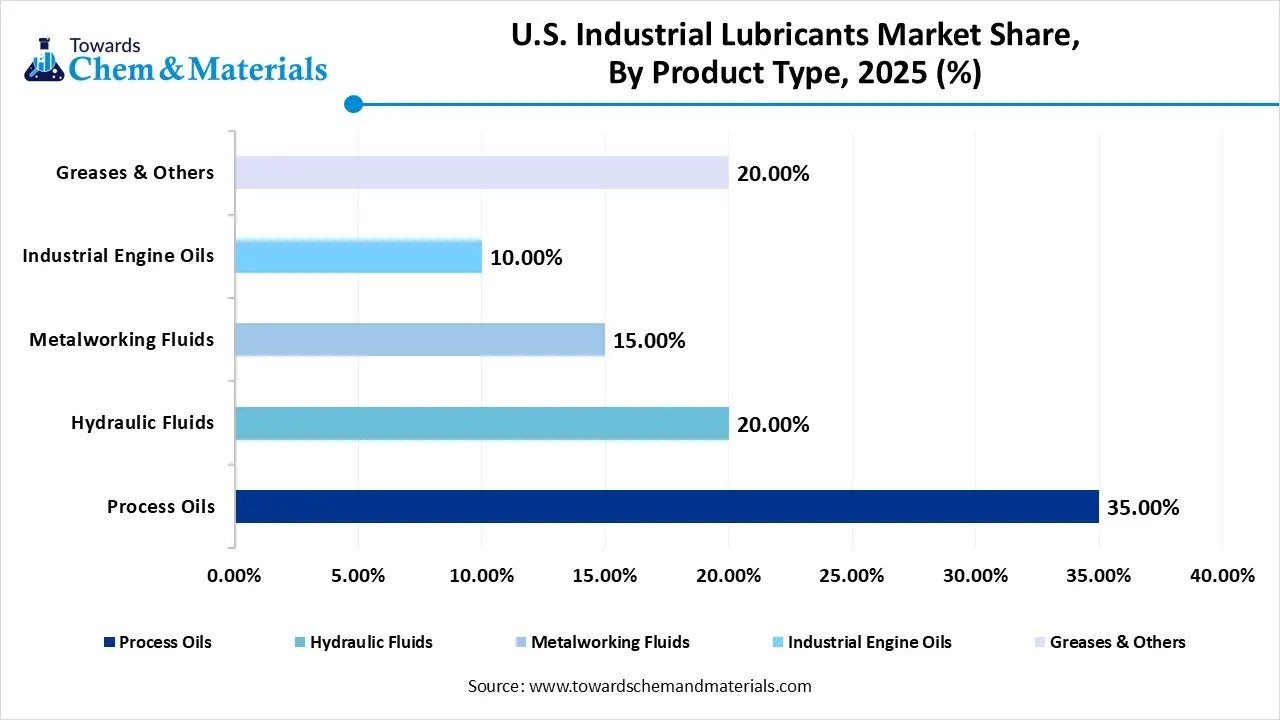
The metalworking fluids segment is experiencing the fastest growth in the market during the forecast period. The expansion is driven by its ability for high-precision manufacturing, enabling complex machining operations in the advanced aerospace, medical device and automotive sectors. The U.S. market is transitioning toward synthetic and semi-synthetic fluids, which enable microbial resistance, bio-stability and safety. The growth is driven by OSHA standards and sustainability efforts, that promoting the development of chlorine-free and biodegradable solutions. Additionally, these fluids are also integrated into digital systems for real-time concentration monitoring, optimizing efficiency in automated metal fabrication.
U.S. Industrial Lubricants Market Share, By Product Type, 2025 (%)
| By Product Type | Revenue Share, 2025 (%) |
| Process Oils | 35.00% |
| Hydraulic Fluids | 20.00% |
| Metalworking Fluids | 15.00% |
| Industrial Engine Oils | 10.00% |
| Greases & Others | 20.00% |
Base Oil Insights
Which Base Oil Dominated the U.S. Industrial Lubricants Market?
The mineral oil segment dominated the market with approximately 60% share in 2025. It serves as a cost-efficient base for heavy-duty applications. The industry is increasingly adopting specialty refined alternatives, and the mineral oils remain crucial among construction, mining, and energy sectors for their compatibility with additives and machinery. U.S. refiners are modernized to hydro-processed oils with higher purity and thermal stability, ensuring regulatory compliance with environmental standards for emissions. while supporting infrastructure needs. Overall, mineral oils act as a reliable, economically viable foundation of large-scale mechanical operations
The synthetic/bio-based segment is anticipated to grow fastest in the market during the forecast period. Driven by its sustainable application, especially where mineral oils' limits are reached. They are vital for high-precision and extreme-environment manufacturing, with synthetics like polyalphaolefins and esters offering thermal stability and durability. The domestic demand for Bio-lubricants is due to national mandates and sustainability goals that promoting the adoption biodegradable, renewable alternatives that offer better lower volatility and oxidative resistance for aerospace, energy, and marine sectors. This segment enhances operational efficiency and environmental compliance by lowering carbon footprint.
U.S. Industrial Lubricants Market Share, By Base Oil, 2025 (%)
| By Base Oil | Revenue Share, 2025 (%) |
| Mineral Oil | 60.00% |
| Synthetic Oil | 25.00% |
| Bio-Based Oil | 15.00% |
End-Use Insights
How did the Manufacturing (Chemical/General) Segment hold the Largest Share in the U.S. Industrial Lubricants Market?
The manufacturing(chemical/general) segment held the largest revenue share of approximately 38% in the market in 2025. The demand for nation technological and economic health. As the U.S. transformation in high-tech reshoring and Industry 4.0 has shifted lubricants from simple consumables to key system components. The rising focus on high-purity process oils and specialized lubricants for harsh environments by integrating with automation and industrial robotics, offering resistance to oxidation and heat, driving the growth. As manufacturers shift to proactive maintenance used real-time fluid diagnosis to reduce energy use and eliminate downtime, making manufacturing a growth catalyst that combines chemical innovation and operational efficiency.
The energy & power segment is experiencing the fastest growth in the market during the forecast period. Due to its expansion in renewable energy and traditional resource extraction. Its significance is driven by a shift to synthetic and biodegradable fluids designed for the stresses of wind turbines and offshore platforms. The technological shift makes the lubricants a key part of predictive maintenance with sensor data and AI tools to maximize uptime, especially in solar, wind, and offshore drilling. Additionally, the stringent environmental regulation and corporate initiatives for eco-toxicological safety, this segment is bridges sustainable resource use with operational reliability.
U.S. Industrial Lubricants Market Share, By End-Use, 2025 (%)
| By End-Use | Revenue Share, 2025 (%) |
| Manufacturing (Chemical/General) | 38.00% |
| Energy & Power Generation | 18.00% |
| Construction &Mining | 14.00% |
| Metal & Metallurgy | 12.00% |
| Others (Textiles, Food) | 18.00% |
State-Wise Insights
Texas Industrial Lubricants Market Trends
Texas plays a major role and dominates the market because of its significant influence in the heavy manufacturing, petrochemical oil and gas, and energy sectors. To preserve equipment efficiency and minimize downtime, large-scale drilling operations, refineries, and industrial plants need to continuously use high-performance lubricants. The demand for lubricants is further strengthened throughout the state by ongoing investments in industrial growth and energy infrastructure.
California Industrial Lubricants Market Trends
The California market shows significant growth, propelled by the manufacturing of electric vehicles, advanced manufacturing, aerospace, and renewable energy. The use of synthetic and environmentally friendly lubricants is encouraged by the state's stringent environmental regulations, which raises demand for premium and sustainable formulations. Growth in the precision and clean technology sectors keeps specialized lubricant use upbeat.
Mexico Industrial Lubricants Market Trends
Mexico's market is growing steadily because manufacturing activities are growing, especially in the automotive, metal processing, and industrial production sectors. Hydraulic fluids, gear oils, and metalworking lubricants are in greater demand because of growing foreign investments and nearshoring trends that are improving factory operations. Modernizing industries and enhancing trade with the United States are also fostering sustained market expansion.
Market Recent Developments
- In June 2025, UE Systems and Perma USA announced a partnership and introduced the UltraTrak VARIO, a lubrication technology equipped with ultrasonic sensors. Technology enables real-time monitoring, equipment reliability, and automated maintenance.(Source: www.uesystems.com)
- In April 2025, The Shell (through its subsidiary Pennzoil-Quaker State Company) and Blue Tide Environmental announced the completion of Blue Tide's world-scale used oil re-refining plant in Baytown. The acquisition focuses on the development and operation of the Baytown plant, supporting domestic supply and circular economy goals.(Source: www.fuelsandlubes.com)
- In October 2024, U.S. Lubricants and U.S. Venture Company announced the acquisition of Jones Oil Warehouse to expand their footprint in the Mid-Atlantic region. The acquisition focuses on delivering better service and distribution to clients with high-quality products.(Source: jobbersworld.com)
Key Market Players and Their Offerings
- ExxonMobil Corporation: The major player that offers high-performance synthetic gear oils and hydraulic fluids for heavy-duty applications.
- Chevron Corporation: The manufacturer of advanced hydraulic fluids, extreme-pressure gear lubricants and provider of industrial system cleaners.
- BP p.l.c. (Castrol): The major company that provides products contain specialized synthetic lubricants and greases that focus on high-precision manufacturing.
- Shell plc
- TotalEnergies SE
- Fuchs SE
- Phillips 66
- Valvoline Global Operations
- Quaker Houghton (Quaker Chemical)
- The Lubrizol Corporation
- AMSOIL INC.
- Kluber Lubrication (Freudenberg Group)
- BASF SE
- Idemitsu Kosan Co., Ltd.
- CITGO Petroleum Corporation
Segment Covered in the Report
By Product Type
- Process Oils
- Hydraulic Fluids
- Metalworking Fluids
- Industrial Engine Oils
- Greases & Others
By Base Oil
- Mineral Oil
- Synthetic Oil
- Bio-Based Oil
By End-Use
- Manufacturing (Chemical/General)
- Energy & Power Generation
- Construction &Mining
- Metal & Metallurgy
- Others (Textiles, Food)
FAQ's
Question 1 : What is the current size and forecast growth of the U.S. industrial lubricants market?
Answer : The U.S. industrial lubricants market was valued at USD 9.11 billion in 2025 and is projected to reach USD 13.16 billion by 2035, growing at a CAGR of 3.75% from 2026 to 2035.
Question 2 : What are the key factors driving growth in the U.S. industrial lubricants market?
Answer : Market growth is driven by expansion in manufacturing and energy infrastructure, adoption of synthetic and bio-based lubricants, technological innovations such as AI-enabled predictive maintenance, and stringent environmental regulations promoting sustainable formulations.
Question 3 : Which segments dominate the U.S. industrial lubricants market by product type, base oil, and end-use?
Answer : Process oils (35%), mineral oil base stocks (60%), and the manufacturing sector (38%) held the largest market shares in 2025 due to extensive industrial applications and cost-efficient lubricant formulations.
Question 4 : Who are the leading companies operating in the U.S. industrial lubricants market?
Answer : Major players include ExxonMobil Corporation, Chevron Corporation, BP p.l.c. (Castrol), Shell plc, TotalEnergies SE, Fuchs SE, Phillips 66, Valvoline Global Operations, Quaker Houghton, Lubrizol Corporation, AMSOIL, Kluber Lubrication, BASF SE, Idemitsu Kosan, and CITGO Petroleum Corporation.
Meet the Team

Saurabh Bidwai
Principal Consultant
Saurabh Bidwai, a B.Tech Chemical Engineering graduate with 4+ years of experience, specializes in specialty chemicals, commodity chemicals, and engineered materials, offering valuable insights into market trends and emerging opportunities.

Aditi Shivarkar
Reviewed By
Aditi Shivarkar, with 14+ years in Chemical and Materials market research, specializes in Chemical and Materials. She ensures accurate, actionable insights, driving Towards Chemicals And Materials Analytics and Consulting excellence in industry trends and sustainability.