
U.S. Metal Recycling Market Size, Share, Trends, Growth and Forecast 2026-2035
The US metal recycling market is expanding rapidly due to rising sustainability initiatives and industrial waste reduction policies. Valued at 90.76 billion dollars in 2025, the market is projected to grow to approximately 96.38 billion dollars in 2026 based on a steady compound annual growth rate of 6.85 percent, on its path toward 121.04 billion dollars by 2035. Ferrous metals dominate the market share at 72 percent, heavily supported by the automotive and construction sectors. Mechanical processing remains the leading recycling method, while specialized plants and e-waste recycling are identified as the fastest-growing segments for future high-value asset recovery.
Content
What is the Current U.S. Metal Recycling Market Size and Share?
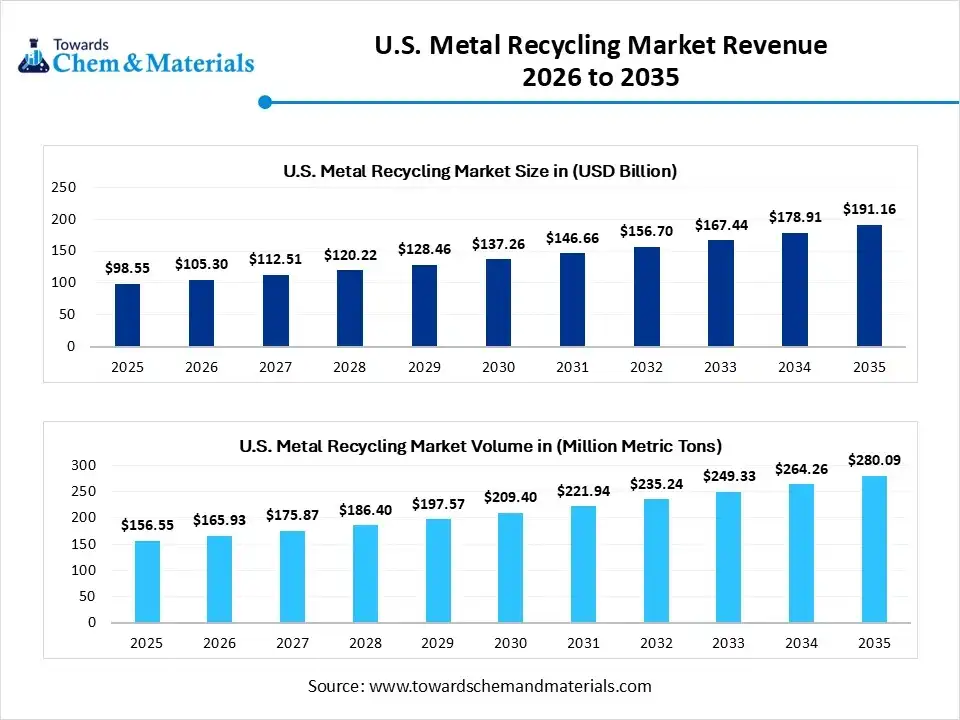
The U.S. metal recycling market size was valued at USD 98.55 billion in 2025, is estimated to reach USD 105.30 billion in 2026, and is projected to reach USD 191.16 billion by 2035, exhibiting a compound annual growth rate (CAGR) of 6.85% over the forecast period from 2026 to 2035. In terms of volume, the U.S. metal recycling market is projected to grow from 156.55 million metric tons in 2025 to 280.09 million metric tons by 2035. growing at a CAGR of 5.99% from 2026 to 2035.The trend towards sustainability has allowed stakeholders to capitalize on growth opportunities.
Key Takeaways
- By metal type, the ferrous metals segment led the U.S. metal recycling market with approximately 72% industry share in 2025, due to its widespread use in the major sectors like automotive, manufacturing, and construction.
- By metal type, the non-ferrous metals segment is expected to grow at the fastest rate in the market during the forecast period, owing to its lightweight application and increased demand in the renewable industry in the past few years.
- By recycling method, the mechanical process segment emerged as the top-performing segment in the market with approximately 52% industry share in 2025, as it is considered the cost-effective, scalable, and simple yet ideal option
- By recycling method, the hydrometallurgical segment is expected to lead the market in the coming years, as demand for recycling complex, high-value metals increases.
- By source, the post-industrial scrap segment led the market with approximately 47% share in 2025, because it provides cleaner, higher-quality materials directly from manufacturing waste.
- By source, the post-consumer segment is expected to capture the biggest portion of the market in the coming years, because it provides cleaner, higher-quality materials directly from manufacturing waste.
- By end user industry, the automotive segment led the market with approximately 47% industry share in 2025, because end-of-life vehicles are one of the largest sources of scrap metals in the U.S.
- By end user industry, the electronics segment is expected to capture the biggest portion of the market in the coming years, as the U.S. faces rising e-waste volumes from rapid tech consumption.
- By recycling facility type, the integrated mills segment led the U.S. metal recycling market with approximately 42% share in 2025, as the U.S. faces rising e-waste volumes from rapid tech consumption.
- By recycling facility type, the specialized plants segment is expected to capture the biggest portion of the market in the coming years, because of the need to handle complex waste streams like e-waste, EV batteries, and critical minerals.
Market Overview
What Are the Current Market Conditions for Scrap Metal in the United States?
The U.S. metal recycling market has experienced rapid growth in recent years. Also, the industries in the United States are prioritizing sustainability, where compliance and cost savings with stricter waste reduction policies have played a major role. As enlarged need for the recycled method from the major sectors like automotive, construction, and electronics is strengthening the foundation for future industry growth.
- In July 2025, the recent aluminum tariff schedule, which was released by President Donald Trump, is likely to fuel domestic metal recycling infrastructure growth in the United States in the coming years, as consumers are not ready to pay additional costs at this time.(Source: www.cnbc.com)
Energy Efficient Metal Production: A Win for Business and the Planet
The need for energy and cost-efficient metals has positively impacted the industry's scalability and revenue potential of the market in recent years. Several manufacturers in the United States have seen under the heavy production of metal from scrap, such to benefits like energy saving, while minimizing the cost of metal as compared to virgin metal production. Also, the trends towards sustainable manufacturing practices have driven investor confidence in the industry’s future.
- For Instance, a survey conducted by the American Iron and Steel Institute (AISI), a huge number of tons of steel scrap is recycled in the region of North America every year, which is approximately 80 to 60 million tons.(Source: www.steel.org)
Market Trends
- The sudden shift towards the electric arc furnaces has gained traction with investment firms in the United States in recent years, as these electric arc furnaces are increasingly seen as relying on recycled scrap material.
- The development of the digital platform for scrap trading is likely to contribute significantly to the growth of future industrial potential in the upcoming period.
Report Scope
| Report Attributes | Details |
| Market Size in 2025 | USD 105.30 Billion / 165.93 Million Metric Tons |
| Expected Size by 2035 | USD 121.04 Billion / 280.09 Million Metric Tons |
| Growth Rate from 2025 to 2035 | CAGR 6.85% |
| Base Year of Estimation | 2025 |
| Forecast Period | 2025 - 2035 |
| Segment Covered | By Metal Type, By Recycling Method, By Source, By End-User IndustryBy Recycling Facility Type |
| Key Companies Profiled | Schnitzer Steel Industries, Inc., Nucor Corporation, Commercial Metals Company, Alter Trading Corporation, Sims Metal Management, Radius Recycling, Metal Management Inc., OmniSource Corporation, Tube City IMS, Philip Metals Inc., Hugo Neu Corporation, Ferrous Processing & Trading Corporation, Sadoff Iron & Metal Company, Yaffe Companies, Inc., Louis Padnos Iron & Metal Company, Adams Steel, Inc., Pacific Coast Recycling, Inc., Azcon Corporation, Tennessee Valley Recycling, Ellis Metals, Inc. |
Market Opportunity
E-Waste Emerges as a High-Value Asset in Metal Recovery
The growth of initiatives like urban mining of e-waste is expected to strengthen the bottom line for production firms during the forecast period. Also, by containing high-value material rather than traditional scrap, the e-waste scrap may lead the robust growth across the sector in the upcoming years in the United States.
- In July 2025, the Techbros expanded their zero-cost e-waste recycling and IT asset disposition facilities in Arizona, United States.(Source: www.cbs42.com)
Market Challenge
Unstable Scrap Pricing Deters Budget-Conscious Businesses
The cost fluctuation between scrap metals might discourage funding and investments in the sector during the projected period. As the scrap material has been tied to global communities that control the industry environment. Furthermore, these price fluctuations are likely to restrict the entry of new market entrants who drive businesses with limited budgets.
Segmental Insights
Metal Type Insights
How did the Ferrous Metals Segment Dominate the U.S. Metal Recycling Market in 2025?
The ferrous metals segment held approximately 72% share of the market in 2025, due to its widespread use in the major sectors like automotive, manufacturing, and construction. Moreover, having advantages like easy collection and wide availability, ferrous scrap has gained immense industry attention in recent years.
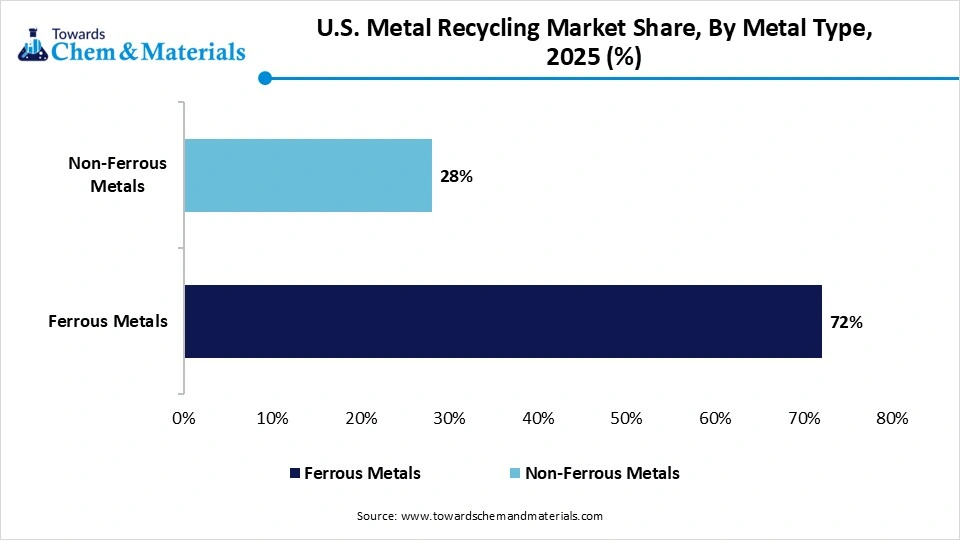
The non-ferrous metals segment is expected to grow at a notable rate during the predicted timeframe, owing to its lightweight application and increased demand in the renewable industry in the past few years. Furthermore, non-ferrous metals like copper, nickel, and aluminum have been seen under high demand from the EV battery and solar panel manufacturers in recent years.
U.S. Metal Recycling Market Share, By Metal Type, 2025 (%)
| By Metal Type | Revenue Share, 2025 (%) |
| Ferrous Metals | 72% |
| Non-Ferrous Metals | 28% |
Recycling Method Insights
Why Does The Mechanical Processing Segment Dominate The U.S. Metal Recycling Market By Recycling Method?
The mechanical processing segment held the approximately 52% share of the U.S. metal recycling market in 2025, as it is considered the cost-effective, scalable, and simple yet ideal option. Furthermore, the manufacturers are observed using techniques like magnetic separation, baling, and shredding for the massive ferrous scrap processing in the current period. Also, by requiring minimum investment, which is less than conventional thermal and chemical recycling, mechanical processing has gained major industry attention in the current period.
The hydrometallurgical segment is expected to grow at a notable rate during the predicted timeframe, as demand for recycling complex, high-value metals increases. Unlike mechanical processing, hydrometallurgy uses chemical solutions to extract metals with high purity, making it ideal for non-ferrous and rare metals.
U.S. Metal Recycling Market Share, By Recycling Methods, 2025 (%)
| By Recycling Method | Revenue Share, 2025 (%) |
| Mechanical Processing | 52% |
| Pyrometallurgical Processing | 27% |
| Hydrometallurgical Processing | 15% |
| Biotechnological Processing | 6% |
Source Insights
How Postindustrial Scrap Segment Dominate The U.S. Metal Recycling Market In 2025?
The post-industrial scrap xpected to grow at a significant rate during the forecast period because it provides cleaner, higher-quality materials directly from manufacturing waste. Industries like automotive and construction generate consistent scrap streams, such as steel trimmings and aluminum cuttings, which are easier to recycle without contamination.
Post-consumer scrap segment is dominated the market with approximately 47% industry share in 2025, because it provides cleaner, higher-quality materials directly from manufacturing waste. Industries like automotive and construction generate consistent scrap streams, such as steel trimmings and aluminum cuttings, which are easier to recycle without contamination.
U.S. Metal Recycling Market Share, By Source, 2025 (%)
| By Source | Revenue Share, 2025 (%) |
| Post-Consumer Scrap | 47% |
| Post-Industrial Scrap | 39% |
| Obsolete Scrap | 14% |
End User Industry Insights
How did the Automotive Segment Dominate the U.S. Metal Recycling Market in 2024?
The automotive segment dominated the market with approximately 47% market share in 2024 because end-of-life vehicles are one of the largest sources of scrap metals in the U.S. Steel, aluminum, and copper from old cars provide consistent recycling streams, supported by well-established dismantling and shredding infrastructure. Automotive recycling also recovers catalytic converters, which contain valuable metals like platinum and palladium.
Electronics segment is expected to grow at a significant rate during the forecast period, as the U.S. faces rising e-waste volumes from rapid tech consumption. Devices like smartphones, laptops, and EV batteries contain valuable non-ferrous and rare metals such as cobalt, lithium, and gold. Unlike traditional scrap, electronic waste offers a higher profit per ton if recycled efficiently.
U.S. Metal Recycling Market Share, By End-User Industry, 2025 (%)
| By End-User Industry | Revenue Share, 2025 (%) |
| Post-Consumer Scrap | 47% |
| Post-Industrial Scrap | 39% |
| Obsolete Scrap | 14% |
Recycling Facility Type Insights
Why Does The Integrated Millis Segment Dominate The U.S. Metal Recycling Market By Recycling Facility Type?
The integrated mills segment dominated the market with a 45% market share in 2024 as the U.S. faces rising e-waste volumes from rapid tech consumption. Devices like smartphones, laptops, and EV batteries contain valuable non-ferrous and rare metals such as cobalt, lithium, and gold. Unlike traditional scrap, electronic waste offers a higher profit per ton if recycled efficiently.
The specialized plants segment is expected to grow at a significant rate during the forecast period, because of the need to handle complex waste streams like e-waste, EV batteries, and critical minerals. Unlike integrated mills, these facilities focus on precision recovery of high-value metals using hydrometallurgy, bioleaching, or advanced sorting. As U.S. industries demand cleaner, high-purity recycled inputs for electronics and energy applications, specialized plants will take the lead.
U.S. Metal Recycling Market Share, By Recycling Facility Type, 2025 (%)
| By Recycling Facility Type | Revenue Share, 2025 (%) |
| Integrated Mills | 42% |
| Recycling Centers | 38% |
| Specialized Processing Plants | 21% |
U.S. Metal Recycling Market Value Chain Analysis
- Distribution to Industrial Users: The metal recycling distribution is primarily linked with the major sectors of the United States, such as renewable energy, construction, and automotive.
- Key players: Nucor, OmniSource, and Schnitzer Steel Industries
- Chemical Synthesis and Processing: Chemical synthesis and processing of metal recycling involve two major processes, such as purification and metal.
- Regulatory Compliance and Safety Monitoring: The metal recycling done in the United States is under the federal laws, such as OSHA and RCRA.
Recent Developments
- In February 2025, the Phinix is ready to launch its new project worth $1.8 million. The company is going to invest in aluminum recycling in the United States, where the quality and sustainability of recycled aluminum have been the key focus area, as per the company's claim.(Source : www.chemanalyst.com)
U.S. Metal Recycling Market Top Companies

- Schnitzer Steel Industries, Inc.
- Nucor Corporation
- Commercial Metals Company
- Alter Trading Corporation
- Sims Metal Management
- Radius Recycling
- Metal Management Inc.
- OmniSource Corporation
- Tube City IMS
- Philip Metals Inc.
- Hugo Neu Corporation
- Ferrous Processing & Trading Corporation
- Sadoff Iron & Metal Company
- Yaffe Companies, Inc.
- Louis Padnos Iron & Metal Company
- Adams Steel, Inc.
- Pacific Coast Recycling, Inc.
- Azcon Corporation
- Tennessee Valley Recycling
- Ellis Metals, Inc.
Segment Covered
By Metal Type
- Ferrous Metals
- Steel
- Carbon Steel
- Stainless Steel
- Alloy Steel
- Iron
- Cast Iron
- Wrought Iron
- Steel
- Non-Ferrous Metals
- Aluminum
- Copper
- Lead
- Zinc
- Nickel
- Precious Metals
- Gold
- Silver
- Platinum Group Metals
By Recycling Method
- Mechanical Processing
- Shredding
- Shearing
- Baling
- Granulation
- Pyrometallurgical Processing
- Smelting
- Refining
- Hydrometallurgical Processing
- Leaching
- Electrowinning
- Biotechnological Processing
- Bioleaching
- Bioremediation
By Source
- Post-Consumer Scrap
- End-of-Life Vehicles
- Household Appliances
- Electronics
- Post-Industrial Scrap
- Manufacturing Waste
- Construction & Demolition Debris
- Obsolete Scrap
- Discarded Industrial Equipment
- Retired Infrastructure Materials
By End-User Industry
- Automotive
- Construction
- Electronics
- Aerospace
- Packaging
- Energy
- Consumer Goods
By Recycling Facility Type
- Integrated Mills
- Mini Mills
- Electric Arc Furnace Mills
- Recycling Centers
- Material Recovery Facilities
- Scrap Yards
- Specialized Processing Plants
- Aluminum Refineries
- Copper Smelters
List of Figures
- U.S. Metal Recycling Market Size and Growth (2024-2034) – 87.91 billion in 2024 (USD), 90.76 billion in 2025, 121.04 billion by 2034, CAGR 3.25%
- Market Share by Metal Type (2024) – Ferrous Metals: 60%, Non-Ferrous Metals: 40%
- Market Share by Recycling Method (2024) – Mechanical Processing: 50%, Hydrometallurgical Processing: 30%, Pyrometallurgical Processing: 15%, Biotechnological Processing: 5%
- Market Share by Source (2024) – Post-Industrial Scrap: 40%, Post-Consumer Scrap: 35%, Obsolete Scrap: 25%
- Market Share by End-User Industry (2024) – Automotive: 30%, Construction: 25%, Electronics: 20%, Aerospace: 5%, Packaging: 5%, Energy: 10%, Consumer Goods: 5%
- Market Share by Recycling Facility Type (2024) – Integrated Mills: 45%, Recycling Centers: 30%, Specialized Processing Plants: 25%
- Projected Growth of Non-Ferrous Metals Segment (2025-2034) – 4.2% CAGR
- Projected Growth of Hydrometallurgical Recycling Method (2025-2034) – 5% CAGR
- Market Distribution by End-User Industry: Forecast by 2034 – Automotive: 35%, Electronics: 25%, Construction: 20%, Other Industries: 20%
- Recycling Facility Type Breakdown by 2034 – Specialized Processing Plants: 40%, Integrated Mills: 35%, Recycling Centers: 25%
List of Tables
- U.S. Metal Recycling Market Size and Growth Forecast (2025-2034) – 90.76 billion in 2025, 121.04 billion by 2034, CAGR 3.25%
- Market Share by Metal Type (2024) – Ferrous Metals: 60%, Non-Ferrous Metals: 40%
- Market Share by Recycling Method (2024) – Mechanical Processing: 50%, Hydrometallurgical Processing: 30%, Pyrometallurgical Processing: 15%, Biotechnological Processing: 5%
- Market Share by Source (2024) – Post-Industrial Scrap: 40%, Post-Consumer Scrap: 35%, Obsolete Scrap: 25%
- Market Share by End-User Industry (2024) – Automotive: 30%, Construction: 25%, Electronics: 20%, Aerospace: 5%, Packaging: 5%, Energy: 10%, Consumer Goods: 5%
- Market Share by Recycling Facility Type (2024) – Integrated Mills: 45%, Recycling Centers: 30%, Specialized Processing Plants: 25%
- Projected Growth of Non-Ferrous Metals Segment (2025-2034) – 4.2% CAGR
- Projected Growth of Hydrometallurgical Recycling Method (2025-2034) – 5% CAGR
- End-User Industry Distribution (2025-2034) – Automotive: 35%, Electronics: 25%, Construction: 20%, Other Industries: 20%
- Recycling Facility Type Forecast by 2034 – Specialized Processing Plants: 40%, Integrated Mills: 35%, Recycling Centers: 25%
FAQ's
Meet the Team

Saurabh Bidwai
Principal Consultant
Saurabh Bidwai, a B.Tech Chemical Engineering graduate with 4+ years of experience, specializes in specialty chemicals, commodity chemicals, and engineered materials, offering valuable insights into market trends and emerging opportunities.

Aditi Shivarkar
Reviewed By
Aditi Shivarkar, with 14+ years in Chemical and Materials market research, specializes in Chemical and Materials. She ensures accurate, actionable insights, driving Towards Chemicals And Materials Analytics and Consulting excellence in industry trends and sustainability.