
U.S Natural Gas Storage Market Size, Share, Growth, Report 2026 to 2035
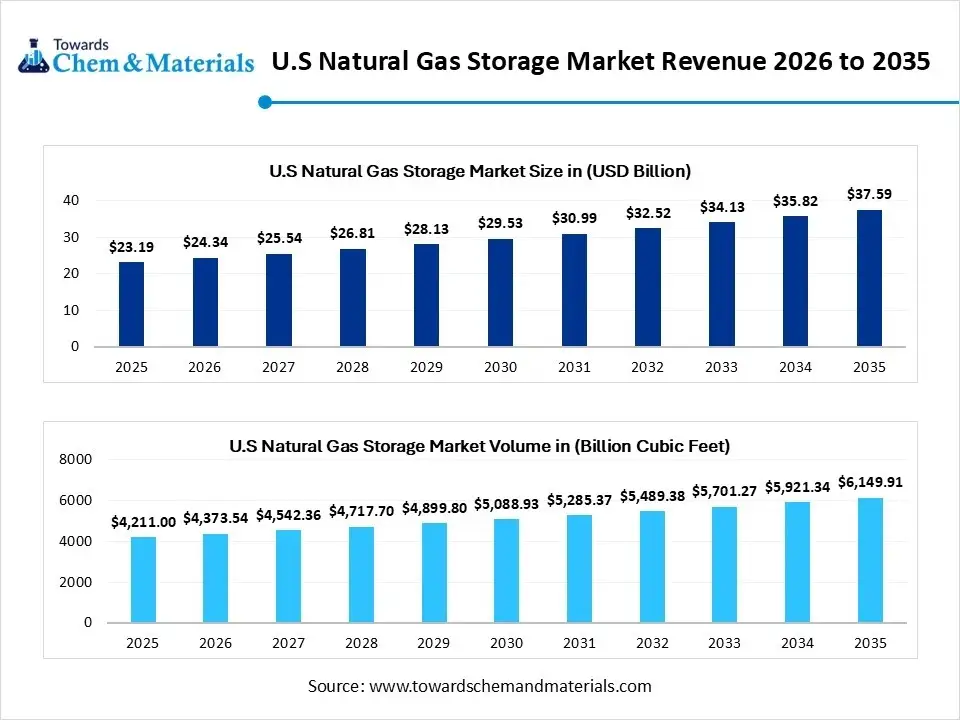
The U.S natural gas storage market size is expected to grow from USD 24.34 billion in 2026 to USD 37.59 billion in 2035, growing at a CAGR of 4.95% from 2026 to 2035. The top key players in the market are Williams Companies, Inc., Enbridge Inc., Kinder Morgan, Inc., Dominion Energy, Inc., Atmos Energy Corporation, ONEOK, Inc., Boardwalk Pipeline Partners, LP, Crestwood Equity Partners LP, DTE Energy Company and National Fuel Gas Company
Content
What is the Current Size & Volume of the U.S Natural Gas Storage Market and Its Projected Growth?
The U.S natural gas storage market size was estimated at USD 23.19 billion in 2025 and is expected to increase from USD 24.34 billion in 2026 to USD 37.59 billion by 2035, growing at a CAGR of 4.95% from 2026 to 2035. In terms of volume, the market is projected to grow from 4,211.00 billion cubic feet in 2025 to 6,149.91 billion cubic feet by 2035. growing at a CAGR of 3.86% from 2026 to 2035. The market is driven by methane emission surveillance, technological innovation and emphasis on operational resilience for storage.
Market Highlights
- By storage type, the underground storage segment held the largest 88% share in the market in 2025 due to ensuring large-scale seasonal supply integrity.
- By storage type, the above ground storage segment held the second largest share of 12% in 2025 and is expected to grow at the fastest growing in the market during the forecast period due to rapid deployment and expanding LNG resilience.
- By ownership type, the interstate storage segment held the largest 55% share in the market in 2025 due to its ability to enable cross-state gas transmission reliability.
- By ownership type, the intrastate storage segment held the second largest share of 30% in 2025 and is expected to grow at the fastest growing in the market during the forecast period due to rising demand that supports the domestic supply chain.
- By application, the power generation segment dominated the market with a 40% share in 2025, driven by its increasing gas-fired power capacity and electrical infrastructure.
- By application, the industrial segment held the second largest share of 25% in 2025 and is expected to grow at the fastest growing in the market during the forecast period due to its ability to maintain continuous manufacturing operations.
- By gas type, the dry gas segment dominated with a held 70% share in the market in 2025 due to its direct consumption and power utility.
- By gas type, the wet gas segment held the second largest share of 30% in 2025 and is anticipated to grow at the fastest CAGR in the market during the forecast period due to demand for safety and rising NGL extraction.
- By function, the base load storage segment dominated with a held 60% share in the market in 2025 because it ensures continuous long-term supply reliability.
- By function, the peak shaving storage segment held the second largest share of 40% in 2025 and is anticipated to grow at the fastest CAGR in the market during the forecast period due to its short-term demand spike efficiency.
Market Size and Volume Forecast
- Market Size (2025): USD 23.19 Billion | CAGR (2025–2035): 4.95%
- Market Projected Size (2035): USD 37.59 Billion
- Market Volume (2025): 4,211 Billion Cubic Feet (BCF) | Volume CAGR (2025–2035): 3.86%
- Market Projected Volume (2035): 6,149.91 Billion Cubic Feet (BCF)
- Market Pricing (2025):
- Average Manufacturing Price: USD 1,170/Metric Ton
- Average Selling Price: USD 1,480/Metric Ton
- Pricing CAGR (2025–2035): 4.85%
Market Overview
The U.S. natural gas storage market is a key part of the midstream infrastructure, acting as a massive underground energy battery that balances supply and demand using depleted reservoirs, salt caverns, and aquifers to meet upstream and downstream infrastructure. The U.S. creates a system that is essential for energy security, providing flexibility to reduce price volatility during extreme meteorological conditions and a baseload fuel supply, consistent power for electricity generation.
The market is a rapid-cycle asset for multiple injections and withdrawals, supporting renewable energy and the LNG export value chain. Additionally, the storage infrastructure increasingly uses AI data centres and has adopted digital twin modeling and advanced leak detection, satellite and drone surveillance, to ensure environmental compliance for sustainability.
Recent Market Trends
- Strategic Investments in Storage Infrastructure: The trend of large midstream players acquiring specialised storage operators with significant investment to produce wellhead-to-water integrated systems from production basins to end-users.
- Integration with LNG Export Waves: The revolutionary liquefaction trains come online, with storage facilities in the U.S. as surge tanks to absorb excess supply to provide regional export demand and avoid delays.
- The Stringent Regulatory Agenda: The low-carbon fuel standards and blending hydrogen mandate into existing natural gas storage reserves are pushing manufacturers towards the adoption of underground infrastructure, aligning with the transition to a hydrogen economy.
Report Scope
| Report Attribute | Details |
| Market Size in 2026 | USD 24.34 Billion / 4,373.54 Billion Cubic Feet |
| Revenue Forecast in 2035 | USD 37.59 Billion / 6,149.91 Billion Cubic Feet |
| Growth Rate | CAGR 4.95% |
| Forecast Period | 2026 - 2035 |
| Base Year | 2025 |
| Segment Covered | By Storage Type, By Ownership Type, By Application, By Gas Type, By Function |
| Key companies profiled | Williams Companies, Inc., Enbridge Inc., Kinder Morgan, Inc., Dominion Energy, Inc., Atmos Energy Corporation, ONEOK, Inc., Boardwalk Pipeline Partners, LP, Crestwood Equity Partners LP, DTE Energy Company and National Fuel Gas Company |
Key Technological Shifts and AI in the U.S. Natural Gas Storage Market
The United States is transforming from seasonal inventory to a digitally integrated energy ecosystem that involves real-time reservoir management with digital twin technology for advanced reservoirs, enhancing capacity and safety.
The rising stringent environmental regulations are driving the adoption of a multi-tiered methane monitoring system that uses sensors, satellite imaging, and drones for real-time emissions detection. The U.S. industry also services variable-speed natural gas compression and automated controls to maintain operational flexibility, balancing renewable loads and baseload power needs.
The recent innovations include subsurface hydrogen blending. Additionally, for the storage of natural gas, the region uses computational fluid dynamics to assess infrastructure compatibility, supported by AI analytics that optimize storage operations, making the storage network a resilient, intelligent energy catalyst for the global logistics supply chain.
U.S. Natural Gas Storage Market: Supply Chain Analysis
- Production and Supply: The stage of recovery of natural gas from underground and above ground reservoirs. The manufacturer's focus on maintaining a steady flow, which is then collected and treated before entering the storage network.
- Key Players: EQT Corporation, Antero Resources, Chesapeake Energy and Coterra Energy
- Transportation and Storage: In this stage, natural gas is processed and transported from high-pressure pipelines to underground facilities, such as depleted oil/gas reservoirs, salt caverns and aquifers. This stage manages the volatility in seasonal demand and supply.
- Key Players: Kinder Morgan, Enbridge, The Williams Companies, Energy Transfer and TC Energy
- Distribution and End-Use: The final stage, where gas is removed from storage and distributed to end-users. With the help of local utilities, serving homes, power plants, and liquefaction terminals for global export.
- Key Players: The Sempra Infrastructure, Southern Company, Cheniere Energy and Duke Energy
Regulatory Framework: U.S. Natural Gas Storage Market
| U.S.-based Region | Key Regulation | Regulatory Focus |
| Federal | FERC, Natural Gas Act, PHMSA, CFR, EPA and Clean Air Act | Focus on fairness and structural integrity, methane emissions for storage capacity and the U.S. to prevent leaks. |
| State level | State Utility Commissions, State-specific administrative codes and utility laws | Oversight for intrastate storage prices and safety of non-interstate field balancing local reliability in winter reserves. |
| Western (California) | CPUC and DOGGR(CalGEM) | Highly restrict the expansion of traditional storage and strict environmental rules that push operators towards renewable storage and enhanced safety technologies. |
| Midwest/East | Regional Transmission Organisation, State PUCs, State Implementation Plans for EPA compliance | Focus on consumer protection and seasonal reliability for preventing local gas shortage and price volatility. |
| Gulf Coast | State Underground Injection Control permits, Texas Railroad Commission, and Louisiana DNR | Specialized permitting for high-pressure salt caverns that focus on export readiness required for LNG terminals |
Segmental Insights
Storage Type Insights
The Underground Storage Segment Dominated The U.S. Natural Gas Storage Market With 88% Market Share In 2025.
Underground storage segment dominated the U.S. natural gas storage market with 88% share in 2025, driven by high-pressure subsurface energy batteries that support the midstream value chain. The segment used depleted oil and gas reservoirs and aquifers to ensure operational reliance. The segment is shifting towards technological advancement, where digital twin and real-time monitoring maintain well-being integrity. The segment is a key asset for global LPG export and a sustainable energy grid through advanced methane surveillance.
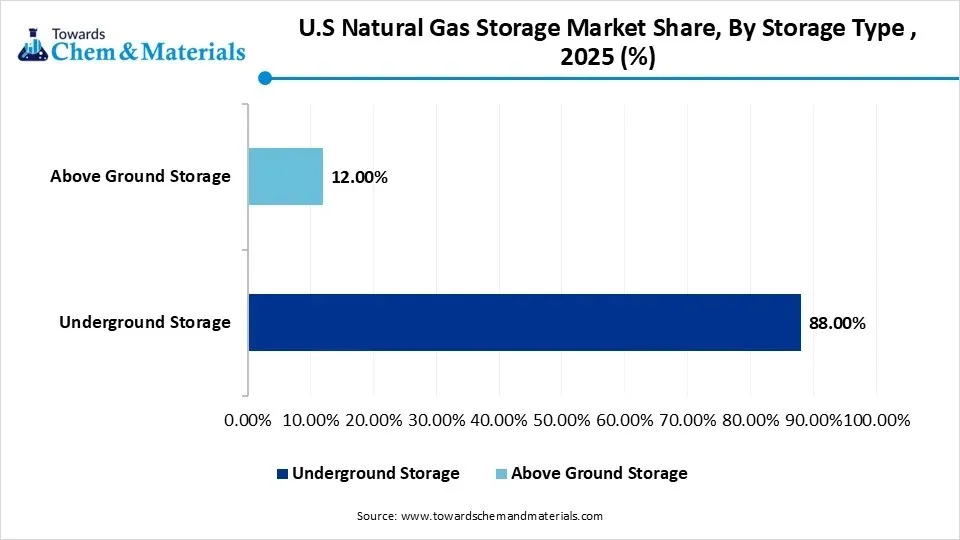
Above ground storage segment held the second largest share of 12% in 2025. It acts as a high-precision cryogenic buffer that uses LNG peak-having tanks and double containment vessels for immediate injectability. The segment offers instantaneous operational reliability and domestic energy supply during high downstream demand. The above ground storage represents integrated surge tanks that balance energy security for geopolitical and industrial hubs using automated regasification and advanced thermal technologies.
U.S Natural Gas Storage Market Share, By Storage Type , 2025 (%)
| By Storage Type | Revenue Share, 2025 (%) |
| Underground Storage | 88.00% |
| Above Ground Storage | 12.00% |
- In 2025, underground storage will dominate the U.S. natural gas storage market, accounting for 88.00% of the revenue share. It is favored for its large capacity, security, and ability to store gas for long periods, providing a reliable supply during peak demand.
- Above ground storage is expected to contribute 12.00% to the market share in 2025. This type of storage offers quicker access and flexibility for short-term needs, making it suitable for emergency situations and rapid response requirements.
Ownership Type Insights
Interstate Storage Segment Dominated The U.S. Natural Gas Storage Market With 55% Share In 2025
Interstate storage segment dominated the U.S. natural gas storage market with 55% share in 2025, driven by the federally regulated framework. The segment acts as a high-capacity subsurface energy integrated with the transmission grid. The stringent governmental regulation authorized by FERC for non-discriminatory access for operators for energy securing fueling the growth. The domestic shippers and distributors align with interstate storage stabilize power generation across state lines.
Intrastate storage segment held the second largest share of 30% in 2025. It represents a state-driven pillar derived from facilities that operate entirely within single state boundaries under state utility commissions promoted by domestic distribution companies and intrastate pipeline operators. The segment is act as a downstream infrastructure bridge that balances city-gate demand and maintains local price volatility aligned with the cost-of-service rate network to meet strict wellbore and emission compliance.
Independent storage operators segment held the third largest share of 15% in 2025, serving as specialized third-party storage services by offering operational flexibility for rapid-cycle injection and removals for trades and power generators to withstand price volatility. The rising midstream infrastructure segment delivers energy reliability and grid resilience that positions it as a market-driven merchant engine.
U.S Natural Gas Storage Market Share, By Ownership Type, 2025 (%)
| By Ownership Type | Revenue Share, 2025 (%) |
| Interstate Storage | 55.00% |
| Intrastate Storage | 30.00% |
| Independent Storage Operators | 15.00% |
- The U.S. Liquefied Natural Gas market in 2025 is expected to be dominated by long-term contracts, making up 55.00% of the revenue share. These contracts provide stability and predictability for both producers and buyers, ensuring consistent supply over extended periods.
- The spot market will contribute 25.00% to the total market share in 2025. It offers flexibility to buyers and sellers, enabling transactions at prevailing market prices for shorter durations.
- Short-term contracts are projected to account for 20.00% of the market share in 2025. This segment caters to those looking for more flexible terms, typically with a duration ranging from one to five years.
Application Insights
Power Generation Segment Dominated The U.S. Natural Gas Storage Market With 40% Share In 2025
Power generation segment dominated the U.S. natural gas storage market with 40% share in 2025, serving as grid-reliability solution for the nation's electrical infrastructure. The segment connects renewable energy and baseload power as a storage tool for operational reliability. Power generation prefers high-deliverability salt caverns for rapid-cycle injection by providing a stable fuel supply. Additionally, the rising utilization of natural gas enables AI-driven data center in power generation, boosting the market expansion.
Industrial segment held the second largest share of 25% in 2025 due to rising focus on operational efficiency in petrochemicals, steel and fertilizer manufacturing in the U.S. The industrial players are adopting storage infrastructure to bypass price volatility and maintain a stable feedstock value chain. The industry demands integrated surge tanks that fuel on-site cogeneration plants' expansion by maintaining regulatory compliance.
Residential segment held the third largest share of 20% in 2025. The growth is driven by seasonal demand and heating reliability shield for households. The segment utilized aquifers and depleted reservoirs to manage climatic conditions and transparency. The residential storage is regulated by local distribution companies that focus on a resilient utility supply chain using advanced demand forecasting and methane emission standards regarding human health.
Commercial segment held the fourth largest share of 15% in 2025, serving as a reliability catalyst for small-to-midscale networks, including hospitals, educational organizations, and retail facilities. The U.S. focuses on a steady supply of gas, where commercial storage acts as a shield from price volatility during weather-driven demand events. The local players in the commercial sector prioritised long-term cost stability and a reliable utility value chain that drives continuous growth.
U.S Natural Gas Storage Market Share, By Application, 2025 (%)
| By Application | Revenue Share, 2025 (%) |
| Residential | 20.00% |
| Commercial | 15.00% |
| Industrial | 25.00% |
| Power Generation | 40.00% |
- The power generation sector will lead the U.S. natural gas storage market, holding 40.00% of the revenue share.
- This sector is expected to continue its dominance due to high demand for energy generation.
- The industrial sector is projected to contribute 25.00% to the market share in 2025. Industrial facilities, particularly those relying on high energy consumption, are key drivers for this segment.
- Residential applications will make up 20.00% of the total market share in 2025. This growth is attributed to the increasing reliance on natural gas for heating and cooking purposes.
- The commercial sector will account for 15.00% of the market share in 2025. Commercial establishments, including offices and retail spaces, continue to use natural gas for various energy needs.
Gas Type Insights
Dry Gas Segment Dominated The U.S. Natural Gas Storage Market With 70% Share In 2025
Dry gas segment dominated the U.S. natural gas storage market with 70% share in 2025. The segment serves as a nation's pipeline-quality methane, where dry gas is preprocessed to remove liquid hydrocarbons and impurities. The segment is crucial for residential heating and industrial baseload as a strategic shock absorber that moderates price volatility and maintains nations' energy security. Additionally, the dry gas is integrating with technological advancement to optimized working gas capacity for the global LNG export value chain.
Wet gas segment held the second largest share of 30% in 2025 because it is a high-value feedstock for methane-containing natural gas liquids. The segment required specialized high-pressure storage infrastructure to maintain precision in various thermodynamic environments to prevent liquid dropout. The wet gas storage balances volatile petrochemical feedstock demand and enables supply flexibility for chemical manufacturing, integrated with advanced monitoring to optimize fractionation schedule.
U.S Natural Gas Storage Market Share, By Gas Type, 2025 (%)
| By Gas Type | Revenue Share, 2025 (%) |
| Dry Gas | 70.00% |
| Wet Gas | 30.00% |
- In 2025, dry gas will dominate the U.S. natural gas storage market, accounting for 70.00% of the revenue share. This segment is expected to maintain strong growth due to its widespread use in various industries, including power generation.
- Wet gas is expected to contribute 30.00% to the market share in 2025. The growth in this segment is driven by its increasing applications in processing and industrial sectors.
Function Insights
Base Load Storage Segment Dominated The U.S. Natural Gas Storage Market With 60% Share In 2025
Base load storage segment dominated the U.S. natural gas storage market with 60% share in 2025. It function as a volumetric pillar for U.S. seasonal demand cycle. The base load storage acts as a key shock absorber for national energy security by maintaining a continuous-state working gas inventory for industrial baseload needs. The segment is transforming towards digital twin modeling to optimize inventory management for the global energy supply chain.
Peak shaving storage segment held the second largest share of 40% in 2025, driven by its ability to provide high-intensity reliability and short-duration energy battery to avoid downstream demand spikes. The segment utilized above-ground LNG tanks and salt caverns to offer near-immediate injectivity during climate and grid fluctuations. It is crucial for midstream infrastructure to protect infrastructure from volumetric shortages and intraday price spikes. The peak shaving storage is implementing a regasification system and predictive monitoring to maintain emergency dispatch strategies.
U.S Natural Gas Storage Market Share, By Function, 2025 (%)
| By Function | Revenue Share, 2025 (%) |
| Base Load Storage | 60.00% |
| Peak Shaving Storage | 40.00% |
- In 2025, base load storage will account for 60.00% of the U.S. natural gas storage market share. This segment plays a crucial role in ensuring a stable energy supply throughout the year.
- Peak shaving storage is expected to contribute 40.00% to the market share in 2025. It helps meet the demand fluctuations during periods of high energy consumption, especially in colder months.
Recent Developments
- In March 2026, NextEra Energy, the largest energy construction in the U.S., received national approval to develop 10GW of natural gas power generation in Texas and Pennsylvania. This project approval is connected with Japan's $550 billion investment commitment with the U.S. from President Donald J. Trump to support surging data center demand.(Source: www.investor.nexteraenergy.com)
- In April 2025, NeuVentus LLC announced final approval from the Railroad Commission of Texas to advance 12 salt caverns for gas and liquid storage at its TRU hub project. The facility enables industrial users to store natural gas, hydrogen, and NGLs along the Gulf Coast.(Source: pgjonline.com)
Top Companies in the U.S. Natural Gas Storage Market and Their Offerings
- EQT Corporation: The largest producer offers a reliable volume of natural gas from the Appalachian Basin and provides a consistent supply for midstream companies, which then inject into storage.
- Kinder Morgan: The leading operator in the U.S. that offers an extensive network of underground storage fields. Their services allow trades to move gas between pipelines at a major storage intersection.
- ONEOK, Inc.: The key midstream provider that strengthened its storage infrastructure through an acquisition. Offers NGL, natural gas, storage, collection, and fractionation services.
- Duke Energy: The offer is Gas-to-Power Conversion utilizing stored gas as a flexible fuel source to balance the electrical grid.
- Williams Companies, Inc.
- Enbridge Inc.
- Dominion Energy, Inc.
- Atmos Energy Corporation
- ONEOK, Inc.
- Boardwalk Pipeline Partners, LP
- DTE Energy Company
- Crestwood Equity Partners LP
- National Fuel Gas Company
Segment Covered in the Report
By Storage Type
- Underground Storage
- Depleted Gas Reservoirs
- Aquifers
- Salt Caverns
- Above Ground Storage
- LNG Storage Tanks
- CNG Storage System
By Ownership Type
- Interstate Storage
- Intrastate Storage
- Independent Storage Operators
By Application
- Residential
- Commercial
- Industrial
- Power Generation
By Gas Type
- Dry Gas
- Wet Gas
By Function
- Base Load Storage
- Peak Shaving Storage
FAQ's
Question 1 : What is the current size and projected growth of the U.S. natural gas storage market?
Answer : The U.S. natural gas storage market was valued at USD 23.19 billion in 2025 and is expected to grow at a CAGR of 4.95%, reaching USD 37.59 billion by 2035.
Question 2 : Which storage type dominates the U.S. natural gas storage market?
Answer : The underground storage segment dominated the U.S. natural gas storage market in 2025, holding 88% of the market share.
Question 3 : What is driving the growth of the U.S. natural gas storage market?
Answer : The market is driven by methane emission surveillance, technological innovations, and an emphasis on operational resilience for storage.
Question 4 : Which ownership type holds the largest share in the U.S. natural gas storage market?
Answer : The interstate storage segment held the largest share of 55% in the U.S. natural gas storage market in 2025, driven by its ability to enable cross-state gas transmission reliability.
Meet the Team

Saurabh Bidwai
Principal Consultant
Saurabh Bidwai, a B.Tech Chemical Engineering graduate with 4+ years of experience, specializes in specialty chemicals, commodity chemicals, and engineered materials, offering valuable insights into market trends and emerging opportunities.

Aditi Shivarkar
Reviewed By
Aditi Shivarkar, with 14+ years in Chemical and Materials market research, specializes in Chemical and Materials. She ensures accurate, actionable insights, driving Towards Chemicals And Materials Analytics and Consulting excellence in industry trends and sustainability.