
U.S. Polyamide Market Size, Share & Trends Analysis Report by 2026-2035
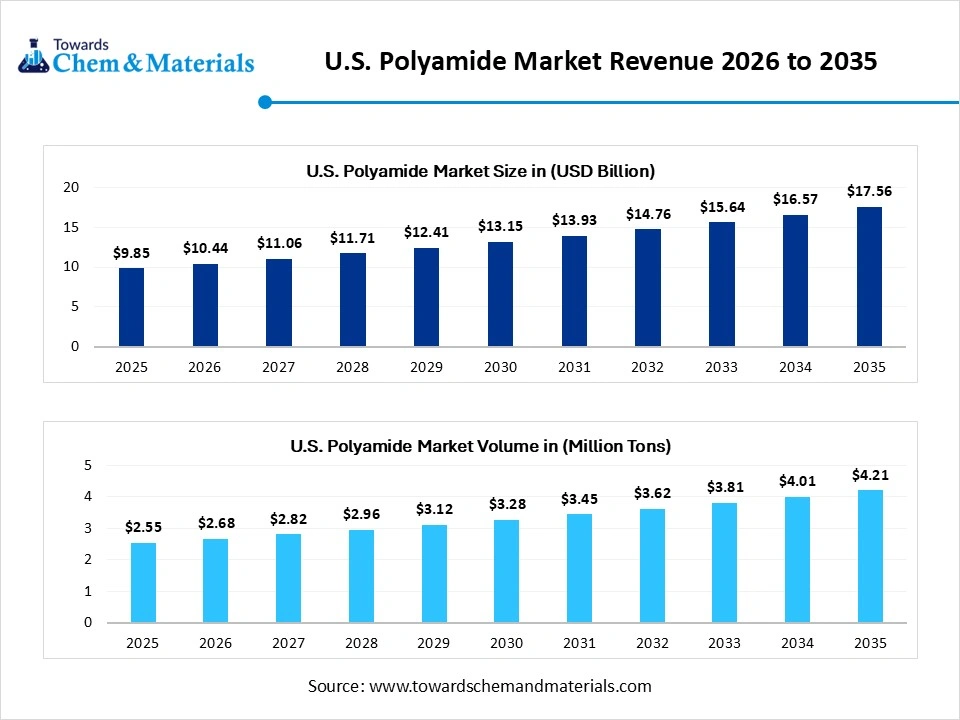
The U.S. polyamide market was valued at USD 9.85 billion in 2025 and is projected to reach approximately USD 17.56 billion by 2035, growing at a CAGR of 5.95% from 2026 to 2035. In terms of volume, the market is expected to expand from 2.55 million tons in 2025 to 4.21 million tons by 2035, registering a CAGR of 5.15%. This report covers detailed market size analysis, segment-wise data, regional trends, competitive landscape, value chain analysis, trade data, and comprehensive insights on key manufacturers and suppliers.
Content
U.S. Polyamide Market Trends, Share and Growth Analysis
The U.S. polyamide market size was estimated at USD 9.85 billion in 2025 and is expected to be worth around USD 17.56 billion by 2035, growing at a CAGR of 5.95% from 2026 to 2035. In terms of volume, the U.S. polyamide market is projected to grow from 2.55 million tons in 2025 to 4.21 million tons by 2035. growing at a CAGR of 5.15% from 2026 to 2035.
Key Takeaways
- By type, the polyamide 6 (PA6) segment dominated the market with the largest share of 42% in 2025
- By type, the bio-based polyamide segment held 12% market share in 2025 and is expected to grow at the fastest CAGR of 8.10% over the forecast period.
- By form, the fiber segment dominated the market with the largest share of 48% in 2025
- By form, the resin segment held 52% market share in 2025 and is expected to grow at the fastest CAGR of 6.30% over the forecast period.
- By end-use industry, the automotive segment dominated the market with the largest share of 32% in 2025
- By end-use industry, the electrical & electronics segment held 21% market share in 2025 and is expected to grow at the fastest CAGR of 6.5% over the forecast period.
- By application, the engineering plastics segment dominated the market with the largest share of 55% in 2025
- By application, the films & coatings segment held 15% market share in 2025 and is expected to grow at the fastest CAGR of 6.80% over the forecast period.
Market Size and Volume Forecast
- Market Estimated Size (2025): USD 9.85 Billion | CAGR (2026–2035): 5.95%
- Market Projected Size (2035): USD 17.56 Billion
- Market Volume (2025): 2.55 Million Tons (MT)| Volume CAGR (2026–2035): 5.15%
- Market Projected Volume (2035): 4.21 Million Tons (MT)
- Market Pricing (2025):
- Average Manufacturing Price: USD 2.25/kg
- Average Selling Price: USD 2.95/kg
- Pricing CAGR (2025–2035): 3.6%
Market Overview
The United States is represented as a key hub for engineering-grade polymer innovation and technological advancement. The regional shift towards metal-to-plastic transformation in automotive and aerospace applications. The strong government support for lowering carbon content in polyamide-based applications through strategic partnerships accelerates the expansion.
The domestic market focuses on carbon-neutral footprint and chemical recycling that is driving substantial investment for advancement in diversified sectors, including 5G electronics, electric vehicle infrastructure to meet U.S corporate sustainability mandates. Additionally, major U.S. leaders focus on regenerated nylon and advancements in applications, driving the market growth.
Market Trends
- Rapid Urbanization and industrialization: The fast-growing population density and the industrial expansion facilitate the development of the U.S. to make products more efficient and durable.
- Supply Chain Collaboration: The U.S. domestic player is forming a strategic partnership and acquisition with a bio-based feedstock manufacturer and a joint venture to accelerate commercialization.
Report Scope
| Report Attribute | Details |
| Market Size in 2025 | USD 9.85 Billion |
| Expected Size by 2035 | USD 17.56 Billion |
| Growth Rate from 2026 to 2035 | CAGR 5.95% |
| Forecast Period | 2026 - 2035 |
| Segment Covered | By Type, By Form, By End-Use Industry and By Application |
| Key companies profiled | Arkema, Ascend Performance Materials, BASF SE, Domo Chemicals, DSM-Firmenich, DuPont, Huntsman Corporation, Koch Industries, AdvanSix Inc., Celanese Corp. |
Key Technological Shifts and AI in the U.S. Polyamide Market
The technological development in the United States is driven by a transformation towards high-performance compounding and digitalized manufacturing. The domestic manufacturers are focused on the implementation of laser-sintering solutions and advanced heat stabilization to foster 3D printing of functional polymer prototypes, especially in the medical and aerospace sectors.
The integration of smart manufacturing systems and real-time monitoring enables innovation of specialized glass-reinforced and flame-retardant grades with precision. The technological shift supporting 5G and emerging 6G infrastructure, miniaturization and E-mobility that offer optimized performance, safety and cost-efficiency
Trade Analysis of the U.S. Polyamide Market: Import and Export Statistics
- The United States exported 654 shipments of U.S. polyamide.
- China exported 194 shipments of U.S. polyamide.
- Italy exported 17 shipments of U.S. polyamide.
- From June 2024 to May 2025, the world exported 470 shipments of U.S. polyamide.
Supply Chain Analysis of the U.S. Polyamide Market
Monomers and Intermediates:
The stage of chemical synthesis that focuses on raw material conversion into key intermediates such as HMDA, adipic acid and caprolactam by leading U.S. players to ensure supply stability.
- Key Players: INVISTA, AdvanSix, BASF SE, and Ascent Performance Materials
Polymerization and Compounding:
The stage of raw monomers transforms into polyamide resin by using injection molding and extrusion. The stage compounds them with glass fibers and flame retardants to create industrial grades.
- Key Players: Envalior, Evonik Industries, Arkema and Celanese Corporation
End-Users Integration and Distribution:
The finished polyamide is distributed for original equipment manufacturers of U.S. consumption, followed by automotive, electronics and industrial applications. Through specialized domestic logistics.
- Key Players: Amco Polymers & Entec Polymers, Asahi Kasei Plastics, and Avient Corporation
Regulatory Framework: U.S. Polyamide Market
| Regulatory Body | Key Regulation | Regulatory Focus |
| Chemical management | TSCA (Toxic Substances Control Act) | Focus on safety for new and existing polyamide resins and chemical intermediates. |
| Environment safety | Clean Air Act/ Clean Water Act | Strict limits and wastewater discharge during caprolactam and adipic acid manufacturing. |
| Workplace safety | OSHA Standards | Standards for handling of high temperature melts and dust control in injection moulding and extrusion infrastructure. |
| Global trade | Section 301 Tariffs | Import duties for raw material and finished products influence domestic supply chain pricing and sourcing. |
| Sustainability | SEC Climate Disclosure Rules | Shift toward bio-based and recycled content for manufacturers to report emissions. |
| Product safety | FDA/ Underwriters Laboratories | Certification for polyamides in food-grade packaging and flame-retardant electronic housing. |
U.S. Polyamide Market Dynamics
Driver
Strict Environmental Regulations
The key driver that shapes this trend is driven by enforcing stricter national initiatives and laws for net zero emissions, that reinforcing domestic manufacturers and regulatory pressure to reduce carbon footprints and polyamide formulation towards safer and greener alternatives
Restraints
Feedstock Volatility
The regional reliance on agricultural raw materials makes the U.S. supply chain inclined to climatic conditions and agricultural uncertainties. The U.S. is leading to price volatility in raw material procurement and potential shortages that restrain the adoption of polyamide in the domestic market.
Opportunity
Integration of Additive Manufacturing
The improvement in additive manufacturing is accelerating the opportunity in 3D printing with high-temperature polyamide filaments for prototyping, improved processability and manufacturing of ultra-complex geometries that enable applications. Overall, the integration offers customization, high-performance and eco-conscious material-printer compatibility in the domestic market.
Segmental Insights
Type Insights
Polyamide 6 (PA6) Segment Dominated the U.S. Polyamide Market with 42% of Market Share in 2025
Polyamide 6 (PA6) segment dominated the market with the largest share of 42% in 2025, accelerated by its versatility, impact resistance and heat stability with cost-effectiveness. The PA6 is replacing heavy metal components across the automotive and electronics sector in domestic scale. The regional focus on greener materials, where PA6 balances performance and sustainability by integrating with advanced recycling techniques.
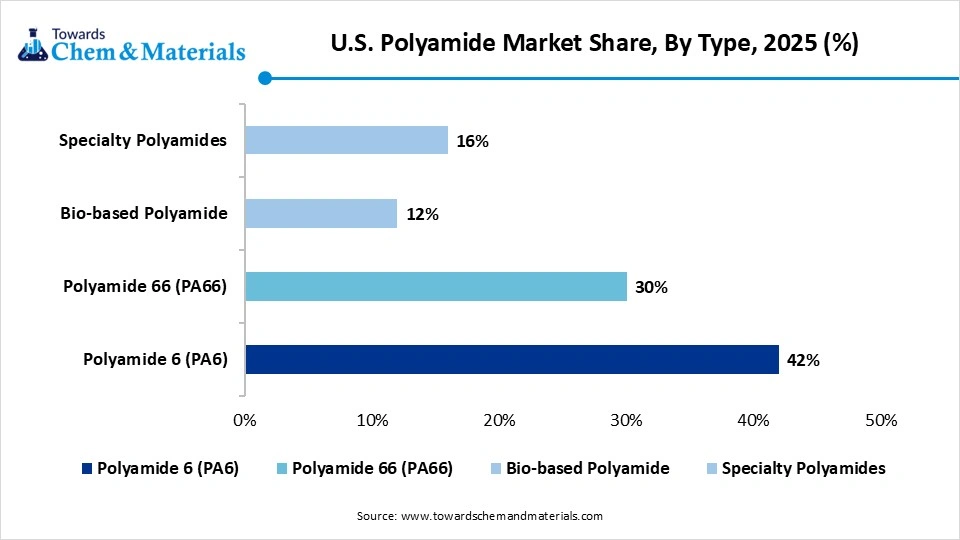
Polyamide 66 (PA66) segment held the 30% market share in 2025. It acts as a key type in under-the-hood automotive parts and industrial electrical connectors by offering thermal stability, structural integrity and lowering moisture absorption. The major domestic manufacturers focus on advanced polyamide chemistry with reinforced and unreinforced grades by setting a standard for mechanical integrity.
Bio-based polyamide segment held the 12% market share in 2025 and expected to grow at the fastest CAGR of 8.10% over the forecast period, driven by regional shift towards decarbonizing supply chain and focus on circular economy targets. The domestic player is adopting renewable feedstock and sustainable resins like PA11 and PA12 by ensuring mechanical strength and a lower-carbon footprint for automotive and electronics sectors.
Specialty Polyamides segment held 16% market share in 2025 due to demand for high temperature polyamides and transparent polyamides that offer chemical resistance, heat stability and dimensional precision by setting a standard for metal replacement and miniaturization limit. Specialty polyamides are preferred in aerospace, electric vehicle thermal systems, and medical equipment.
Form Insights
Fiber Segment Dominated the U.S. Polyamide Market with 48% of Market Share in 2025
Fiber segment dominated the market with the largest share of 48% in 2025. Driven by its high-strength filament yarns, staple fiber crucial for carpet and industrial textiles applications. The fiber known for wear resistance, superior elasticity, enabling U.S. industry scalability in commercial flooring, automotive interiors, and high-performance sport apparel. Additionally, the domestic producer focuses on integrating post-consumer recycled waste and sustainable materials to boost fiber adoption.
U.S. Polyamide Market Share, By Form, 2025 (%)
| By Form | Revenue Share, 2025 (%) |
| Fiber | 48% |
| Resin | 52% |
Resin segment held the 52% market share in 2025 and expected to grow at the fastest CAGR of 6.30% over the forecast period due to demand for high-performance pellets and powder required for injection moulding and precision extrusion. The resin is engineered for automotive and industrial hardware that focuses on mechanical resilience, heat resistance, and structural integrity. The region integrated specialized compounds with impact modifiers and flame retardants to meet safety and high-performance standards.
End-Use Industry Insights
Automotive Segment Dominated the U.S. Polyamide Market with 32% of Market Share in 2025
Automotive segment dominated the market with the largest share of 32% in 2025, driven by local demand for lightweighting and transition towards electric vehicles by accelerating superior heat resistance and mechanical integrity. The polyamide is standard for under-the-hood components, electrical components and thermal management framework where domestic players adopt flame-retardant grades and glass-reinforced resin as metal replacement by maintaining safety and structural integrity to meet fuel-efficacy standards.
Electrical & electronics segment held the 21% market share in 2025 and expected to grow at the fastest CAGR of 6.5% over the forecast period due to its high-precision demand for miniaturization and flame retardancy. The U.S. manufacturers shifted to halogen-free resins and 5G infrastructure in insulation housings, circuit breakers, and high-voltage connectors by maintaining dielectric strength, operational safety and thermal stability in heat-sensitive electronics.
U.S. Polyamide Market Share, By End-Use Industry, 2025 (%)
| By End-Use Industry | Revenue Share, 2025 (%) |
| Automotive | 32% |
| Electrical & Electronics | 21% |
| Textiles | 18% |
| Packaging | 10% |
| Industrial Machinery | 11% |
| Consumer Goods | 8% |
Textiles segment held the 18% market share in 2025, driven by rising domestic demand for high-performance apparel and industrial fabrics that are driving the high consumer adoption of nylon filaments with superior durability, elastic recovery, color vibrancy and excellent moisture management system. The region is shifting towards regenerated polyamide and bio-based fibers for modern sustainable fashion.
Industrial machinery segment held 11% market share in 2025, due to heavy-duty applications where United States players focus on self-lubricating engineering and metal replacement for bearings, conveyor rollers and gears. The domestic hit towards automation is driving the implementation of glass-filled and MoS2-enhanced grades by providing structural integrity and high wear resistance.
Application Insights
Engineering Plastics Segment Dominated the U.S. Polyamide Market with 55% of Market Share in 2025
Engineering plastics segment dominated the market with the largest share of 55% in 2025, driven by the integration of advanced resins with higher chemical resistance, strength-to-weight ratio and dimensional integrity. The segment's domestic adoption is boosted by the need for metal-to-plastic conversion technology for the automotive and aerospace sectors. The engineering plastics are dominated by glass-reinforced and toughened grades to maintain safety and structural integrity for industrial automation and renewable energy frameworks.
U.S. Polyamide Market Share, By Application, 2025 (%)
| By Application | Revenue Share, 2025 (%) |
| Engineering Plastics | 55% |
| Fibers | 30% |
| Films & Coatings | 15% |
Fibers segment held the 30% market share in 2025, driven by fibers demand due to its abrasion resistance, dye affinity and flexible recovery, that providing high-tenacity yarns for commercial flooring and industrial textiles. fiber is ideal for heavy-duty, durable carpeting and performance apparel to meet sustainability goals and circularity for modern automotive and fashion sectors.
Films & coatings segment held the 15% market share in 2025 and expected to grow at the fastest CAGR of 6.80% over the forecast period, driven by the requirement for high-performance food packaging and chemical-resistant finishes. The U.S. manufacturer is shifting toward sustainable barrier solutions and monomaterial innovation to improve oxygen-blocking capability, puncture resistance and mechanical robustness of multi-layer film systems with a lower environmental footprint.
Recent Developments
- In February 2026, Formerra announced an expanded distribution partnership with Evonik for high-performance polyamides (VESTAMID® and TROGAMID®) for healthcare grades. The distribution agreement covers the United States and Canadian medical markets.
- In April 2025, BASF SE and TE Connectivity announced a strategic collaboration to develop an automotive connector with components made using Ultramid Ccycled polyamide. It is a chemical recycling solution derived from post-consumer plastic waste. This partnership focuses on sustainable solutions in the automotive sector.
Top Companies in the U.S. Polyamide Market
- Arkema
- Ascend Performance Materials
- BASF SE
- Domo Chemicals
- DSM-Firmenich
- DuPont
- Huntsman Corporation
- Koch Industries
- AdvanSix Inc.
- Celanese Corp.
U.S. Polyamide Market Segment Covered in the Report
By Type
- Polyamide 6 (PA66)
- Injection Grade
- Fiber Grade
- Extrusion Grade
- Polyamide 66 (PA66)
- Reinforced
- Unreinforced
- Bio-based Polyamide
- PA11
- PA12
- Specialty Polyamides
- High Temperature Polyamide (HTPA)
- Transparent Polyamides
By Form
- Fiber
- Filament Yarn
- Staple Fiber
- Resin
- Pellets
- Powder
By End-Use Industry
- Automotive
- Under-the-Hood Components
- Interior Components
- Electrical Components
- Electrical & Electronics
- Connectors
- Circuit Breakers
- Cable Insulation
- Textiles
- Apparel
- Industrial Textiles
- Packaging
- Flexible Packaging
- Rigid Packaging
- Industrial Machinery
- Bearings
- Gears
- Consumer Goods
- Appliances
- Sports Equipment
By Application
- Engineering Plastics
- Fibers
- Films & Coatings
FAQ's
Question 1 : What is the expected growth rate of the U.S. polyamide market?
Answer : The market is expected to grow at a CAGR of 5.95% from 2026 to 2035, driven by increasing demand across automotive, electronics, and industrial applications.
Question 2 : What factors are driving the growth of the U.S. polyamide market?
Answer : Key growth drivers include rising demand for lightweight materials in automotive, increasing adoption of electric vehicles, advancements in 3D printing, and growing focus on sustainable and bio-based materials.
Question 3 : Which polyamide type dominates the U.S. market?
Answer : Polyamide 6 (PA6) dominates the market, accounting for 42% of the total share in 2025 due to its cost-effectiveness and versatile performance characteristics.
Question 4 : Which segment is expected to grow the fastest in terms of type?
Answer : The bio-based polyamide segment is expected to grow at the fastest CAGR of 8.10% during the forecast period due to increasing sustainability initiatives.
Question 5 : What is the leading form segment in the U.S. polyamide market?
Answer : The fiber segment leads the market with a 48% share in 2025, driven by its extensive use in textiles, carpets, and industrial fabrics.
Meet the Team

Saurabh Bidwai
Principal Consultant
Saurabh Bidwai, a B.Tech Chemical Engineering graduate with 4+ years of experience, specializes in specialty chemicals, commodity chemicals, and engineered materials, offering valuable insights into market trends and emerging opportunities.

Aditi Shivarkar
Reviewed By
Aditi Shivarkar, with 14+ years in Chemical and Materials market research, specializes in Chemical and Materials. She ensures accurate, actionable insights, driving Towards Chemicals And Materials Analytics and Consulting excellence in industry trends and sustainability.