
U.S. Polymer Foam Market Size, Share, Trends & Growth Report, 2034
The U.S. polymer foam market is projected to grow from USD 13.85 billion in 2025 to USD 14.63 billion in 2026, with an expected CAGR of 5.65% from 2026 to 2035. The market's volume is set to increase from 4.35 million metric tons in 2025 to 6.99 million metric tons by 2035, growing at a CAGR of 4.85%. Polystyrene foams currently dominate the market due to their versatility, especially in packaging and construction. However, polyurethane foam, known for its flexibility and versatility, is anticipated to experience the fastest growth, driven by demand in the mattress, furniture, and automotive seating industries. The automotive sector, representing 30% of the market share, continues to be a key end-user, with a growing demand for lightweight, safety-enhancing
Content
U.S. Polymer Foam Market Size & Volume, Share, Growth and Forecast 2026-2035
The U.S. polymer foam market size was valued at USD 13.85 billion in 2025, is estimated to reach USD 14.63 billion in 2026, and is projected to reach USD 24.00 billion by 2035, growing at a CAGR of 5.65% from 2026 to 2035 In terms of volume, the market is projected to grow from 4.35 million metric tons in 2025 to 6.99 million metric tons by 2035. growing at a CAGR of 4.85% from 2026 to 2035.The need for lightweight material is fueling the expansion of opportunities within the sector.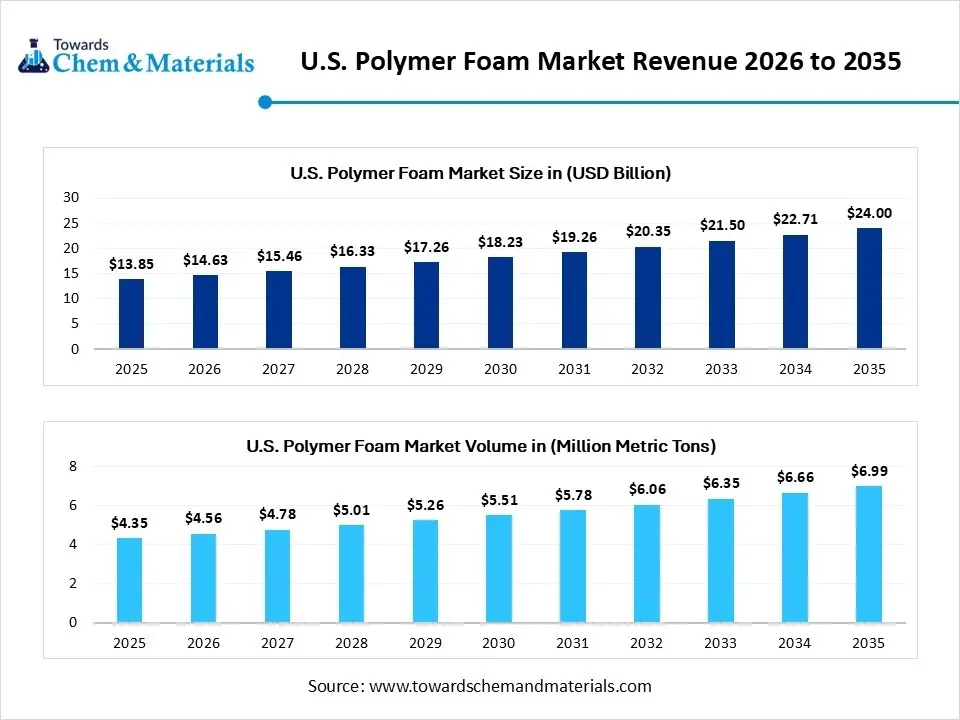
Key Takeaways
- By type, the polystyrene foams segment led the market with approximately 88% industry share in 2024, due to their versatility and cost-effectiveness, mainly in the packaging and construction industries
- By type, the polyurethane foam segment is expected to grow at the fastest rate in the market during the forecast period, owing to increased demand from industries such as the mattress, furniture, and automotive seating, akin to its superior versatility.
- By form, the flexible foam segment emerged as the top-performing segment in the market with approximately 60% industry share in 2024, because they deliver comfort, cushioning, and ergonomic support, making them ideal for furniture, bedding, and automotive seating-three major United States industries.
- By form, the rigid foam segment is expected to fastest growth in the market in the coming years, due to their unmatched insulation properties that help reduce energy costs in U.S. buildings.
- By density type, the low-density segment led the market with approximately 50% share in 2024, due to its lightweight and cost-efficient nature.
- By density type, the high-density foam segment is expected to grow at the fastest rate in the market during the forecast period, because it offers superior durability, strength, and long-term performance.
- By end use, the automotive segment emerged as the top-performing segment in the U.S. polymer foams market with approximately 30% industry share in 2024, because of its need for lightweight, comfort-driven, and safety-enhancing materials.
- By end use, the footwear segment is expected to grow at the fastest rate in the market during the forecast period, due to the rise of performance-driven and sustainable shoe designs.
Market Size and Volume Forecast
- Market Size (2025): USD 13.85 Billion | CAGR (2025–2035): 5.65%
- Market Projected Size (2035): USD 24 Billion
- Market Volume (2025): 4.35 Million Metric Tons (MMT) | Volume CAGR (2025–2035): 4.85%
- Market Projected Volume (2035): 6.99 Million Metric Tons (MMT)
- Market Pricing (2025):
- Average Manufacturing Price: USD 3,211 per Ton
- Average Selling Price: USD 4,380 per Ton
- Pricing CAGR (2025–2035): 3.43%
Market Overview
The Polymer Foam Boom: Sustainability, Innovation, And Market Growth
The U.S. polymer foam market has experienced sophisticated growth in recent years, as the region is increasingly shifting towards better lightweight material, insulation, and cushioning, which is continuously improving the financial performance and sector growth at the same time.
Moreover, by packaging fragile items to provide better energy efficiency to buildings, the polymer foams have been widely discussed in technological forums and white papers in the United States in the past few years. Also, the greater investment from the manufacturer for the development and implementation of the sustainable foam production is likely to create greater opportunities in the United States during the projected period.
- The United States is one of the leading polyethylene foam exporters with 3,429 shipments after China in 2024.(Source: www.volza.com)
Polymer Foam Propel Innovation in Key U.S Industries
The increased need for lightweight material from the aerospace and automotive industry is actively driving the sectoral scalability and strategic transformation in the United States. Moreover, these industries are seen under heavy pressure to cut excess fuel consumption, where the polymer foams have gained traction with investment firms and analysts in recent years. Also, having factors like affordability and durability, the polymer foams are expected to usher in a wave of profitable ventures in the coming years.
- For instance, The United States is expected to use 116.4 MT of plastic or lightweight plastic in 2025.(Source: www.oecd.org)
Market Trends
- The adoption and development of 3D printed foams have immensely enhanced market readiness and future industry capabilities in recent years, as additive manufacturing has a major role in the customization of foam structures.
- The trend towards sustainability has put pressure on manufacturers, which leading the greater investments to produce biobased foams in recent years, as per the market survey.
Report Scope
| Report Attributes | Details |
| Market Size in 2026 | USD 14.63 Billion / 4.56 Million Metric Tons |
| Expected Size by 2035 | USD 24.00 Billion / 6.99 Million Metric Tons |
| Growth Rate from 2025 to 2035 | CAGR 4.65% |
| Base Year of Estimation | 2025 |
| Forecast Period | 2025 - 2035 |
| Segment Covered | By Type, By Form, By Density, By End-Use Industry, |
| Key Companies Profiled | Owens Corning , BASF Corporation , Dow Chemical Company , Carpenter Co. , Foamcraft Inc. , FXI , Huntsman International LLC , Innocor Foam Technologies , Premier Foam , Rogers Corporation , Saint-Gobain , Sheela Foam Ltd. , UFP Technologies Inc. , Arkema, Covestro AG , Eurofoam S.r.l. , INOAC Corporation , Sekisui Chemical Co., Ltd. , Zotefoams plc , Creative Foam Corporation |
Market Opportunity
Sustainable Foam Paving the Way for Greener Manufacturing
The development of high-performance foams for sports equipment and footwear is seen as the higher-margin opportunity for manufacturers in the coming years. Furthermore, individuals from sports culture or regular fitness are increasingly demanding sports gear and shoes with better cushioning and breathability, where the manufacturers are expected to attract increased capital and a sophisticated consumer base in the upcoming period. Furthermore, the manufacturers can gain major industry attention by establishing a collaboration with premium footwear brands in the United States.
- In March 2023, OrthoLite has established a partnership with Novamont. The motive behind collaboration is to develop and research innovative circular foam material options in footwear, according to the company's claim.(Source: www.novamont.com)
Market Challenge
Green Mandates Rise, Plastic Industry Feels the Heat
The increased pressure from global implementation of the sustainability standards, where plastic is considered the most harmful material for the environment. These sustainability standards are projected to curb capital flow and expansion activities of the industry in the coming years. Also, the United States government has banned single-use plastic in recent years.
Segmental Insights
Type Insights
How Did The Polystyrene Foam Segment Dominate The U.S. Polymer Foam Market In 2024?
The polystyrene foam segment held the largest share of the market in 2024, due to their versatility and cost-effectiveness, mainly in the packaging and construction industries. Moreover, having properties like lightweight, cushioning, and insulation has provided the sophisticated consumer base to the segment in recent years. furthermore, the heavy e-commerce industry in the United States is actively driving the growth of the segment in the current period.
The polyurethane foam segment is expected to grow at the fastest rate during the predicted timeframe, owing to increased demand from industries such as the mattress, furniture, and automotive seating, akin to its superior versatility. Also, the polyurethane foams can be able to be engineered into flexible and rigid which is likely to provide greater attention to the segment in the upcoming years as per future industry expectations.
Form Insights
Why Does The Flexible Foam Segment Dominate The U.S. Polymer Foam Market By Form Type?
The flexible foam segment held the largest share of the market in 2024, because they deliver comfort, cushioning, and ergonomic support, making them ideal for furniture, bedding, and automotive seating-three major U.S. industries. Consumers in the region are highly brand-conscious in furniture and bedding, and flexible foams allow companies to create premium designs without significantly raising costs. Their softness, resilience, and ability to mold into different shapes make them preferred in comfort-related applications.
The rigid foams segment is expected to grow at the fastest rate during the forecast period, due to their unmatched insulation properties that help reduce energy costs in U.S. buildings. With stricter building codes and net-zero energy targets, demand for high-performance insulation is surging. Rigid foams, especially polyurethane and polyisocyanurate, offer superior thermal resistance, making them crucial in construction
Density Type Insights
How did the Low-Density Segment Dominate the U.S. Polymer Foam Market in 2024?
The low-density segment dominated the market with the largest share in 2024 due to its lightweight and cost-efficient nature. They are easy to process, widely used in disposable packaging, and popular in furniture cushions where softness and comfort matter more than durability. The e-commerce industry boosted low-density foam use for protective packaging solutions.
The high-density foam segment is expected to grow at the fastest rate during the forecast period, because it offers superior durability, strength, and long-term performance. As U.S. consumers demand higher-quality mattresses, automotive seating, and footwear, high-density foams provide better resilience and longevity compared to low-density types. In construction, high-density rigid foams are essential for insulation and structural stability, meeting strict building codes.
End Use Insights
How did the Automotive Segment Dominate the U.S. Polymer Foam Market in 2024?
The automotive segment held the largest share of the market in 2024, because of its need for lightweight, comfort-driven, and safety-enhancing materials. Foams are essential for seating, headrests, armrests, Insulation, and noise reduction. With nearly every vehicle part requiring foam, the automotive sector has been the largest consumer. U.S. automakers focus heavily on comfort and safety standards, making foam irreplaceable in design.
The footwear segment is expected to grow at the fastest rate during the forecast period, due to the rise of performance-driven and sustainable shoe designs. Regional consumers increasingly demand lightweight, shock-absorbing, and eco-friendly footwear, especially for sports, athleisure, and everyday wear. Polymer foam, particularly engineered polyurethane and EVA blends, provide superior cushioning, flexibility, and breathability.
U.S. Polymer Foam Market Value Chain Analysis
- Distribution to Industrial Users: The industries in the United States can buy foam from the specialized chemical distributors and direct sales from manufacturers.
- Chemical Synthesis and Processing: The chemical synthesis of polymer foam in United States has included steps such as CBA decomposition, reaction-based foaming, and physical foaming.
- Regulatory Compliance and Safety Monitoring: The safety monitoring and regulatory compliance of foam in the United States is mainly under the regulatory agencies, like the FDA.
Recent Development
- In September 2024, Future Foam established a collaboration with BASF for the launch of its latest and innovative foam product line. The newly launched flexible foam is specifically designed for the bedding industry and made up of the Biomass Balance (BMB) Lupranate® T 80 toluene diisocyanate (TDI).(Source: www.basf.com)
U.S. Polymer Foam Market Top Companies
- Owens Corning
- BASF Corporation
- Dow Chemical Company
- Carpenter Co.
- Foamcraft Inc.
- FXI
- Huntsman International LLC
- Innocor Foam Technologies
- Premier Foam
- Rogers Corporation
- Saint-Gobain
- Sheela Foam Ltd.
- UFP Technologies Inc.
- Arkema
- Covestro AG
- Eurofoam S.r.l.
- INOAC Corporation
- Sekisui Chemical Co., Ltd.
- Zotefoams plc
- Creative Foam Corporation
Segment Covered
By Type
- Polyurethane Foam
- Polystyrene Foam
- Polyvinyl Chloride (PVC) Foam
- Polyolefin Foam
- Melamine Foam
- Phenolic Foam
- Others
By Form
- Flexible Foam
- Rigid Foam
By Density
- Low-Density Foam
- Medium-Density Foam
- High-Density Foam
By End-Use Industry
- Automotive
- Construction
- Packaging
- Furniture & Bedding
- Footwear
- Sports & Recreational
- Others
FAQ's
Question 1 : What is the size and volume of the U.S. polymer foams market?
Answer : The U.S. polymer foam market size was valued at USD 13.85 billion in 2025, is estimated to reach USD 14.63 billion in 2026, and is projected to reach USD 24.00 billion by 2035, growing at a CAGR of 5.65% from 2026 to 2035 In terms of volume, the market is projected to grow from 4.35 million metric tons in 2025 to 6.99 million metric tons by 2035. growing at a CAGR of 4.85% from 2026 to 2035.
Question 2 : What factors are driving the growth of the U.S. polymer foams market?
Answer : Rising demand for lightweight materials in automotive and aerospace for fuel efficiency. Construction sector expansion, with rigid foams used for insulation and energy savings. Furniture, bedding, and mattress demand, driving flexible foam consumption. Sustainability push, leading to the development of bio-based and recyclable foams. Growing packaging needs, particularly from e-commerce and fragile goods logistics.
Question 3 : What are the main challenges for the U.S. polymer foams market?
Answer : Regulatory pressure due to bans on single-use plastics and stricter green mandates. Volatile raw material prices, especially for petrochemical-based foams. Sustainability hurdles, requiring a shift to bio-based or recyclable alternatives. Environmental concerns about plastic waste and recycling limitations, which may restrict investment flow
Question 4 : Who are the leading companies operating in the U.S. polymer foams market?
Answer : Owens Corning , BASF Corporation , Dow Chemical Company , Carpenter Co. , Foamcraft Inc. , FXI , Huntsman International LLC , Innocor Foam Technologies , Premier Foam , Rogers Corporation , Saint-Gobain , Sheela Foam Ltd. , UFP Technologies Inc. , Arkema, Covestro AG , Eurofoam S.r.l. , INOAC Corporation , Sekisui Chemical Co., Ltd. , Zotefoams plc , Creative Foam Corporation
Meet the Team

Saurabh Bidwai
Principal Consultant
Saurabh Bidwai, a B.Tech Chemical Engineering graduate with 4+ years of experience, specializes in specialty chemicals, commodity chemicals, and engineered materials, offering valuable insights into market trends and emerging opportunities.

Aditi Shivarkar
Reviewed By
Aditi Shivarkar, with 14+ years in Chemical and Materials market research, specializes in Chemical and Materials. She ensures accurate, actionable insights, driving Towards Chemicals And Materials Analytics and Consulting excellence in industry trends and sustainability.