
UV Curable Coatings Market Manufacturers & Suppliers Company Analysis 2026-2035
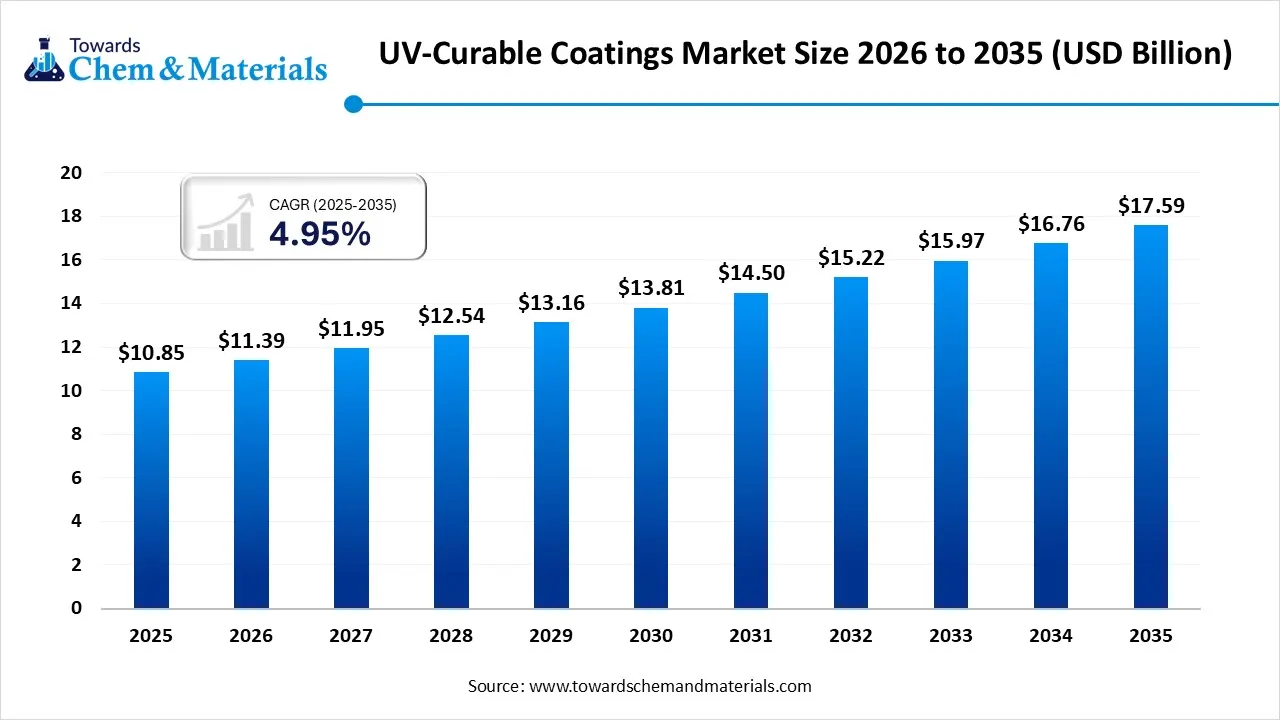
The global uv curable coatings market size is expected to grow from USD 11.39 billion in 2026 to USD 17.59 billion in 2035, growing at a CAGR of 4.95% from 2026 to 2035. The top key players in the market are AkzoNobel N.V., PPG Industries Inc., BASF SE, Axalta Coating Systems, Sherwin-Williams, Hempel A/S, Nippon Paint Holdings, DSM Coatings, Axion Specialty, CoatingsSokan New Materials-Global Forecast 2026 To 2035
Content
What is the Current UV Curable Coatings Market Size and Share?
The global uv curable coatings market size was estimated at USD 10.85 billion in 2025 and is expected to increase from USD 11.39 billion in 2026 to USD 17.59 billion by 2035, growing at a CAGR of 4.95% from 2026 to 2035. Asia Pacific dominated the uv curable coatings market with the largest revenue share of 35.65% in 2025. The growing need for quick, durable bonding solutions has accelerated the industry's potential in recent years.The specific type of coatings that become hard when it exposes in UV light is known as the UV curable coatings. Moreover, by stronger bonding advantages in a faster time period, the UV curable coatings have major industry attention from the major sectors such as the plastic, metal, wood, packaging, and electronics, as per the recent observation. Also, these coatings are seen as not emitting harmful chemical supporting industrial sustainability nowadays.
Market Highlights
- The Asia Pacific dominated UV-curable coatings market with the largest revenue share of 35.65% in 2025,due to its strong manufacturing base.
- By raw material, the oligomers segment dominated the market revenue share 42.55% in 2025, owing to they form the main backbone of the coating.
- By application, the industrial segment dominated the market and accounted for the largest revenue share of 26.66% in 2025, owing to its inclusion of many large-scale applications like wood finishing, automotive parts, machinery, and flooring.
Trade Analysis of the UV-Curable Coatings Market:
Import, Export, Consumption, and Production Statistics
- The UV curable coatings export has increased in recent years, while 17 exporters and 46 buyers have been reported between May 2024 and April 2025, with 318 shipments globally, as per the record.
- Japan has seen under the sophisticated exporter of UV curable coatings with 355 shipments, while India (166 shipments) and China (96 shipments) are likely to create a competitive environment for Japan in the coming years.
- Also, India itself emerged as the leading importer of UV curable coatings with 177 shipments, and Indonesia (157) and Vietnam (148) are following.
Market Trends:
- The heavy focus on production bonding speed has driven substantial financial gains in the manufacturing sector in recent years. Also, several industries are actively adopting UV coatings for faster bonding solutions, which provided heavy attention on the UV curable coatings.
- The heavy usage of every product has increased return on investment for manufacturers in the past few years. Moreover, the manufacturers of furniture, smartphones, and packaging are actively seen in using UV curable coatings to improve the appearance and durability of the products in the current period.
- The greater shift from the protective coatings to better user experience provider coatings is expected to present new business models for the forward-thinking manufacturers in the coming years. Also, the companies are looking for coatings that not only protect the product but also enhance the feel and product outlook in recent years.
Report Scope
| Report Attribute | Details |
| Market Size in 2026 | USD 11.39 Billion |
| Revenue Forecast in 2035 | USD 17.59 Billion |
| Growth Rate | CAGR 4.95% |
| Forecast Period | 2026 - 2035 |
| Base Year | 2025 |
| Dominant Region | Asia Pacific |
| Segment Covered | By Raw Material, By Application, By Region |
| Key companies profiled | AkzoNobel N.V., PPG Industries Inc., BASF SE, Axalta Coating Systems, Sherwin-Williams, Hempel A/S, Nippon Paint Holdings, DSM Coatings, Axion Specialty, CoatingsSokan New Materials |
Value Chain Analysis
Distribution to Industrial Users
- Industrial users obtain UV-curable coatings through a streamlined specialty chemical supply chain focused on technical support and rapid delivery. Manufacturers typically distribute high volumes directly to large-scale automotive or electronics plants, while smaller industrial operations rely on regional authorized distributors.
- These coatings require specific storage conditions to prevent premature polymerization.
Chemical Synthesis and Processing
- The synthesis of UV-curable coatings involves blending photoinitiators, oligomers, and monomers into a stable liquid matrix. During processing, these components are applied to substrates via roller or spray methods.
- Upon exposure to ultraviolet light, photoinitiators trigger a rapid photopolymerization reaction, cross-linking the resins into a durable solid film within seconds.
Regulatory Compliance and Safety Monitoring
- Manufacturers must adhere to REACH and TSCA mandates for chemical registration, specifically monitoring photoinitiators like TPO under updated safety classifications.
- Process safety is governed by OSHA 29 CFR 1910, requiring rigorous skin and respiratory protection against acrylate sensitization. Furthermore, compliance with ISO 45001 and IEC 62471 ensures equipment shielding from harmful UV radiation.
From Heat to High Speed Light
The industry is shifting from traditional heat-based drying to advanced light-based curing systems, which are expected to support stronger cash flows for manufacturing enterprises in the coming years. In the past few years, the coatings needed high temperatures and long drying times, but UV curing works quickly at lower temperatures. This makes it suitable for heat-sensitive materials like plastics. New technologies are also more energy-efficient, smaller in size, and easier to control.
UV-Curable Coatings Market Regulatory Landscape: Global Regulations
| Country Region | Regulatory Body | Key Regulations | Focus Areas |
| United States | Environmental Protection Agency (EPA) | TSCA Section 6(h): Regulates persistent, bioaccumulative, and toxic (PBT) chemicals. | Reduction of ozone-forming VOCs, management of hazardous air pollutants (HAPs), and pre-market safety reviews for new monomers and photoinitiators under TSCA Section 5. |
| European Union | ECHA | REACH Regulation (EC) No 1907/2006: Annex XIV (Authorisation List) and Annex XVII (Restrictions). | Phasing out Substances of Very High Concern (SVHCs) like the photoinitiator TPO |
| China | State Administration for Market Regulation (SAMR)Administration (SAC) | GB 30981.1-2025 (Architectural) & GB 30981.2-2025 (Industrial): Mandatory national standards for the "Limit of Harmful Substances of Coatings." | Strict VOC content limits for specific coating categories (e.g., exterior wall coatings reduced to 80 g/L) |
Segmental Insights
Raw Material Insights
How did the Oligomers Segment Dominate the UV-Curable Coatings Market in 2025?
The oligomers segment dominated the market share 42.55% in 2025, because they form the main backbone of the coating. They give strength, hardness, flexibility, and durability to the final surface. When industries need strong and long-lasting coatings, oligomers become very important. They also help in controlling properties like scratch resistance and chemical resistance.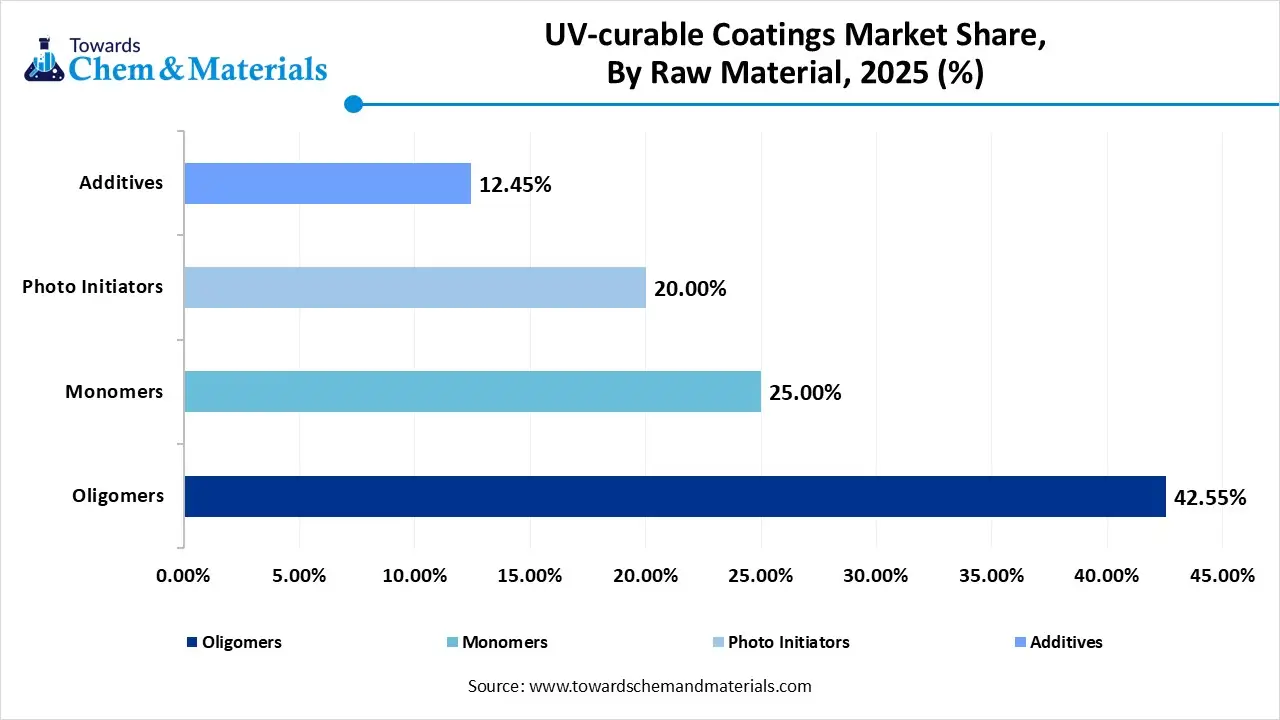
The monomers segment is expected to grow with a rapid CAGR, owing to their help in improving processing and cost efficiency. Also, monomers reduce the thickness and viscosity of coatings, making them easier to apply and faster to cure. This is important for industries that want high-speed production. They also help in adjusting properties like flexibility and surface smoothness. As companies focus more on lightweight coatings and energy saving, monomers become more useful.
UV-curable Coatings Market Share, By Raw Material , 2025 (%)
| By Raw Material | Revenue Share, 2025 (%) |
| Oligomers | 42.55% |
| Monomers | 25.00% |
| Photo Initiators | 20.00% |
| Additives | 12.45% |
Application Insights
How did the Industrial Segment Dominate the UV-Curable Coatings Market in 2025?
The industrial segment dominated the market share 26.66% in 2025, due to it includes many large-scale applications like wood finishing, automotive parts, machinery, and flooring. Moreover, these industries require strong, durable, and fast-curing coatings, which UV technology provides very well. Industrial production also happens in high volumes, so fast curing helps increase efficiency.
The electronic products segment is expected to grow, owing to devices becoming smaller, smarter, and more delicate. UV curable coatings are perfect for protecting electronic components from moisture, dust, and damage without adding weight. They can be applied very precisely, which is important for small circuits and parts. Also, electronics manufacturing needs fast processes, and UV coatings cure instantly, saving time.
Regional Insights
The Asia Pacific uv curable coatings market size was valued at USD 3.87 billion in 2025 and is expected to be worth around USD 6.28 billion by 2035, exhibiting at a compound annual growth rate (CAGR) of 4.97% over the forecast period from 2026 to 2035. Asia Pacific dominated the UV-curable coatings market share 35.65% in 2025, due to its strong manufacturing base. 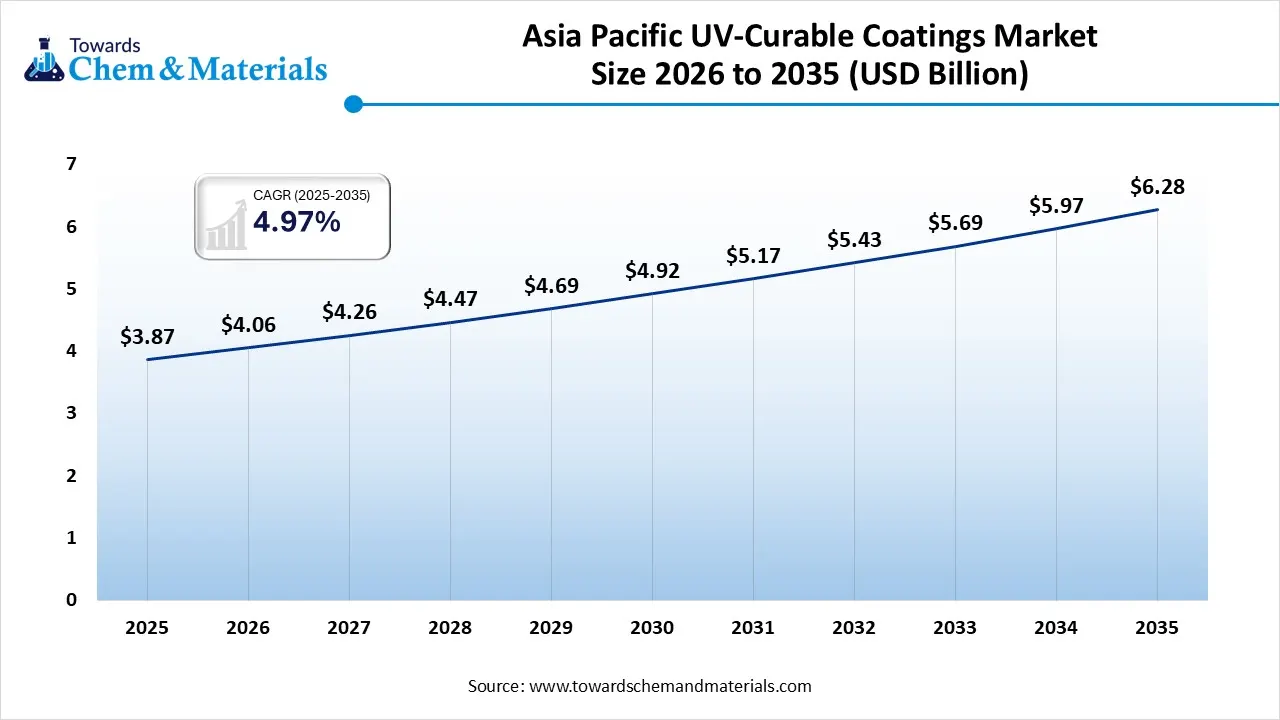
Furthermore, countries in this region produce large volumes of electronics. furniture, packaging, and automotive products, all of which use UV coatings. Labor and production costs are also lower, which encourages companies to set up factories here. Rapid industrial growth and urbanization are increasing the demand for coatings. Additionally, governments in this region are supporting industrial development and exports.
Stronger Supply Chains Fuel Growth in China
China maintained its dominance in the market, owing to its being one of the largest manufacturing countries in the world, which produces a wide range of goods like electronics, furniture, packaging, and automotive parts, all of which require coatings. China has a strong supply chain, which helps in large-scale production at a lower cost. The country is also focusing on improving environmental standards, which supports the use of UV coatings as they are more eco-friendly.
UV-Curable Coatings Market Evaluation in Europe
Europe uv curable coatings market segment accounted for the major revenue share of 25.66% in 2025. Europe is expected to capture a major share of the UV-curable coatings market with a rapid CAGR, owing to its strict environmental regulations. Many countries in Europe are reducing the use of harmful chemicals, and UV coatings are a good alternative because they produce low emissions. Industries in Europe are also focusing on high-quality and premium products, where UV coatings are very useful.
Germany Dominates in Advanced Coatings
Germany is expected to emerge as a prominent country for the UV-curable coatings market in the coming years, due to its strong industrial base. It has well-developed automotive, machinery, and electronics industries, which require high-performance coatings. Germany is known for quality and precision, so industries prefer advanced coating technologies like UV curing. The country is also a leader in innovation, with many companies developing new materials and processes.
North America UV-Curable Coatings Market Examination
North America uv curable coatings market segment accounted for the major revenue share of 22.19% in 2025. North America is notably growing in industry, owing to increasing demand for advanced and sustainable technologies. Companies in this region are adopting UV coatings to improve efficiency and reduce environmental impact. There is also strong demand from industries like packaging, automotive, and electronics. The innovation driving regional growth is as companies invest in research and development.
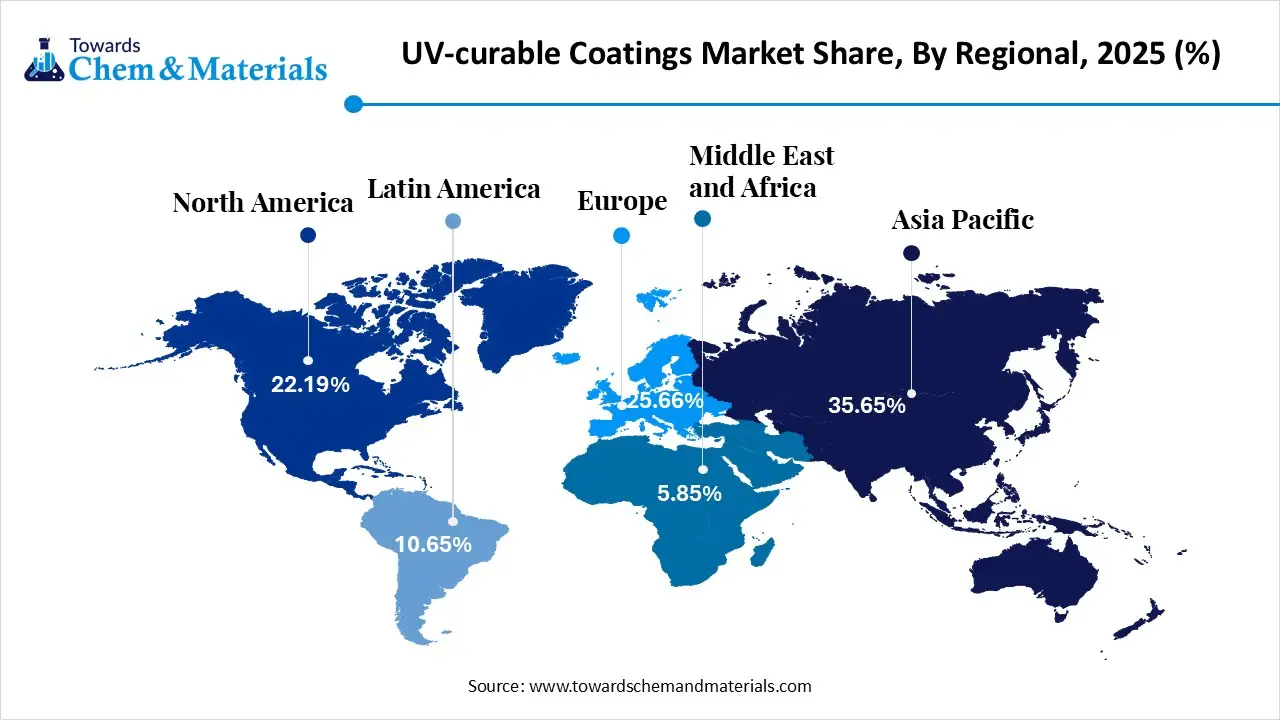
UV-curable Coatings Market Share, By Regional, 2025 (%)
| Regional | Revenue Share, 2025 (%) |
| North America | 22.19% |
| Europe | 25.66% |
| Asia Pacific | 35.65% |
| Latin America | 10.65% |
| Middle East & Africa | 5.85% |
Sustainable Coatings Transforms United States Manufacturing
The United States is expected to gain a significant industry share owing to it has a strong presence of industries like electronics, packaging, and automotive. and construction. Companies in the United States focus on innovation and efficiency, which supports the adoption of UV curing technology. There is also a growing focus on sustainability, encouraging the use of low-emission coatings. The country has advanced manufacturing systems, which require fast and reliable coating solutions.
Recent Developments
- In February 2026, Hydromer Inc has increased its ongoing expansion into the UV coating and curing equipment manufacturing. Moreover, the company has aimed to provide a comprehensive and end-to-end solution by integrating proprietary coatings and liners with high-performance equipment, as per the published report by the company.(Source: www.eqs-news.com)
- In February 2026, Freudenberg Medical has unveild latest hydrophilic coatings. Moreover, the newly launched coatings called LUBRITEQ are advanced, single-step hydrophilic and UV curable coatings as per the company's claim.(Source: www.mpo-mag.com)
Top Vendors in the UV-Curable Coatings Market & Their Offerings:
- AkzoNobel N.V.: Based in Amsterdam, AkzoNobel is a leading global producer of paints and performance coatings. Operating in over 150 countries, it owns iconic brands like Dulux, Sikkens, and International. In late 2025, the company announced a major merger of equals with Axalta Coating Systems to create a premier global coatings leader.
- PPG Industries Inc.: Headquartered in Pittsburgh, PPG Industries is a Fortune 500 company and one of the world's largest suppliers of paints, coatings, and specialty materials. It serves diverse markets, including aerospace, automotive, and construction.
- BASF SE: BASF SE, headquartered in Ludwigshafen, Germany, is the largest chemical producer in the world. Its vast portfolio spans six segments, including chemicals, materials, and surface technologies. While it is a major player in automotive coatings, BASF has recently focused on expanding its production in China and streamlining operations in Europe due to high energy costs.
- Axalta Coating Systems: Axalta is a leading global provider of liquid and powder coatings, particularly renowned for its refinish and transportation segments. Formerly part of DuPont, it serves the light vehicle, commercial vehicle, and industrial markets. Its upcoming merger with AkzoNobel is expected to significantly enhance its geographic reach and R&D capabilities across more than 160 countries.
- Sherwin-Williams
- Hempel A/S
- Nippon Paint Holdings
- DSM Coatings
- Axion Specialty Coatings
- Sokan New Materials
Segments Covered in the Report
By Raw Material
- Oligomers
- Monomers
- Photo Initiators
- Additives
By Application
- Wood
- Industrial
- Printing Inks
- Paper & Film
- Electronic Products
- Adhesives
- Glass
- Other Applications
By Region
- North America
- U.S.
- Canada
- Mexico
- Europe
- Germany
- UK
- France
- Italy
- Spain
- Asia Pacific
- China
- India
- Japan
- South Korea
- Latin America
- Brazil
- Argentina
- Middle East & Africa
- Saudi Arabia
- South Africa
FAQ's
Question 1 : What is the current market size of the UV Curable Coatings Market?
Answer : The global UV curable coatings market size was estimated at USD 10.85 billion in 2025 and is expected to reach USD 17.59 billion by 2035, growing at a CAGR of 4.95%.
Question 2 : What are the key growth drivers in the UV Curable Coatings Market?
Answer : The demand for faster, durable bonding solutions and the adoption of UV curable coatings in sectors like electronics, automotive, and packaging are key growth drivers.
Question 3 : Which region dominates the UV Curable Coatings Market?
Answer : Asia Pacific dominates the UV curable coatings market, holding a revenue share of 35.65% in 2025, driven by a strong manufacturing base and high demand across various industries.
Question 4 : Who are the leading companies in the UV Curable Coatings Market?
Answer : Leading companies in the UV curable coatings market include AkzoNobel N.V., PPG Industries Inc., BASF SE, Axalta Coating Systems, and Sherwin-Williams.
Meet the Team

Saurabh Bidwai
Principal Consultant
Saurabh Bidwai, a B.Tech Chemical Engineering graduate with 4+ years of experience, specializes in specialty chemicals, commodity chemicals, and engineered materials, offering valuable insights into market trends and emerging opportunities.

Aditi Shivarkar
Reviewed By
Aditi Shivarkar, with 14+ years in Chemical and Materials market research, specializes in Chemical and Materials. She ensures accurate, actionable insights, driving Towards Chemicals And Materials Analytics and Consulting excellence in industry trends and sustainability.