
Water-Based Resins Market Size, Production & Manufacturing Efficiency, Sales Volume, Export & Import Dependency, Adoption Rates, Cost Structure, Recycling Rate, and Supply Chain Metrics
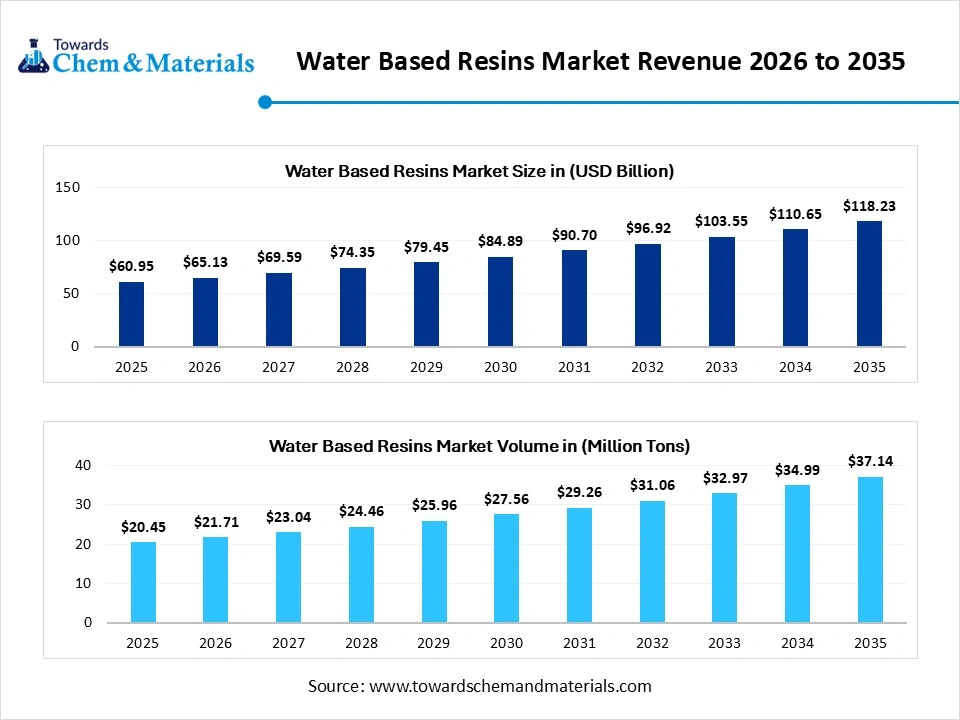
The water-based resins market is projected to grow from USD 60.95 billion in 2025 to USD 118.23 billion by 2035, registering a CAGR of 6.85% from 2026 to 2035, with 2026 estimated at USD 60.95 billion. In terms of volume, the market is expected to expand from 20.45 million tons in 2025 to 37.14 million tons by 2035, growing at a CAGR of 6.15%. This study provides in-depth segment analysis, regional market trends, and detailed company profiles, along with competitive landscape evaluation, value chain assessment, trade data insights, and comprehensive coverage of manufacturers and suppliers.
Content
Water-Based Resins Market Trends, Growth and Market Size Analysis
The global water-based resins market was valued at USD 60.95 billion in 2025, is estimated to reach USD 60.95 billion in 2026, and is projected to reach USD 118.23 billion by 2035, growing at a CAGR of 6.85% from 2026 to 2035. In terms of volume, the water-based resins market is projected to grow from 20.45 million tons in 2025 to 37.14 million tons by 2035. growing at a CAGR of 6.15% from 2026 to 2035.
Key Takeaways
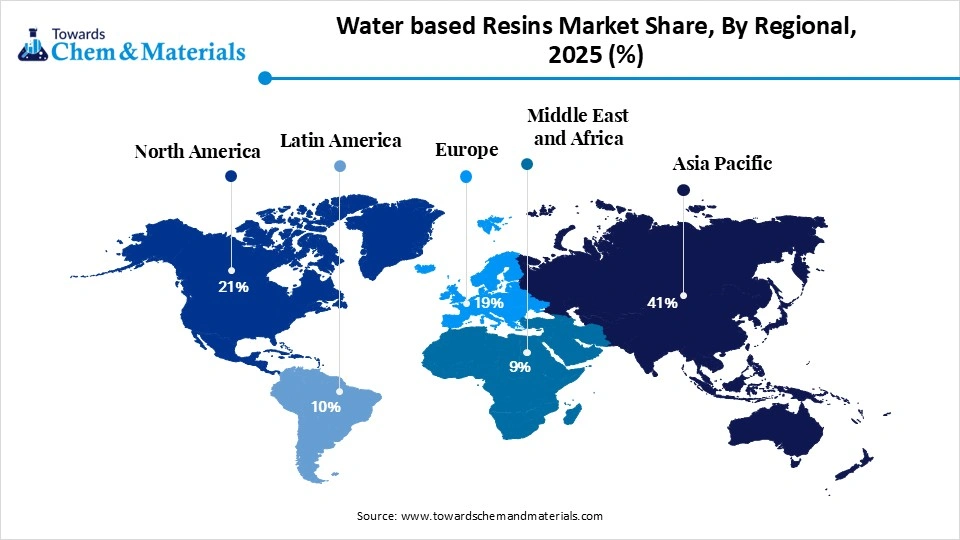
- By region, Asia Pacific dominated the market with a share of 41% in 2025 and is expected to be the fastest-growing region in the market, with a CAGR of 7.4% in the forecast period.
- By region, North America is notably growing with 21% market share in 2025.
- By resin type, the acrylic resin segment dominated the market with 38% share in 2025.
- By resin type, the polyurethane dispersions (PUD) segment held the 23% market share in 2025 and is expected to be the fastest-growing in the market, with a CAGR of 7.5% in the forecast period.
- By application, the paints and coatings segment dominated the market with 54% share in 2025.
- By application, the adhesives and sealants segment held the 16% market share in 2025 and is expected to be the fastest-growing in the market, with a CAGR of 7.3% in the forecast period.
- By end-use industry, the building and construction segment dominated the market with 36% share in 2025.
- By end-use industry, the automotive and transportation segment held the 16% market share in 2025 and is expected to be the fastest-growing in the market, with a CAGR of 7.2% in the forecast period.
- By solid content, the medium solid (40-60%) segment dominated the market with 46% share in 2025.
- By solid content, the high solid (>60%) segment held the 26% market share in 2025 and is expected to be the fastest-growing in the market, with a CAGR of 7.4% in the forecast period in 2025.
- By distribution channel, the direct sales (B2B) segment dominated the market with a 57% share in 2025.
- By distribution channel, retail/E-commerce segment held the 15% market share in 2025 and is expected to be the fastest-growing in the market, with a CAGR of 7.6% in the forecast period.
- By technology, the waterborne emulsion segment dominated the market with a 44% share in 2025.
- By technology, the waterborne dispersion segment held the 34% market share in 2025 and is expected to be the fastest-growing in the market, with a CAGR of 7.3% in the forecast period.
At a glance
- Market Estimated Size (2025): USD 60.95 Billion | CAGR (2026–2035): 6.85%
- Market Projected Size (2035): USD 118.23 Billion
- Market Volume (2025): 20.45 Million Tons | Volume CAGR (2026–2035): 6.15%
- Market Projected Volume (2035): 37.14 Million Tons
- Market Pricing (2025):
- Average Manufacturing Price (2025): USD 1,660 per ton
- Average Selling Price (2025): USD 2,160 per ton
- Pricing CAGR (2025–2035): 3.15%
Eco Resins Power Industrial Growth
The type of polymer material in which water is used as a primary carrier, instead of using any fossil fuel or organic solvents, is known as water-based resins. Also, the heavy demand from common applications, such as inks, coatings, and adhesives, is seen as a high-margin opportunity for manufacturers in recent years, as per the survey.
Water-Based Resins Market Trends:
- The greater focus on health and environmental safety has translated into financial prospects for producers in recent years. Also, several global regulatory bodies are observed in the middle of the implementation of stricter rules for toxic chemicals across the globe.
- The heavy expansion in the various application areas is elevating earning potential for producers in the current period. Also, earlier coatings and paints are primarily areas of water-based resins, but nowadays its being used in adhesives, printing inks, and wood finishes.
- The need for product performance improvement is expected to attract increased capital and investment in manufacturing during the forecast period. Also, the manufacturers are heavily investing in R&D programs for the better performance of water-based resins, which can lead to sales in the coming years as per the expectations.
Smarter Production Methods Transform Industry
The industry is actively experiencing a shift toward more advanced and efficient production technologies in the current period. Manufacturers are adopting improved formulation techniques to enhance product consistency and reduce development time. Also, there is a growing focus on creating multifunctional resins that can provide multiple benefits, such as durability, flexibility, and surface protection, within a single product.
Supply Chain Analysis of the Water-Based Resins Market:
Distribution to Industrial Users
- Water-based resins reach industrial plants through localized chemical hubs or direct refinery pipelines. Distribution involves high-volume packaging like lined steel drums or tote tanks to maintain purity.
- Success depends on rapid, climate-monitored transit, as these eco-friendly formulas are sensitive to thermal changes during the final delivery to manufacturing sites
Chemical Synthesis and Processing
- Synthesizing water-based resins involves polymerizing monomers within an aqueous medium using specialized surfactants to ensure stable dispersion. This controlled reaction creates microscopic particles suspended in water rather than solvents.
- Subsequent processing focuses on refining viscosity and pH levels, resulting in low-emission binders ready for sustainable industrial coatings and adhesives.
Regulatory Compliance and Safety Monitoring
- Manufacturers ensure safety by aligning water-based resin production with global standards like REACH and regional VOC limits. Strict monitoring protocols track chemical stability and toxicity profiles throughout the lifecycle.
- Comprehensive Safety Data Sheets guide handling, while regular laboratory testing verifies that final formulations meet rigorous environmental and workplace health regulations.
Water-Based Resins Market Regulatory Landscape: Regulations
| Country Region | Regulatory Body | Key Regulations | Focus Areas |
| United States | Environmental Protection Agency (EPA) | 40 CFR Part 59: National Volatile Organic Compound (VOC) Emission Standards for architectural and industrial coatings. | Limiting VOC and hazardous air pollutant (HAP) emissions to reduce photochemical smog, and ensuring chemical migration safety in food-contact materials. |
| Europe | European Commission | REACH (Regulation (EC) No 1907/2006): Governs the registration, evaluation, and authorisation of all chemical substances. | High-level human health and environmental protection through rigorous substance registration and standardized hazard communication (GHS) |
| China | State Administration for Market Regulation (SAMR) | GB 33372-2020: Limits for volatile organic compounds content in adhesives. | Aggressive reduction of industrial VOCs to combat air pollution and enforcing mandatory national safety standards for consumer-facing products. |
Market Dynamics
Driver
Clean Demand Accelerates Market Transition
The growing need for safer and cleaner materials is driving the industry's potential in the current period. Also, governments are setting stricter rules to reduce harmful emissions, which pushes industries to move away from solvent-based products.
Restraint
Performance Barriers Affect Market Expansion
The performance limitations in certain conditions are likely to create growth barriers for manufacturers in the coming years. Also, water-based resins have improved; they may still face challenges in extreme weather or high chemical exposure compared to solvent-based alternatives.
Opportunity
Emerging Applications Boost Resin Market Growth
The continuous improvement and new applications are anticipated to create lucrative opportunities for the manufacturer during the projected period. Also, one major opportunity in developing high-performance resins that match or exceed traditional materials. There is also growing demand in emerging sectors such as eco-friendly packaging and green buildings.
Segmental Insights
Resin Type Insights
The Acrylic Resin Segment Dominated the Water-Based Resins Market with 38% Market Share in 2025.
The acrylic resin segment dominated the market with 38% share in 2025, as continuous improvement and new applications. One major opportunity lies in developing high-performance resins that match or exceed traditional materials. There is also growing demand in emerging sectors such as eco-friendly packaging and green buildings.
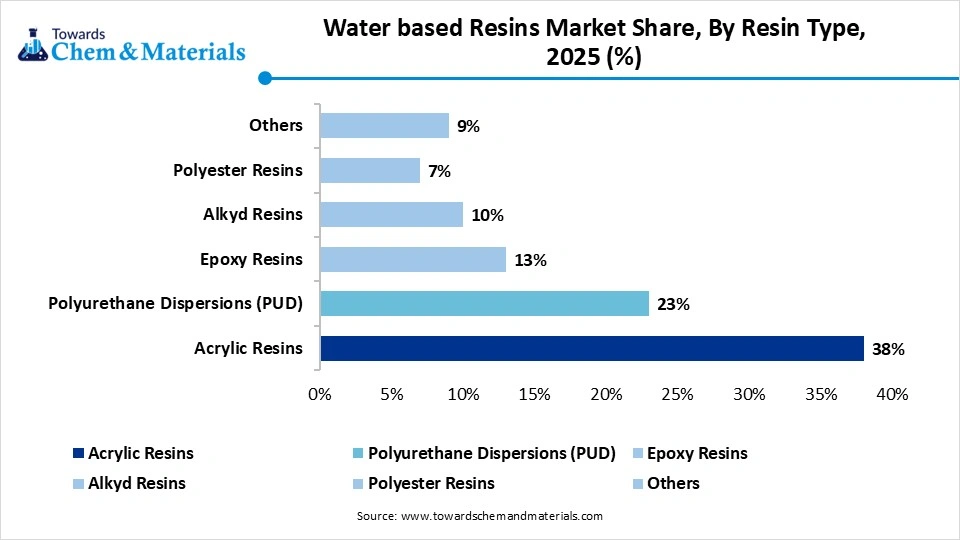
The polyurethane dispersions (PUD) segment held the 23% market share in 2025 and is expected to be the fastest-growing in the market, with a CAGR of 7.5% in the forecast period, owing to their superior performance. They offer high flexibility, strong adhesion, and excellent resistance to chemicals and abrasion. These properties make them suitable for demanding applications such as automotive coatings and industrial finishes. As industries look for materials that integrate durability with environmental safety, polyurethane dispersions offer a strong solution.
Application Insights
The Paints and Coatings Segment Dominated the Market with 54% Market Share in 2025
The paints and coatings segment dominated the market with 54% share in 2025 because they are the largest and most consistent users of water-based resins. These materials are essential for protecting and finishing surfaces in buildings, vehicles, and equipment. Water-based resins are especially suitable for this application due to their low odor and environmental safety.
Water based Resins Market Share, By Application, 2025 (%)
| By Application | Revenue Share, 2025 (%) |
| Paints & Coatings | 54% |
| Adhesives & Sealants | 16% |
| Inks | 9% |
| Textile Finishing | 7% |
| Paper & Paperboard Coatings | 8% |
| Construction Chemicals | 6% |
The adhesives and sealants segment held the 16% market share in 2025 and is expected to be the fastest-growing in the market, with a CAGR of 7.3% in the forecast period, due to increasing demand in packaging, construction, and automotive industries. These applications require materials that are strong, flexible, and safe to use. Water-based resins are well-suited for this purpose, especially as industries shift toward environmentally friendly solutions.
End-Use Industry Insights
The Building and Construction Segment Dominated the Water-Based Resins Market with 36% Market Share in 2025
The building and construction segment dominated the market with 36% share in 2025, as it uses large volumes of paints, coatings, and sealants. Water-based resins are widely used in walls, floors, and protective coatings due to their safety and ease of application. Rapid urbanization and infrastructure development have increased demand for such materials.
Water based Resins Market Share, By End-Use Industry, 2025 (%)
| By End-Use Industry | Revenue Share, 2025 (%) |
| Building & Construction | 36% |
| Automotive & Transportation | 16% |
| Packaging | 14% |
| Textile Industry | 11% |
| Electronics | 8% |
| Furniture & Wood Coatings | 9% |
| General Industrial | 6% |
The automotive and transportation segment held the 16% market share in 2025 and is expected to be the fastest-growing in the market, with a CAGR of 7.2% in the forecast period, due to the increasing demand for high-performance and eco-friendly coatings. Vehicles require coatings that provide protection, durability, and aesthetic appeal. Water-based resins are becoming more suitable for these needs due to improved technology.
Solid Content Insights
The Medium Solid (40-60%) Segment Dominated the Market with 46% Market Share in 2025
The medium solid (40-60%) segment dominated the market with 46% share in 2025 owing to they offer a balance between performance and ease of application. They are not too thick, which makes them easier to handle and apply in different processes. At the same time, they provide sufficient coverage and durability for most applications.
Water based Resins Market Share, By Solid Content, 2025 (%)
| By Solid Content | Revenue Share, 2025 (%) |
| Low Solid (<40%) | 28% |
| Medium Solid (40–60%) | 46% |
| High Solid (>60%) | 26% |
The high solid (>60%) segment held the 26% market share in 2025 and is expected to be the fastest-growing in the market, with a CAGR of 7.4% in the forecast period in 2025, because they contain more active material and less water. This means better coverage, fewer layers, and improved efficiency. They also help reduce emissions and waste, which supports environmental goals.
Distribution Channel Insights
The Direct Sales (B2B) Segment Dominated the Market with 57% Market Share in 2025
The direct sales (B2B) segment dominated the market with a 57% share in 2025, owing to many buyers prefer to deal directly with manufacturers. This allows better communication, customized solutions, and technical support. Large industries often require specific formulations, which are easier to obtain through direct interaction. It also helps in maintaining a consistent supply and quality.
Water based Resins Market Share, By Distribution Channel, 2025 (%)
| By Distribution Channel | Revenue Share, 2025 (%) |
| Direct Sales (B2B) | 57% |
| Distributors & Wholesalers | 28% |
| Retail / E-commerce | 15% |
The retail/E-commerce segment held the 15% market share in 2025 and is expected to be the fastest-growing in the market, with a CAGR of 7.6% in the forecast period, due to buying behavior is changing. Small businesses and individual users now prefer easy and quick purchasing options. Online platforms allow customers to compare products, check specifications, and place orders conveniently.
Technology Insights
The Waterborne Emulsion Segment Dominated the Market with 44% Market Share in 2025
The waterborne emulsion segment dominated the market with a 44% share in 2025, owing to its simplicity, stability, and cost-effectiveness. It allows resins to be easily mixed with water and applied without complex processes. This technology is widely used in paints and coatings, where consistent performance is important.
Water based Resins Market Share, By Technology, 2025 (%)
| By Technology | Revenue Share, 2025 (%) |
| Waterborne Emulsion | 44% |
| Waterborne Dispersion | 34% |
| Waterborne Solution | 22% |
The waterborne dispersion segment held the 34% market share in 2025 and is expected to be the fastest-growing in the market, with a CAGR of 7.3% in the forecast period, owing to it offers better control over particle size and performance. This results in improved durability, strength, and finish quality. It is particularly useful for high-performance applications where standard emulsions may not be sufficient.
Regional Insights
How will Asia Pacific Dominate the Water-Based Resins Market in 2025?
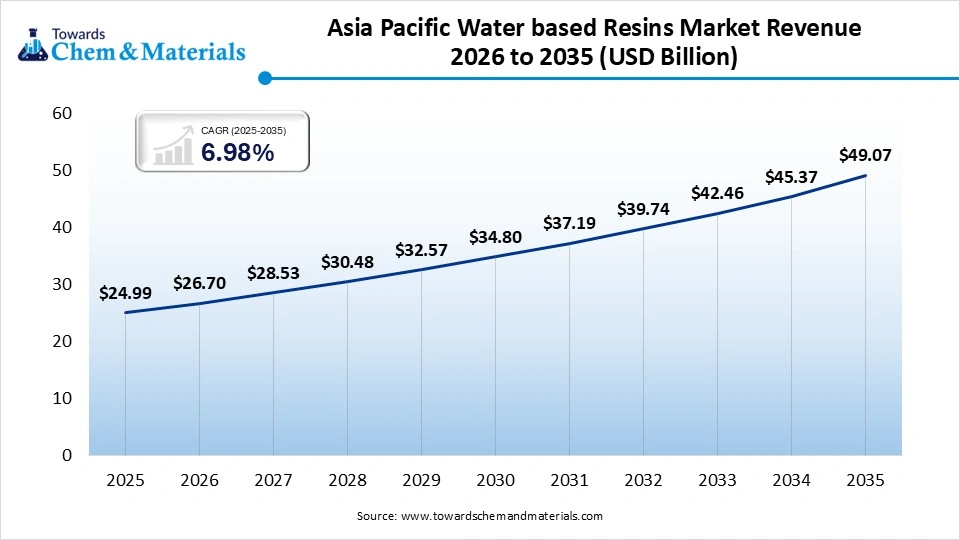
The Asia Pacific water-based resins market size was estimated at USD 24.99 billion in 2025 and is projected to reach USD 49.07 billion by 2035, growing at a CAGR of 6.98% from 2026 to 2035 Countries in this region are investing heavily in construction, infrastructure, and manufacturing. This increases the demand for paints, coatings, and adhesives. In addition, population growth and rising income levels support higher consumption of housing and consumer goods.
Strong Industry Keeps China Ahead
China maintained its dominance in the market, owing to its large industrial base. It has strong demand from the construction, automotive, and manufacturing sectors. The country is also focusing on reducing pollution, which supports the use of water-based resins. Local production capacity is high, allowing both domestic use and exports.
Water-Based Resins Market Evaluation in North America
North America is notably growing with 21% market share in 2025, owing to a strong focus on innovation and environmental standards. The region has strict regulations that encourage the use of low-emission materials. Companies are investing in research and development to create advanced resin technologies.
Advanced United States Industry Fuels Resin Expansion
United States is expected to emerge as a prominent country for the water-based resins market in the coming years, due to its advanced industrial structure. It has strong demand from the automotive, construction, and packaging industries. The country is also a leader in technological development, which supports innovation in water-based resins. Environmental regulations are strict, encouraging companies to adopt safer materials.
Recent Development
- In November 2025, SABIC introduced their latest product line of resin and a newly launched resin called NORYLTM. Also, this resin ate specifically designed for the water management applications with consideration of the upcoming expected butadine-free regulation.
Top Vendors in the Water-Based Resins Market & Their Offerings:
- BASF SE: Based in Germany, BASF is a global leader in water-based resin innovation, focusing on high-performance dispersions for coatings and adhesives. The company prioritizes sustainability through its "ChemCycling" and biomass balance approaches, offering a vast portfolio of acrylic and polyurethane resins that help industrial clients meet strict environmental and performance standards.
- Dow Inc.: A powerhouse in material science, Dow provides a comprehensive range of water-borne acrylic and epoxy resins primarily under the DOWSHTIELD and MAINCOTE brands. The U.S.-based company focuses on developing low-VOC solutions that enhance durability and corrosion resistance, serving diverse sectors from architectural paints to heavy-duty industrial infrastructure.
- Arkema S.A.: France’s Arkema specializes in advanced specialty materials, offering extensive water-based resin solutions through its Encor and Rheotech product lines.
Water-Based Resins Market Key Players
- Allnex GMBH
- Covestro AG
- The Lubrizol Corporation
- DIC Corporation
- Evonik Industries AG
Water-Based Resins Market Segments Covered in the Report
By Resin Type
- Acrylic Resins
- Pure Acrylic
- Styrene Acrylic
- Modified Acrylic
- Polyurethane Dispersions (PUD)
- Aliphatic PUD
- Aromatic PUD
- Epoxy Resins
- Waterborne Epoxy Esters
- Waterborne Epoxy Adducts
- Alkyd Resins
- Short Oil Alkyds
- Medium Oil Alkyds
- Long Oil Alkyds
- Polyester Resins
- Saturated Polyester
- Unsaturated Polyester
- Others
- Vinyl Resins
- Hybrid Resins
By Application
- Paints & Coatings
- Architectural Coatings
- Interior Coatings
- Exterior Coatings
- Industrial Coatings
- Protective Coatings
- Automotive Coatings
- Architectural Coatings
- Adhesives & Sealants
- Pressure Sensitive Adhesives
- Structural Adhesives
- Inks
- Printing Inks
- Packaging Inks
- Textile Finishing
- Paper & Paperboard Coatings
- Construction Chemicals
By End-Use Industry
- Building & Construction
- Automotive & Transportation
- Packaging
- Textile Industry
- Electronics
- Furniture & Wood Coatings
- General Industrial
By Solid Content
- Low Solid (<40%)
- Medium Solid (40–60%)
- High Solid (>60%)
By Distribution Channel
- Direct Sales (B2B)
- Distributors & Wholesalers
- Retail / E-commerce
By Technology
- Waterborne Dispersion
- Waterborne Solution
- Waterborne Emulsion
By Regions
- North America:
- U.S.
- Canada
- Mexico
- Rest of North America
- Latin America:
- Brazil
- Argentina
- Rest of Latin America
- Europe:
- Western Europe
- Germany
- Italy
- France
- Netherlands
- Spain
- Portugal
- Belgium
- Ireland
- UK
- Iceland
- Switzerland
- Poland
- Rest of Western Europe
- Eastern Europe
- Austria
- Russia & Belarus
- Türkiye
- Albania
- Rest of Eastern Europe
- Asia Pacific:
- China
- Taiwan
- India
- Japan
- Australia and New Zealand,
- ASEAN Countries (Singapore, Malaysia)
- South Korea
- Rest of APAC
- MEA:
- GCC Countries
- Saudi Arabia
- United Arab Emirates (UAE)
- Qatar
- Kuwait
- Oman
- Bahrain
- South Africa
- Egypt
- Rest of MEA
- MEA:
FAQ's
Question 1 : What is the current size of the water-based resins market?
Answer : The global market was valued at USD 60.95 billion in 2025 and is projected to reach USD 118.23 billion by 2035, growing at a CAGR of 6.85%.
Question 2 : Which region dominates the water-based resins market?
Answer : Asia Pacific leads the market with a 41% share in 2025 and is also the fastest-growing region, driven by rapid industrialization and infrastructure development.
Question 3 : Which resin type holds the largest market share?
Answer : Acrylic resins dominate the market with a 38% share, owing to their versatility and wide usage in coatings and adhesives.
Question 4 : Which resin segment is expected to grow the fastest?
Answer : Polyurethane dispersions (PUDs) are projected to grow the fastest, with a CAGR of 7.5%, due to their superior durability, flexibility, and chemical resistance.
Question 5 : Which end-use industry consumes the most water-based resins?
Answer : The building and construction sector leads with a 36% market share, driven by demand for paints, coatings, and sealants.
Meet the Team

Saurabh Bidwai
Principal Consultant
Saurabh Bidwai, a B.Tech Chemical Engineering graduate with 4+ years of experience, specializes in specialty chemicals, commodity chemicals, and engineered materials, offering valuable insights into market trends and emerging opportunities.

Aditi Shivarkar
Reviewed By
Aditi Shivarkar, with 14+ years in Chemical and Materials market research, specializes in Chemical and Materials. She ensures accurate, actionable insights, driving Towards Chemicals And Materials Analytics and Consulting excellence in industry trends and sustainability.