
Wire and Cable Polymer Market Size, Share, Growth, Report 2026 to 2035
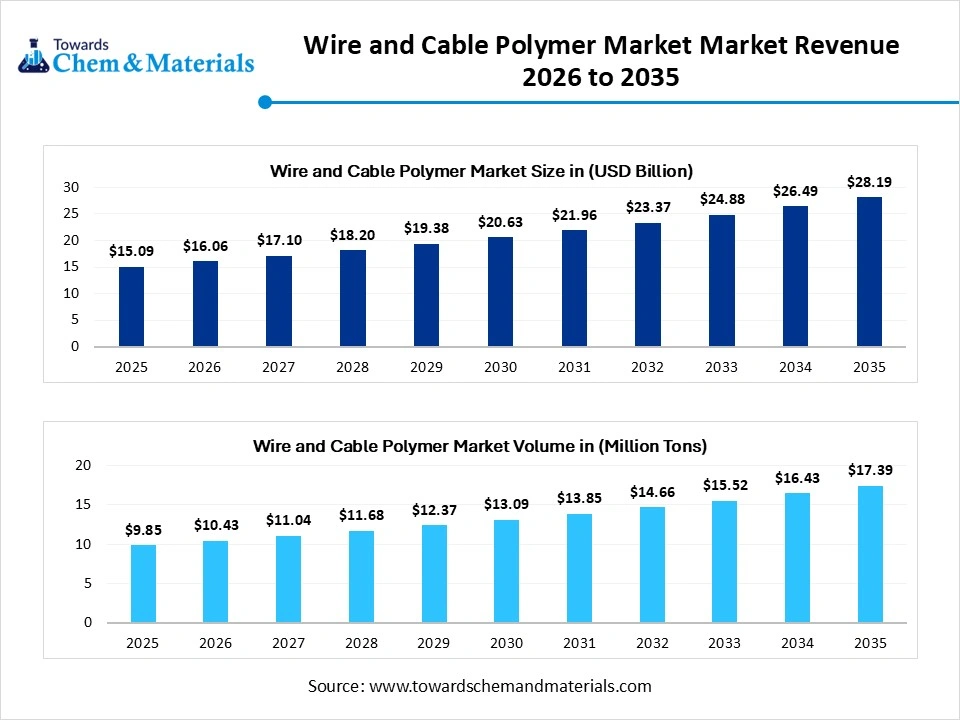
The wire and cable polymer market is expected to witness steady growth, expanding from USD 16.06 billion in 2026 to USD 28.19 billion by 2035 at a CAGR of 6.45%. This study includes in-depth market size evaluation, segmentation data across various polymer types and applications, and regional performance insights. Additionally, it provides analysis of leading companies, competitive positioning, value chain structure, trade statistics, and a comprehensive overview of manufacturers and suppliers driving industry expansion.
Content
Wire and Cable Polymer Market Size, Share, Trends and Forecast Analysis
The global wire and cable polymer market size was estimated at USD 15.09 billion in 2025 and is expected to be worth around USD 28.19 billion by 2035, exhibiting a compound annual growth rate (CAGR) of 6.45% over the forecast period from 2026 to 2035.In terms of volume the wire and cable polymer market is projected to grow from 9.85 million tons in 2025 to 17.39 million tons by 2035. growing at a CAGR of 5.85% from 2026 to 2035. The report provides complete insights into market size, detailed segment-wise data by material type, application, and end-use industry, along with comprehensive regional analysis across major markets. It also covers key company profiles, competitive landscape, value chain analysis, trade data, and detailed information on manufacturers and suppliers, highlighting the growing demand for durable and fire-resistant materials.
Key Takeaways
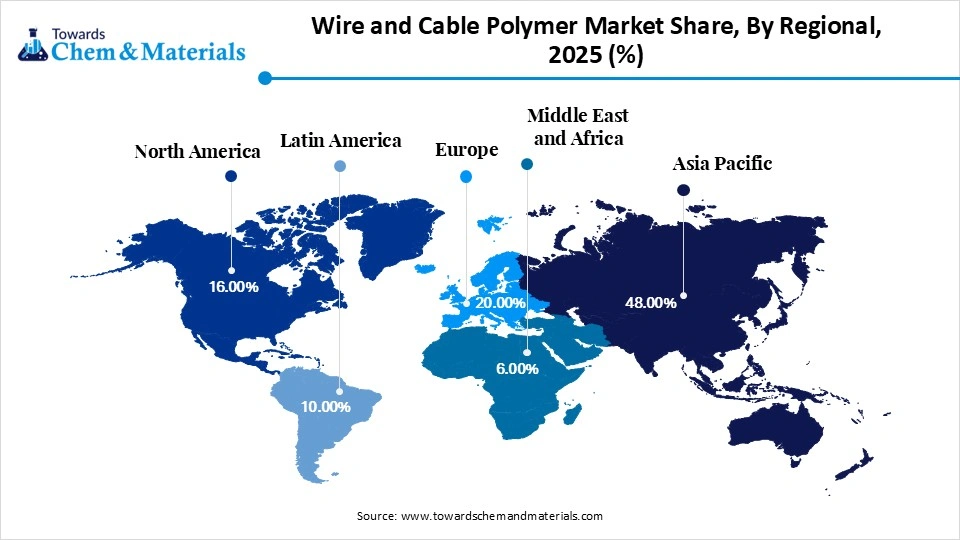
- By region, Asia Pacific dominated the wire and cable polymer market in 2025, with 48% share expected to sustain its position while growing with a CAGR of 7.2% in the forecast period, due to rapid development in infrastructure and industry.
- By region, Europe held the second largest share of 20% in 2025 and expects notable growth with a CAGR of 5.80% during the forecast period, due to its focus on improving quality and upgrading systems.
- By polymer type, the PVC segment dominated the market with 38% share in 2025, owing to it gives a very practical balance between cost, performance, and ease of use.
- By polymer type, the XLPE segment expects the fastest growth in the market with 7.2% CAGR during the forecast period, owing to it can handle higher stress compared to traditional materials.
- By voltage type, the low voltage segment dominated the market with 44% share in 2025, owing to they are used in everyday life on a very large scale.
- By voltage type, the extra high voltage segment expects the fastest growth in the market with 7.5% CAGR during the forecast period, due to countries' focus on efficient long-distance power transmission.
- By application, the power transmission & distribution segment dominated the market with 40% share in 2025, owing to it forms the backbone of the entire electricity system. From generation to final use, every step requires cables.
- By application, the automotive segment expects the fastest growth in the market with 7.5% CAGR during the forecast period, due to vehicles becoming more advanced and electric.
- By insulation type, the thermoplastic insulation segment dominated the market with 58% share in 2025, owing to its easy processing and cost-effectiveness.
- By insulation type, the thermoset insulation segment expects the fastest growth in the market with 7.1% CAGR during the forecast period due its performance in tough conditions.
Market Size and Volume Forecast
- Market Size (2025): USD 15.09 Billion | CAGR (2026–2035): 6.45%
- Market Projected Size (2035): USD 28.19 Billion
- Market Volume (2025): 9.85 Million Tons (MT) | Volume CAGR (2026–2035): 5.85%
- Market Projected Volume (2035): 17.39 Million Tons (MT)
- Market Pricing (2025):
- Average Manufacturing Price: USD 1,680/Ton
- Average Selling Price: USD 2,090/Ton
- Pricing CAGR (2025–2035): 3.95%
Essential Polymers Powering Safe Cable Systems
The type of plastic which is primarily used for covering electrical wires for their safety and proper working is known as the wire and cable polymer. Moreover, by stopping electricity leakage while protecting wires from water, heat, and dust, the wire and cable polymer gained major industry attention in recent years. Also, these wires are very flexible and affordable, as per the recent observation.
Wire and Cable Polymer Market Trends
- The greater shift towards the smarter material, not only durable, has driven strategic transformation and sectoral scalability in recent years. Also, several major firms have been actively seen in choosing reliable and smart materials instead of cheap materials in the past few years.
- The heavy transition to sustainable and eco-friendly materials has allowed the stakeholders to capitalize on growth opportunities in the current period. Also, several companies are observed shifting towards materials that create less pollution and are easier to recycle nowadays.
- The increasing demand from unexpected industries, such as earlier, the wires and cable polymers were mainly used by the electricity and construction industry, but in recent years, automobiles, like electric vehicles, are heavily demanding these polymers for their internal wiring works as per the recent industry survey.
From Protection to Active Cable Safety
Materials are being developed to behave more actively in the current period. Also, the thinking is to make cables safer in real-life situations, not just in testing. Moreover, this is a big shift because now materials are designed based on real-world problems. Also, the polymers are slowly moving from just protection to active safety support, which makes cables more reliable in critical situations.
Supply Chain Analysis of the Wire and Cable Polymer Market
Distribution to Industrial Users
- Industrial users receive wire and cable polymers primarily through bulk resin distributors and specialized chemical suppliers. These materials, such as PVC, PE, and XLPE, are delivered in gaylords, silos, or bags for use in high-speed extrusion lines.
- Distribution focuses on providing technical grades that meet specific electrical insulation, flame retardancy, and durability standards.
Chemical Synthesis and Processing
- Wire and cable polymers are synthesized via polymerization of monomers like ethylene or vinyl chloride. Processing involves compounding base resins with additives, antioxidants, flame retardants, and UV stabilisers to enhance performance.
- This material is then fed into extruders, where it is melted and pressure-coated onto metal conductors to create durable insulation.
Regulatory Compliance and Safety Monitoring
- Wire and cable polymers must meet strict UL, CSA, and IEC standards for electrical insulation and flame retardancy. Compliance monitoring involves rigorous testing for smoke emission, toxicity, and heat resistance. Manufacturers also adhere to RoHS and REACH regulations to ensure materials are free from hazardous substances like lead or cadmium.
Wire and Cable Polymer Market Regulatory Landscape: Regulations
| Country Region | Regulatory Body | Key Regulations | Focus Areas |
| United States | National Fire Protection Association (NFPA) | NFPA 70 (National Electrical Code - NEC): The primary standard for electrical installations. | Flame spread, smoke density (Plenum vs. Riser ratings), and chemical restrictions under TSCA Section 6(h). |
| Europe | European Chemicals Agency (ECHA) | Construction Products Regulation (CPR - EU No 305/2011): Mandatory for cables permanently installed in buildings | Standardised Euroclasses (A to F) for fire reaction, acidity of gases, and environmental sustainability |
| China | State Administration for Market Regulation (SAMR) | GB/T 19666: The core standard for "General rules for flame retardant and fire resistant wires and cables. | Mandatory China Compulsory Certificate (CCC) for safety, flame retardancy, and public safety in high-density urban infrastructure. |
Segmental Insights
Polymer Type Insights
The PVC Segment Dominated the Wire and Cable Polymer Market with 38% Market Share in 2025
The PVC segment dominated the market with 38% share in 2025, owing to it gives a very practical balance between cost, performance, and ease of use. Also, most manufacturers prefer materials that are easy to process and don’t increase production complexity, and PVC fits perfectly. It provides good insulation, decent flexibility, and basic safety features that are enough for daily applications like home wiring and small industries.
The XLPE segment is expected to be the fastest-growing in the market, with 7.2% CAGR during the forecast period. It can handle higher stress compared to traditional materials. It performs well under high temperature and voltage, which makes it suitable for modern power systems. As infrastructure becomes more advanced, the need for durable and stable materials is increasing.
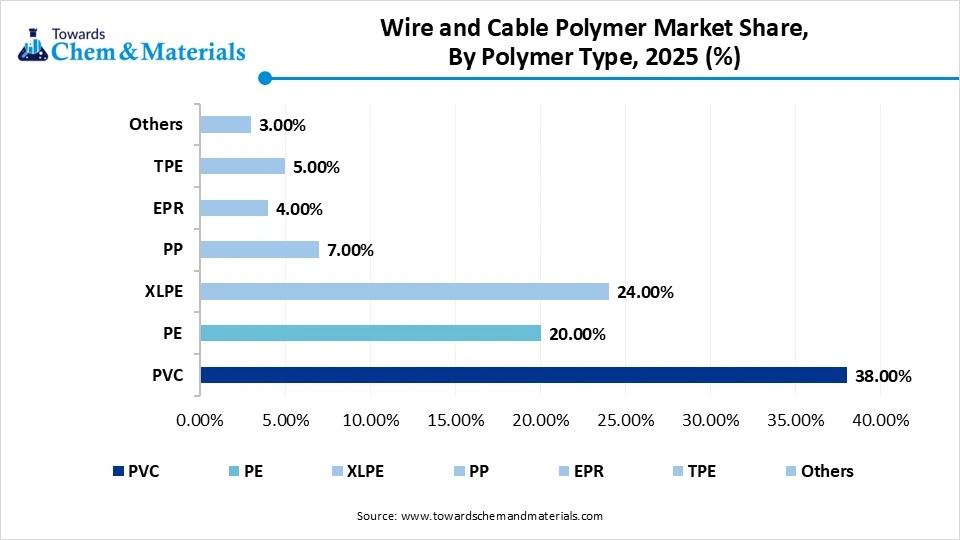
The PE segment held the third largest share of 20% in 2025 due to its performance in applications where signal quality matters. It allows smooth transmission of data with very low loss, which makes it ideal for communication cables. It is also lightweight and resistant to moisture, helping cables last longer in outdoor conditions.
PP segment held the fourth largest share of 6% in 2025, owing to its usefulness in specific applications, but not as widely used as other polymers. It offers good chemical resistance and is lightweight, which makes it suitable for certain industrial uses. However, it does not provide the same level of flexibility or broad usability as PVC or PE. Still, it plays an important supporting role in the market where its properties match the requirements.
Wire and Cable Polymer Market Share, By Polymer Type, 2025 (%)
| By Polymer Type | Revenue Share, 2025 (%) |
| PVC | 38.00% |
| PE | 20.00% |
| XLPE | 24.00% |
| PP | 7.00% |
| EPR | 4.00% |
| TPE | 5.00% |
| Others | 3.00% |
Voltage Type Insights
The Low Voltage Segment Dominated the Market with 44% Market Share in 2025
The low voltage segment dominated the market with 44% share in 2025, owing to they are used in everyday life on a very large scale. Every home, office, and small business needs wiring for lighting and appliances. This creates continuous and high demand. Even though each cable is small, the total volume is huge. It is also easy to install and widely required across all regions.
The medium voltage segment held the second largest share of 28% in 2025 due to they are essential for distributing electricity within cities and industrial areas. They connect substations to different parts of the network, ensuring a stable power supply. As urban areas grow and industries expand, the need for such cables increases steadily.
High voltage segment held the third largest share of 18% in 2025 due to they are used for long-distance transmission of electricity, especially between power plants and major grid systems. These projects are large but fewer in number, which keeps the overall volume lower compared to other segments.
The extra high voltage segment is expected to be the fastest-growing in the market, with 7.5% CAGR during the forecast period, as countries are focusing on efficient long-distance power transmission. As energy demand increases and renewable energy projects expand, there is a need to move electricity with minimal loss. These cables help improve efficiency and support large-scale networks.
Wire and Cable Polymer Market Share, By Voltage Type, 2025 (%)
| By Voltage Type | Revenue Share, 2025 (%) |
| Low Voltage | 44.00% |
| Medium Voltage | 28.00% |
| High Voltage | 18.00% |
| Extra High Voltage | 10.00% |
Application Insights
The Power Transmission & Distribution Segment Dominated the Wire and Cable Polymer Market with 40% Market Share in 2025
The power transmission & distribution segment dominated the market with 40% share in 2025, owing to it forms the backbone of the entire electricity system. From generation to final use, every step requires cables. Continuous demand for electricity in homes, industries, and cities keeps this segment strong. It also includes maintenance and expansion of existing networks, which adds to demand.
Telecommunication held the second largest share of 20% in 2025, owing to modern life depends heavily on connectivity. Internet, mobile networks, and digital services all require reliable cable systems. As data usage increases, the need for high-quality cables also grows. These cables must maintain signal strength and speed, which increases demand for good polymers.
The automotive segment is expected to be the fastest-growing in the market with 7.5% CAGR during the forecast period due to vehicles becoming more advanced and electric. Modern cars use complex wiring systems for batteries, sensors, and electronic features. As electric vehicles increase, the demand for high-performance cables also rises.
The building and construction segment held the fourth largest share of 12% in 2025, owing to its steady but stable demand. Every building requires wiring, which keeps the need consistent. However, its growth is not as fast as sectors like telecom or automotive. It mainly depends on construction activity, which grows at a regular pace.
Wire and Cable Polymer Market Share, By Application 2025 (%)
| By Application | Revenue Share, 2025 (%) |
| Power Transmission & Distribution | 40.00% |
| Telecommunications | 20.00% |
| Automotive | 14.00% |
| Building & Construction | 12.00% |
| Industrial | 9.00% |
| Others | 5.00% |
Insulation Type Insights
The Thermoplastic Insulation Segment Dominated the Market with 58% Market Share in 2025
The thermoplastic insulation segment dominated the market with 58% share in 2025, owing to its easy processing and cost-effectiveness. Manufacturers can produce cables quickly using these materials, which helps in large-scale production. It also provides good flexibility and performance for normal applications.
The thermoset insulation segment is expected to be the fastest-growing in the market with 7.1% CAGR during the forecast period, due to its performance in tough conditions. It can handle higher temperatures and does not easily lose shape under stress. This makes it suitable for advanced and high-performance applications. As industries move towards stronger systems, demand for such materials increases.
Wire and Cable Polymer Market Share, By Insulation Type 2025 (%)
| By Insulation Type | Revenue Share, 2025 (%) |
| Thermoplastic Insulation | 58.00% |
| Thermoset Insulation | 42.00% |
Regional Insights
How will Asia Pacific Dominate the Wire and Cable Polymer Market in 2025?
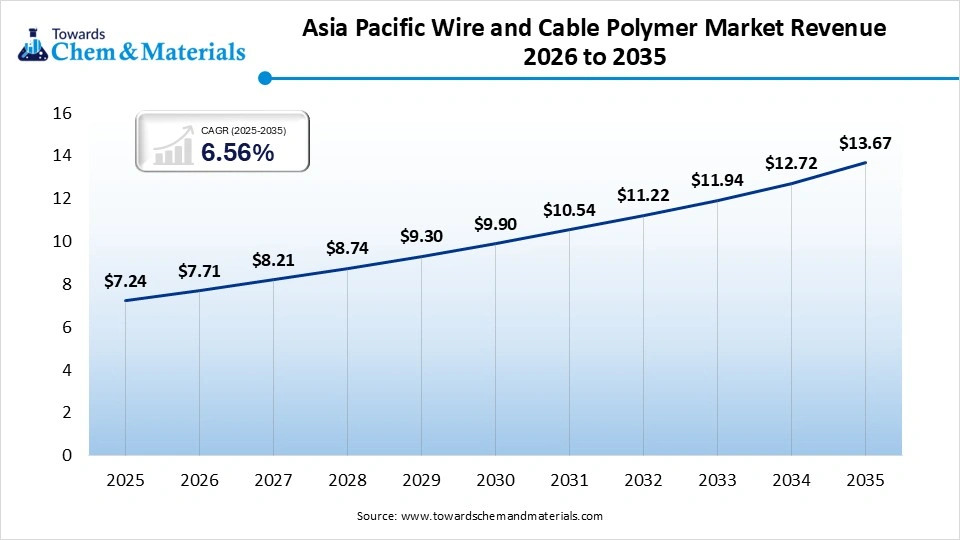
The Asia Pacific wire and cable polymer market size was estimated at USD 7.24 billion in 2025 and is projected to reach USD 13.67 billion by 2035, growing at a CAGR of 6.56% from 2026 to 2035. Asia Pacific dominated the market with a share of 48% in 2025 owing to rapid development in infrastructure and industry. Many countries in this region are building power systems, communication networks, and urban areas at a fast pace. This creates huge demand for cables and related materials. Large population and increasing electricity needs also support growth.
China Dominating Cable Production and Demand
China maintained its dominance in the market, owing to its production and use of a large amount of cables. It has strong manufacturing capabilities and invests heavily in infrastructure projects. The country is continuously expanding its power and communication networks, which increases demand. It also supplies materials to other regions. In simple words, China plays both roles, producer and consumer.
Wire and Cable Polymer Market Evaluation in Europe
Europe held the second largest share of 20% in 2025 and expects notable growth with a CAGR of 5.80% during the forecast period, owing to its focus on improving quality and upgrading systems. Many countries are modernizing their infrastructure and adopting better technologies. There is also strong awareness about safety and performance, which increases demand for advanced materials.
Germany Driving Future Cable Innovation
Germany is expected to emerge as a prominent country for the wire and cable polymer market in the coming years, due to its strong industrial and technological base. It is known for high-quality manufacturing and innovation. The country is active in sectors like automotive and energy, which require advanced cable systems. It also focuses on efficient and reliable solutions.
Wire and Cable Polymer Market Share, By Regional, 2025 (%)
| Regional | Revenue Share, 2025 (%) |
| Asia-Pacific | 48.00% |
| Europe | 20.00% |
| North America | 16.00% |
| Latin America | 10.00% |
| Middle East & Africa | 6.00% |
Recent Developments
- In April 2026, SIKORA introduced its latest solution for the wire and cable industries, which includes the LASER PRO diameter measurement series, the LM PRO length measuring system, and the X-RAY 6000 measurement system. This solution is specifically designed to increase product efficiency while improving quality control, as per the company's claim.
- In June 2025, the Premix, Maillefer, and LyondellBasell have created a strategic collaboration in recent years. Also, the aim behind this partnership establishment is to create polypropylene-based power cable solutions as per the published report. Also, the Premix has PRE-ELEC® PP18220 while LYB stands with their Catalloy Hifax CA 7910A, and Maillefer ensures reliability as per the observations.
Top Vendors in the Wire and Cable Polymer Market & Their Offerings:
- Dow Inc.: A global leader in materials science, Dow provides high-performance polyethylene resins and wire and cable compounds. Their flagship ENDURITY™ and SI-LINK™ brands focus on medium-to-high voltage insulation. Dow’s expertise lies in cross-linking technologies and sustainable polymer solutions that enhance grid reliability and long-term cable durability.
- Borealis AG: Based in Austria, Borealis specializes in polyolefins for the energy and communications sectors. They are renowned for their Borstar® and Borlink™ technologies, which set industry standards for HVDC (High Voltage Direct Current) cable insulation. Their focus is on advancing the "EverMinds" circular economy through recyclable polymer grades.
- BASF SE: The world’s largest chemical producer, BASF supplies high-performance engineering plastics and additives for the cable industry. Key offerings include polyurethanes (TPU) for flexible, abrasion-resistant jacketing and flame-retardant additives. Their products are essential for automotive wiring, industrial automation, and harsh-environment cabling applications.
- SABIC: Headquartered in Saudi Arabia, SABIC provides a vast portfolio of polyethylenes, polypropylenes, and specialty resins like LEXAN™ and ULTEM™. Their wire and cable solutions prioritize flame retardancy and heat resistance. SABIC is a major supplier for telecommunications, consumer electronics, and renewable energy infrastructure projects globally.
Wire and Cable Polymer Market Key Players
- Solvay S.A. (Syensqo)
- Arkema SA
- ExxonMobil Corporation
- LG Chem Ltd.
- LyondellBasell Industries N.V.
- Avient Corporation
Wire and Cable Polymer Market Segments Covered in the Report
By Polymer Type
- Polyvinyl Chloride (PVC)
- Plasticized PVC
- Unplasticized PVC
- Polyethylene (PE)
- Low-Density Polyethylene (LDPE)
- High-Density Polyethylene (HDPE)
- Linear Low-Density Polyethylene (LLDPE)
- Cross-linked Polyethylene (XLPE)
- Polypropylene (PP)
- Ethylene Propylene Rubber (EPR)
- Thermoplastic Elastomers (TPE)
- Others
- Fluoropolymers
- Silicone Rubber
By Voltage Type
- Medium Voltage
- High Voltage
- Extra High Voltage
By Application
- Power Transmission & Distribution
- Overhead Cables
- Underground Cables
- Submarine Cables
- Telecommunications
- Fiber Optic Cables
- Copper Communication Cables
- Automotive
- EV Wiring
- Conventional Vehicles
- Building & Construction
- Residential Wiring
- Commercial Wiring
- Industrial
- Machinery
- Oil & Gas
- Others
- Aerospace
- Marine
By End-Use
- Energy & Power
- Telecommunications
- Automotive
- Construction
- Industrial Manufacturing
- Oil & Gas
- Others
By Insulation Type
- Thermoplastic Insulation
- Thermoset Insulation
By Region
- North America:
- U.S.
- Canada
- Mexico
- Rest of North America
- Latin America:
- Brazil
- Argentina
- Rest of Latin America
- Europe:
- Western Europe
- Germany
- Italy
- France
- Netherlands
- Spain
- Portugal
- Belgium
- Ireland
- UK
- Iceland
- Switzerland
- Poland
- Rest of Western Europe
- Eastern Europe
- Austria
- Russia & Belarus
- Türkiye
- Albania
- Rest of Eastern Europe
- Asia Pacific:
- China
- Taiwan
- India
- Japan
- Australia and New Zealand,
- ASEAN Countries (Singapore, Malaysia)
- South Korea
- Rest of APAC
- MEA:
- GCC Countries
- Saudi Arabia
- United Arab Emirates (UAE)
- Qatar
- Kuwait
- Oman
- Bahrain
- South Africa
- Egypt
- Rest of MEA
- GCC Countries
FAQ's
Question 1 : What are the key trends shaping the wire and cable polymer market?
Answer : The greater shift towards durable materials is the current industry trend.
Question 2 : Who are the key players in the wire and cable polymer market?
Answer : Solvay S.A. (Syensqo), Arkema SA, ExxonMobil Corporation, and LG Chem Ltd are major players in the wire and cable polymer market.
Question 3 : Which application segment holds the largest market share?
Answer : The power transmission & distribution segment leads the market with a 40% share in 2025, as it forms the backbone of electricity infrastructure.
Question 4 : Which application segment is expected to grow the fastest?
Answer : The automotive segment is expected to grow the fastest at a CAGR of 7.5%, driven by the rise of electric vehicles and advanced vehicle electronics.
Question 5 : Which region dominates the wire and cable polymer market?
Answer : Asia Pacific dominates the market with a 48% share in 2025, driven by rapid industrialization, infrastructure development, and increasing electricity demand.
Meet the Team

Saurabh Bidwai
Principal Consultant
Saurabh Bidwai, a B.Tech Chemical Engineering graduate with 4+ years of experience, specializes in specialty chemicals, commodity chemicals, and engineered materials, offering valuable insights into market trends and emerging opportunities.

Aditi Shivarkar
Reviewed By
Aditi Shivarkar, with 14+ years in Chemical and Materials market research, specializes in Chemical and Materials. She ensures accurate, actionable insights, driving Towards Chemicals And Materials Analytics and Consulting excellence in industry trends and sustainability.