
Wood Bio-Products Market Size, Share, Growth, Report 2026 to 2035
The wood bio-products market report is Segmented By Product Type(Wood Pellets, Biochar, Lignin-based Products, Cellulose-based Products, Tall Oil Products, Wood-based Biochemicals, Wood-derived Activated Carbon, Others), By Feedstock(Forestry Residues, Sawmill Residues, Recycled Wood Waste, Energy Crops), By Technology(Thermochemical Conversion, Biochemical Conversion, Mechanical Processing, Chemical Processing), By Application(Energy Generation, Agriculture, Construction Materials, Packaging, Automotive, Chemicals & Materials, Water & Air Purification), By Distribution Channel(Direct Sales, Distributors & Traders, Online B2B Platforms, Retail Supply Networks)- Global Industry Analysis, Size, Trends, Leading Companies, Regional Outlook, and Forecast 2026 to 2035.
Content
What is the Current Wood Bio-Products Market Size and Share?
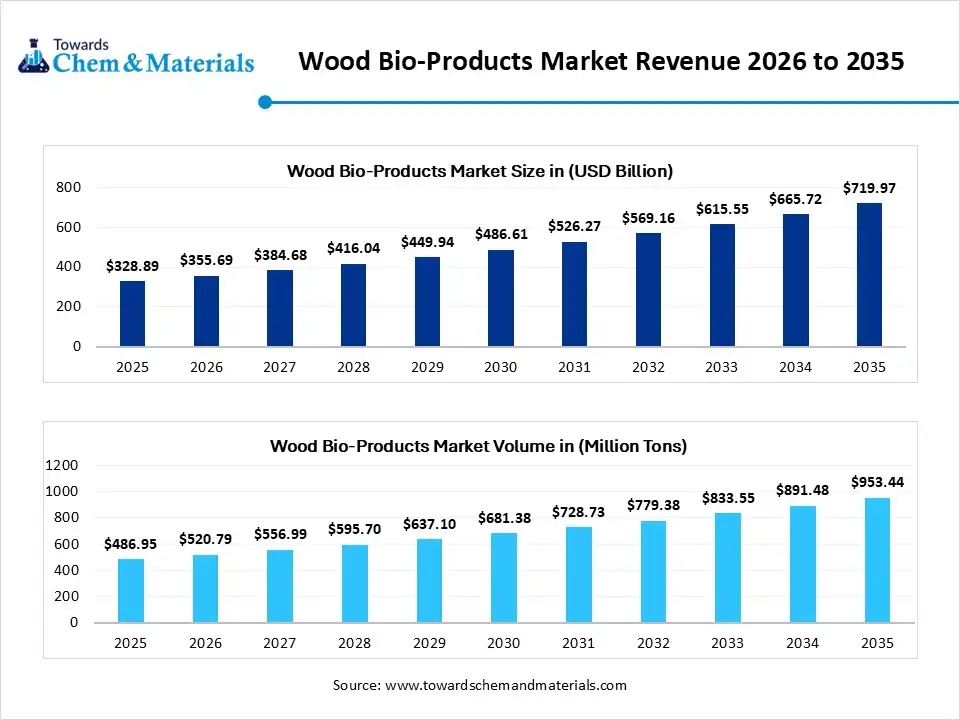
The global wood bio-products market size was valued at USD 328.89 billion in 2025, is estimated to reach USD 355.69 billion in 2026, and is projected to reach USD 719.97 billion by 2035, exhibiting a compound annual growth rate (CAGR) of 8.15% over the forecast period from 2026 to 2035. In terms of volume, the wood bio-products market is projected to grow from 486.95 million tons in 2025 to 953.44 million tons by 2035. growing at a CAGR of 6.95% from 2026 to 2035.The increasing demand for sustainable materials is the key factor driving market growth. Also, stringent environmental regulations and innovations in biorefinery technology can fuel market growth further.
The market encompasses the sales of energy, materials, and chemicals derived from wood components using sustainable, generally biotechnological processes. It acts as a biodegradable and renewable alternative to fossil-based materials in sectors such as packaging, construction, and automotive, with a significant market value driven by increasing demand for sustainability.
The global transition toward sustainable energy systems has intensified the focus on renewable alternatives, with wood-based biofuels, specifically wood pellets and chips, gaining significant traction as viable substitutes for fossil fuels. These lignocellulosic resources are increasingly utilized across multiple sectors, including residential heating, industrial power generation, and the production of transportation fuels. Wood-sourced materials are increasingly transitioning from laboratory experimentation to commercial adoption as firms seek to replace petrochemical inputs with sustainable alternatives.
Market Highlights
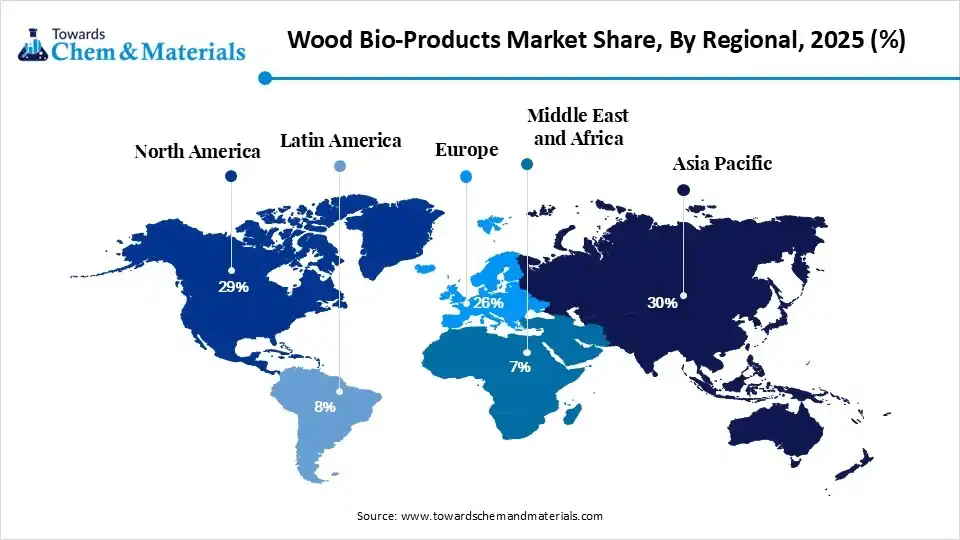
- By region, Europe dominated the market with the largest share of 33% in 2025. The dominance of the region can be attributed to the ongoing innovation in biorefinery and lignin technologies.
- By region, Asia Pacific held the market share of 27% in 2025 and is expected to grow at the fastest CAGR of 9.4% over the forecast period. The growth of the region can be credited to the increasing industrialization among emerging countries.
- By product type, the wood pellets segment dominated the market with the largest share of 31% in 2025. The dominance of the segment can be attributed to the increasing pellet consumption.
- By product type, the biochar segment is expected to grow at the fastest CAGR of 10.4% over he forecast period. The growth of the segment can be credited to the agricultural industries increasingly adopting biochar.
- By feedstock, the forestry residues segment dominated the market with the largest share of 36% in 2025. The dominance of the segment can be driven by ongoing logging and thinning applications.
- By feedstock, the recycled wood waste segment is expected to grow at the fastest CAGR of 9.4% over the forecast period. The growth of the segment is owing to the surge in the recycling of wood waste.
- By technology, the thermochemical conversion segment dominated the market with the largest share of 39% in 2025. The dominance of the segment can be attributed to the growing investment in advanced reactors.
- By technology, the chemical processing segment is expected to grow at the fastest CAGR of 9.3% over the forecast period. The growth of the segment can be credited to the increasing demand for advanced renewable chemicals.
- By application, the energy generation segment dominated the market with the largest share of 34% in 2025. The dominance of the segment can be driven by increasing energy security concerns.
- By application, the packaging segment is expected to grow at the fastest CAGR of 9.9% during the projected period. The growth of the segment is owed to the ongoing E-commerce growth.
- By distribution channel, the direct sales segment dominated the market with the largest share of 44% in 2025. The dominance of the segment can be attributed to the ongoing long-term procurement.
- By distribution channel, the online B2B platforms segment is expected to grow at the fastest CAGR of 10.2% over the study period. The growth of the segment can be credited to the market players increasingly adopting online supply chain management platforms.
At a Glance
- Market Estimated Size (2025): USD 328.89 Billion | CAGR (2026–2035): 8.15%
- Market Projected Size (2035): USD 719.97 Billion
- Europe: largest Market Revenue Share of 33% in 2025.
- Market Estimated Volume (2025): 486.95 Million Tons | Volume CAGR (2026–2035): 6.95%
- Market Projected Volume (2035): 953.44 Million Tons
- Market Pricing (2025):
- Average Manufacturing Price (2025): USD 486/Ton
- Average Selling Price (2025): USD 643/Ton
- Pricing CAGR (2025–2035): 3.85%
How Cutting-Edge Technologies Are Revolutionizing the Wood Bio-Products Market?
Advanced technologies are transforming the market by converting conventional forestry materials into sustainable and high-value alternatives to fossil-based products. Furthermore, nanaceullose integration allows wood fibers to be utilised in biomedical devices, flexible electronics, and cutting-edge filtration systems. Nanomaterials enhance wood preservation by deeply penetrating wood cell walls, resulting in superior stability and decay resistance.
Wood Bio-Products Market Trends
- Increasing demand for sustainable materials is the latest trend in the market, shaping positive market growth. There is a growing demand for substituting conventional non-renewable materials with sustainable ones in both industrial and consumer goods.
- Technological innovations in wood processing are another major trend shaping positive market growth. Emerging technologies, like engineered wood composites and nanotechnology, are increasing the overall functional efficiency and growing the diversified potential uses of wood-based products.
- The increasing demand for furniture and flooring products is anticipated to boost the growth of the market in the upcoming years. Also, furniture and flooring products include interior furnishings like tables, chairs, and sofas, as well as floor covering materials such as laminate, hardwood, and carpet.
Report Scope
| Report Attribute | Details |
| Market Size and Volume in 2026 | USD 355.69 Billion/ 520.79 Million Tons |
| Revenue Forecast in 2035 | USD 719.97 Billion/ 953.44 Million Tons |
| Growth Rate | CAGR 8.15% |
| Forecast Period | 2026 - 2035 |
| Base Year | 2025 |
| Dominant Region | Europe |
| Segment Covered | By Product Type, By Feedstock, By Technology, By Application, By Distribution Channel, By Regions |
| Key companies profiled | UPM, Stora Enso, West Fraser Timber Co., Enviva Inc., Metsä Group, Sappi Ltd, Canadian Forest Products Ltd., Drax Group plc, Georgia-Pacific LLC, Borregaard ASA. |
Supply Chain Analysis of the Wood Bio-Products Market
- Feedstock Procurement:It involves the sustainable sourcing, collection, aggregation, and transportation of woody biomass to produce biochemicals, bioenergy, and biomaterials.
- Major Plyers: Stora Enso, UPM-Kymmene4
- Chemical Synthesis and Processing :It includes the chemical transformation of raw forest biomass into high-value intermediates, biochemicals, and renewable materials to replace fossil-based alternatives.
- Major Plyers: Borregaard ASA, Stora Enso Oyj
- Packaging and Labeling :It emphasizes the use of wood-derived and renewable materials to create sustainable packaging and compliant tracking solutions.
- Major Players: Mondi Group, UFP Industries, Inc
- Regulatory Compliance and Safety Monitoring :It involves adhering to international and regional standards regarding sustainability, chemical usage, and product safety to ensure that products are legally non-toxic, sourced, and environmentally responsible.
- Major Plyers: Georgia-Pacific LLC, Sappi Limited
Wood Bio-Products Market's Regulatory Landscape: Global Regulations
| Country/Region | Key Regulations |
| European Union (EU) | EU Deforestation Regulation (EUDR): Replaces the older EUTR; mandates strict geolocation traceability back to the plot of land to guarantee wood products do not originate from deforested areas. |
| United States | Inflation Reduction Act (IRA): Provides tax credits and funding mechanisms accelerating domestic Bioenergy Carbon Capture and Storage (BECCS) deployment and clean fuel production. |
| China | The government is focusing on building a "low-carbon" bioeconomy, promoting high-efficiency utilization of biomass and reducing dependence on traditional timber sources. |
Market Dynamics
Drivers
Technological Innovations in Wood Processing
Cutting-edge technologies, including engineered wood composites and nanotechnology, are raising the functional efficiency and increasing the variety of potential uses of wood-based products, which is the major factor driving market growth. They help in deriving key chemicals and materials out of wood, like bioplastics, biofuels, and bio-based chemicals. In addition, advanced wood processing technologies, such as precision cutting and eco-friendly harvesting, significantly optimize raw material utilization. By minimizing waste and improving sustainability from production inception, these innovations can reduce operational costs and enhance the market position of Wood Bio-Products against conventional materials.
Restraints
Economic and Financial Hurdles
Establishing innovative biorefineries and production lines for engineered wood or biochemicals needs extensive initial infrastructure investment, which is the major factor hindering market expansion. Extracting and isolating tedious wood elements such as lignin and cellulose derivatives needs intensive, expensive biochemical methods. Organic bio-products exhibit significant susceptibility to moisture-induced degradation, UV-C radiation-induced discolouration, and lower structural integrity compared to synthetic alternatives.
Opportunity
Supply chain collaboration
Key players, including suppliers and producers of wood residues, who offer the raw materials and logistics companies, focus on effective management of these materials, which is the key factor creating lucrative opportunities in the market. Furthermore, strategic coordination among all stakeholders is imperative to ensure a seamless and uninterrupted biomass supply chain. Deficiencies in collaboration can lead to operational downtime, logistics delays, and substantial financial losses, ultimately impacting industry viability. Therefore, maintaining robust information exchange and close communication between producers is crucial.
Segmental Insights
Product Type Insights
The wood pellets segment dominated the market with the largest share of 31% in 2025. The dominance of the segment can be attributed to the increasing pellet consumption across the globe due to biomass power generation and government support for renewable heating solutions through carbon reduction technology.
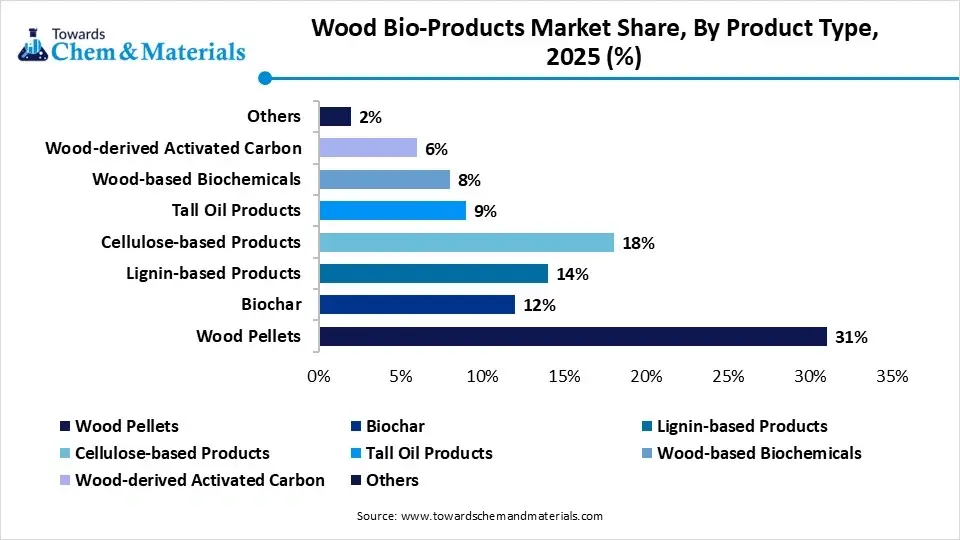
The biochar segment held the market share of 12% in 2025 and is expected to grow at the fastest CAGR of 10.4% over the forecast period. The growth of the segment can be credited to the agricultural industries increasingly adopting biochar for soil enhancement and carbon sequestration applications. Market players are expanding biochar utilization in filtration.
The cellulose-based products segment held the market share of 18% in 2025. The growth of the segment can be linked to the increasing demand for biodegradable and lightweight materials, along with the ongoing research investment in processing technology. The packaging industry is also increasingly adopting nanocellulose fibers.
Wood Bio-Products Market Share, By Product Type, 2025 (%)
| By Product Type | Revenue Share, 2025 (%) |
| Wood Pellets | 31% |
| Biochar | 12% |
| Lignin-based Products | 14% |
| Cellulose-based Products | 18% |
| Tall Oil Products | 9% |
| Wood-based Biochemicals | 8% |
| Wood-derived Activated Carbon | 6% |
| Others | 2% |
Feedstock Insights
The forestry residues segment dominated the market with the largest share of 36% in 2025. The dominance of the segment can be driven by ongoing logging and thinning applications generating abundant biomass feedstock for bio product manufacturing and forest management, encouraging residue utilisation to reduce wildfire risks.
Wood Bio-Products Market Share, By Feedstock, 2025 (%)
| By Feedstock | Revenue Share, 2025 (%) |
| Forestry Residues | 36% |
| Sawmill Residues | 33% |
| Recycled Wood Waste | 19% |
| Energy Crops | 12% |
The recycled wood waste segment held the market share of 19% in 2025 and is expected to grow at the fastest CAGR of 9.4% over the forecast period. The growth of the segment is owing to the surge in recycling of wood waste into bio-based products, along with the implementation of stringent landfill diversion by the government in many regions.
The sawmill residues segment held the market share of 33% in 2025. The growth of the segment is due to increasing monetization of bark, sawdust, and wood chips for bio product applications and circular economy initiatives, strengthening industrial residue utilization.
Technology Insights
The thermochemical conversion segment dominated the market with the largest share of 39% in 2025. The dominance of the segment can be attributed to the growing investment in advanced reactors and industrial biomass operations seeking efficient biomass conversion systems. Pyrolysis and gasification techniques are expanding rapidly across sectors.
Wood Bio-Products Market Share, By Technology, 2025 (%)
| By Technology | Revenue Share, 2025 (%) |
| Thermochemical Conversion | 39% |
| Biochemical Conversion | 21% |
| Mechanical Processing | 24% |
| Chemical Processing | 16% |
The chemical processing segment held the market share of 16% in 2025 and is expected to grow at the fastest CAGR of 9.3% over the forecast period. The growth of the segment can be credited to the increasing demand for advanced renewable chemicals, accelerating commercial scale adoption, along with the companies developing enzyme technologies to enhance biomass processing efficiency.
The mechanical processing segment held the market share of 24% in 2025. The growth of the segment can be linked to the expanding pellet export market and companies increasingly developing enzyme technologies to enhance biomass processing efficiency. Fermentation technology is supporting biochemical production capacity.
Application Insights
The energy generation segment dominated the market with the largest share of 34% in 2025. The dominance of the segment can be driven by increasing energy security concerns, boosting biomass adoption, and the government introducing incentives for coal-to-biomass conversion projects.
Wood Bio-Products Market Share, By Application, 2025 (%)
| By Application | Revenue Share, 2025 (%) |
| Energy Generation | 34% |
| Agriculture | 14% |
| Construction Materials | 16% |
| Packaging | 13% |
| Automotive | 7% |
| Chemicals & Materials | 11% |
| Water & Air Purification | 5% |
The packaging segment held the market share of 13% in 2025 and is expected to grow at the fastest CAGR of 9.9% during the projected period. The growth of the segment is owing to the ongoing E-commerce growth expanding sustainable packaging demand, coupled with the growing adoption of molded fiber materials. Consumer brands are accelerating their transition towards bio-based solutions.
The construction materials segment held the market share of 16% in 2025. The growth of the segment is due to construction industries increasingly adopting bio-based panels, adhesives, and insulation materials, along with green building certification supporting renewable materials utilization.
Distribution Channel Insights
The direct sales segment dominated the market with the largest share of 44% in 2025. The dominance of the segment can be attributed to the ongoing long-term procurement ensuring stable feedstock and product supply, along with technical support and logistics supporting direct partnerships. Large biomass producers are maintaining direct contracts with utilities.
Wood Bio-Products Market Share, By Distribution Channel, 2025 (%)
| By Distribution Channel | Revenue Share, 2025 (%) |
| Direct Sales | 44% |
| Distributors & Traders | 31% |
| Online B2B Platforms | 11% |
| Retail Supply Networks | 14% |
The online B2B platforms segment held the market share of 11% in 2025 and is expected to grow at the fastest CAGR of 10.2% over the study period. The growth of the segment can be credited to the market players increasingly adopting online supply chain management platforms and the rapid integration of e-commerce, improving transaction transparency.
The distributors & traders segment held the market share of 31% in 2025. The growth of the segment can be linked to the rising export activities supporting distribution channel growth, and small and medium manufacturers depend on distributor inventory management. Regional distributors are expanding their supply network rapidly.
Regional Insights
How did Europe Dominate the Wood Bio-Products Market in 2025?
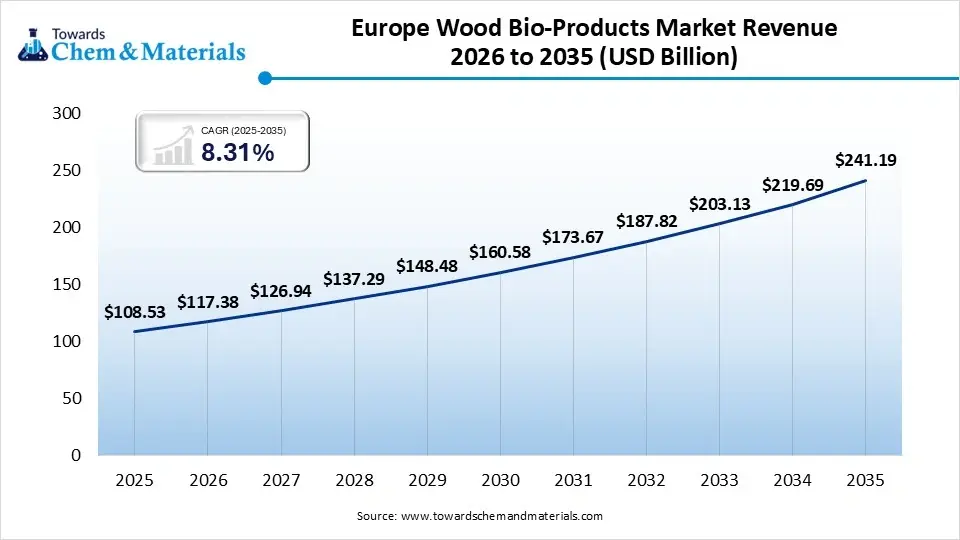
The Europe wood bio-products market size was estimated at USD 108.53 billion in 2025 and is projected to reach USD 241.19 billion by 2035, growing at a CAGR of 8.31% from 2026 to 2035Europe dominated the market with the largest share of 33% in 2025. The dominance of the region can be attributed to the ongoing innovation in biorefinery and lignin technologies, along with the growing adoption of bio-based materials from various sectors. In addition, increasing utilisation of engineered wood products (such as CLT) in sustainable commercial and residential construction replaces carbon-intensive materials like steel and concrete.
Germany Wood Bio-Products Market Trends
In Europe, Germany dominated the market owing to the increase in demand for sustainable building materials and robust policy initiatives focused on a circular bioeconomy, promoted by strong regional forestry resources. Also, growing adoption of wood-based and biodegradable packaging solutions to fulfil consumer demand within the e-commerce sector is driving positive market growth further.
Asia Pacific held the market share of 27% in 2025 and is expected to grow at the fastest CAGR of 9.4% over the forecast period. The growth of the region can be credited to the increasing industrialization among emerging countries, driving demand for bio-based chemicals, and ongoing government investment in innovative infrastructure projects. Furthermore, the region boasts wide forestry resources and robust manufacturing hubs for wood processing, especially in India, China, Indonesia, and Vietnam.
China Wood Bio-Products Market Trends
The growth of the market in the country is due to the increasing demand for engineered wood products for interior construction and tall buildings, coupled with innovations in biotechnology and wood processing. Moreover, the demand for biodegradable and sustainable packaging solutions for e-commerce promotes the growth of wood-based packaging materials.
Recent Development
- In December 2025, UPM, a global leader in sustainable material solutions, achieved a significant milestone with the commercial production launch of wood-based chemicals at its Leuna biorefinery in Germany. This facility represents the largest industrial-scale investment in biochemicals within Europe and has commenced the production and commercial distribution of industrial sugars.(Source: www.upm.com)
Wood Bio-Products Market Companies
- UPM: UPM-Kymmene Corporation (UPM) is a major player in the global wood bio-products market, positioning itself as a "material solutions company" that converts woody biomass into renewable materials.
- Stora Enso: Stora Enso is a leading global provider of renewable materials, specializing in wood-based packaging, biomaterials, and engineered wood construction products. As a key player in the wood bio-products market, the company focuses on replacing fossil-based materials with sustainable alternatives.
Other Companies in the Market
- West Fraser Timber Co.
- Enviva Inc.
- Metsä Group
- Sappi Ltd
- Canadian Forest Products Ltd.
- Drax Group plc
- Georgia-Pacific LLC
- Borregaard ASA
Segments Covered in the Report
By Product Type
- Wood Pellets
- Industrial Wood Pellets
- Residential Heating Pellets
- Biochar
- Agricultural Biochar
- Industrial Biochar
- Environmental Remediation Biochar
- Lignin-based Products
- Lignin Resins
- Lignin-based Adhesives
- Carbon Fiber Precursors
- Cellulose-based Products
- Nanocellulose
- Cellulose Fibers
- Cellulose Derivatives
- Tall Oil Products
- Tall Oil Fatty Acids
- Tall Oil Rosin
- Distilled Tall Oil
- Wood-based Biochemicals
- Bioethanol
- Bioplastics
- Organic Acids
- Wood-derived Activated Carbon
- Powdered Activated Carbon
- Granular Activated Carbon
- Others
- Wood Vinegar
- Hemicellulose Products
- Bio-based Solvents
By Feedstock
- Forestry Residues
- Logging Residues
- Thinning Residues
- Sawmill Residues
- Wood Chips
- Sawdust
- Bark
- Recycled Wood Waste
- Construction Wood Waste
- Industrial Wood Waste
- Energy Crops
- Short Rotation Coppice
- Fast-growing Trees
By Technology
- Thermochemical Conversion
- Pyrolysis
- Gasification
- Torrefaction
- Biochemical Conversion
- Fermentation
- Enzymatic Hydrolysis
- Mechanical Processing
- Fiber Separation
- Pelletization
- Chemical Processing
- Pulping
- Fractionation
- Hydrolysis
By Application
- Energy Generation
- Biomass Power Plants
- Residential Heating
- Combined Heat & Power
- Agriculture
- Soil Amendment
- Livestock Feed Additives
- Carbon Sequestration
- Construction Materials
- Bio-based Panels
- Insulation Materials
- Wood Adhesives
- Packaging
- Biodegradable Packaging
- Molded Fiber Packaging
- Automotive
- Lightweight Composites
- Interior Components
- Chemicals & Materials
- Resins
- Coatings
- Industrial Chemicals
- Water & Air Purification
- Water Treatment
- Air Filtration
By Distribution Channel
- Direct Sales
- Distributors & Traders
- Online B2B Platforms
- Retail Supply Networks
By Regions
- North America
- U.S.
- Canada
- Mexico
- Europe
- Germany
- UK
- France
- Italy
- Spain
- Asia Pacific
- China
- India
- Japan
- South Korea
- Latin America
- Brazil
- Argentina
- Middle East & Africa
- Saudi Arabia
- South Africa
FAQ's
Question 1 : What exactly are wood bio-products?
Answer : Wood bio-products are materials, chemicals, and energy sources derived from wood components using sustainable, eco-friendly processes. They serve as renewable alternatives to petroleum-based products in industries like packaging, construction, and automotive manufacturing.
Question 2 : Why is the biochar segment growing so fast?
Answer : Biochar is growing at a rapid 10.4% CAGR because the agricultural sector is heavily adopting it as a soil amendment. It helps retain moisture, improves nutrient delivery, and acts as a highly effective tool for long-term carbon sequestration.
Question 3 : What is driving the wood bio-products market in Europe?
Answer : Europe\'s dominance is driven by strict environmental policies like the EU Deforestation Regulation (EUDR) and heavy corporate investments. For instance, companies like UPM launched commercial scale production of wood-based biochemicals at their biorefinery in Germany.
Question 4 : What are the main challenges facing this market?
Answer : The biggest hurdles are economic and financial. Setting up advanced biorefineries requires massive initial infrastructure investments. Additionally, separating components like lignin can be expensive, and bio-based products sometimes face issues with moisture degradation compared to synthetic plastics.
Question 5 : How does packaging impact the wood bio-products market?
Answer : Packaging is the fastest-growing application segment with a 9.9% CAGR. The massive rise in e-commerce has forced consumer brands to transition away from single-use plastics and adopt molded fiber materials and biodegradable wood-based packaging.
Meet the Team

Saurabh Bidwai
Principal Consultant
Saurabh Bidwai, a B.Tech Chemical Engineering graduate with 4+ years of experience, specializes in specialty chemicals, commodity chemicals, and engineered materials, offering valuable insights into market trends and emerging opportunities.

Aditi Shivarkar
Reviewed By
Aditi Shivarkar, with 14+ years in Chemical and Materials market research, specializes in Chemical and Materials. She ensures accurate, actionable insights, driving Towards Chemicals And Materials Analytics and Consulting excellence in industry trends and sustainability.