
Wood Coatings Market Size, Share, Growth, Report 2026 to 2035
The wood coatings market report segmented By Resin Type, the market is classified into Polyurethane, Acrylic, Nitrocellulose, Polyester, Alkyd, Epoxy, and Others. By Technology, it is categorized into Waterborne Coatings, Solventborne Coatings, UV-Cured Coatings, Powder Coatings, and Others. By Application, the market is divided into Furniture, Cabinets, Flooring, Doors & Windows, Decking, and Others. By End-Use, the segmentation includes Residential, Commercial, Industrial, and Institutional sectors.-Global Industry Analysis, Size, Trends, Leading Companies, Regional Outlook, and Forecast 2026 to 2035
Content
What is the Wood Coatings Market Size and Share?
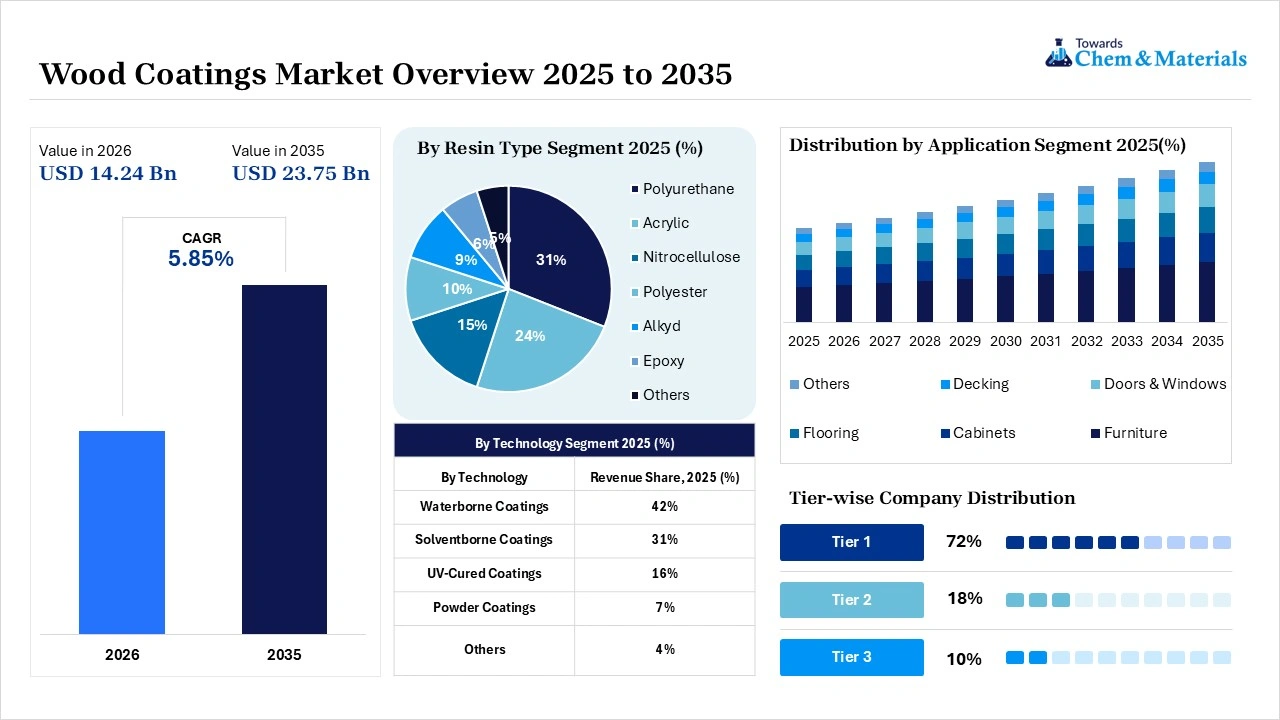
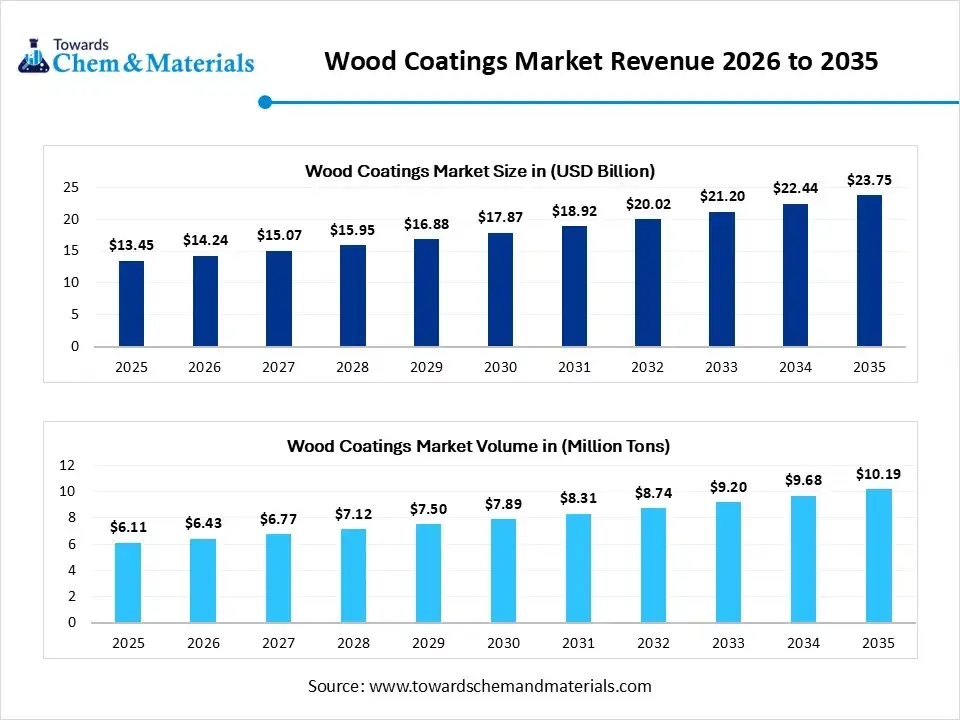
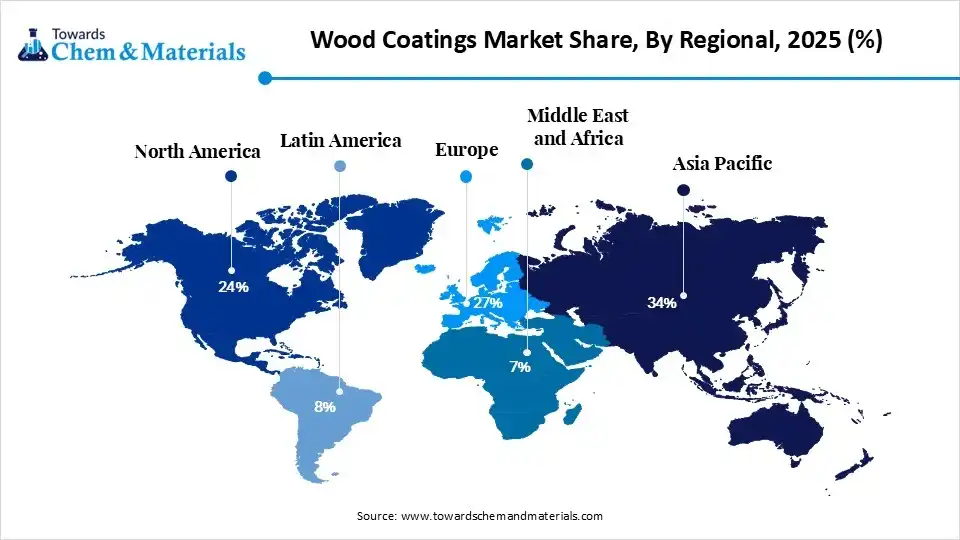
The global wood coatings market size was valued at USD 13.45 billion in 2025, is estimated to reach USD 14.24 billion in 2026, and is projected to reach USD 23.75 billion by 2035, exhibiting a compound annual growth rate (CAGR) of 5.85% over the forecast period from 2026 to 2035. Asia Pacific dominated the wood coatings market with the largest revenue share of 34% in 2025 and is expected to grow at the fastest CAGR of 6.01% during the forecast period. In terms of volume, the wood coatings market is projected to grow from 6.11 million tons in 2025 to 10.19 million tons by 2035. growing at a CAGR of 5.25% from 2026 to 2035. The growth of the market is driven by rapid urbanization and infrastructure development projects, which drive the growth of the market.
 Market Highlights
- By region, Asia Pacific dominated the market with a share of 34% in 2025 and is expected to experience the fastest growth with a CAGR of 7.20% in the forecast period. Rapid urbanization boosts construction and furniture production.
- By region, Europe held 27% market share in 2025. Strict environmental regulations accelerate technology upgrades.
- By resin type, the polyurethane segment dominated the market with 31% share in 2025. Delivers excellent durability and abrasion resistance.
- By resin type, the acrylic segment held 24% market share in 2025 and is expected to have the fastest growth with a CAGR of 6.30% in the forecast period. Provides color retention and weather resistance.
- By technology, the waterborne coatings segment dominated the market with 42% share in 2025. Environmental regulations accelerate adoption.
- By technology, the UV-cured coatings segment held 16% market share in 2025 and is expected to have the fastest growth with a CAGR of 7.10% in the forecast period. Enables rapid curing and higher productivity.
- By application, the furniture segment dominated the market with 38% share in 2025. Global furniture production continues to expand.
- By application, the flooring segment held 16% market share in 2025 and is expected to have the fastest growth with a CAGR of 6.4% in the forecast period. Hardwood flooring demand rises globally.
- By end-use, the residential segment dominated the market with 46% share in 2025. Housing construction and renovation activities remain strong.
- By end-use, the institutional segment held 9% market share in 2025 and is expected to have the fastest growth with a CAGR of 6.2% in the forecast period. Public infrastructure investments increase wood installations.
The wood coatings market plays a crucial role by enhancing the durability and appearance of wooden products, supporting the global furniture industry, and promoting sustainable, low-emission building practices, thereby increasing the demand. It is closely connected to worldwide housing, construction, and renovation activities, with growing infrastructure development projects. Since wood is porous and vulnerable to moisture, UV rays, temperature changes, and fungi, high-quality coatings like lacquers, varnishes, and polyurethanes serve as protective barriers against warping, decay, and scratches. This is especially important for outdoor uses like decks and fences, as well as busy indoor areas.
With increasing urbanization and population growth in regions like the Asia-Pacific, the demand for residential and commercial furniture continues to rise. Moreover, economic factors favoring home upgrades and renovations further boost demand for wood coatings. Stricter environmental regulations are encouraging the industry to shift from traditional solvent-based, high-VOC products to eco-friendly options that meet global standards without compromising performance or safety.
Market Trends
- Eco-Friendly Formulations: Stricter environmental regulations in regions and consumer demand for indoor air quality are pushing the market toward water-based and UV-curable coatings with low VOC (Volatile Organic Compounds).
- Focus on Aesthetics: Consumer demand for premium furniture, architectural joinery, and custom cabinets is pushing manufacturers to prioritize high-gloss, matte, and textured finishes.
- High-Performance Resins: demand for high-performance materials due to their properties like superior scratch resistance and clarity, and their application fuels the growth of the market.
Report Scope
| Report Attributes | Details |
| Market Size and Volume in 2026 | USD 14.24 Billion / 6.43 Million Tons |
| Revenue Forecast in 2035 | USD 23.75 Billion / 10.19 Million Tons |
| Growth Rate | CAGR 5.85% |
| Base Year of Estimation | 2025 |
| Forecast Period | 2025 - 2035 |
| High Impact Region | Asia Pacific |
| Segment Covered | By Resin Type, By Technology, By Application, By End-Use, By Regions |
| Key Companies Profiled | RPM International Inc. (US), Kansai Paint Co., Ltd. (Japan), Teknos Group (Finland), Nippon Paint Holdings Co., Ltd. (Japan), The Sherwin-Williams Company, PPG Industries, Inc., Akzo Nobel N.V., Diamond Paints, KANSAI HELIOS, BASF SE, Axalta Coating Systems, LLC |
Key Technological Shifts in the Wood Coatings Market:
Technological shifts in the wood coatings market are driven by stringent environmental regulations, shifting consumer preferences, and the demand for higher durability. The transition away from high-VOC solvent-based formulas towards advanced, eco-friendly, and highly durable coating technologies dominates current industry development. Innovations like self-healing and smart coatings are altering maintenance paradigms for premium wood surfaces. Ultraviolet and electron beam curable coatings are gaining significant momentum due to their instant curing capabilities.
Wood Coatings Market Regulatory Landscape
| Country / Region | Regulatory Body | Key Regulations | Focus Areas | Notable Notes |
| United States | Environmental Protection Agency (EPA); Occupational Safety and Health Administration (OSHA) | Clean Air Act; National VOC Emission Standards | Low-VOC coatings, worker safety, sustainable finishes | The U.S. promotes environmentally friendly wood coatings with increasing adoption of water-based and UV-cured technologies. |
| European Union | European Chemicals Agency (ECHA); European Commission | REACH Regulation; Industrial Emissions Directive (IED); EU Green Deal | VOC reduction, sustainable chemicals | Europe strongly regulates solvent emissions and encourages eco-friendly wood coating formulations. |
| China | Ministry of Ecology and Environment (MEE) | VOC Emission Control Standards; Environmental Protection Law | Water-based coatings, industrial sustainability | China is rapidly shifting toward low-VOC and water-based wood coatings due to stricter environmental regulations. |
| India | Central Pollution Control Board (CPCB); Bureau of Indian Standards (BIS) | Air Pollution Control Regulations; BIS Coating Standards | Sustainable coatings, indoor air quality | India is witnessing rising demand for eco-friendly wood coatings driven by furniture and construction growth. |
| Japan | Ministry of Economy, Trade and Industry (METI); Ministry of the Environment | Chemical Substances Control Law (CSCL) | High-performance coatings, environmental safety | Japan focuses on advanced low-emission and durable coating technologies. |
Supply Chain Analysis of Wood Coatings Market:
- Coating Production & Formulation:Wood coatings are produced through the formulation of resins, solvents, pigments, additives, and curing agents to provide protection, durability, and aesthetic enhancement for wood surfaces.
- Key players: AkzoNobel, Sherwin-Williams, PPG Industries, BASF
- Quality Testing and Certification:Wood coatings must comply with standards for adhesion, scratch resistance, VOC emissions, chemical durability, and environmental safety before commercial application.
- Key players: International Organization for Standardization, ASTM International, U.S. Environmental Protection Agency, European Chemicals Agency
- Distribution to Industrial Users:Wood coatings are supplied to furniture manufacturers, residential and commercial construction projects, flooring producers, cabinetry manufacturers, and interior décor industries.
- Key players: AkzoNobel, Sherwin-Williams, PPG Industries.
Wood Coatings Market Dynamics
| Drivers | Restrains | Opportunities |
| Technological Advancements: | Stricter Environmental Regulations and Compliance Costs: | Eco-Friendly & Low-VOC Formulations: |
| Technologies like nanotechnology and UV-curable coatings have revolutionized the market. These coatings offer instant drying capabilities alongside superior scratch resistance, significantly extending the lifespan of the wood. | Governments and environmental bodies enforce strict limits on Volatile Organic Compounds. Traditional solvent-borne coatings often fail to meet these thresholds without extensive reformulation | Strict environmental regulations on volatile organic compounds (VOCs) are pushing the industry toward sustainable alternatives. Gaining immense popularity for industrial applications. |
| Sustainability and Environmental Regulations: | Volatile Raw Material Costs: | Premium Aesthetics & Customization: |
| Stringent environmental regulations, particularly in North America and Europe, are forcing manufacturers to transition away from solvent-based formulations. | Unpredictable spikes in raw material costs force manufacturers to either absorb the financial hit or pass it on to consumers, which can dampen demand. | As disposable incomes rise, consumers are shifting toward luxury and high-end wooden interiors, driving the need for specific finishing aesthetics. Strong demand in modern architectural designs and bespoke boutique furniture. |
| Construction and Housing Market Expansion: | Supply Chain Disruptions and Economic Slowdowns: | Smart & High-Performance Coatings: |
| Rapid urbanization and infrastructure development in emerging economies fuel the construction of new residential and commercial spaces. | Wood coatings rely heavily on the construction, real estate, and furniture industries; macroeconomic downturns or rising interest rates directly reduce consumer spending on home renovations and new builds. | Modern wood coatings are evolving from purely decorative layers to high-tech protective shields. Emerging technologies are yielding bio-based and ceramic-hybrid finishes, providing extreme durability without sacrificing sustainability. |
Segmental Insights
Resin Type Insights
The polyurethane segment dominated the market with 31% share in 2025, due to its superior durability, abrasion resistance, and aesthetic finish for furniture and flooring applications. Driven by its exceptional scratch resistance, UV protection, and longevity, the segment is seeing rapid adoption across furniture and flooring. A shift toward water-based polyurethane formulations is also accelerating due to strict environmental regulations on VOCs.
The acrylic segment held 24% market share in 2025 and is expected to have the fastest growth with a CAGR of 6.30% in the forecast period, are witnessing strong growth owing to increasing demand for water-based and low-VOC formulations. Acrylic resins provide excellent flexibility, weather resistance, and a soft, non-yellowing finish that is highly prized for premium indoor and outdoor furniture.
The nitrocellulose segment held 15% market share in 2025, remain important for high-gloss and decorative wood finishing applications. NC coatings are renowned for evaporating quickly while leaving a transparent, flexible, and high-gloss film. The booming residential construction and furniture manufacturing industries rely on it for boutique furniture, decorative panels, and musical instruments.
The polyester segment held 10% market share in 2025, driven by its high filling capability, exceptional chemical and mechanical stability, and superior resistance to degradation. It is highly prized in premium furniture and architectural finishes. Polyester coatings are gaining major traction in applications requiring high-gloss, scratch-resistant, and durable surfaces.
Wood Coatings Market Share, By Resin Type, 2025 (%)
| By Resin Type | Revenue Share, 2025 (%) |
| Polyurethane | 31% |
| Acrylic | 24% |
| Nitrocellulose | 15% |
| Polyester | 10% |
| Alkyd | 9% |
| Epoxy | 6% |
| Others | 5% |
Technology Insights
The waterborne coatings segment dominated the market with 42% share in 2025, due to stringent environmental regulations and increasing preference for sustainable coating technologies. They are widely used due to their low volatile organic compound (VOC) content, eco-friendly footprint, and stricter global environmental regulations. They are increasingly favored for offering high durability, fast drying times, and reduced odors in household and commercial applications.
The solventborne coatings segment held 31% market share in 2025, continue to be used in heavy-duty and industrial applications requiring high durability. inue to experience significant growth due to their superior durability, deep wood penetration, and excellent aesthetic finish. They offer excellent flow and leveling properties, resulting in smoother finishes with minimal brush marks.
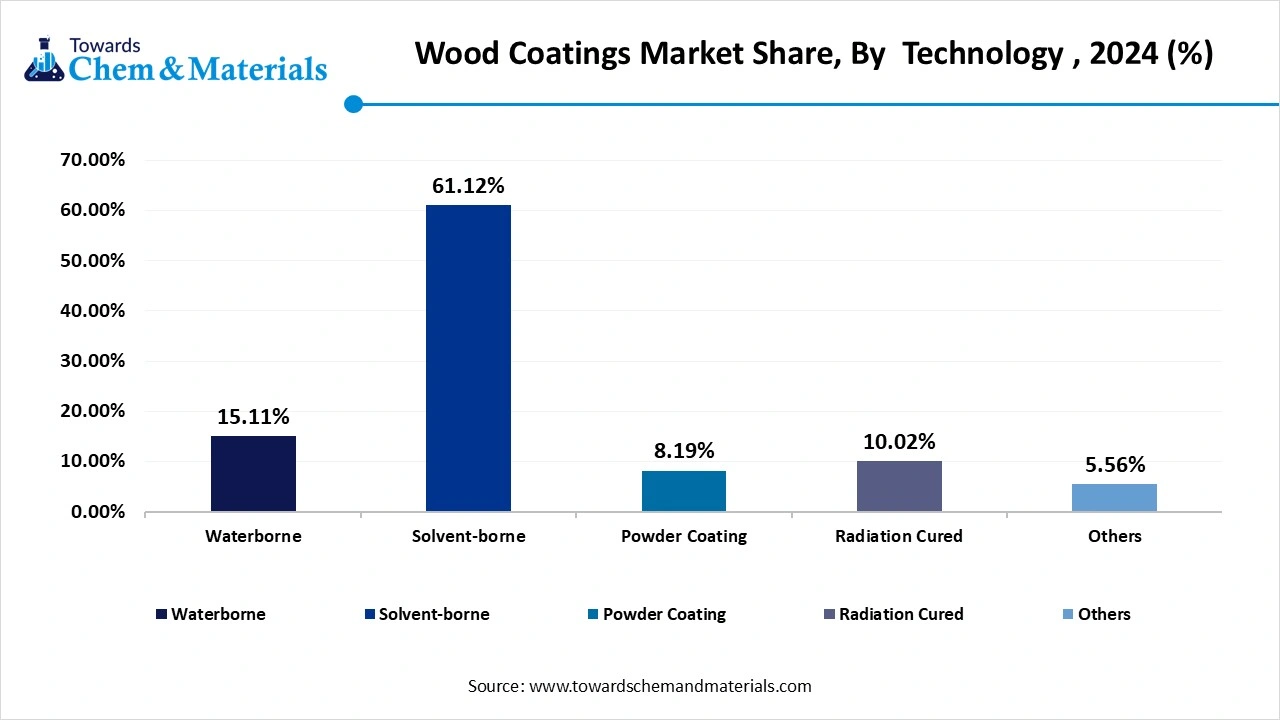
The UV-cured coatings segment held 16% market share in 2025 and is expected to have the fastest growth with a CAGR of 7.10% in the forecast period, gaining traction for its fast curing time and enhanced performance characteristics. It is rapidly transforming the industry, primarily because its instantaneous UV cure enables continuous automated finishing lines that thermal-cure systems simply cannot match.
The powder coatings segment held 7% market share in 2025. This growth is primarily fueled by a strong industry shift toward eco-friendly, zero-VOC solutions and the breakthrough ability to apply powder finishes to heat-sensitive substrates like medium-density fiberboard. Surging consumer and regulatory demand for sustainable, zero-VOC alternatives is pushing traditional solvent-based coatings aside.
Wood Coatings Market Share, By Technology, 2025 (%)
| By Technology | Revenue Share, 2025 (%) |
| Waterborne Coatings | 42% |
| Solventborne Coatings | 31% |
| UV-Cured Coatings | 16% |
| Powder Coatings | 7% |
| Others | 4% |
Application Insights
The furniture segment dominated the market with 38% share in 2025, due to rising residential and commercial demand for decorative wood products. This expansion is fueled by rising urbanization, booming commercial and residential construction, and a strong consumer shift toward premium, customized aesthetics and eco-friendly finishes.
The cabinets segment held 18% market share in 2025, experiencing rapid expansion due to rising residential renovations and a consumer shift toward custom, high-end cabinetry. Because cabinets are frequently exposed to moisture, heat, and daily wear, manufacturers and consumers demand advanced finishes that resist scratches, stains, and UV damage.
The flooring segment held 16% market share in 2025 and is expected to grow the fastest, with a CAGR of 6.4% over the forecast period. Driven by surging demand for hardwood floors and rising residential remodeling investments, this segment requires highly durable coatings capable of withstanding heavy foot traffic, moisture, and wear. Rising investments in home renovation and outdoor decking have drastically spiked the demand for coatings with superior UV and water resistance.
The doors and windows segment held 14% market share in 2025. Driven by booming construction, renovation activities, and rising demand for premium, energy-efficient fixtures, modern builders and consumers are increasingly investing in durable, aesthetically pleasing wooden joinery. Insulated doors and windows require high-performance coatings to extend their lifespan against extreme weather conditions.
Wood Coatings Market Share, By Application, 2025 (%)
| By Application | Revenue Share, 2025 (%) |
| Furniture | 38% |
| Cabinets | 18% |
| Flooring | 16% |
| Doors & Windows | 14% |
| Decking | 8% |
| Others | 6% |
End-Use Insights
The residential segment dominated the market with 46% share in 2025, fueled by increasing urbanization, rising disposable incomes, and a strong consumer shift toward eco-friendly, premium home interiors. Homeowners are increasingly spending on furniture, cabinetry, and flooring to enhance aesthetics and durability. Renovation and DIY projects are surging globally, with homeowners seeking high-quality finishes to upgrade living spaces.
The commercial segment held 27% market share in 2025, driven by surging investments in commercial infrastructure, hospitality projects, and organized retail. Driven by the need for high-performance, durable, and aesthetically pleasing surfaces, this segment is outpacing residential growth in many urbanizing regions.
The industrial segment held 18% market share in 2025, driven by the mass production of ready-to-assemble (RTA) furniture, specialized cabinetry, and commercial flooring. Manufacturers are shifting toward UV-cured and waterborne formulations to meet strict environmental regulations while scaling up production lines to satisfy booming urbanization in the Asia Pacific region.
The institutional segment held 9% market share in 2025 and is expected to grow the fastest, with a CAGR of 6.2% over the forecast period. Driven by a surge in non-residential construction and renovation, demand is escalating for high-performance, durable, and sustainable coatings that withstand high-traffic environments. Stricter environmental mandates are pushing commercial projects toward low-VOC, water-based, and UV-cured formulations to meet green building certifications.
Wood Coatings Market Share, By End-Use, 2025 (%)
| By End-Use | Revenue Share, 2025 (%) |
| Residential | 46% |
| Commercial | 27% |
| Industrial | 18% |
| Institutional | 9% |
Regional Analysis
How did Asia Pacific dominate the Wood Coatings Market in 2025?
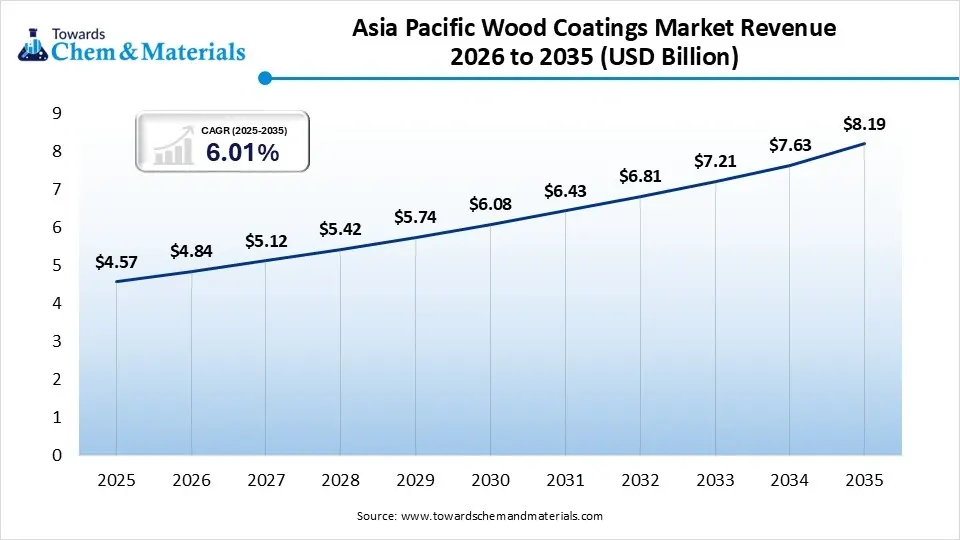
The Asia Pacific wood coatings market size was estimated at USD 4.57 billion in 2025 and is projected to reach USD 8.19 billion by 2035, growing at a CAGR of 6.01% from 2026 to 2035.Asia Pacific dominated the market with a 34% share in 2025 and is expected to sustain its position, growing at a CAGR of 7.20% over the forecast period, due to strong furniture production, urbanization, and expanding construction activities. Rapid urbanization and rising disposable incomes in countries like India and Indonesia fueled robust demand for residential housing, hardwood flooring, and commercial interior design. China and Vietnam served as the world's primary furniture production engines, applying coatings on an industrial scale for global retail giants before exporting.
India
- The Indian wood coatings market is a rapidly expanding sector, driven by rising urbanization, modern interior design trends, and a booming real estate market.
- As disposable incomes rise, consumers investing in costly timber like teak prefer high-performance coatings over traditional paints to preserve natural grains.
China
- China leads the regional market, supported by large-scale furniture manufacturing and increasing adoption of environmentally friendly coating technologies.
- The highly competitive and concentrated market is led by major international and domestic coating companies, including AkzoNobel, Sherwin-Williams, PPG, Nippon Paint, Carpoly, and Guangdong Huarun.
Japan
- Japan has rich domestic forestry resources (such as the highly sought-after Hinoki or Japanese Cypress), which drives a specialized, localized coating supply chain tailored to native softwoods.
- Companies are increasingly focusing on UV-cured coatings and advanced polyurethane resins to achieve maximum durability without sacrificing environmental integrity.
Europe Wood Coatings Market Growth Factor
The Europe wood coatings market size was estimated at USD 3.63 billion in 2025 and is projected to reach USD 6.53 billion by 2035, growing at a CAGR of 6.05% from 2026 to 2035.Europe held the market share of 27% in 2025, emphasizing sustainable and low-emission coating technologies supported by stringent environmental regulations. Growth is anchored by the EU's Renovation Wave and a strong shift toward eco-friendly, low-VOC (Volatile Organic Compound) waterborne and UV-cure formulations. Stringent European environmental regulations are rapidly driving the market away from traditional solvent-based formulas toward waterborne and bio-based coatings.
Germany
- The market is driven by the country's robust building, construction, and premium furniture sectors, with strict environmental regulations actively shaping consumer and industrial preferences.
- Germany leads the region with advanced furniture manufacturing and strong adoption of eco-friendly wood coatings
Italy
- Steady demand is fueled by the premium Italian artisanal furniture sector and commercial construction.
- Italy represents one of the largest regional markets for industrial wood coatings in Europe.
- Italy is home to a robust mix of domestic specialists and global manufacturing giants serving the market.
France
- Strict European Union mandates aimed at reducing volatile organic compound (VOC) emissions are the primary forces shaping the French market. This has catalyzed massive demand for eco-friendly products like water-borne and UV-curable coatings.
- The artisanal furniture and luxury décor sectors remain major end-users, driving the need for durable, visually appealing finishes.
North America Wood Coatings Market Growth Factor
The North America wood coatings market size was estimated at USD 3.23 billion in 2025 and is projected to reach USD 5.82 billion by 2035, growing at a CAGR of 6.06% from 2026 to 2035.North America held the market share of 24% in 2025, driven by renovation trends, premium furniture demand, and sustainable coating adoption. Sustained growth is fueled by an uptick in residential and commercial remodeling, rising consumer spending on premium timber furniture and flooring, and the convenience of user-friendly DIY coating products. Manufacturers are increasingly utilizing UV-curing and nanotechnology to increase the longevity, scratch resistance, and moisture protection of wood substrates.
U.S.
- The U.S. market benefits from strong residential remodeling activities and increasing preference for low-VOC wood coatings.
- State and federal mandates are accelerating the shift from traditional solvent-borne technologies to water-borne and UV-cured formulations.
- Driven by residential remodeling and wooden furniture production, the market is rapidly shifting toward low-VOC, water-borne formulations to meet strict EPA guidelines.
Canada
- Demand is concentrated heavily in the Ontario and Quebec furniture corridors, as well as in British Columbia's growing timber construction industry.
- An aging Canadian housing stock is driving renovation and cabinet replacement cycles, which heavily utilize custom architectural millwork.
Latin America Wood Coatings Market Growth Factor
The Latin America wood coatings market size was estimated at USD 1.08 billion in 2025 and is projected to reach USD 2.02 billion by 2035, growing at a CAGR of 6.46% from 2026 to 2035.Latin America held the market share of 8% in 2025, witnessing gradual growth due to increasing residential construction and furniture production. Growth is primarily anchored by Brazil’s furniture manufacturing sector, increasing nearshoring exports, and residential housing recoveries throughout the region. Stricter environmental regulations, particularly within Mercosur, are boosting the shift toward sustainable and water-borne coating systems.
Brazil
- Brazil supports market expansion through growing wood processing and furniture manufacturing industries.
Brazil’s robust residential construction and active furniture manufacturing sectors form the backbone of local coating demand. - Eco-conscious consumer preferences and tightening environmental regulations from agencies like INMETRO and ABNT are driving a shift towards low-VOC (Volatile Organic Compound) and water-borne coating formulations.
Argentina
- Humidity, termites, and climatic exposure across Argentina fuel the rapid adoption of specialized wood preservatives and sealers.
- The furniture wood coatings segment within Argentina saw a notable increase in imports, highlighting a reliance on high-tech formulations sourced from broader Latin American and European markets.
Middle East and Africa Wood Coatings Market Growth Factor
The Middle East and Africa wood coatings market size was estimated at USD 0.94 billion in 2025 and is projected to reach USD 1.78 billion by 2035, growing at a CAGR of 6.66% from 2026 to 2035.The Middle East and Africa held the market share of 7% in 2025. The region is experiencing rising demand for decorative wood products and premium interior finishes. Growth is heavily driven by urbanization, luxury real estate projects, and a booming furniture manufacturing sector across the Gulf and Africa. Markets like Kenya, Nigeria, and Egypt balance price-sensitive domestic demand with export-oriented furniture manufacturing. Experiencing the fastest geographic growth, propelled by premium architectural millwork and developments like Expo City Dubai.
Saudi Arabia
- Mega-developments and expanding residential, hotel, and commercial segments drive heavy demand for wood flooring, cabinetry, and custom furniture.
- The region's intense heat, humidity, and UV exposure drive a need for high-performance, durable coatings to prevent wood from warping, cracking, or fading.
UAE
- The UAE is driving growth through luxury real estate developments and increasing demand for high-end wood finishing solutions.
- The expanding UAE furniture market fuels demand for high-end wood coatings that offer moisture resistance, UV stability, and scratch protection against the region's harsh climate.
Recent Developments
- In March 2026, Pittsburgh Paints Company launched Tru-Industrial, a new dedicated coatings brand offering solvent-based (TRU-SOLV MAX), water-based (H-TRU-O MAX), and specialized shed coatings (TRU-SHED MAX) for industrial applications. The portfolio combines heritage formulas and new technologies designed for heavy-duty protection, with products available across 500+ locations and online.(Source: www.woodworkingnetwork.com)
- In February 2025, AkzoNobel launched RUBBOL WF 3350, a sustainable, sprayable opaque waterborne wood coating developed by its Sikkens Wood Coatings business in Malmö, Sweden. Formulated with 20% plant-derived, bio-based content verified by independent C-14 testing, the coating is designed for both interior and exterior wood surfaces without compromising on durability or weather resistance.(Source: www.akzonobel.com)
Top players in the Wood Coatings Market & Their Offerings:
- RPM International Inc. (US): Parent company to specialized wood coating brands like Rust-Oleum, FinishWorks, serving both DIY and industrial sectors.
- Kansai Paint Co., Ltd. (Japan): A significant competitor in the global market, particularly strong in the Asian furniture and industrial manufacturing sectors.
- Teknos Group (Finland): Well-known for specialized industrial wood coatings, particularly for joinery and exterior wood applications.
- Nippon Paint Holdings Co., Ltd. (Japan): A dominant player in the Asia-Pacific region, expanding its capacity for low-VOC and inline viscosity-controlled wood coatings.
Other Top Players Are
- The Sherwin-Williams Company
- PPG Industries, Inc.
- Akzo Nobel N.V.
- Nippon Paint Holdings Co., Ltd.
- RPM International Inc.
- Diamond Paints
- KANSAI HELIOS
- BASF SE
- Axalta Coating Systems, LLC
- Asian Paints
- Eastman Chemical Company
Segments Covered in the Report
By Resin Type
- Polyurethane
- Solvent-borne Polyurethane
- Water-borne Polyurethane
- UV-Curable Polyurethane
- Acrylic
- Water-based Acrylic
- Solvent-based Acrylic
- UV Acrylic
- Nitrocellulose
- Clear Nitrocellulose
- Pigmented Nitrocellulose
- Polyester
- Unsaturated Polyester
- Saturated Polyester
- Alkyd
- Long Oil Alkyd
- Medium Oil Alkyd
- Short Oil Alkyd
- Epoxy
- Water-based Epoxy
- Solvent-based Epoxy
- Others
- Shellac
- Lacquer Blends
- Hybrid Resins
By Technology
- Waterborne Coatings
- Acrylic Waterborne
- Polyurethane Waterborne
- Hybrid Waterborne
- Solventborne Coatings
- Polyurethane Solventborne
- Alkyd Solventborne
- Nitrocellulose Solventborne
- UV-Cured Coatings
- UV Acrylic
- UV Polyurethane
- UV Hybrid
- Powder Coatings
- Thermoset Powder
- Thermoplastic Powder
- Others
- Radiation-Cured Systems
- High-Solid Coatings
By Application
- Furniture
- Residential Furniture
- Commercial Furniture
- Outdoor Furniture
- Cabinets
- Kitchen Cabinets
- Bathroom Cabinets
- Storage Cabinets
- Flooring
- Hardwood Flooring
- Engineered Wood Flooring
- Decorative Flooring
- Doors & Windows
- Interior Doors
- Exterior Doors
- Window Frames
- Decking
- Residential Decking
- Commercial Decking
- Others
- Wooden Toys
- Musical Instruments
- Decorative Articles
By End-Use
- Residential
- New Housing
- Renovation & Remodeling
- Commercial
- Offices
- Hospitality
- Retail Facilities
- Industrial
- Manufacturing Facilities
- Warehouses
- Industrial Furniture
- Institutional
- Educational Buildings
- Healthcare Facilities
- Government Buildings
By Region
- North America
- U.S.
- Canada
- Europe
- Germany
- UK
- France
- Italy
- Spain
- Sweden
- Denmark
- Norway
- Asia Pacific
- China
- Japan
- India
- South Korea
- Thailand
- Latin America
- Brazil
- Mexico
- Argentina
- Middle East & Africa
- South Africa
- UAE
- Saudi Arabia
- Kuwait
FAQ's
Question 1 : What is the projected market size of the wood coatings industry by 2035?
Answer : The global wood coatings market is projected to reach USD 23.75 billion by the year 2035. This long-term growth is supported by a compound annual growth rate of 5.85% stretching from 2026 to 2035.
Question 2 : Which region holds the largest market share in wood coatings?
Answer : The Asia Pacific region holds the largest market share at 34%, operating as the primary engine for global furniture production and new housing construction.
Question 3 : Why are waterborne wood coatings dominating the market?
Answer : Waterborne wood coatings dominate with a 42% market share because they contain low volatile organic compounds (VOCs). This makes them much safer for indoor air quality and helps manufacturers comply with strict global environmental laws.
Question 4 : Which resin type is most commonly used in wood coatings?
Answer : Polyurethane resins are the market leader, holding a 31% share due to their superior durability, excellent abrasion resistance, and high-quality protective finish on floors and furniture.
Question 5 : Which companies are the top key players in the global wood coatings market?
Answer : The global market is led by major multinational chemical and coating giants. The top key players include The Sherwin-Williams Company, AkzoNobel N.V., PPG Industries, Axalta Coating Systems, Nippon Paint Holdings, and RPM International.
Meet the Team

Saurabh Bidwai
Principal Consultant
Saurabh Bidwai, a B.Tech Chemical Engineering graduate with 4+ years of experience, specializes in specialty chemicals, commodity chemicals, and engineered materials, offering valuable insights into market trends and emerging opportunities.

Aditi Shivarkar
Reviewed By
Aditi Shivarkar, with 14+ years in Chemical and Materials market research, specializes in Chemical and Materials. She ensures accurate, actionable insights, driving Towards Chemicals And Materials Analytics and Consulting excellence in industry trends and sustainability.