
Zero-waste Construction Materials Market Size, Share, Growth, Report 2026 to 2035
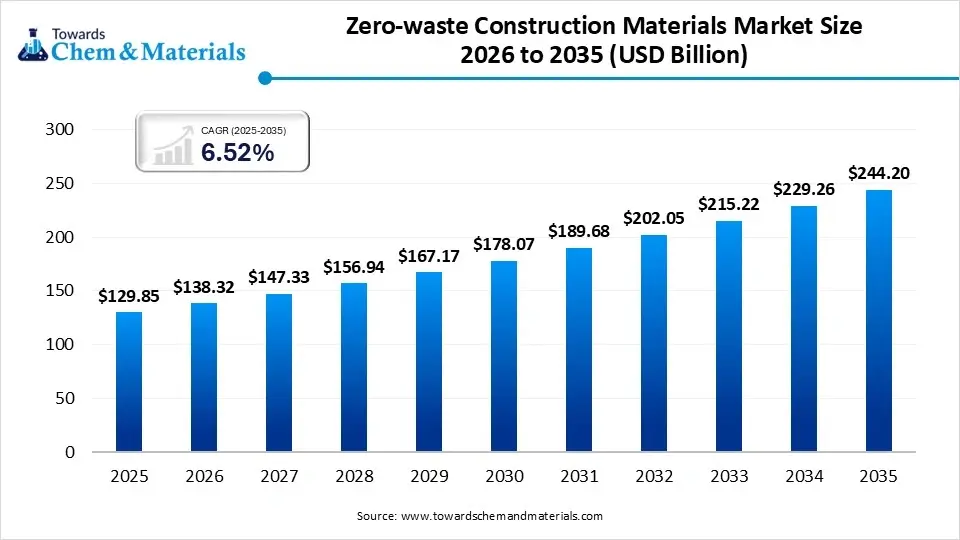
The global zero-waste construction materials market size is expected to grow from USD 138.32 billion in 2026 to USD 244.20 billion in 2035, growing at a CAGR of 6.52% from 2026 to 2035. The top key players in the market are Strawcture Eco Pvt. Ltd., Tvasta, ANGIRUS IND PVT LTD, NOVACRET, ARQLITESPC, Rawblox, a:gain, Greenfiber, Yi Design, Greenful Group LLC-Global Forecast 2026 To 2035
Content
What is the Current Size of the Zero-waste Construction Materials Market and Its Projected Growth?
The zero-waste construction materials market size was estimated at USD 129.85 billion in 2025 and is predicted to increase from USD 138.32 billion in 2026 to approximately USD 244.20 billion by 2035, expanding at a CAGR of 6.52% from 2026 to 2035. Increasing adoption of circular economy principles is the key factor driving market growth. Also, ongoing technological innovations such as BIM, coupled with the rapid implementation of corporate sustainability goals, can fuel market growth further.
Market Highlights
- By region, Asia Pacific dominated the market with the largest share 32% in 2025. The dominance of the region can be attributed to the extensive infrastructure development in developing countries.
- By region, North America is expected to grow at the fastest CAGR over the forecast period. The growth of the region can be credited to the increasing adoption of prefabrication.
- By region, Europe is expected to grow at a notable CAGR over the forecast period. The growth of the region can be driven by the growing adoption of materials such as recycled plastics.
- By product type, the recycled aggregates and concrete segment dominated the market with the largest share in 2025. The dominance of the segment can be attributed to the high demolition (C&D) activities.
- By product type, the recycled plastics and polymers segment is expected to grow at the fastest CAGR over the forecast period. The growth of the segment can be credited to the ongoing innovations in material technology.
- By end use, the non-residential construction segment held the largest market share in 2025. The dominance of the segment can be linked to the growing adoption of cutting-edge recyclable materials and modular assembly.
- By end use, the residential construction segment is expected to grow at the fastest CAGR during the forecast period. The growth of the segment can be driven by growing consumer demand for energy-efficient homes.
What Are Zero-waste Construction Materials Market?
The market encompasses products, materials, and systems created to eliminate construction waste, support sustainability initiatives, and reduce landfill disposal. These materials are sourced sustainably, recycled, or designed for reuse, repairability, and easy disassembly at the end of their lifecycle. Key materials include recycled content such as concrete aggregates, steel, low-impact, sustainable materials, and bio-based materials like bamboo and timber.
Recent Market Trends
- Many governments across the globe are taking major steps towards imposing stringent building codes and environmental regulations, using eco-friendly materials in the construction industry. These regulations focus on reducing greenhouse gas emissions to promote energy efficiency and development.
- Growing disposable fees and landfill taxes are making conventional "take-make-dispose" models financially unsustainable, impelling market players towards cost-efficient recycled alternatives, boosting market expansion over the forecast period.
- Ongoing innovations in modular/prefabricated construction and Building Information Modelling (BIM) are substantially minimizing on-site waste upto 50%. Also, growing inclination towards sustainable living environments is pushing developers in the residential sector to use eco-friendly materials to raise marketability.
Report Scope
| Report Attribute | Details |
| Market Size in 2026 | USD 138.32 Billion |
| Revenue Forecast in 2035 | USD 244.20 Billion |
| Growth Rate | CAGR 6.52% |
| Forecast Period | 2026 - 2035 |
| Base Year | 2025 |
| Dominant Region | Asia Pacific |
| Segment Covered | By Product Type, By End-use, By Region |
| Key companies profiled | Strawcture Eco Pvt. Ltd., Tvasta, ANGIRUS IND PVT LTD, NOVACRET, ARQLITESPC, Rawblox, a:gain, Greenfiber, Yi Design, Greenful Group LLC |
How Cutting-Edge Technologies Are Revolutionizing The Zero-waste Construction Materials Market?
Advanced technologies are revolutionizing the market by optimizing waste conversion and material efficiency. Key advancements include AI-powered design, 3D printing, and converting plastic or agricultural waste into robust structural panels. Furthermore, many startups are manufacturing structural insulated panels created from agricultural residues such as straw, facilitating carbon-negative construction.
Trade Analysis of the Zero-waste Construction Materials Market: Import & Export Statistics
According to Quick Estimates of Department of Commerce, engineering goods boosted their presence in India's export basket, rising to 25.79% of total merchandise exports in March 2025, up from 24.61% in February. This upward trend was reflected across the full 2024-25 fiscal year, where the sector's share climbed to 26.67%, compared to 25.01% the previous year.
An analysis by the World Trade Organization shows that global imports of construction materials rose by 7.3% year-over-year during the first three quarters of 2024. This growth was largely driven by surging demand in emerging markets, specifically Vietnam (+14.2%), Indonesia (+12.5%), and Mexico (+9.8%).
- According to data, global buyers imported 113 shipments of construction materials into India between July 2024 and June 2025. These transactions involved 765 exporters supplying 13 verified global buyers over the trailing twelve months.
- China, the UAE, and the U.S. dominate construction material exports, while the UK, U.S., and Russia rank as top importers.
Zero-waste Construction Materials Market Supply Chain Analysis
Feedstock Procurement
- It refers to the process of sourcing, collecting, and securing essential raw materials, mainly agricultural waste, industrial by-products, and recycled waste.
- Major Players: ANGIRUS IND PVT LTD, Strawcture Eco Pvt
Chemical Synthesis and Processing
- It refers to the use of innovative chemical engineering and "green chemistry" to transform agricultural, industrial, or plastic waste into high-performance building components.
- Major Players: Holcim, Hoffmann Green Cement Technologies
Packaging and Labelling
- It includes the strategic use of digital tools and materials to eliminate waste over the supply chain and end-of-life phases. This approach aligns with sustainability initiatives.
- Major Players: International Paper, Berry Global:
Regulatory Compliance and Safety Monitoring
- It involves adhering to stringent safety, environmental, and quality standards while using recycled, bio-based, or reusable materials.
- Major Players: Rawblox, Greenfiber
Zero-waste Construction Materials Market's Regulatory Landscape: Global Regulations
| Country/Region | Key Regulations |
| India | The Environment (Construction and Demolition) Waste Management Rules, 2025, which take full effect on April 1, 2026, mandate that builders of large projects (built-up area > 20,000) use processed C&D waste. |
| European Union (EU) | The Circular Economy Act, expected to be formally proposed in late 2026, aims to create a single market for secondary raw materials and double the EU’s circularity rate to 24% by 2030. |
| United Kingdom (UK) | Starting October 2026, new Digital Waste Tracking rules will phase out paper waste tickets, requiring all construction waste movements to be recorded digitally for audit transparency. |
| China | Targets 60% recycling of new bulk solid waste by 2030; promotes "Zero-Waste Cities" with 100 pilot cities establishing localized recycling systems. |
Segmental Insights
By Material Type
The Zero-waste Construction Materials Market is led by recycled materials segment, which hold a dominant share of 42.00% in 2025, driven by increasing emphasis on circular economy practices and reuse of construction waste. Bio-based materials account for 22.00% and are gaining traction due to their sustainability and lower environmental footprint.
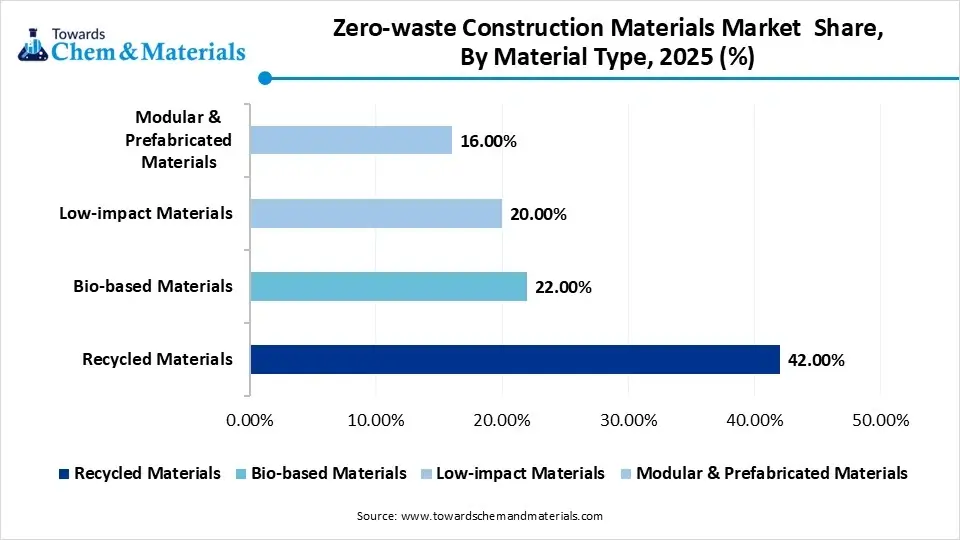
Low-impact materials represent 20.00%, supported by rising demand for energy-efficient and eco-friendly building solutions. Modular and prefabricated materials capture 16.00% of the market, benefiting from reduced construction waste and faster project timelines. Among these, recycled materials is dominate, while bio-based materials is the fastest growing segment owing to innovation and regulatory support.
| By Material Type | Revenue Share, 2025 (%) |
| Recycled Materials | 42.00% |
| Bio-based Materials | 22.00% |
| Low-impact Materials | 20.00% |
| Modular & Prefabricated Materials | 16.00% |
- Recycled materials dominate the zero-waste construction materials market with 42.00% of the share in 2025, driven by the growing emphasis on reducing waste and reusing materials from demolished buildings and construction sites.
- Bio-based materials hold a 22.00% share, gaining traction due to their sustainability, lower environmental impact, and increasing demand in eco-friendly building projects and green construction.
- Low-impact materials represent 20.00% of the market, supported by the rise in energy-efficient and environmentally friendly construction practices that minimize the ecological footprint of building materials.
- Modular and prefabricated materials account for 16.00% of the market, benefiting from their ability to reduce construction waste, shorten project timelines, and improve overall efficiency in the building process.
End-use Insights
The Non-Residential Construction Segment Held the Largest Market Share In 2025.
The segment by end-use, is primarily driven by residential construction, which holds the dominant position in 2025. This is largely due to the growing demand for sustainable housing, rising urbanization, and increasing consumer awareness about eco-friendly living spaces. Homebuyers and developers alike are actively seeking materials that reduce environmental impact while maintaining quality and affordability. Commercial construction also represents a significant share, supported by green building certifications and corporate sustainability goals. Industrial construction is gradually adopting zero-waste materials as companies aim to minimize their environmental footprint and comply with regulations.
Meanwhile, infrastructure development is emerging as a key growth area, driven by government initiatives focused on sustainable public projects. Residential construction is dominate, as it continues to lead in adoption. However, infrastructure development is the fastest growing segment, fueled by large-scale investments and a strong push toward environmentally responsible urban development worldwide.
Zero-waste Construction Materials Market Share, By End-Use 2025 (%)
| By End-Use | Revenue Share, 2025 (%) |
| Residential Construction | 36.00% |
| Commercial Construction | 28.00% |
| Industrial Construction | 18.00% |
| Infrastructure Development | 18.00% |
- Residential construction accounts for 36.00% of the zero-waste construction materials market in 2025, driven by the increasing demand for sustainable and eco-friendly homes, as homeowners and developers prioritize environmentally responsible building practices.
- Commercial construction holds a 28.00% share, with growing adoption of green building materials in office buildings, retail spaces, and hotels, as businesses focus on energy-efficient and sustainable structures to meet environmental standards.
- Industrial construction represents 18.00% of the market, supported by the demand for zero-waste materials in factories, warehouses, and manufacturing plants, where durability, cost-effectiveness, and environmental impact are key considerations.
- Infrastructure development also captures 18.00% of the market, driven by large-scale projects such as roads, bridges, and public utilities, where sustainable construction materials are increasingly used to support long-term environmental goals.
By Waste Source
By waste source, is largely driven by construction waste segment, which holds a dominant share of 48.00% in 2025. This dominance is mainly due to the massive volume of debris generated from demolition and renovation activities, making it a readily available and cost-effective input for recycled construction materials. Industrial waste follows with a 34.00% share, supported by increasing efforts from manufacturers to repurpose by-products such as slag, fly ash, and other residues into building materials.
Meanwhile, agricultural waste accounts for 18.00% of the market and is steadily gaining attention as innovative technologies enable its conversion into eco-friendly construction inputs like bio-composites and panels. Construction waste is dominate, as it remains the most accessible and widely utilized source. However, agricultural waste is the fastest growing segment, driven by rising sustainability awareness and the push toward greener, renewable material alternatives in modern construction practices.
| By Waste Source | Revenue Share, 2025 (%) |
| Construction Waste | 48.00% |
| Industrial Waste | 34.00% |
| Agricultural Waste | 18.00% |
- Construction waste dominates the zero-waste construction materials market with 48.00% of the share in 2025, driven by the large volume of debris generated from demolition and renovation projects, making it a valuable source for recycling and reusing materials in new construction.
- Industrial waste holds a 34.00% share, with growing efforts from manufacturing industries to repurpose by-products like slag, ash, and metals into construction materials, contributing to sustainability and waste reduction.
- Agricultural waste represents 18.00% of the market, gaining momentum as innovative methods convert materials like crop residues and plant fibers into sustainable building products, supporting green building initiatives and circular economy practices.
By Application
The Zero-waste Construction Materials Market, by application, is broadly categorized into structural applications, non-structural applications, and infrastructure. Structural applications hold the largest share in 2025, as these materials are widely used in core building components such as beams, columns, and load-bearing walls where durability and strength are essential. The growing adoption of sustainable practices in residential and commercial construction further supports this segment’s leadership. Non-structural applications also contribute significantly, with increasing use in insulation, interior fittings, and decorative elements where eco-friendly materials are gaining popularity.
Meanwhile, the infrastructure segment is steadily expanding, driven by government investments in sustainable roads, bridges, and public utilities. Structural applications is dominate, as it forms the backbone of construction activities. However, infrastructure is the fastest growing segment, fueled by large-scale green infrastructure projects and rising awareness around reducing environmental impact across public development initiatives.
| By Application | Revenue Share, 2025 (%) |
| Structural Applications | 38.00% |
| Non-Structural Applications | 34.00% |
| Infrastructure | 28.00% |
- Structural applications lead the zero-waste construction materials market with 38.00% of the share in 2025, driven by the high demand for durable and strong materials used in load-bearing components such as beams, columns, and foundations in both residential and commercial projects.
- Non-structural applications hold 34.00% of the market, supported by the use of eco-friendly materials in interior finishing, insulation, and decorative elements, where sustainability is increasingly prioritized without compromising aesthetic value.
- Infrastructure accounts for 28.00% of the market, benefiting from large-scale government and private sector investments in sustainable public works, including roads, bridges, and utilities, where zero-waste materials offer cost-effective and environmentally responsible solutions.
Regional Insights
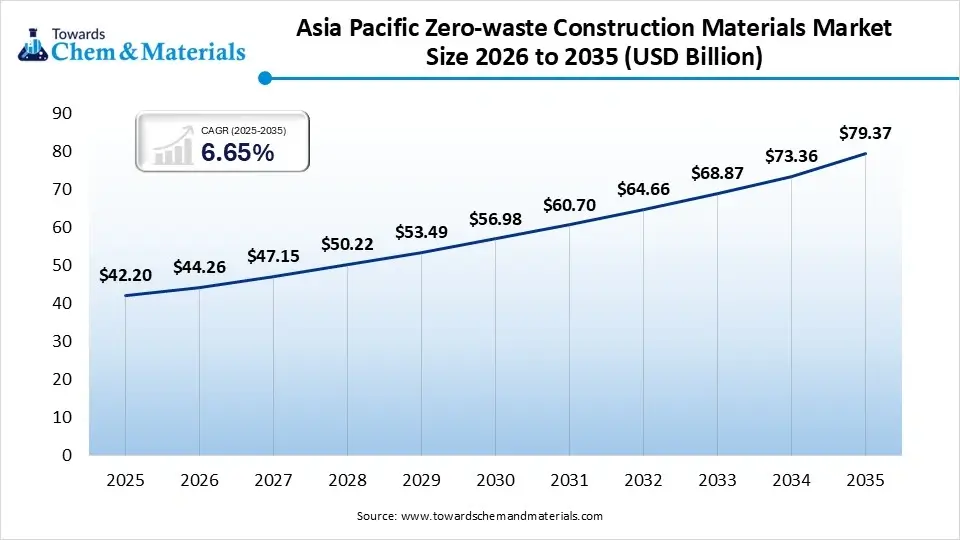
The Asia Pacific zero-waste construction materials market size was valued at USD 42.20 billion in 2025 and is expected to be worth around USD 79.37 billion by 2035, exhibiting at a compound annual growth rate (CAGR) of 6.65% over the forecast period from 2026 to 2035. Asia Pacific dominated the market with the largest share in 2025. The dominance of the region can be attributed to the extensive infrastructure development in developing countries and stringent government initiatives that prefer sustainability. In addition, major cities in the region are heavily investing in innovative waste collection systems and technologies to minimize dependence on landfills, supporting circular economy principles.
China Zero-waste Construction Materials Market Trends
In the Asia Pacific, China dominated the market owing to the surge in investment in modular, sustainable, and recycled materials, along with the ongoing urban redevelopment projects in major cities. Also, highly expanding urban centers, especially in Eastern China, are propelling demand for sustainable materials and recycled aggregates via greenfield developments.
North America is expected to grow at the fastest CAGR over the forecast period. The growth of the region can be credited to the increasing adoption of prefabrication and rising investments in durable, sustainable, and cost-effective materials such as bio-based products. Additionally, innovations in polymer processing and the incorporation of IoT and AI for waste sorting are enhancing the performance of recycled materials.
U.S. Zero-waste Construction Materials Market Trends
In North America, the U.S. led the market due to the growing need for energy-efficient buildings and increasing adoption of advanced technologies such as BIM for waste minimization. Escalating demand for green buildings has supported increased investment in materials such as green insulation, engineered timber, and modular building techniques, leading to further market growth.
Europe is expected to grow at a notable CAGR over the forecast period. The growth of the region can be driven by the growing adoption of materials such as recycled plastics and timber, along with the ongoing transition towards a circular economy. Furthermore, the region is increasingly promoting the adoption of demolition audits, which boosts the "environmentally friendly" construction sector, contributing to regional growth soon.
Germany Zero-waste Construction Materials Market Trends
The growth of the market in the country is due to increasing demand for sustainable building certifications coupled with the robust transition towards circular construction. Moreover, there is a rise in development for eco-friendly alternatives such as mycelium insulation, hempcrete, and low-carbon cement, focused on enhancing thermal efficiency and minimizing carbon emissions.
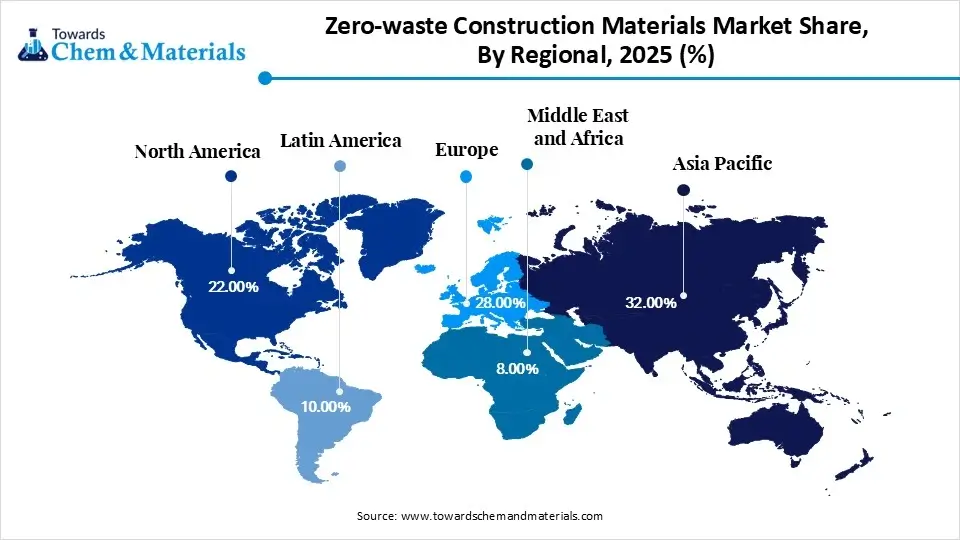
Zero-waste Construction Materials Market Share, By Regional, 2025 (%)
| Regional | Revenue Share, 2025 (%) |
| Asia-Pacific | 32.00% |
| Europe | 28.00% |
| North America | 22.00% |
| Latin America | 10.00% |
| Middle East & Africa | 8.00% |
- Asia-Pacific leads the zero-waste construction materials market with 32.00% of the share in 2025, driven by rapid urbanization, strong infrastructure development, and a growing emphasis on sustainable construction practices in countries like China, India, and Japan.
- Europe holds 28.00% of the market, supported by strict environmental regulations, green building certifications, and a strong focus on reducing carbon footprints across the region's construction and infrastructure projects.
- North America accounts for 22.00% of the market, fueled by the increasing adoption of eco-friendly materials in residential, commercial, and industrial construction, with a significant push towards green building technologies in the U.S. and Canada.
- Latin America represents 10.00% of the market, as countries in the region increasingly invest in sustainable construction practices and green infrastructure, driven by environmental awareness and urbanization.
- The Middle East & Africa holds 8.00% of the market, with a growing focus on sustainable building projects in countries like the UAE and South Africa, where eco-friendly materials are becoming a key component of modern construction.
Recent Developments
- In January 2026, the Los Angeles-based demolition and excavation firm Demo Leaders launched a companywide zero-waste program to minimize the environmental footprint of its projects. Founded in 2010, the company provides full-service residential and commercial demolition, specializing in everything from interior and pool removals to full-scale building teardowns.(Source: www.newsfilecorp.com)
- In August 2025, UNU-FLORES will launch the House of No Waste (HØW) international ideas competition this September. They are calling on the next generation of architects, engineers, designers, and scientists to reimagine the built environment and design a future for a pollution-free planet.(Source: unu.edu)
Market Companies
- Strawcture Eco Pvt. Ltd.: It is a leading Indian company developing zero-waste, carbon-negative building materials from >90% agricultural residue. Their compressed agri-fiber bio-panels provide sustainable alternatives to timber and gypsum, primarily used for walls, doors, and furniture to lower embodied carbon.
- Tvasta: Tvasta Manufacturing Solutions is a Chennai-based deep-tech startup and a leading player in India's zero-waste and sustainable construction materials market. Founded by IIT-Madras alumni in 2016, the company specializes in Construction 3D Printing (3DCP), offering an end-to-end technology platform.
- ANGIRUS IND PVT LTD: Angirus Ind Pvt Ltd, founded in 2020 in Udaipur, is a pioneering sustainable startup creating "Wricks" eco-friendly, non-fired bricks made from 100% recycled industrial/plastic waste. Their lightweight, waterproof bricks are up to 20% cheaper than traditional bricks.
- NOVACRET: NOVACRET (founded 2024, Bengaluru) is an emerging Indian startup producing cement-free, waterless concrete alternatives made from industrial/agricultural waste. Their geo-polymer materials reduce carbon emissions by up to 80% and water usage by 90%, achieving full strength in 3 days, targeting sustainable, waste-free construction projects.
- ARQLITESPC
- Rawblox
- a:gain
- Greenfiber
- Yi Design
- Greenful Group LLC
Segments Covered in the Report
By Product Type
- Recycled Aggregates & Concrete
- Recycled Metals
- Reclaimed Wood & Timber
- Recycled Plastics & Polymers
- Others
By End-use
- Residential Construction
- Non-residential Construction
By Material Type
- Recycled Materials
- Recycled Concrete
- Recycled Metals
- Recycled Plastics
- Reclaimed Wood
- Bio-based Materials
- Bamboo
- Hempcrete
- Cork
- Mycelium-based Materials
- Low-impact Materials
- Fly Ash-based Products
- Slag-based Cement
- Geopolymer Concrete
- Modular & Prefabricated Materials
- Precast Concrete Panels
- Modular Steel Structures
- Engineered Timber Panels
By Waste Source
- Construction Waste
- Demolition Waste
- Renovation Waste
- Industrial Waste
- Fly Ash
- Blast Furnace Slag
- Plastic Waste
- Agricultural Waste
- Rice Husk Ash
- Straw-based Materials
- Bagasse
By Application
- Structural Applications
- Foundations
- Load-bearing Walls
- Structural Frames
- Non-Structural Applications
- Insulation
- Flooring
- Roofing
- Cladding
- Infrastructure
- Roads
- Bridges
- Tunnels
By End-Use
- Residential Construction
- Single-family Housing
- Multi-family Housing
- Commercial Construction
- Offices
- Retail Spaces
- Hospitality
- Industrial Construction
- Warehouses
- Manufacturing Facilities
- Infrastructure Development
- Transportation
- Public Utilities
By Distribution Channel
- Direct Sales
- Distributors & Wholesalers
- Online Platforms
By Region
- North America
- U.S.
- Canada
- Mexico
- Europe
- Germany
- UK
- France
- Italy
- Spain
- Asia Pacific
- China
- India
- Japan
- South Korea
- Latin America
- Brazil
- Argentina
- Middle East & Africa
- Saudi Arabia
- South Africa
FAQ's
Question 1 : What are the key growth drivers for the zero-waste construction materials market?
Answer : The increasing adoption of circular economy principles, government regulations, and innovations in sustainable construction technologies are driving the growth of the zero-waste construction materials market.
Question 2 : How is the zero-waste construction materials market expected to evolve by 2035?
Answer : The market is projected to grow at a CAGR of 6.52%, reaching USD 244.20 billion by 2035, driven by rising demand for eco-friendly materials and circular construction practices.
Question 3 : What are the technological innovations shaping the zero-waste construction materials market?
Answer : Key technological advancements like Building Information Modelling (BIM), 3D printing, and the conversion of agricultural and plastic waste into structural materials are revolutionizing the zero-waste construction materials market.
Question 4 : Who are the leading companies operating in the zero-waste construction materials market?
Answer : Leading companies in the zero-waste construction materials market include Strawcture Eco Pvt. Ltd., Tvasta, ANGIRUS IND PVT LTD, NOVACRET, and Rawblox, known for their sustainable and innovative building material solutions.
Meet the Team

Saurabh Bidwai
Principal Consultant
Saurabh Bidwai, a B.Tech Chemical Engineering graduate with 4+ years of experience, specializes in specialty chemicals, commodity chemicals, and engineered materials, offering valuable insights into market trends and emerging opportunities.

Aditi Shivarkar
Reviewed By
Aditi Shivarkar, with 14+ years in Chemical and Materials market research, specializes in Chemical and Materials. She ensures accurate, actionable insights, driving Towards Chemicals And Materials Analytics and Consulting excellence in industry trends and sustainability.