
1,3 Butadiene Market Size, Production Volume, Sales Performance, Export & Import Dynamics, Adoption Rates, Recycling Rate, Material Efficiency, Market Share Analysis, and Demand Trends
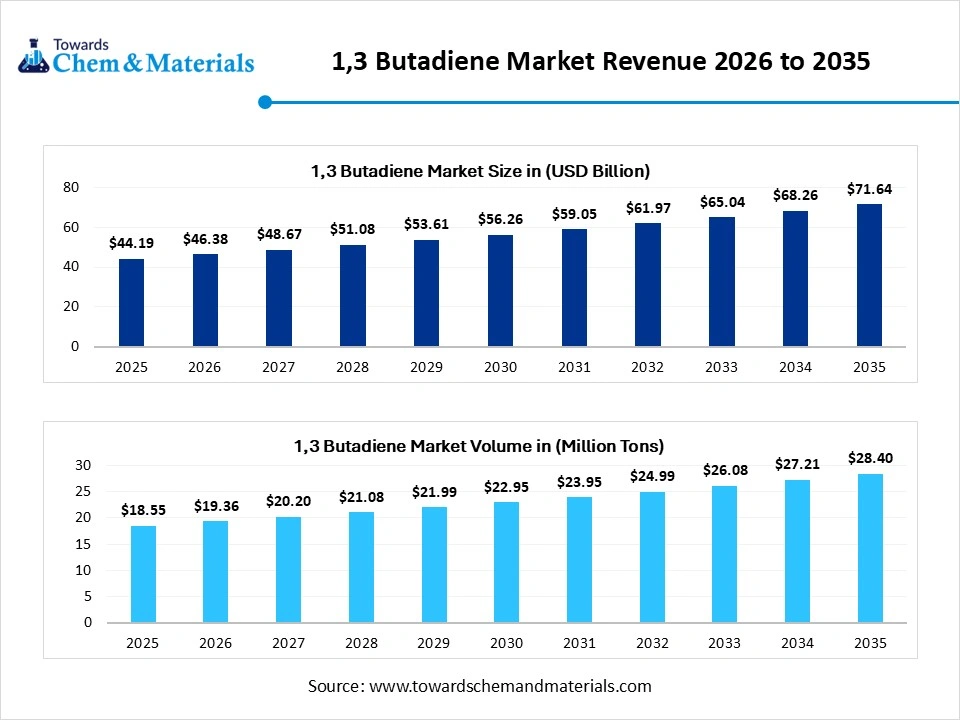
The 1,3 butadiene market was valued at USD 44.19 billion in 2025 and is estimated to reach USD 46.38 billion in 2026, further projected to grow to USD 71.64 billion by 2035, registering a CAGR of 4.95% during the forecast period. In terms of volume, the market is expected to expand from 18.55 million tons in 2025 to 28.4 million tons by 2035, growing at a CAGR of 4.35%. The report provides comprehensive coverage of market size, segment-wise data, regional insights, detailed company profiling, competitive analysis, value chain evaluation, trade data, and in-depth analysis of manufacturers and suppliers, offering a complete industry outlook.
Content
1,3 Butadiene Market Size, Share, Trends and Forecast Analysis
The global 1,3 butadiene market was valued at USD 44.19 billion in 2025, is estimated to reach USD 46.38 billion in 2026, and is projected to reach USD 71.64 billion by 2035, growing at a CAGR of 4.95% from 2026 to 2035. In terms of volume, the 1,3 butadiene market is projected to grow from 18.55 million tons in 2025 to 28.4 million tons by 2035. growing at a CAGR of 4.35% from 2026 to 2035. Increasing demand for synthetic rubber is the key factor driving market growth. Also, rapid urbanisation and a surge in the construction of infrastructure projects can fuel market growth further.
Key Takeaways
- By region, Asia Pacific dominated the market with the largest share of 49% in 2025 and is expected to grow at the fastest CAGR of 5.60% over the forecast period.
- By region, North America held the market share of 18% in 2025.
- By production process, the C4 hydrocarbon extraction segment dominated the market with the largest share of 68% in 2025.
- By production process, the on-purpose production segment is expected to grow at the fastest CAGR of 6.10% over the forecast period.
- By application, the styrene-butadiene rubber (SBR) segment dominated the market with the largest share of 41%in 2025.
- By application, the other segment is expected to grow at the fastest CAGR of 5.80% over the forecast period.
- By end-use industry, the automotive segment dominated the market with the largest share of 52% in 2025.
- By end-use industry, the electronics segment is expected to grow at the fastest CAGR of 5.60% during the forecast period.
- By distribution channel, the direct sales segment dominated the market with the largest share of 46%in 2025.
- By distribution channel, the contract supply agreements segment is expected to grow at the fastest CAGR of 5.40% during the projected period.
Market Size and Volume Forecast
- Market Estimated Size (2026): USD 46.38 Billion | CAGR (2026–2035): 4.95%
- Market Projected Size (2035): USD 71.64 Billion
- Market Volume (2025): 18.55 Million Tons (MT) | Volume CAGR (2026–2035): 4.35%
- Market Projected Volume (2035): 28.40 Million Tons (MT)
- Market Pricing (2025):
- Average Manufacturing Price: USD 950/ton
- Average Selling Price: USD 1,190/ton
- Pricing CAGR (2025–2035): 3.11%
What is 1,3 Butadiene Market?
The market encompasses the manufacturing, trade, and consumption of a flammable, colorless gas used mainly as a monomer and chemical intermediate to produce synthetic rubbers and polymers. It is crucial for manufacturing plastic, tires, and adhesives, which are boosted by the growth of the construction and automotive sectors.
Market Trends
- Increasing demand for 1, 3 butadiene in the automotive sector is the latest trend in the market, shaping positive market growth. It is mainly used as a chemical intermediate and monomer in the manufacture of polymers like synthetic rubbers and elastomers, which are generally used in the manufacture of tires.
- The market is substantially influenced by the surge in plastic manufacturing, especially in the production of acrylonitrile-butadiene-styrene (ABS) and polystyrene plastics. These materials are extensively used in different applications, such as electronics, consumer goods, and construction.
- Technological advancements in manufacturing processes are another major trend driving market growth. Innovations in extraction and refining technologies are facilitating more cost-effective and efficient production of butadiene. These developments can enhance the overall economic viability of butadiene production.
Report Scope
| Report Attribute | Details |
| Market Size and Volume in 2026 | USD 46.38 Billion / 18.55 Million Metric Tons |
| Expected Size and Volume by 2035 | USD 71.64 Billion / 28.4 Million Metric Tons |
| Growth Rate from 2026 to 2035 | CAGR 4.95% |
| Forecast Period | 2026 - 2035 |
| Dominant Region | Asia-Pacific |
| Segment Covered | By Production Process, By Application, By End-Use Industry, By Distribution Channel and By Regions |
| Key companies profiled | Evonik Oxeno GmbH & Co. KG, Tokyo Chemical Industry (India) Pvt. Ltd., Haldia Petrochemicals Limited, Saudi Basic Industries Corporation, Deluxe Industrial Gases, Polymer Source Inc., LG Chem Ltd., Bangkok Synthetics Co. Ltd., Braskem S.A., Versalis S.p.A., BASF SE, LyondellBasell Industries Holdings B.V. |
How Cutting-Edge Technologies Are Revolutionizing the 1,3 Butadiene Market?
Advanced technologies are transforming the market by transitioning manufacturing towards bio-based feedstocks and improving material performance via nanotechnology. Furthermore, technologies are improving SSBR for automotive tires, giving lower rolling resistance and superior wear properties, which are primarily crucial for electric vehicles.
Trade Analysis of the 1,3 Butadiene Market: Import & Export Statistics
- In 2024, the United States exported 247,773,000 kg of rubber (in primary forms or plates), valued at $470,802.24K. The top five destinations for these exports were Mexico ($98,158.59K, 52,230,900 Kg), Canada ($68,977.79K, 32,744,500 Kg), Brazil ($53,606.73K, 26,523,900 Kg), Chile ($24,383.67K, 12,199,200 Kg), and Belgium ($22,897.11K, 13,802,700 Kg).
- In 2025, China's butadiene imports surged by 25.79% to reach a record-breaking 541,800 tonnes, according to data from the General Administration of Customs (GACC).
- China imported 53,959.41 tons of butadiene in October 2024, marking a significant 98.54% year-on-year increase and a 19.79% month-on-month rise, according to customs data.
- According to recent trade statistics, the global synthetic rubber import market reached a total valuation of $28.49 billion in 2024. This figure represents a 4% year-over-year increase, reflecting steady demand across key industrial sectors.
- India's synthetic rubber imports reached $1.33 billion in 2024–25, representing a significant 4.7% of the global market share.
Supply Chain Analysis of the 1,3 Butadiene Market
Feedstock Procurement
It involves sourcing of essential materials mainly crude C4 streams from steam crackers to manufacture refined butadiene, crucial for synthetic rubber.
- Major Players: Sinopec, Trinseo
Chemical Synthesis and Processing
It refers to the laboratory and industrial methods used to manufacture monomers and their specialized derivatives, which are necessary for the polymer industry.
- Major Players: The Dow Chemical Company, LG Chem
Packaging and Labelling
It emphasizes the safety of storing and transporting this highly volatile gas, which is flammable, generally necessitating pressurized containers and hazardous material warnings.
- Major Players: Royal Dutch Shell Plc, Sinopec
Regulatory Compliance and Safety Monitoring
It involves stringent adherence to environmental regulations, along with the stringent workplace exposure limits set by governments in various countries.
- Major Players: TPC Group, BASF
1,3 Butadiene Market's Regulatory Landscape: Global Regulations
| Country/Region | Key Regulations |
| United States | TSCA Section 6: As of April 2026, the US Environmental Protection Agency (EPA) is developing a proposed risk management rule following its determination that 1,3-Butadiene presents unreasonable risks to workers during manufacturing and disposal. |
| South Korea | Inventory Caps: Businesses are prohibited from holding inventories exceeding 80% above levels from the same period in the previous year through June 30, 2026. |
| European Union | Regulated under REACH for registration and authorization. Subject to strict VOC emission limits and hazardous substance restrictions (e.g., 2002/95/EC) in electronics. |
Market Dynamics
Driver
Increasing Emphasis on Sustainable Practices
The market is experiencing a rapid shift towards sustainable practices, fuelled by regulatory pressures and environmental concerns. Major market players are rapidly adopting sustainable manufacturing methods and exploring bio-based solutions to conventional butadiene sources.
Restraint
Growing Concern Towards Personal Care
1, 3 butadiene is widely used in health care and personal care products, which can cause blood cancer in humans; this is the major factor hindering market growth. Butadiene causes severe headaches and dizziness, which can lead to coma or death.
Opportunity
Surge in Capital Investment
Major market players are heavily investing in vertical integration and capacity upgrades, creating lucrative opportunities in the market. Furthermore, the adoption of bio-based feedstocks and catalytic cracking is anticipated to disrupt the conventional production line, minimizing overall costs.
Segmental Insights
Production Process Insights
The C4 Hydrocarbon Extraction Segment Dominated the Market with 68% of Market Share in 2025
The C4 hydrocarbon extraction segment dominated the market with the largest share of 68% in 2025. The dominance of the segment can be attributed to the increasing product demand from the healthcare sector and a surge in antiseptic and sanitizer production. Established petrochemical infrastructure supports large-scale production further.
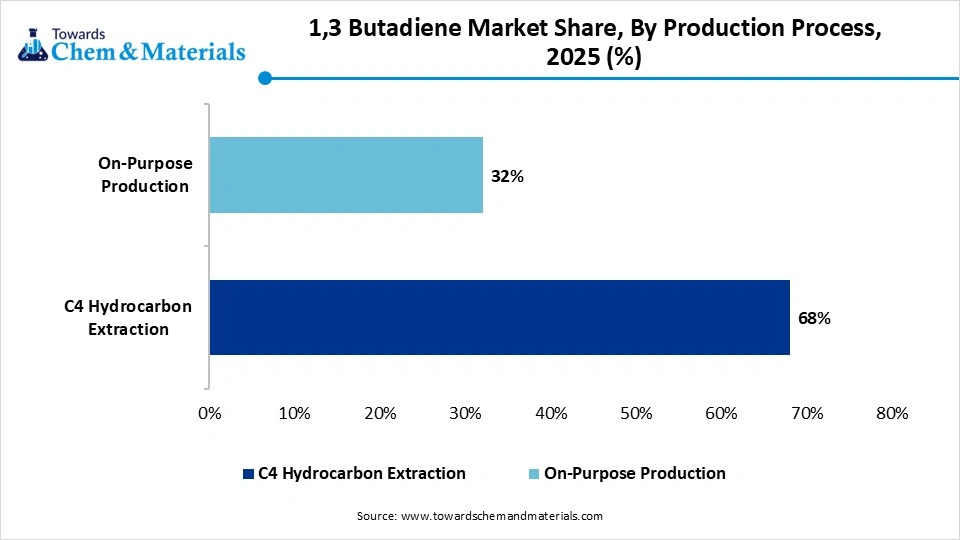
The on-purpose production segment held the market share of 32% in 2025 and is expected to grow at the fastest CAGR of 6.10% over the forecast period. The growth of the segment can be credited to the technological innovations in the production process, along with the rise in feedstock constraints. Bio-based and ethanol pathways are gaining traction for sustainability.
Application Insights
The Styrene-Butadiene Rubber (SBR) Segment Dominated the Market with 41% of Market Share in 2025
The styrene-butadiene rubber (SBR) segment dominated the market with the largest share of 41%in 2025. The dominance of the segment can be linked to the increasing SBR demand from the tire manufacturers and the surge in automotive production globally. Its performance benefits improve adoption in premium tires.
1,3 Butadiene Market Share, By Application, 2025 (%)
| By Application | Revenue Share, 2025 (%) |
| Styrene-Butadiene Rubber (SBR) | 41% |
| Polybutadiene Rubber (PBR) | 24% |
| Acrylonitrile Butadiene Styrene (ABS) | 13% |
| Nitrile Butadiene Rubber (NBR) | 9% |
| Adiponitrile Production | 8% |
| Others | 5% |
The other segment held the market share of 5% in 2025 and is expected to grow at the fastest CAGR of 5.80% over the forecast period. The growth of the segment can be driven by rapid advancements in polymer manufacturing technologies, along with the rise in use in specialty applications. Diversification of chemical usage enhances growth opportunities shortly.
The polybutadiene rubber (PBR) segment held the market share of 24%in 2025. The growth of the segment is owed to its growing use in tires due to its robust resilience and durability, coupled with the expanding automotive industry. Improved material properties fuel industrial applications.
End-Use Industry Insights
The Automotive Segment Dominated the Market with 52% of Market Share in 2025
The automotive segment dominated the market with the largest share of 52% in 2025. The growth of the segment can be attributed to the increasing vehicle production and expansion of the EV sector, and the increased use of advanced tires. Escalating tire manufacturing further supports the segment growth.
1,3 Butadiene Market Share, By End-Use Industry, 2025 (%)
| By End-Use Industry | Revenue Share, 2025 (%) |
| Automotive | 52% |
| Construction | 12% |
| Consumer Goods | 16% |
| Electronics | 11% |
| Industrial Manufacturing | 9% |
The electronics segment held the market share of 11% in 2025 and is expected to grow at the fastest CAGR of 5.60% during the forecast period. The growth of the segment can be credited to the technological advancements in the manufacturing process and the growth of electronics production. ABS plastic leads device casings.
The consumer goods segment held the market share of 16% in 2025. The growth of the segment can be linked to the growing demand for durable plastics and the surge in middle-class consumption of consumer goods made from ABS plastic. Moreover, lightweight materials improve overall product performance.
Distribution Channel Insights
The Direct Sales Segment Dominated the Market with 46% of Market Share in 2025
The direct sales segment dominated the market with the largest share of 46%in 2025. The dominance of the segment is owed to the growing infrastructure developments necessitating durable coatings and adhesives. Rising demand for construction materials is impacting positive market growth.
1,3 Butadiene Market Share,By Distribution Channel, 2025 (%)
| By Distribution Channel | Revenue Share, 2025 (%) |
| Direct Sales | 46% |
| Distributors & Traders | 28% |
| Contract Supply Agreements | 26% |
The contract supply agreements segment held the market share of 26% in 2025 and is expected to grow at the fastest CAGR of 5.40% during the projected period. The growth of the segment is due to the growing demand for synthetic rubber in automotive tires, along with the surge in vehicle production. Major players are rapidly entering into alliances to secure feedstock.
The distributors & traders segment held the market share of 28% in 2025. The growth of the segment can be attributed to the rise in consumer goods production and the growing petrochemical infrastructure. Advancements in butadiene production processes will drive segment growth soon.
Regional Insights
How did Asia Pacific Dominate the 1,3 Butadiene Market in 2025?
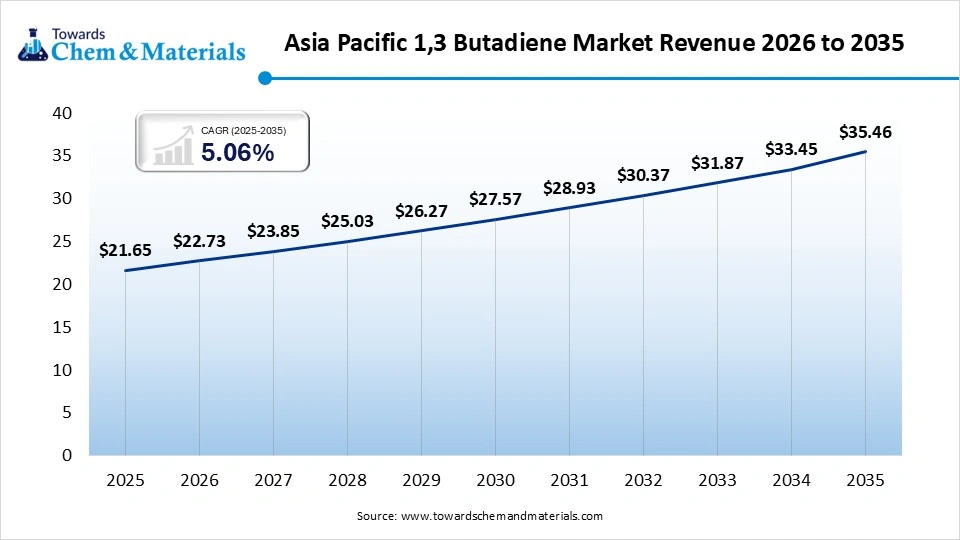
The Asia Pacific 1,3 butadiene market size was estimated at USD 21.65 billion in 2025 and is projected to reach USD 35.46 billion by 2035, growing at a CAGR of 5.06% from 2026 to 2035. The dominance and growth of the region can be attributed to the ongoing urbanisation and surge in disposable income in emerging economies such as China and India. In addition, favourable policies and initiatives enforced by the government in developing countries support overall industrial growth and attract production hubs.
China 1,3 Butadiene Market Trends
In the Asia Pacific, China dominated the market owing to the increasing product demand from the automotive industry for synthetic rubber used in tires. Also, butadiene is a crucial component in acrylonitrile butadiene styrene (ABS) plastics, which are widely utilised in electronics, appliances, and consumer goods.
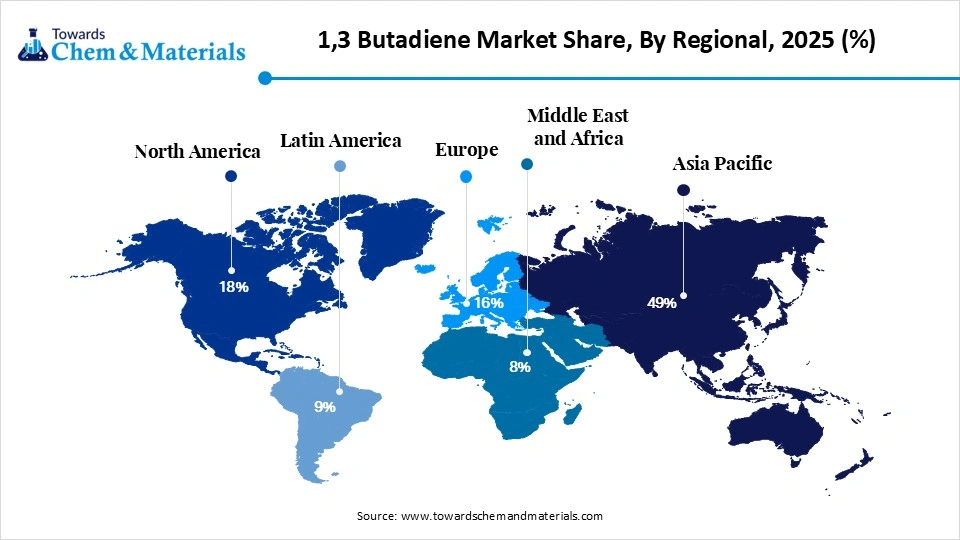
North America held the market share of 18% in 2025. The growth of the region can be linked to the surge in consumer buying capacity and growing end-use sectors such as healthcare and construction. Furthermore, R&D investments from ExxonMobil and LyondellBasell are targeting advanced elastomers for aerospace and defense, accelerating regional market growth.
U.S. 1,3 Butadiene Market Trends
The growth of the market in the country is due to ongoing technological innovations in manufacturing processes, coupled with the surge in investment in infrastructure development. Moreover, states such as Texas and Louisiana are dominating the market due to the presence of robust chemical manufacturing infrastructure and extensive availability of raw material sources.
Recent Development
- In February 2026, ARLANXEO officially inaugurated a new Therban® HNBR plant in Changzhou, China, expanding its production footprint in the Asia-Pacific region. This facility aims to meet the growing demand for high-performance elastomers in advanced transportation, industrial applications, and the new energy sector.
1,3 Butadiene Market Company
- BASF SE: BASF SE is a leading participant in the global butadiene market, operating with an integrated supply chain that ensures a steady material supply. The company produces butadiene through naphtha cracking at its steam cracker facilities, catering primarily to the tire, paper, and plastics industries.
- Lyondell Basell Industries Holdings B.V: LyondellBasell is a leading global producer of 1,3-butadiene, primarily manufacturing this petrochemical building block through steam cracking processes. Butadiene is essential for producing synthetic rubber for tires, hoses, and adhesives, as well as nylon for clothing and engineering plastics.
Companies in the 1,3 Butadiene Market
- Evonik Oxeno GmbH & Co. KG
- Tokyo Chemical Industry (India) Pvt. Ltd.
- Haldia Petrochemicals Limited.
- Saudi Basic Industries Corporation
- Deluxe Industrial Gases
- Polymer Source. Inc.
- LG Chem, Ltd
- Bangkok Synthetics Co. Ltd.
- Braskem SA
- Versalis S.p.A.,
1,3 Butadiene Market Segments Covered in the Report
By Production Process
- C4 Hydrocarbon Extraction
- Steam Cracking (Naphtha-based)
- Steam Cracking (LPG-based)
- On-Purpose Production
- Dehydrogenation of Butanes/Butenes
- Ethanol-to-Butadiene Process
By Application
- Styrene-Butadiene Rubber (SBR)
- Emulsion SBR (E-SBR)
- Solution SBR (S-SBR)
- Polybutadiene Rubber (PBR)
- Acrylonitrile Butadiene Styrene (ABS)
- Nitrile Butadiene Rubber (NBR)
- Adiponitrile Production
- Others (includes specialized polymers and chemical intermediates)
By End-Use Industry
- Automotive
- Tires
- Automotive Components
- Construction
- Consumer Goods
- Electronics
- Industrial Manufacturing
By Distribution Channel
- Direct Sales
- Distributors & Traders
- Contract Supply Agreements
By Regions
- North America
- U.S.
- Canada
- Mexico
- U.S.
- Europe
- Germany
- UK
- France
- Italy
- Spain
- Germany
- Asia Pacific
- China
- India
- Japan
- South Korea
- China
- Latin America
- Brazil
- Argentina
- Brazil
- Middle East & Africa
- Saudi Arabia
- South Africa
- Saudi Arabia
FAQ's
Question 1 : What is the 1,3 Butadiene Market?
Answer : The 1,3 butadiene market includes the global production, trade, and consumption of butadiene, a colorless, flammable gas primarily used as a monomer in the manufacturing of synthetic rubber and polymers. It plays a crucial role in industries such as automotive, construction, and electronics.
Question 2 : What is the current size of the 1,3 Butadiene Market?
Answer : The market was valued at USD 44.19 billion in 2025 and is estimated to reach USD 46.38 billion in 2026, with projections indicating growth to USD 71.64 billion by 2035.
Question 3 : What is the expected CAGR of the 1,3 Butadiene Market?
Answer : The market is expected to grow at a CAGR of 4.95% from 2026 to 2035, while volume demand is projected to grow at a CAGR of 4.35% during the same period.
Question 4 : Which application segment dominates the market?
Answer : The Styrene-Butadiene Rubber (SBR) segment dominates the market, accounting for 41% of the total share in 2025, mainly due to its extensive use in tire manufacturing.
Question 5 : Which region dominates the 1,3 Butadiene Market?
Answer : Asia Pacific leads the market with a 49% share in 2025 and is expected to grow at the fastest rate due to strong industrial growth in countries like China and India.
Meet the Team

Saurabh Bidwai
Principal Consultant
Saurabh Bidwai, a B.Tech Chemical Engineering graduate with 4+ years of experience, specializes in specialty chemicals, commodity chemicals, and engineered materials, offering valuable insights into market trends and emerging opportunities.

Aditi Shivarkar
Reviewed By
Aditi Shivarkar, with 14+ years in Chemical and Materials market research, specializes in Chemical and Materials. She ensures accurate, actionable insights, driving Towards Chemicals And Materials Analytics and Consulting excellence in industry trends and sustainability.