
Butadiene Market Manufacturers & Suppliers Company Analysis 2026-2035
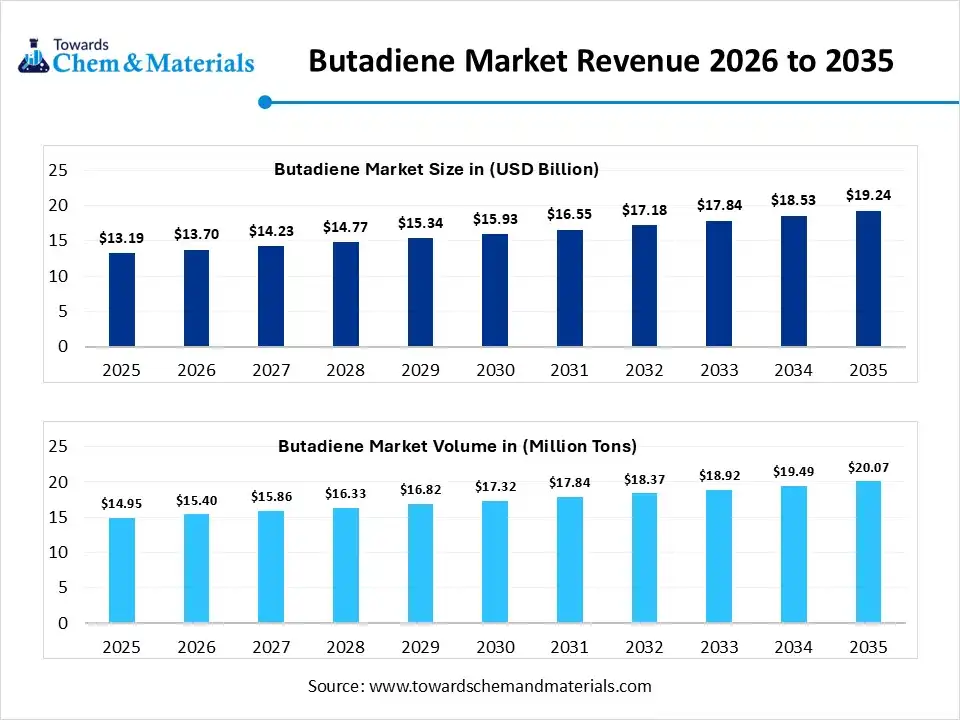
The global butadiene market size is expected to grow from USD 13.70 billion in 2026 to USD 19.24 billion in 2035, growing at a CAGR of 3.85% from 2026 to 2035. The top key players in the market are INEOS Group AG, LyondellBasell Industries, TPC Group, LG Chem, ExxonMobil Chemical, Sinopec, BASF SE, Arlanxeo, PetroChina, Versalis, Braskem, Shell plc, Formosa Plastics Corporation, Evonik Industries, Sabic-Global Forecast 2026 To 2035
Content
What is the Current Butadiene Market Size and Share?
The butadiene market size was estimated at USD 13.19 billion in 2025 and is expected to increase from USD 13.70 billion in 2026 to USD 19.24 billion by 2035, growing at a CAGR of 3.85% from 2026 to 2035. In terms of volume, the market is projected to grow from 14.95 million tons in 2025 to 20.07 million tons by 2035. growing at a CAGR of 2.99% from 2026 to 2035. Asia Pacific dominated the butadiene market with the largest share of 51.60% in 2025. The growth of the market is driven by the growing demand from the automotive sector due to the need for sustainable products, high-performance material requirement which drive the growth. The market is critically significant as the primary, irreplaceable raw material for producing synthetic rubbers, specifically Styrene-Butadiene Rubber (SBR) and Polybutadiene Rubber (PBR), which account for roughly 60% of its use, mainly for tire manufacturing. As a vital petrochemical intermediate, it drives the automotive, tire, construction, and plastics industries, with increasing demand for specialized rubber in electric vehicles (EVs).
Market Highlights
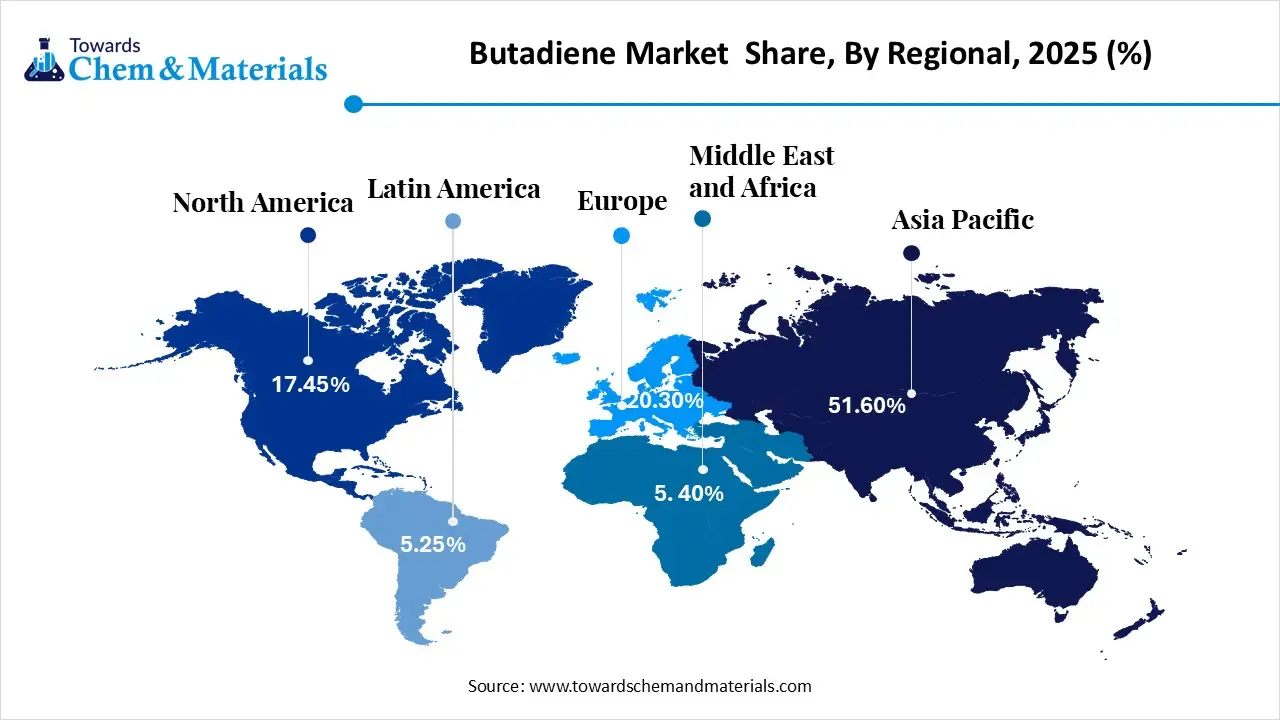
- By region, Asia Pacific dominated the market with a share of approximately 51.6% in 2025. The growth is driven by growing manufacturing hubs.
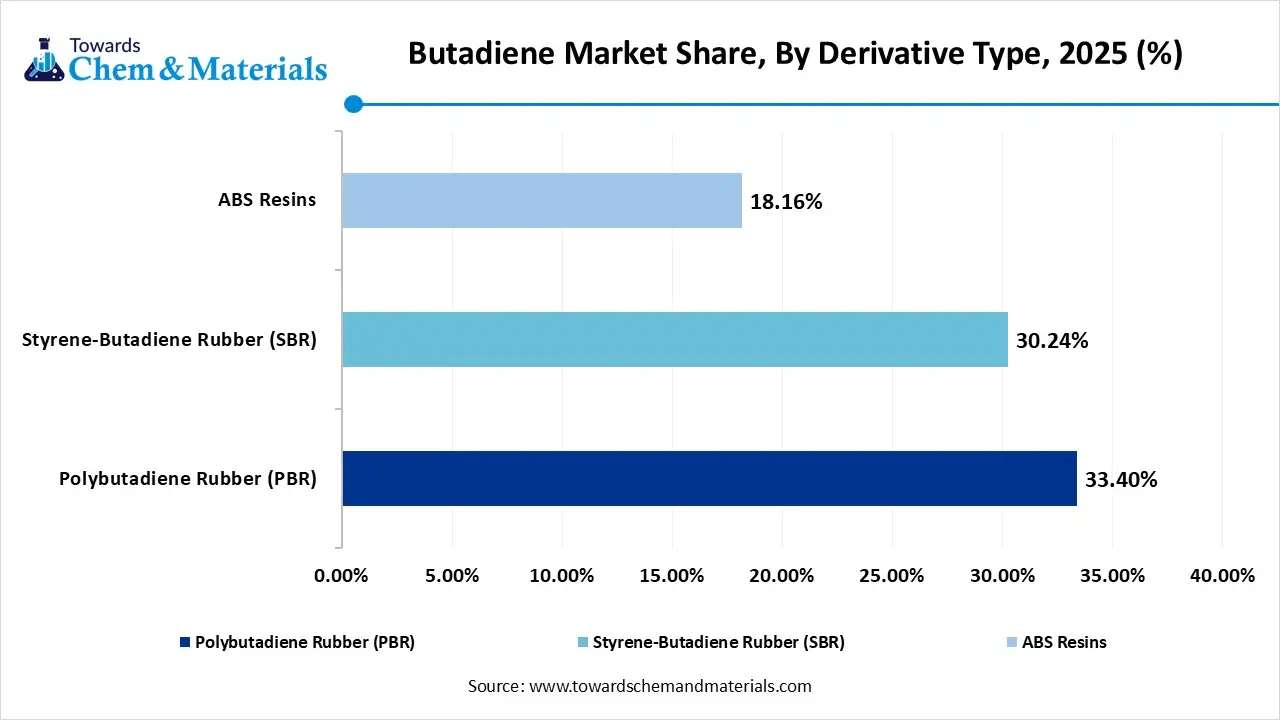
- By derivative type, the polybutadiene rubber (PBR) segment dominated the market with a share of approximately 33.4% in 2025, Vital for high-performance tire treads and sidewalls.
- By application/end user, the tire and rubber segment dominated the market with a share of approximately 70.00% in 2025. Remains the primary engine of the market.
Key Technological Shifts in the Butadiene Market:
The global butadiene market is undergoing significant technological and structural shifts driven by the need for sustainable production, supply chain changes, and high-performance requirements in the automotive industry. Industry leaders like SABIC, Trinseo, and Versalis are investing in bio-based feedstocks and green technologies to meet demand for sustainable products, particularly for "green tires," fueling the growth of the market.
Trade Analysis of the Butadiene Market: Import & Export Statistics
- Based on Global Export Data, the world exported 184,167 Butadiene shipments via 7,765 verified exporters and 8,501 buyers.
- Additionally, 4,077 Butadiene Rubber shipments were exported by 149 verified exporters to 431 buyers.
- For Synthetic Butadiene, 1,645 shipments were shipped by 53 verified exporters to 185 buyers.
- Between May 2024 and April 2025 (TTM), 213 Poly Butadiene shipments were exported through 9 verified exporters to 46 buyers.
- The leading importers of Poly Butadiene are Sri Lanka, Thailand, and Vietnam, while India (1,182 shipments), South Korea (846), and the United States (825) are the top exporters.
Growth Trends:
- Sustainability and Bio-Based Shift: There is an increasing focus on developing bio-based butadiene as a sustainable alternative to petroleum-derived products to lower carbon emissions.
- Electric Vehicle (EV) Impact: The surge in EV production is increasing demand for specialized, high-performance tires, which heavily rely on solution styrene-butadiene rubber (S-SBR).
- ABS Plastics Growth: Acrylonitrile-Butadiene-Styrene (ABS) demand is rising, driven by consumer electronics and appliance manufacturers localizing supply chains.
Report Scope
| Report Attribute | Details |
| Market Size in 2026 | USD 13.70 Billion |
| Revenue Forecast in 2035 | USD 19.24 Billion |
| Growth Rate | CAGR 3.85% |
| Forecast Period | 2026 - 2035 |
| Base Year | 2025 |
| Dominant Region | Asia Pacific |
| Segment Covered | By Derivative Type, By Application / End-User, By Regions |
| Key companies profiled | INEOS Group AG, LyondellBasell Industries, TPC Group, LG Chem, ExxonMobil Chemical, Sinopec, BASF SE, Arlanxeo, PetroChina, Versalis, Braskem, Shell plc, Formosa Plastics Corporation, Evonik Industries, Sabic |
Butadiene Market Value Chain Analysis
Production & Processing
- Butadiene is produced primarily as a byproduct of steam cracking of hydrocarbons and through on-purpose production routes such as butane dehydrogenation, followed by extraction, purification, and stabilization to achieve polymer-grade specifications.
- Key players: Shell Chemicals, ExxonMobil Chemical, LyondellBasell Industries, SABIC.
Quality Testing and Certification
- Butadiene requires certifications ensuring chemical purity, safe handling, transportation compliance, and performance consistency for polymerization applications. Key certifications include ISO quality standards, REACH registration, hazardous material transport compliance, and ASTM chemical specifications.
- Key players: ISO (International Organization for Standardization), ECHA (REACH), ASTM International, OSHA.
Distribution to Industrial Users
- Butadiene is supplied to synthetic rubber manufacturers (SBR, BR), ABS resin producers, latex manufacturers, and chemical intermediate producers serving automotive, plastics, adhesives, and industrial goods sectors.
- Key players: LyondellBasell Industries, SABIC, Shell Chemicals.
Butadiene Regulatory Landscape: Global Regulations
| Country / Region | Regulatory Body | Key Regulations / Policies | Focus Areas |
| United States | EPA (Environmental Protection Agency) OSHA (Occupational Safety & Health Administration) DOT (Department of Transportation) |
TSCA Risk Evaluation & Upcoming Risk Management Rule (butadiene designated high-priority chemical) OSHA 1,3-Butadiene Exposure Standard (29 CFR 1910.1051) Clean Air Act VOC/HAP controls Hazard Communication & Safety Data Sheet Requirements |
Worker protection & exposure limits Chemical risk evaluation & forthcoming management actions Air emissions & VOC control in production Safe transportation of flammable gas |
| European Union | European Chemicals Agency (ECHA) European Commission |
REACH (Registration, Evaluation, Authorization & Restriction of Chemicals) CLP (Classification, Labeling & Packaging) Industrial Emissions Directive VOC & Emission Norms |
Detailed substance safety data & registration Hazard classification & labeling Emission permits & BAT requirements Public health & environmental safeguards |
| China | Ministry of Ecology and Environment (MEE) MIIT / SAMR |
National air/water pollution control laws Chemical product/production standards (GB) Emission standards & safety reporting |
Environmental compliance for chemical plants Toxic substance handling & reporting Worker safety guidelines |
| India | Ministry of Environment, Forest & Climate Change (MoEFCC) CPCB (Central Pollution Control Board) |
Air (Prevention & Control of Pollution) Act Water (Prevention & Control of Pollution) Act Hazardous Chemicals Rules |
Emissions & effluent regulation Hazardous chemical handling Worker safety & plant permitting |
Segmental Insights
Derivative Type Insights
How did the Polybutadiene Rubber (PBR) Segment Dominate the Butadiene Market?
The polybutadiene rubber (PBR) segment dominated the market with a share of approximately 33.4% in 2025, driven by high demand for tires in the automotive sector, which increases the growth of the market. The rise in electric vehicle (EV) production and the need for durable, efficient tires are driving the demand for PBR. The other factor by which the market is driven is the use of high-performance tires and industrial applications.
The ABS resins segment is projected to grow at the fastest CAGR between 2026 and 2035 in the market, driven by demand in the automotive, electronics, and construction sectors. Increasing focus on sustainability, with recyclability driving innovation in production are also a factor responsible for growth. The benefits offered like versatility of the material, offering strength, durability, and a glossy finish, making it vital for both functional and aesthetic applications.
Butadiene Market Share, By Derivative Type, 2025 (%)
| By Derivative Type | Revenue Share, 2025 (%) |
| Polybutadiene Rubber (PBR) | 33.40% |
| Styrene-Butadiene Rubber (SBR) | 30.24% |
| ABS Resins | 18.16% |
| Adiponitrile (ADN) | 18.20% |
Application / End-User Insights
Which Application / End-User Segment Dominates the Butadiene Market?
The tire & rubber segment dominated the market with a share of approximately 65-70% in 2025, driven by high automotive demand, particularly in the production of electric vehicles and high-performance, eco-friendly tires, fueling the growth. This segment's high demand is largely due to the essential role of butadiene in providing durability, fuel efficiency, and abrasion resistance in tires, fueling the growth and expansion of the market.
The automotive & transportation segment is projected to grow at the fastest CAGR between 2026 and 2035 in the market, due to the growing demand for synthetic rubber (SBR/PBR) in tires and components, especially with electric vehicle (EV) adoption, which propels the growth of the market. Increased vehicle ownership in emerging economies and steady replacement cycles in mature markets are driving consistent demand, further supporting the growth and expansion of the market.
Butadiene Market Share, By By Application, 2025 (%)
| By Application | Revenue Share, 2025 (%) |
| Tire & Rubber | 70.00% |
| Automotive & Transportation | 12.00% |
| Consumer Goods | 8.00% |
| Building & Construction | 10.00% |
Regional Analysis
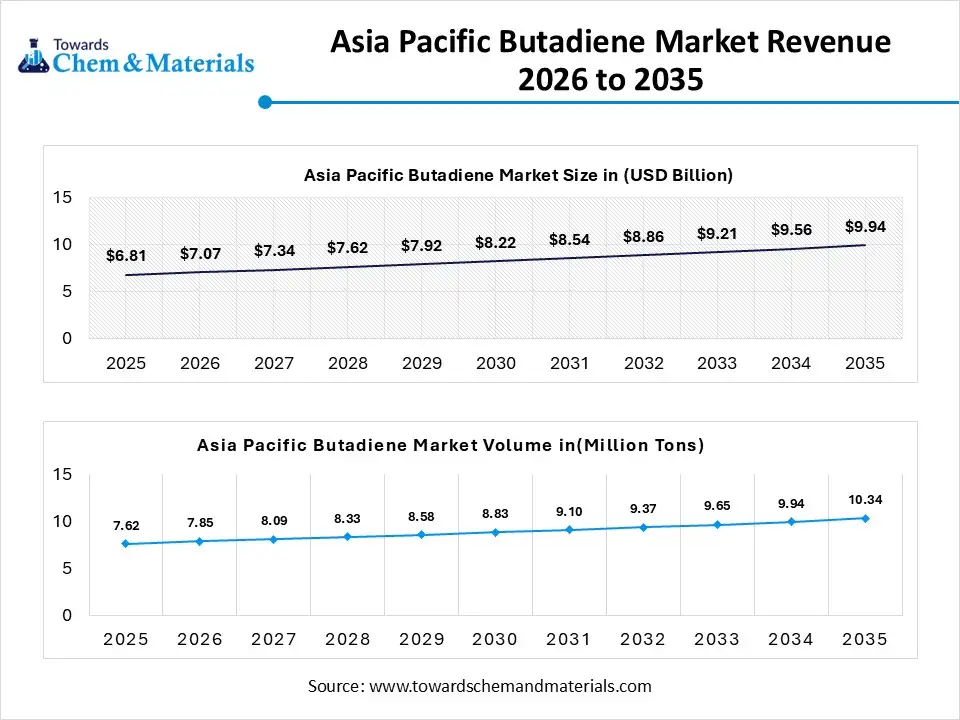
The Asia Pacific butadiene market size was valued at USD 6.81 billion in 2025 and is expected to be worth around USD 9.94 billion by 2035, exhibiting at a compound annual growth rate (CAGR) of 3.87% over the forecast period from 2026 to 2035. Asia Pacific dominated the market with a share of approximately 51.60% in 2025. The Asia Pacific butadiene market volume was estimated at 7.62 million tons in 2025 and is projected to reach 10.34 million tons by 2035, growing at a CAGR of 3.10% from 2026 to 2035.
The growth is driven by the growing demand from various industries like automotive, due to the growing manufacturing base in the region, which requires specialized tires drives the demand for butadiene, driving growth. Other key growth drivers are infrastructure and manufacturing base, growing production hubs due to the presence of major players like Sinopec, INEOS, and LyondellBasell, making the region the highest producer and consumer, meeting the expanding need.
India Butadiene Market Growth Trends
India has seen significant growth in the market, driven by various factors like growing sectors such as the automobile and tire industry, infrastructure growth due to increased construction activity, healthcare sector, which drives growth. The 'Make in India' initiative is boosting domestic manufacturing of ABS and other synthetic rubber products, driving localized consumption. These government initiatives drive the growth and expansion of the market.
North America Butadiene Market Growth Analysis
North America butadiene market segment accounted for the major revenue share of 17.45% in 2025. North America is expected to have fastest growth in the market in the forecast period between 2026 and 2035, driven by robust demand from the automotive, tire, and construction sectors, which fuel the growth of the market. The other key growth drivers include the production of synthetic rubber (SBR, PBR) for SUVs/light trucks and the adoption of bio-based feedstocks, supported by major manufacturing hubs in Texas and Louisiana, driving the growth and expansion of the market in the region.
U.S. Butadiene Market Growth Trends
The U.S. market has seen significant growth, driven by high demand for synthetic rubber in the automotive tire industry and ABS plastics, which fuel the growth of the market. The market, heavily reliant on steam crackers, is facing supply constraints, which are increasing focus on on-purpose production, bio-based alternatives, and improved extraction techniques to meet rising demand from polymer applications, which drives the growth and expansion of the market in the country.
Europe Butadiene Market Growth Analysis
Europe butadiene market segment accounted for the major revenue share of 20.30% in 2025. The European market is experiencing strong growth, driven by high demand from the automotive industry for tires, and is expanding, particularly in Germany. The market is shifting toward sustainable, bio-based feedstock and efficient production methods to align with EU environmental regulations due to rising environmental concerns, which drives the growth of the market. Significant demand is also generated by the styrenic block copolymers, adhesives, and coatings industries, driving the growth and expansion of the market.
Butadiene Market Share, By Regional, 2025 (%)
| Regional | Revenue Share, 2025 (%) |
| North America | 17.45% |
| Europe | 20.30% |
| Asia Pacific | 51.60% |
| Latin America | 5.25% |
| Middle East & Africa | 5.40% |
Germany Butadiene Market Growth Trends
The German market, a major European hub, is driven by high demand in synthetic rubber, automotive tires, and construction polymers, which fuels the growth of the market in the country. Localized production methods focusing on steam cracking are a major growth driver. A significant trend is the increasing adoption of bio-based feedstock for synthetic rubber production to meet eco-friendly manufacturing regulations, propelling the growth of the market.
Recent Developments
- In November 2025, SABIC's NORYL™ WM300G is a specialty resin launched for the water management industry to meet future regulations on butadiene in drinking water. This butadiene-free material offers 20-30% higher burst strength compared to an older grade and is compliant with BPA, PFAS, and food-contact standards.(Source: www.chemanalyst.com)
- In December 2025, Michelin, IFPEN, and Axens demonstrated the industrial viability of producing 100% bio-based butadiene from standard and advanced bioethanol through their BioButterfly project. The bio-based butadiene produced at the Bassens site demonstrator has been successfully used to synthesize rubber meeting the specifications for high-performance tires.(Source: www.indianchemicalnews.com)
- In June 2025, Zeon Corporation established a new research facility at its Zeon Chemicals Yonezawa site in Yamagata Prefecture, Japan, focused on developing plant-based processes for synthetic rubber raw materials. This facility is part of Zeon’s “STAGE30” plan to reduce CO2 emissions and aims to commercialize bio-based butadiene and isoprene production by 2034.(Source: www.chemengonline.com)
Top players in the Butadiene Market & Their Offerings:
- INEOS Group AG: INEOS is a major global producer of butadiene and related derivatives (e.g., SBR, PBR, ABS) with integrated production capacities and strategic partnerships across Europe, Asia, and the Americas. It focuses on reliable supply chains and downstream integration with the synthetic rubber and plastics industries.
- LyondellBasell Industries: LyondellBasell is a global petrochemical leader producing butadiene and its derivatives with extensive downstream integration into ABS, SBR, and elastomer products used across automotive, consumer goods, and industrial markets.
- TPC Group: TPC Group is a significant North American producer of butadiene, often supplying high-cis and high-performance grades for tire manufacturers and elastomer producers. Its capacity and specialty focus help address regional demand in automotive applications.
- LG Chem: LG Chem supplies butadiene and derivative elastomers, including S-SBR and polybutadiene rubbers, to automotive and tire manufacturers across the Asia Pacific and global markets. Its chemical portfolio supports performance materials for modern tires and industrial components.
- ExxonMobil Chemical: ExxonMobil Chemical supplies butadiene and petrochemical intermediates as part of its global olefins and aromatics operations, serving key markets in North America, Asia, and Europe, including automotive elastomers and ABS plastics.
- Sinopec
- BASF SE
- Arlanxeo
- PetroChina
- Versalis
- Braskem
- Shell plc
- Formosa Plastics Corporation
- Evonik Industries
- Sabic
Segments Covered:
By Derivative Type
- Polybutadiene Rubber (PBR)
- Styrene-Butadiene Rubber (SBR)
- ABS Resins
- Adiponitrile (ADN)
By Application / End-User
- Tire & Rubber
- Automotive & Transportation
- Consumer Goods
- Building & Construction
By Regions
- North America
- U.S.
- Canada
- Mexico
- Europe
- Germany
- UK
- France
- Italy
- Spain
- Asia Pacific
- China
- India
- Japan
- South Korea
- Latin America
- Brazil
- Argentina
- Middle East & Africa
- Saudi Arabia
- South Africa
FAQ's
Question 1 : What is the current size and growth outlook of the Butadiene market?
Answer : The global butadiene market was valued at USD 13.19 billion in 2025 and is projected to reach USD 19.24 billion by 2035, growing at a CAGR of 3.85% from 2026 to 2035.
Question 2 : Which region dominates the global Butadiene market and why?
Answer : Asia Pacific dominated the butadiene market with a 51.60% share in 2025, driven by strong automotive manufacturing, tire production, and expanding petrochemical industries in countries such as China, India, Japan, and South Korea.
Question 3 : What are the key growth drivers influencing the Butadiene market?
Answer : The market growth is primarily driven by rising demand for synthetic rubber in tire manufacturing, increasing electric vehicle production, expanding ABS plastics usage in electronics, and growing adoption of bio-based butadiene technologies.
Question 4 : Who are the leading companies operating in the global Butadiene market?
Answer : Key companies in the butadiene market include INEOS Group AG, LyondellBasell Industries, TPC Group, LG Chem, ExxonMobil Chemical, Sinopec, BASF SE, Arlanxeo, PetroChina, Versalis, Braskem, Shell plc, Formosa Plastics Corporation, Evonik Industries, and SABIC.
Meet the Team

Saurabh Bidwai
Principal Consultant
Saurabh Bidwai, a B.Tech Chemical Engineering graduate with 4+ years of experience, specializes in specialty chemicals, commodity chemicals, and engineered materials, offering valuable insights into market trends and emerging opportunities.

Aditi Shivarkar
Reviewed By
Aditi Shivarkar, with 14+ years in Chemical and Materials market research, specializes in Chemical and Materials. She ensures accurate, actionable insights, driving Towards Chemicals And Materials Analytics and Consulting excellence in industry trends and sustainability.