
Asia Pacific Paints And Coatings Market Size, Share, Growth, Report 2026 to 2035
The report offers a comprehensive segmentation of the Asia Pacific Paints And Coatings Market, analyzing key areas such as By Resin Type (Acrylic Resins, Alkyd Resins, Epoxy Resins, Polyester Resins, Polyurethane Resins, Fluoropolymer Resins, Vinyl Resins, and Other Resin Types), By Technology (Water-borne Coatings, Solvent-borne Coatings, Powder Coatings, and Other Technologies), and By End-Use Industry (Architectural and Industrial)- Industry Analysis, Size, Trends, Leading Companies, Regional Outlook, and Forecast 2026 to 2035
Content
What is the current Asia Pacific Paints And Coatings Market Size and Share?
The Asia Pacific paints and coatings market size was estimated at USD 105.11 billion in 2025 and is expected to be worth around USD 182.11 billion by 2035, growing at a CAGR of 5.65% from 2026 to 2035. In terms of volume, the Asia Pacific paints and coatings industry is projected to grow from 35.11 million tons in 2025 to 58.01 million tons by 2035, exhibiting a compound annual growth rate (CAGR) of 5.15% over the forecast period from 2026 to 2035. The growth is propelled by rapid urbanization, government support, domestic production capacity expansion, and advancement in surface protection technologies & sustainable coatings.
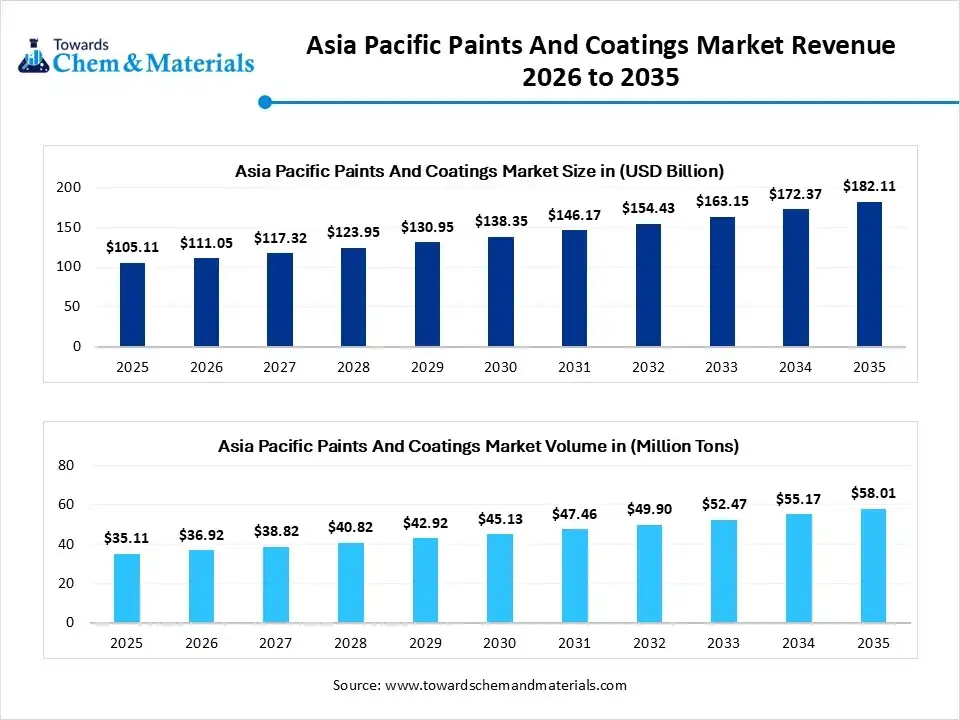
The Asia Pacific paints and coatings market is defined by its dynamic manufacturing practices, fueled by urban development and production capacity expansion through the infrastructural investments. The region focuses on innovation that boosts the advancement of eco-friendly waterborne technologies, powder coatings, novel low-VOC formulations, and radiation-cured systems. Asia Pacific's stringent regulatory framework supports sustainability commitment and environmental safety. The continuous growth is propelled by the transition towards smart city infrastructure, commercial construction, and megacity development projects by ensuring domestic expansion.
The emerging countries are optimizing advanced polymer chemistry, where the architectural and decorative sector is promoted by automotive assembly lines and specialized industrial production hubs.
The major paints and coatings sector is focusing on corporate strategies on supply chain backward integration that fueling the raw material security. The rising consumer awareness for ease of clean-up and health is driving the regional shift toward low-VOC and bio-based paints and coatings formulation to meet green chemistry compliances. The technological shift towards AI-driven digital color-matching tools to capture the consumer retail market, which is accelerating in the country, is the fastest-growing and high-value domestic consumer market.
Asia Pacific regulation focuses on heavy metal-free paint and powder coating safety and VOC limits for industrial coatings that are pushing manufacturers towards high-solid technology and waterborne solutions. Additionally, the emerging opportunity is the integration of nanotechnology through strategic collaboration with end users, accelerating real-time innovation that involves co-developing systems directly with industrial manufacturers as a practical alternative solution.
Market Highlights
- By country, China dominated the Asia Pacific paints and coatings market by holding a 46% share in 2025, driven by domestic production capacity expansion and industrial coating applications.
- By country, India held the 24% market share in 2025 and is expected to grow at the fastest with a CAGR of 7.02% during the forecast period, fueled by rapid urbanization and strong government support for the coating framework.
- By resin type, the acrylic resins segment dominated the market with the largest share of 28% in 2025, driven by demand for strong decorative coatings and superior weather resistance
- By resin type, the polyurethane resins segment held 16% market share in 2025 and is expected to grow at the fastest CAGR of 6.91% over the forecast period due to its high abrasion resistance that utilized in automotive and industrial coating infrastructure.
- By technology, the water-borne coatings segment dominated the market with the largest share of 41% in 2025 and is expected to grow at the fastest CAGR of 7.12% over the forecast period, driven by VOC regulations and technological advancement for low-emission coating systems.
- By end-use industry, the architectural segment dominated the market with the largest share of 58% in 2025, driven by rising residential and commercial paint consumption and government support for renovation activities.
- By end-use industry, the industrial segment held 42% market share in 2025 and is expected to grow at the fastest CAGR of 6.11% over the forecast period, accelerated by corrosion protection requirements and industrial modernization, especially in automotive and manufacturing sectors.
Recent Market Trends
- Focus on Sustainability: The major regional players are to implement surface-friendly technology and low-emission coating solutions.Sustainability drives innovation of bio-based formulation for urban and industrial applications.
- Nano-Improved Smart Finish: This is an emerging trend in the Asia Pacific, which drives integration of nanotechnology and artificial intelligent offer self-healing, heat-reflective, and anti-microbial materials for the smart city and commercialization.
Key Technological Shifts and AI in the Asia Pacific Paints And Coatings Market
Artificial Intelligence in the Asia Pacific paints and coatings market plays a significant role in its regional expansion. AI integration optimizes coating formulations and enhances product efficiency. The technological integration supports quality control and predicts coating performance through machine learning algorithms.
The digital integration of e-commerce platforms in the Asia Pacific manages urban delivery and supply chain resilience. AI in the automotive industry is reforming manufacturing operations, from raw material handling to distribution to end-user, and reducing operational costs in the efficiency-driven paints and coatings market.
Report Scope
| Report Attribute | Details |
| Market Size and Volume in 2026 | USD 111.05 Billion/ 36.92 Million Tons |
| Revenue Forecast in 2035 | USD 182.11 Billion/ 58.01 Million Tons |
| Growth Rate | CAGR 5.65% |
| Forecast Period | 2026 - 2035 |
| Base Year | 2025 |
| Segment Covered | By Resin Type, By Technology, By End-Use Industry, By Country |
| Key companies profiled | Akzo Nobel NV, Asian Paints, Avian Brands, Axalta Coating Systems, BASF SE, Berger Paints India Limited, Boysen Paints, Davies Paints Philippines Inc., Hempel AS, Jotun, Kansai Paint Co. Ltd, Nippon Paint Holdings Co. Ltd, PPG Industries Inc., PT. Propan Raya, The Sherwin-Williams Company, TOA Paint Public Company Limited |
Supply Chain Analysis of the Asia Pacific Paints And Coatings Market
- Feedstock Procurement: The initial stage of sourcing of chemical inputs, resins, binders, pigments, and extenders through localized logistics. Asia Pacific is a key hub for petrochemical derivatives, supplying specialized polymers and chemical feedstock.
- Key Players: DIC Corporation, Mitsui Chemicals, LB group, Sudarshan Chemical Industries, Sinopec, and Petronas
- Paint Formulation and Manufacturing: The stage of raw materials blended and packaged into finished industrial and architectural products. The regional corporate coating manufacturers and high-capacity production facilities utilize automated and smart factories.
- Key Players: Asia Paints, AkzoNobel, The Sherwin-Williams Company, JSW Paints, PPG Industries, Nippon Paint Holdings, and SKSHU Paint
- End-Use Integration and Distribution: The final stage of finished goods to market through highly complex retail & decorative channels, industrial OEM channel, and E-commerce.
- Key Players: Maruti Suzuki, Toyota, exclusive dealer network, Hyundai, CSSC and local dealer.
Regulatory Framework: Asia Pacific Paints And Coatings Market
| Country | Key Regulation | Regulatory Focus |
| China | GB Industrial and Architectural Standards, VOC Consumption Tax | Stringent VOC emission limits and focus on phase-out of traditional solvent-borne lines of water-borne and powder systems. |
| India | Regulation of Lead Contents in Household and Decorative Paints Rules | Strict 90 ppm lead limit for household decorative coatings and limiting lead-based paints in the domestic retail supply chain. |
| Japan | Industrial Safety and Health Act, Air Pollution Control Act | Drives adoption of low-cure powder, solvent-free coatings, and advanced aqueous dispersion. |
| South Korea | K-REACH Act | Mandatory registration for imported chemical material and compliance costs for raw material and resin suppliers. |
| Australia | Australian Industrial Chemicals Introduction Scheme | Standards for chemical import for the use of non-compliant and hazardous polymer additives. |
Asia Pacific Paints And Coatings Market Dynamics
Driver
Regulatory Compliances align with Substantial Investment
The Asia Pacific clean mandates focus on volatile organic compounds and toxic emissions, reinforcing the manufacturer shift toward low-emission and bio-based alternatives as a green solution. To meet regulatory targets, manufacturers increasingly focus on eco-friendly water-borne technology, powder coating, and radiation-cure systems. The rising focus on safety and innovation has bolstered investment in commercial, residential, and construction infrastructure that accelerating domestic growth.
Restraints
Lack of Skilled Labor and Feedstock Price Volatility
The high-performance paints and coatings require demanding surface preparation to maintain structural integrity, which is currently in short supply due to a lack of technically skilled labor in the Asia Pacific. The coating needs petrochemical derivation, which leads to inconsistent manufacturing costs and profit margins that enable domestic market volatility.
Opportunity
Emerging Countries Focus on Eco-friendly Innovation
The Asia Pacific market is growing due to rapid urbanization, and industrialization focuses on developing biodegradable, PFAS-free, and plant-based feedstock for aesthetic and protective coatings. The regional market players demand eco-friendly innovation in consumer goods, food packaging, and renewable energy industries, that make Asia Pacific a key manufacturing hub for the domestic consumer market. Additionally, China is the export leader, and India is expanding in automotive assembly lines, which fosters the opportunity for innovation.
Segmental Insights
Resin Type Insights
The acrylic resins segment dominated the market with the largest share of 28% in 2025, driven by regional high-volume consumption. As competitive binders focus on superior intercoat adhesion and hydrophobic stability, driving the advancement of surfactant-free acrylic hydrosols and fluoropolymers-acrylic blends to meet Asia Pacific regulatory standards. The diversified infrastructural projects and an automotive manufacturing hub fueled the acrylate monomer production to supply local decorative paint blenders and industrial coating lines
The alkyd resins segment held the 17% market share in 2025, due to regional coating infrastructure, where alkyd resins offer higher substrate wetting, film gloss, and cost-effectiveness. Alkyd binders derived from natural fatty acids ensure higher corrosion protection. Asia Pacific is evolving in the development of alkyd-acrylic hybrids & water-reducible alkyd emulsions. Additionally, the residential wood-finishing industries and heavy-machinery metal fabrication infrastructure are boosting regional growth.
The polyurethane resins segment held the 16% market share in 2025 and is expected to grow at the fastest CAGR of 6.91% over the forecast period. It serves as a high-durability binder technology in the Asia Pacific coating ecosystem. The regional shift towards isocyanoid-free formulation, blocked polyurethane systems, and aqueous polyurethane dispersion technology is fueling the domestic expansion. Polyurethane resins offer higher tensile strength, scratch flexibility, and superior chemical protection that make them key for Asia Pacific's expanding high-speed industrial network and premium electronic assembly lines.
The epoxy resins segment held 14% market share in 2025, functioning as a key anti-corrosive shield for regional industrial infrastructure. The epoxy resin offers high impact tolerance, superior chemical isolation, and cross-linking adhesion that make it key for Asia Pacific diversified manufacturing plants, civil infrastructure projects, and deep-sea shipyards. Additionally, regional eco-toxicity limits and public awareness of environmental impact foster the growth.
Asia Pacific Paints And Coatings Market Share, By Resin Type, 2025 (%)
| By Resin Type | Revenue Share, 2025 (%) |
| Acrylic Resins | 28% |
| Alkyd Resins | 17% |
| Epoxy Resins | 14% |
| Polyester Resins | 11% |
| Polyurethane Resins | 16% |
| Fluoropolymer Resins | 7% |
| Vinyl Resins | 5% |
| Other Resin Types | 2% |
Technology Insights
The water-borne coatings segment dominated the market with the largest share of 41% in 2025 and is expected to grow at the fastest CAGR of 7.12% over the forecast period. The region is increasingly implementing water-borne coating due to its superior neutral odor profile and higher fire safety. The regional research and development focuses on the development core-shell particle morphology & ambient-cure crosslinking mechanisms to meet regional industrial standards. The water-borne coatings demand is driven by Asia Pacific decarbonization targets and consumer-based green building infrastructure through municipal blue-sky initiatives and legacy organic solvent system mandates.
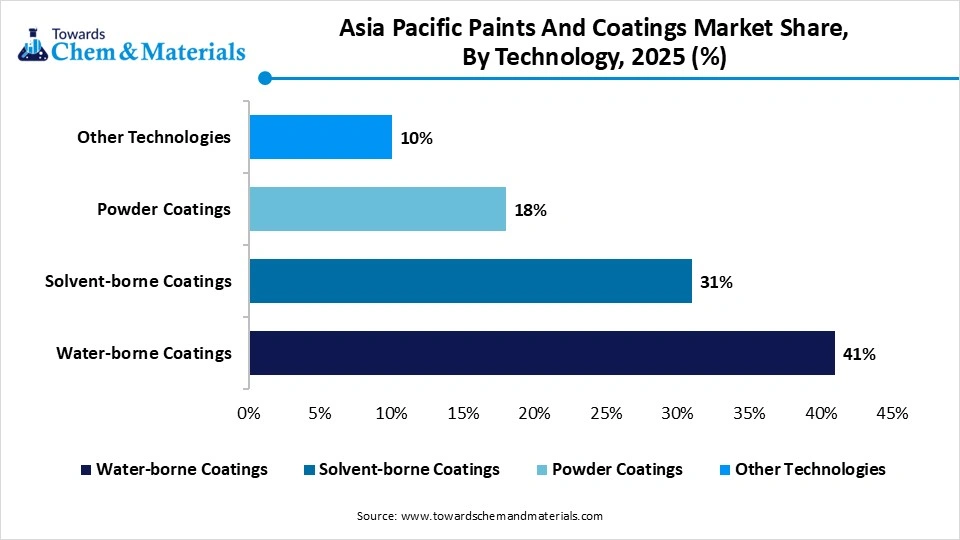
The solvent-borne coatings segment held the 31% market share in 2025. The regional demand for organic-solvent vehicle resins, where this technology offers impeccable film formation, ambient low-temperature crosslinking, and zero susceptibility during high-humidity applications. The Asia Pacific manufacturers are shifting toward high-solid systems and ultra-low VOC solvent lines to minimized emission and limit water-based alternatives. The offshore energy platforms, automotive repair network, and marine hulls are adopting solvent-borne coatings.
The powder coatings segment held the 18% market share in 2025, accelerated by their solvent-free composition and near-total overspray recovery rates. The Asia Pacific domestic players are fusing dry polymer powders into an ultra-durable layer to manufacture zero-VOC products and eliminate hazardous waste disposal costs. Regional chemical formulators are focused on low-bake powder chemistry and hyper-durable TGIC-free system align wit automated green manufacturing into heavy automotive infrastructure components and architectural aluminum cladding.
Asia Pacific Paints And Coatings Market Share, By Technology, 2025 (%)
| By Technology | Revenue Share, 2025 (%) |
| Water-borne Coatings | 41% |
| Solvent-borne Coatings | 31% |
| Powder Coatings | 18% |
| Other Technologies | 10% |
End-Use Industry Insights
The architectural segment dominated the market with the largest share of 58% in 2025, represent high-volume consumer framework for the domestic market. The architectural sector growth is propelled by demographic transition into urban hubs, continuous residential repainting cycles, and municipal modernization programs. The rising demand for advanced photocatalytic air-purifying paints and elastomeric weather-proofing systems to meet Asia Pacific green building compliances. The leading manufacturers in countries rapidly digitizing their supply chain and expanding rural retail networks, which are accelerating mass-housing development and high-end commercial infrastructure.
The industrial segment held the 42% market share in 2025 and is expected to grow at the fastest CAGR of 6.11% over the forecast period, driven by massive industrial machinery fabrication and commercial marine shipyard supported by public infrastructure expansion. The industrial operators demand high-performance ultralow-VOC solvent technology, polyurethane finishes, and pure solids epoxies to safeguard economic assets. The stringent regional environmental mandates reinforce manufacturers to prefer long-term anti-corrosion chemistry and high-speed application efficiency.
Asia Pacific Paints And Coatings Market Share, By End-use Industry, 2025 (%)
| By End-use Industry | Revenue Share, 2025 (%) |
| Architectural | 58% |
| Industrial | 42% |
Country Level Analysis
How Did the China Dominated the Asia Pacific Paints And Coatings Market in 2025?
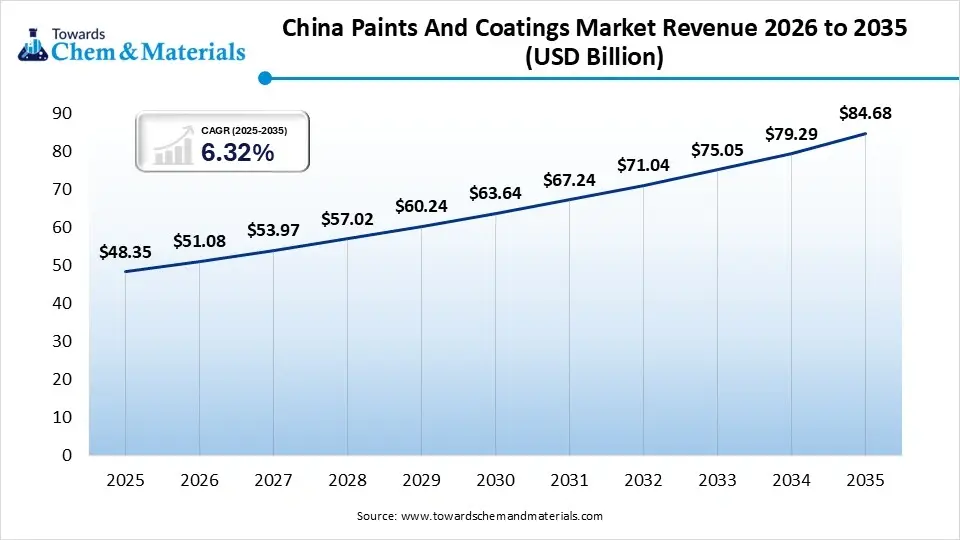
China Paints And Coatings Market size was estimated at USD 48.35 billion in 2025 and is projected to reach USD 84.68 billion by 2035, growing at a CAGR of 6.32% from 2026 to 2035.China dominated the market by holding 46% share in 2025, driven by its industrial output and domestic consumption practices. China is shifting towards electric vehicle assembly lines and high-capacity electronics manufacturing through municipal infrastructure revitalization projects. The central government's blue-sky environmental goals and strict VOC chemical taxes are forcing domestic brands to adopt high-performance aqueous emulsions and zero-emission dry powders.
India Paints And Coatings Market Growth Trends
India Paints And Coatings Market size was estimated at USD 25.23 billion in 2025 and is projected to reach USD 44.62 billion by 2035, growing at a CAGR of 5.87% from 2026 to 2035. India held the 24% market share in 2025 and is expected to grow at the fastest with a CAGR of 7.02% during the forecast period. The surging disposable income and demanding public-private infrastructure capacity expansion are driving the domestic growth. The Indias ecologic transition towards urban cool-roof initiatives and zero-VOC finish mandate is accelerating the demand for sustainable waterborne emulsion. The country's growth is driven by heavy capital investment and strategic partnerships for a stable supply chain.
Japan Paints And Coatings Market Growth Trends
Japan Paints And Coatings Market size was estimated at USD 13.66 billion in 2025 and is projected to reach USD 24.58 billion by 2035, growing at a CAGR of 6.05% from 2026 to 2035.Japan held the 13% market share in 2025. Japan market is a key hub for high-margin and advancement in functional chemistry. The rising commercialization of aqueous polyurethane dispersion, modern self-healing nanocoating, and low-cured powder systems is boosting the domestic expansion. Japan focuses on the restoration of aging infrastructure, and heat-reflective smart layers enhance its market growth.
Asia Pacific Paints And Coatings Market Share, By Country, 2025 (%)
| By Country | Revenue Share, 2025 (%) |
| China | 46% |
| India | 24% |
| Japan | 13% |
| South Korea | 10% |
| Australia | 7% |
Recent Developments
- In November 2025, Birla Opus Paints expanded its market presence by launching a high-performance aerosol paint range, One Aero, engineered with 15-minute quick-dry technology with superior performance for DIY and professional maintenance.(Source: businessnewsbyte.com)
- In August 2025, PPG Industries successfully renewed its Indian joint venture with Asian Paints Ltd. The 15-year renewal alliance expands operational capabilities across the country’s industrial, protective, marine, packaging, automotive, and powder coatings customers.(Source: investor.ppg.com)
Top Companies in the Asia Pacific Paints And Coatings Market
- Akzo Nobel NV
- Asian Paints
- Avian Brands
- Axalta Coating Systems
- BASF SE
- Berger Paints India Limited
- Boysen Paints
- Davies Paints Philippines Inc.
- Hempel AS
- Jotun
- Kansai Paint Co. Ltd
- Nippon Paint Holdings Co. Ltd
- PPG Industries Inc.
- PT. Propan Raya
- The Sherwin-Williams Company
- TOA Paint Public Company Limited
Segment Covered in the Report
By Resin Type
- Acrylic Resins
- Pure Acrylic Resins
- Styrene Acrylic Resins
- Acrylic Emulsion Resins
- Alkyd Resins
- Long Oil Alkyd Resins
- Medium Oil Alkyd Resins
- Short Oil Alkyd Resins
- Epoxy Resins
- Bisphenol A Epoxy
- Novolac Epoxy
- Waterborne Epoxy
- Polyester Resins
- Saturated Polyester
- Unsaturated polyester
- Powder Coating Polyester
- Polyurethane Resins
- Water-borne Polyurethane
- Solvent-borne Polyurethane
- Aliphatic Polyurethane
- Fluoropolymer Resins
- PVDF Resins
- FEVE Resins
- Vinyl Resins
- Polyvinyl Acetate
- Polyvinyl Chloride
- Other Resin Types
- Silicone Resins
- Amino Resins
- Phenolic Resins
By Technology
- Water-borne Coatings
- Acrylic Water-borne
- Polyurethane Water-borne
- Epoxy Water-borne
- Solvent-borne Coatings
- Conventional Solvent-borne
- High Solids Solvent-borne
- Powder Coatings
- Thermoset Powder Coatings
- Thermoplastic Powder Coatings
- Other Technologies
- UV-Cured Coatings
- Nano Coatings
- High Solids Coatings
By End-Use Industry
- Architectural
- Residential Buildings
- Interior Coatings
- Exterior Coatings
- Commercial Buildings
- Offices
- Retail Infrastructure
- Hospitality Infrastructure
- Infrastructure Projects
- Bridges
- Airports
- Smart Cities
- Residential Buildings
- Industrial
- Automotive
- OEM Coatings
- Refinish Coatings
- General Industrial
- Machinery Coatings
- Appliance Coatings
- Marine
- Cargo Vessel Coatings
- Offshore Platform Coatings
- Wood
- Furniture Coatings
- Flooring Coatings
- Packaging
- Metal Packaging Coatings
- Food Packaging Coatings
- Automotive
By Country
- China
- Taiwan
- India
- Japan
- Australia and New Zealand,
- ASEAN Countries (Singapore, Malaysia)
- South Korea
- Rest of APAC
FAQ's
Question 1 : What is the Asia Pacific paints and coatings market used for?
Answer : The market provides protective and aesthetic layers used across two major sectors: architectural and industrial. It protects residential homes and commercial offices from weather damage while safeguarding vehicles, ships, electronics, and factory machinery from rust and physical wear.
Question 2 : what is the recent size of the Asia Pacific paints and coatings market?
Answer : The Asia Pacific paints and coatings market size was estimated at USD 105.11 billion in 2025 and is expected to be worth around USD 182.11 billion by 2035, growing at a CAGR of 5.65% from 2026 to 2035. In terms of volume, the Asia Pacific paints and coatings industry is projected to grow from 35.11 million tons in 2025 to 58.01 million tons by 2035, exhibiting a compound annual growth rate (CAGR) of 5.15% over the forecast period from 2026 to 2035.
Question 3 : Why are water-borne coatings growing so quickly?
Answer : Water-borne coatings are growing fast because regional governments have set strict limits on volatile organic compounds (VOCs). These eco-friendly formulas use water as a carrier instead of chemical solvents, making them safer for painters, low in odor, and better for indoor air quality.
Question 4 : What are the top key players in the market?
Answer : The top key players dominating the regional landscape include global leaders like AkzoNobel, PPG Industries, and Sherwin-Williams, alongside major regional giants such as Asian Paints, Nippon Paint, Kansai Paint, and Berger Paints.
Question 5 : How is artificial intelligence used in the paint industry?
Answer : Artificial intelligence is used to speed up product development by predicting how chemical formulas will perform over time. Brands also deploy AI machine-learning tools on e-commerce platforms to manage urban supply chains and power digital color-matching apps for retail buyers.
Meet the Team

Saurabh Bidwai
Principal Consultant
Saurabh Bidwai, a B.Tech Chemical Engineering graduate with 4+ years of experience, specializes in specialty chemicals, commodity chemicals, and engineered materials, offering valuable insights into market trends and emerging opportunities.

Aditi Shivarkar
Reviewed By
Aditi Shivarkar, with 14+ years in Chemical and Materials market research, specializes in Chemical and Materials. She ensures accurate, actionable insights, driving Towards Chemicals And Materials Analytics and Consulting excellence in industry trends and sustainability.