
Green Building Materials Market Size, Share, Growth, Report 2026 to 2035
The green building materials market report is segmented by product type (Structural, Exterior, Interior, and Others) and by application (Framing, Insulation, Roofing, Exterior Siding, Interior Finishing, and Others),-Global Industry Analysis, Size, Trends, Leading Companies, Regional Outlook, and Forecast 2026 to 2035
Content
What is the current Green Building Materials Market Size and Share?
The global green building materials market size was valued at USD 455.19 billion in 2025, is estimated to reach USD 507.31 billion in 2026, and is projected to reach USD 1,345.84 billion by 2035, exhibiting a compound annual growth rate (CAGR) of 11.45% over the forecast period from 2026 to 2035. In terms of volume, the green building materials market is projected to grow from 14.55 billion square meters equivalent in 2025 to 40.39 billion square meters equivalent by 2035. growing at a CAGR of 10.75% from 2026 to 2035. The growth of the market is driven by rapid urbanization, substantial government investments in public infrastructure, and a surging demand for sustainable, green construction solutions.
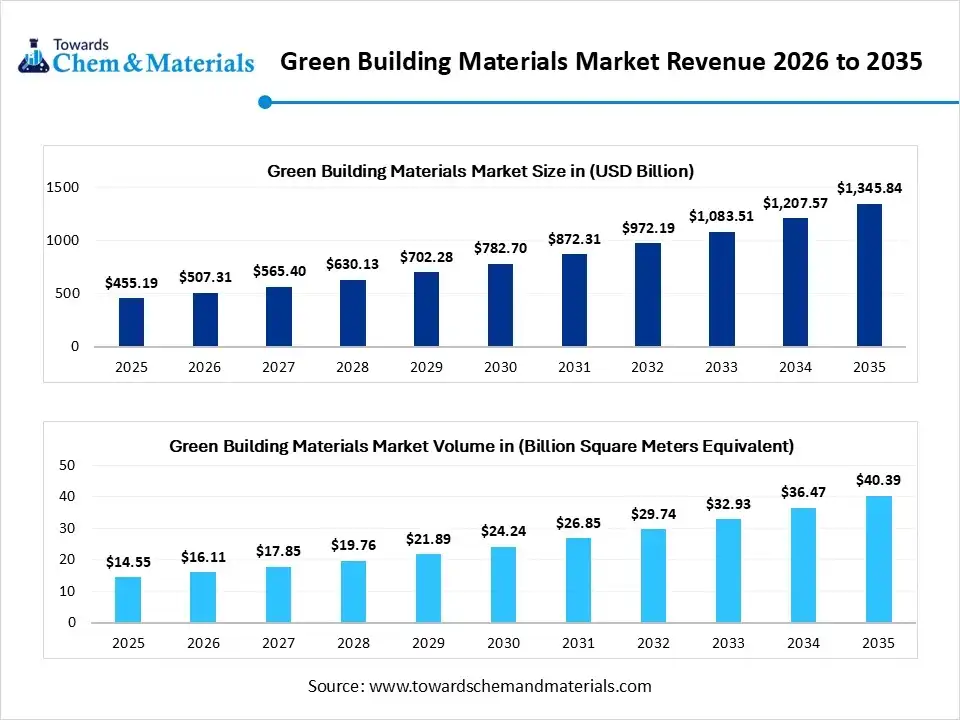
The green building materials market reflects a global move toward eco-friendly, non-toxic construction resources such as reclaimed wood, low-carbon concrete, and recycled metals. Its importance lies in reducing greenhouse gas emissions, conserving natural resources, and decreasing operational costs and health risks in both residential and commercial buildings.
Traditional materials like conventional concrete and steel significantly contribute to global carbon footprints. In contrast, green materials reduce embodied carbon throughout their lifecycle from production to disposal. They emphasize upcycled, renewable, or recycled resources, lessening reliance on non-renewable natural resources. As sustainability becomes more valued in real estate, certified green buildings often fetch higher resale values, better rental returns, and higher occupancy rates.
Unlike conventional materials that may emit toxic chemicals like certain VOCs in lead-based paints, green materials are designed to be non-toxic, improving indoor air quality and respiratory health. Governments worldwide, including initiatives in India’s growing infrastructure sector, are implementing stricter environmental standards and offering incentives for green building practices
Market Highlights
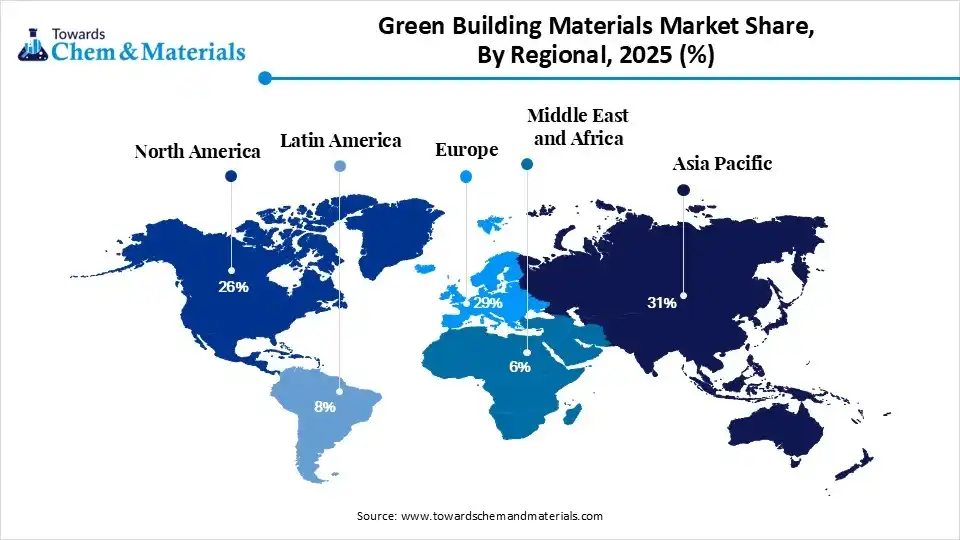
- By region, Asia Pacific dominated the market with a share of 31% in 2025 and is expected to experience the fastest growth with a CAGR of 13.08% in the forecast period. Rapid urbanization boosts the demand for sustainable construction materials significantly.
- By region, Europe held the 29% market share in 2025. The growth is driven by the stringent carbon neutrality regulations.
- By product type, the structural segment dominated the market with 38% share in 2025. Energy conservation regulations accelerate insulation material installations worldwide.
- By product type, the interior segment held 25% market share in 2025 and is expected to have the fastest growth with a CAGR of 12.74% in the forecast period. Green renovation trends boost demand for sustainable decorative materials.
- By application, the insulation segment dominated the market with 28% share in 2025. Energy conservation regulations accelerate insulation material installations worldwide.
- By application, the interior finishing segment held 13% market share in 2025 and is expected to have the fastest growth with a CAGR of 13.14% in the forecast period. Green renovation trends boost demand for sustainable decorative materials.
Green Building Materials Market Growth Trends:
Who are the Leading Exporters of Cross-Laminated Timber?
| Country | Export |
| Austria | $252M |
| Germany | $53.6M |
| Canada | $17.4M |
Growing Construction Activities Surge Demand for Green Building Materials
The rapid urbanization increases demand for various construction activities. The growing construction activities in various regions increase demand for green building materials. The increasing environmental concerns focus on the development of environmentally friendly construction. The growing commercial, industrial, and residential construction increases the adoption of green building materials. The increasing construction industry shift towards sustainable construction practices fuels demand for green building materials.
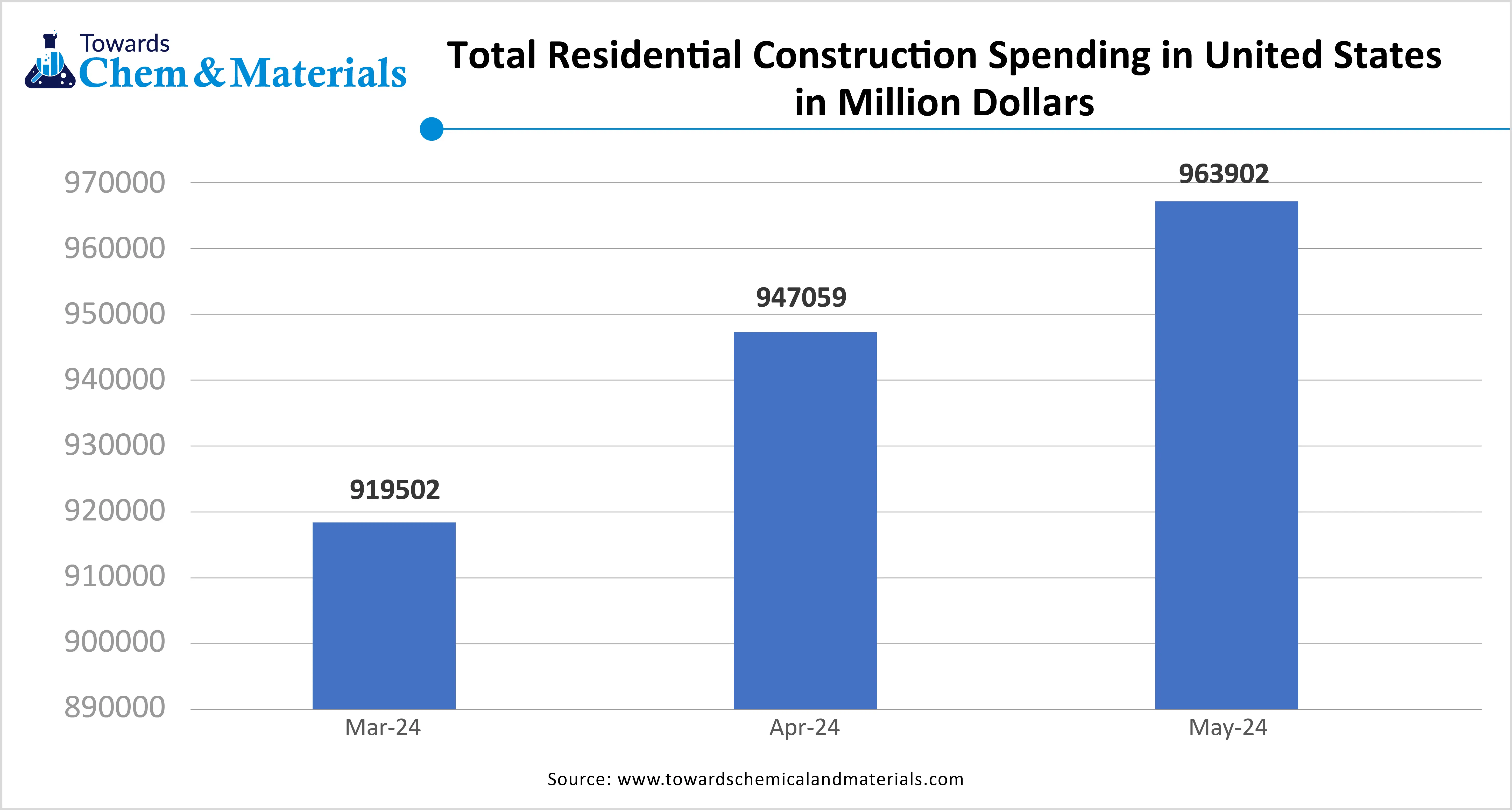
The focus on the development of smart city solutions increases demand for green building materials. The growing government investment in infrastructure development, like government buildings, offices, and airports, fuels demand for green building materials. The increasing development of green office spaces and the focus on indoor air quality require green building materials. The growing construction activities are a key driver for the green building materials market.
Growth Trends
- Innovation in Durability: Advanced materials like self-healing concrete are gaining traction. These materials utilize embedded bacteria to automatically seal micro-cracks, extending structural lifespans significantly.
- Prefabrication and Modular Construction: Builders are increasingly favoring ready-mix concrete and precast components to reduce construction timelines and labor dependency.
- Localization and Compliance: Regional compliance and supply-chain logistics are reshaping distribution. Manufacturers are focusing on reducing coordination burdens and speeding up compliance tracking.
Report Scope
| Report Attribute | Details |
| Market Volume in 2025 | USD 507.31 Billion/ 16.11 Billion Square Meters Equivalent |
| Expected Volume by 2035 | USD 1,345.84 Billion/ 40.39 Billion Square Meters Equivalent |
| Growth Rate from 2025 to 2035 | CAGR 11.45% |
| Base Year of Estimation | 2025 |
| Forecast Period | 2025 - 2035 |
| Dominant Region | Asia Pacific |
| Segment Covered | By Product Type, By Application, By Region |
| Key Companies Profiled | Kingspan Group, BASF, Sika AG, UltraTech Cement, JSW Cement, Alumasc Group Plc, Bauder Ltd, BSW GROUP, CertainTeed Corporation, RedBuilt, LLC, PPG Industries, DuPont, Interface, Inc., Forbo Group, HOLCIM, Owens Corning |
Key Technological Shifts in the Green Building Materials Market through innovation:
The green building materials market is rapidly shifting toward decarbonization and circularity. Key technological drivers include innovations in low-carbon cement, mass timber, and smart, energy-efficient insulation. Driven by strict energy codes, the industry is transitioning to sustainability-focused procurement that prioritizes minimizing embodied carbon and energy consumption. Technologies are transitioning from traditional roof-mounted panels to solar-integrated roofing and intelligent façades, allowing new structures to generate clean energy directly from their exterior surfaces.
Green Building Materials Market Regulatory Landscape
| Country / Region | Regulatory Body | Key Regulations | Focus Areas | Notable Notes |
| United States | Environmental Protection Agency (EPA); U.S. Green Building Council (USGBC); Department of Energy (DOE) | LEED Certification Standards; Energy Policy Act; ENERGY STAR Programs | Energy-efficient construction, sustainable materials | The U.S. promotes green building materials through green certification systems and energy efficiency regulations. |
| European Union | European Commission; European Chemicals Agency (ECHA) | EU Green Deal; Energy Performance of Buildings Directive (EPBD); REACH Regulation | Low-carbon construction, circular economy | Europe emphasizes sustainable construction materials and carbon-neutral building initiatives. |
| China | Ministry of Housing and Urban-Rural Development (MOHURD); Ministry of Ecology and Environment (MEE) | Green Building Evaluation Standards; Carbon Neutrality Policies | Energy-efficient buildings, eco-friendly materials | China is rapidly expanding green construction projects and sustainable infrastructure investments. |
| India | Bureau of Energy Efficiency (BEE); Ministry of Environment, Forest and Climate Change (MoEFCC) | Energy Conservation Building Code (ECBC); Green Building Guidelines | Sustainable urban development, energy conservation | India promotes green construction through smart city initiatives and sustainable infrastructure programs. |
| Japan | Ministry of Land, Infrastructure, Transport and Tourism (MLIT); Ministry of the Environment | Building Energy Efficiency Act; CASBEE Certification | Low-energy buildings, sustainable construction | Japan focuses on earthquake-resistant and energy-efficient green building materials. |
| UAE | Dubai Municipality; Emirates Green Building Council | Dubai Green Building Regulations; Estidama Pearl Rating System | Sustainable urban infrastructure, energy efficiency | The UAE is increasing the adoption of green building materials through sustainable city development projects. |
Supply Chain Analysis of Green Building Materials Market
- Sustainable Material Production & Processing:Green building materials are produced using recycled, renewable, low-emission, and energy-efficient raw materials such as recycled steel, bamboo, fly ash, sustainable wood, and eco-friendly insulation products to minimize environmental impact in construction.
- Key players: Holcim, Saint-Gobain, Kingspan Group, Cemex
- Quality Testing and Certification:Green building materials must comply with sustainability standards, energy efficiency regulations, indoor air quality requirements, and environmental safety certifications before use in construction projects.
- Key players: Leadership in Energy and Environmental Design, Building Research Establishment Environmental Assessment Method, International Organization for Standardization, U.S. Green Building Council
- Distribution to Industrial Users:Green building materials are supplied to residential and commercial construction projects, infrastructure developments, industrial facilities, and smart city initiatives for sustainable construction applications.
- Key players: Holcim, Saint-Gobain, Kingspan Group.
Green Building Materials Market Dynamics
| Drivers | Restrains | Opportunities |
| Strict Government Regulations & Mandates: Stricter building energy codes, net-zero emissions mandates, and state-level incentives push the adoption of sustainable materials across residential and commercial sectors. | High Upfront Costs and Investment Barriers:Sustainable materials often require advanced manufacturing techniques, sustainable sourcing, and are produced in lower volumes. This makes them significantly more expensive upfront than traditional building supplies. |
Energy-Efficient Insulation & Glazing: Rising consumer and corporate investments in high-performance vacuum insulation panels, cool roofs, and smart electrochromic glass to minimize thermal loads. |
| Corporate ESG Targets: Fortune 500 companies and commercial developers are embedding strict carbon caps into building requirements to meet investor and organizational sustainability goals. | Knowledge Many small-to mid-size contractors lack formal training in handling sustainable materials. This causes them to default to familiar, conventional techniques.Gaps and Skills Shortages: | Circular & Recycled Products:Significant potential in repurposing industrial by-products like fly ash, recycled steel, and reclaimed wood into new modular building components. |
| Occupant Health & Wellbeing: There is rising awareness of the health risks associated with conventional materials. Eco-friendly materials that lack toxic emissions and volatile organic compounds (VOCs) are in high demand. | Supply Chain and Sourcing Challenges:Procuring certified green materials like low-carbon concrete bio-foams can be difficult locally, requiring long-distance transportation that counteracts the environmental benefits. | Smart & Healthy Indoor Materials: Growing focus on zero-VOC (volatile organic compound) paints, antibacterial bio-based flooring, and materials that actively improve indoor air quality. |
Segmental Insights
Product Type Insights
The structural segment dominated the market with 38% share in 2025, driven by surging demand for low-carbon building alternatives, tighter energy regulations, and the mainstream commercialization of engineered wood and recycled metals. Stricter building energy codes, net-zero emissions targets, and developers' Environmental, Social, and Governance (ESG) mandates are heavily pushing the industry to minimize embodied carbon in primary construction.
The exterior segment held 27% market share in 2025, due to rising global temperatures, strict environmental regulations, and the need for energy efficiency. Property owners are increasingly investing in durable, eco-friendly exterior solutions to lower utility costs and mitigate urban heat island effects. Products like repurposed aluminum and steel are highly favored. They offer structural integrity and can be recycled repeatedly, sharply reducing a building's carbon footprint and operational costs.
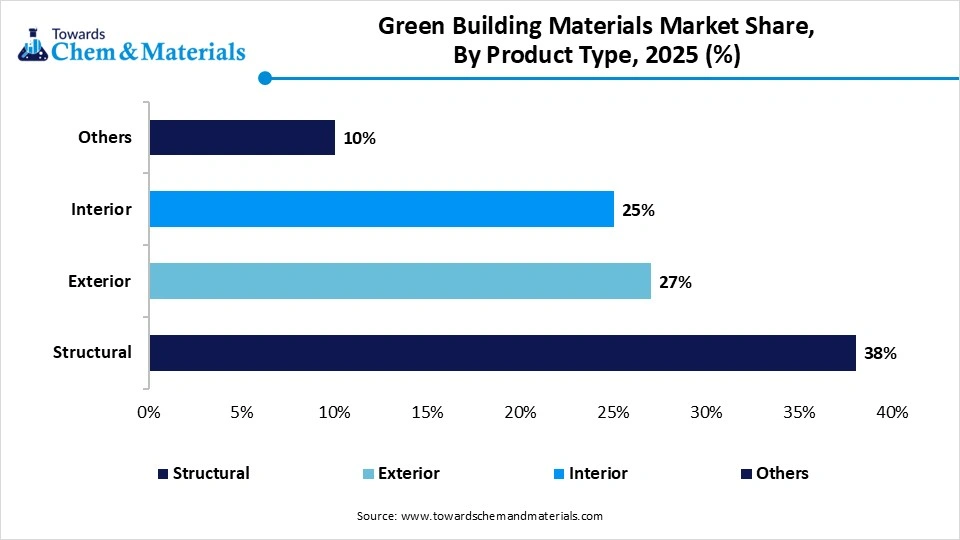
The interior segment held 25% market share in 2025 and is expected to have the fastest growth with a CAGR of 12.74% in the forecast period, due to consumer demand for healthier, non-toxic living spaces, and a stronger focus on indoor air quality. Strong adoption of rapidly renewable and reclaimed materials, such as bamboo, cork, and reclaimed timber, alongside recycled-content carpets.
The other segment held 10% market share in 2025. The other segment includes green adhesives, sealants, acoustic materials, and fire-resistant eco materials. The green adhesives segment is growing rapidly, fueled by the shift toward non-toxic, low-emission, and bio-based bonding agents. The sealants segment is experiencing significant growth within the market, driven by strict regulations regarding low volatile organic compound (VOC) emissions, energy-efficiency demands, and a push for structural longevity. The acoustic materials segment is expanding significantly due to stricter green building certifications (like LEED), rising noise pollution awareness, and a shift toward eco-friendly, biodegradable alternatives. The fire-resistant eco materials segment is rapidly expanding within the market. Driven by rising awareness of sustainability, stricter fire-safety regulations, and climate change.
Green Building Materials Market Share, By Product Type, 2025 (%)
| By Product Type | Revenue Share, 2025 (%) |
| Structural | 38% |
| Exterior | 27% |
| Interior | 25% |
| Others | 10% |
Application Insights
The insulation segment dominated the market with 28% share in 2025, due to rising global energy costs, stringent energy efficiency regulations, and a demand for healthier indoor environments. Sustainable insulation minimizes energy loss, directly lowering building operational emissions and reducing heating and cooling demands. There is a rapid shift away from traditional products toward sustainable alternatives like cellulose, bio-foam, natural fibers (hemp/sheep wool), and recycled denim.
The framing segment held 24% market share in 2025. It is being propelled by the adoption of low-carbon engineered lumber, recycled structural steel, and prefabricated modular components that drastically reduce on-site construction waste. There is a strong industry move toward factory-certified framing assemblies. Prefabrication minimizes material waste, tightens quality control, and significantly shortens project delivery times.
The roofing segment held 16% market share in 2025, due to stringent environmental regulations, aggressive government incentives for energy efficiency, and a booming focus on mitigating the urban heat island effect. Compared to traditional roofing, green roofs lower building energy use, resulting in direct annual savings for both residential and commercial property owners.
The interior finishing segment held 13% market share in 2025 and is expected to have the fastest growth with a CAGR of 13.14% in the forecast period, because of rising consumer awareness about indoor air quality, the push for net-zero commercial spaces, and government mandates. Increased adoption of rapidly renewable or recycled materials, such as reclaimed/FSC-certified wood, bamboo, and recycled glass countertops.
Green Building Materials Market Share, By Application, 2025 (%)
| By Application | Revenue Share, 2025 (%) |
| Framing | 24% |
| Insulation | 28% |
| Roofing | 16% |
| Exterior Siding | 14% |
| Interior Finishing | 13% |
| Others | 5% |
Regional Analysis
How did Asia Pacific dominate the Green Building Materials Market in 2025?
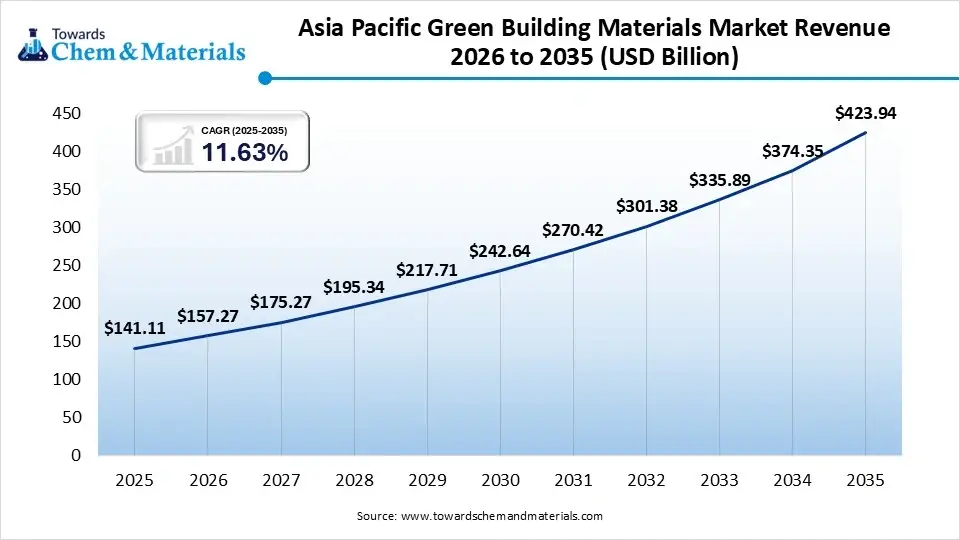
The Aisa Pacific green building materials market size was estimated at USD 141.11 billion in 2025 and is projected to reach USD 423.94 billion by 2035, growing at a CAGR of 11.63% from 2026 to 2035. The Middle East and Africa held 6% market share in 2025.Asia Pacific dominated the market with a share of 31% in 2025 and is expected to experience the fastest growth with a CAGR of 13.08% in the forecast period, due to rapid urbanization, infrastructure development, and increasing government support for green construction. This growth is propelled by rapid urbanization, stringent government decarbonization mandates, the economic benefits of energy efficiency, and a rising consumer preference for healthy, sustainable living environments.
India
- The Indian green building materials market is primarily driven by progressive government initiatives, strict energy efficiency mandates, a rising focus on ESG compliance, and increasing consumer awareness.
- Demand is propelled by the growing popularity of sustainability ratings, such as those governed by the Indian Green Building Council (IGBC) and LEED India, which add significant market and asset value to real estate projects.
China
- China's green building materials market is primarily driven by strict government mandates, urbanization demands, and national decarbonization targets like the "Dual Carbon" goals.
- The construction sector’s massive energy consumption and environmental impact have made sustainable, eco-friendly building products essential.
- China is heavily investing in sustainable infrastructure, eco-friendly construction materials, and energy-efficient urban development projects.
Japan
- National policies demand greater energy efficiency for all new constructions, heavily incentivizing developers to source eco-friendly materials.
- Frameworks like CASBEE (Comprehensive Assessment System for Built Environment Efficiency) guide 90% of local green certifications, pushing suppliers to offer verified sustainable materials.
Europe Green Building Materials Market Growth Factor
The European green building materials market size was estimated at USD 132.01 billion in 2025 and is projected to reach USD 397.02 billion by 2035, growing at a CAGR of 11.64% from 2026 to 2035. The Middle East and Africa held 6% market share in 2025. Europe held a 29% market share in 2025, due to stringent environmental regulations, circular economy initiatives, and aggressive decarbonization targets in the construction sector. The market is primarily driven by strict EU climate regulations, including the Energy Performance of Buildings Directive, widespread consumer awareness, and the need to renovate the region's largely inefficient older building stock to meet zero-emission targets.
Germany
- The German green building materials market is driven by strict energy-efficiency mandates, ambitious climate targets, and rising environmental consciousness.
- Germany leads in sustainable architecture, energy-efficient construction technologies, and low-carbon building materials innovation.
Italy
- The Italian green building materials market is primarily propelled by European Union energy directives, national sustainability incentives, and an escalating consumer shift toward eco-friendly housing.
- These factors drive continuous demand for sustainable solutions like low-carbon concrete, recycled metals, and energy-efficient insulation.
France
- The France green building materials market is primarily driven by strict environmental regulations, aggressive net-zero carbon targets, and consumer demand for energy efficiency.
- There is a growing preference among French homeowners and buyers for healthy indoor environments and energy-efficient, eco-friendly homes.
North America Green Building Materials Market Growth Factor
The North America green building materials market size was estimated at USD 118.35 billion in 2025 and is projected to reach USD 356.65 billion by 2035, growing at a CAGR of 11.66% from 2026 to 2035. The Middle East and Africa held 6% market share in 2025.North America held 26% market share in 2025 due to strong adoption of green building certifications, sustainable construction practices, and energy-efficient infrastructure projects. The growth of the market is primarily driven by strict government energy regulations, widespread green certifications (such as LEED), federal tax incentives, and growing consumer and investor awareness regarding long-term energy cost savings. Institutional investors and major corporations prioritize ESG (Environmental, Social, and Governance) compliance, driving massive demand for eco-friendly framing, insulation, and roofing
U.S.
- The U.S. leads the region with widespread LEED-certified buildings and increasing investments in low-carbon construction materials.
- Additionally, rising corporate ESG requirements, consumer preference for sustainable construction, and new material innovations continue to accelerate market expansion.
Canada
- The Canada green building materials market is driven by strict government decarbonization targets, surging consumer demand for energy-efficient homes, rising corporate ESG standards, and the need to reduce carbon footprints to meet net-zero national goals by 2050.
- High adoption rates of eco-friendly, low-carbon concrete and cement, alongside bio-based insulation and recycled metals, replacing traditional high-emission materials.
Latin America Green Building Materials Market Growth Factor
The Latin American green building materials market size was estimated at USD 36.42 billion in 2025 and is projected to reach USD 114.40 billion by 2035, growing at a CAGR of 12.13% from 2026 to 2035. The Middle East and Africa held 6% market share in 2025.Latin America held 8% market share in 2025, supported by sustainable housing projects and rising environmental awareness. The rising popularity of certifications like LEED is encouraging developers to use renewable, low-impact, and energy-saving materials. The demand for high-efficiency insulation and cool roofing solutions is rising due to the long-term operational cost savings they offer. Expanding local manufacturing and the increased availability of bio-based aggregates make sustainable materials more accessible.
Brazil
- Brazil is expanding the adoption of green construction materials due to urban infrastructure development and sustainability initiatives.
- National and local initiatives promoting energy-efficient construction, combined with Brazil's already robust renewable energy grid, provide a foundational push for decarbonizing the built environment.
Argentina
- Argentina’s green building materials market is primarily driven by the push for energy efficiency to lower operational costs, the rising demand for eco-friendly urban housing, and international investments in sustainable infrastructure.
- Argentina faces major urban housing needs. The government's plans to facilitate the construction of hundreds of thousands of homes over the next decade are pushing developers to utilize cost-effective, sustainable building materials.
Middle East and Africa Green Building Materials Market Growth Factor
The Middle East and Africa green building materials market size was estimated at USD 27.31 billion in 2025 and is projected to reach USD 87.48 billion by 2035, growing at a CAGR of 12.35% from 2026 to 2035.The Middle East and Africa held 6% market share in 2025. The region is increasingly adopting green building materials for sustainable urban development and energy-efficient infrastructure projects. National sustainability initiatives are the primary driver. For Instance, Vision 2030 in Saudi Arabia and the UAE's Dubai Green Building Regulations mandate specific reductions in energy & water consumption for all latest constructions.
Green Building Materials Market Share, By Regional, 2025 (%)
| Regional | Revenue Share, 2025 (%) |
| North America | 26% |
| Europe | 29% |
| Asia-Pacific | 31% |
| Latin America | 8% |
| Middle East & Africa | 6% |
Saudi Arabia
- Economic diversification and aggressive sustainability targets, spearheaded by the Saudi Green Initiative, mandate emissions reductions and energy efficiency across massive urban and commercial developments.
- Stricter building laws mandate a reduced carbon footprint, encouraging the transition from traditional to eco-friendly building practices.
UAE
- The UAE is a regional leader in sustainable construction, supported by smart city projects and green building regulations.
- Strict building laws, such as the Dubai Green Building Regulations and Abu Dhabi's Estidama Certification system, mandate high-efficiency construction, driving massive demand for eco-friendly materials.
Recent Developments
- In March 2026, the IFC, GBPN and Bengaluru based climate tech firm Smarter Dharma launched Marketplace for Green Equipment and Materials (MGEM) is a first-of-its-kind national digital platform in India built to transform sustainable construction. Launched the platform to address a critical bottleneck in the Indian real estate market by democratising access to verified green building products, especially in fast-growing Tier 2 and Tier 3 cities.(Source: realty.economictimes.indiatimes.com)
- In February 2026, Dynamic Cables Limited officially announced its strategic expansion into the green building material sector with the launch PVC Insulated FR-LSH and HR-FRLSH Green Building Wires, a specialized eco-friendly range of building wires. The rollout marks the power infrastructure manufacturer's entry into the sustainable real estate market with products engineered to minimize toxic emissions during structural hazards.(Source: scanx.trade)
Top players in the Green Building Materials Market & Their Offerings
- Kingspan Group: Dominates high-performance insulation panels and building envelopes designed to maximize energy efficiency.
- BASF: Supplies advanced chemical solutions for construction, including concrete admixtures that lower carbon footprints and high-performance insulation.
- Sika AG: Produces specialty chemicals and adhesives for waterproofing, sealing, and roofing that improve the longevity and energy efficiency of green structures.
- UltraTech Cement: Leads in green cement and concrete products, offering low-carbon variants.
- JSW Cement: Specializes in eco-friendly Portland Slag Cement (PSC) and Ground Granulated Blast-furnace Slag (GGBS).
Other Key players
- Alumasc Group Plc
- Bauder Ltd
- BSW GROUP
- CertainTeed Corporation
- RedBuilt, LLC
- PPG Industries
- DuPont
- Interface, Inc.
- Forbo Group
- HOLCIM
- Owens Corning
Segments Covered
By Product Type
- Structural
- Green Concrete
- Engineered Wood
- Recycled Steel
- Cross Laminated Timber
- Exterior
- Sustainable Cladding
- Eco-friendly Facades
- Green Roofing Materials
- Recycled Composite Panels
- Interior
- Low VOC Paints
- Recycled Flooring
- Sustainable Ceiling Systems
- Eco-friendly Wall Panels
- Others
- Green Adhesives
- Sealants
- Acoustic Materials
- Fire-resistant Eco Materials
By Application
- Framing
- Residential Framing
- Commercial Framing
- Industrial Framing
- Insulation
- Fiberglass Insulation
- Cellulose Insulation
- Mineral Wool Insulation
- Bio-based Insulation
- Roofing
- Cool Roofing
- Recycled Roofing Sheets
- Solar-integrated Roofing
- Exterior Siding
- Fiber Cement Siding
- Recycled Wood Siding
- Composite Siding
- Interior Finishing
- Flooring
- Wall Coverings
- Ceiling Finishes
- Decorative Panels
- Others
- Doors & Windows
- Green Plumbing Materials
- Sustainable HVAC Components
By Region
- North America
- U.S.
- Canada
- Europe
- Germany
- UK
- France
- Italy
- Spain
- Sweden
- Denmark
- Norway
- Asia Pacific
- China
- Japan
- India
- South Korea
- Thailand
- Latin America
- Brazil
- Mexico
- Argentina
- Middle East & Africa
- South Africa
- UAE
- Saudi Arabia
- Kuwait
FAQ's
Question 1 : What is the current size of the Green Building Materials Market
Answer : The global Green Building Materials Market was valued at USD 455.19 billion in 2025 and is projected to reach USD 1,345.84 billion by 2035.
Question 2 : What is the growth rate of the Green Building Materials Market
Answer : The market is expected to grow at a CAGR of 11.45% from 2026 to 2035.
Question 3 : Which region dominates the Green Building Materials Market
Answer : Asia Pacific dominated the market in 2025 with a 31% market share due to rapid urbanization and government investments in sustainable infrastructure.
Question 4 : What factors are driving market growth
Answer : Key drivers include rapid urbanization, energy-efficiency regulations, rising environmental awareness, green building certifications, and increasing demand for sustainable construction.
Question 5 : Who are the major companies in the market
Answer : Major companies include Kingspan Group, BASF, Sika AG, UltraTech Cement, HOLCIM, Owens Corning, and DuPont.
Meet the Team

Saurabh Bidwai
Principal Consultant
Saurabh Bidwai, a B.Tech Chemical Engineering graduate with 4+ years of experience, specializes in specialty chemicals, commodity chemicals, and engineered materials, offering valuable insights into market trends and emerging opportunities.

Aditi Shivarkar
Reviewed By
Aditi Shivarkar, with 14+ years in Chemical and Materials market research, specializes in Chemical and Materials. She ensures accurate, actionable insights, driving Towards Chemicals And Materials Analytics and Consulting excellence in industry trends and sustainability.