
Asphalt Release Agents Market Size, Share & Trends Analysis Report by 2026-2035
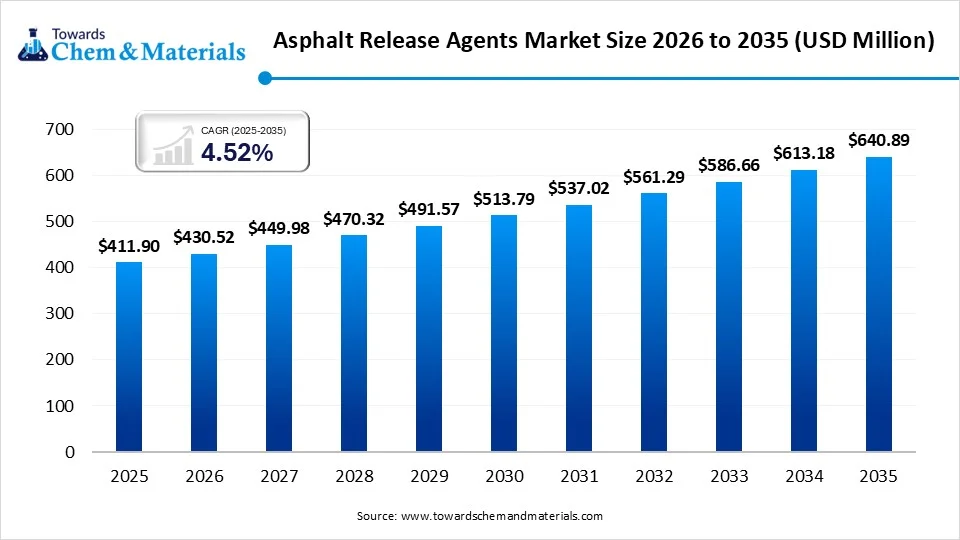
The global asphalt release agents market size is expected to grow from USD 430.52 billion in 2026 to USD 640.89 billion in 2035, growing at a CAGR of 4.52% from 2026 to 2035. The top key players in the market are FUCHS, Zeller+Gmelin, BG Chemical, Meyer Lab, Zep Inc., SoySolv, Rhomar Industries Inc., Industrial Chemical Solutions, McGee Industries, Inc., Miller-Stephenson Chemical Company, Inc.-Global Forecast 2026 To 2035
Content
What is the Current Asphalt Release Agents Market Size and Share?
The global asphalt release agents market size was estimated at USD 411.90 million in 2025 and is expected to increase from USD 430.52 million in 2026 to USD 640.89 million by 2035, growing at a CAGR of 4.52% from 2026 to 2035. Asia Pacific dominated the asphalt release agents market with the largest revenue share of 36% in 2025.The growth is driven by sustainability practices, technological innovation, and a stringent regulatory framework. The market is evolving from hazardous solvents to specialized, environmentally friendly solutions that restrict asphalt sticking to surfaces like truck beds, pavers, and rollers. The market is driven by strict environmental and workplace safety regulations to prevent pavement stripping and groundwater contamination. The manufacturers shift toward bio- based, biodegradable, low-VOC, non-toxic agents from renewable resources. These agents enhance operational efficiency, reduce downtime, and improve infrastructure durability, supported by automated spray technology to optimize application and waste output.
Market Highlights
- The Asia Pacific dominated asphalt release agents market with the largest revenue share of 36% in 2025, due to its rapid urbanization and infrastructure modernization.
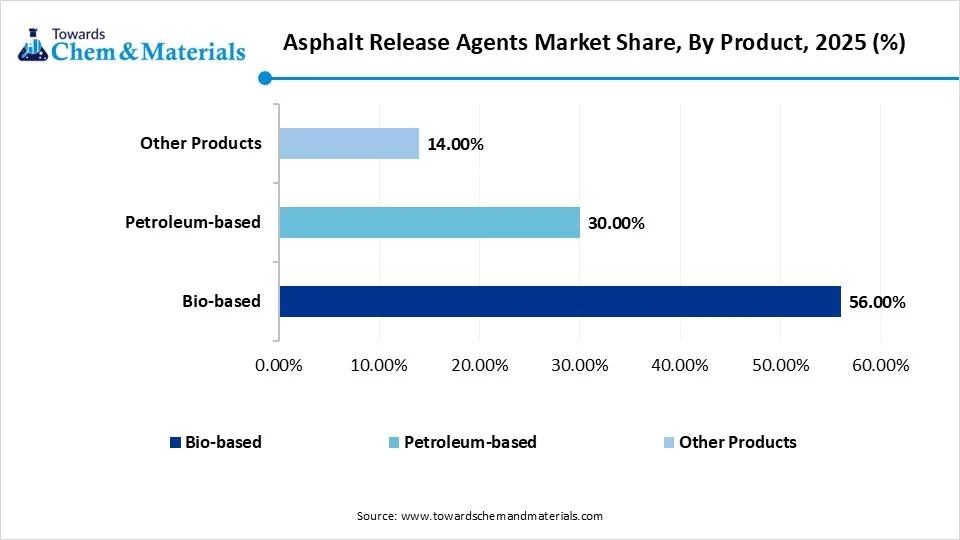
- By product, the bio-based segment dominated the market and accounted for the largest revenue share of 56.00% in 2025 due to its biodegradability and green infrastructure projects.
- By product, the petroleum-based agents segment is expected to grow at the fastest CAGR 4.41% during the forecast period due to its thermal stability and lubricity.
- By application, the truck beds segment led the market with the largest revenue share of 45.00% in 2025, due to demand for cost-effective and non-toxic protection in heavy machinery.
- By application, the pavers segment is anticipated to grow at the fastest CAGR in the market during the forecast period due to reduced downtime and pavement quality.
Key Technological Shifts and AI in the Asphalt Release Agents Market
AI and molecular engineering are transforming the market into a data- driven field for precision application. The machine learning used to develop tailored lubricants and polymer-modified binders that boost thermal stability without harming pavement integrity. AI- based automated spray systems with smart sensors ensure optimal application, lower chemical waste, and prevent mechanical fouling. Additionally, the advancement of smart bio- polymers extend machinery lifespan and helps maintain environmental and workplace safety standards.
Recent Market Trends
- Rising Adoption of Eco-Friendly Alternatives: The shift towards non-carcinogenic, bio-based and low-VOC formulations to reduce inhalation of hazardous fumes to meet workplace safety and environmental standards.
- Innovation and Operational Efficiency: The innovation in advanced agents to develop micro-thin molecular film that offers reduction of equipment downtime, material waste and high-flash points.
- Shielding of Asphalt Binder Integrity: The trend is to focus on the elimination of pavement stripping that ensures chemical inertness without degrading bitumen binder, longevity and quality of road surface.
- Additive Incorporation with Product: The next-generation product includes integration of rust inhibitors and anti-corrosive agents to extend the lifespan of products and to protect metallic surfaces.
Report Scope
| Report Attribute | Details |
| Market Size in 2026 | USD 430.52 Million |
| Revenue Forecast in 2035 | USD 640.89 Million |
| Growth Rate | CAGR 4.52% |
| Forecast Period | 2026 - 2035 |
| Base Year | 2025 |
| Dominant Region | Asia Pacific |
| Segment Covered | By Product, By Application, By Region |
| Key companies profiled | FUCHS, Zeller+Gmelin, BG Chemical, Meyer Lab, Zep Inc., SoySolv, Rhomar Industries Inc., Industrial Chemical Solutions, McGee Industries, Inc., Miller-Stephenson Chemical Company, Inc. |
Asphalt Release Agents Market: Supply Chain Analysis
- Feedstock Procurement: The initial stage of sourcing of petrochemical derivatives and bi-based feedstock from key suppliers like chemical refineries and agrochemical industries that provide lipids and emulsifiers to produce heat-resistant formulation.
- Key Players: BASF SE, ExxonMobil, Dow Inc., Arkema SA, and Kraton Corporation
- Chemical Formulation and Manufacturing: The stage where specialized manufacturers use advanced blending technologies to convert raw materials into final release agents to achieve thermal stability and non-stripping properties. The stage focuses on innovation to develop concentrated emulsions and low-VOC solutions.
- Key Players: ArrMaz, BITEEREX, RENOCAST, FUCHS, BG Chemical, SoySolv, and Miller-Stephenson
- End-Use Application and Distribution: The stage of logistical shift of product to asphalt plants and road construction sites through specialized distribution network. The stage involve automated spray gantry system and dilution equipment for end users that offers efficiency, reduces downtime, and workplace safety.
- Key Players: ChemStation International, BG Chemical, Rhomar Industries, Gemplers asphalt plants, private paving contractors, and construction sites
Regulatory Framework: Asphalt Release Agents Market
| Region | Key Regulation | Regulatory Focus |
| North America | EPA Title 40 CFR and State DOT Approvals | The regulation prohibits agent which compromise pavement integrity. The mandates for ARAs biodegradability and non-stripping |
| European Union | REACH Regulations, Water Hazard Class, and Blue Angel | Incentives focus on registration and safety for chemical substances and aquatic toxicity. Strict limit on occupational exposure to asphalt fumes and SVHC-free formulation |
| Asia Pacific | GB Standards and low-VOC mandates | The national standards for low-VOC limits in industrial cleaning and release agents. |
| Global | ILO Occupational Safety | Global standards for non-flammable and non-carcinogenic agents to improve operational safety for paving crews. |
Segmental Insights
Product Insights
Why the Bio-based Segment Dominates the Asphalt Release Agents Market?
The bio-based segment dominated the market in 2025, driven by a focus on renewable and sustainable feedstocks offering biodegradable, non- toxic alternatives by replacing hazardous hydrocarbons that prevent pavement stripping and groundwater contamination. The rising emphasis on occupational health enables formulations to maintain high flash points and low VOCs by offering efficiency, reducing maintenance, and supporting green infrastructure projects.
The petroleum-based agents’ segment is the fastest-growing in the market during the forecast period because of its thermal stability and lubricity, especially in industrial uses, despite environmental pressures. The segment focuses on refined mineral oils and low-VOC petrochemical derivatives to provide cost- effective, durable non-stick barriers on heavy machinery. The stringent environmental mandates are pushing manufacturers toward low- VOC emulsions by maintaining protection for equipment and reliable material discharge.
Asphalt Release Agents Market Share, By Product , 2025 (%)
| By Product | Revenue Share, 2025 (%) |
| Bio-based | 56.00% |
| Petroleum-based | 30.00% |
| Other Products | 14.00% |
Application Insights
How did the Truck Beds Segment hold the Largest Share in the Asphalt Release Agents Market?
The truck beds segment held the largest revenue share in the market in 2025. It acts as a robust operational lubricant that enable quick, complete asphalt discharge. Its high consumption and adhesion to bed surfaces make it an ideal solution engineered for thermal resilience and a sacrificial barrier. Additionally, integrated with automated spray systems ensuring cost-efficient, long- lasting, non- toxic protection across multiple haul cycles.
The pavers segment is experiencing the fastest growth in the market during the forecast period. It acts as an anti-stick lubricant due to its pavement quality and equipment efficiency that need high- performance agents to prevent adhesion, tearing, and uneven surfaces. The advancement in multifunctional emulsions maintains structural integrity in paving machinery. These agents are formulated for heat resistance, thermal strength, emphasizing bio-based concentrates and lubrication, reducing mechanical wear and repairs with safety.
Asphalt Release Agents Market Share, By Application , 2025 (%)
| By Application | Revenue Share, 2025 (%) |
| Truck Beds | 45.00% |
| Pavers | 30.00% |
| Rollers | 15.00% |
| Other Applications | 10.00% |
Regional Insights
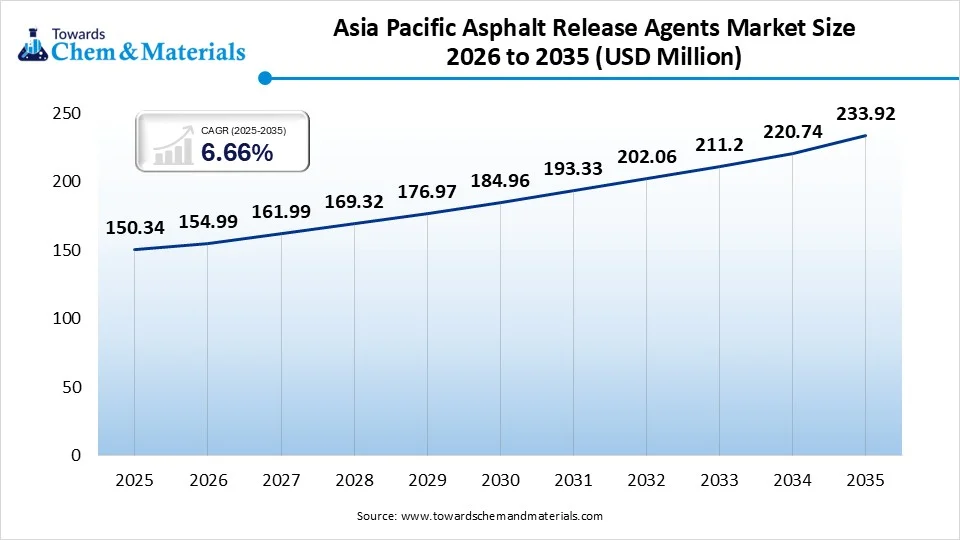
The Asia Pacific asphalt release agents market size was valued at USD 150.34 million in 2025 and is expected to be worth around USD 233.92 million by 2035, exhibiting at a compound annual growth rate (CAGR) of 6.66%over the forecast period from 2026 to 2035. Asia Pacific dominated the market share 36.00% in 2025. The growth is fueled by rapid urbanization and infrastructure modernization. The region shifts toward sustainable practices with environmental regulations promoting bio-based solvents. These agents are vital in road construction and highway maintenance, offering operational efficiency and protecting equipment that drives the domestic expansion as the industry focuses on workplace safety and low-VOC formulations supporting green development in the region.
China Asphalt Release Agents Growth Trends
The China market is driven by a shift towards eco-friendly chemicals to support expressway expansion and urban renewal. The region is a technological leader in adhesion prevention technology and is rapidly adopting biodegradable, high-performance bio-based agents that enhance its transportation networks with excellent thermal stability and lubricity. Additionally, China is a key hub in product innovation with a highly competitive landscape.
North America Asphalt Release Agents Growth Trends
North America asphalt release agents market segment accounted for the major revenue share of 25.00% in 2025. North America is expected to grow at the fastest CAGR in the market during the forecast period, represents technological advancements and strong government support for bio-based and biodegradable solutions by replacing hazardous agent. The region focuses on innovation with low-VOC, high-efficiency products to protect the integrity of asphalt binders and prevent contamination. EPA mandates, modernization programs, and large infrastructure investments drive the region by emphasizing operational flexibility across diverse climates.
U.S. Asphalt Release Agents Growth Trends
The U.S. market led in regulatory-driven innovation and strict EPA mandates. The region transitioned to bio-based and water-soluble agents, focusing on pavement integrity and groundwater safety. The domestic demand for thermal-stable lubricants is supported by federal funding and investment that is integrated with automated spray systems, positioning the U.S. towards the fastest growth.

Europe Asphalt Release Agents Growth Trends
Europe asphalt release agents market segment accounted for the major revenue share of 20.00% in 2025. The Europe market, witnessing notable growth due to regulatory compliance with REACH and Circular Economy policies. The region emphasizes sustainable construction, non-label products, and chemical safety. The domestic market preferred biodegradable, low-footprint, water-based emulsions meeting green procurement and environmental standards, serving as a global catalyst for VOC reduction and ecosystem protection.
Asphalt Release Agents Market Share, By Regional, 2025 (%)
| Regional | Revenue Share, 2025 (%) |
| North America | 25.00% |
| Europe | 20.00% |
| Asia Pacific | 36.00% |
| Latin America | 10.00% |
| Middle East & Africa | 9.00% |
Germany Asphalt Release Agents Growth Trends
Germany market is driven by regulatory frameworks like Water Hazard Class (WGK) and Blue Angel that focus on hazardous solvents with synthetic esters and plant-based emulsions. The region is a leader in biodegradable products that are supported by Autobahn maintenance and federal projects. It prioritizes asphalt durability and VOC-free formulations, ensuring efficiency and safety promoted by rigorous green mandates.
Recent Breakthroughs in the Market
- In July 2025, Harima Chemicals announced the development of biomass-based asphalt regeneration additives in collaboration with Japan's Public Works Research Institute and Nihon University. The focus is on carbon neutrality and the enhancement of the sustainability of road infrastructure.(Source:www.publicnow.com)
- In June 2025, Verde Resource Inc. entered into a Memorandum of Understanding (MOU) with Ergon Asphalt & Emulsion Inc. to develop the commercialization of low-carbon road materials. The collaboration focuses on the invention of specialized emulsions used in cold-mix biochar-asphalt surface material and has led to the generation of new carbon removal credits.(Source: www.prnewswire.com)
Top Companies in the Market and Their Offerings
- FUCHS: The global leader in lubricants that offers bitumen release agents and specialized vegetable-oil emulsions that offer high-flash points, clean discharge of hot-mix asphalt.
- Zeller+Gmelin: The European leader provides solvent-free agents and high-performance non-stick surfaces for heavy-duty sectors to meet safety standards.
- BG Chemical: The global leader of the formation of polymer-modified asphalt and high-performance, water-dilutable release agent that creates a slick, durable film on truck beds and conveyor belts.
- Meyer Lab
- Zep Inc.
- SoySolv
- Rhomar Industries Inc.
- Industrial Chemical Solutions
- McGee Industries, Inc.
- Miller-Stephenson Chemical Company, Inc.
Segment Covered in the Report
By Product
- Bio-based
- Petroleum-based
- Other Products
By Application
- Truck Beds
- Pavers
- Rollers
- Other Applications
By Region
- North America
- U.S.
- Canada
- Mexico
- Europe
- Germany
- UK
- France
- Italy
- Spain
- Asia Pacific
- China
- India
- Japan
- South Korea
- Latin America
- Brazil
- Argentina
- Middle East & Africa
- Saudi Arabia
- South Africa
FAQ's
Question 1 : What is the current market size of the asphalt release agents industry and its expected growth rate?
Answer : The asphalt release agents market is valued at USD 411.90 million in 2025, expected to grow at a CAGR of 4.52% to reach USD 640.89 million by 2035.
Question 2 : What are the key drivers fueling the growth of the asphalt release agents market?
Answer : The market growth is driven by sustainability practices, technological innovations, and stringent environmental regulations focused on reducing workplace hazards and promoting eco-friendly solutions.
Question 3 : Which regions are leading the asphalt release agents market and why?
Answer : Asia Pacific leads the market with a 36% share in 2025 due to rapid urbanization, infrastructure development, and a shift toward sustainable, bio-based solutions.
Question 4 : Who are the top companies operating in the global asphalt release agents market?
Answer : Leading companies in the asphalt release agents market include FUCHS, Zeller+Gmelin, BG Chemical, Meyer Lab, and Zep Inc.
Meet the Team

Saurabh Bidwai
Principal Consultant
Saurabh Bidwai, a B.Tech Chemical Engineering graduate with 4+ years of experience, specializes in specialty chemicals, commodity chemicals, and engineered materials, offering valuable insights into market trends and emerging opportunities.

Aditi Shivarkar
Reviewed By
Aditi Shivarkar, with 14+ years in Chemical and Materials market research, specializes in Chemical and Materials. She ensures accurate, actionable insights, driving Towards Chemicals And Materials Analytics and Consulting excellence in industry trends and sustainability.