
Copper Foil Market Size, Share, Growth, Report 2026 to 2035
The copper foil market report is segmented by product type (Rolled Copper Foil and Electrodeposited (ED) Copper Foil) and by application (Circuit Boards, Batteries, Electrical Appliances, Solar & Alternative Energy, Medical, and Other)-Global Industry Analysis, Size, Trends, Leading Companies, Regional Outlook, and Forecast 2026 to 2035
Content
What is the Copper Foil Market Size and Share?
The global copper foil market size was valued at USD 17.55 billion in 2025, is estimated to reach USD 19.40 billion in 2026, and is projected to reach USD 47.85 billion by 2035, exhibiting a compound annual growth rate (CAGR) of 10.55% over the forecast period from 2026 to 2035. In terms of volume, the copper foil market is projected to grow from 2.25 million tons in 2025 to 5.79 million tons by 2035. growing at a CAGR of 9.92% from 2026 to 2035.The market growth is driven by rising demand for EV batteries, for consumer electronics, and even renewable energy storage setups is really speeding up global copper foil consumption.
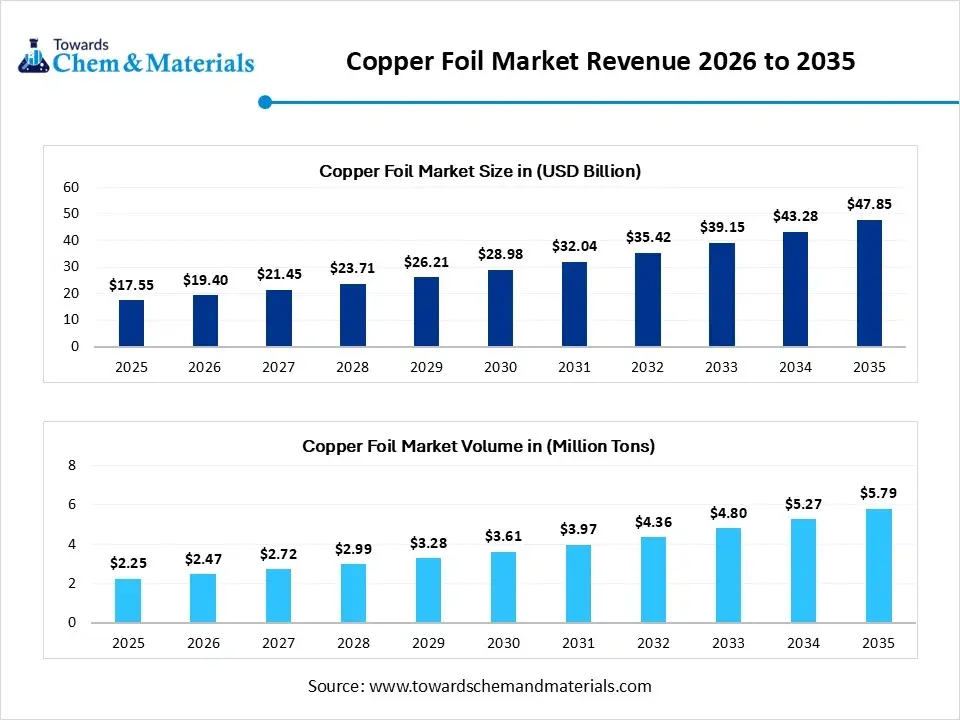
The copper foil market expansion is accelerated by advancements in modern electronic and clean energy infrastructure. The copper foil offers superior electrical conductivity, mechanical flexibility, and thermal efficiency that maintain higher performance and faster processing speeds. The consumer demand for advanced electronic devices and high-performance computing hardware makes copper foil a key component for next-generation automation. The shift toward green energy solutions and sustainable logistics is driving the requirement for high-quality electrodeposited materials to promote renewable power generation and high-volume energy storage infrastructure. The surge in electric mobility enabled the demand for conductive foil as a negative electrode current collector.
Copper foil is a key component in the manufacturing of printed circuit boards and lithium-ion battery system which strengthens the copper foil demand in digital transformation. The manufacturer focuses on innovation that offers high-tensile and ultra-smooth copper foil utilized in industrial applications. The emerging trends towards specialized low-profile foil to lower signal loss and electromagnetic interference in high-frequency and high-speed data transmission system accelerating the market expansion. Copper foil maintains its dominance in mass-market electronics, automotive, telecommunication, and energy-intensive fabrication sectors.
The manufacturers investing in sustainable manufacturing practices, wastewater management, and automated quality control systems are boosting the adoption of copper foil. The research increasingly focuses on surface treatment technologies and copper alloy development to meet technical and performance standards. The government mandates and closed-loop recycling programs to meet strict environmental compliance and hazardous chemical limits. Additionally, the integration of artificial intelligence and IoT automation ensures copper foil is a key for modern technological innovation and the competitive landscape.
Market Highlights
- By region, Asia Pacific dominated the copper foil market by holding 48.00% share in 2025 and is expected to grow at the fastest with a CAGR of 12.84% during the forecast period, driven by manufacturing capacity expansion and high-volume industrial infrastructure.
- By region, Europe held the 23.00% market share in 2025. The growth is accelerated by the growing automotive electrification which drives the demand for the battery material.
- By product type, the electrodeposited (EU) copper foil segment dominated the market with the largest share of 64% in 2025 and is expected to grow at the fastest CAGR of 11.86% over the forecast period due to demand for ultra-thin conductive foil technologies and scalability in EV battery and electronics.
- By application, the circuit boards segment dominated the market with the largest share of 41% in 2025, driven by technological advancement for high-conductivity and high consumer demand.
- By application, the batteries segment held 34% market share in 2025 and is expected to grow at the fastest CAGR of 14.88% over the forecast period, fueled by a shift towards electric mobility and investment in ultra-thin copper foil technologies.
Copper Foil Market Trends
- EV Battery Boom Accelerates Copper Foil Consumption:The surge in EV growth is driving up the demand for copper foil as current collectors in lithium-ion batteries. Strong demand continues to grow worldwide of course, with the government incentives, battery gigafactory investments, and growing EV usage, not only in the U.S. but also in Germany, the UK, China, and India.
- Flexible Electronics Drive Miniaturized Copper Foils:The ongoing surge in smartphone, tablet, wearables, and miniaturized computing device growth has been driving the growth of Flexible Printed Circuits (FPCs). Rolled Annealed Copper (RAC) foils are becoming more popular every day due to their greater flexibility, strength and conductivity in thinner, lighter, and more compact electronic designs.
- Rolled and Electrodeposited Foils Take Shared Steps:Rolled copper foil continues to be the most popular product in line with its excellent bendability and smooth surface quality used in automotive electronics and flexible PCBs. In contrast, electrodeposited copper foil is seeing fast growth due to its cost-effectiveness and the amount of use in EV battery anodes and in traditional circuit boards.
- High-Performance Copper Foils Enable 5G Growth:High-strength, ultra-thin copper foils are in demand for the expansion of 5G infrastructure, advanced electronics, and batteries with high power. A major challenge for manufacturers is creating materials that have greater tensile strength, thermal resistance, and conductivity, which will enable the faster data transmission, greater energy efficiency, and better device performance.
Report Scope
| Report Attributes | Details |
| Market Volume in 2025 | USD 19.40 Billion / 2.47 Million Tons |
| Expected Volume in 2035 | USD 47.85 Billion / 5.79 Million Tons |
| Growth Rate | CAGR of 10.55% |
| Base Year of Estimation | 2025 |
| Forecast Period | 2025-2035 |
| Dominant Region | Asia Pacific |
| Segment Covered | By Product Type, By Application, By Regions |
| Key Companies Profiled | LS Mtron Ltd., SKC, Furukawa Electric Co., Ltd., Chang Chun Group, Lingbao, Circuit Foils, Lotte Energy Materials, Doosan Corporation Electro-Materials, Nippon Denkai, Ltd., UACJ Foil Corporation |
Key Technological Shifts and AI in the Copper Foil Market
The copper foil market is rapidly changing with the advent of ultra-thin multilayer foils, HVLP materials for 5G and AI servers, and the advancement of advanced battery foils for EVs & energy storage systems. Local and sustainable manufacturing technologies are being adopted by manufacturers more and more.
Defect detection via machine vision, predictive maintenance, real-time process optimization and sophisticated demand forecasting are driving the change in operations through the application of AI. Machine learning models also help shorten research time and enhance product quality by simulating metallurgical performance, thus accelerating alloy development.
Overall, these technologies contribute to the efficiency, minimisation of material waste, optimisation of thermal performance and resilience of supply chains in the global copper foil industry.
Supply Chain Analysis of the Copper Foil Market
- Feedstock Procurement: The initial stage of mining, extraction and electrolytic refining to produce high-purity copper scrap and cathodes.
- Key Players: BHP, Aurubis, Freeport-McMoRan, Codelco, and Jiangxi Copper
- Fabrication of Specialized Foil: The practical stage of conversion of copper into thin sheets by using processes like cold rolling, specialized surface treatments, and cold rolling to improve the bonding.
- Key Players: Wieland-Werke, Nan Ya Plastics, SK Nexilis, Mitsui Mining and Smelting
- Application and Product Integration: The final stage of laminating the foil onto substrates for coatings with active materials, with key processes like PCB lamination, anode electrode coatings, and semiconductor packaging.
- Key Players: Samsung SDI, Tesla, CATL, LG Energy Solution, TSMC, and Intel
Regulatory Framework: Copper Foil Market
| Region | Key Regulation | Regulatory Focus |
| Asia Pacific | Production Linked Incentive | Aimed at boosting domestic electric vehicle (EV) batteries and electronic component manufacturing. |
| North America | USMCA Agreement | Importers of copper foil must navigate distinct rules of origin and recent U.S. executive actions. |
| European Union | Critical Raw Materials Act (CRMA) | Mandate stringent sustainability, recycling, and supply-chain transparency requirements for battery and electronics manufacturers. |
Copper Foil Market Dynamics
Drivers
Smart Electronics and PCB Expansion Drives Copper Foil Demand
The consumption of copper foil is gaining momentum due to the high-speed digitalization, increasing internet accessibility and increasing sales of smartphones, tablets, laptops and wearables. Copper foils are essential in printed circuit boards and other flexible electronic components, enabling compact designs and advanced connectivity applications, faster processing, and global use.
EV and Renewable Energy Adoption Accelerate Market Growth
The move towards EV and RE technology is driving up the demand for lithium-ion batteries around the world. Copper foil is used as an important current collector in batteries, and the growth of solar infrastructure drives the overall market growth prospects for manufacturers.
Restraints
Copper Price Volatility Pressures Manufacturer Profit Margins
The volatility of copper prices in the global market introduces uncertainty for manufacturers, as it leads to higher production expenses and less price stability. Due to the fact that the copper is one of the key raw materials used during the manufacture of copper foil, any unexpected changes in the market directly influence the profitability, procurement planning and long-term investment decisions of the copper foil industry.
Expansion of the Environmental Compliance limit and Complexity of production
The process of making copper foil is subject to rigorous environmental standards in the areas of chemical treatment, waste handling and emission control. Furthermore, the production of ultra-thin and defect-free foils demands highly complex equipment and advanced technical know-how, which makes investment large and new market players difficult to enter the market worldwide.
Opportunities
Governments Decentralization drive opens doors of opportunities for growth
The government's push for promoting domestic electronics industry and battery manufacturing is creating excellent prospects for copper foil suppliers in the country. Advanced chemistry cell and semiconductors, as well as hardware manufacturing incentive programs, are driving local production and decreasing reliance on imported copper foil materials.
Advanced 5G and Thin Battery Foils Enables Premium Markets
Ultra-thin, high-performance copper foils are becoming more and more in demand due to the expansion of 5G infrastructure and next-generation electric vehicles. High quality for high-precision battery foils used for manufacturers of HVLP, high tensile strength battery foils offer them premium pricing, better margins and high growth in the global market for advanced telecommunications and automotive applications.
Segmental Insights
Product Type Insights
The electrodeposited (ED) copper foil segment dominated the market with the largest share of 64% in 2025and is expected to grow at the fastest CAGR of 11.86% over the forecast period. serving as a key product for the fabrication of printed circuit boards and a negative electrode current collector for advanced electronics and lithium-ion batteries. Electrodeposited copper foil is manufactured through a continuous electrochemical plating process that offers higher electrical conductivity, thermal dissipation, and mechanical adhesion by maintaining cost-effectiveness. Innovation focuses on specialized surface technologies and closed-loop electrolyte recycling that make electrodeposited copper foil key for digital transformation and next-generation electronics to meet sustainability commitments.
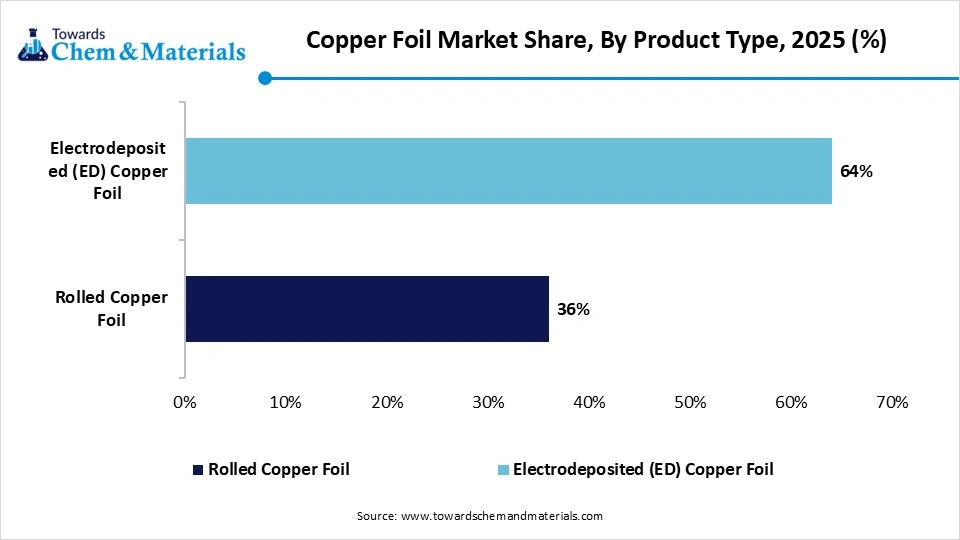
Rolled copper foil segment held the 36% market share in 2025, driven by its superior mechanical endurance, ductility, and structural standardization. Rolled copper foil is produced by compressing copper slabs through heavy precision rollers, key for flexible printed circuits, medical electronics, and aerospace systems. The rolled alternative lower high-frequency signal loss and ensures higher tensile strength, which is required in heavy-duty automotive wiring and electronic solutions. The industrial transition towards flexible, wearable, and lightweight assets makes rolled copper foil crucial for precision annealing and micro-alloying.
Copper Foil Market Share, By Product Type, 2025 (%)
| By Product Type | Revenue Share, 2025 (%) |
| Rolled Copper Foil | 36% |
| Electrodeposited (ED) Copper Foil | 64% |
Application Insights
The circuit boards segment dominated the market with the largest share of 41% in 2025, driven by the utilization of copper foil in modern electronics, high-speed telecommunication, and advanced data computing. The copper foil offers superior electrical conductivity and structural resilience by preventing high-frequency signal loss and electrical circuit degradation, supporting the growth of server infrastructure through microscopic conductive pathways.
The batteries segment held the 34% market share in 2025 and is expected to grow at the fastest CAGR of 14.88% over the forecast period due to the shift towards electric mobility, electrochemical expansion, and high-volume grid storage infrastructure. The copper foil acts as the key negative electrode current collector that enables low-resistance electron transport during charging cycles. The demand for near-microscopic thickness and metallurgical purity to maximize battery energy density and superior tensile strength is fueling the supply of copper foils.
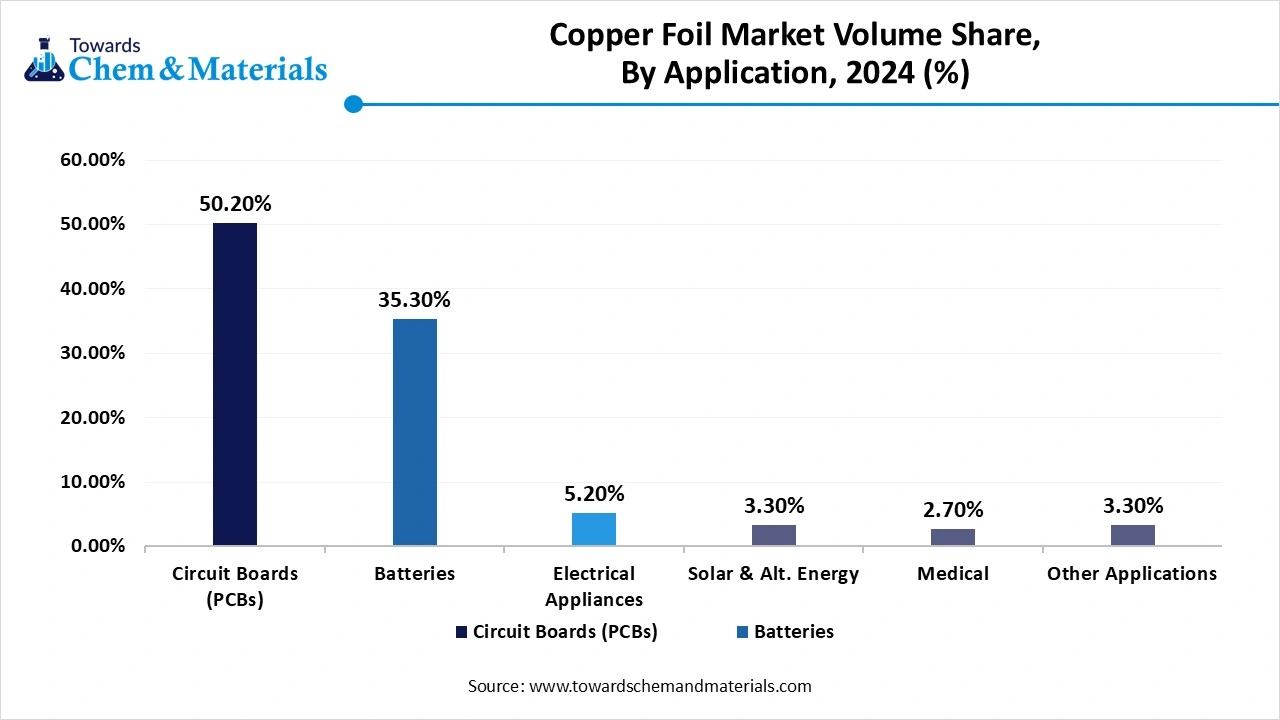
The electrical appliances segment held the 10% market share in 2025, accelerated by demand in consumer electronics, household appliances, and industrial equipment. The copper foil utilized for power distribution and electromagnetic shielding provides superior thermal dissipation. The integration of smart automation and wireless connectivity makes copper foil a cost-effective and durable solution for balancing electrical load safely in the presence of continuous mechanical vibration.
The solar & alternative energy segment held 8% market share in 2025, accelerated by decarbonization advancements & commitments in surface treatment technologies. The copper foils are key components for renewable power generation and photovoltaic modules by offering high-efficiency interconnect and minimal electrical impedance. For wind turbine generators, high-dimension transformers, and grid-scale energy storage reservoirs, copper foil maintains operational reliability and structural integrity.
Copper Foil Market Share, By Application, 2025 (%)
| By Application | Revenue Share, 2025 (%) |
| Circuit Boards | 41% |
| Batteries | 34% |
| Electrical Appliances | 10% |
| Solar & Alternative Energy | 8% |
| Medical | 3% |
| Other | 4% |
Regional Insights
How Did the Asia Pacific Dominated the Copper Foil Market in 2025?
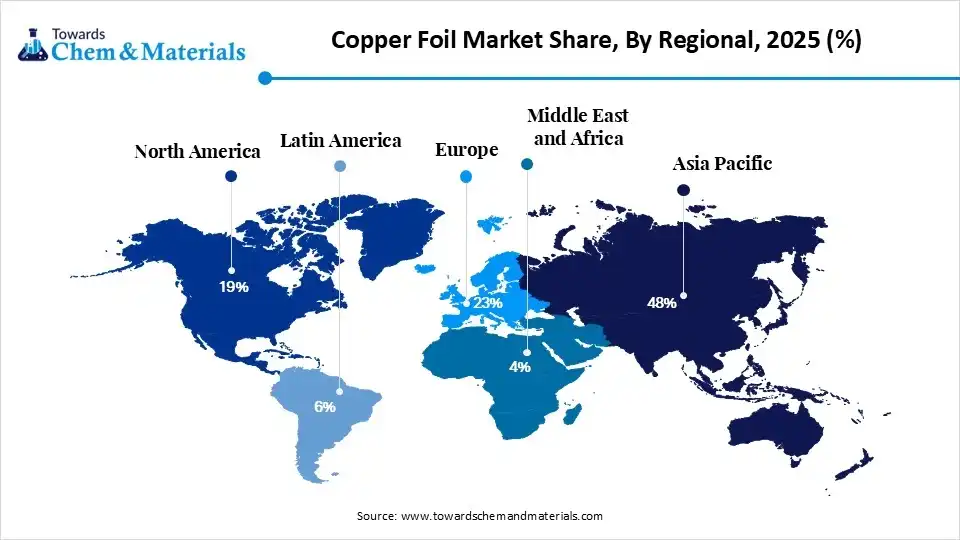
Asia Pacific copper foil market size was estimated at USD 8.42 billion in 2025 and is projected to reach USD 23.21 billion by 2035, growing at a CAGR of 10.67% from 2026 to 2035.Asia Pacific dominated the market by holding 48% share in 2025 and is expected to grow at the fastest with a CAGR of 12.84% during the forecast period, driven by large-scale consumer demand and expansion in production capacity. The region is growing in a technological ecosystem and an integrated supply chain that is fueling the continuous demand for electrodeposited and rolled copper foils in advanced semiconductor, printed circuit boards, and consumer electronics. Asia Pacific is scaling in metallurgical purity and mass-production of ultra-thin foil gauges that make the regional dominance in modern telecommunication and cloud computing servers.
China
- The rise in domestic demand for ultra-thin electrodeposited and rolled copper foils is tremendous due to massive investments in EV battery gigafactories and semiconductors manufacturing.
- The healthy development of copper foil is supported by the strong government support for 5G construction, AI data centers and high-end electronics manufacturing.
- The vertically integrated supply chain and cost-efficient metallurgical processing of China provides an advantage in terms of the production scalability and export competitiveness globally.
India
- Government-supported incentive schemes are driving growth of domestic electronics manufacturing, which in turn is driving up demand for PCB-grade copper foils.
- Local demand for copper foil is being driven by increasing investments in EV battery manufacturing, renewable energy storage and telecom.
- Growth in semiconductor packaging, smart devices, and digital infrastructure is driving advanced copper foil capacity growth.
The Europe copper foil market size was estimated at USD 4.04 billion in 2025 and is projected to reach USD 11.24 billion by 2035, growing at a CAGR of 10.77% from 2026 to 2035.Europe held the 23% market share in 2025 and expects notable growth in the market with 10.44% CAGR during the forecast period. The growth is fueled by stringent climate compliance and circular economy targets. The region's high-value hub in sustainable engineering and shift toward clean mobility are boosting the domestic ecosystem for lithium-ion battery manufacturing. Europe's development in industrial automation and specialized low-profile, ultra-thin copper foil through carbon-neutral fabrication facilities promoted by closed-loop recycling programs.
Germany
- Lithium-ion battery copper foils are in demand due to the fast pace of EV transition in Germany, which has a robust automotive sector.
- High performance ultra-thin copper foils are developed with the help of advanced industrial automation and precision engineering techniques.
- Environmental policies for carbon-neutral production processes and circular economy models are promoting sustainable copper foil production and recycling technologies.
France
- Renewable energy technology and battery production are driving up the copper foil market.
The internal demand for advanced conductive material is growing in the direction of sustainability targets set by the government and initiatives for clean mobility. - Innovation is being driven by the high-frequency electronics and aerospace sectors in France, which are getting increasing support from copper foil technologies that are less conspicuous.
The North America copper foil market size was estimated at USD 3.33 billion in 2025 and is projected to reach USD 9.33 billion by 2035, growing at a CAGR of 10.85% from 2026 to 2035.North America held 19% market share in 2025, represents a key for innovation driven hub and highly customized metallurgical integration. The regional expansion is fueled by capital investment in modern aerospace, electronics, and automotive sectors. The stringent federal policies, carbon-accounting compliance, and tax incentives focus on domestic clean-energy infrastructure. North America advanced in surface treatment technologies and zero-waste fabrication to minimize high-frequency signal loss, along with an automated quality control system.
United States
- The growing investment in semiconductor fabs, EV battery manufacturing and aerospace electronics is driving up demand for copper foil.
- Federal policies to support domestic clean energy manufacturing and supply chains are driving new manufacturing facilities.
- AI servers, cloud computing infrastructure and advanced telecom applications are driving rapid market demand for high frequency copper foils.
Canada
- Copper foil market is getting boost from the growth of clean energy projects and battery materials processing industries.
- Strong focus on sustainable mining and environmentally responsible manufacturing strengthens the regional copper supply ecosystem.
- Due to the increased investments in smart grid and electric mobility, the demand for advanced conductive materials is on the rise.
The Latin America copper foil market size was estimated at USD 1.05 billion in 2025 and is projected to reach USD 3.11 billion by 2035, growing at a CAGR of 11.47% from 2026 to 2035.Latin America held 6% market share in 2025 and serves as a global manufacturer of refined copper. The region is increasing its investment in solar and alternative energy infrastructure with advanced surface treatment technologies. Latin America is expanding its domestic consumption through telecommunication modernization and automotive part fabrication, that driving the regional leadership in the downstream industrial sector.
Brazil
- The rising production and assembling of electronics and automobiles are contributing to the copper foil demand in the industrial sector.
- Growth in the consumption of conductive materials is driven by investments by the government in renewable energy and transmission infrastructure.
- New opportunities are arising for PCB & flexible circuit production due to expansion of telecommunication modernization projects.
Chile
- The country's status as a top copper producer in the world provides stable raw materials for copper foil production.
- Advanced metallurgical processing plant development is being promoted due to increasing investments in lithium and battery supply chains.
- The growing trend of renewable energy development and industrial modernisation is boosting local demand for high-conductivity copper materials.
The Middle East & Africa copper foil market size was estimated at USD 0.70 billion in 2025 and is projected to reach USD 2.15 billion by 2035, growing at a CAGR of 11.88% from 2026 to 2035.The Middle East & Africa held 4% market share in 2025, due to its economic diversification initiatives and massive infrastructural modernization. The region is focused on sustainability goals that fuel the demand for high-conductivity copper foil, integrating with well-developed surface treatment technologies. The MEA rise in smart city engineering, resource recovery, and domestic mass-volume in telecommunication is accelerating the domestic expansion.
Copper Foil Market Share, By Regional, 2025 (%)
| Regional | Revenue Share, 2025 (%) |
| North America | 19% |
| Europe | 23% |
| Asia-Pacific | 48% |
| Latin America | 6% |
| Middle East & Africa | 4% |
Saudi Arabia
- The copper-based materials are seeing a rise in demand due to the implementation of economic diversification programs and investments in smart city infrastructure.
- The growth in renewable energy projects and digital connectivity infrastructure is helping to drive up copper foil consumption.
- The government's emphasis on the localization of industry and development of manufacturing is prompting investment in advanced material processing technologies.
South Africa
- The region has strong mining capability and developing industrial infrastructure to support copper processing ecosystem.
- It is expected that the number of projects involving conductive materials will rise as new renewable energy systems and grid modernization projects are undertaken.
- Telecommunications and automotive component production are increasing, providing opportunities for copper foil applications.
Recent Developments
- In March 2026, SK Nexilis showcased specialized copper foil products at the Interbattery 2026 convention in Seoul, highlighting 4-micrometer-thick ultra-wide copper foil with a width of 1,400 mm and a length of 5km. This product key is for improving battery energy density and manufacturing productivity.(Source: www.ajupress.com)
- In February 2026, NEO Battery Materials Ltd. announced a strategic partnership with Korea Zinc & Taesung to advance and commercialise composite copper current collector (foil) technology. The alliance focuses on innovation of high-performance batteries in drone, robotics, and micromobility uses.(Source:neobatterymaterials.com )
Top Companies in the Market
- LS Mtron Ltd.
- SKC
- Furukawa Electric Co., Ltd.
- Chang Chun Group
- Lingbao
- Circuit Foils
- Lotte Energy Materials
- Doosan Corporation Electro-Materials
- Nippon Denkai, Ltd.
- UACJ Foil Corporation
Segment Covered in the Report
By Product Type
- Rolled Copper Foil
- High Flexibility Rolled Foil
- Standard Rolled Foil
- Ultra-thin Rolled Foil
- Electrodeposited (ED) Copper Foil
- Standard ED Copper Foil
- High-temperature ED Copper Foil
- Lithium-ion Battery Grade ED Foil
- Reverse-treated ED Foil
By Application
- Circuit Boards
- Rigid Printed Circuit Boards
- Flexible Printed Circuit Boards
- High-density Interconnect Boards
- Batteries
- Lithium-ion Batteries
- Solid-state Batteries
- EV Battery Systems
- Electrical Appliances
- Consumer Electronics
- Industrial Electrical Equipment
- Smart Home Devices
- Solar & Alternative Energy
- Solar Panels
- Wind Energy Systems
- Energy Storage Systems
- Medical
- Medical Imaging Devices
- Diagnostic Equipment
- Wearable Medical Electronics
- Other
- Aerospace Electronics
- Defense Equipment
- Telecommunication Infrastructure
By Region
- North America
- U.S.
- Canada
- Mexico
- Europe
- UK
- Germany
- France
- Italy
- Spain
- Sweden
- Denmark
- Norway
- Asia Pacific
- Japan
- China
- India
- Australia
- South Korea
- Thailand
- Latin America
- Brazil
- Argentina
- The Middle East and Africa
- South Africa
- Saudi Arabia
- UAE
- Kuwait
FAQ's
Question 1 : What is the current Copper Foil Market size?
Answer : The global Copper Foil Market was valued at USD 17.55 billion in 2025 and is projected to reach USD 47.85 billion by 2035.
Question 2 : What is the growth rate of the Copper Foil Market?
Answer : The Copper Foil Market is expected to grow at a CAGR of 10.55 percent from 2026 to 2035.
Question 3 : Which region dominates the Copper Foil Market?
Answer : Asia Pacific dominated the Copper Foil Market in 2025 with a 48 percent market share.
Question 4 : What factors are driving Copper Foil Market growth?
Answer : The market is driven by electric vehicle demand, battery manufacturing expansion, 5G infrastructure growth, and rising adoption of renewable energy systems.
Question 5 : Who are the major companies in the Copper Foil Market?
Answer : Major companies include LS Mtron Ltd., SKC, Furukawa Electric Co. Ltd., Lotte Energy Materials, and Nippon Denkai Ltd.
Meet the Team

Saurabh Bidwai
Principal Consultant
Saurabh Bidwai, a B.Tech Chemical Engineering graduate with 4+ years of experience, specializes in specialty chemicals, commodity chemicals, and engineered materials, offering valuable insights into market trends and emerging opportunities.

Aditi Shivarkar
Reviewed By
Aditi Shivarkar, with 14+ years in Chemical and Materials market research, specializes in Chemical and Materials. She ensures accurate, actionable insights, driving Towards Chemicals And Materials Analytics and Consulting excellence in industry trends and sustainability.