
Europe PE and PP Compounding Market Size, Share, Growth, Report 2026 to 2035
The Europe PE and PP compounding market size is expected to grow from USD 20.59 billion in 2026 to USD 34.34 billion in 2035, growing at a CAGR of 5.85% from 2026 to 2035. The top key players in the market are LyondellBasell Industries, SABIC, Borealis AG, INEOS Group Limited, ExxonMobil Chemical, Dow Inc., Ravago Group, TotalEnergies SE, BASF SE, Covestro AG
Content
What is the Current Size of the Europe PE and PP Compounding Market and Its Projected Growth?
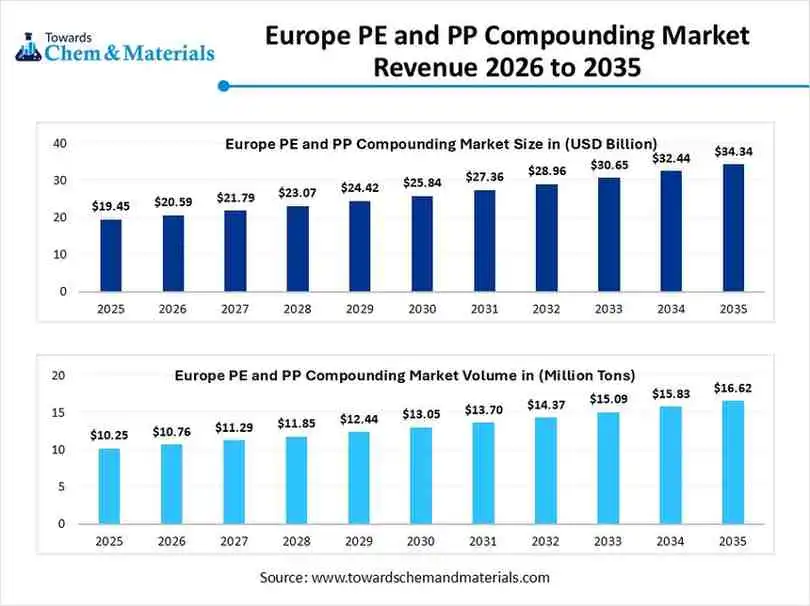
The Europe PE and PP compounding market size was estimated at USD 19.45 billion in 2025 and is expected to increase from USD 20.59 billion in 2026 to USD 34.34 billion by 2035, growing at a CAGR of 5.85% from 2026 to 2035. In terms of volume, the market is projected to grow from 10.25 million tons in 2025 to 16.62 million tons by 2035. growing at a CAGR of 4.95% from 2026 to 2035. The greater shift towards sustainability and cost-effective materials has accelerated the industry's growth in recent years.
Market Highlights
- By country, Germany dominated the Europe PE and PP compounding market in 2025, with a significant industry share expected to sustain its position while growing with a rapid CAGR in the forecast period, as it has a strong industrial base and advanced manufacturing.
- By country, the United Kingdom held the second largest share in 2025 and expects notable growth with the rapid CAGR during the forecast period, due to its focus on innovation and sustainability.
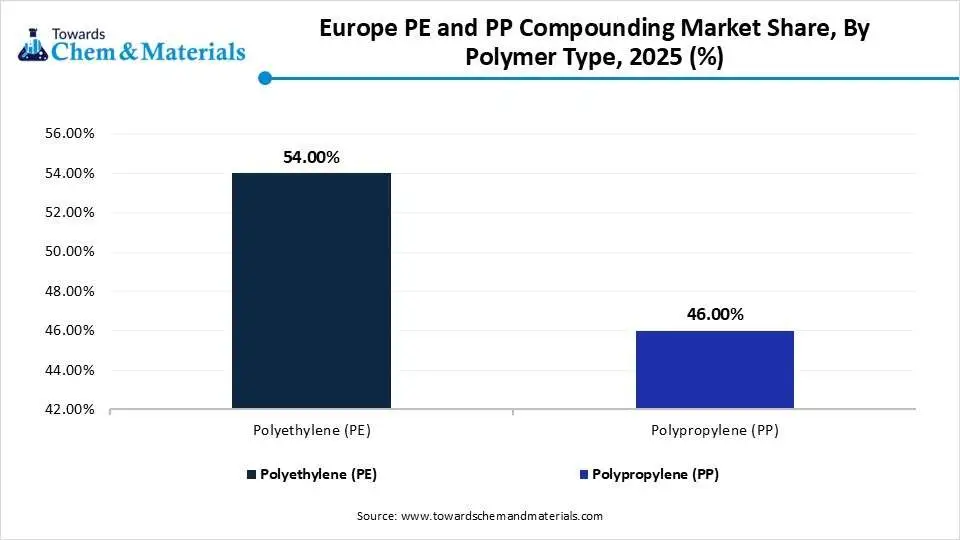
- By polymer type, the polyethylene segment dominated the market with 54% share in 2025, owing to its simplicity, flexibility, and use everywhere.
- By polymer type, the polypropylene segment is expected to experience the fastest growth in the market with 7.2% CAGR during the forecast period, due to industries now wanting stronger and smarter plastic.
- By compounding type, the filled compounds segment dominated the market with 29% share in 2025, owing to they help companies save money without losing too much performance.
- By compounding type, the additive compound segment expects the fastest growth in the market with 7.5% CAGR during the forecast period, as products now need special features, not just basic functions.
- By processing technology, the extrusion compounding segment dominated the market with 41% share in 2025, owing to its simplicity, continuity, and efficiency.
- By processing technology, the injection moulding segment expects the fastest growth in the market with 6.9% CAGR during the forecast period, due to products becoming more detailed and design-focused.
- By application, the packaging segment dominated the market with 34% share in 2025, owing to its use every single day in huge quantities.
- By application, the automotive segment expects the fastest growth in the market with 7.4% CAGR during the forecast period, owing to the industry's move toward lightweight and high-performance materials.
Market Size and Volume Forecast
- Market Size (2025): USD 19.45 Billion | CAGR (2026–2035): 5.85%
- Market Projected Size (2035): USD 34.34 Billion
- Market Volume (2025): 10.25 Million Tons (MT) | Volume CAGR (2026–2035): 4.95%
- Market Projected Volume (2035): 16.62 Million Tons (MT)
- Market Pricing (2025):
- Average Manufacturing Price: USD 1,480/ton
- Average Selling Price: USD 1,996/ton
- Pricing CAGR (2025–2035): 3.5%
Compounding Boosting Strength, and Cost Efficiency
The PP and PE compounding refers to the making of plastic behave. Also, by mixing other materials into compounding, companies are actively creating stronger and more durable products in recent years, which has gained industry attention from previous years. Moreover, this compounding is likely to attract greater investment by making cost-effective and tougher plastic by adding rubber into it, as per expectations.
Recent Market Trends:
- The heavy demand for cost-effective materials has attracted increased capital and investment in manufacturing in recent years. Also, several manufacturers have been actively seen in adding fillers and cheaper materials to maintain this affordability in recent years.
- Emergence of the easier processing materials is supporting the stronger cash flows for manufacturing enterprises in the current period. Also, the manufacturers are focusing on easy processing methods rather than high performance nowadays.
- The greater shift towards problem-free recycled plastic is expected to elevate earning potential for producers during the forecast period. Moreover, the manufacturers are increasingly observed in making plastic that looks like fresh plastic.
Report Scope
| Report Attribute | Details |
| Market Size in 2026 | USD 20.59 Billion / 10.76 Million Tons |
| Revenue Forecast in 2035 | USD 34.34 Billion / 16.62 Million Tons |
| Growth Rate | CAGR 5.85% |
| Forecast Period | 2026 - 2035 |
| Base Year | 2025 |
| Segment Covered | By Polymer Type, By Compounding Type, By Processing Technology, By Application, By Country |
| Key companies profiled | LyondellBasell Industries, SABIC, Borealis AG, INEOS Group Limited, ExxonMobil Chemical, Dow Inc., Ravago Group, TotalEnergies SE, BASF SE, Covestro AG |
Smart Formulations Beats Machine Advantage
In recent years, the companies have focused on having big and advanced machines. Now, almost everyone has similar machines. So, the real difference is in how smartly companiese make the plastic. Also, the small changes in material mix can give big results. Experienced companies learn from past trials and improve step by step. Moreover, the companies that understand materials deeply are winning in the market.
Supply Chain Analysis of the Europe PE and PP Compounding Market:
Distribution to Industrial Users
- Industrial distribution of PE and PP compounding in Europe focuses on delivering customized resins to the automotive, packaging, and construction sectors.
- High-performance compounds are supplied through specialized logistics networks to manufacturers requiring lightweight, durable, and chemically resistant materials for technical applications like vehicle components and protective industrial packaging.
Chemical Synthesis and Processing
- European PE and PP compounding involves blending base polymers with additives, fillers, or reinforcements through high-shear twin-screw extrusion. This thermal process chemically stabilizes the resin while enhancing mechanical properties.
- The resulting high-performance compounds are pelletized for industrial use, ensuring precise material consistency for demanding automotive and packaging applications.
Regulatory Compliance and Safety Monitoring
- European PE and PP compounding is strictly governed by REACH and CLP regulations, ensuring chemical safety and traceability. Manufacturers must perform rigorous migration testing and provide Safety Data Sheets (SDS).
- Continuous monitoring focuses on volatile emissions and additive limits to meet stringent food-contact and automotive safety standards across the EU
Europe PE and PP Compounding Market Regulatory Landscape: Regulations
| Country Region | Regulatory Body | Key Regulations | Focus Areas |
| Germany | Federal Institute for Risk Assessment (BfR) | BfR Recommendations: Specifically Recommendation III (Polyethylene) and Recommendation VII (Polypropylene). These are not legally binding but represent the state of the art for compliance with the German Food and Feed Code (LFGB). | Migration limits for additives (e.g., antioxidants, slip agents), toxicological assessment of non-intentionally added substances (NIAS), and increasing the use of recycled content to lower EPR fees. |
| United Kingdom | Health and Safety Executive (HSE) | UK REACH (Statutory Instrument 2019/758): Assumes the role of EU REACH post-Brexit for chemical registration and authorization. | Grandfathering of EU registrations into the UK system, monitoring Persistent Organic Pollutants (POPs), and maintaining safety data for substances manufactured or imported over one tonne per year. |
| Italy | Ministry of Health e l'Istituto Superiore di Sanità (ISS). | Ministerial Decree 21/03/1973: The foundational national law on hygiene for packaging and containers. |
Strict adherence to "Positive Lists," Specific Migration Limits (SML) for primary aromatic amines and phthalates, and official control plans (2023–2027) for food contact materials |
Segmental Insights
Polymer Type Insights
The Polyethylene (PE) Segment Dominated the Europe PE and PP Compounding Market with 54% Market Share in 2025
The polyethylene (PE) segment dominated the market with 54% share in 2025, owing to its simplicity, flexibility, and use everywhere. It works very well in packaging like films, bags, and containers, which are needed in huge volumes every day. It is also easier to process compared to many other plastics, so factories prefer it. Also, the cost of PE is generally cheaper and gives good performance for basic needs. Companies don’t always need high-performance plastic; they need a reliable and affordable material.
The polypropylene (PP) segment is expected to be the fastest growing in the market with 7.2% CAGR during the forecast period due to industries now wanting stronger and smarter plastic. PP can handle more heat, more stress, and more complex applications than PE. This makes it perfect for automotive, appliances, and technical products. As industries move toward lightweight and durable materials, PP becomes more useful. It also allows more design flexibility, which companies like.
Europe PE and PP Compounding Market Share, By Polymer Type, 2025 (%)
| By Polymer Type | Revenue Share, 2025 (%) |
| Polyethylene (PE) | 54.00% |
| Polypropylene (PP) | 46.00% |
- Polyethylene leads the Europe PE and PP compounding market with a 54.00% share in 2025, driven by its wide usage in packaging, films, and consumer goods applications. Its versatility, cost-effectiveness, and strong demand from end-use industries support its dominant position.
- Polypropylene accounts for 46.00% of the market share in 2025, supported by its growing use in automotive components, textiles, and rigid packaging solutions. The material’s strength, lightweight properties, and recyclability contribute to its steady market growth.
Compounding Type Insights
The Filled Compounds Segment Dominated the Market with 29% Market Share in 2025
The filled compounds segment dominated the market with 29% share in 2025, owing to they help companies save money without losing too much performance. By adding fillers like minerals, manufacturers reduce the amount of expensive plastic used. This makes the final product cheaper. At the same time, fillers can improve stiffness and shape stability. Moreover, companies get both cost benefits and useful properties.
The additive compounds segment is expected to be the fastest-growing in the market, with 7.5% CAGR in the coming years, as products now need special features, not just basic functions. As industries become more advanced, simple plastic is not enough. Companies want materials that solve specific problems. Additives help achieve that. Also, regulations in Europe are strict, so materials must meet safety and environmental standards.
The reinforced compounds segment held the third largest share of 18% in 2025, owing to they provide extra strength without making products heavy. By adding materials like glass fiber, plastics become much stronger and more durable. It is very useful in industrial and automotive parts where strength matters. Companies are trying to replace metal with lighter materials, and reinforced plastics help in doing that. They also improve product life and reliability.
The blends & alloys segment held 14% market share in 2025 due to they allow companies to combine the best features of different plastics. Sometimes one plastic is strong but not flexible, and another is flexible but not strong. By blending them, companies create a balanced material. This helps in meeting specific application needs. It also gives more design freedom to manufacturers. As products become more complex, single-material solutions are not enough.
Europe PE and PP Compounding Market Share, By Compounding Type, 2025 (%)
| By Compounding Type | Revenue Share, 2025 (%) |
| Filled Compounds | 29.00% |
| Reinforced Compounds | 18.00% |
| Blends & Alloys | 14.00% |
| Color Compounds | 16.00% |
| Additive Compounds | 23.00% |
- Filled compounds hold the largest share of the Europe PE and PP compounding market at 29.00% in 2025, driven by their cost efficiency and enhanced material properties such as improved stiffness and dimensional stability. These compounds are widely used in automotive, packaging, and construction applications.
- Reinforced compounds account for 18.00% of the market share in 2025, supported by their superior strength and durability achieved through the addition of glass fibers or other reinforcements. They are increasingly used in high-performance applications, especially in the automotive and industrial sectors.
- Blends & alloys represent 14.00% of the market share in 2025, as they combine multiple polymers to achieve tailored properties for specific applications. This segment benefits from growing demand for customized materials across various industries.
- Color compounds capture 16.00% of the market in 2025, driven by the need for aesthetic appeal and product differentiation in consumer goods and packaging. They also offer consistency in color and performance across large-scale production.
- Additive compounds hold a 23.00% share of the market in 2025, supported by their ability to enhance polymer performance through features like UV resistance, flame retardancy, and anti-static properties. Increasing demand for high-performance and specialty plastics is boosting this segment.
Processing Technology Insights
The Extrusion Compounding Segment Dominated the Europe PE and PP Compounding Market with 41% Market Share in 2025
The extrusion compounding segment dominated the market with 41% share in 2025, owing to its simplicity, continuity, and efficiency. It allows large amounts of material to be processed quickly, which is perfect for high-demand industries. The process is stable and gives consistent quality, which companies trust.
The injection molding compounding segment is expected to be the fastest growing in the market with 6.9% CAGR during the forecast period due to products becoming more detailed and design-focused. This process allows complex shapes, fine finishing, and high precision. Industries like automotive and electronics need such advanced designs. As demand for smart and compact products increases, injection moulding becomes more important. It also supports automation, which improves production speed and consistency.
The blow molding compounding segment held the third largest share of 19% in 2025, owing to they are ideal for making hollow products like bottles, containers, and tanks. Also, these products are always in demand, especially in packaging and storage. The process is efficient and suitable for mass production. It also allows lightweight designs, which help reduce material use.
The rotational molding compounding segment held the fourth largest share of 13% in 2025, owing to it is useful for making large and durable hollow products like water tanks and storage containers. It gives uniform thickness and strong structure without complex machinery. This makes it suitable for outdoor and heavy-duty applications. As demand for infrastructure and storage solutions increases, this process becomes more important.
Europe PE and PP Compounding Market Share, By Processing Technology, 2025 (%)
| By Processing Technology | Revenue Share, 2025 (%) |
| Extrusion Compounding | 41.00% |
| Injection Molding Compounding | 27.00% |
| Blow Molding Compounding | 19.00% |
| Rotational Molding Compounding | 13.00% |
- Extrusion compounding leads the Europe PE and PP compounding market with a 41.00% share in 2025, driven by its efficiency in producing continuous profiles, sheets, and films. Its widespread use in packaging and construction applications supports its dominant position.
- Injection molding compounding accounts for 27.00% of the market share in 2025, supported by its ability to produce complex and high-precision components. This technology is widely adopted in automotive, consumer goods, and electronics industries.
- Blow molding compounding holds a 19.00% share of the market in 2025, primarily used for manufacturing hollow products such as bottles and containers. The growing demand for packaging solutions is a key factor driving this segment.
- Rotational molding compounding represents 13.00% of the market share in 2025, as it is suitable for producing large, hollow, and durable products like tanks and containers. Its ability to create uniform wall thickness products contributes to its steady demand.
Application Insights
The Packaging Segment Dominated the Market with 34% Market Share in 2025
The packaging segment dominated the market with 34% share in 2025, owing to its use every single day in huge quantities. Almost every product needs packaging for food, medicine, consumer goods, and everything. PE and PP are perfect for packaging because they are lightweight, safe, and cost-effective. The demand is continuous and very high. Even small improvements in cost or performance make a big impact due to large volumes.
The automotive segment is expected to be the fastest-growing in the market, with 7.4% CAGR during the forecast period, owing to the industry's move toward lightweight and high-performance materials. Cars now need to be fuel-efficient and suitable for electric systems. Plastics like PP help reduce weight and improve efficiency. Also, modern vehicles require more design flexibility and advanced parts. Compounded plastics can meet these needs better than traditional materials.
The construction segment held the third largest share of 16% in 2025, due to its need for durable and long-lasting materials. PE and PP compounds are used in pipes, insulation, and fittings. These materials resist chemicals, moisture, and weather, making them ideal for construction use. As infrastructure projects increase, demand for such materials also rises. They are also easier to install and maintain compared to traditional materials.
The electrical and electronics segment held the fourth largest share of 9% in 2025, owing to devices needing safe and reliable materials. Compounded plastics provide insulation, heat resistance, and durability. These properties are important for wires, connectors, and electronic parts. As technology grows, demand for such materials also increases. Devices are becoming smaller and more advanced, so materials must perform better.
Europe PE and PP Compounding Market Share, By Application, 2025 (%)
| By Application | Revenue Share, 2025 (%) |
| Packaging | 34.00% |
| Automotive | 22.00% |
| Construction | 16.00% |
| Electrical & Electronics | 9.00% |
| Consumer Goods | 8.00% |
| Healthcare | 5.00% |
| Agriculture | 4.00% |
| Others | 2.00% |
- Packaging leads the Europe PE and PP compounding market with a 34.00% share in 2025, driven by strong demand for flexible and rigid packaging solutions. The segment benefits from increasing consumption of packaged goods and sustainability-focused materials.
- Automotive accounts for 22.00% of the market share in 2025, supported by the rising use of lightweight and durable polymer compounds in vehicle components. This helps improve fuel efficiency and reduce overall vehicle weight.
- Construction holds a 16.00% share of the market in 2025, driven by the use of PE and PP compounds in pipes, fittings, insulation, and building materials. Growth in infrastructure and real estate development supports this segment.
- Electrical & electronics capture 9.00% of the market share in 2025, as these compounds are used in cables, connectors, and electronic housings. Increasing demand for advanced electronic devices is contributing to segment growth.
- Consumer goods represent 8.00% of the market in 2025, supported by the use of polymer compounds in household items, appliances, and everyday products. The demand for durable and cost-effective materials drives this segment.
- Healthcare accounts for 5.00% of the market share in 2025, driven by applications in medical devices, packaging, and equipment. The need for safe, lightweight, and sterilizable materials supports steady growth.
- Agriculture holds 4.00% of the market in 2025, with PE and PP compounds used in irrigation systems, films, and agricultural equipment. Increasing focus on efficient farming practices is boosting demand.
- Others capture 2.00% of the market share in 2025, covering niche and emerging applications across various industries. This segment reflects specialized uses with limited but steady demand.
By End Use
The Europe PE and PP compounding market, segmented by end use, is led by copper smelters & refiners, accounting for approximately 36% share, making it the dominant segment due to strong demand for compounded polymers in cable insulation, piping systems, and corrosion-resistant applications used in metal processing and refining operations. The foundries segment holds around 18% share, supported by its use of polymer compounds in molding components, protective coatings, and auxiliary equipment.
Among the remaining segments, the automotive industry is the fastest-growing segment, driven by the increasing adoption of lightweight and high-performance polymer compounds in vehicle components to improve fuel efficiency and support electrification trends. Industry data shows that automotive applications consistently represent the largest demand driver in plastic compounding across Europe, supported by lightweighting initiatives and rising vehicle production . The construction industry also captures a significant share, fueled by growing infrastructure development and the use of PE and PP compounds in pipes, insulation, and building materials. Meanwhile, electrical manufacturing is witnessing steady growth due to increasing demand for wire & cable applications and electronic components, where compounded polymers provide durability, insulation, and flame-retardant properties .
Overall, while traditional heavy industries such as smelters and foundries dominate in terms of share, growth momentum is increasingly shifting toward automotive, construction, and electrical sectors, driven by sustainability trends, material innovation, and expanding industrial applications across Europe.
Europe PE and PP Compounding Market Share, By End-Use, 2025 (%)
| By End-Use | Revenue Share, 2025 (%) |
| Copper Smelters & Refiners | 36.00% |
| Foundries | 18.00% |
| Electrical Manufacturing | 20.00% |
| Construction Industry | 14.00% |
| Automotive Industry | 12.00% |
- Copper smelters & refiners lead the Europe PE and PP compounding market with a 36.00% share in 2025, driven by the need for durable and high-performance polymer compounds in insulation and processing applications. Their extensive use in handling and protecting materials supports strong demand in this segment.
- Foundries account for 18.00% of the market share in 2025, supported by the use of compounded polymers in tooling, patterns, and auxiliary applications. The demand is driven by the need for efficient and cost-effective manufacturing processes.
- Electrical manufacturing holds a 20.00% share of the market in 2025, as PE and PP compounds are widely used in cables, insulation, and electrical components. Increasing electrification and infrastructure development are key growth drivers.
- The construction industry represents 14.00% of the market share in 2025, driven by applications in pipes, fittings, and building materials. Growth in infrastructure projects and urban development continues to support this segment.
- The automotive industry captures 12.00% of the market in 2025, supported by the use of lightweight and durable polymer compounds in vehicle parts. Rising demand for fuel-efficient and sustainable vehicles is boosting adoption in this segment.
Country Insights
How will Germany dominate the Europe PE and PP Compounding Market in 2025?
Germany maintained its dominance in the market, owing to its having a strong industrial base and advanced manufacturing. It has many automotive, engineering, and chemical companies that use high-quality materials. The country focuses on precision and innovation, which increases demand for compounded plastics. It also has a well-developed infrastructure and skilled workforce. This helps in efficient production and development.
United Kingdom Leading Sustainable Plastic Growth
The United Kingdom is expected to emerge as a prominent country for the Europe PE and PP compounding market in the coming years, due to its focus on innovation and sustainability. Also, companies are investing in new materials, recycling, and advanced applications. There is also growing demand in sectors like packaging, healthcare, and electric mobility. The market is becoming more flexible and open to new ideas. This creates opportunities for compounding companies.
Recent Developments
- In March 2025, Rialti unveiled its latest product line of PP compounds at PRSE 2025. Moreover, the newly launched compounds include post-industrial and post-consumer recycled content, which strongly promote sustainability and are specifically designed for the construction and home gardening industries, as per the company's claim.(Source: www.borealisgroup.com)
- In January 2026, Sabic established its latest PP compounding line, which is located in Genk, Belgium. Furthermore, this plant is equipped with the latest and advanced technologies and aims to deliver high-performance PP and high-quality PP in the market, as per the published report. (Source: www.modernplasticsglobal.com)
Top Vendors in the Europe PE and PP Compounding Market & Their Offerings:
- LyondellBasell Industries: Headquartered in London and Rotterdam, LyondellBasell is the world’s largest producer of polypropylene and a major licensor of polyethylene technologies. It operates 55 manufacturing sites globally, focusing on high-performance polymers for automotive, healthcare, and sustainable packaging. By 2026, the company aims to significantly expand its circular and low-carbon solutions.
- SABIC: Based in Riyadh with 60 plants worldwide, SABIC is a global leader in chemicals and engineering plastics. A subsidiary of Saudi Aramco, it produces advanced PE and PP compounds for the automotive and electronics sectors. In early 2026, it divested parts of its European petrochemicals business to focus on high-margin specialties and sustainability.
- Borealis AG: This Vienna-based company is Europe’s second-largest polyolefin producer, owned by OMV and ADNOC. It specializes in advanced materials for energy, infrastructure, and consumer packaging. As of March 2026, Borealis has combined with Borouge and NOVA Chemicals to form Borouge International, creating a new global leader in polyolefin innovation and circular economy solutions.
- INEOS Group Limited: A private British multinational, INEOS operates 194 sites across 29 countries. It is one of the world's largest chemical producers, supplying essential PE and PP raw materials for industrial and medical use. Beyond chemicals, INEOS has diversified into the automotive sector with the Grenadier and maintains a massive professional sports portfolio.
- ExxonMobil Chemical
- Dow Inc.
- Ravago Group
- TotalEnergies SE
- BASF SE
- Covestro AG
Segments Covered in the Report
By Polymer Type
- Polyethylene (PE)
- Polypropylene (PP)
By Compounding Type
- Filled Compounds
- Reinforced Compounds
- Blends & Alloys
- Color Compounds
- Additive Compounds
By Processing Technology
- Extrusion Compounding
- Injection Molding Compounding
- Blow Molding Compounding
- Rotational Molding Compounding
By Application
- Packaging
- Automotive
- Construction
- Electrical & Electronics
- Consumer Goods
- Healthcare
- Agriculture
- Others
By Country
- Germany
- Italy
- France
- Netherlands
- Spain
- Portugal
- Belgium
- Ireland
- UK
- Iceland
- Switzerland
- Poland
- Austria
- Russia & Belarus
- Türkiye
- Albania
FAQ's
Question 1 : What are the key growth drivers, trends, and market dynamics shaping the Europe PE and PP compounding market?
Answer : The market is driven by rising demand for cost-effective and sustainable materials, increasing use of recycled plastics, and growing adoption of lightweight, high-performance polymers across packaging and automotive sectors.
Question 2 : What is the current market size, projected CAGR, and investment potential of the Europe PE and PP compounding market through 2035?
Answer : The market was valued at USD 19.45 billion in 2025 and is projected to reach USD 34.34 billion by 2035, growing at a CAGR of 5.85%, reflecting steady long-term investment potential.
Question 3 : How are technological advancements and regulatory frameworks influencing innovation and adoption in the Europe PE and PP compounding market?
Answer : Advancements in compounding technologies and smart material formulations, along with strict European regulations like REACH and CLP, are driving innovation while ensuring safety, sustainability, and compliance.
Question 4 : Who are the leading companies operating in the Europe PE and PP compounding market, and what strategies are they adopting to stay competitive?
Answer : Key players such as LyondellBasell, SABIC, Borealis AG, INEOS, and BASF are focusing on sustainable materials, advanced compounding technologies, and strategic expansions to strengthen their market position.
Meet the Team

Saurabh Bidwai
Principal Consultant
Saurabh Bidwai, a B.Tech Chemical Engineering graduate with 4+ years of experience, specializes in specialty chemicals, commodity chemicals, and engineered materials, offering valuable insights into market trends and emerging opportunities.

Aditi Shivarkar
Reviewed By
Aditi Shivarkar, with 14+ years in Chemical and Materials market research, specializes in Chemical and Materials. She ensures accurate, actionable insights, driving Towards Chemicals And Materials Analytics and Consulting excellence in industry trends and sustainability.