
Fermentation Chemicals Market Size, Share, Growth, Report 2026 to 2035
The global fermentation chemicals market size is expected to grow from USD 85.23 billion in 2026 to USD 169.66 billion in 2035, growing at a CAGR of 7.95% from 2026 to 2035. The top key players in the market are BASF SE, Novonesis, DuPont Danisco, DSM, Amano Enzymes USA Co., Ltd., AB Enzymes, Chr. Hansen Holding A/S, Dow, Evonik Industries AG, Cargill, Incorporated, Ajinomoto Co., Inc., ADM.
Content
What is the Current Size of the Fermentation Chemicals Market and Its Projected Growth?
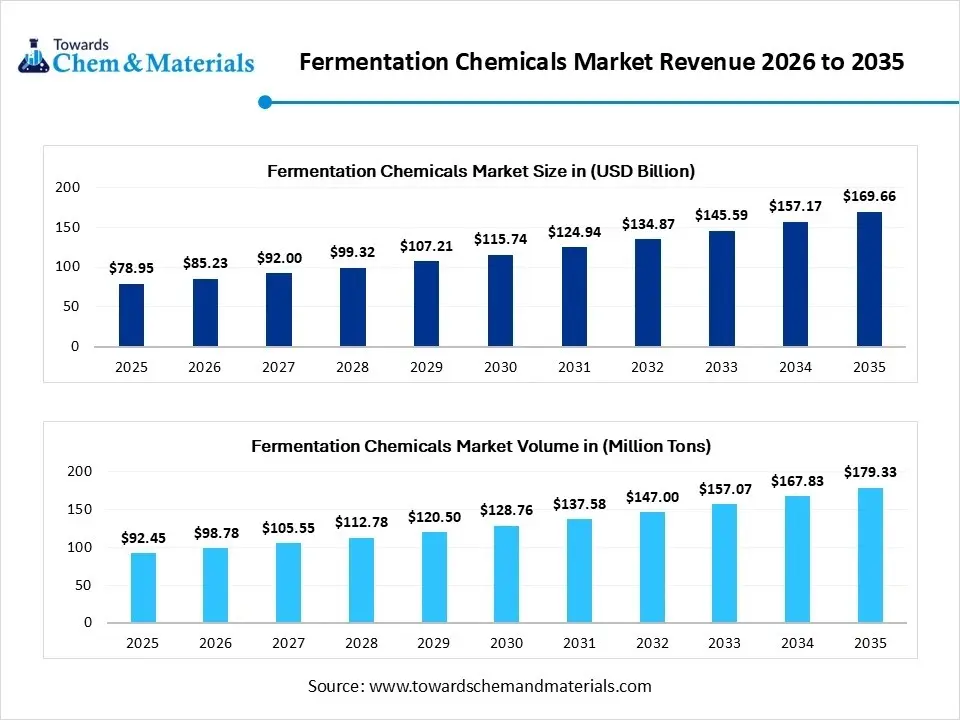
The global fermentation chemicals market size was estimated at USD 78.95 billion in 2025 and is expected to increase from USD 85.23 billion in 2026 to USD 169.66 billion by 2035, growing at a CAGR of 7.95% from 2026 to 2035. In terms of volume, the market is projected to grow from 92.45 million tons in 2025 to 179.33 million tons by 2035. growing at a CAGR of 6.85% from 2026 to 2035.Asia Pacific dominated the fermentation chemicals market with the largest revenue share of 44% in 2025.The increasing adoption of industrial biotechnology is the key factor driving market growth. Also, a surge in investments in R&D, coupled with the growth of the pharmaceutical industry, can fuel market growth further.
Market Highlights
- By region, Asia Pacific dominated the market with 44% share in 2025 and is expected to grow at the fastest CAGR of 8.1% over the forecast period. The dominance and growth of the region can be attributed to the increasing demand for processed foods.
- By region, North America held the second-largest share of 20% in 2025 and is expected to experience notable growth in the market with 7.20% CAGR during the forecast period. The growth of the region can be credited to its advanced biotechnology industry.
- By product type, the alcohols segment dominated the market with 28% share in 2025. The dominance of the segment can be attributed to the increasing bioethanol demand.
- By product type, the enzymes segment is expected to grow at the fastest CAGR of 8.1% over the forecast period. The growth of the segment can be credited to the increasing industrial biocatalyst demand.
- By raw material, the sugar-based feedstock segment dominated the market with 34% share in 2025. The dominance of the segment is owing to the abundant availability of sugarcane.
- By raw material, the lignocellulosic biomass is expected to grow at the fastest CAGR of 8.4% over the forecast period. The growth of the segment can be attributed to the ongoing technological innovations.
- By process type, the batch fermentation segment dominated the market with 42% share in 2025. The dominance of the segment can be credited to its extensive adoption in pharmaceuticals.
- By process type, the fed-batch fermentation segment is expected to grow at the fastest CAGR of 7.6% during the forecast period. The growth of the segment can be attributed to the rising industrial-scale applications.
- By application, the food & beverages segment dominated the market with 30% share in 2025. The dominance of the segment can be linked to the increasing drug production globally.
- By application, the industrial application segment is expected to grow at the fastest CAGR of 8.2% over the projected period. The growth of the segment can be credited to the expansion of industrial biotechnology.
Market Size and Volume Forecast
- Market Size (2025): USD 78.95 Billion | CAGR (2026–2035): 7.95%
- Market Projected Size (2035): USD 169.66 Billion
- Market Volume (2025): 92.45 Million Tons (MT) | Volume CAGR (2026–2035): 6.85%
- Market Projected Volume (2035): 179.33 Million Tons (MT)
- Market Pricing (2025):
- Average Manufacturing Price: USD 1,270/ton
- Average Selling Price: USD 2,150/ton
- Pricing CAGR (2025–2035): 4.95%
What are Fermentation Chemicals Market?
The market includes the manufacturing and sale of compounds created via microbial action, such as yeast and fungi, on organic substrates, like sugars. These sustainable, bio-based products, including acids, alcohols, enzymes, and vitamins, act as eco-friendly alternatives to petrochemicals across pharmaceutical, food, and industrial applications.
Recent Market Trends
- The increasing product demand in the food and beverage sector is the latest trend in the market, shaping positive market growth. The trend is fuelled by growing consumer preference for clean-label products, natural ingredients, and functional foods, which leads market players to incorporate fermentation-based preservatives and additives.
- The ongoing innovations in fermentation technology are another major factor driving market expansion.
- Advancements in microbial engineering, bioprocessing, and precision fermentation have substantially enhanced scalability, efficiency, and product diversity across various industries.
- The market has experienced an increasing demand for biofuels due to the rising demand for energy security and growing concerns over environmental pollution. Also, the governments in major countries have launched policies to optimise manufacturing and use biofuels, leading to market growth soon.
Report Scope
| Report Attribute | Details |
| Market Size in 2026 | USD 85.23 Billion / 98.78 Million Tons |
| Revenue Forecast in 2035 | USD 169.66 Billion / 179.33 Million Tons |
| Growth Rate | CAGR 7.95% |
| Forecast Period | 2026 - 2035 |
| Base Year | 2025 |
| Dominant Region | Asia Pacific |
| Segment Covered | By Product Type, By Raw Material, By Application, By End-Use Industry, By Regions |
| Key companies profiled | BASF SE, Novonesis, DuPont Danisco, DSM, Amano Enzymes USA Co., Ltd., AB Enzymes, Chr. Hansen Holding A/S, Dow, Evonik Industries AG, Cargill, Incorporated, Ajinomoto Co., Inc., ADM |
How Cutting-Edge Technologies Are Revolutionizing the Fermentation Chemicals Market?
Advanced technologies are transforming the market by transitioning it from conventional, empirical processes to data-driven, high-accuracy, and eco-friendly biomanufacturing. Furthermore, state-of-the-art techniques enable the utilisation of renewable feedstocks, like carbon emissions and agricultural waste, to manufacture high-grade chemicals, supporting circular economy principles.
Trade Analysis of the Fermentation Chemicals Market: Import & Export Statistics
- Based on Canadian import data, the value of organic chemical shipments from the United States in 2024 was 25 billion United States dollars.
- According to 2024 Mexican import data, the United States exported organic chemicals to Mexico valued at approximately $18 billion.
- According to Chinese import data, the United States exported $14 billion worth of organic chemicals to China in 2024.
- In 2023-24, the international chemical export market was valued at $695.12 billion, accompanied by a 3.5% increase in global chemical production in 2024, indicating robust growth in the sector.
- As the world's top producer, China dominated the global market in 2024 with the production of approximately 1.3 billion metric tons of chemicals, with a heavy focus on basic chemicals.
- India's chemical industry, valued at approximately Rs. 21,50,750 crores in 2024, is projected to reach US$300 billion by 2028 and scale to Rs. 86,03,000 by 2040, driven by robust domestic demand and manufacturing growth.
Fermentation Chemicals Market Supply Chain Analysis
Feedstock Procurement
- It refers to the strategic sourcing, acquisition, and management of essential materials required to fuel microorganisms in bioreactors to produce chemicals, enzymes, and biofuels.
- Major Players: Archer Daniels Midland (ADM), Cargill, Incorporated
Chemical Synthesis and Processing
- It refers to the industrial-scale conversion of raw feedstocks into high-grade organic compounds through controlled chemical or biological reactions.
- Major Players: Cargill, Incorporated, Novozymes
Packaging and Labelling
- It includes the specialized materials and regulatory information necessary to safely store, transport, and identify bio-based products such as organic acids, enzymes, and alcohols.
- Major Players: Berry Global, DuPont
Regulatory Compliance and Safety Monitoring
- It refers to the adherence to international and local guidelines, quality controls, and safety protocols needed for the manufacturing of substances via plant, microbial, and animal cell cultures.
- Major Players: Archer Daniels Midland Company (ADM), AB Enzymes
Fermentation Chemicals Market's Regulatory Landscape: Global Regulations
| Country/Region | Key Regulations |
| European Union (EU) | Food Additives & Enzymes: Regulated under Regulation (EC) No 1333/2008 and Regulation (EC) No 1331/2008, which establish a "Union list" of authorised substances. |
| United States (US) | Specific rules, such as the Gluten-Free Labeling of Fermented or Hydrolyzed Foods rule (2020), dictate how manufacturers must document compliance when intact proteins are altered during fermentation. |
| India | Fermentation-based "smart proteins" (e.g., mycoprotein) are regulated under the Non-Specified Food and Food Ingredients Regulations (NSF), requiring prior approval before manufacturing or import. |
Segment Insights
Product Type Insights
The Alcohols Segment Dominated The Market With 28% Share In 2025.
The alcohols segment dominated the market with 28% share in 2025. The dominance of the segment can be attributed to the increasing bioethanol demand and a surge in ethanol production across the globe. In addition, growing industrial solvent usage supports sustained demand for alcohols in different sectors.
The enzymes segment held 16% market share in 2025 and is expected to grow at the fastest CAGR of 8.1% over the forecast period. The growth of the segment can be credited to the increasing industrial biocatalysis demand and technological innovations to improve enzyme efficiency. The demand for enzymes is also rising in detergents and food processing sectors.The organic acids segment held the second largest share in the market of 22% in 2025. The growth of the segment can be linked to the growing adoption of green chemistry trends, along with the increase in demand for lactic and citric acid in processed food.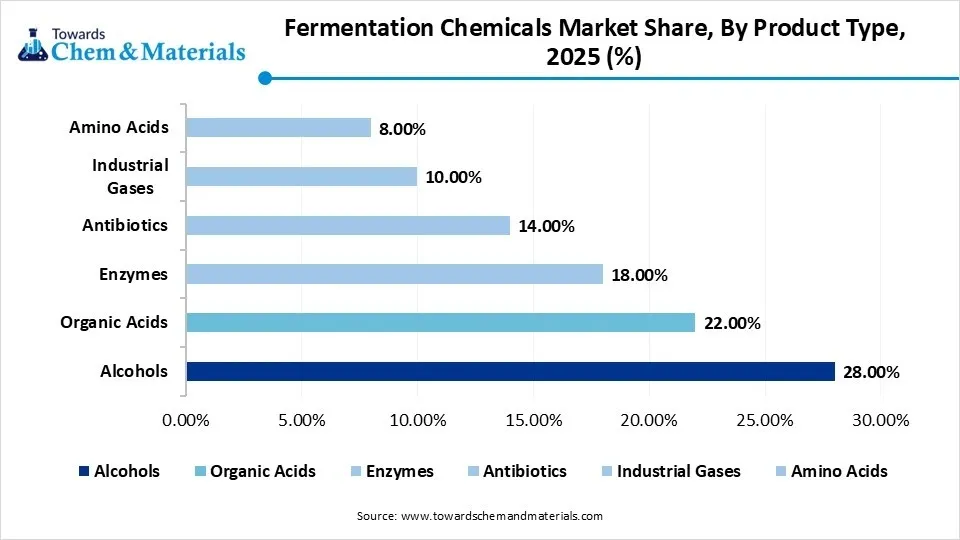
The antibiotics segment held the fourth largest share in the market of 14% in 2025. The growth of the segment can be driven by increasing product demand from the healthcare industry, coupled with the growth of the generic drug manufacturing across the globe. Pharmaceutical production depends heavily on fermentation-derived antibiotics.
Fermentation Chemicals Market Share, By Product Type, 2025 (%)
| By Product Type | Revenue Share, 2025 (%) |
| Alcohols | 28.00% |
| Organic Acids | 22.00% |
| Enzymes | 18.00% |
| Antibiotics | 14.00% |
| Industrial Gases | 10.00% |
| Amino Acids | 8.00% |
Raw Material Insights
The Sugar-Based Feedstock Segment Dominated The Market With 34% Share In 2025
The sugar-based feedstock segment dominated the market with 34% share in 2025. The dominance of the segment is owing to the abundant availability of sugarcane and high yield efficiency, coupled with the robust bioethanol production across the globe, which increases the utilization of ethanol as a raw material in different applications.
The lignocellulosic biomass segment held a 20% market share in 2025 and is expected to grow at the fastest CAGR of 8.4% over the forecast period. The growth of the segment can be attributed to the ongoing technological innovations to improve conversion efficiency and the growing adoption of biofuels. Sustainable feedstock also reduces the overall carbon footprint.
The starch-based feedstock segment held the second-largest share in the market of 28% in 2025. The dominance of the segment can be linked to the strong presence of established supply chains to ensure stability. The corn and wheat provide cost-effective fermentation inputs necessary for large-scale industrial usage. The other segment held the fourth largest share in the market of 18% in 2025. The dominance of the segment is due to growing industrial waste usage and the ongoing implementation of circular economy principles to improve product utilization. Molasses and waste streams offer low-cost alternatives.
Fermentation Chemicals Market Share, By Raw Material, 2025 (%)
| By Raw Material | Revenue Share, 2025 (%) |
| Sugar-based Feedstock | 34.00% |
| Starch-based Feedstock | 28.00% |
| Lignocellulosic Biomass | 20.00% |
| Others | 18.00% |
Process Type Insights
The Batch Fermentation Segment Dominated The Market With 42% Share In 2025
The batch fermentation segment dominated the market with 42% share in 2025. The dominance of the segment can be credited to its extensive adoption in the pharmaceutical and food industries, along with the lower contamination risks associated with it. Flexible production supports diverse product manufacturing.The fed-batch fermentation segment held the second largest share of 36% in 2025 and is expected to grow at the fastest CAGR of 7.6% during the forecast period. The growth of the segment can be attributed to the rising industrial-scale applications and its good control over nutrient supply. Also, improved yield and productivity enhanced its overall adoption.
The continues fermentation segment held the third largest share in the market of 22% in 2025. The dominance of the segment can be attributed to its fewer downtimes to improve operational efficiency, coupled with the rapid output, which supports large-scale production. It is Suitable for biofuel and chemical manufacturing.
Fermentation Chemicals Market Share, By Process Type, 2025 (%)
| By Process Type | Revenue Share, 2025 (%) |
| Batch Fermentation | 42.00% |
| Fed-batch Fermentation | 36.00% |
| Continuous Fermentation | 22.00% |
Application Insights
The Food & Beverages Segment Dominated The Market With 30% Share In 2025
The food & beverages segment dominated the market with 30% share in 2025. The dominance of the segment can be linked to the increasing drug production globally, along with the expansion of the beverage industry. Moreover, functional foods drive ingredient demand further.
The industrial application segment held the 20% market share in 2025 and is expected to grow at the fastest CAGR of 8.2% over the projected period. The growth of the segment can be credited to the expansion of industrial biotechnology and the growing demand for bioplastics and biofuels. Sustainability regulations will drive its adoption soon.The pharmaceutical segment held the second-largest share in the market of 22% in 2025. The growth of the segment can be attributed to the increasing drug manufacturing to fuel fermentation demand, along with the innovations in biopharmaceuticals. Vaccine and antibiotic manufacturing are also witnessing robust market growth.
The animal feed segment held the fourth-largest market share of 16% in 2025. The growth of the segment is due to increasing meat consumption in emerging economies and improvements in feed efficiency. Amino acid supplementation improves livestock productivity.
Fermentation Chemicals Market Share, By Application, 2025 (%)
| By Application | Revenue Share, 2025 (%) |
| Food & Beverages | 30.00% |
| Pharmaceuticals | 22.00% |
| Industrial Applications | 20.00% |
| Animal Feed | 16.00% |
| Personal Care | 12.00% |
- Food & beverages lead the fermentation chemicals market with a 30.00% share in 2025, driven by high demand for fermented ingredients, preservatives, and flavor enhancers. The segment benefits from rising consumption of processed and functional food products globally.
- Pharmaceuticals account for 22.00% of the market share in 2025, supported by the extensive use of fermentation in producing antibiotics, vaccines, and therapeutic proteins. Continuous advancements in biotechnology are further strengthening this segment.
- Industrial applications hold a 20.00% share of the fermentation chemicals market, as these chemicals are widely used in producing enzymes, organic acids, and bio-based materials. The shift toward sustainable industrial processes is a key growth driver for this segment.
- Animal feed represents 16.00% of the market share in 2025, with fermentation chemicals used to enhance nutritional value and improve gut health in livestock. Increasing demand for high-quality animal protein is supporting the growth of this segment.
- Personal care captures 12.00% of the fermentation chemicals market, driven by their use in cosmetics and skincare products for natural and bioactive ingredients. The growing preference for organic and clean-label products is boosting demand in this segment.
By End User
The fermentation chemicals market, segmented by end user, is led by the food industry, accounting for approximately 29% share, making it the dominant segment due to extensive use of fermentation chemicals in food processing, preservation, flavor enhancement, and clean-label product development. This aligns with industry data showing food & beverages as the largest consumer, typically contributing around 30–40% of total demand globally . The pharmaceutical industry, with about 24% share, represents the fastest-growing segment, driven by rising demand for antibiotics, enzymes, and bio-based active ingredients produced through fermentation processes, supported by strong expansion in global healthcare and biotechnology sectors .
The chemical industry holds a significant but comparatively moderate share, as fermentation chemicals are increasingly used as bio-based feedstocks and intermediates in sustainable chemical production. Meanwhile, the agriculture industry is witnessing steady growth due to rising adoption in biofertilizers, soil conditioners, and animal feed additives. The energy industry, though smaller in share, is gaining momentum with increasing use of fermentation-derived biofuels such as ethanol, making it an emerging growth area within the market.
Fermentation Chemicals Market Share, By End User, 2025 (%)
| By End User | Revenue Share, 2025 (%) |
| Food Industry | 29.00% |
| Pharmaceutical Industry | 24.00% |
| Chemical Industry | 18.00% |
| Agriculture Industry | 15.00% |
| Energy Industry | 14.00% |
- The food industry holds the largest share of the fermentation chemicals market, accounting for 29.00% in 2025. This dominance is driven by the growing demand for processed foods, preservatives, and fermentation-based ingredients in the global food sector.
- The pharmaceutical industry contributes 24.00% of the market share in 2025, supported by the increasing use of fermentation processes in drug production, including antibiotics and biologics. The sector continues to expand due to rising healthcare needs and innovation in biopharmaceuticals.
- The chemical industry captures 18.00% of the fermentation chemicals market, as fermentation plays a key role in producing organic acids, enzymes, and industrial chemicals. This segment benefits from the shift toward sustainable and bio-based chemical production methods.
- The agriculture industry accounts for 15.00% of the market share in 2025, driven by the use of fermentation chemicals in biofertilizers, pesticides, and soil enhancement solutions. Increasing focus on sustainable farming practices is further boosting demand in this segment.
- The energy industry holds 14.00% of the fermentation chemicals market, primarily due to the production of biofuels such as ethanol through fermentation processes. Growing emphasis on renewable energy sources is supporting the steady growth of this segment.
Regional Insights
How did Asia Pacific Dominate the Fermentation Chemicals Market in 2025?
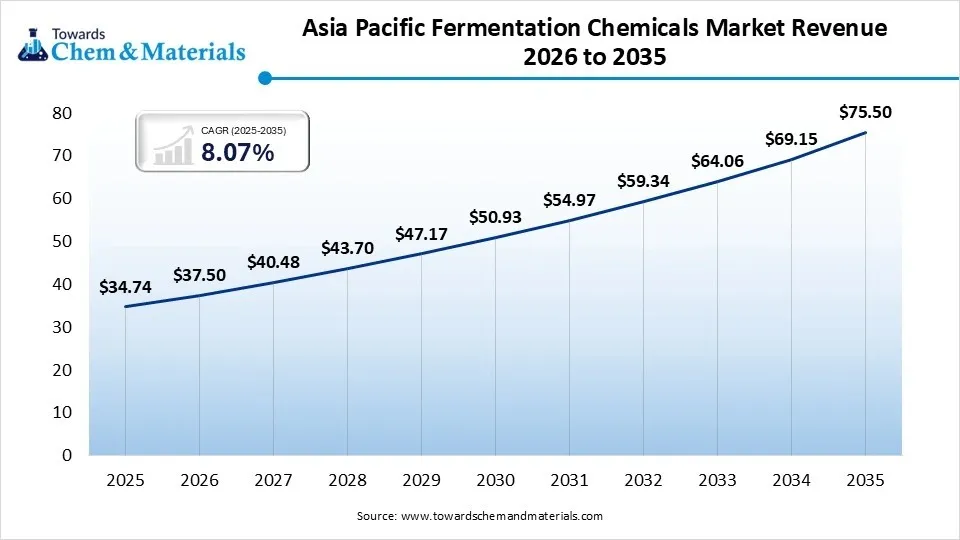
The Asia Pacific fermentation chemicals market size was valued at USD 34.74 billion in 2025 and is expected to be worth around USD 75.50 billion by 2035, exhibiting at a compound annual growth rate (CAGR) of 8.07% over the forecast period from 2026 to 2035. Asia Pacific dominated the market with 44% share in 2025 during the forecast period. The dominance and growth of the region can be attributed to the increasing demand for processed foods, rapid urbanization, and effective environmental policies in emerging economies. In addition, the region also has extensive access to essential agricultural raw materials like maize, sugarcane, rice, and cassava, leading to further market growth.
China Fermentation Chemicals Market Trends
In the Asia Pacific, China dominated the market owing to the growing need for bio-based products along with the robust government support for green technology. Also, the rapid shift towards renewable energy propels the demand for industrial ethanol manufactured through fermentation, which makes the country a leading manufacturer of fermentation products.
North America held the second-largest share of 20% in 2025, and is expected to experience notable growth in the market with 7.20% CAGR during the forecast period. The growth of the region can be credited to its advanced biotechnology industry, high biofuel production, and strong R&D investments in manufacturing processes. Furthermore, growing consumption of natural food ingredients and fermented foods boosts the demand for acids and enzymes.
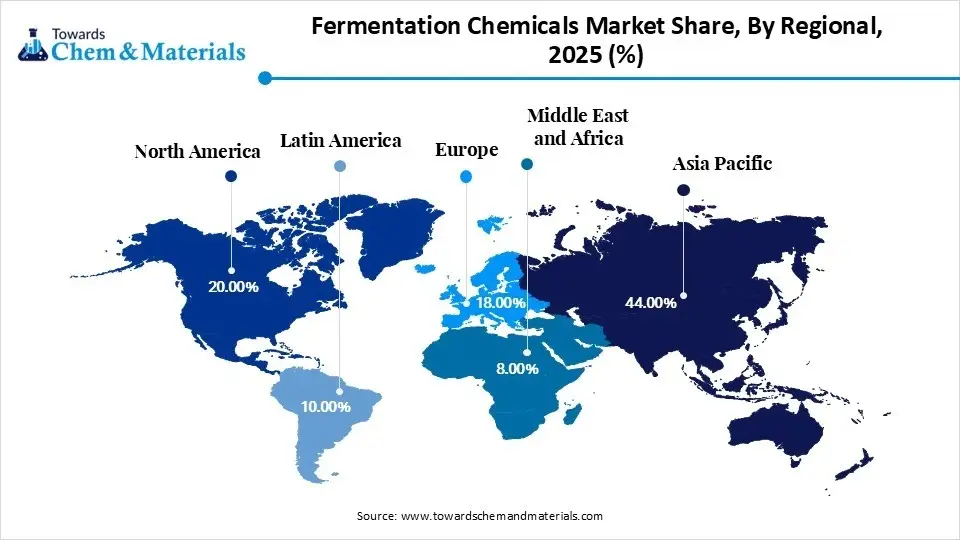
Fermentation Chemicals Market Share, By Regional, 2025 (%)
| Regional | Revenue Share, 2025 (%) |
| Asia-Pacific | 44.00% |
| North America | 20.00% |
| Europe | 18.00% |
| Latin America | 10.00% |
| Middle East & Africa | 8.00% |
- Asia-Pacific dominates the fermentation chemicals market with a 44.00% share in 2025, driven by strong industrial growth, expanding food processing sectors, and rising pharmaceutical production. Countries like China and India play a key role due to their large manufacturing base and increasing demand.
- North America holds a 20.00% share of the market in 2025, supported by advanced biotechnology infrastructure and high demand from the pharmaceutical and food industries. The region also benefits from strong research and development activities in fermentation technologies.
- Europe accounts for 18.00% of the market share in 2025, driven by strict environmental regulations and a growing shift toward bio-based and sustainable chemicals. The presence of established chemical and pharmaceutical industries further strengthens regional growth.
- Latin America represents 10.00% of the fermentation chemicals market, with growth fueled by expanding agricultural activities and increasing use of bio-based products. The region is also witnessing rising investments in food processing and industrial applications.
- Middle East & Africa capture 8.00% of the market share in 2025, supported by gradual industrial development and increasing adoption of fermentation-based solutions. Growth is further driven by rising demand in food, agriculture, and energy sectors.
U.S. Fermentation Chemicals Market Trends
The growth of the market in the country is due to growing demand for biofuels, ongoing innovations in biotechnology, and rising consumer awareness regarding the health benefits of these products. Moreover, government incentives such as the U.S. Renewable Fuel Standard (RFS) focus on the production of biofuel, directly driving demand for fermentation-derived ethanol and butanol.
Recent Developments
In February 2026, Glatt and PreferCo launched the PreferCo-Glatt Centre of Excellence for Bioprocess Scale-Up in Hyderabad's Genome Valley to accelerate India's $300 billion bioeconomy. The facility offers 1,500-litre capacity, combining AI-enabled process support and automation to accelerate lab-to-industrial production for biotechnology, food, and chemical industries.(Source: www.indianchemicalnews.com)
Fermentation Chemicals Market Companies
- BASF SE: BASF SE is a key player in the growing fermentation chemicals market, focusing on producing bio-based ingredients through biotechnology to drive sustainability. The company is actively investing in new fermentation capacity, such as a high double-digit million-euro project in Ludwigshafen for crop protection products.
- Novonesis: Novonesis, formed by the merger of Novozymes and Chr. Hansen is a global leader in biosolutions, dominating the industrial enzymes and microbial fermentation market.
- DuPont Danisco
- DSM
- Amano Enzymes USA Co., Ltd.
- AB Enzymes
- Chr. Hansen Holding A/S
- Dow
- Evonik Industries AG
- Cargill, Incorporated
- Ajinomoto Co., Inc.
- ADM
Segments Covered in the Report
By Product Type
- Alcohols
- Ethanol
- Butanol
- Organic Acids
- Lactic Acid
- Citric Acid
- Acetic Acid
- Enzymes
- Proteases
- Amylases
- Lipases
- Antibiotics
- Penicillin
- Streptomycin
- Industrial Gases
- Carbon Dioxide
- Hydrogen
- Amino Acids
- Lysine
- Glutamic Acid
- Methionine
By Raw Material
- Sugar-based Feedstock
- Sugarcane
- Sugar Beet
- Starch-based Feedstock
- Corn
- Wheat
- Lignocellulosic Biomass
- Agricultural Residues
- Wood Biomass
- Others
- Molasses
- Industrial Waste Streams
By Process Type
- Batch Fermentation
- Fed-batch Fermentation
- Continuous Fermentation
By Application
- Food & Beverages
- Dairy Products
- Alcoholic Beverages
- Processed Foods
- Pharmaceuticals
- Antibiotics Production
- Vaccine Production
- Industrial Applications
- Biofuels
- Bioplastics
- Animal Feed
- Personal Care
By End-Use Industry
- Food Industry
- Pharmaceutical Industry
- Chemical Industry
- Agriculture Industry
- Energy Industry
By Regions
- North America
- U.S.
- Canada
- Mexico
- Europe
- Germany
- UK
- France
- Italy
- Spain
- Asia Pacific
- China
- India
- Japan
- South Korea
- Latin America
- Brazil
- Argentina
- Middle East & Africa
- Saudi Arabia
- South Africa
FAQ's
Question 1 : What are the key growth drivers, trends, and market dynamics shaping the fermentation chemicals market globally?
Answer : The market is driven by increasing adoption of industrial biotechnology, rising demand for bio-based and clean-label products, growing biofuel consumption, and advancements in microbial engineering and precision fermentation.
Question 2 : What is the current market size, projected CAGR, and long-term investment potential of the fermentation chemicals market through 2035?
Answer : The market was valued at USD 78.95 billion in 2025 and is projected to reach USD 169.66 billion by 2035, growing at a CAGR of 7.95%, indicating strong investment potential.
Question 3 : How are technological advancements and regulatory frameworks influencing innovation and adoption in the fermentation chemicals market?
Answer : Innovations in bioprocessing, AI-driven fermentation, and renewable feedstock utilization, along with supportive regulations for bio-based products and food safety, are accelerating market adoption and efficiency.
Question 4 : Who are the leading companies operating in the fermentation chemicals market, and what strategies are they adopting to stay competitive?
Answer : Key players such as BASF, Novonesis, DuPont Danisco, DSM, and Cargill are focusing on capacity expansion, R&D investments, and sustainable bio-based product development to strengthen their market position.
Meet the Team

Saurabh Bidwai
Principal Consultant
Saurabh Bidwai, a B.Tech Chemical Engineering graduate with 4+ years of experience, specializes in specialty chemicals, commodity chemicals, and engineered materials, offering valuable insights into market trends and emerging opportunities.

Aditi Shivarkar
Reviewed By
Aditi Shivarkar, with 14+ years in Chemical and Materials market research, specializes in Chemical and Materials. She ensures accurate, actionable insights, driving Towards Chemicals And Materials Analytics and Consulting excellence in industry trends and sustainability.