
Green Coatings Market Size | Companies Analysis 2026- 2035
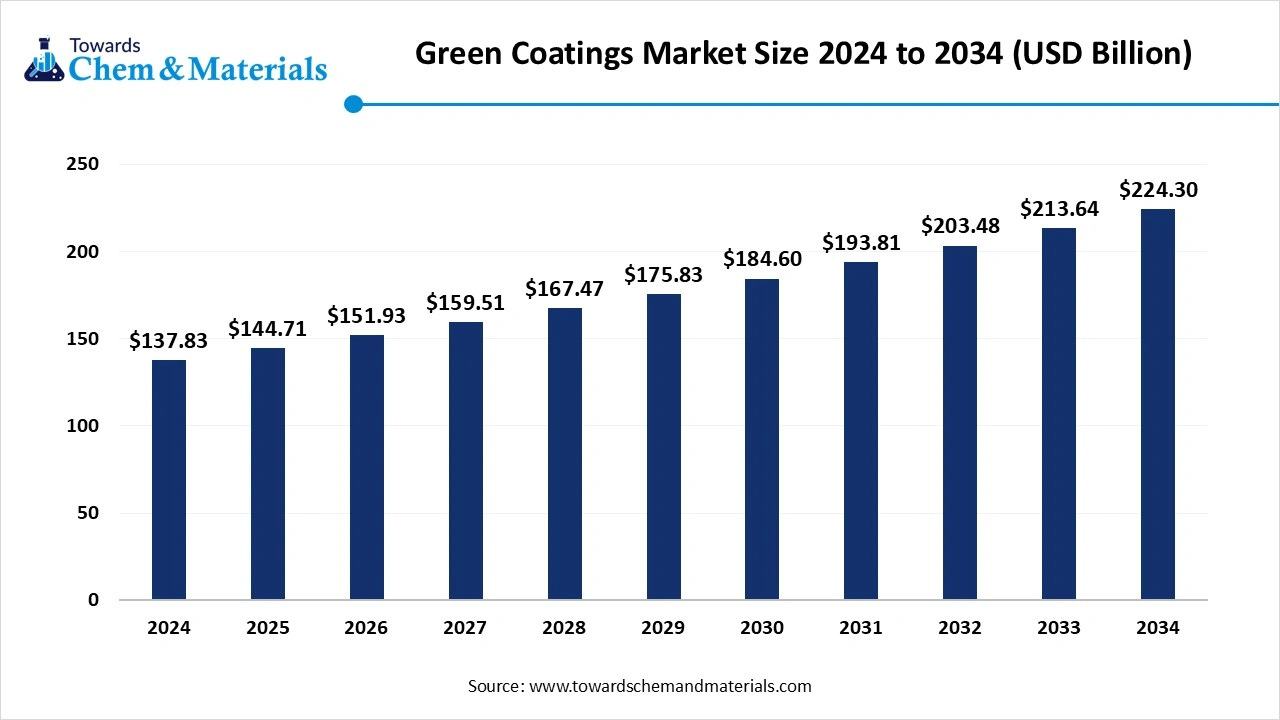
The global green coatings market is projected to grow from USD 145.19 billion in 2025 to USD 236.27 billion by 2035, growing at a compound annual growth rate (CAGR) of 4.99% over the forecast period from 2026 to 2035. Key players in the green coatings market are Akzo Nobel N.V., Arkema Group, Asian Paints Limited, Axalta Coating Systems Ltd., BASF SE, Berger Paints India Limited, Jotun A/S, Lifetime Green Coatings, PPG Industries,The Sherwin-Williams Company
Content
What is the Current Green Coatings Market Size and Share?
The global green coatings market size is calculated at USD 145.19 billion in 2025 and is predicted to increase from USD 152.43 billion in 2026 and is projected to reach around USD 236.27 billion by 2035, The market is expanding at a CAGR of 4.99% between 2025 and 2035. Asia Pacific dominated the green coatings market with a market share of 45.88% the global market in 2025. The ongoing government incentives for sustainable practices are the key factor driving market growth. Also, a surge in awareness of the harmful effects of volatile organic compounds (VOCs), coupled with the advancements in green coating technologies, can fuel market growth further.
Key Takeaways
- Asia Pacific dominated the global green coatings market with the largest revenue share of 45.88% in 2025.
- The China green coatings market is projected to grow during the forecast period.
- By type, the waterborne segment accounted for the largest revenue share of 75.11% in 2025.
- By application, the architectural coatings segment dominated with the largest revenue share of 40.11% in 2025.
What are Green Coatings?
The market refers to the global sector for sustainable and eco-friendly paints and surface treatments which are designed to reduce the harm to human health and the environment altogether. These coatings achieve this by minimizing or cutting volatile organic compounds (VOCs), using sustainable production processes, and using
Green Coatings Market Trends
- There is an increasing demand for coatings made from bio-based and renewable sources such as plant oils, which is the latest trend in the market. This demand aligns well with long-term circular economy goals.
- Rapid advancements are enhancing the performance of green coatings. The innovations in powder coating and radiation cure technologies for faster curing and reduced waste, along with the development of high-performance coatings for resistance and durability.
- The automotive sector is adopting green coatings to minimize emissions and adhere to regulations, and other sectors are adopting them to minimize overall maintenance costs and comply with sustainability rules, leading to further market growth.
- Major companies in the market are collaborating to strengthen supply chains and investing in R&D to create sustainable and advanced formulations, which in turn results in the rapid expansion of the market.
Report Scope
| Report Attribute | Details |
| Market Size Value in 2026 | USD 152.43 Billion |
| Revenue Forecast in 2035 | USD 236.27 Billion |
| Growth Rate | CAGR 4.99% |
| Forecast Period | 2026 - 2035 |
| Base Year | 2025 |
| Dominant Region | Asia Pacific |
| Fastest Growing Region | Europe |
| Segments covered | By Type, By Application, By Region |
| Key companies profiled | Asian Paints Limited, Axalta Coating Systems Ltd., BASF SE, Hempel A/S, Jotun, Kansai Paint Co. Ltd., Koninklijke DSM N.V., Nippon Paint Holdings Co. Ltd., PPG Industries Inc, The Sherwin-Williams Company |
How Cutting Edge Technologies are revolutionizing the Green Coatings Market?
Advanced technologies are transforming the market by propelling the development of sustainable, high-performance, and multi-functional solutions, fuelled by advances in bio-based materials, nanotechnology, and digitalization (AI, Machine Learning, IoT). Moreover, these innovations collectively offer durable, cost-effective, and environmentally sound solutions that meet sustainability standards.
Trade Analysis of Green Coatings Market: Import & Export Statistics:
- In 2024, U.S. paint and coatings exports to Canada and Mexico totaled nearly $2 billion, with Canada receiving $1.24 billion and Mexico $722 million. These two countries remain the largest export markets for the industry, collectively accounting for about 70% of all U.S. paint and coatings exports in that year, a consistent trend for these USMCA partners.
- Despite a 1.6% decrease in production volume, which totaled 35.34 million tons, China's coatings industry saw positive financial growth in 2024, with revenue increasing by 1.56% to over 408.9 billion yuan and profit surging 9.34% to 26.29 billion yuan.
- Between October 2023 and September 2024, India's imports of Coating Chemicals increased by 21% to 138 shipments, which were sourced from 17 foreign exporters and sent to 16 Indian buyers.
Green Coatings Market Value Chain Analysis
- Feedstock Procurement : It involves the strategic sourcing of bio-based, renewable, or recycled raw materials to replace conventional petrochemical-based ingredients. The raw materials for green coatings are derived from various waste and biological sources.
- Major Players: PPG Industries Inc., The Sherwin-Williams Company.
- Chemical Synthesis and Processing : It refers to he development and implementation of sustainable methods to create coatings such as solvents,bio-based, and additives. It also involves using sustainable raw materials and employing energy-efficient processes to produce coatings with less environmental impact.
- Major Players: Axalta Coating Systems, InKemia Green Chemicals
- Packaging and Labelling : This stage focuses on applying sustainable coatings and using eco-friendly packaging and labeling materials for various products, especially in the food and beverage industry. This area is boosted by stringent regulations and growing consumer demand for reusable materials.
- Major Players: Amcor PLC, Mondi Group
- Regulatory Compliance and Safety Monitoring: It involves adhering to stringent laws and standards that govern the safe and sustainable manufacturing, use, and disposal of coatings. Major players such as PPG Industries and Sherwin-Williams heavily invest in R&D to comply with these regulations.
- Major Players: Axalta Coating Systems, PPG Industries.
Green Coatings Market 's Regulatory Landscape: Global Regulations
| Country/Region | Key Regulations |
| European Union | Paints Directive (2004/42/EC): Sets maximum VOC content limits for different categories of paints, varnishes, and vehicle refinishing products to reduce air pollution and the formation of ground-level ozone. |
| United States | The EPA sets national VOC emission standards for architectural coatings to address potential contributions to ozone pollution. |
| Asia-Pacific | Countries in the APAC region are implementing regulations concerning VOC emissions and other environmental standards for coatings, especially for industrial and architectural applications. |
Segmental Insights
Type Insights
How Much Share Did the Waterborne Segment Held in 2024?
The waterborne segment dominated the market with the largest share of 75.11% in 2025. The dominance of the segment can be attributed to the growing environmental awareness and strict government regulations that focus on minimizing volatile organic compounds (VOCs). Growing coating demand from the construction and automotive sectors can impact positive market growth soon.
The UV-cured segment is expected to grow at the fastest CAGR over the forecast period. The growth of the segment can be credited to the growing demand for high-performance and fast-curing coatings in various sectors. UV-cured powder coatings are extensively used for applications such as medium-density fiberboard (MDF).
The growth of the powder segment can be fulfilled by growing consumer and industrial demand for long-lasting and sustainable finishes. Powder coatings offer excellent corrosion resistance and scratch resistance, which extends the product's life in various sectors.
The high-solid segment held a significant market share in 2025. The growth of the segment can be boosted by the growing demand for high-performance coatings with reduced solvent content, coupled with the rapid advancements in coating formulations, making them easier to use.
Application Insights
Which Application Type Segment Dominated the Green Coatings Market in 2024?
The architectural coatings segment dominated the market share of 40.11% in 2025. The dominance of the segment can be linked to the growing public and industry awareness of the ecological impact of conventional coatings, which leads to a preference for sustainable products.
The automotive coatings segment is expected to grow at the fastest CAGR over the forecast period. The growth of the segment can be driven by rapid R&D, which leads to new high-performance green coatings. Automakers require their suppliers to adopt greener practices and materials to fulfil market demands.
The industrial coatings segment held a major market share in 2025. The growth of the segment can be boosted by the harmful environmental impacts of conventional coating, which is creating a robust market push towards more green alternatives. Market players are increasingly adopting green coatings to lower their carbon footprint.
The growth of the wood coatings segment can be propelled by the growing popularity of sustainable building practices and an emphasis on the circular economy initiatives. Expansion in the construction and furniture sectors is fuelling demand for wood coatings soon.
Regional Insights
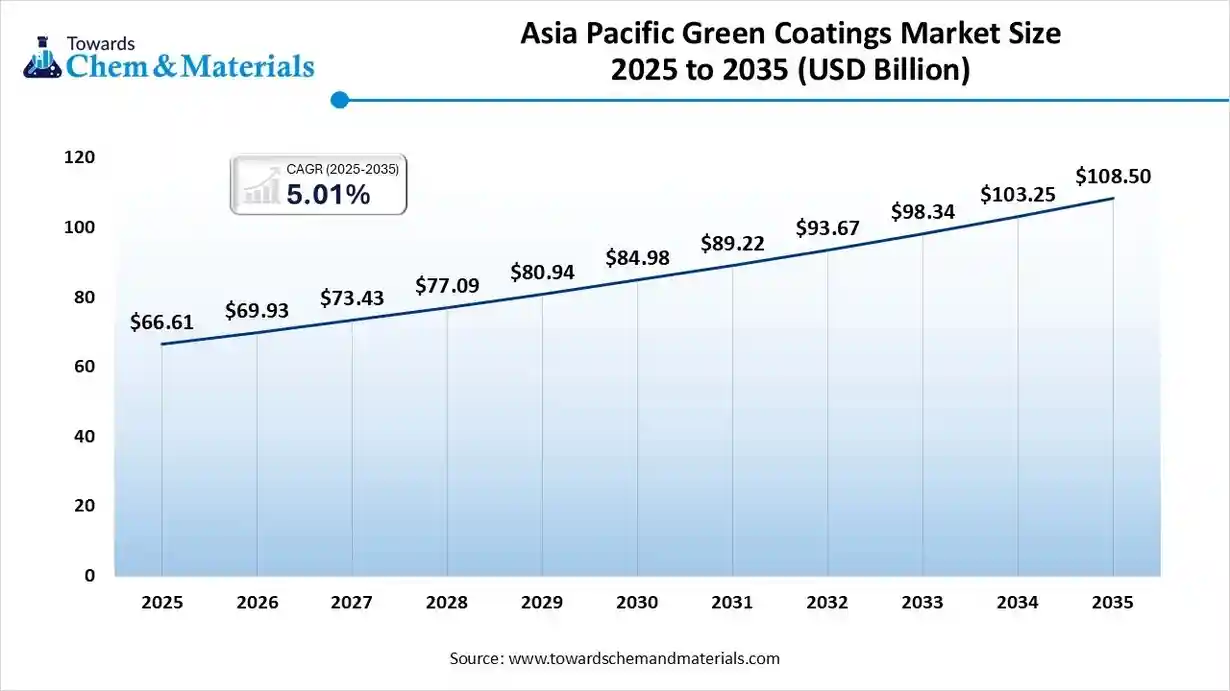
The Asia Pacific green coatings market size was valued at USD 66.61 billion in 2025 and is expected to reach USD 108.50 billion by 2035, growing at a CAGR of 5.01% from 2026 to 2035.
Asia Pacific is expected to grow at the fastest CAGR over the forecast period. The growth of the region can be credited to the growing product demand from the automotive and construction sectors, along with the stricter VOC emission policies implemented by the government. In addition, the ongoing expansion of infrastructure and industries in emerging economies is likely to impact positive market growth soon.
In the Asia Pacific, China dominated the market due to rapid urbanization and industrialization, along with a surge in population and rising disposable income. China's government has also implemented stringent environmental policies to reduce air pollution, which mandate the use of low-VOC products.
Europe dominated the market with the largest share in 2025. The dominance of the region can be attributed to the increasing consumer demand for sustainable products, coupled with the technological innovations in formulations such as powder and waterborne coatings. In addition, major sectors in the region are committing to using greener coatings to minimize their carbon footprint, leading to market expansion soon.
Germany Green Coatings Market Trends
In Europe, Germany led the market owing to its increasing emphasis on energy-efficient buildings and infrastructure, along with he growing need for coatings that enhance insulation and reduce overall energy consumption. Germany's robust automotive sector is committed to minimizing its carbon footprint through the use of green coatings.
North America is expected to grow at a notable CAGR over the projected period. The growth of the region can be driven by growing emphasis on energy-efficient buildings, as some coatings can enhance insulation and reduce energy consumption. Major market players in the region are investing heavily in R&D to create advanced green coating formulations.

U.S. Green Coatings Market Trends
The growth of the market in the U.S. can be boosted by increasing preference from both businesses and consumers for products that are environmentally responsible and sustainable. An emphasis on creating more high-performance buildings is driving demand for coatings that can enhance insulation.
The growth of the market in Latin America can be linked to the increasing consciousness about sustainability, which leads to a robust demand for eco-friendly products such as green coatings, especially from the middle class in developing countries. Furthermore, advancements in coating formulations are creating more effective green coatings.
Brazil Green Coatings Market Trends
In Latin America, Brazil held a significant market share in 2024. The growth of the country can be propelled by an evolving consumer landscape and a surge in the middle-class population in the major cities. Brazil is a major automobile producer in Latin America, and the automotive industry is a key application area for green coatings.
The green coatings market in the Middle East and South Africa is gaining momentum, driven by booming infrastructure projects, urbanisation, and stricter environmental regulations. In Gulf countries like Saudi Arabia and the UAE, large-scale construction and industrial investments are fueling demand for low-VOC, water-based, and powder coatings. n South Africa, sustainable growth in the automotive, mining and protective coatings sectors is pushing the adoption of eco friendly formulations. Regulatory incentives, green building certifications and a shift to bio based raw materials are key enablers of this growth.
Saudi Arabia Green Coatings Market Trends
In Saudi Arabia, the market is gaining traction due to strict VOC regulations imposed by the Saudi Standards, Metrology and Quality Organization (SASO). Mega-projects under Vision 2030 like NEOM and the Red Sea Project are fueling demand for eco-friendly architectural coatings. In industrial sectors, there’s a shift toward water-based and low-VOC formulations, especially in oil & gas infrastructure.
Recent Developments
- In February 2025, Cosmo Specialty Chemicals introduces OGR barrier coatings for sustainable packaging. These coatings offer excellent oil and grease resistance for food packaging applications. Its unique formulation gives versatile coating application compatibility.(Source: www.indianchemicalnews.com)
- In October 2025, Chemetall, a leading provider of advanced surface treatment solutions, launched the first chromium-free and fluoride-free passivation technology for copper foils, Gardolene D.(Source: www.basf.com)
Top Green Coatings Market Companies
Akzo Nobel N.V.
Corporate Information
- Name: Akzo Nobel N.V. (stylized AkzoNobel)
- Headquarters: Amsterdam, Netherlands.
- Industry: Paints, Coatings, Specialty Chemicals.
- Key People: CEO - Greg Poux Guillaume; Chair of Supervisory Board - Ben Noteboom.
- 2023 Financials (approx): Revenue ~ €10.67 bn; Operating Income ~ €1.03 bn; ~35,200 employees.
History and Background
- Origins: AkzoNobel emerged from the 1994 merger of Akzo N.V. (Dutch) and Nobel Industries AB (Swedish).
Predecessor Companies:
- Akzo N.V.: Its roots go back to Vereinigte Glanzstoff-Fabriken (founded 1899), which eventually merged into AKU.
- Nobel Industries: Formed via the merger of chemical companies including KemaNobel and Bofors.
Key Developments and Strategic Initiatives
Sustainability / Green Strategy:
- Set a target to reduce carbon emissions (Scope 1 & 2) by 50% by 2030 (vs 2018 baseline), approved by the Science Based Targets initiative (SBTi).
- Created a Sustainable Innovation Team in Industrial Coatings (packaging, coil, extrusion, wood finishes) to drive eco-innovation.
- Uses a Sustainable Product Portfolio Assessment (SPPA) methodology (developed with WBCSD) to evaluate the environmental impact of its entire product range.
- Solvent recovery initiatives: At its Hilden site, a solvent-recovery unit reduces waste significantly (~1,872 tons of waste annually) and supports circular economy.
Restructuring:
- Plans to cut ~2,200 jobs and close at least five sites by 2025 to realize cost savings.
- Target to achieve ~€300 million in annualized gross savings by 2027 from restructuring.
Mergers & Acquisitions
Acquisition of ICI (Imperial Chemical Industries)
- In 2008, AkzoNobel acquired ICI (UK) for ~£8.1 billion (≈ €11.6 billion) to strengthen its position in paints, coatings, and specialty chemicals.
- This deal brought in well-known brands (e.g., Dulux) and expanded Akzo’s global footprint.
- As part of this acquisition, AkzoNobel later divested certain non-core ICI businesses to satisfy regulatory commitments: for instance, it sold the adhesives and electronic materials business to Henkel.
Partnerships & Collaborations
- Sustainability Partnerships: Works with the World Business Council for Sustainable Development (WBCSD) to run its SPPA methodology.
- Internal Collaboration: The newly formed Sustainable Innovation Team works across business segments and regions, aligning sustainability goals with customer needs.
- Product Launches / Innovations : AkzoNobel is investing in low VOC and PFAS-free coatings (part of its sustainability roadmap). Through its coil and extrusion coatings business, it focuses on durable, long-lasting surfaces that reduce maintenance (hence environmental impact).
Key Technology Focus Areas
- Sustainability / Eco-innovation: low-VOC, PFAS reduction, solvent recovery.
- Durability / Long-Life Coatings: via weathering programs.
- Circular Economy: solvent recovery, more efficient materials.
- Advanced R&D: large-scale global R&D network, patent development, cross-technology integration (industrial + decorative + powder).
R&D Organisation & Investment
- ~91 R&D facilities globally (post Axalta merger).
- ~4,200 researchers, scientists, and engineers (combined) in the merged entity.
- ~3,200 patents (granted + pending) between the two companies.
- Combined R&D budget: ~$400 million annually (post-merger).
SWOT Analysis
Strengths
- Strong global brand portfolio (Dulux, Interpon, etc.).
- Deep R&D capabilities and innovation pipeline (large research network).
- Clear sustainability ambition: strong targets, dedicated innovation team.
- Synergies from merger with Axalta (cost, technology, footprint).
Weaknesses
- Exposure to raw material cost volatility.
- High leverage / debt risk; financial flexibility could be constrained.
- Complexity of operations (wide geographic spread) which can lead to coordination issues.
- Restructuring costs weighing on short-term profitability.
Opportunities
- Growing demand for sustainable coatings (regulated by environmental norms).
- Expansion via combined portfolio with Axalta to gain market share in industrial and automotive sectors.
- Potential to scale eco-innovation across global markets using its R&D strength.
- Strategic divestments (like the India business) to rationalize core focus and redeploy capital.
Threats
- Intense competition from other big coatings players (e.g. PPG, Sherwin Williams).
- Macroeconomic slowdown affecting end markets like construction and automotive.
- Regulatory risk: stricter environmental regulations and compliance costs (VOCs, PFAS).
- Supply chain disruptions or raw material scarcity.
Recent News & Strategic Updates
- Merger with Axalta (Nov 2025): All-stock merger creating a $25 bn coatings company.
- Restructuring: Plan to cut ~2,200 jobs and shut at least five sites by 2025 for cost savings.
- Sale of India Unit: JSW Paints to acquire ~74.76% stake in Akzo Nobel India for ~€1.4 bn.
- Acquisition of Powder Coatings & R&D in India: AkzoNobel N.V. offered to buy its Indian subsidiary’s powder coatings business + R&D centre.
Other Companies in the Market
- Asian Paints Limited: Asian Paints Limited is a key player in the green coatings market, focusing on sustainable product development through its "Green Assure" framework and certifications like the U.S. Green Seal. The company has a history of proactive environmental initiatives.
- Axalta Coating Systems Ltd.: Axalta Coating Systems Ltd. contributes by offering low-VOC, eco-friendly industrial and automotive coatings, emphasizing sustainability and regulatory-compliant green solutions.
- BASF SE
- Hempel A/S
- Jotun
- Kansai Paint Co. Ltd.
- Koninklijke DSM N.V.
- Nippon Paint Holdings Co. Ltd.
- PPG Industries Inc
- The Sherwin-Williams Company
Segments Covered in the Report
By Type
- Waterborne
- Powder
- High Solid
- UV Cured
By Application
- Architectural Coatings
- Industrial Coatings
- Automotive Coatings
- Wood Coatings
- Packaging Coatings
- Others
By Region
- North America
- U.S.
- Canada
- Mexico
- Europe
- Germany
- UK
- France
- Italy
- Spain
- Asia Pacific
- China
- India
- Japan
- South Korea
- Latin America
- Brazil
- Argentina
- Middle East & Africa
- Saudi Arabia
- South Africa
FAQ's
Question 1 : What is the global green coatings market size ?
Answer : The global green coatings market is projected to grow from USD 145.19 billion in 2025 to USD 236.27 billion by 2035, growing at a compound annual growth rate (CAGR) of 4.99% over the forecast period from 2026 to 2035.
Question 2 : Which regions will lead and grow the fastest in the green coatings market?
Answer : Asia Pacific: Dominates in 2024 due to strong construction, automotive, and manufacturing growth, plus cost-efficient production. Europe: Expected fastest CAGR thanks to strict environmental policies, advanced manufacturing, and high adoption of sustainable building practices. North America: Significant growth from green building codes and industrial sustainability mandates.
Question 3 : What are the key growth drivers for the green coatings industry?
Answer : Stricter environmental regulations pushing for low-VOC and sustainable formulations. Green building boom: LEED and eco-friendly construction standards. Automotive industry shift to low-emission, eco-friendly coatings. Consumer demand for sustainable products in packaging and consumer goods. Technological improvements enhancing durability, drying times, and performance.
Question 4 : What are the main challenges to scaling green coatings adoption?
Answer : Higher production costs due to premium bio-based raw materials. Pricing pressure from conventional, lower-cost coatings. Region-specific regulatory compliance complexity for chemical use. Small-scale manufacturer constraints in R&D investment and production efficiency.
Question 5 : What role do regulations and policies play in driving market growth?
Answer : Global VOC reduction mandates are forcing a shift away from solvent-based coatings. Green building certifications (LEED, BREEAM) are increasing demand for eco-friendly architectural coatings. Government incentives and penalties are accelerating sustainable manufacturing adoption. Circular economy goals encourage recyclable and low-toxicity materials.
Question 6 : Who are the top companies in the global green coatings market?
Answer : Akzo Nobel N.V., Arkema Group, Asian Paints Limited, Axalta Coating Systems Ltd., BASF SE, Berger Paints India Limited, Jotun A/S, Lifetime Green Coatings, PPG Industries,The Sherwin-Williams Company
Meet the Team

Saurabh Bidwai
Principal Consultant
Saurabh Bidwai, a B.Tech Chemical Engineering graduate with 4+ years of experience, specializes in specialty chemicals, commodity chemicals, and engineered materials, offering valuable insights into market trends and emerging opportunities.

Aditi Shivarkar
Reviewed By
Aditi Shivarkar, with 14+ years in Chemical and Materials market research, specializes in Chemical and Materials. She ensures accurate, actionable insights, driving Towards Chemicals And Materials Analytics and Consulting excellence in industry trends and sustainability.