
Rubber-Repair Adhesives Market Size, Share, Growth, Report 2026 to 2035
The global rubber-repair adhesives market is segmented based on Process, Application, and End Use Industry. By Process, the market is classified into Hot Bonding and Cold Bonding. By Application, it is categorized into Conveyor Belt, Tanks & Vessels, Pipes & Fittings, and Others. By End Use Industry, the segmentation includes Mining & Quarrying, Cement & Aggregates, Steel, and Others-Global Industry Analysis, Size, Trends, Leading Companies, Regional Outlook, and Forecast 2026 to 2035
Content
What is Rubber-Repair Adhesives Market Size and Share?
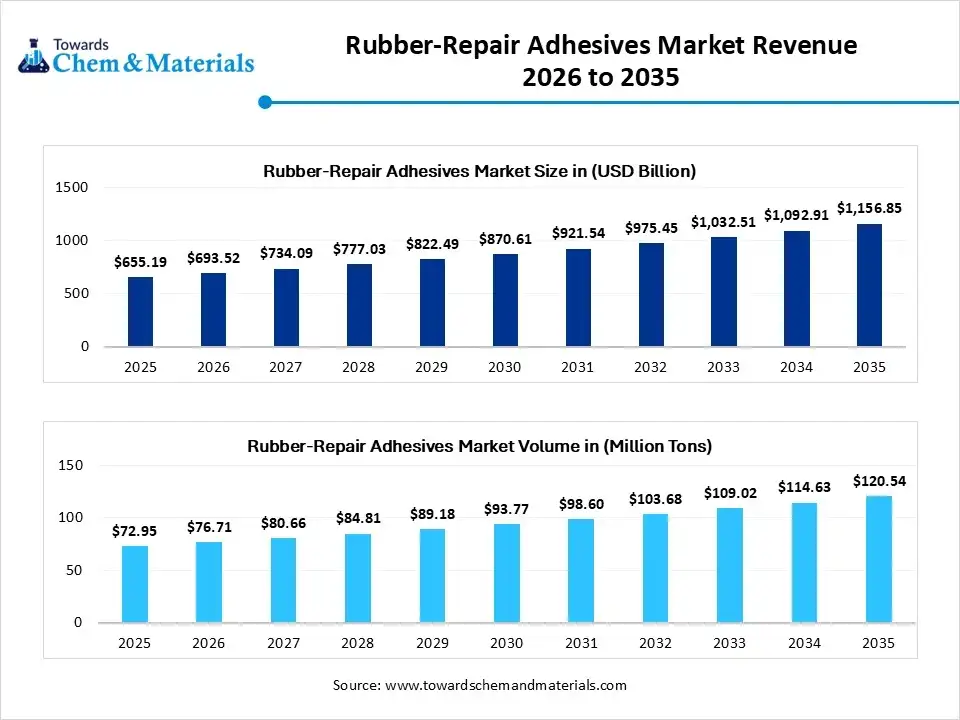
The rubber-repair adhesives market size was valued at USD 655.19 million in 2025, is estimated to reach USD 693.52 million in 2026, and is projected to reach USD 1,156.85 million by 2035, exhibiting a compound annual growth rate (CAGR) of 5.85% over the forecast period from 2026 to 2035.Asia Pacific dominated the rubber-repair adhesives market with the largest revenue share of 41% in 2025 and is expected to grow at the fastest CAGR of 5.98% during the forecast period. In terms of volume, the rubber-repair adhesives market is projected to grow from 72.95 thousand tons in 2025 to 120.54 thousand tons by 2035. growing at a CAGR of 5.15% from 2026 to 2035.The market is supported by industrial maintenance activities, expansion of conveyor-intensive operations, demand for corrosion protection, and infrastructure modernization.
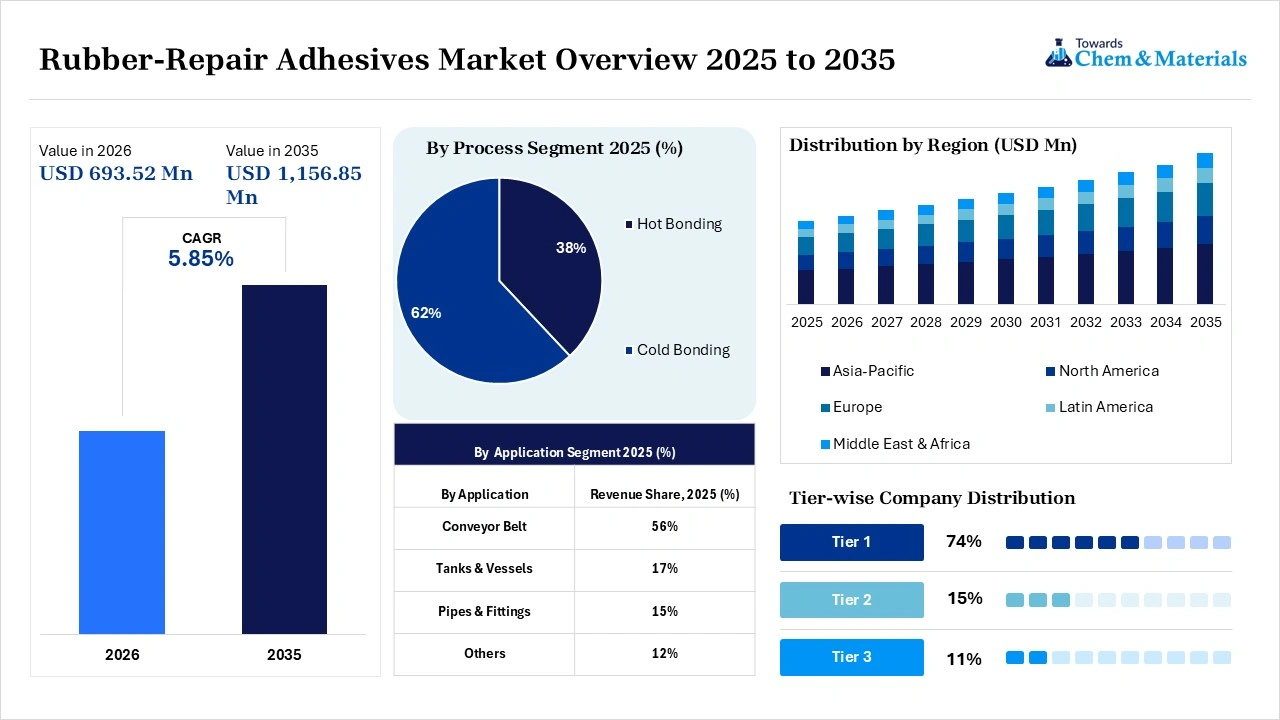
The rubber-repair adhesives market development is driven by industrial requirements to optimize efficiency and extend machinery life. These markets include multi-part polyurethanes, epoxy-elastomer hybrids, and cold-vulcanizing agents, which offer high elongation and peel strength. The rubber-repair adhesives are high-performance, cost-effective, & reliable options, supported by advanced chemical engineering. Innovation focuses on rapid-curing formulations, enabling quick, on-site repair and removing traditional vulcanizing equipment in industrial infrastructure. Diversified sectors such as mining, power generation, and chemical synthesis use rubber components.
Market Highlights
- By region, Asia Pacific dominated the rubber-repair adhesives market by holding 41% share in 2025 and is expected to grow at the fastest with a CAGR of 7.10% during the forecast period, driven by expanding material handling infrastructure and investment for large-scale mineral processing.
- By region, Europe held the 22% market share in 2025 and expects notable growth in the market with 4.90% CAGR during the forecast period, accelerated by strict maintenance practices and industrial modernization.
- By process, the cold bonding segment dominated the market with the largest share of 62% in 2025 due to the requirement for a low-capital repair solution and increasing demand in field maintenance.
- By process, the hot bonding segment held 38% market share in 2025 and is expected to grow at the fastest CAGR of 6.40% over the forecast period, driven by its use in heavy-duty industrial repair and mining operations.
- By application, the conveyor belt segment dominated the market with the largest share of 56% in 2025 due to expanding material handling and mining operations through preventive maintenance programs.
- By application, the pipes & fittings segment held 15% market share in 2025 and is expected to grow at the fastest CAGR of 6.30% over the forecast period, driven by slurry transportation systems and continuous growth in pipeline networks.
- By end use industry, the mining & quarrying segment dominated the market with the largest share of 61% in 2025 due to the expansion of mineral extraction and demand for conveyor belt repair and abrasion requirements.
- By end use industry, the cement & aggregates segment held 18% market share in 2025 and is expected to grow at the fastest CAGR of 6.50% over the forecast period due to adhesives consumption in capacity expansion and war-intensive solutions.
Quick Stats at a Glance
- Market Estimated Size (2025): USD 655.19 Million | CAGR (2026–2035): 5.85%
- Market Projected Size (2035): USD 1,156.85 Million
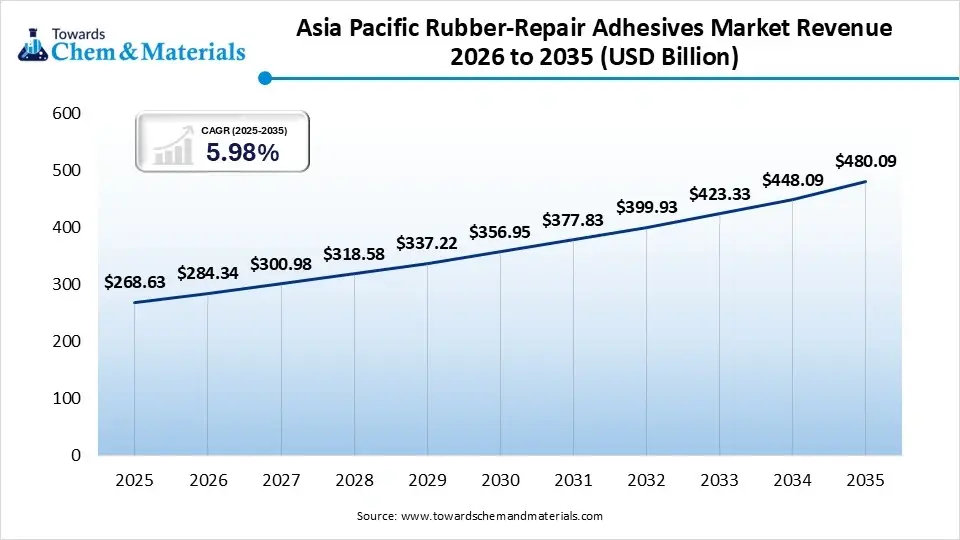
- Asia Pacific: largest Market Revenue Share of 41% in 2025|USD 268.63 Million
- Market Estimated Volume (2025): 72.95 Thousand Tons | Volume CAGR (2026–2035): 5.15%
- Market Projected Volume (2035): 72.95 Thousand Tons
- Market Pricing (2025):
- Average Manufacturing Price: USD 5.90/kg
- Average Selling Price: USD 8.60/kg
- Pricing CAGR (2026–2035): 2.45%
Global demand for environmental and safety regulations drives R&D investment that focuses on re-engineering adhesive formulas. The emerging trend towards developing sustainable adhesives and innovating green formulations for contaminated or damp surfaces is gaining momentum, especially with end-users seeking sustainability. Adhesive manufacturers tend to implement solvent-based chemistries with volatile organic compounds for speedy evaporation and superior uniformity. Stricter global emissions standards are fueling manufacturers toward low-VOC, solvent-free, eco-friendly solutions.
The rubber-repair adhesive maintains strong rubber-to-metal bonding and precision in surface preparation essential for automotive, construction, aerospace, and marine industries. Adhesives are required to reliably join rubber components to metals, polymers, and nanocomposites, and to provide specialized cleaning and texturing. The industrial transition towards automating high-performance elastomeric sealants is accelerating, and the integration of technology into adhesive manufacturing is boosting market growth. Additionally, the strategic partnership with manufacturers, degreasers, and promoters is ensured by a long-term contract, driving the market expansion.
Market Trends
- Move Towards Cold-Vulcanizing Machinery: Leading mining and chemical companies are increasingly adopting high-performance cold-vulcanizing agents, which form molecular bonds at ambient temperature and significantly reduce repair times.
- Focus on Rubber-to-Metal Bonding: The demand for advanced adhesive systems in growing applications includes electric vehicles, aerospace, and defense industries to maintain rubber-to-metal bonds to meet low-VOC emission targets.
Report Scope
| Report Attributes | Details |
| Market Size in 2026 | USD 693.52 Million/ 76.71 Thousand Tons |
| Expected Market Size in 2035 | USD 1,156.85 Million/ 120.54 Thousand Tons |
| Growth Rate | CAGR of 3.68% |
| Base Year of Estimaton | 2025 |
| Forecast Period | 2025-2035 |
| Dominant Region | Asia Pacific |
| Segments Covered | By Process, By Application, By End Use Industry, By Region |
| Key Companies Profile | Cyberbond LLC, 3M Company, Dow Inc., Henkel AG & Co. KGaA, H.B. Fuller Company, Arkema S.A., Huntsman Corporation, ITW Devcon, LORD Corporation, Mapei Corporation, Master Bond Inc., Permabond Engineering Adhesives Ltd., Pidilite Industries Ltd., Royal Adhesives & Sealants, Sika AG |
Key Technological Shifts and AI in the Rubber-Repair Adhesives Market
The technological development in this market combines advanced polymer synthesis and smart techniques to ensure optimized operational efficiency. Chemical formulators utilize machine learning for molecular simulations of rubber and the development of eco-friendly, low-VOC adhesives to meet national air standards. AI integration enhances bonding performance. Automated plants deploy AI sensors to package rubber-repair compounds into pre-measured containers, avoiding manual errors and bond letdowns.
This digital transformation enables field engineers to capture real-time examinations of damaged adhesives by testing tear depth, temperature, and moisture. AI algorithms provide step-by-step protocols for surface research and curing analysis. The technological transition empower the manufacturing of rubber-repair adhesives with real-time data. This approach converts industrial maintenance towards precise, data-driven science, extending asset life and lowering production downtime.
Supply Chain Analysis of the Rubber-Repair Adhesives Market
- Feedstock Procurement and Advanced Chemical Synthesis: The stage of advanced chemical synthesis through the conversion of raw fossil fuels and organic compounds into high-purity output. The stage involves liquid epoxy resin, prepolymers, cyanoacrylate monomer, cross-linkers, and low-VOC solvent.
- Key Players: BASF SE, Covestro AG, Dow Chemical Company, Huntsman Corporation, Arkema and Evonik Industries
- Formulation and Quality Control: The stage of raw chemical synthesis transformation into an application-ready rubber repair system supported by specialized adhesive manufacturers. The stage focuses on higher peer strength and abrasion resistance by removing errors during surface preparation. Stage involves blending, chemical compounding, and batch testing.
- Key Players: Sika AG, 3M Company, Henke AG & Co. KGaA, Fourthane, Pidilite Industries, and Belzon International Ltd.
- B2B Distribution and End-User Operation: The stage of on-site technical execution, providing rubber-to-metal bonding through a specialized B2B logistics framework. The end-user industry and technical service contractor are adopting specialized rubber-repair adhesives.
- Key Players: Marine Logistics Hub, Rio Tinto, B2b distributors, and material handling companies.
Regulatory Framework: Rubber-Repair Adhesives Market
| Region | Key Regulation | Regulatory Focus |
| North America | EPA Standard, Clean Air Act, OSHA, and SCAQMD Rule | Mandated for executing chemical-heavy surface preparation and rubber-to-metal bonding. imposes caps on VOC emission |
| Europe | REACH Regulation, SVHCs, and ECHA | Focus on the phase out of toxic solvents and isocyanates in polyurethanes. Regulation driving the shift towards eco-friendly adhesive and low-VOC formulation. |
| Asia Pacific | China's GB Standards (Adhesive VOC Limits), Japan's CSCL, ISHA, and India's BIS standards | Mandates low-VOC limit and restriction for hazardous solvents to manufacture a cleaner two-part adhesive system and sustainable co-vulcanizing agents. |
| Latin America | Brazil's ANVISA / IBAMA and Mexico's NOM | Standards for environmental contamination, waste disposal, and toxic chemical formation |
| Middle East & Africa | GSO Standards and South Africa's SANS Standards | Focus on lowering hazardous emissions and high-friction in oil refineries and minimizing operations. Standards for chemical safety |
Rubber-Repair Adhesives Market Dynamics
Driver
Reducing Operational Downtime Through Speedy Asset Repair
The main driver of the rubber-repair adhesives market is the need to reduce operational downtime and cost by offering superior longevity in heavy-duty applications. This demand is influencing the adoption of cold-vulcanizing agents and polyurethane repair compounds enables quick, permanent, on-site repairs, especially in the mining conveyor belts, slurry pump liners, or industrial pipes. The manufacturers' focus on lowering operation downtime also enables the innovation for advancing repair and maintenance services by balancing profitability and increasing output.
Restraints
Stringent Application and Safety Protocols
The primary restraint in the rubber-repair adhesives market is the strict need for continuous surface preparation and the high risk of faulty installation. Industrial-grade two-part adhesives and cold-vulcanizing agents are chemically affected by field contaminants and operational environments, which require well-trained operators and certified technicians, thus limiting market growth.
Opportunity
Next-Generation Green Formulations and Regulatory Compliance
The rubber-repair adhesives market is increasingly inclining towards low-VOC, eco-friendly adhesives to meet environmental and safety requirements. The regulatory support for the adhesive composition enables the emergence of technology in the high-volume production lines. This creates important opportunities for manufacturers to innovate solvent-free, sustainable adhesives that ensure peel strength and durability. Suppliers, distributors, and manufacturers are increasingly investing in green formulations in the production of rubber-repair adhesives to achieve zero emissions and safety targets.
Segmental Insights
Process Insights
The cold bonding segment dominated the market with the largest share of 62% in 2025.This process uses ambient-temperature chemical adhesives to create robust crosslinked polymers. This process offers a cost-effective alternative to hot vulcanization, ideal for emergency maintenance and quick field repairs. The low-VOC requirement is boosting on-site use of the cold-curing process by integrating automation to reduce downtime, cut labor costs, and extend equipment life, thereby achieving environmental compliance in repair infrastructure.
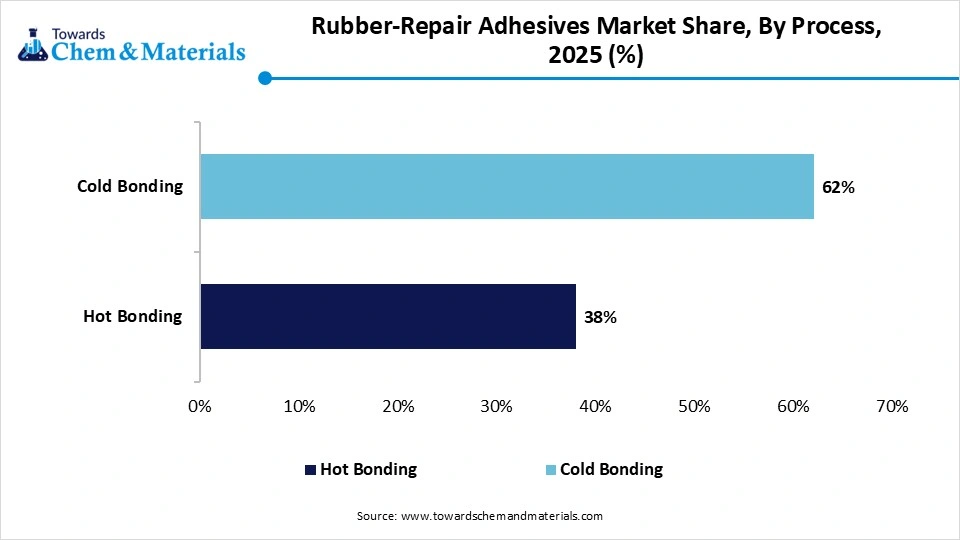
The hot bonding segment held the 38% market share in 2025 and is expected to grow at the fastest CAGR of 6.40% over the forecast period. Defined by its strong vulcanized and thermally activated bonds. By injecting uncured rubber and thermosetting adhesives, this process is used to repair conveyor systems, heavy-duty rubber lining, and high-temperature applications. Additionally, the advancement in hot bonding with specialized equipment enables higher resistance to friction and joint failure.
Rubber-Repair Adhesives Market Share, By Process, 2025 (%)
| By Process | Revenue Share, 2025 (%) |
| Hot Bonding | 38% |
| Cold Bonding | 62% |
Application Insights
The conveyor belt segment dominated the market with the largest share of 56% in 2025. This application fuels demand for high-performance rubber-repair adhesives, liquid elastomers, and vulcanized components to extend belt life and optimize flow. These solutions are suitable for processing plants, mining operations, and material handling systems by ensuring flexible, smooth seals and targeted maintenance.
The tanks & vessels segment held the 17% market share in 2025, because rubber-repair adhesives are essential for maintaining industrial & chemical storage tanks, lining maintenance, and corrosion protection containers. This application, like slurry-handling systems and process vessels, uses specialized bonding compounds and repair pastes to patch damage and provide chemical resistance, preventing leaks and environmental risks.
The pipes & fittings segment held the 15% market share in 2025 and is expected to grow at the fastest CAGR of 6.30% over the forecast period, supported by the maintenance of industrial fittings and slurry pipes. Pipelines and fittings carrying abrasive slurries and wastewater depend on vulcanized rubber linings and metal boding. The operators utilized high-viscosity bonding agents and fast-curing elastomers in mineral processing pipelines and wear protection components with high shear strength and optimized fluid flow.
Rubber-Repair Adhesives Market Share, By Application, 2025 (%)
| By Application | Revenue Share, 2025 (%) |
| Conveyor Belt | 56% |
| Tanks & Vessels | 17% |
| Pipes & Fittings | 15% |
| Others | 12% |
The others segment held 12% market share in 2025. The shift towards infrastructure modernization is driving the need for refurbishment of rubber-lined equipment, pulleys & rollers, and specialty maintenance applications. The high-volume manufacturing network focuses on industrial maintenance programs to increase the frequency of repairs.
End Use Industry Insights
The mining & quarrying segment dominated the market with the largest share of 61% in 2025. The rubber-repair adhesives are vital for surface and underground mining by applying chemical bonding agents at extraction sites with conveyor systems. The mining & quarrying industry demands cold-vulcanizing adhesives, polyurethane adhesives, and elastomers that cure quickly and have superior shear strength. The rubber-repair adhesives are efficient for pipeline operation, especially in mineral extraction and metal mining.
The cement & aggregates segment held the 18% market share in 2025 and is expected to grow at the fastest CAGR of 6.50% over the forecast period. The expansion was boosted by construction activities aligning with cement facilities and aggregates operations using conveyor systems. The rubber-repair adhesives are crucial for screening and crushing plants in construction infrastructure. Maintenance operators use cold-vulcanizing solutions, chemical adhesives, and raw material handling solutions to repair damage and cure quickly for clinker processing.
The steel segment held the 11% market share in 2025. Steel mills and integrated steel plants use conveyor systems, hoppers, and blast-furnace solutions for material handling systems. The steel industry is characterized by high thermal and mechanical stresses, where rubber-repair adhesives enable wear protection and slag processing. Maintenance services include high-temperature vulcanizing epoxy resin for on-site repairs, providing continuous flow.
The others segment held 10% market share in 2025. The expansion is supported by manufacturers' prominence in maintenance outsourcing and the extension of equipment lifespans through repair infrastructure. The power generation, pulp & paper, and chemical processing industries are adopting rubber-repair adhesives as a reliability improvement asset.
Rubber-Repair Adhesives Market Share, By End Use Industry, 2025 (%)
| By End Use Industry | Revenue Share, 2025 (%) |
| Mining & Quarrying | 61% |
| Cement & Aggregates | 18% |
| Steel | 11% |
| Others | 10% |
By Grade
The solar grade segment dominated the rubber-repair adhesives market with the largest revenue share of 87% in 2025. The segment's leadership is attributed to the extensive use of specialized adhesive formulations in solar manufacturing and maintenance applications, where durable bonding performance and resistance to environmental stress are essential. Solar-grade rubber-repair adhesives are widely utilized for repairing and maintaining rubber components exposed to harsh outdoor conditions, including sealing systems, protective coverings, and equipment used in photovoltaic production facilities. The growing deployment of solar energy projects and increasing investments in renewable energy infrastructure further supported the segment’s substantial market share.
The electronics grade segment accounted for 13% of the market share in 2025 and is anticipated to witness steady growth during the forecast period. Demand is driven by the expanding electronics manufacturing sector, where rubber-repair adhesives are used for repairing rubber-based insulation materials, seals, gaskets, and protective components in electronic devices and equipment. These adhesives offer strong adhesion, flexibility, and resistance to temperature fluctuations, making them suitable for precision applications. The continued advancement of consumer electronics, semiconductor production, and industrial electronic systems is expected to contribute to the segment’s growth in the coming years.
Rubber-Repair Adhesives Market Share, By Grade, 2025 (%)
| By Grade | Revenue Share, 2025 (%) |
| Solar Grade | 87% |
| Electronics Grade | 13% |
Regional Insights
How Did the Asia Pacific Dominated the Rubber-Repair Adhesives Market in 2025?
The Asia Pacific rubber-repair adhesives market size was estimated at USD 268.63 million in 2025 and is projected to reach USD 480.09 million by 2035, growing at a CAGR of 5.98% from 2026 to 2035.Asia Pacific dominated the market by holding 41% share in 2025 and is expected to grow at the fastest with a CAGR of 7.10% during the forecast period, Because of the emerging countries' demand for continuous operation of large-scale handling assets, the development is influenced by infrastructure expansion and the formation of extraction hubs. Asia Pacific chemical companies invest in a local production hub to ensure quick access to cold-vulcanizing agents and liquid elastomers. Regulatory pressure has reshaped the region by restricting VOCs and banning benzene-heavy formulations, which facilitates the development of high-tack, eco-friendly two-part adhesives.
China
- China's ecosystem is mainly regulated to control VOC levels and manage environmental safety in domestic manufacturing, industrial adhesives, and infrastructure sectors.
- The government supports the adoption of solvent-free, two-part adhesive systems and supports the domestic scaling of bulk material handling.
India
- Major mining corridors and chemical processing plants are increasingly utilizing high-strength synthetic rubber contact adhesives with on-site curing infrastructure that fueling the domestic growth.
- In India, regulatory compliance boosts the use of rubber-repair adhesives for quick and long-term asset maintenance.
The Europe rubber-repair adhesives market size was estimated at USD 144.14 million in 2025 and is projected to reach USD 260.29 million by 2035, growing at a CAGR of 6.09% from 2026 to 2035.Europe held the 22% market share in 2025. The region focuses on green chemistry, promoting eco-friendly adhesives and certified, low-VOC formulations derived from bio-resins through momentous investments. Europe's corporate efforts toward the circular economy and resource efficiency bolster the demand for sustainable adhesives. Domestic operators lead in advanced rubber repairs for component rebuilding to lower supply chain emissions. The regional supplier integrated automated networks and AI-driven tools for pre-surface preparation, removing chlorinated content and toxic isocyanate.
Germany
- The country maintained continuous dominance in the rubber repair adhesives market by integrating a high-performance cold-vulcanizing agent and a robust conveyor belt splicing network through strategic acquisitions.
- Moreover, stringent domestic corporate policies combined with equipment maintenance efforts aim to achieve carbon neutrality and support circular economy targets.
France
- France focuses on innovation and progress through co-development alliances, especially in commercial aviation and high-speed railway infrastructure.
- Domestic manufacturers are increasingly interested in rubber-bonding materials and specialized PVDF formulations used in modern logistics modules to meet regulatory standards regarding monomer exposure.
The North America rubber-repair adhesives market size was estimated at USD 124.49 million in 2025 and is projected to reach USD 225.59 million by 2035, growing at a CAGR of 6.13% from 2026 to 2035.North America held the 19% market share in 2025. Leads in venture capital invest in startups developing smart adhesive matrices with superior elongation and peel strength. North America's strict VOC regulations facilitate the development of solvent-free primers & enclosed application systems for safety. A domestic R&D partnership between adhesive manufacturers and electric vehicle assembly lines is fulfilling green formulations for rubber-to-metal bonding.
United States
- The US domestic push towards low-VOC formulations and technological advancements to improve flexible rubber-to-metal bonding, mainly in automotive and aerospace manufacturing.
- Domestic producers are accepting silane-modified polymer formulations & upgrading adhesive infrastructure to align with clean air standards.
Canada
- Canada stands strong in development and field operations that demand high cure efficiency by maintaining a high VOC concentration limit in coatings and adhesives.
- The country is witnessing a growth in deep-pit oil sands extraction and large-scale material handling to achieve net-zero emission goals.
The Latin America rubber-repair adhesives market size was estimated at USD 65.52 million in 2025 and is projected to reach USD 121.47 million by 2035, growing at a CAGR of 6.37% from 2026 to 2035.Latin America held the 10% market share in 2025, emerging ecosystem defined by its mining and mineral processing operation especially in copper and lithium belts. The regulation focuses on managing chemical waste for storage and disposal to reduce environmental impact. The domestic players' investment is driving the expansion of quick-curing liquid rubbers. Latin America leads in distribution collaboration with global mining companies to test adhesives with micro-ceramic additives.
Brazil
- The domestic focus on lifecycle maintenance is projected in sectors like agricultural logistics hubs, deep-sea offshore oil plants, and sugar mills.
- Brazil's regulatory framework boosts the adoption of eco-friendly adhesives and high-strength rubber-to-metal bonding agents in large-scale manufacturing.
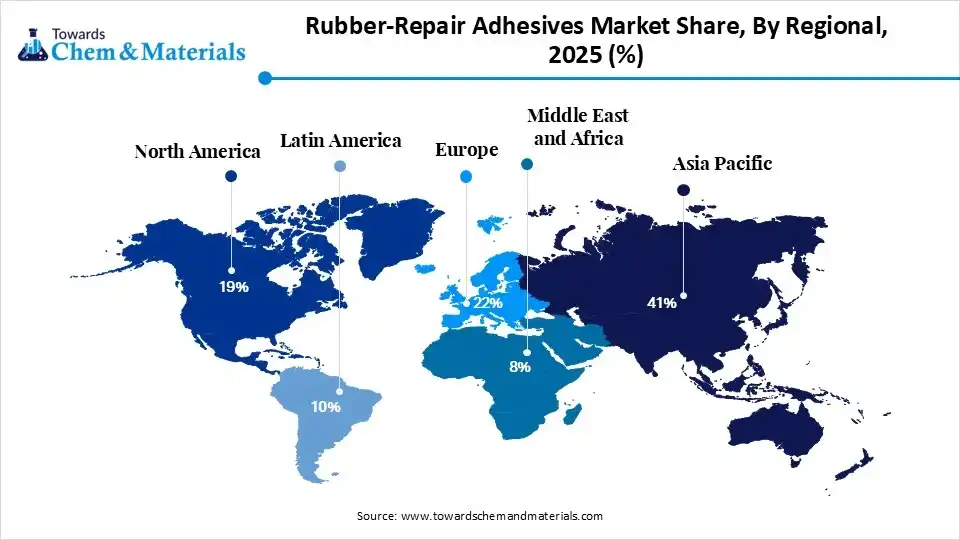
The Middle East & Africa rubber-repair adhesives market size was estimated at USD 65.52 million in 2025 and is projected to reach USD 121.47 million by 2035, growing at a CAGR of 6.37% from 2026 to 2035.The Middle East & Africa held the 8% market share in 2025. Driven by state-driven upgradation and petrochemical refining infrastructure. The region's demand for high-thermal-stability. MEA is defined by its dusty desert fields and by manufacturers' partnerships with institutions to train technicians in cleaning and compounding operations. Additionally, modernizing regulatory infrastructure to reduce pollutants and enhance chemical safety creates opportunities for innovation across MEA.
Saudi Arabia
- The substantial investments by domestic players accelerated the need for a specialized two-part adhesive system to prevent joint delamination.
- The government’s Gulf standardization organization is intensively modernizing regulations to restrict hazardous pollutants and support clean air standards in oil refining complexes, petrochemical processing, and sea desalination facilities.
Top Companies in the Rubber-Repair Adhesives Market
- Cyberbond LLC
- 3M Company
- Dow Inc.
- Henkel AG & Co. KGaA
- H.B. Fuller Company
- Arkema S.A.
- Huntsman Corporation
- ITW Devcon
- LORD Corporation
- Mapei Corporation
- Master Bond Inc.
- Permabond Engineering Adhesives Ltd.
- Pidilite Industries Ltd.
- Royal Adhesives & Sealants
- Sika AG
Rubber-Repair Adhesives Market Segments Covered
By Process
- Hot Bonding
- Vulcanized Hot Bonding
- Conveyor Belt Repair
- Heavy-Duty Rubber Lining Repair
- Thermally Activated Bonding
- Industrial Rubber Components
- High-Temperature Applications
- Vulcanized Hot Bonding
- Cold Bonding
- Solvent-Based Cold Bonding
- Field Repairs
- Emergency Maintenance
- Solvent-Free Cold bonding
- Environmentally Compliant Repairs
- Low-VOC Applications
- Solvent-Based Cold Bonding
By Application
- Conveyor Belt
- Mining Conveyor Belts
- Overland Conveyors
- Processing Plant Conveyors
- Industrial Conveyor Belts
- Manufacturing Facilities
- Material Handling Systems
- Mining Conveyor Belts
- Tanks & Vessels
- Chemical Storage Tanks
- Corrosion Protection Repairs
- Lining Maintenance
- Process Vessels
- Industrial Process Equipment
- Slurry Handling Systems
- Chemical Storage Tanks
- Pipes & Fittings
- Slurry Pipes
- Mining Pipelines
- Mineral Processing Pipelines
- Industrial Fittings
- Elbows & joints
- Wear Protection Components
- Slurry Pipes
- Others
- Chutes & Hoppers
- Pulleys & Rollers
- Rubber-Lined Equipment
- Specialty Maintenance Applications
By End Use Industry
- Mining & Quarrying
- Surface mining
- Coal Mining
- Metal Mining
- Underground Mining
- Hard Rock Mining
- Mineral Extraction
- Surface mining
- Cement & Aggregates
- Cement Plants
- Raw Material Handling
- Clinker Processing
- Aggregates Operations
- Crushing Plants
- Screening Facilities
- Cement Plants
- Steel
- Integrated Steel Plants
- Material Handling Systems
- Slag Processing Systems
- Mini Mills
- Conveyor Systems
- Wear Protection Applications
- Integrated Steel Plants
- Others
- Power Generation
- Chemical Processing
- Ports & Bulk Terminals
- Pulp & Paper
By Region
- North America
- U.S.
- Canada
- Mexico
- Europe
- UK
- Germany
- France
- Italy
- Spain
- Sweden
- Denmark
- Norway
- Asia Pacific
- Japan
- China
- India
- Australia
- South Korea
- Thailand
- Latin America
- Brazil
- Argentina
- The Middle East and Africa
- South Africa
- Saudi Arabia
- UAE
- Kuwait
FAQ's
Question 1 : What is the rubber-repair adhesives market size and share?
Answer : The global rubber-repair adhesives market size is estimated to reach USD 693.52 million in 2026 and is projected to hit USD 1,156.85 million by 2035. Geographically, the Asia Pacific region dominates the global industry with a leading 41% market share.
Question 2 : Who are the key players in the market?
Answer : The top key players driving the global rubber-repair adhesives market include 3M Company, Dow Inc, Henkel AG and Co KGaA, Sika AG, Arkema SA, Huntsman Corporation, HB Fuller Company, Cyberbond LLC, and Pidilite Industries Ltd.
Question 3 : Why is cold bonding more popular than hot bonding?
Answer : Cold bonding holds a dominant 62% market share because it does not require specialized heating equipment. It allows technicians to perform fast, on-site emergency repairs at ambient temperatures, which drastically cuts down on labor costs and operational downtime.
Question 4 : Which application segment drives the most adhesive consumption?
Answer : The conveyor belt segment is the largest application, commanding 56% of the market share in 2025. Preventing belt tears and performing regular maintenance in mining and material handling plants is vital to keep industrial production moving smoothly.
Question 5 : What are the main regulatory trends affecting this industry?
Answer : Global environmental agencies are enforcing strict limits on volatile organic compounds or VOCs. This clean air push is forcing adhesive manufacturers to move away from toxic, solvent-based formulas and invest heavily in eco-friendly, green, and solvent-free bonding alternatives.
Meet the Team
Towards Chemical & Materials
Saurabh Bidwai, a B.Tech Chemical Engineering graduate with 4+ years of experience, specializes in specialty chemicals, commodity chemicals, and engineered materials, offering valuable insights into market trends and emerging opportunities.

Aditi Shivarkar
Reviewed By
Aditi Shivarkar, with 14+ years in Chemical and Materials market research, specializes in Chemical and Materials. She ensures accurate, actionable insights, driving Towards Chemicals And Materials Analytics and Consulting excellence in industry trends and sustainability.